


What do a 200-year-old British chocolate company, a 112-year-old American cookie brand, a Swiss mountain-shaped chocolate bar, and a California energy bar founded by a couple in a garage all have in common? They are all part of the Mondelez International empire — the world’s largest dedicated snacking company and one of the most recognizable consumer goods corporations on the planet.
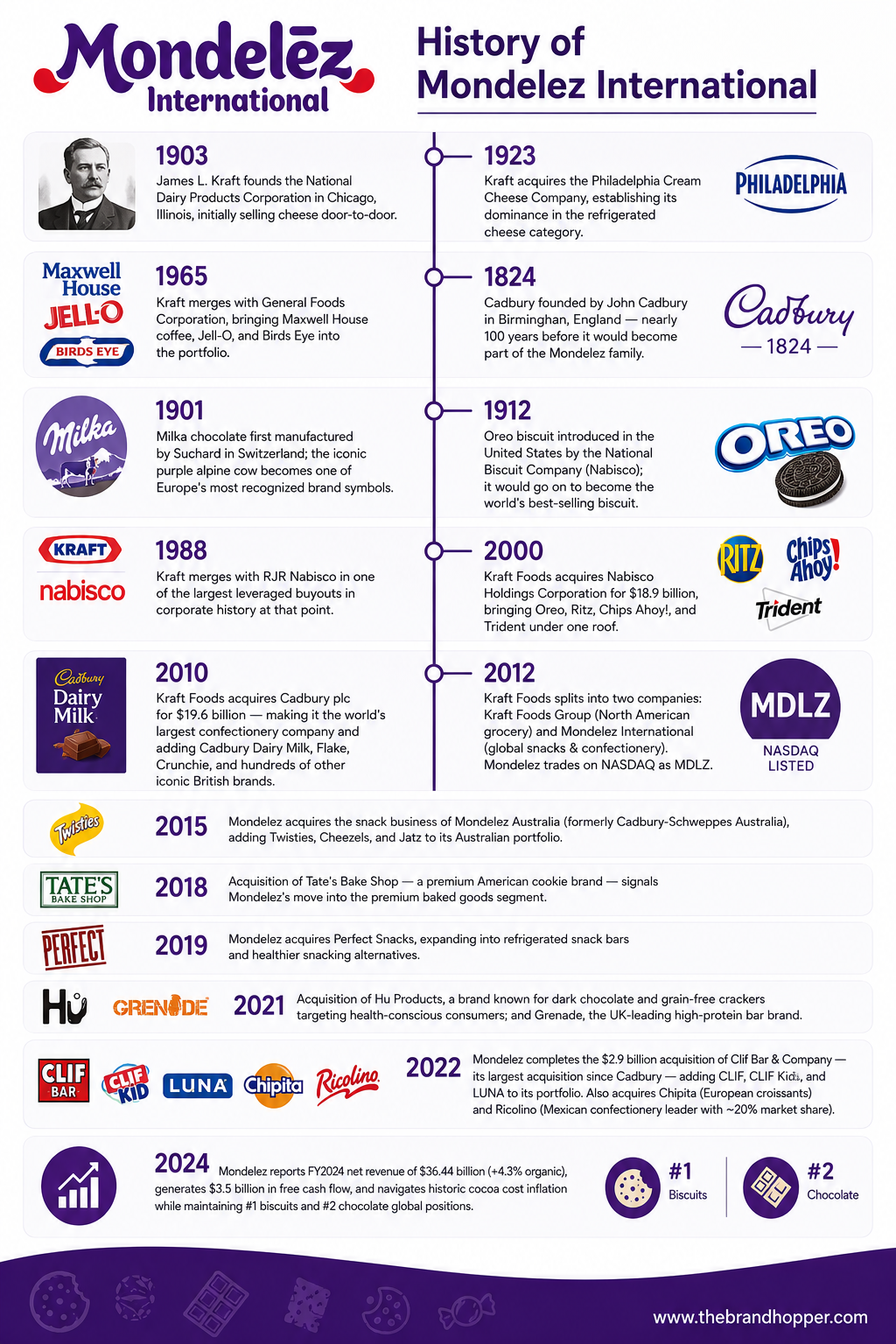
Mondelez International was established in 2012 following the historic split of Kraft Foods Inc. into two separate companies. The snacking business, which retained the most globally loved consumer brands, became Mondelez — a name derived from “monde” (world in French) and “delez” (a blend of delicious and snacks). Headquartered in Chicago, Illinois, the company today operates in over 150 countries, employs approximately 91,000 people globally, and holds the #1 global position in biscuits and #2 in chocolate — generating $38.54 billion in net revenue in FY2025.
But Mondelez’s story is not simply one of inherited scale. Since the 2012 spin-off, the company has aggressively transformed its portfolio — acquiring Clif Bar for $2.9 billion, integrating the Hu chocolate brand, Perfect Snacks, Grenade protein bars, and Mexican confectionery leader Ricolino — while simultaneously deploying generative AI for marketing, building the world’s most ambitious sustainable cocoa program, and navigating the most severe cocoa price inflation in decades. This is the full, updated story of how Mondelez built, grows, and sustains one of the great snacking empires of the modern era.

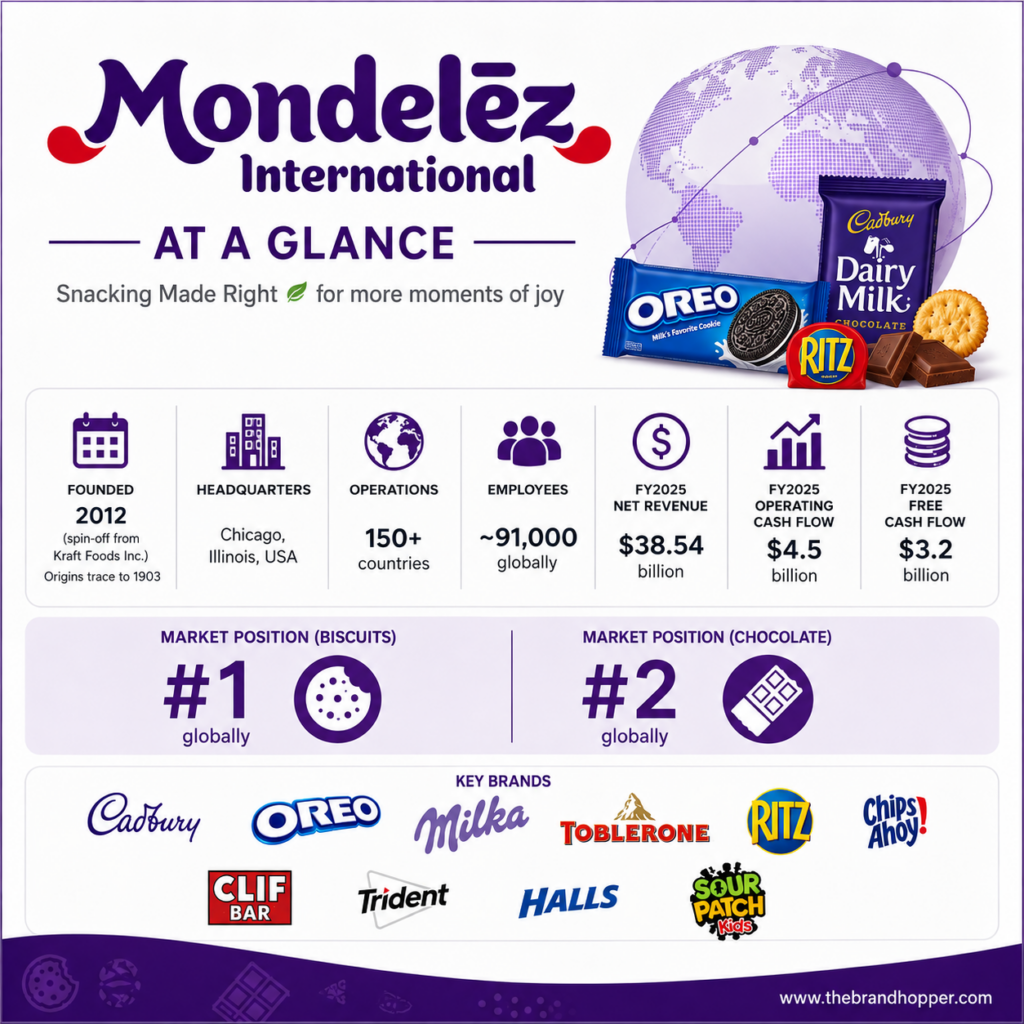
History of Mondelez International: From Cheese to Global Snacking Giant
The history of Mondelez International is a story of relentless reinvention — a company that has transformed from a single-product dairy business into the world’s largest pure-play snacking company over the course of more than a century. Understanding this history is essential to understanding why Mondelez’s brands carry such extraordinary cultural weight and consumer loyalty.

Naming note: “Mondelez” is a portmanteau coined by the company’s employees, combining “monde” (world in French) and “delez” — evoking “delicious.” The name was selected from nearly 1,700 suggestions submitted by employees during the 2012 rebranding process.
Brand Portfolio of Mondelez International
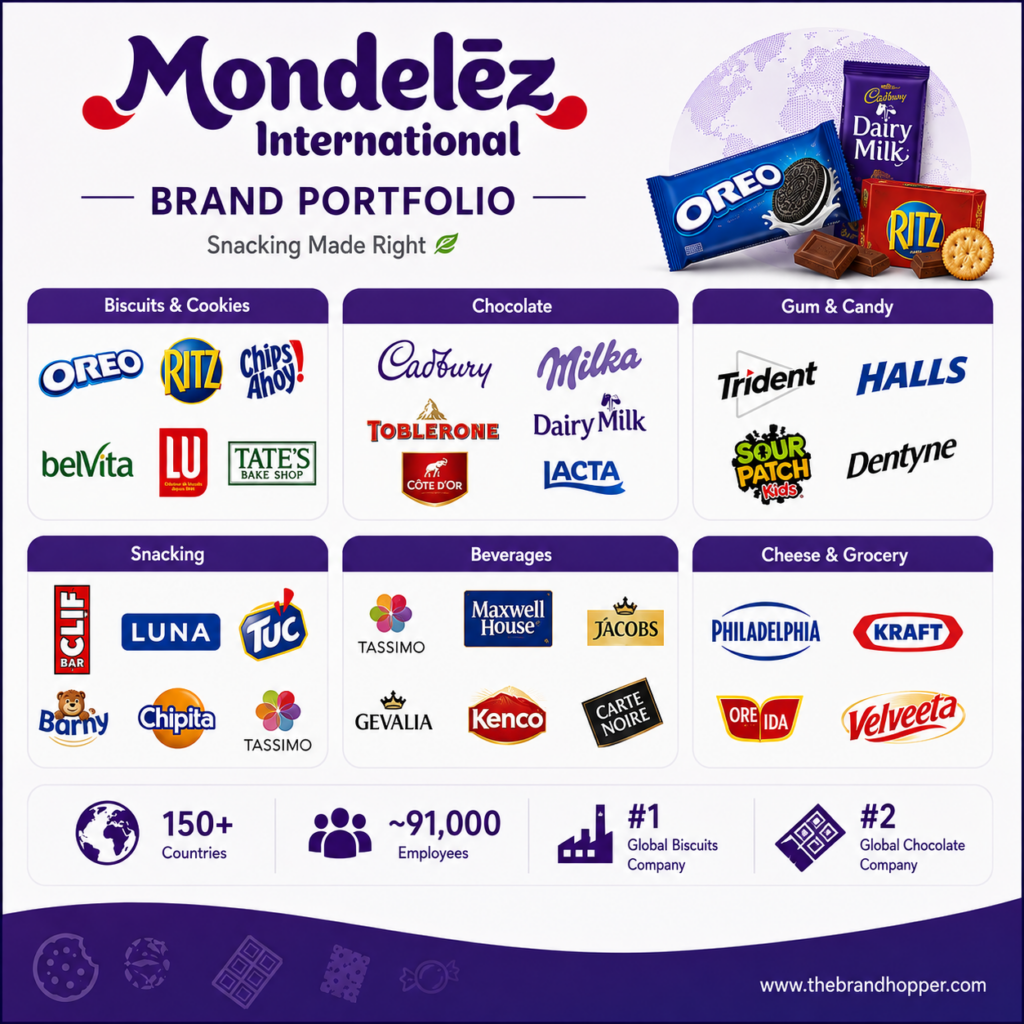
Mondelez International’s brand portfolio is one of the most powerful in global consumer goods — combining legacy brands with centuries of cultural equity with newer acquisitions that capture evolving consumer preferences for health, premium quality, and natural ingredients. The company holds brands that are genuinely generational: Cadbury has been making chocolate since 1824, Oreo since 1912, and Toblerone since 1908. Here is an overview of the key brands that define the Mondelez portfolio:
Heritage & Flagship Brands
1. Cadbury
Founded in 1824 in Birmingham, England, Cadbury is one of the world’s most beloved and culturally significant chocolate brands. Acquired by Kraft in 2010 for $19.6 billion, Cadbury’s portfolio includes Dairy Milk (the UK’s best-selling chocolate bar), Flake, Crunchie, Roses, Heroes, Caramel, and dozens of market-specific products sold across more than 50 countries. In markets including India, Australia, South Africa, and the UK, Cadbury is synonymous with chocolate itself. The brand’s “Joyville” and “Generosity” campaigns have consistently ranked among the most effective emotional advertising in the FMCG sector.
2. Oreo
Introduced in 1912 as “the chocolate sandwich cookie,” Oreo is the world’s best-selling biscuit brand — sold in more than 100 countries and generating over $3 billion in annual global retail sales. Oreo’s marketing strategy has been a masterclass in cultural relevance: from its viral “Dunk in the Dark” tweet during the 2013 Super Bowl blackout to ongoing limited-edition flavour collaborations (Lady Gaga Oreo, Pokemon Oreo, Dungeons & Dragons Oreo), the brand consistently generates earned media at scale. The brand’s tagline “Wonderfilled” and its “Kid Inside” campaign have anchored its emotional positioning for younger consumers and nostalgic adults alike.
3. Milka
Founded in 1901 in Switzerland (originally by Suchard), Milka is the #1 chocolate brand in Continental Europe — sold in more than 40 countries. Its distinctive Alpine purple packaging and the iconic Lila the Cow have made it one of Europe’s most recognizable brand identities. Milka’s sponsorship of the FIS Alpine Ski World Cup and its alpine heritage positioning reflect a brand that has successfully married category association (smooth, fresh mountain milk chocolate) with European cultural identity. Popular lines include Milka Alpine Milk, Milka Daim (almond caramel), and the Milka x Oreo crossover range.
4. Toblerone
Created by Theodor Tobler in Bern, Switzerland in 1908, Toblerone is recognized globally by its distinctive triangular shape, inspired by the Matterhorn and Swiss Alps. The brand offers milk, dark, white, and fruit-and-nut variants and is particularly strong in the travel retail (duty-free) channel, where it ranks among the most purchased confectionery products in airports worldwide. In 2023, Mondelez moved a portion of Toblerone’s production from Switzerland to Slovakia — a decision that, under Swiss law, required the removal of the Matterhorn image from packaging, generating significant global media attention.
5. Ritz
Launched in 1934 by Nabisco, Ritz crackers are one of North America’s most iconic salty snack brands. The circular, lightly salted butter cracker has been a staple of American households for nine decades and serves as a versatile platform for both savoury toppings and sweet pairings. Ritz Bits, Ritz Peanut Butter Crackers, and Ritz Crisp & Thins represent the brand’s portfolio extensions into adjacent snack formats.
6. Chips Ahoy!
Introduced in 1963 by Nabisco, Chips Ahoy! is one of the most recognized chocolate chip cookie brands in the United States. The brand offers the original crunchy format, Chewy Chips Ahoy!, Mini Bites, and brownie-filled variants. Its playful “Real Chocolate Chips” positioning and high cookie count messaging have sustained consumer engagement across generations.
7. Trident
Founded in 1964 and now sold in over 70 countries, Trident is a leading chewing gum brand positioned around long-lasting flavour and oral health benefits. Available in peppermint, spearmint, fruit, and tropical flavours — with sugar-free options — Trident competes with Mars’s Wrigley brands (Extra, Orbit, Doublemint) across North and South America, Europe, and the Middle East.
Growth & Acquisition Brands (Recent Portfolio Additions)
8. Clif Bar (Acquired 2022, $2.9 billion)
Clif Bar & Company — founded in 1992 by Gary Erickson and Lisa Thomas in Emeryville, California — is the leading energy bar brand in the United States. The acquisition added three key brands: CLIF Bar (the original oat-based energy bar), CLIF Kid (organic, non-GMO snack bars for children), and LUNA Bar (nutrition bars targeted at women). The acquisition expanded Mondelez’s global snack bar business to over $1 billion and significantly strengthened its position in the high-growth “better-for-you” snacking segment. Clif continues operating from its Emeryville headquarters with manufacturing in Twin Falls, Idaho and Indianapolis, Indiana.
9. Grenade (Acquired 2021)
Grenade is the UK’s leading high-protein bar brand — known for its flagship Carb Killa bars, which dominate the performance nutrition snacking category in Britain. The acquisition gave Mondelez a platform in the premium, protein-forward snacking segment that resonates strongly with health-conscious and fitness-oriented consumers. Grenade has since expanded from bars into shakes, spreads, and confectionery.
10. Hu Products (Acquired 2021)
Hu is a premium brand offering dark chocolate and grain-free crackers made with simple, minimally processed ingredients. The brand was founded in New York City in 2012 with a “human” food philosophy — no refined sugar, no gluten, no dairy, no soy — and has built a loyal following among health-conscious urban consumers. Hu gives Mondelez a premium, “better-for-you” chocolate brand that sits in a distinct positioning from Cadbury and Milka.
11. Perfect Snacks (Acquired 2019)
Perfect Snacks is a US brand producing refrigerated peanut butter protein snack bars. The brand pioneered the refrigerated snack bar format in the US and holds a strong position in natural and specialty food retail channels. Its products are made from whole food ingredients and positioned as a fresh, clean-label snacking alternative.
12. Ricolino (Acquired 2022)
Ricolino is one of Mexico’s most iconic confectionery brands — with approximately 20% market share in the Mexican confectionery market. The acquisition gave Mondelez direct access to one of Latin America’s largest and fastest-growing snack markets, with a portfolio of Mexican consumer staples including Bubulubu, Paleta Payaso, and Vero candy brands that are deeply embedded in Mexican cultural identity.
13. Tate’s Bake Shop (Acquired 2018)
Tate’s Bake Shop is a premium American cookie brand known for its thin, crispy butter cookies — a quality positioning distinct from mass-market cookie brands. The brand is particularly strong in premium grocery and specialty retail channels, providing Mondelez with a premium-tier entry point in the US cookie market alongside the mass-market Oreo and Chips Ahoy! brands.
14. Halls & Sour Patch Kids
Halls is a leading menthol confectionery brand sold globally for cough drop and throat soothing use. Sour Patch Kids is a cult-status sour candy brand enormously popular with Gen Z consumers in North America — known for its irreverent marketing and first-sour-then-sweet candy format. Both brands contribute to Mondelez’s portfolio diversification beyond chocolate and biscuits into candy and medicated confectionery.
Marketing Strategies of Mondelez International
Mondelez International’s marketing approach combines the scale advantages of a $36 billion global corporation with the brand-level intimacy required to maintain emotional connections with consumers across dozens of cultures and languages. The company spends approximately 9-11% of net revenues on consumer marketing — with a strategic shift underway toward digital, data-driven, and AI-powered marketing that is fundamentally changing how the world’s most iconic snack brands communicate with consumers.
1. Advertising: Emotional Storytelling at Scale
Mondelez International is among the top 20 global advertisers by spend, with investments spanning television, digital, out-of-home, cinema, and print. But what distinguishes Mondelez’s advertising from mere spending power is its consistent ability to generate emotional resonance — the kind of advertising that becomes part of cultural memory rather than simply delivering product messages.
Cadbury: Generosity and Joy
Cadbury’s advertising history is a masterclass in emotional brand-building. The “Gorilla” campaign (2007, directed by Juan Cabral for Fallon London) — featuring a gorilla drumming to Phil Collins’ “In the Air Tonight” — is consistently cited in advertising research as one of the most emotionally effective advertisements ever produced. More recently, Cadbury’s “Joyville” campaign created a mythology around a magical factory, and its “Cadbury Inventor” campaign invited consumers to submit and vote on new chocolate bar flavour combinations — generating massive social engagement and new UGC while reinforcing the brand’s playful, collaborative identity.
Cadbury’s “Generosity” positioning in recent years — manifested in campaigns featuring small acts of sharing chocolate as expressions of love and connection — has been particularly effective in markets like India, where Cadbury Dairy Milk has become deeply embedded in gift-giving and celebration culture, especially around Diwali and other festivals.
Oreo: Cultural Relevance at Real-Time Speed
Oreo’s marketing strategy is built around cultural agility — the brand’s ability to insert itself into cultural conversations faster and more cleverly than any competitor. The “Dunk in the Dark” tweet — posted during the Super Bowl XLVII blackout with the copy “You can still dunk in the dark” — became one of the most celebrated moments in social media marketing history and demonstrated that Oreo’s brand team operated with unusual creative authority and speed. This real-time marketing capability has been sustained through the brand’s ongoing program of limited-edition collaborour collaborations with pop culture properties, gaming brands, and entertainment franchises — each generating organic earned media and driving retail traffic.
2. Generative AI in Marketing: The Accenture/Publicis Partnership
In September 2024, Mondelez made one of the most significant marketing technology announcements in the FMCG sector: the launch of a proprietary generative AI platform for marketing, developed in partnership with Accenture and Publicis Groupe. The platform is designed to enable the creation of personalized text, images, and video content at unprecedented speed and scale — allowing Mondelez to produce and test thousands of creative variations across its brand portfolio simultaneously, rather than relying on the traditional agency production model of creating a small number of major campaigns each year.
The strategic logic is clear: Mondelez operates over 50 major brands across 150+ countries. The sheer volume of culturally relevant, locally adapted marketing content required to serve those markets effectively is beyond the capacity of traditional creative production. Generative AI allows Mondelez to maintain brand consistency at the global level while enabling hyper-local personalization at the regional and individual level — serving the right content to the right consumer in the right context, at a fraction of the cost and time of conventional creative production.
Beyond content creation, Mondelez uses AI to analyze consumer behavior patterns, optimize media spend allocation, predict product demand, monitor the health of cocoa trees via satellite imagery and machine learning (part of the Cocoa Life program), and enhance supply chain resilience. The company has described its AI strategy as “human-centred” — using AI to enhance, not replace, the creative judgment and emotional intelligence of its marketing teams.
3. Sponsorships and Sports Marketing
Mondelez uses sponsorships strategically to anchor its brands in cultural contexts that reinforce their core identity. The partnerships are chosen to create genuine associations rather than mere logo placements:
Oreo & the NFL: Oreo’s sponsorship of the National Football League in the United States has produced multiple Super Bowl advertising campaigns and activations, including the “Game of Thrones” Oreo campaign that recreated the show’s opening title sequence in cookies. The NFL association positions Oreo as an everyday American snacking staple with a sense of fun and spectacle.

Milka & Alpine Ski World Cup: Milka’s long-running sponsorship of FIS Alpine Skiing directly supports the brand’s Alpine heritage positioning. Being present at the World Cup — in the Alps, with athletes in purple — creates an authentic visual association between the brand’s purple-and-cow identity and the mountain landscape that inspires its chocolate.
Cadbury & cricket: In markets including Australia, India, and South Africa, Cadbury has maintained long-running cricket sponsorships that position it as the sport’s confectionery brand — particularly around key tournaments and test series.
Toblerone & travel retail: Toblerone’s positioning in airport duty-free channels is itself a form of strategic sponsorship — the brand’s presence in departure halls worldwide reinforces its identity as a premium gift and souvenir, with airport retail partners investing in dedicated Toblerone display architecture.
4. Social Media and Digital Marketing
Mondelez runs one of the most sophisticated multi-brand digital marketing operations in the FMCG sector. The company’s approach reflects its recognition that different brands require fundamentally different social strategies — there is no single Mondelez social media tone of voice, because Cadbury, Oreo, Milka, Toblerone, and Clif Bar speak to different audiences in different emotional registers.
Platform-specific strategies
Instagram & TikTok: Primarily used by Oreo and Sour Patch Kids to reach Gen Z consumers through short-form video, trend participation, and creator collaborations. Sour Patch Kids’ TikTok presence — built around the brand’s “first sour, then sweet” personality — has been particularly effective with the 16-24 demographic.
Facebook & YouTube: Primary channels for Cadbury and Milka to reach millennial and older consumers with longer-form emotional storytelling content and extended-cut campaign films.
Twitter/X: Where Oreo maintains its real-time cultural commentary capability — the brand’s social team operates with unusual creative authority to engage in trending conversations with relevant, witty responses.
Digital commerce: Mondelez invests in direct-to-consumer platforms and branded e-commerce (Cadbury Gifts Direct in the UK), which serve both commercial and consumer relationship purposes — providing first-party data while delivering premium gifting experiences.
Cadbury Inventor — UGC-Driven Campaign Innovation
The Cadbury Inventor campaign is one of Mondelez’s most successful recurring digital marketing initiatives. Consumers submit ideas for new chocolate bar flavours, which are then voted on by the public — with the winning flavour actually produced and sold in retail. The campaign simultaneously generates extraordinary social engagement (submissions, votes, debate), earns significant media coverage, reinforces Cadbury’s collaborative brand personality, and provides genuinely useful consumer product preference data. It is UGC at its most commercially sophisticated.
5. Experiential Marketing: Creating Chocolate Worlds
Mondelez’s experiential marketing strategy centres on transforming brand encounters from passive consumption into immersive physical experiences that create emotional memories and generate social media content. The approach is most fully realized through Cadbury’s permanent and pop-up experiential properties:
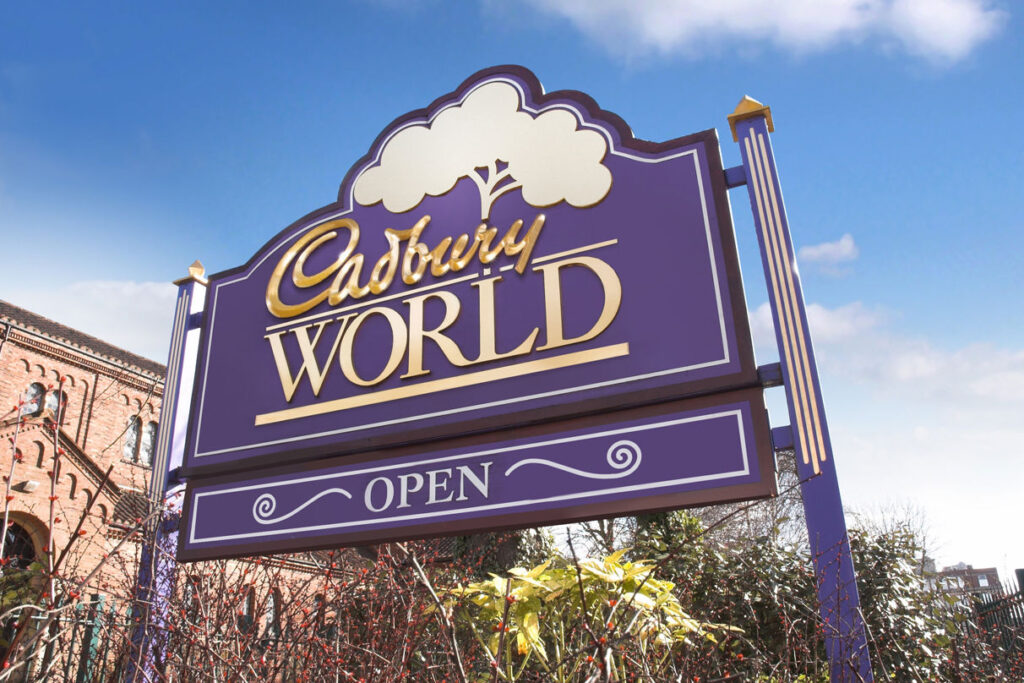
Cadbury World (Birmingham, England): The UK’s largest confectionery visitor attraction — a permanent brand experience centre at the original Bournville factory site that takes approximately 550,000 visitors per year through the history of chocolate, a recreation of Aztec cocoa culture, and an interactive journey through Cadbury’s brand history. Cadbury World is simultaneously a commercial operation, a brand museum, and a live marketing exercise that converts visitors into emotionally engaged brand advocates.
Pop-up retail experiences: Cadbury regularly deploys pop-up stores and immersive activations in high-traffic urban locations — including a London pop-up featuring a giant chocolate vending machine and a bar where consumers could customize their own Cadbury chocolate bars. These activations generate significant social media content and earned media coverage while delivering memorable brand encounters.
Oreo Dunk Challenge: Oreo’s experiential campaigns often extend into digital — the “Dunk Challenge” invited consumers to photograph and share their personal Oreo-dunking methods on social media, generating millions of user-created posts that simultaneously entertained consumers and spread brand content organically.
6. Cocoa Life: Sustainability as Marketing Differentiation
Mondelez’s Cocoa Life program is the company’s most significant long-term brand investment in sustainability — and it has evolved from a CSR initiative into a genuine competitive differentiator and marketing asset. Launched in 2012, Cocoa Life has invested over $800 million in cocoa farming communities across Ghana, Ivory Coast, Indonesia, India, the Dominican Republic, and Brazil.
In 2025, Cocoa Life achieved a landmark milestone: full coverage of approximately 100% of cocoa volume sourced for Mondelez’s chocolate business now comes through the program — meaning every Cadbury bar, every Milka square, every Toblerone triangle is produced with Cocoa Life-sourced cocoa. The program works with over 257,000 registered Cocoa Life farmers, supporting training in sustainable agricultural practices, community infrastructure, child protection, and gender equality.
Mondelez is now pursuing an enhanced cocoa sourcing strategy that includes direct supply chain diversification and partnerships with food-tech startups to develop lab-grown and alternative cocoa ingredients — a forward-looking response to the extreme cocoa price volatility that has impacted the company’s FY2025 outlook. The company is also using AI and satellite imagery to monitor the health of cocoa trees, predict yield, and detect disease before it spreads — bringing precision agriculture technology to smallholder farming at scale.
Marketing Mix of Mondelez International (4Ps)
1. Product: A Tiered Portfolio for Every Snacking Occasion
Mondelez’s product strategy organizes its portfolio across three tiers: mass-market scale brands (Oreo, Cadbury Dairy Milk, Ritz, Chips Ahoy!), mid-market heritage brands (Milka, Toblerone, Trident, Halls), and premium/better-for-you brands (Clif Bar, Hu, Grenade, Tate’s Bake Shop, Perfect Snacks). This three-tier architecture allows Mondelez to compete across the full price and positioning spectrum — from a $1.50 Oreo package at a convenience store to a $5.00 Hu dark chocolate bar at Whole Foods.
Product innovation is a core strategic priority. Mondelez operates innovation centers around the world staffed by research teams exploring new formats, flavours, and ingredients. The company’s innovation strategy is increasingly informed by AI — using machine learning models to analyze consumer preference data, social media signals, and market trends to identify innovation opportunities before competitors. Key product innovation themes include: plant-based and reduced-sugar variants across the chocolate portfolio, high-protein extensions (leveraging the Grenade platform), cross-brand collaborations (Milka Oreo, Cadbury Oreo), and localized product development for emerging markets.
2. Price: Premium Positioning with Value Tier Breadth
Mondelez employs a tiered pricing strategy that reflects the diversity of its portfolio and the varied purchasing power of its 150-country market footprint. Mass-market brands like Oreo and Ritz are priced to be accessible and occasion-appropriate — delivering high units per household per year. Premium brands like Toblerone, Hu, and Tate’s Bake Shop command significant price premiums justified by ingredient quality, heritage, and experiential positioning.
In response to historic cocoa cost inflation — which pushed raw material costs to multi-decade highs in 2023-2024 — Mondelez has implemented selective price increases across its chocolate portfolio, supplemented by “shrinkflation” adjustments in some markets (reducing pack sizes while maintaining price points). The FY2025 earnings guidance acknowledges the ongoing challenge: while organic revenue growth of ~5% is expected, adjusted EPS is forecast to decline approximately 10% due to cocoa cost headwinds — illustrating the pricing power constraints even a #2 global chocolate brand faces when raw material costs spike historically.
3. Place: Omnipresent Distribution Across 150+ Countries
Mondelez’s distribution strategy aims to place its snacks in every channel where a consumer might seek a snack — a goal that requires managing extraordinarily complex logistics and retail relationships across market types ranging from hypermarkets in Germany to traditional trade distributors in rural India.
Modern trade: Hypermarkets, supermarkets, and discounters (Walmart, Tesco, Carrefour, Lidl) globally. Mondelez is among the top 5 suppliers by revenue for most major global grocery retailers.
Convenience and impulse: Petrol station forecourts, airport kiosks, train station outlets — Toblerone’s airport duty-free dominance and Cadbury’s impulse bar sales at checkout are key examples of channel-specific product placement strategy.
Traditional trade: In emerging markets including India, Southeast Asia, and sub-Saharan Africa, traditional “mom-and-pop” kirana stores and general trade distributors are the primary channel — requiring fundamentally different pack sizes, price points, and distribution infrastructure from modern trade approaches.
Digital commerce: E-commerce represents a rapidly growing share of Mondelez’s revenue in markets including China (via Tmall and JD.com) and the United States. The Cadbury Gifts Direct D2C platform provides both e-commerce revenue and first-party consumer data.
Foodservice: Mondelez supplies ingredients (particularly chocolate) to food manufacturers, bakeries, and foodservice operators globally — an important but often underappreciated revenue stream.
4. Promotion: From Mass Broadcast to Personalized AI Marketing
Mondelez’s promotional strategy has undergone a structural shift over the past five years — moving from a primarily broadcast advertising model (large TV campaigns, mass print) to a data-driven, digital-first, increasingly AI-powered model that enables precision targeting, real-time creative optimization, and personalized content delivery at scale. The 2024 generative AI marketing platform launch with Accenture and Publicis marks the inflection point of this transformation.
Key promotional channels and investments include: heavy television advertising for emotional brand building (particularly Cadbury and Milka); digital performance marketing for direct response and e-commerce conversion; influencer and creator partnerships (particularly for Oreo, Sour Patch Kids, and Clif Bar); sponsorship and sports marketing (NFL, Alpine skiing, cricket); experiential events and pop-ups; and targeted digital media through Google, Meta, and programmatic networks, increasingly informed by Mondelez’s growing first-party data capabilities.
Financial Performance of Mondelez International
Mondelez International is a financially strong, cash-generative business that has delivered consistent revenue growth over its history as a standalone company. Here are the key financial highlights from the official FY2025 earnings release:
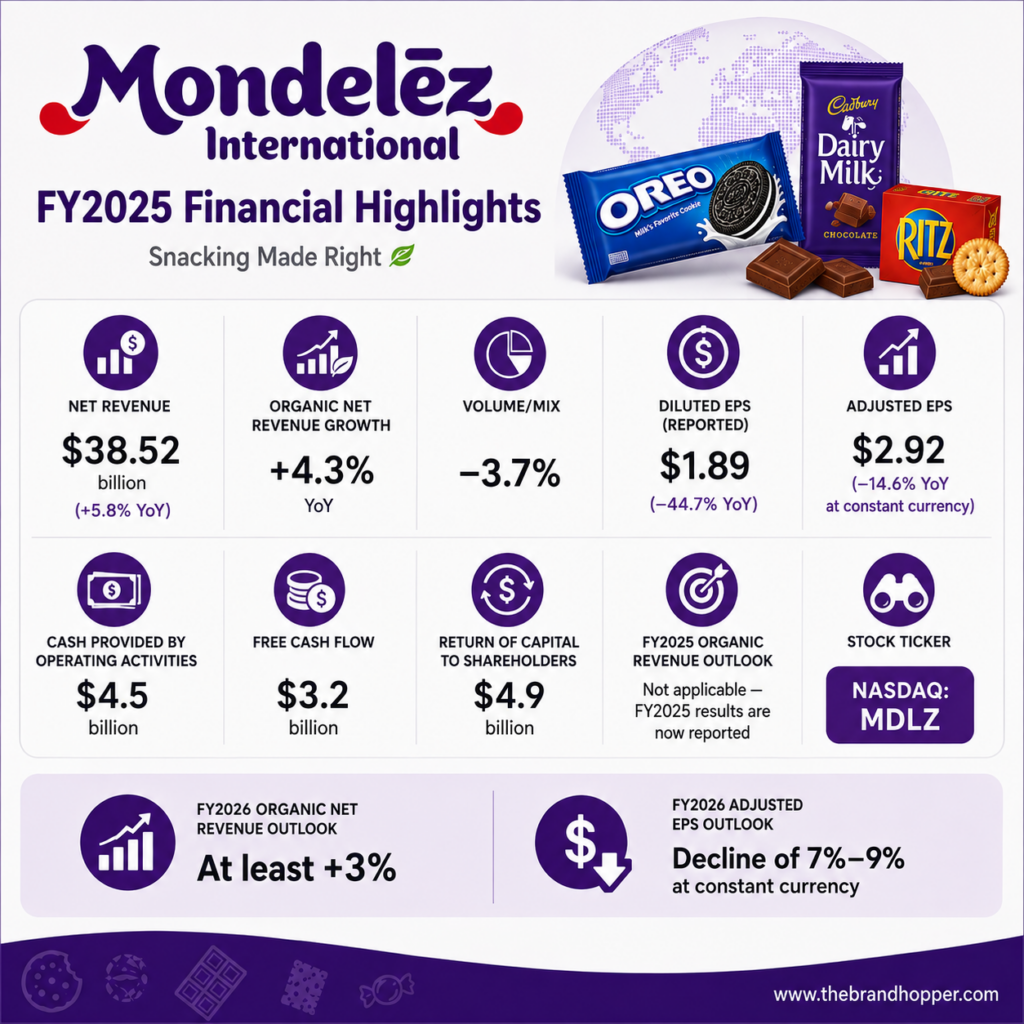
For historical reference, Mondelez’s annual revenue trend and net income history are available via Macrotrends. The company’s net revenue has grown from $28.7 billion in 2021 to $36.44 billion in 2024 — representing consistent top-line growth driven by organic price increases, volume growth in emerging markets, and the accretive contribution of acquisitions including Clif Bar, Ricolino, and Chipita.
The most significant near-term financial challenge is cocoa cost inflation. Global cocoa prices reached multi-decade highs in 2023-2024 due to El Nino weather disruptions across West Africa (which produces approximately 70% of the world’s cocoa), significantly impacting Mondelez’s chocolate segment margins. The company’s FY2025 earnings guidance — which projects adjusted EPS declining ~10% despite ~5% organic revenue growth — reflects the earnings headwind from higher cocoa input costs that cannot be fully passed through to consumers via price increases without unacceptable volume loss. Mondelez is responding through supply chain diversification, alternative ingredient research (including lab-grown cocoa partnerships), and expanded Cocoa Life investments to build long-term supply resilience.
Competitors of Mondelez International
Mondelez competes in the highly competitive global snacking industry — facing rivals at every level from multinational conglomerates to agile challenger brands. Its #1 biscuits and #2 chocolate global positions are hard-won and consistently contested. Here are the primary competitive forces:
| Competitor | Key Competing Brands | Primary Overlap |
| Nestlé | KitKat, Smarties, Aero, Quality Street, After Eight, Lion | Chocolate & confectionery globally |
| Mars, Incorporated | M&Ms, Snickers, Twix, Skittles, Milky Way, Extra/Wrigley gum | Chocolate, candy & gum globally |
| The Hershey Company | Hershey’s, Reese’s, Kit Kat (US), Jolly Rancher, SkinnyPop | North American chocolate & snacks |
| Ferrero Group | Nutella, Ferrero Rocher, Kinder, Tic Tac, Thorntons | Chocolate & confectionery globally |
| PepsiCo (Frito-Lay) | Lay’s, Doritos, Cheetos, SunChips, Quaker, Gatorade | Savoury snacks, North America & global |
| Kellogg/WK Kellogg | Pringles, Cheez-It, Pop-Tarts, Special K, MorningStar | Biscuits, crackers & breakfast globally |
| Kraft Heinz | Kraft, Jell-O, Oscar Mayer, Planters | US packaged foods |
| Lindt & Sprungli | Lindt, Lindor, GHIRARDELLI, Russell Stover | Premium chocolate globally |
Mondelez’s competitive advantages versus these rivals include: (1) the Cadbury heritage brand in the UK, India, Australia, and Africa — markets where Cadbury’s cultural penetration is unmatched by any chocolate competitor; (2) Oreo’s position as the world’s #1 biscuit — a category where Mondelez has no peer at global scale; (3) the Cocoa Life program, which gives Mondelez a credible, long-term sustainability narrative that competitors find difficult to replicate at equivalent scale; and (4) the growing “better-for-you” portfolio through Clif, Hu, Grenade, and Perfect Snacks, which positions Mondelez favorably in the high-growth healthier snacking segment.
Frequently Asked Questions (FAQs)
Q: What is Mondelez International?
A: Mondelez International (NASDAQ: MDLZ) is the world’s largest dedicated snacking company — headquartered in Chicago, Illinois, operating in 150+ countries, employing approximately 91,000 people, and generating $36.44 billion in net revenue in FY2024. The company holds the #1 global position in biscuits (cookies and crackers) and #2 in chocolate. Its portfolio includes Cadbury, Oreo, Milka, Toblerone, Ritz, Chips Ahoy!, Clif Bar, Trident, Halls, Sour Patch Kids, Hu, Grenade, and dozens of other brands. Mondelez was created in 2012 when Kraft Foods Inc. split into two companies: Mondelez International (global snacks) and Kraft Foods Group (North American grocery).
Q: What brands does Mondelez own?
A: Mondelez’s global brand portfolio spans heritage brands and recent acquisitions. Heritage brands include: Cadbury (founded 1824, UK; acquired 2010 for $19.6B), Oreo (1912, US), Milka (1901, Switzerland), Toblerone (1908, Switzerland), Ritz (1934, US), Chips Ahoy! (1963, US), Trident gum (1964), Halls, and Sour Patch Kids. Major recent acquisitions include: Clif Bar (acquired 2022, $2.9B — CLIF, CLIF Kid, LUNA brands), Grenade UK protein bars (2021), Hu dark chocolate/crackers (2021), Perfect Snacks refrigerated bars (2019), Tate’s Bake Shop premium cookies (2018), Ricolino Mexican confectionery (2022), and Chipita European croissant brands (2022).
Q: What is Mondelez’s annual revenue?
A: Mondelez International reported net revenues of $36.44 billion for the full year 2024 — representing 1.2% reported growth and 4.3% organic growth year-over-year. The company generated $4.9 billion in operating cash flow and $3.5 billion in free cash flow, returning $4.7 billion to shareholders through dividends and buybacks. For historical comparison, net revenue has grown from $26.6 billion in 2020 and $28.7 billion in 2021. Source: Official Mondelez FY2024 earnings release, ir.mondelezinternational.com, published February 4, 2025.
Q: When was Mondelez International founded?
A: Mondelez International as a standalone company was founded in 2012, when Kraft Foods Inc. executed a corporate split into two separate entities: Mondelez International (global snacks and confectionery) and Kraft Foods Group (North American grocery). However, the company’s operational heritage traces to 1903, when James L. Kraft founded the National Dairy Products Corporation in Chicago. The Cadbury brand Mondelez owns dates to 1824 in Birmingham, England, Oreo to 1912, and Milka to 1901 — making Mondelez a steward of some of the world’s oldest consumer brands.
Q: What is Mondelez’s Cocoa Life program?
A: Cocoa Life is Mondelez International’s global sustainable cocoa sourcing program — launched in 2012 with a commitment of over $800 million in investment. The program works with over 257,000 registered cocoa farmers across Ghana, Ivory Coast, Indonesia, India, the Dominican Republic, and Brazil, supporting sustainable agricultural practices, community development, child protection, and gender equality. In 2025, Cocoa Life achieved full coverage: approximately 100% of cocoa sourced for Mondelez’s chocolate business now comes through the program, meaning every Cadbury, Milka, and Toblerone product is made with Cocoa Life-sourced cocoa. Source: Mondelez International Sustainability Milestones press release, ir.mondelezinternational.com.
Q: Why did Mondelez acquire Clif Bar?
A: Mondelez International acquired Clif Bar & Company for $2.9 billion in August 2022 as a strategic move to strengthen its position in the fast-growing energy and nutrition bar segment. At acquisition, Clif was the #1 energy bar brand in the United States. The deal added three brands: CLIF Bar, CLIF Kid, and LUNA, expanding Mondelez’s global snack bar business to over $1 billion. Strategically, Clif Bar gives Mondelez a meaningful presence in the ‘better-for-you’ snacking segment — positioned alongside Perfect Snacks (refrigerated bars), Grenade (UK protein bars), and Hu (dark chocolate/crackers) — allowing the company to compete with PepsiCo/Quaker and Nestlé in the growing health-conscious snacking market.
Q: What is Mondelez’s marketing strategy?
A: Mondelez employs seven core marketing strategies: (1) Emotional brand advertising — Cadbury’s ‘Gorilla’ and ‘Joyville’ campaigns, Oreo’s real-time ‘Dunk in the Dark’ social media marketing; (2) Generative AI for marketing — a proprietary AI platform with Accenture and Publicis (launched 2024) for personalized content at scale; (3) Sports sponsorships — Oreo/NFL, Milka/Alpine Skiing, Cadbury/cricket; (4) Social media — platform-specific strategies across Instagram, TikTok, Facebook, YouTube, and X; (5) Experiential marketing — Cadbury World visitor attraction, pop-up stores and immersive brand experiences; (6) Sustainability marketing — Cocoa Life program reaching full cocoa coverage, supporting 257,000+ farmers; (7) UGC-driven campaigns — Cadbury Inventor, Oreo flavour competitions.
Q: Who are Mondelez’s main competitors?
A: Mondelez’s primary competitors include: (1) Nestlé — KitKat, Smarties, Aero in chocolate; (2) Mars Inc. — M&Ms, Snickers, Twix, Milky Way in chocolate; Wrigley (Extra, Orbit, Doublemint) in gum competing with Trident; (3) The Hershey Company — Hershey’s, Reese’s, Kit Kat (US) in North American chocolate; (4) Ferrero Group — Nutella, Ferrero Rocher, Kinder in premium chocolate; (5) PepsiCo/Frito-Lay — Lay’s, Doritos, Cheetos in savoury snacks; (6) Kellogg — Pringles, Cheez-It in biscuits and crackers; (7) Lindt & Sprungli in premium chocolate. Mondelez differentiates through Cadbury heritage in key markets, global Oreo leadership, and the Cocoa Life sustainability platform.
Q: How is Mondelez using AI?
A: Mondelez has deployed AI across multiple functions. In marketing: a generative AI platform developed with Accenture and Publicis (2024) enables personalized content creation at scale across all brands. In supply chain: AI models predict demand, optimize inventory, and monitor logistics. In agriculture: satellite imagery and machine learning monitor cocoa tree health across Cocoa Life farms, enabling early disease detection. In product innovation: AI analyzes consumer preference data and social signals to identify innovation opportunities. In advertising: programmatic AI optimizes media spend across digital channels in real-time. CEO Dirk Van de Put has described Mondelez’s AI approach as ‘human-centred’ — augmenting rather than replacing human creative judgment.
Q: What is Mondelez’s position in the global snack market?
A: Mondelez International holds the #1 global position in biscuits (cookies and crackers) — with Oreo as the world’s best-selling biscuit brand and a strong position through Ritz, Chips Ahoy!, LU, and Tuc crackers. The company holds the #2 position in global chocolate — with Cadbury, Milka, and Toblerone leading across their respective geographies, behind only Nestlé in global share. Biscuits and baked snacks account for approximately 47% of Mondelez’s revenue; chocolate accounts for approximately 33%. The company’s ‘better-for-you’ portfolio (Clif, Hu, Grenade, Perfect Snacks) is growing as a share of revenue, positioning Mondelez well for the long-term consumer shift toward healthier snacking.
Also Read: Nestle – The Global FMCG Brand Providing Good Food And Good Life
To read more content like this, subscribe to our newsletter
Go to the full page to view and submit the form.