


Kering is a French luxury goods group and one of the most iconic names in global high fashion — home to Gucci, Saint Laurent, Bottega Veneta, Balenciaga, Alexander McQueen, and a constellation of other luxury houses in jewellery, leather goods, and tailoring. Founded in 1963 by François Pinault as a timber trading company in Brittany, France, Kering has undergone one of the most extraordinary corporate transformations in business history — pivoting from wood and paper into a luxury empire that recorded €17.2 billion in revenues in 2024 and counts approximately 47,000 employees worldwide.
Kering is listed on Euronext Paris (ticker: KER) and is the world’s second-largest luxury goods group by revenue, behind only LVMH. Its brand portfolio spans fashion, leather goods, jewellery, and eyewear, operating through approximately 1,813 directly managed stores globally. The group is navigating a challenging period of creative transitions and macroeconomic headwinds with a bold new leadership and creative strategy designed to drive recovery and position its houses for the next decade of growth.
This article provides a complete, verified guide to Kering’s current brand portfolio, financial performance, business strategy, sustainability leadership, and the strategic moves that will define its trajectory — with every figure sourced from official Kering reporting and verified against primary sources.

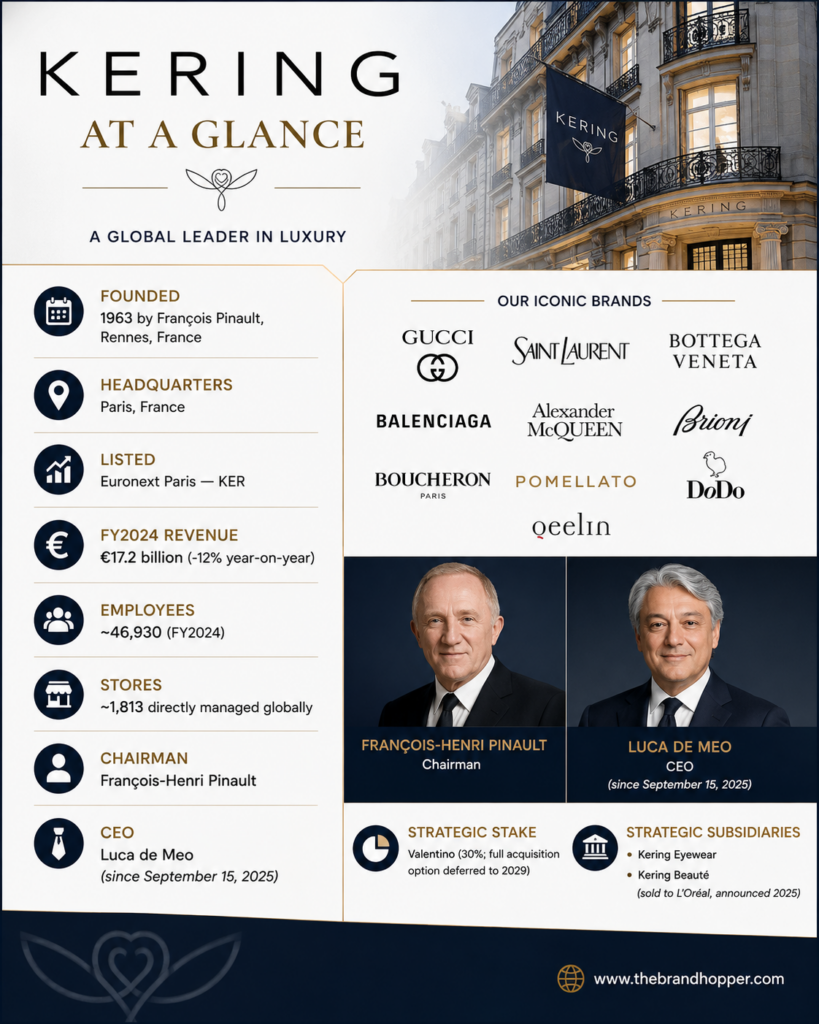
| Portfolio update: Kering’s portfolio has changed significantly since 2022. Girard-Perregaux and Ulysse Nardin were sold to their management in May 2022. Christopher Kane was sold back to its designer in 2019. Kering Beauté (including Creed fragrances) has been sold to L’Oréal for €4 billion, with the transaction expected to close in the first half of next year. |
From Timber to Treasure: The History of Kering
The Kering story is one of the most remarkable corporate transformations in modern business history. François Pinault founded the company in 1963 as a timber trading business in Brittany, France. Through the 1970s and 1980s, the company diversified into building materials, distribution, and retail, going public in 1988. By the early 1990s, Pinault had built a significant retail conglomerate — acquiring Printemps department stores and the FNAC entertainment retail chain — creating a business known as PPR (Pinault-Printemps-Redoute).
The definitive pivot to luxury came in 1999, when François Pinault acquired a controlling stake in the Gucci Group for approximately $3 billion — including Gucci itself, Saint Laurent, Sergio Rossi, and other brands. This was one of the most consequential luxury acquisitions of the era, outbidding LVMH in a fierce public takeover battle. In 2001, Kering added Balenciaga, Stella McCartney, and Alexander McQueen to the portfolio. Boucheron had been acquired in 2000, establishing the jewellery pillar.
In 1999, François Pinault passed operational leadership to his son François-Henri Pinault, who became Chairman and CEO. Under his leadership, Kering’s strategy sharpened decisively toward luxury. The group progressively divested non-luxury retail assets — selling FNAC, La Redoute, Conforama, and Printemps between 2012 and 2014 — and rebranded from PPR to Kering in 2013. The name “Kering” was chosen partly as a linguistic echo of “caring” (reflecting the group’s values) and partly as a phonetic reference to its origins in Brittany.
Key Milestones in Kering’s History
| Year | Milestone |
| 1963 | François Pinault founds timber trading company in Brittany, France |
| 1988 | Company goes public on Paris Stock Exchange |
| 1994 | Acquires FNAC; rebrands as Pinault-Printemps-Redoute (PPR) |
| 1999 | Acquires controlling stake in Gucci Group (incl. Saint Laurent) — landmark luxury pivot |
| 1999 | François-Henri Pinault assumes leadership |
| 2000 | Acquires Boucheron; Balenciaga joins via Gucci Group negotiation |
| 2001 | Alexander McQueen and Stella McCartney added to portfolio |
| 2004 | Puma acquired (later divested in 2018 via distribution to shareholders) |
| 2011 | Brioni acquired |
| 2012–2014 | Divestment of retail assets (FNAC, La Redoute, Conforama, Printemps) |
| 2013 | Rebranded from PPR to Kering; Pomellato and Qeelin acquired |
| 2014 | Kering Eyewear established |
| 2019 | Christopher Kane sold back to designer |
| 2022 | Girard-Perregaux and Ulysse Nardin sold to management (May 2022) |
| 2023 | 30% stake in Valentino acquired for €1.7 billion |
| 2024 | Demna appointed Artistic Director of Gucci; new CEO Luca de Meo announced |
| 2025 | Luca de Meo becomes CEO (September); Kering Beauté sale to L’Oréal announced |
Kering’s Business Strategy & Philosophy
Kering’s fundamental competitive strategy rests on a clear and consistent principle: build a portfolio of authentic, heritage-rooted luxury houses and provide them with the operational infrastructure, financial support, and strategic guidance to achieve their full creative and commercial potential — while allowing each house to retain its distinct identity, aesthetic, and leadership team.
The “Maison” Model
Kering operates through individual autonomous “Houses” (Maisons), each with its own CEO, creative director, and brand strategy. Unlike conglomerates that impose uniform operational standards, Kering gives its houses a high degree of autonomy on creative and commercial decisions, stepping in primarily at the level of supply chain, sustainability standards, financial governance, and strategic planning. This model enables creative authenticity while delivering operational leverage across shared services (logistics, IT, procurement, compliance).
Direct Retail Control
Kering, like its peers in luxury, has steadily increased the proportion of revenues generated through directly owned and operated stores (DOS) versus wholesale or licensed channels. Direct retail gives the group control over pricing, client experience, product assortment, and brand desirability. As of 2024, the group operates approximately 1,813 directly managed stores globally, complemented by e-commerce platforms for each house.
Premiumisation & Desirability
Kering’s 2024–2026 strategic plan includes a deliberate premiumisation initiative: reducing volume by closing underperforming stores and cutting entry-level price-point products, while investing in ultra-luxury and bespoke offerings that reinforce desirability and brand elevation. This is particularly pronounced at Gucci, where CEO Stefano Cantino and incoming Artistic Director Demna are architecting a reset that prioritises price and exclusivity over volume.
Innovation in Eyewear & Beauty
Kering has used its Eyewear and Beauté subsidiaries to capture value from its fashion brands beyond core fashion and leather goods. Kering Eyewear, founded in 2014 and now one of the world’s largest luxury eyewear businesses, designs and distributes frames for Kering’s houses. Kering Beauté (including Creed fragrances and the beauty licenses of Gucci, Balenciaga, and others) was built rapidly but is now being divested to L’Oréal for €4 billion, with Kering refocusing capital on its core luxury fashion and jewellery houses.
Kering’s Current Brand Portfolio: 10 Luxury Houses
Kering’s current portfolio comprises ten operating luxury houses across two segments: Fashion & Leather Goods (Gucci, Saint Laurent, Bottega Veneta, Balenciaga, Alexander McQueen, and Brioni) and Jewelry (Boucheron, Pomellato/Dodo, Qeelin). Each house is profiled below with its founding story, current commercial position, and distinctive competitive strengths.
1. Gucci

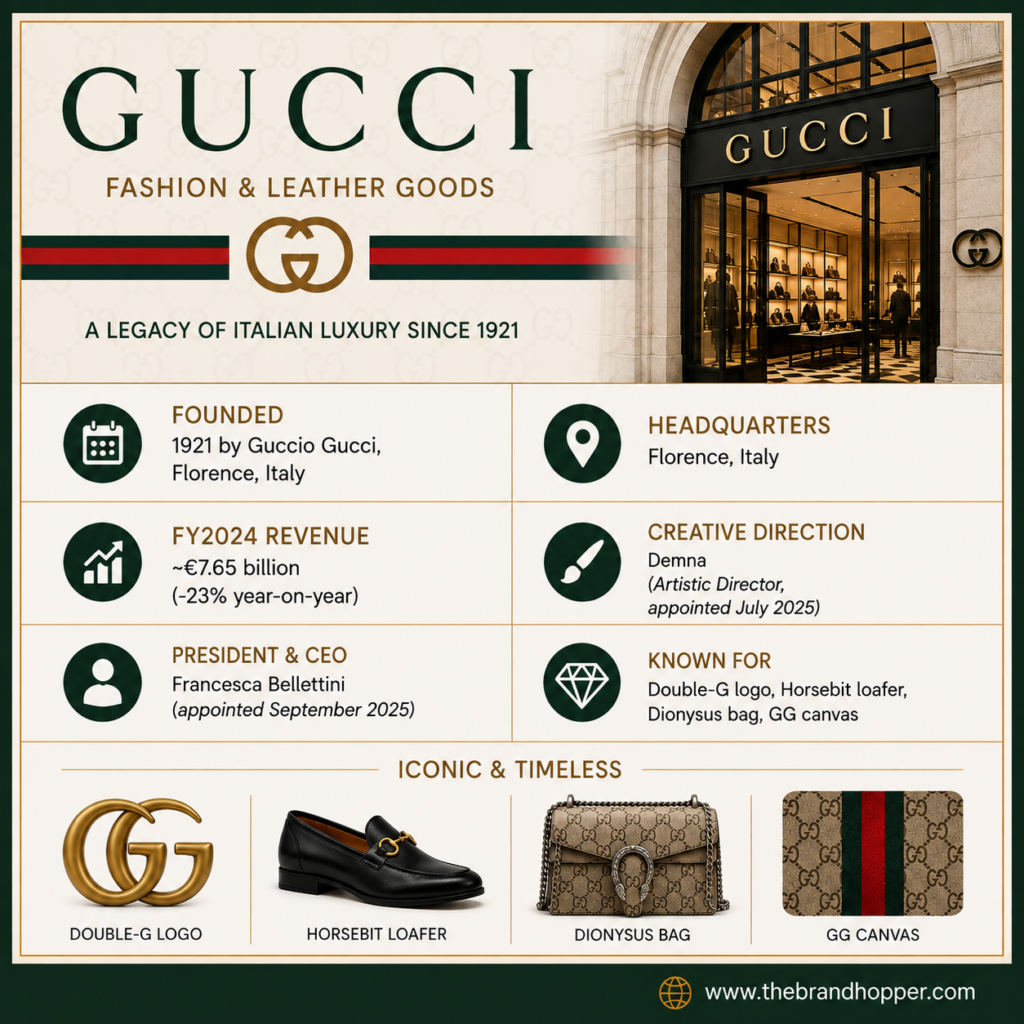
Gucci is Kering’s flagship brand, generating approximately 40–45% of the group’s total revenues, and remains one of the world’s most recognisable luxury fashion houses. Founded in 1921 by Guccio Gucci in Florence, the brand grew from a leather goods atelier into a global cultural phenomenon synonymous with Italian craftsmanship, eccentricity, and maximalist glamour. Kering’s acquisition of a controlling stake dates to 1999, and Gucci has since been the centrepiece of Kering’s luxury strategy.
Gucci experienced significant headwinds in 2024, with revenues falling approximately 23% to €7.65 billion as the brand navigated a transitional creative period. Following the departure of Creative Director Alessandro Michele in late 2022 and the appointment of Sabato De Sarno in 2023, whose tenure ended after a brief run, Kering made a transformative creative decision: appointing Demna — the celebrated Georgian designer who had built Balenciaga into a global streetwear-meets-couture powerhouse — as Artistic Director. Demna delivered his Gucci runway debut in February 2026, signalling a bold new chapter for the house.
The Gucci turnaround plan rests on three pillars: creative reinvention under Demna, operational discipline through store rationalisation (closing approximately 50 underperforming doors), and premiumisation of the product mix to reinforce Gucci’s desirability among ultra-high-net-worth clients. CEO Stefano Cantino, appointed in 2024, is leading the commercial transformation while Demna drives the cultural narrative. With its iconic codes — the Horsebit hardware, GG monogram, Bamboo bag, and Florentine craftsmanship heritage — Gucci retains the DNA to reclaim its former growth trajectory.
Key Highlights
- World’s second most-recognised luxury brand after Louis Vuitton, with iconic GG monogram and Horsebit heritage
- Demna appointed Artistic Director (July 2025) in Kering’s high-stakes bet on creative transformation
- Store rationalisation underway: closing ~50 doors to elevate exclusivity and drive per-door productivity
- Premiumisation strategy focuses on top-tier clients to defend margin amid volume reset
2. Saint Laurent
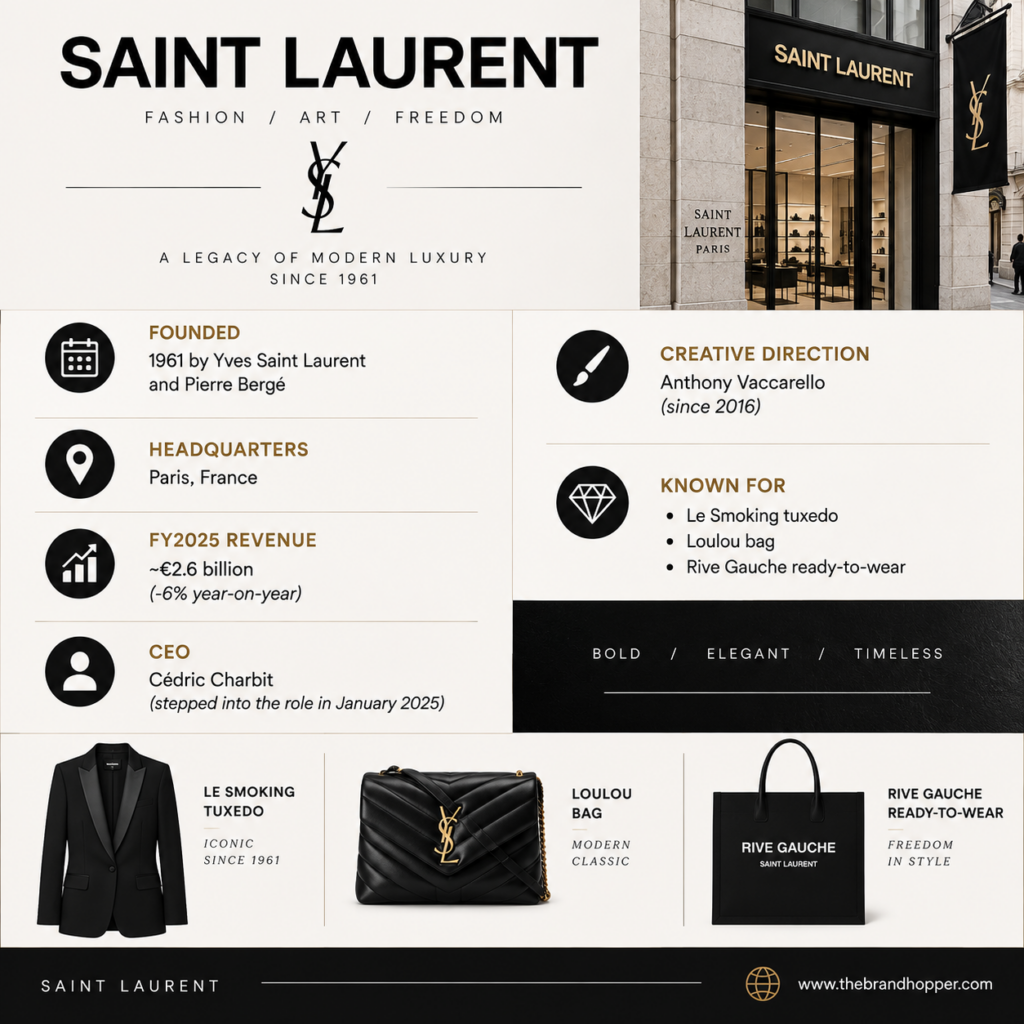
Saint Laurent is Kering’s second-largest house and one of the most architecturally coherent luxury brands in the world. Founded in 1961 by Yves Saint Laurent and Pierre Bergé, the house revolutionised fashion with the “Le Smoking” women’s tuxedo suit in 1966 and the concept of luxury prêt-à-porter through its Rive Gauche boutiques. Kering (then PPR) acquired the brand in 1999, and it underwent a dramatic brand repositioning from 2012 onward under then-creative director Hedi Slimane, who reintroduced the modern “Saint Laurent” name and a rock-inflected aesthetic.
Under Anthony Vaccarello, Creative Director since 2016, Saint Laurent has cemented a distinct identity of Parisian elegance with a subversive edge — tailored silhouettes, the iconic Loulou bag, and a confident minimalism that has proven highly durable across fashion cycles. Despite a 9% revenue decline in 2024, Saint Laurent has been one of Kering’s most resilient houses: its lower exposure to Asia and its price-conscious product mix (relative to Gucci) have insulated it partially from the broader luxury slowdown in the region.
Saint Laurent’s leather goods business — built around the Loulou, Kate, and Niki bags — has become a cornerstone of its commercial performance, complementing its fashion-forward ready-to-wear and shoe offerings. The brand operates a network of directly-owned stores in the world’s most prestigious shopping addresses and maintains a strong presence in the travel retail and duty-free channel. With consistent creative direction under Vaccarello and a brand identity that resonates strongly with younger luxury consumers, Saint Laurent is positioned as one of Kering’s most important future growth drivers as the overall luxury cycle recovers.
Key Highlights
- Architect of modern luxury ready-to-wear — Le Smoking (1966) remains one of fashion’s most iconic creations
- Consistent creative direction under Vaccarello (since 2016) has built enduring brand equity
- Leather goods (Loulou, Kate, Niki) now anchor commercial performance alongside ready-to-wear
- Less Asia-dependent than Gucci — provided relative resilience during the 2023–2024 luxury slowdown
3. Bottega Veneta
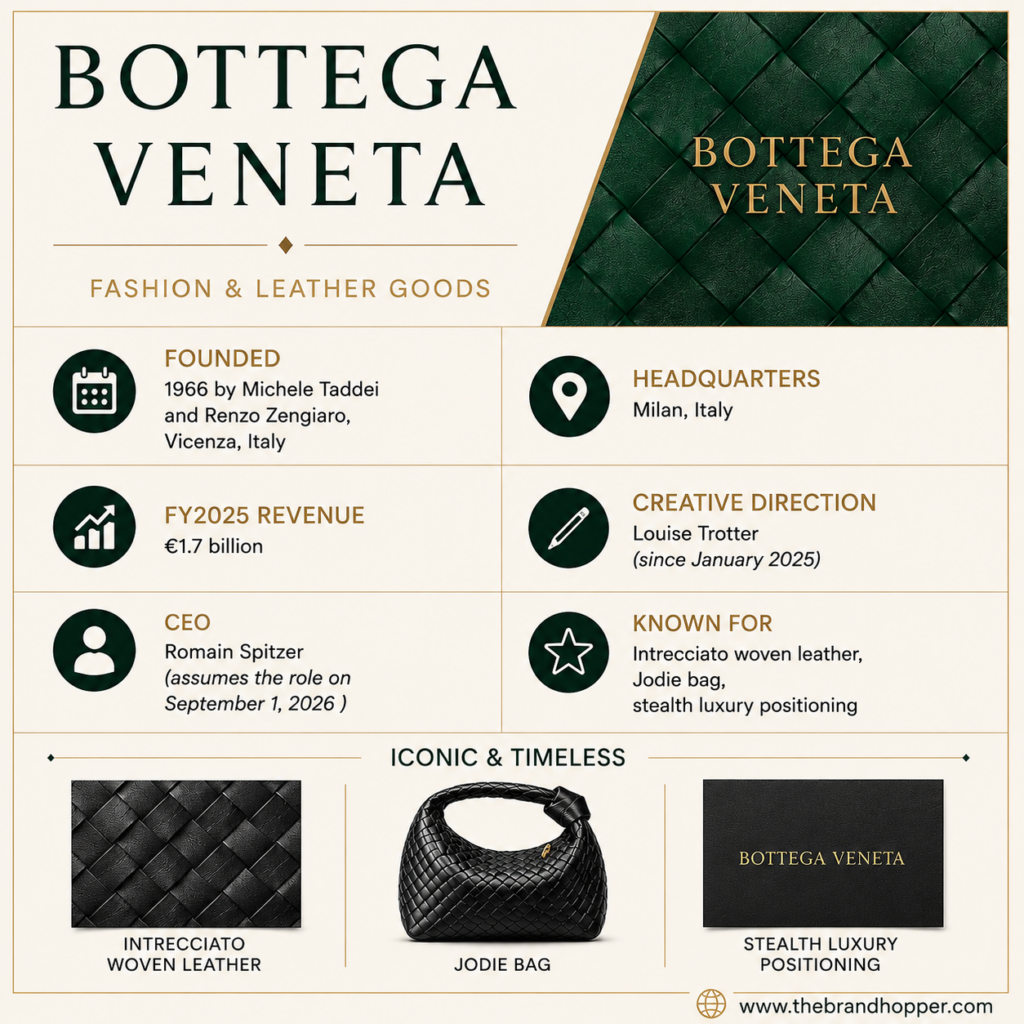
Bottega Veneta is Kering’s most consistent growth story among its major fashion houses, delivering €1.71 billion in revenue for 2024 making it the standout performer in a year when most luxury brands contracted. Founded in 1966 in Vicenza, Italy, Bottega Veneta has built its identity around the concept of “stealth luxury”: exquisite craftsmanship, the iconic Intrecciato woven leather technique, and a deliberate absence of visible branding that appeals to the most discerning ultra-high-net-worth consumers.
After the transformative tenure of Daniel Lee (2018–2021), whose Jodie bag and “new Bottega” identity energised the brand’s relevance with younger luxury consumers, Matthieu Blazy oversaw a period of consistent commercial success from 2022 until late 2024. Louise Trotter, who joined as Creative Director in January 2025 following stints at Lacoste and Cartier’s creative consultancy, is now charged with maintaining the brand’s premium positioning while expanding its commercial reach across categories including shoes, jewellery, and home.
Bottega Veneta’s success in a difficult macro environment underscores the power of genuine craftsmanship and brand coherence. The Cabat, Jodie, Cassette, and Andiamo bags have become modern icons. The brand’s deliberate restraint on logo placement and its commitment to Venetian artisanal techniques (much of the production remains in the Veneto region of Italy) make it the archetype of “quiet luxury” — a trend that has gained significant cultural momentum globally and that positions Bottega Veneta favourably as consumers increasingly seek substance over spectacle.
Key Highlights
- Only major Kering house to grow in 2025 — outstanding in a difficult market
- Pioneer of “stealth luxury” — no visible logo, pure craftsmanship appeal to ultra-high-net-worth consumers
- Intrecciato weave and Jodie bag are modern icons; production anchored in Veneto, Italy
- Louise Trotter (since Jan 2025) maintaining brand continuity and expanding lifestyle categories
4. Balenciaga
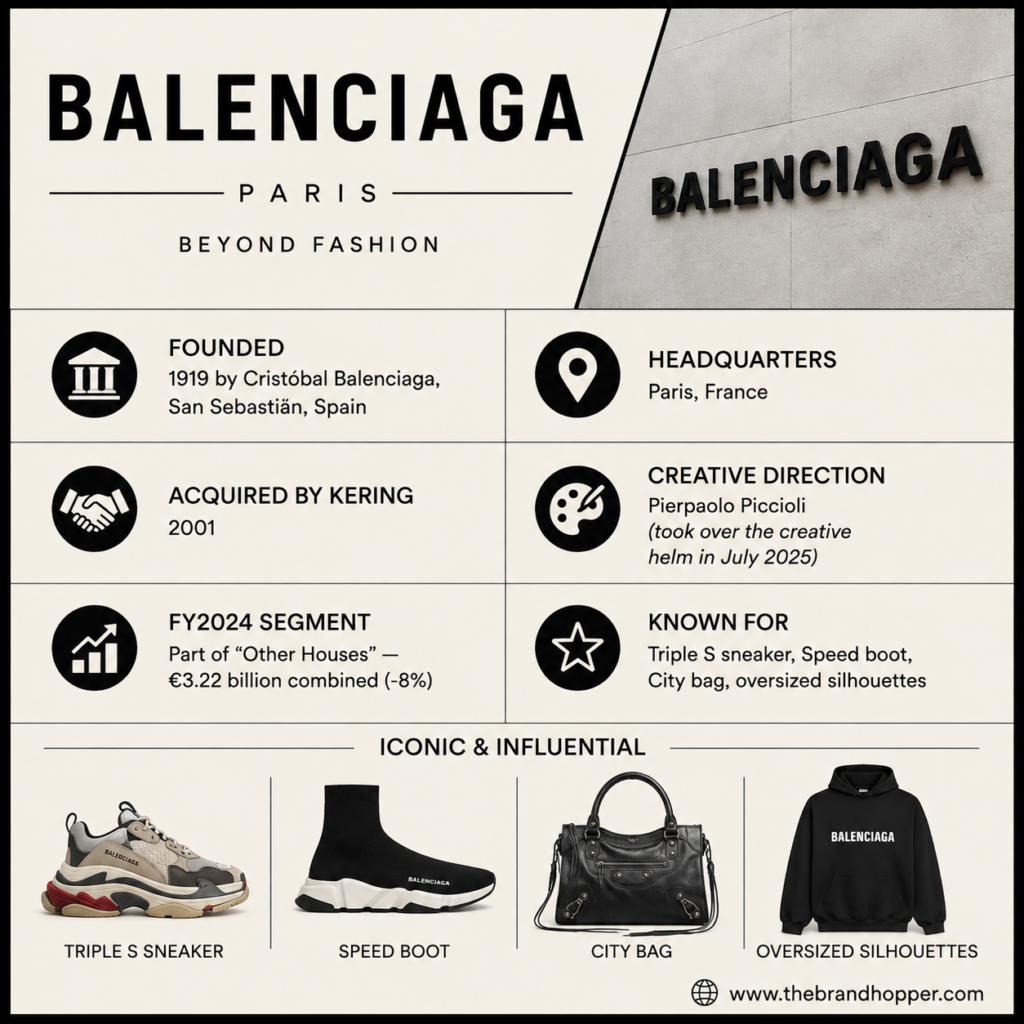
Balenciaga is one of fashion’s most culturally powerful brands — a house that has consistently defined the conversation at the intersection of luxury, streetwear, and cultural commentary. Founded in 1919 by the Spanish master couturier Cristóbal Balenciaga, who was revered by Christian Dior as “the master of us all,” the brand was acquired by Kering in 2001 and relaunched as a contemporary luxury powerhouse. Under Demna (Gvasalia), Creative Director from 2015 to mid-2025, Balenciaga became synonymous with boundary-pushing aesthetics — the Triple S platform sneaker, the Political Campaign hoodie, and an advertising universe that blurred luxury and provocation.
Balenciaga’s leather goods performed well in 2024, with the City bag and newer silhouettes continuing to attract significant demand, even as the brand worked through reputational challenges. In July 2025, Demna departed Balenciaga for Gucci, marking the end of a defining creative era. The house faces the complex challenge of sustaining its cultural authority while establishing a new creative voice for the post-Demna chapter. Its parent, Kering, has an exceptional track record of navigating creative transitions at its houses.
Balenciaga’s commercial legacy under Demna is exceptional: the brand grew from a niche couture name to a multi-billion-euro global phenomenon, capturing extraordinary relevance among Gen Z and millennial luxury consumers. The Triple S sneaker and Speed sock boot became cultural artefacts, while Balenciaga’s fashion shows — held in unusual venues from a disused shopping mall to an outdoor mud track — became global media events. The brand’s future direction will be closely watched as one of luxury fashion’s most significant creative succession stories.
Key Highlights
- Founded 1919; Cristóbal Balenciaga was the undisputed master of twentieth-century couture
- Under Demna (2015–2025): Triple S, Speed boot, City bag became global luxury streetwear icons
- Demna departed for Gucci in July 2025 — new creative direction being established for this iconic house
- Strong leather goods performance even through transitional period
5. Alexander McQueen
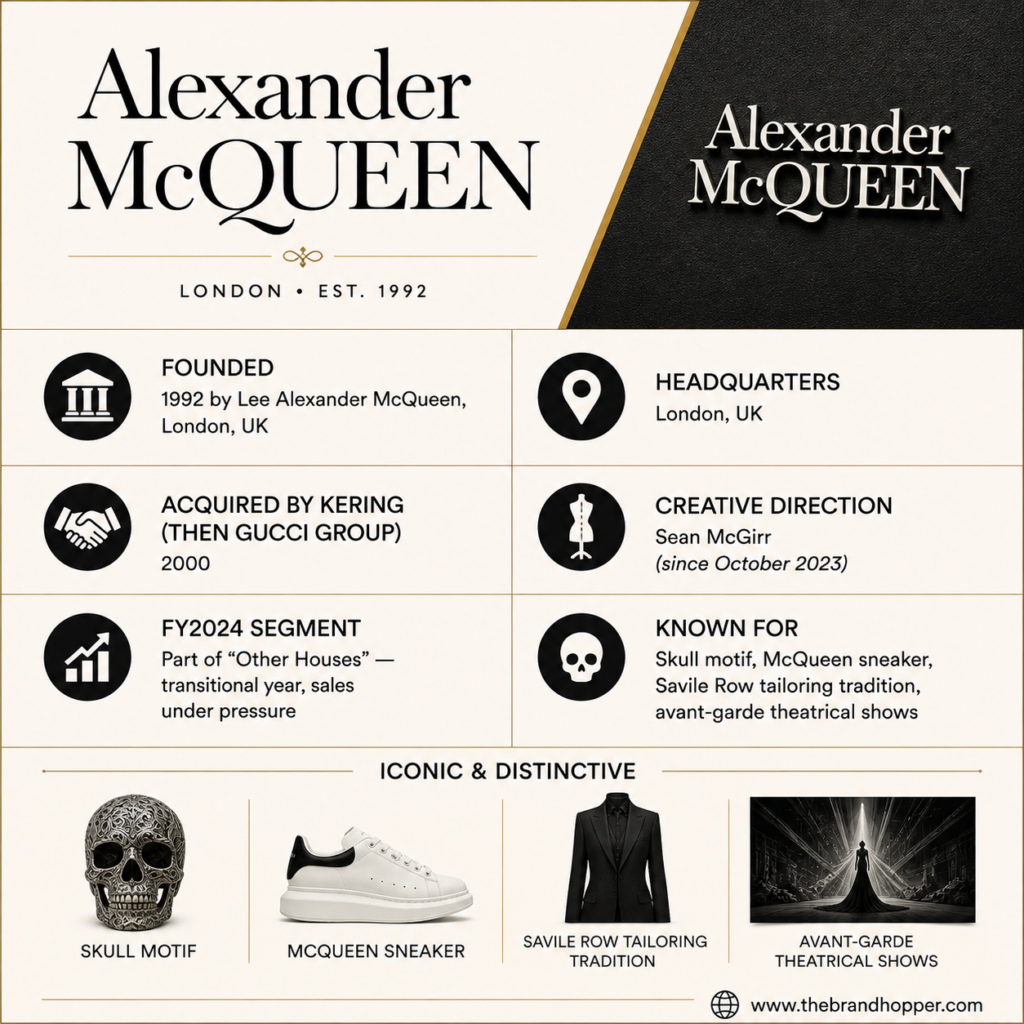
Alexander McQueen is one of British fashion’s most celebrated houses, founded in 1992 by the late Lee Alexander McQueen — widely regarded as the most technically gifted and theatrically visionary designer of his generation. The brand was acquired by Kering’s predecessor (Gucci Group) in 2000. After Lee’s death in 2010, Creative Director Sarah Burton sustained the house’s distinctive combination of dark romanticism and impeccable tailoring for over a decade until her departure in late 2023.
Sean McGirr, formerly a senior designer at JW Anderson, was appointed Creative Director in October 2023, marking a fresh start for the house. His tenure’s early seasons have generated significant industry attention, though the transition has weighed on sales: Kering noted in its 2024 results that Alexander McQueen’s revenues were under pressure as it worked through its creative transition. The brand’s iconic products — the skull-motif scarf, the McQueen sneaker (one of the most sold luxury sneakers globally), and its sharply tailored suiting — maintain strong brand equity.
Alexander McQueen’s positioning as an edgy, artisanal British luxury house with a strong commitment to craft (much of its tailoring is rooted in the Savile Row tradition) differentiates it clearly within the Kering portfolio. The McQueen sneaker has been a commercial standout, consistently ranking among the highest-selling luxury sneakers globally. As McGirr’s vision for the house becomes clearer and production evolves accordingly, Alexander McQueen is expected to return to growth as one of Kering’s most distinctive and beloved brand assets.
Key Highlights
- Founded by the legendary Lee Alexander McQueen — one of fashion’s most revered creative visionaries
- Sean McGirr appointed Creative Director February 2024, bringing a new chapter to an iconic British house
- McQueen sneakers remain one of the world’s best-selling luxury sneakers globally
- Distinctive Savile Row tailoring heritage combined with avant-garde theatricality
6. Brioni
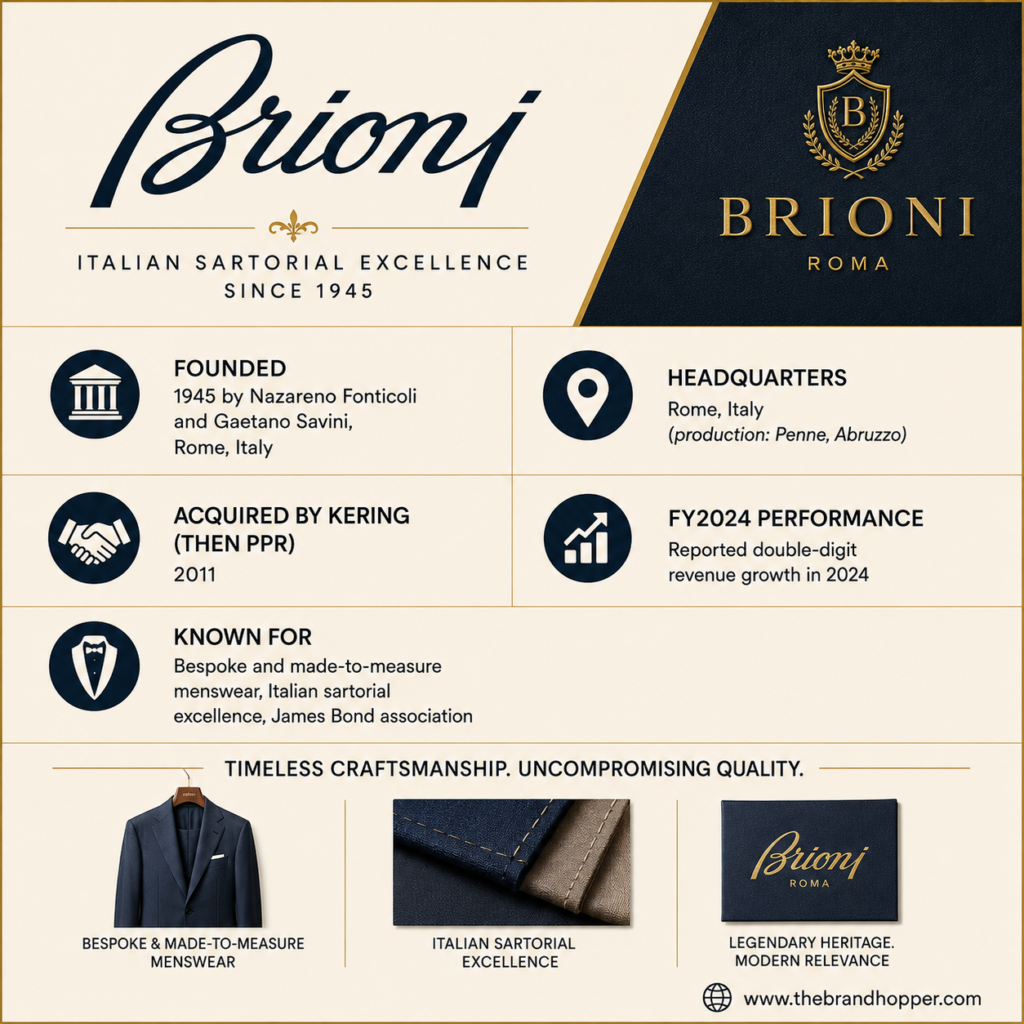
Brioni is the undisputed pinnacle of Italian men’s tailoring — a brand synonymous with bespoke craftsmanship, impeccable suiting, and a client list that has included five US Presidents, multiple heads of state, and generations of Hollywood royalty. Founded in Rome in 1945 by master tailor Nazareno Fonticoli and entrepreneur Gaetano Savini, Brioni became globally famous for dressing Pierce Brosnan’s James Bond in four films, cementing its association with refined, powerful masculinity. Kering acquired Brioni in 2011.
Brioni stands out as one of Kering’s brightest performers in 2024, delivering double-digit revenue growth against a backdrop of widespread luxury sector weakness. Its success reflects the resilience of ultra-luxury menswear: Brioni’s clients tend to be mature, high-net-worth individuals with stable purchasing power who are less sensitive to cyclical downturns than aspirational luxury consumers. The brand’s atelier in Penne, Abruzzo, employs skilled craftspeople who undergo years of training in Brioni’s proprietary tailoring techniques.
Brioni’s suits begin at approximately €4,000 for made-to-measure and can exceed €50,000 for full bespoke commissions incorporating hand-stitching and exclusive fabrics. The brand has been expanding its ready-to-wear and accessories range to complement its heritage tailoring business, and has invested in store renovations in key markets including New York, London, Tokyo, and the Middle East. Its exclusivity, craftsmanship heritage, and strong connection to a loyal ultra-wealthy clientele make Brioni one of the most distinctive assets in the Kering portfolio.
Key Highlights
- Delivered double-digit revenue growth in 2024 — one of Kering’s standout performers
- Dressed five US Presidents and four James Bond films — the epitome of global prestige tailoring
- Artisanal atelier in Penne, Abruzzo with craftspeople trained in proprietary techniques
- Ultra-luxury clientele (suits from €4,000+) provides insulation from luxury cycle downturns
7. Boucheron
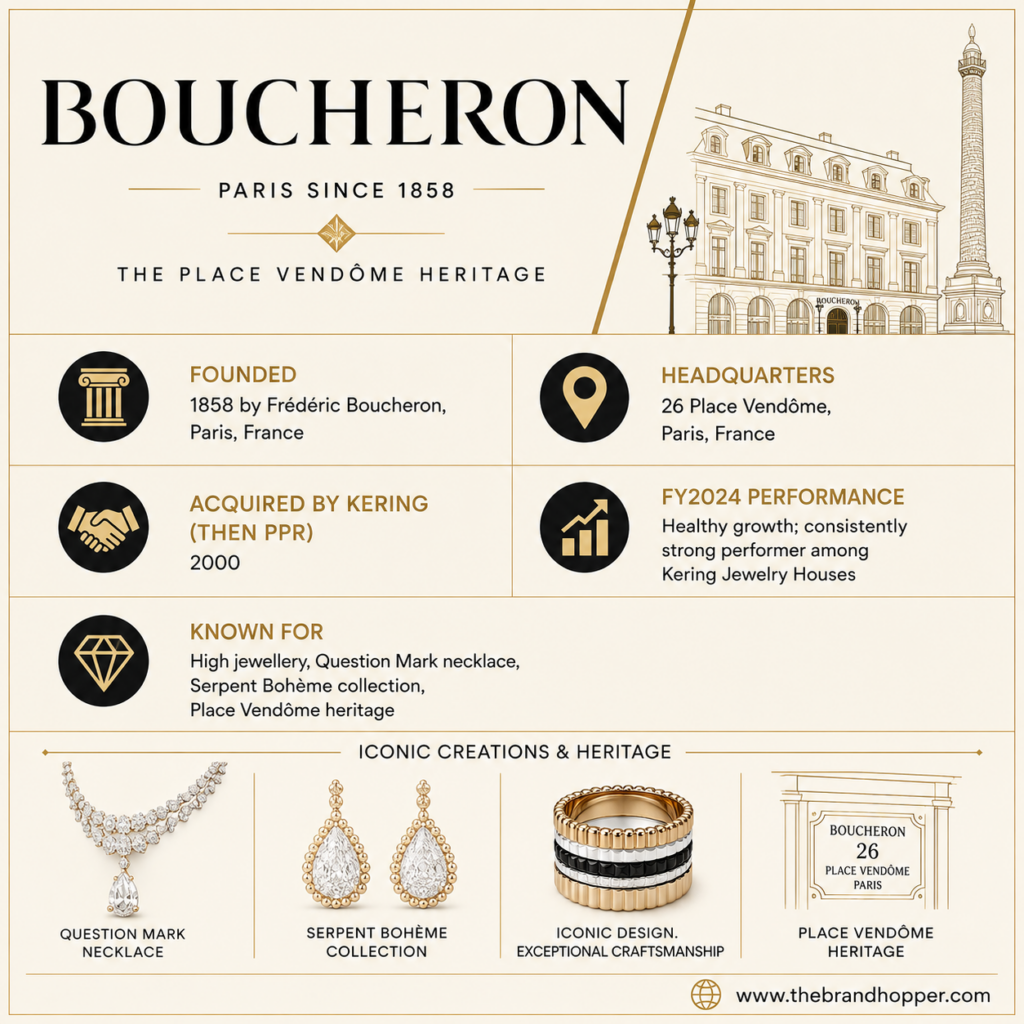
Boucheron holds a singular place in fine jewellery history: founded by Frédéric Boucheron in 1858, it was the first house to establish itself at 26 Place Vendôme in Paris in 1893 — the legendary address that became the world’s most prestigious jewellery destination. Frédéric Boucheron chose the address strategically for its maximum exposure to winter sunlight, which would make his gemstones sparkle most brilliantly — a story that encapsulates the house’s commitment to light, sparkle, and artisanal excellence that has endured for over 165 years.
Boucheron is consistently the most commercially successful of Kering’s Jewelry Houses. In 2024, when the combined Jewelry Houses segment generated approximately €1 billion in revenues, Boucheron was singled out by Kering management for “particularly healthy performance.” Its iconic high jewellery collections — including the Question Mark necklace (a transformable jewel worn in multiple ways) and the Serpent Bohème line — maintain exceptionally strong global demand, particularly in the Middle East, Asia Pacific, and among Boucheron’s historic European clientele.
Under Creative Director Claire Choisne, Boucheron has developed a distinctive creative vision built on narrative jewellery — each high jewellery collection tells an elaborate story through its gemstones, materials, and forms. The Hiver Impérial, Contemplation, and Holographique collections have earned critical acclaim and strong demand at auction. Boucheron’s position at the heart of Place Vendôme, its 165-year heritage, and its commitment to couture-level high jewellery craftsmanship position it as a genuine rival to Cartier and Van Cleef & Arpels in the rarefied world of ultra-luxury fine jewellery.
Key Highlights
- First jewellery house on Place Vendôme (1893) — over 165 years of Parisian fine jewellery heritage
- Consistently strongest commercial performer among Kering’s Jewelry Houses
- Question Mark necklace and Serpent Bohème are iconic modern jewellery references
- Creative Director Claire Choisne’s narrative high jewellery collections are critically acclaimed globally
8. Pomellato
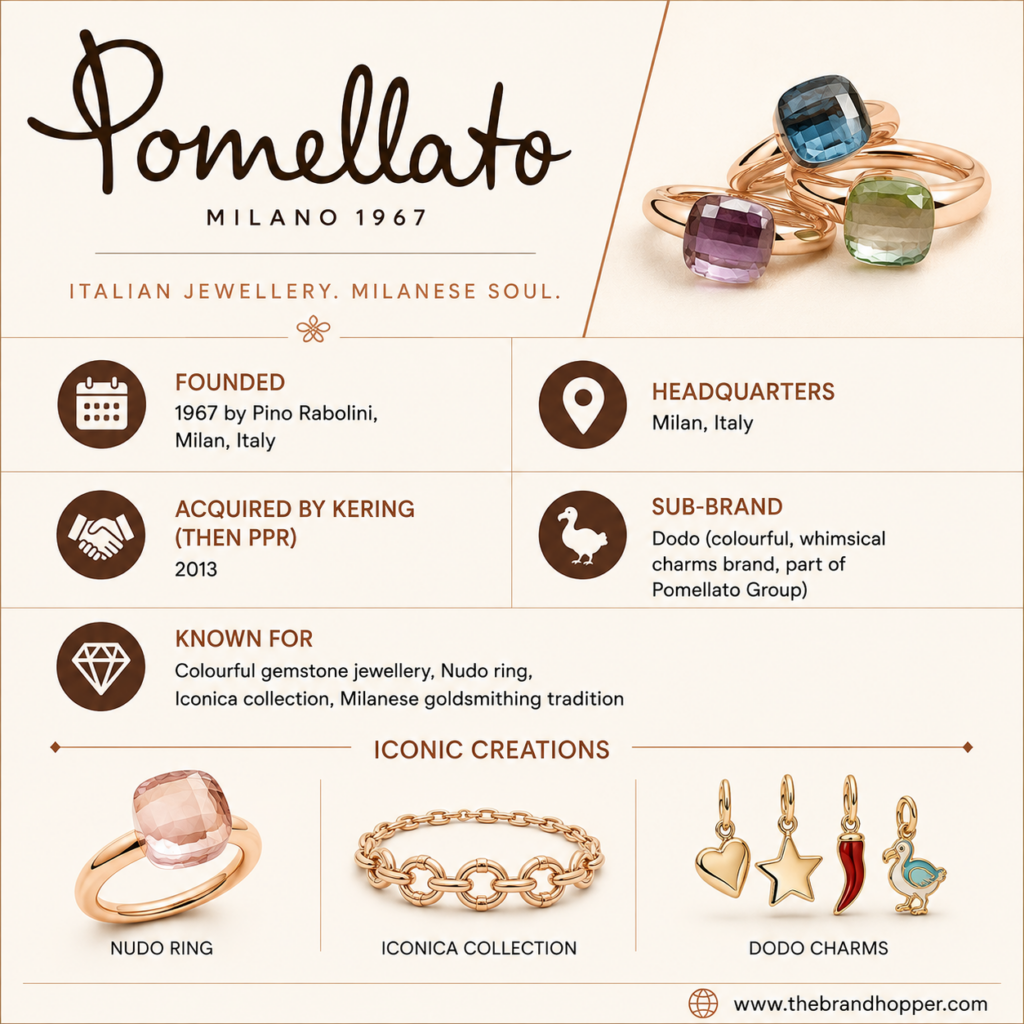
Pomellato is a uniquely positioned luxury jewellery brand — vibrant, colourful, and feminine in a way that is distinctly different from the architectural grandeur of Paris’s Place Vendôme maisons. Founded in 1967 in Milan by goldsmith Pino Rabolini, Pomellato pioneered the concept of “prêt-à-porter jewellery” — high-quality, colourful gemstone pieces designed to be worn every day rather than locked in a vault. The brand’s signature Nudo ring, with its cushion-cut semi-precious stone set in a delicate frame designed to “hug” the finger, has been a global bestseller since its launch in 2000.
Pomellato’s appeal is built on the vivid colour palette of its stones — prasiolite, blue topaz, amethyst, turquoise, garnet — and on a design philosophy rooted in Milanese goldsmithing tradition. Its collections, including Iconica, Nudo, and M’ama Non M’ama, have a consistent visual identity that is immediately recognisable. Pomellato has been an early and consistent advocate of responsible sourcing, obtaining Fairtrade certified gold for its products and committing to responsible gemstone supply chains — important differentiators in a jewellery market increasingly scrutinised for sourcing ethics.
Pomellato’s group also includes Dodo, a colourful Italian jewellery brand known for its whimsical charm collections. Dodo targets a younger, more accessible luxury price point with gold and silver charms, bracelets, and necklaces that capture the playful energy of Italian design. Together, Pomellato and Dodo offer Kering breadth across the Italian fine jewellery market — from accessible luxury (Dodo) to high jewellery adjacent (Pomellato’s Rainbow and Pom Pom Dot collections).
Key Highlights
- Pioneer of “prêt-à-porter jewellery” — colourful, wearable, distinctive Milanese goldsmithing style
- Nudo ring (launched 2000) remains a global bestseller across multiple gemstone colours
- Early adopter of Fairtrade certified gold and responsible gemstone sourcing
- Dodo sub-brand extends Kering’s jewellery reach into accessible luxury for younger consumers
9. Qeelin
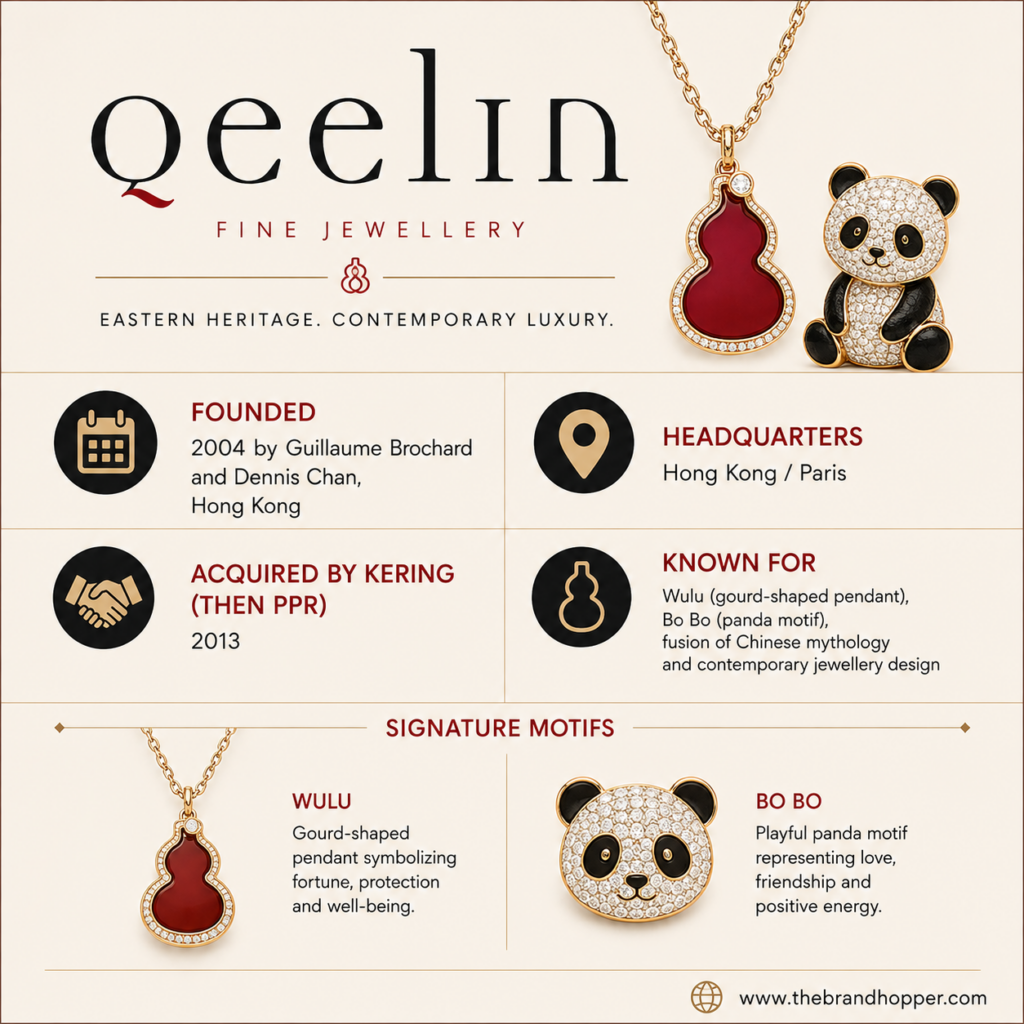
Qeelin is Kering’s most distinctively positioned jewellery house — a brand that fuses the rich symbolism of Chinese mythology and cultural iconography with the craft standards of high jewellery. Founded in Hong Kong in 2004 by Guillaume Brochard and creative director Dennis Chan, Qeelin was created as the first true Chinese fine jewellery brand with global luxury ambitions. Kering acquired it in 2013, recognising its strategic importance as an authentic bridge between Chinese cultural heritage and the international luxury market.
Qeelin’s signature pieces draw deeply from Chinese auspicious symbolism. The Wulu collection centres on the gourd shape — a powerful symbol of happiness, health, and longevity in Chinese culture — rendered in gold and diamonds at various price points from fine jewellery to high jewellery. The Bo Bo collection features pandas rendered in gold, onyx, and diamonds, drawing on one of China’s most beloved cultural symbols. This approach gives Qeelin an authenticity and cultural resonance in the Chinese luxury market that no Western jewellery house can replicate.
As Kering pursues growth in Asia, particularly in China, Qeelin’s strategic importance has grown. The brand is expanding its store network and brand awareness through collaborations with Chinese cultural institutions, digital engagement on platforms including Weibo and WeChat, and by hosting high-profile events during key Chinese cultural moments such as Lunar New Year. Its relatively small current scale represents significant upside potential as Chinese consumers increasingly seek culturally resonant luxury alternatives to Western brands.
Key Highlights
- First authentic Chinese luxury fine jewellery brand with global ambitions — unique cultural positioning
- Wulu (gourd) and Bo Bo (panda) collections draw on deep Chinese auspicious symbolism
- Strategic asset for Kering’s China growth strategy — cultural authenticity no Western brand can match
- Expanding digital presence on Weibo and WeChat, leveraging Chinese cultural moments for brand engagement
Strategic Subsidiaries & Partnerships
1. Kering Eyewear
Kering Eyewear, founded in 2014 and headquartered in Padua, Italy, is one of the world’s leading luxury eyewear companies. It designs, manufactures, and distributes sunglasses and optical frames for Kering’s own fashion houses (Gucci, Saint Laurent, Bottega Veneta, Balenciaga, Alexander McQueen, and others) as well as for selected licensed third-party luxury brands.
Kering Eyewear represents a significant value-creation vehicle: by bringing eyewear in-house rather than licensing to third-party manufacturers, Kering captures more of the product value chain and ensures quality control over a high-margin product category that is central to each house’s accessories business.
2. Kering Beauté (Sold to L’Oréal)
Kering Beauté was established as a beauty and fragrance subsidiary to manage the beauty licenses of Kering’s fashion houses and to develop owned fragrance brands, most significantly Creed — the iconic British-French parfum house acquired by Kering in 2023.
In December 2025, Kering announced that Kering Beauté would be sold to L’Oréal for €4 billion, with the transaction expected to close in the first half of the following year. The sale allows Kering to reduce its €9.5 billion debt load and refocus capital on its core luxury fashion and jewellery houses under new CEO Luca de Meo’s strategic review. Following the sale, fragrance and beauty licenses for Kering’s houses (Gucci, Balenciaga, etc.) will be managed through L’Oréal’s luxury division.
3. Valentino: 30% Strategic Stake
In November 2023, Kering completed the acquisition of a 30% shareholding in Valentino from Qatari investment fund Mayhoola for €1.7 billion. The agreement originally included an option for Kering to acquire 100% of Valentino, but this timeline has been amended: full acquisition options are now deferred to 2028 and 2029.
Kering and Mayhoola have also agreed to inject €100 million into Valentino to support its financial position after the Italian fashion house reported a challenging 2024 (revenue declined 2% to €1.3 billion; EBITDA fell 22%). Valentino’s stabilisation and potential full integration remains a medium-term strategic option for the group.
Kering Financial Performance: FY2024 Results
Kering’s 2024 annual results, published February 11, 2025, reflect a challenging year for the luxury sector globally — particularly in China, which had been the primary growth engine for luxury demand in the post-pandemic period.
The group’s total revenue of €17.2 billion represents a 12% decline in reported terms, driven primarily by a significant contraction at Gucci. The following table summarises performance by brand segment.
| Brand / Segment | FY2024 Revenue | YoY Change | Key Commentary |
| Gucci | ~€7.65 billion | -23% | Creative transition year; CEO Stefano Cantino; Demna appointed AD July 2025 |
| Saint Laurent | ~€2.881 billion | -9% | Resilient performance; Vaccarello’s consistent creative direction maintained |
| Bottega Veneta | €1.71 billion | +4% (+6% comparable) | Standout performer; “quiet luxury” positioning driving sustained demand |
| Other Houses* | ~€3.22 billion | -8% | Brioni: double-digit growth; Alexander McQueen: transitional pressure |
| Jewelry Houses** | ~€1.0 billion | Healthy growth | Boucheron: particularly strong; Pomellato and Qeelin progressing |
| Total Group | €17.2 billion | -12% | Macroeconomic headwinds; China slowdown; luxury cycle contraction |
* Other Houses includes Balenciaga, Alexander McQueen, Brioni, and others.
** Jewelry Houses includes Boucheron, Pomellato, Dodo, and Qeelin.
| Source: Kering Press Release — 2024 Annual Results (February 11, 2025). All figures are as reported in euros. Year-on-year changes are on a reported basis unless otherwise noted. |
Kering’s Sustainability Leadership
Kering has established itself as the most ambitious sustainability practitioner in the global luxury industry, pioneering tools and frameworks that have since been adopted across the fashion and luxury sector. Its sustainability strategy operates across three pillars: care for the environment, care for people, and care for creativity.
1. Environmental Profit & Loss (EP&L)
Kering’s most significant contribution to corporate sustainability is the Environmental Profit & Loss (EP&L) account — a proprietary methodology that quantifies and monetises the environmental impact of the group’s entire operations and supply chain. The EP&L translates impacts including greenhouse gas emissions, air and water pollution, water consumption, land use, and waste into monetary terms, enabling Kering to measure and compare the true environmental cost of its business decisions. Kering has committed to reducing its EP&L footprint by 40% by 2025 relative to its growth trajectory (baseline: 2015).
2. Carbon and Climate Commitments
Kering has committed to achieving carbon neutrality across its own operations and is targeting a 50% reduction in absolute carbon emissions across its supply chain. The group has been carbon neutral across its own direct operations since 2018, offsetting residual emissions through high-quality verified projects. All Houses are required to integrate EP&L analysis into their operational and sourcing decisions, ensuring that environmental impact is treated as a real financial cost rather than an externality.
3. Responsible Materials & Sourcing
Kering requires all its Houses to source materials responsibly. Pomellato uses Fairtrade certified gold; Gucci and other leather goods houses work within Kering’s Material Innovation Lab, which researches and validates sustainable alternatives to conventional leather, exotic skins, and synthetic materials. The group’s “Crafting Tomorrow’s Luxury” programme sets minimum standards for supplier practices on human rights, environmental management, and transparency across the full supply chain.
4. Social Responsibility & Craft Preservation
Kering’s Care Programme focuses on the wellbeing of the approximately 46,930 employees across its houses. The group has published a social policy charter, supports gender equality initiatives (Kering’s Board has been gender-balanced for several years), and has launched the Kering Foundation — focused on combating violence against women globally. Kering also invests in artisanal craft preservation through its Houses’ dedicated ateliers: Brioni in Penne, Bottega Veneta in the Veneto, and Gucci and Saint Laurent in Tuscany are all key sites of Italian and French luxury craftsmanship heritage.
Kering vs. LVMH: How the Luxury Giants Compare
Kering’s most direct and formidable competitor is LVMH Moët Hennessy Louis Vuitton — the world’s largest luxury goods group. The rivalry between these two French conglomerates defines much of the competitive dynamics in global luxury. For a detailed analysis of LVMH’s strategy, see: The Magic of LVMH: Exploring the Marketing Strategy of Luxury Empire.

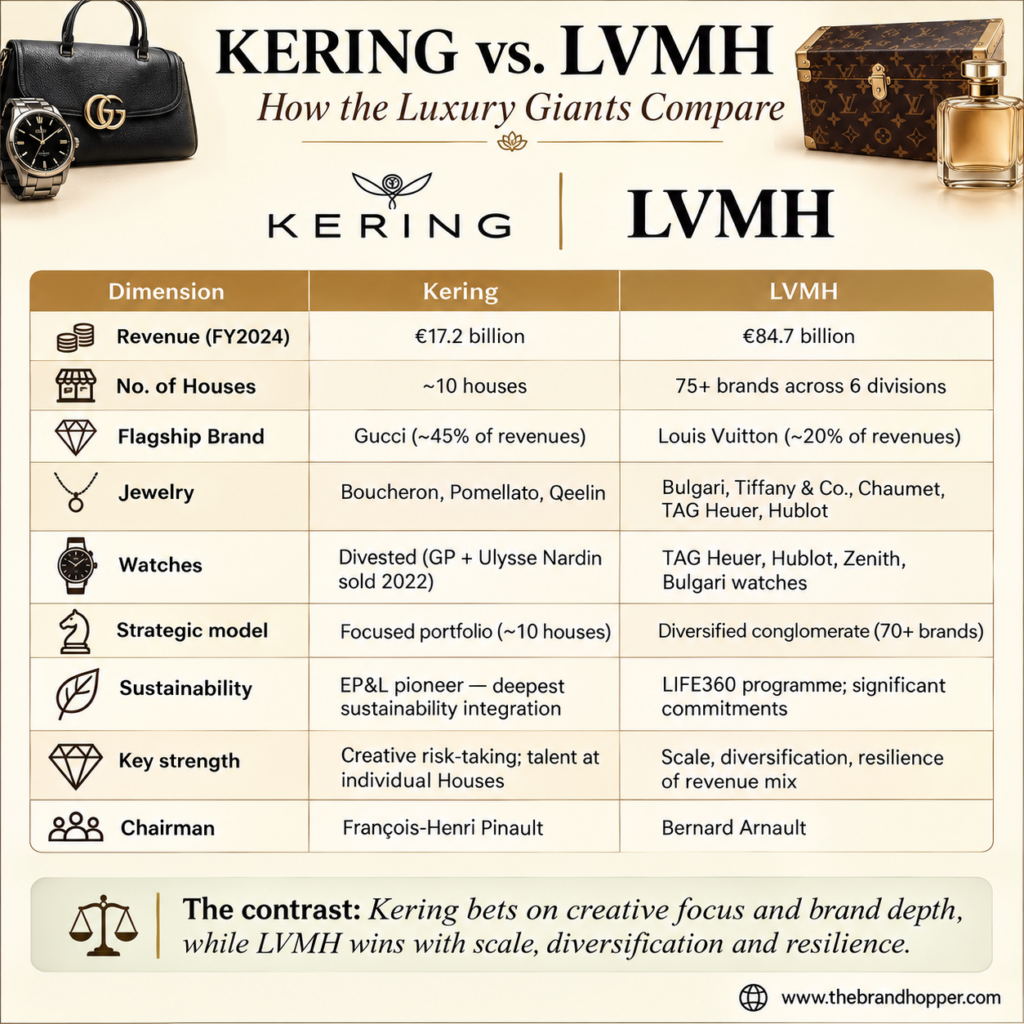
The fundamental strategic difference between Kering and LVMH is one of focus versus diversification. LVMH’s portfolio of 75+ brands across fashion, watches, jewellery, wines & spirits, perfumes & cosmetics, and selective retailing provides extraordinary revenue resilience — when one segment softens, others compensate. Kering’s tighter portfolio of ~10 houses means its financial performance is more sensitive to the fortunes of individual brands, particularly Gucci. This concentration risk has been apparent in 2024, where Gucci’s 23% decline significantly dragged group performance. However, Kering’s focused model also enables deeper investment in each house and a sharper creative identity for each brand — a genuine competitive advantage when the creative direction is right.
Leadership & Governance
Kering underwent a significant governance transformation in 2025. For the first time in the company’s history, the roles of Chairman and CEO were formally separated — bringing Kering’s governance structure in line with best practices for large publicly listed companies.
| Chairman | François-Henri Pinault — Chairman of the Board; son of founder François Pinault; led Kering as CEO from 1999 to 2025; architect of the luxury transformation strategy |
| CEO | Luca de Meo — appointed CEO September 15, 2025; formerly CEO of Renault Group; prior roles at Fiat, Volkswagen Group (Head of Sales), Audi (CEO), and SEAT (CEO) |
| Major Shareholder | Pinault family (via Financière Pinault / Artémis): ~42% capital, ~57% voting rights |
| Listed | Euronext Paris — KER (CAC 40 constituent) |
| Board Structure | Independent directors hold majority of Board seats; gender-balanced Board composition |
Luca de Meo brings a distinctive profile to Kering — an auto-industry leader known for product-centred strategy, brand building, and commercial turnaround execution. His tenure at Renault (where he revitalised the brand’s product portfolio and positioned it for the EV transition) and his earlier work at Audi and SEAT are seen as evidence of his ability to reinvigorate brands at an inflection point. De Meo has identified debt reduction (from approximately €9.5 billion), the Gucci turnaround, and portfolio focus (including the Kering Beauté divestiture) as his early strategic priorities.
Conclusion
Kering stands at one of the most consequential inflection points in its history. After decades of transformational growth that turned a timber company into a global luxury powerhouse, the group is navigating a period of acute challenge: a Gucci reset, significant management transition, macroeconomic headwinds in its most important growth market (China), and a debt load that requires active management. Yet the foundations for recovery are being laid with unusual clarity and ambition.
The appointment of Demna at Gucci is the boldest creative bet in Kering’s history — one that acknowledges the need for radical reinvention while betting on a designer with an extraordinary track record of brand transformation. Luca de Meo brings a fresh external perspective and a commercial rigour honed across some of the world’s most competitive industrial companies. The Kering Beauté divestiture to L’Oréal provides capital to reduce leverage and reinvest in core houses. And Bottega Veneta’s continued growth demonstrates that at least one of Kering’s major houses is firing on all cylinders, providing evidence that the portfolio model works when the creative and commercial conditions are right.
The luxury industry has proved its long-term resilience across multiple cycles. As Chinese consumer confidence recovers, as Gucci’s creative reinvention takes hold in the market, and as the group’s other houses — Saint Laurent, Boucheron, Brioni, and Bottega Veneta — continue to build their respective scale and prestige, Kering is positioning itself for a return to sustainable, profitable growth. The question is not whether Kering will recover, but how quickly and how completely — and whether the Demna-led Gucci chapter will prove as transformative as the story demands
Frequently Asked Questions (FAQs)
Q1: How many brands does Kering own?
A: Kering currently owns ten luxury houses: Gucci, Saint Laurent, Bottega Veneta, Balenciaga, Alexander McQueen, Brioni (fashion & leather goods) and Boucheron, Pomellato (including Dodo), and Qeelin (jewelry). Kering also holds a 30% strategic stake in Valentino and operates Kering Eyewear. The group previously owned Girard-Perregaux and Ulysse Nardin (sold 2022) and Christopher Kane (sold 2019).
Q2: Who owns Kering?
A: Kering is a publicly listed company on Euronext Paris (ticker: KER). The Pinault family, through their holding company Financière Pinault (formerly Artémis), holds approximately 42% of Kering’s share capital and 57% of voting rights. The company’s Chairman is François-Henri Pinault, and CEO is Luca de Meo (since September 2025).
Q3: Who is the CEO of Kering?
A: Luca de Meo became CEO of Kering on September 15, 2025, following approval at a shareholder meeting. De Meo previously served as CEO of Renault Group and has held senior executive roles at Fiat, Volkswagen Group, and Audi. This appointment separated the Chairman and CEO roles for the first time, with François-Henri Pinault remaining as Chairman of the Board.
Q4: What happened to Gucci’s creative director?
A: Gucci appointed Demna (formerly Demna Gvasalia of Balenciaga) as its new Artistic Director in early 2025, effective July 2025. Demna succeeded Sabato De Sarno, who had a brief tenure. Demna delivered his first Gucci runway show in February 2026, marking a new creative era for the house. His appointment is widely regarded as Kering’s most important creative decision in a decade, given Gucci’s central role in the group’s financial performance.
Q5: Is Valentino owned by Kering?
A: Kering holds a 30% strategic stake in Valentino, acquired in November 2023 for €1.7 billion from Qatari investment fund Mayhoola. The original agreement gave Kering an option to acquire 100% of Valentino, but this timeline has been amended: Kering’s full acquisition option has been deferred to 2029, with Mayhoola’s put options also postponed to 2028 and 2029. Valentino is not currently consolidated as a Kering subsidiary.
Q6: What was Kering’s revenue in 2024?
A: Kering reported full-year 2024 revenue of €17.2 billion, a decline of 12% in reported terms. Gucci (€7.65 billion, -23%) was the primary driver of the decline, while Bottega Veneta (€1.71 billion, +4%) was the standout growth performer. Saint Laurent (€2.9 billion, -9%) and the Other Houses group (Balenciaga, Alexander McQueen, Brioni, etc.; €3.22 billion, -8%) also contracted. Kering’s Jewelry Houses delivered approximately €1 billion collectively, with Boucheron recording healthy growth.
Q7: How does Kering approach sustainability?
A: Kering is widely regarded as one of the most sustainability-focused luxury groups in the world. The group pioneered the Environmental Profit & Loss (EP&L) methodology — an accounting tool that translates environmental impacts (greenhouse gas emissions, water use, land use, air and water pollution) into monetary values across the entire supply chain. Kering has set targets to reduce its EP&L footprint by 40% by 2025 relative to growth (2015 baseline), committed to carbon neutrality across its brands, and requires suppliers to meet strict standards on materials sourcing, including Fairtrade certified gold for Pomellato.
Q8: What is Kering Eyewear?
A: Kering Eyewear is a dedicated subsidiary created in 2014 that designs, manufactures, and distributes eyewear (sunglasses and optical frames) for Kering’s fashion houses (Gucci, Saint Laurent, Bottega Veneta, Balenciaga, Alexander McQueen, and others) as well as for selected licensed third-party luxury brands. Headquartered in Padua, Italy, Kering Eyewear has grown into a significant business and is one of the world’s leading luxury eyewear companies. It was previously part-owned by Richemont’s Cartier division in a joint venture, and Kering moved toward full ownership.
To read more content like this, subscribe to our newsletter
Go to the full page to view and submit the form.