


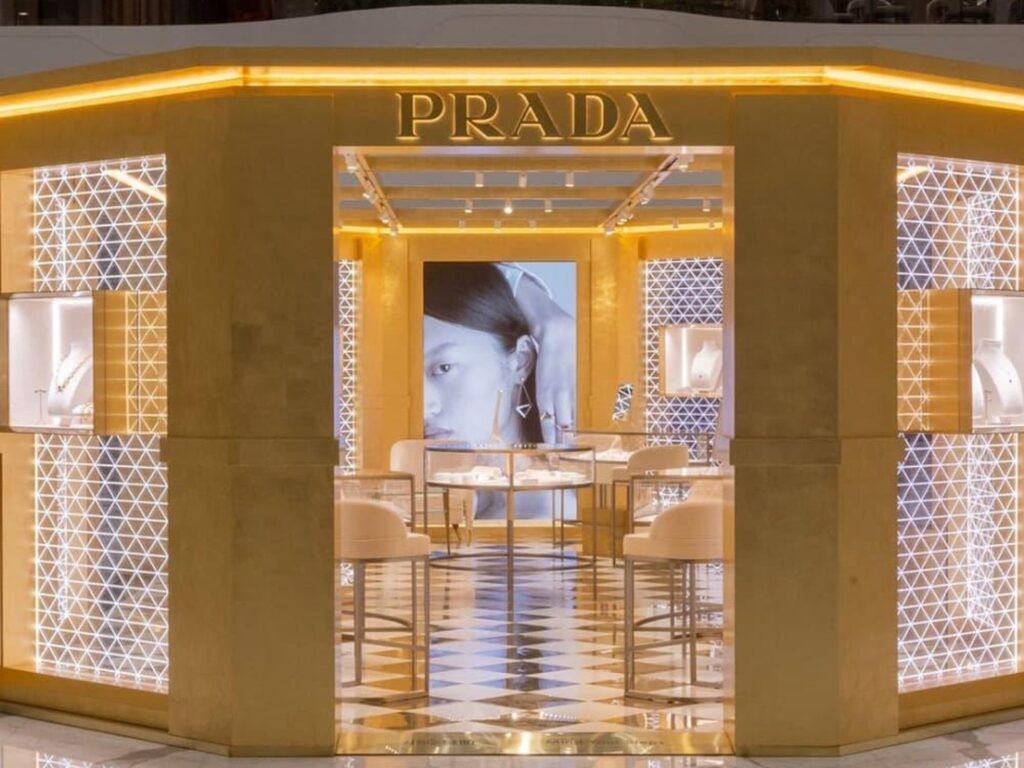
Prada is an Italian luxury fashion house founded in 1913 in Milan by Mario Prada. It specializes in leather handbags, travel accessories, shoes, ready-to-wear, and other fashion accessories. Prada licenses its name and branding to Luxottica for eyewear and L’Oréal for fragrances and beauty. In this article, we’ll delve into the marketing strategies and marketing mix of Italian ultra-luxury fashion house, Prada.
Prada is known for its high-quality, conceptually rigorous designs. The brand’s signature aesthetic is characterized by a blend of clean lines, unexpected silhouettes, and muted palettes disrupted by bold artistic gestures — an approach its creative directors describe as “ugly chic,” a deliberate challenge to conventional luxury beauty standards.
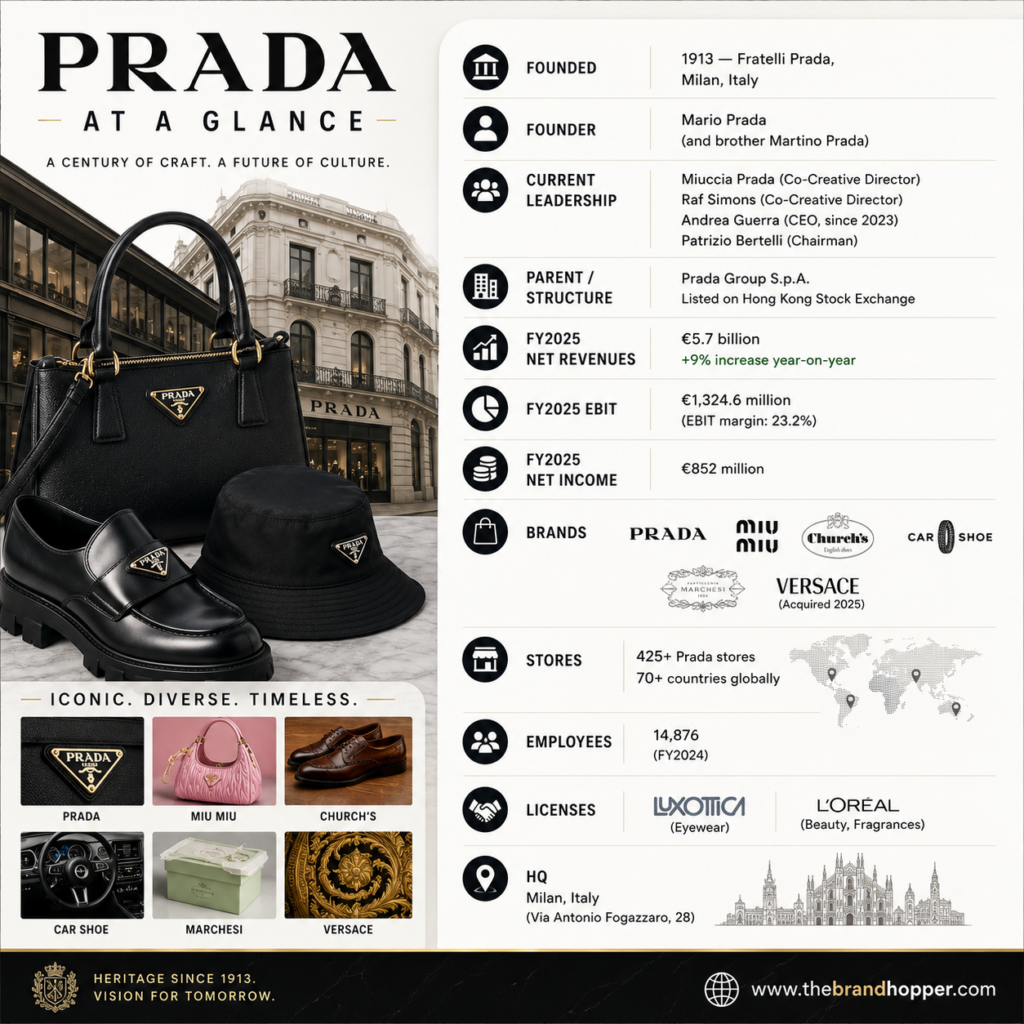
Today, the Prada Group is a global fashion powerhouse that generated net revenues of €5.4 billion in the financial year ended December 31, 2024 — a 17% increase at constant exchange rates. The Group operates 425+ Prada stores across 70+ countries and employs 14,876 people worldwide. Its brand portfolio includes Prada, Miu Miu, Church’s, Car Shoe, Pasticceria Marchesi, and — following a landmark acquisition in 2025 — Versace.
Prada continues to be shaped by the extraordinary vision of Miuccia Prada, who took over the company in 1978 and, alongside Belgian designer Raf Simons (appointed co-creative director in February 2020) and CEO Andrea Guerra (appointed January 2023), is positioning the Prada Group as a potential Italian answer to the French luxury conglomerates LVMH and Kering.

The Founding History of Prada: From Leather Goods to Global Fashion Powerhouse
Prada, one of the world’s most prestigious and influential luxury fashion houses, has a rich and storied founding history that dates back over a century. The brand was founded in 1913 by Mario Prada and his brother Martino in Milan, Italy, under the name “Fratelli Prada” (Prada Brothers). The store primarily offered leather goods, including handbags, luggage, and accessories, catering to an elite clientele from its landmark location within the Galleria Vittorio Emanuele II.
Mario Prada’s family legacy continued through his daughter Luisa, who ran the company for nearly twenty years, and then through his granddaughter, Miuccia Prada, who joined the company in 1970 and took over from Luisa in 1978. Miuccia brought a fresh, radical perspective — she held a PhD in political science and approached fashion as a form of cultural commentary.

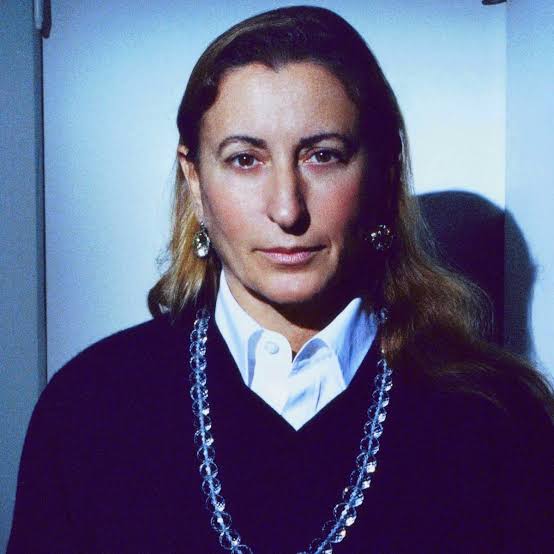
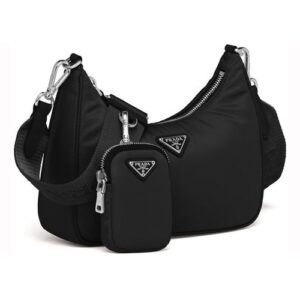
Under Miuccia’s guidance, and with the business acumen of her husband Patrizio Bertelli (who joined as business manager), Prada was transformed. She introduced the first line of luxury nylon handbags in 1979, using tough military-specification black nylon that her grandfather had used as trunk coverings. The lightweight, durable nylon bags, adorned with the now-famous Prada triangular logo, became an instant hit and a symbol of the brand’s modern and minimalist aesthetic.
The brand’s iconic black nylon backpack, introduced in 1984, became a defining accessory and a symbol of Prada’s distinctive blend of practicality and high fashion. In 1985, Miuccia released the “classic Prada handbag” — sleek, practical, and luxurious — which became an overnight sensation. Prada’s popularity surged among celebrities, fashion influencers, and trendsetters throughout the 1990s as the brand introduced women’s and men’s ready-to-wear collections and expanded its retail presence across fashion capitals worldwide.

In the late 1990s, the Prada Group expanded aggressively, acquiring Helmut Lang (1999), Jil Sander (1999), and Church’s (1999), and taking a joint stake in Fendi (1999) alongside LVMH. The group subsequently divested several of these acquisitions to manage debt, but retained Church’s as part of its core portfolio.
In February 2020, Miuccia Prada and Patrizio Bertelli named Belgian designer Raf Simons as co-creative director of the Prada brand — a pairing described by the fashion industry as a meeting of two of fashion’s most intellectual minds. Their collaborative collections have continued to earn critical acclaim and commercial success, with the Prada brand generating €3,988.1 million in net revenues in FY2024.
In January 2023, Andrea Guerra was appointed CEO of the Prada Group, tasked with overseeing the transition to the next generation of leadership. One of Guerra’s most significant strategic decisions was the acquisition of Versace from Capri Holdings for €1.25 billion in 2025 — a landmark deal that signals Prada’s ambition to build an Italian luxury group with the scale to compete with LVMH and Kering.
Prada’s journey has also been shaped by a commitment to cultural patronage through the Fondazione Prada, established by Miuccia Prada in Milan and Venice as a space for contemporary art and culture — a cornerstone of the brand’s identity as a patron of the arts, not merely a fashion producer.
STP Analysis of Prada
Prada’s global success rests on a sophisticated segmentation, targeting, and positioning framework that has evolved significantly over 50 years of growth — from a niche Italian leather goods store to an internationally dominant luxury fashion house.
| STP Dimension | Prada’s Approach |
| Segmentation | Demographic: HNWIs and UHNWIs globally; core buyers aged 25-55; highly educated, fashion-literate consumers. Psychographic: status-seekers who appreciate intellectual luxury; art and culture enthusiasts; sustainability-conscious affluent consumers. Behavioral: aspirational and loyal repeat purchasers; omnichannel shoppers; occasion-driven buyers for fashion weeks, events, and limited-edition launches. |
| Targeting | Primary target: Affluent women aged 25-45 across fashion capitals (New York, Paris, Milan, Tokyo, Shanghai). Secondary: Affluent men via Prada menswear. Tertiary: Younger aspirational consumers via the Miu Miu subsidiary. Emerging: K-pop and global pop culture enthusiasts reached via ENHYPEN ambassadors and social-first campaigns. |
| Positioning | “Intellectual luxury” — Prada does not simply sell elegance; it sells a philosophy. Miuccia Prada’s “ugly chic” ethos challenges conventional fashion norms, positioning Prada as the luxury brand for the intellectually curious. The dual creative direction of Miuccia Prada and Raf Simons reinforces this with collections that blend conceptual depth with impeccable craftsmanship — differentiating Prada from purely aesthetic-driven competitors like Gucci or Louis Vuitton. |
Segmentation in Depth
Prada segments its global market across four key dimensions.
Demographically, its core buyers are high-net-worth individuals (HNWIs) and ultra-high-net-worth individuals (UHNWIs), typically aged 25-55, globally mobile, highly educated, and fashion-literate — consumers who regard a Prada purchase as an investment in personal identity as much as a product acquisition.
Psychographically, Prada targets status-seekers who appreciate intellectual depth in luxury, art and culture enthusiasts who follow the brand’s Fondazione Prada exhibitions as well as its runway shows, and sustainability-conscious affluent consumers (addressed through the Re-Nylon programme).
Geographically, the brand targets consumers across all major luxury markets, with particular strength in Europe (+17.5% retail sales, FY2024), Japan (+45.8%, top performing region), Asia Pacific (+13.1%), and the rapidly growing Middle East (+26.0%).
Behaviourally, Prada reaches aspirational and loyal repeat purchasers, omnichannel shoppers who transition between physical flagship experiences and digital commerce, and occasion-driven buyers energised by fashion week reveals and limited-edition drops.
Targeting Strategy
Prada’s primary target remains affluent women aged 25-45 across global fashion capitals.
The brand’s secondary target is affluent men, addressed through a consistently innovative and commercially successful menswear line.
Its tertiary target — and one of its most commercially exciting growth vectors — is younger aspirational luxury consumers addressed through Miu Miu, Miuccia’s subsidiary brand founded in 1992 that generated €1,377.9 million in net revenues in FY2024 (+93.2% vs FY2023).
Miu Miu’s explosive growth reflects Prada Group’s strategic success in targeting a younger, fashion-forward consumer with a distinct brand identity, separate retail presence, and its own roster of celebrity ambassadors.
The Prada brand has additionally broadened its targeting through ENHYPEN, the South Korean K-pop group appointed as Prada brand ambassadors in 2023, delivering the brand to a global fanbase of Gen Z luxury aspirants.
Positioning
Prada occupies a uniquely intellectual position in the luxury fashion landscape. Unlike competitors who compete primarily on heritage (Hermès, Chanel) or glamour (Gucci, Versace), Prada positions itself as the luxury brand for the intellectually curious — one that interrogates fashion conventions, explores cultural contradictions, and produces collections that function as intellectual propositions.
This “ugly chic” positioning, first identified by fashion critics in the mid-1990s, has evolved under the dual creative direction of Miuccia Prada and Raf Simons into a sophisticated dialogue between tradition and avant-garde — between Italian craftsmanship and conceptual minimalism.
The NASA Axiom Space partnership (developing the AxEMU spacesuit for the Artemis III moon mission) is a perfect expression of this positioning: Prada is not merely a fashion house, it is a design intelligence with applications beyond the runway.
Marketing Strategies of Prada: Elevating Luxury Fashion
Prada’s marketing strategies are among the most admired in the luxury fashion industry. They are characterised by a consistent commitment to brand integrity, creative daring, and a refusal to compromise the brand’s intellectual identity for the sake of short-term commercial trends. Here are the key marketing strategies that have made Prada one of the world’s most powerful luxury brands:
1. Brand Image and Positioning
Elevated Luxury Aesthetic: At the heart of Prada’s brand identity lies a commitment to beautifully designed garments and accessories made from only the finest materials and craftsmanship techniques. Each piece embodies a refined yet understated elegance — a “luxury without logos” ethos that appeals to discerning consumers seeking exceptional quality and timeless style rather than conspicuous branding. From sleek handbags to tailored suits and statement outerwear, every item exudes prestige and exclusivity.
Iconic Logo and Signature Colors: Prada’s triangular enamel logo — originally derived from the House of Savoy’s coat of arms — is one of the most recognisable symbols in luxury fashion. The black and blue stripes running diagonally across the label have become synonymous with the brand’s heritage. The consistent use of these visual codes across all product categories and markets creates instant, powerful brand recognition.
Artistic and Cultural Engagement: Prada regularly engages in creative projects beyond fashion through the Fondazione Prada (established 1995 in Milan, expanded to Venice), an institution dedicated to contemporary art, film, and philosophy. The Foundation hosts exhibitions by artists including Thomas Demand, Theaster Gates, and Carsten Höller, and represents Prada’s conviction that fashion exists in dialogue with broader cultural movements. This cultural engagement elevates the brand’s positioning and demonstrates a dedication to creative leadership that transcends the seasonal fashion calendar.
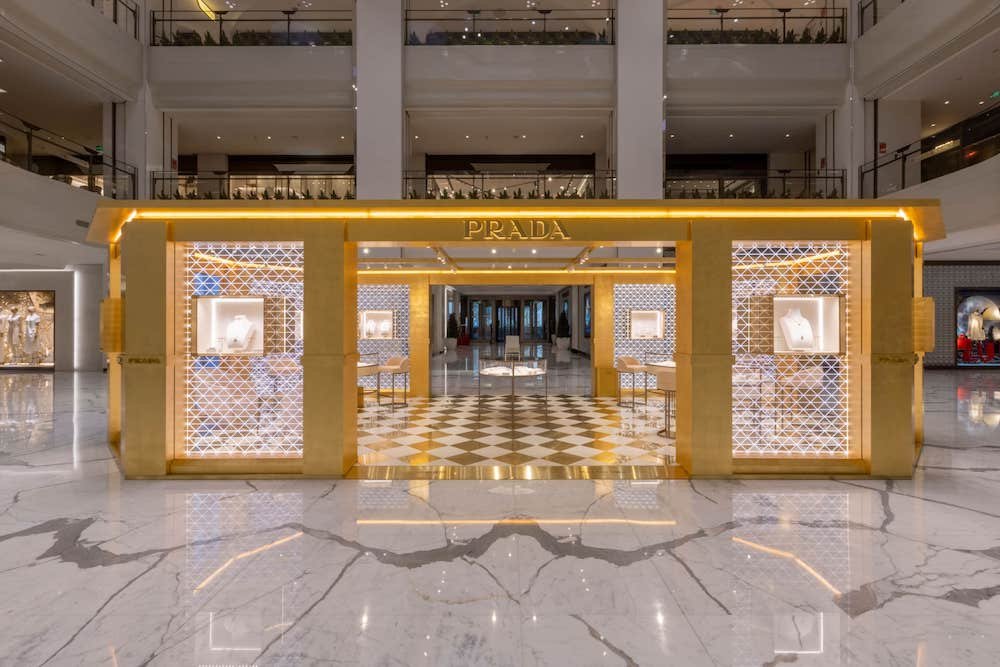
Exclusive Retail Environment: Prada stores are designed to provide an intimate and luxurious shopping experience. The minimalist interiors — polished marble flooring, sleek chrome accents, soft lighting — create an ambiance that complements the brand’s elegant designs. Sales associates receive extensive training to understand each product line and deliver personalised service that mirrors the sophisticated client relationship experience expected at the highest level of luxury retail.
2. Design Innovation and Creative Direction
Prada’s most powerful marketing strategy is arguably not a marketing strategy at all — it is the creative vision of its designers. Miuccia Prada has consistently been recognised for setting trends rather than following them, pushing boundaries of traditional fashion norms and introducing unexpected silhouettes, fabrics, and colour palettes. Since February 2020, her creative partnership with Raf Simons — another intellectual fashion figure, formerly creative director at Dior and Calvin Klein — has produced collections described by critics as dialogues between two of fashion’s most curious minds.
Prada runway shows are renowned for their impressive production values, showcasing cutting-edge technology and immersive sets. From LED screens to interactive projections and architectural staging (collaborations with Rem Koolhaas’s OMA architecture practice), the brand’s presentations blend artistry with technological innovation, creating memorable moments that generate global media coverage far exceeding the value of conventional advertising spend.
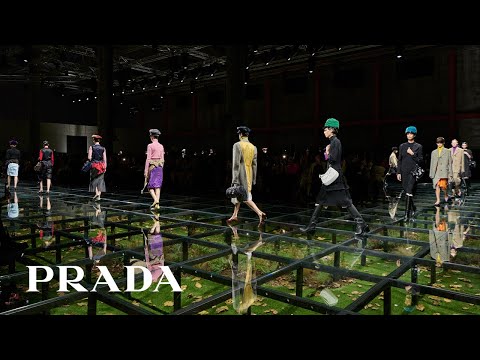
The FY2024 performance validates the creative direction: the Prada Group’s above-market revenue growth (+17% at constant exchange rates) was described in the Annual Report as driven by “desirability and disciplined execution.” Notably, Miu Miu’s +93.2% retail sales growth in FY2024 made it one of the fastest-growing luxury brands in the world, reflecting the exceptional commercial impact of Miuccia’s creative leadership of both brands.
3. Digital and Social Media Presence
Prada leverages digital and social media as an essential component of its marketing strategy, balancing the exclusivity demands of a luxury brand with the need to maintain cultural relevance in a digitally saturated media environment.

Engaging Website and E-Commerce: Prada’s website serves as a virtual flagship store where visitors can explore current collections, discover behind-the-scenes content, and shop online. The site provides an engaging user experience that mirrors the physical shopping journey while emphasising ease of use and mobile optimisation. In the early 2000s, Prada was among the first luxury houses to embrace digital commerce; today its online operations are integrated with its global retail network.
Interactive Online Lookbooks: Prada presents its collections through interactive online lookbooks that allow users to zoom in on details, view different angles, and click through to purchase options. These multimedia experiences enhance the customer’s understanding of each collection and increase engagement with the brand.
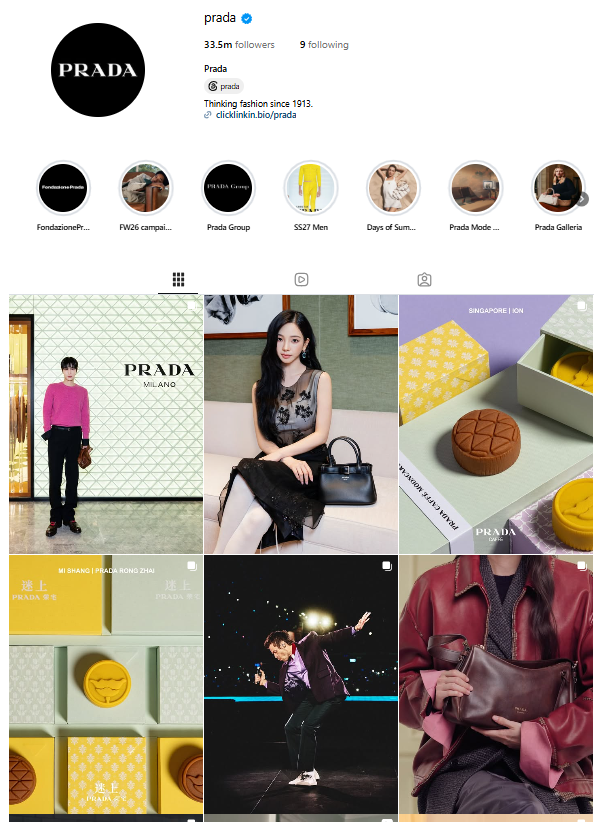
Regular Social Media Engagement: Prada maintains active profiles on Instagram, Facebook, TikTok, and WeChat, sharing regular updates featuring new arrivals, campaign imagery, backstage glimpses during fashion week, and insider views of events and parties. The brand’s Instagram presence exceeds 34 million followers — a significant platform for reaching a global audience with visual luxury storytelling.
ENHYPEN and K-Pop Strategy: Since 2023, South Korean pop group ENHYPEN has served as Prada brand ambassadors — appearing in campaigns, wearing Prada at major global events, and generating enormous social media engagement with the brand. This partnership reflects Prada’s deliberate strategy to access the enormous purchasing power and brand enthusiasm of K-pop’s global fanbase, particularly in Asia Pacific markets where the Group’s FY2024 performance was strongest.
Virtual Reality and Immersive Experiences: Prada has experimented with incorporating virtual reality (VR) and immersive digital elements into its marketing efforts. The brand launched a VR film titled “The Human Race” during Milan Fashion Week, allowing viewers to immerse themselves in the world of Prada. More recently, Prada has explored digital fashion and gaming collaborations that allow younger, digital-native consumers to engage with the brand in online environments.
Personalised Email Communications: Prada sends targeted emails to customers based on their interests and purchases. These communications include tailored recommendations, invitations to exclusive events, and updates on new arrivals — building stronger relationships with clients and increasing repeat purchase rates.
4. Iconic Advertising Campaigns
Print Advertising: Prada regularly places print advertisements in top international publications including Vogue, Harper’s Bazaar, Vanity Fair, and W Magazine. These visually stunning spreads feature the latest collections, highlight key seasonal pieces, and reinforce Prada’s identity as a luxury of intellectual, artistic depth.
Billboards and Outdoor Displays: Prada employs large-scale billboard installations and street-level displays in major cities globally — New York, Paris, Milan, Tokyo, Shanghai. These eye-catching installations establish the brand’s premium positioning and create unmissable brand touchpoints in the luxury consumer’s daily environment.


Collaborative Photography: Prada teams up with renowned photographers, stylists, and creative directors to produce memorable campaigns. Working with visionaries like Steven Meisel, Inez van Lamsweerde & Vinoodh Matadin, and Willy Vanderperre ensures bold, thought-provoking images that challenge conventional beauty standards and reflect Prada’s intellectual fashion identity.
Prada Paradoxe Fragrance Campaign: The Prada Paradoxe fragrance campaign, launched with actress Emma Watson in 2022, was a significant brand moment — positioning the fragrance as a celebration of the freedom to be multiple selves simultaneously (“I am contradictory, therefore I am”). The campaign exemplified Prada’s ability to translate its intellectual brand philosophy into an emotionally resonant, commercially successful fragrance marketing effort. Prada Paradigme, launched in 2025, continued this tradition of thought-provoking fragrance storytelling.
Limited Edition Product Launches: Prada frequently introduces special editions and capsule collections that generate significant interest among collectors and enthusiasts. These exclusive offerings drive demand, generate social media conversation, and reinforce the brand’s positioning as a source of rare, covetable luxury.
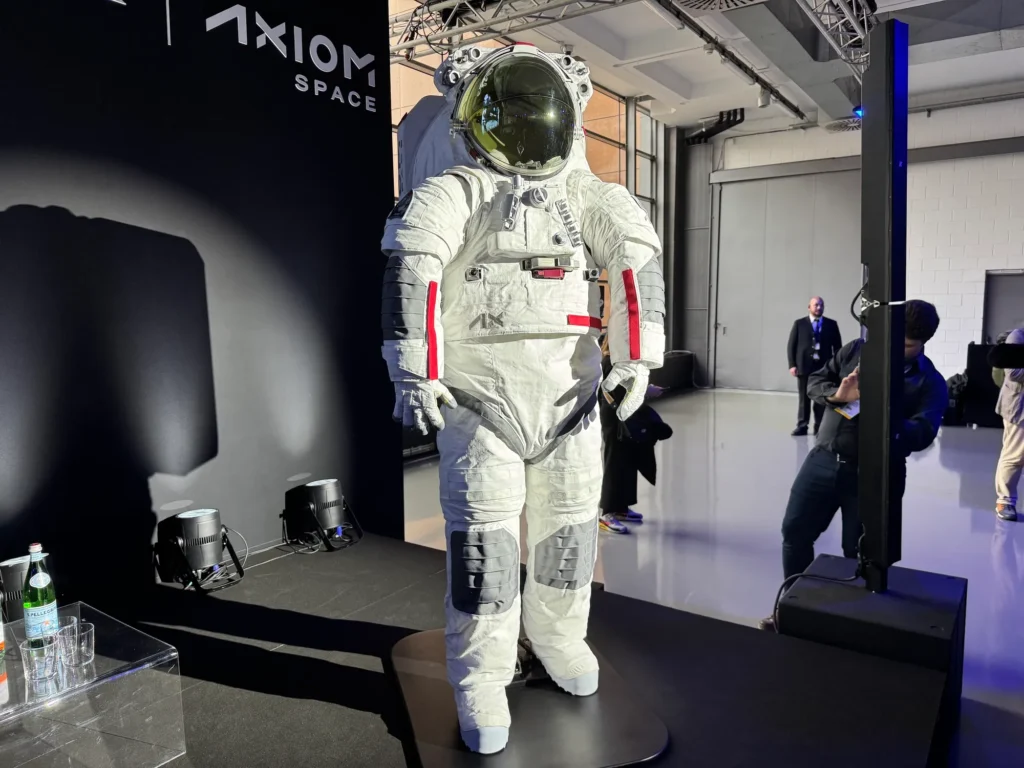
NASA/Axiom Space Partnership (2024): In a defining expression of its innovation-forward positioning, Prada partnered with Axiom Space in 2024 to co-design the Axiom Extravehicular Mobility Unit (AxEMU) spacesuit for NASA’s Artemis III mission — the mission that will return humans to the Moon’s south polar region. Prada’s design contribution to the spacesuit brought its expertise in performance materials, construction precision, and aesthetic sensibility to one of the most technically demanding garment design challenges in human history. This partnership generated global media coverage and positioned Prada as a design intelligence at the frontier of human achievement.
5. Store Design and Retail Experience
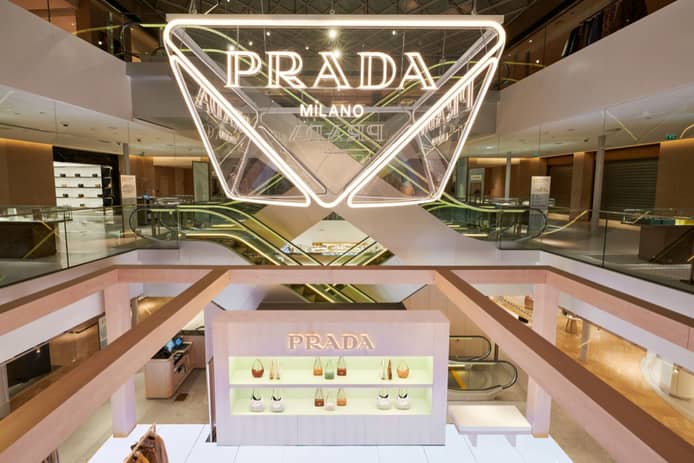
Prada’s physical retail spaces are designed with meticulous attention to detail, reflecting the brand’s sophisticated and minimalist aesthetic. The stores offer a luxurious and immersive shopping experience, reinforcing the brand’s image of exclusivity and elegance.
Epicenter Stores: Prada’s landmark “Epicenter” stores — designed by OMA/Rem Koolhaas in New York (2001) and Los Angeles (2004), and by Herzog & de Meuron in Tokyo (2003) — are architectural masterpieces that function as cultural destinations as well as retail spaces. The New York Epicenter’s distinctive “wave” design and dedicated cultural programme space set the standard for luxury retail architecture. These landmark buildings communicate that a Prada purchase is an act of participation in a cultural project, not merely a commercial transaction.

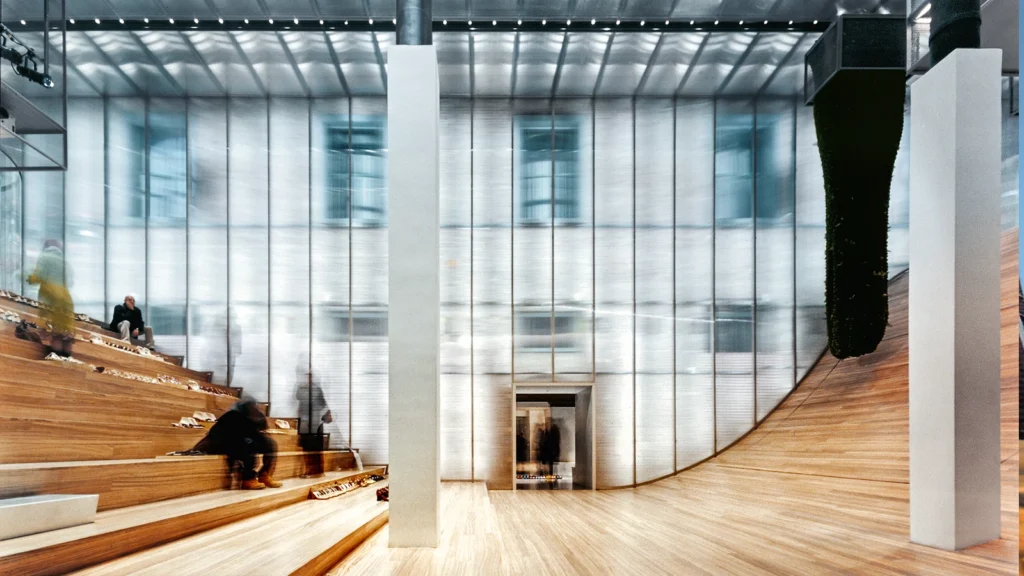
Minimalism Meets Luxury: Prada stores globally embody a sleek, modern aesthetic characterised by clean lines, muted colours, and ample use of glass and metal. This minimalist sensibility reflects the brand’s focus on simplicity and functionality while communicating sophisticated luxury — ensuring the products themselves are the focal point of the retail experience.
Immersive and Personalised Experience: Prada strives to create immersive environments where visitors are transported into the world of the brand. The flagship Milan store includes a dedicated room for art installations and special exhibits related to the company’s history and cultural contributions. Customisable services like monogramming and custom fittings are available, underscoring the brand’s dedication to individuality.
Pop-Up Stores and Prada Cafè: Temporary pop-up stores — including the Prada Cafè, a branded hospitality concept with locations in cities including Harrods in London, Rinascente in Milan, and international event activations — inject fresh energy into the brand’s retail landscape, generating buzz through exclusivity and creating owned experiences that reinforce brand loyalty.


6. Collaborations and Limited Editions
Artistic Partnerships: Prada has teamed up with contemporary artists across different mediums to create one-off works inspired by the brand’s heritage and current collections. By partnering with artists like Theaster Gates, John Baldessari, and Olga Polska — including through the Fondazione Prada’s programming — Prada showcases its appreciation for cutting-edge creativity and positions itself as a patron of cultural progress rather than merely a consumer-goods manufacturer.
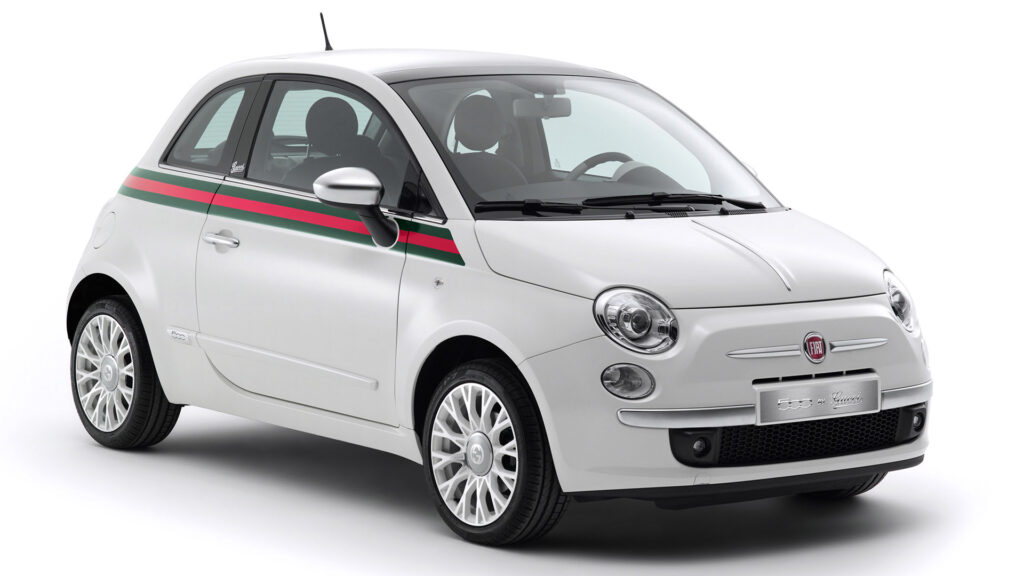
Fiat x Prada (Automotive Collaboration): Prada joined forces with fellow Italian icon Fiat to develop a limited-edition car featuring the label’s signature black nylon fabric — blending two icons of Italian excellence and emphasising their shared passion for quality craftsmanship and timeless design. This collaboration reinforced Prada’s cross-category design authority.
LG Electronics Mobile Partnership: In 2007, Prada began producing mobile phones with LG Electronics, resulting in three devices: the LG Prada (KE850), LG Prada II (KF900), and LG Prada 3.0. The LG Prada KE850 was notable for its touchscreen interface — predating the iPhone — and demonstrated Prada’s early willingness to apply its design philosophy to technology products.
Axiom Space (Spacesuit Design): The 2024 partnership with Axiom Space to co-design the AxEMU spacesuit for NASA’s Artemis III mission is the most technologically ambitious collaboration in Prada’s history. Prada contributed material science expertise, construction technique, and aesthetic refinement to produce a spacesuit designed for lunar surface activities — demonstrating that Italian fashion craftsmanship has applications at the frontier of human exploration.
Prada x Baz Luhrmann (Cinema): Miuccia Prada designed costumes for Baz Luhrmann’s 2013 film “The Great Gatsby” in collaboration with costume designer Catherine Martin, embedding the brand in one of the most anticipated film productions of the decade and reaching audiences far beyond traditional fashion media.
Prada Marfa (Permanent Art Installation): In 2005, a permanent Prada boutique installation was built 26 miles from Marfa, Texas — a conceptual artwork that deliberately decays into its landscape. Shoes and bags from the Summer 2005 season were placed inside, never to be sold. The installation has become an iconic piece of American landscape art and a perpetual, cost-free global media touchpoint for the brand.
7. Celebrity Endorsements and Brand Ambassadors
ENHYPEN (K-pop, since 2023): The appointment of ENHYPEN as Prada brand ambassadors in 2023 marked a decisive strategic shift in how the brand reaches the next generation of luxury consumers. The seven-member South Korean group’s global fanbase — heavily concentrated in the 16-30 age demographic across Asia, North America, and Europe — provides Prada with authentic access to a consumer segment that may not yet be purchasing luxury but is building brand loyalties that will shape their luxury spending for decades. ENHYPEN members regularly wear Prada at awards shows and concerts, generating organic social media content with extraordinary reach.


Emma Watson (Prada Paradoxe Fragrance): British actress and activist Emma Watson served as the face of the Prada Paradoxe fragrance from its 2022 launch. Watson’s reputation as an intellectual, values-driven public figure aligned precisely with Prada’s brand positioning — reinforcing the “intellectual luxury” identity rather than simply delivering aspirational beauty celebrity.
Historical Actor Ambassadors: Prada has featured numerous actors as models and ambassadors, including Gary Oldman, Adrien Brody, Emile Hirsch, and Norman Reedus — a preference for actors over traditional fashion models that reflects the brand’s interest in narrative, character, and cultural substance rather than pure aesthetic spectacle.
Tom Holland (S/S 2022 Menswear): Prada partnered with actor Tom Holland to produce a campaign advertisement featuring the brand’s Spring/Summer 2022 menswear collection — capitalising on Holland’s extraordinary global profile with younger consumers following the Spider-Man franchise.
Diversity and Inclusion Advisory Council: Following the 2018 blackface product controversy, Prada assembled a Diversity and Inclusion Advisory Council co-chaired by director Ava DuVernay and artist Theaster Gates. This council has shaped the brand’s creative review processes and brand communication standards — a structural commitment to responsible creativity that has contributed to rebuilding trust and improving the brand’s cultural standing.
8. Sustainability Marketing: Re-Nylon and Responsible Luxury
Re-Nylon Programme: Prada’s Re-Nylon initiative is the brand’s most significant sustainability programme, involving the conversion of Econyl — a regenerated nylon produced from recovered ocean plastic, fishing nets, and textile waste — into Prada’s iconic nylon products. The Re-Nylon collection was launched in 2019 with the goal of replacing all virgin nylon in Prada products with regenerated nylon. This initiative directly connects Prada’s most iconic material (the nylon that launched the brand’s modern identity in 1979) with its sustainability ambitions, making the environmental commitment authentic and brand-relevant rather than a tacked-on corporate responsibility exercise.


Fur-Free Policy (effective 2020): Prada announced in 2019 that it would eliminate fur from its collections and all house brands as of 2020, citing its commitment to innovative materials and ethical product development. The ban also extended to kangaroo leather (announced 2020). This policy positioned Prada at the progressive edge of luxury fashion’s sustainability debate.
Kolhapuri Sandals Partnership: Following controversy over Prada debuting Kolhapuri chappal-inspired sandals at its Men’s Summer show without crediting Indian artisans (June 2025), Prada took meaningful corrective action. By December 2025, the brand announced a three-year partnership with Indian leather artisan organisations (including LIDCOM and LIDKAR) to produce 2,000 limited-edition “Made in India” luxury sandals at €800 per pair. The collaboration includes training, skill exchange, fair pay for artisans, and opportunities to learn at Prada’s Academy in Italy — transforming a brand crisis into a genuine cultural bridge between Italian manufacturing excellence and Indian traditional craftsmanship.
Prada Esg Commitments: The Prada Group’s annual reporting now includes comprehensive ESG (Environmental, Social, and Governance) disclosures, covering carbon footprint, supply chain transparency, workplace inclusion, and community investment. These commitments reflect the growing expectation from luxury consumers — particularly younger, high-earning millennials — that the brands they support demonstrate measurable responsibility.
Marketing Mix of Prada (4Ps Analysis)
The marketing mix of Prada, often referred to as the 4Ps, encompasses the key elements that the luxury fashion brand employs to effectively market its products and maintain its position as a prestigious and sought-after label.
Product
Prada’s product strategy revolves around its luxury fashion offerings — a comprehensive portfolio that has expanded well beyond the original leather goods to encompass multiple product categories:
Ready-to-Wear (Womenswear and Menswear): Prada’s ready-to-wear collections showcase a blend of classic elegance and avant-garde elements — clean lines disrupted by unexpected details, minimalist silhouettes enriched by artisanal finishing. The brand’s clothing lines encompass a wide range of styles, from architectural minimalism to bold artistic statements.
Handbags and Accessories: Prada is renowned for its luxurious and iconic handbags — the Galleria, the Re-Edition 2005, the Cleo, the Saffiano tote — crafted from premium leathers and the brand’s signature Re-Nylon, featuring the iconic triangular logo. The brand’s accessory lines include footwear, eyewear (Luxottica licence), scarves, and small leather goods.
Fragrances: The Prada fragrance portfolio — licensed to L’Oréal since 2021 — includes landmark scents such as Infusion d’Iris, Luna Rossa, Prada Candy, and the recent Prada Paradoxe (2022) and Prada Paradigme (2025). These fragrances embody the brand’s elegant and sophisticated ethos and bring Prada into a broader consumer’s daily life.
Prada Beauty (launched 2023): Via its L’Oréal Luxe partnership, Prada launched Prada Color (makeup) and Prada Skin (skincare) in 2023 — a full luxury beauty range including lipstick, foundation, eyeshadow, cleanser, moisturiser, and serum. This launch extended the Prada brand into one of the fastest-growing segments of the luxury goods market.
Limited Editions and Collaborations: Prada regularly releases limited-edition products and collaborates with artists, designers, and other brands to create exclusive collections, adding to the brand’s allure, desirability, and cultural relevance.
Miu Miu (subsidiary brand): Founded in 1992 as Miuccia’s more accessible, playful, and youth-oriented brand, Miu Miu generated €1,377.9 million in net revenues in FY2024 — a +93.2% increase that made it the Prada Group’s most explosive growth vehicle.
Price
Prada positions itself as a high-end luxury fashion brand, and its pricing strategy reflects the exclusivity and craftsmanship of its products. The brand’s products command premium prices: entry-level leather accessories start at several hundred euros, iconic handbags range from approximately €1,200 to €4,000+, and made-to-measure and limited-edition items command multiples of these prices.
Prada’s pricing is based on factors including the use of high-quality materials (fine leathers, Re-Nylon Econyl, cashmere), artisanal Italian craftsmanship, brand reputation, and the perception of exclusivity and intellectual prestige. The premium pricing strategy aligns with the brand’s positioning and reinforces its image as a symbol of luxury sophistication. Prada does not engage in discounting or outlet sales — a discipline that is essential to the protection of its luxury pricing integrity over time.
Promotion
Prada’s promotional efforts are meticulously curated to maintain the brand’s aura of exclusivity and creative authority. Promotional touchpoints include:
Fashion Shows and Runway Presentations: Prada’s biannual runway shows (womenswear and menswear, Milan Fashion Week) are highly anticipated events in the fashion calendar. Presented collaboratively by Miuccia Prada and Raf Simons since 2020, these shows set cultural trends and generate extraordinary earned media.
Advertising Campaigns: Prada’s campaigns — in print, outdoor, and digital — are visually striking, conceptually demanding, and often feature remarkable creative collaborators (Steven Meisel, Willy Vanderperre). They reflect the brand’s artistic and intellectual identity while serving commercial objectives.
Digital and Social Media: Instagram (34M+ followers), TikTok, and WeChat — backed by ENHYPEN’s ambassador content and influencer partnerships — maintain Prada’s cultural relevance with a global, digitally native audience.
Flagship Stores and Pop-Up Experiences: Prada’s retail spaces serve as promotional instruments — the Epicenter stores in New York, Los Angeles, and Tokyo are cultural destinations that generate media coverage and foot traffic beyond their commercial function.
Fondazione Prada Cultural Programming: Exhibitions, film screenings, and philosophical lectures hosted at the Fondazione Prada’s Milan and Venice spaces provide a non-commercial promotion of the brand’s intellectual identity to an influential, culturally engaged audience.
Place (Distribution)
Prada’s distribution strategy focuses on strategic placement of its products in exclusive and high-profile locations. Key distribution channels include:
Directly Operated Stores (DOS): 425+ Prada stores across 70+ countries, strategically located in prestigious shopping districts in fashion capitals, luxury hotel districts, and major international airports. Retail net sales via DOS accounted for 89.3% of total FY2024 net revenues.
Flagship Epicenter Stores: Prada’s architectural landmark stores in New York, Los Angeles, and Tokyo serve as symbolic brand cathedrals — destination retail experiences that attract fashion enthusiasts and tourists beyond their regular clientele.
Select Department Stores and Boutiques: Prada products are available through high-end department stores including Harrods (London), Bergdorf Goodman (New York), Le Bon Marché (Paris), and Lane Crawford (Hong Kong) — partners that align with the brand’s luxury positioning.
Online Store and E-Commerce: Prada operates a global online store offering the full collection with options to explore, personalise, and purchase. Since 2016, Prada has also sold through select luxury e-commerce partners including Net-a-Porter and Mytheresa, extending its digital reach without compromising brand positioning.
Wholesale (Curated): A small but important wholesale channel (10.7% of FY2024 net revenues) covers independent multi-brand luxury retailers in key markets — curated to ensure alignment with Prada’s brand standards.
SWOT Analysis of Prada
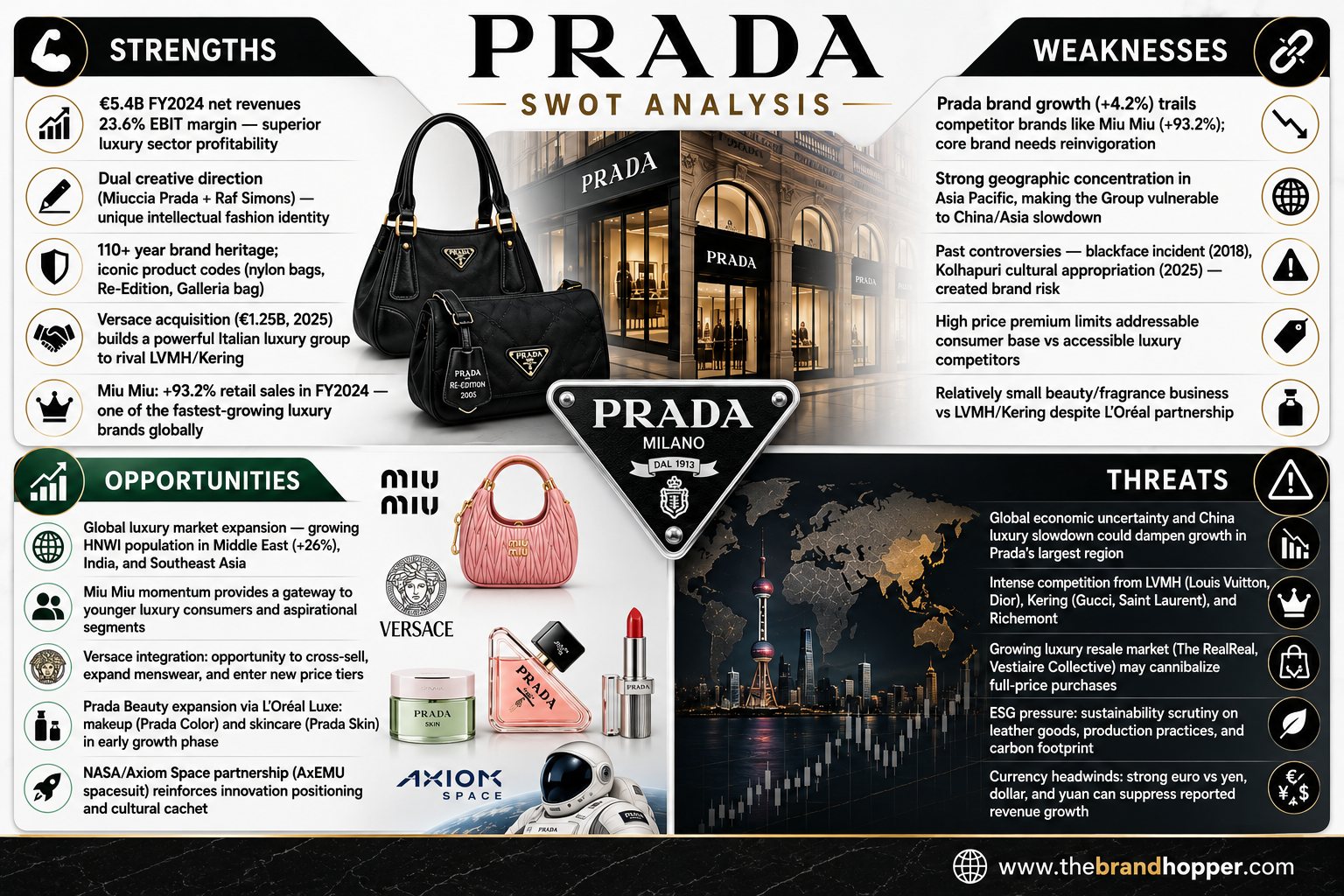
The SWOT analysis below synthesises Prada’s current competitive position based on the Prada Group’s FY2024 Annual Report and recent market developments:

Frequently Asked Questions (FAQs)
Q1: What is Prada’s annual revenue?
The Prada Group generated net revenues of €5,431.6 million (€5.4 billion) in the financial year ended December 31, 2024 — a 17.0% increase at constant exchange rates compared to FY2023. The Group’s EBIT was €1,279.6 million (23.6% margin), and net income was €843.4 million. These figures are sourced directly from the Prada Group FY2024 Annual Report. The Prada brand contributed €3,988.1 million and Miu Miu contributed €1,377.9 million to FY2024 net revenues.
Q2: Who is the creative director of Prada?
Prada is led by two co-creative directors: Miuccia Prada, the granddaughter of founder Mario Prada, who has shaped the brand’s creative identity since taking over in 1978; and Raf Simons, the Belgian designer appointed as co-creative director in February 2020. Together they present the brand’s biannual collections at Milan Fashion Week. Miuccia Prada also serves as the sole creative director of Miu Miu. Andrea Guerra serves as CEO of the Prada Group since January 2023, and Patrizio Bertelli (Miuccia’s husband) serves as Chairman.
Q3: Who are Prada’s brand ambassadors?
Prada’s brand ambassadors include South Korean K-pop group ENHYPEN (appointed in 2023), who represent the brand at global events and in campaigns targeted at Gen Z luxury consumers. The brand has also worked with actress Emma Watson (face of Prada Paradoxe fragrance from 2022), actor Tom Holland (S/S 2022 menswear campaign), and historical ambassador relationships with actors including Gary Oldman, Adrien Brody, and Norman Reedus. These ambassador relationships reflect Prada’s preference for culturally substantive public figures over conventional fashion models.
Q4: What is Prada’s sustainability strategy?
Prada’s sustainability strategy centres on the Re-Nylon programme, which converts regenerated nylon (Econyl — produced from recovered ocean plastic, fishing nets, and industrial waste) into the brand’s iconic nylon products. The goal is to replace all virgin nylon in Prada products with this recycled alternative. Prada also implemented a fur-free policy (effective 2020) and eliminated kangaroo leather (2020). In 2025, following controversy over Kolhapuri-inspired sandals, Prada established a three-year partnership with Indian artisan organisations to co-produce limited-edition “Made in India” sandals, combining Italian and Indian craft traditions.
Q5: What is Miu Miu and why is it growing so fast?
Miu Miu is Prada’s sister brand, founded by Miuccia Prada in 1992 and named after her childhood nickname. It targets a younger, fashion-forward consumer with a more playful and eclectic aesthetic compared to the Prada mainline’s intellectual minimalism. In FY2024, Miu Miu delivered retail net sales growth of +93.2% — one of the fastest growth rates ever recorded by a luxury brand. This extraordinary performance reflects the brand’s exceptional cultural moment: Miu Miu’s micro-miniskirt collections became viral fashion phenomena, driving global desirability. The brand generated €1,377.9 million in net revenues in FY2024.
Q6: What was the Prada and NASA spacesuit collaboration?
In 2024, Prada partnered with Axiom Space to co-design the Axiom Extravehicular Mobility Unit (AxEMU) spacesuit for NASA’s Artemis III mission — the mission planned to return humans to the Moon’s south polar region. Prada contributed its expertise in performance materials, precision construction, and design aesthetics to produce a spacesuit suited for lunar surface activities. The partnership is a landmark expression of Prada’s innovation positioning: the same craftsmanship applied to its luxury handbags was deployed for one of the most technically demanding wearable design challenges in human history.
Q7: Has Prada acquired any brands recently?
Yes — in one of the most significant luxury industry deals of 2025, Prada acquired Versace from Capri Holdings for €1.25 billion. The deal was agreed in April 2025 and completed in December 2025. With the acquisition, Prada Group began building an Italian luxury conglomerate to rival French groups LVMH and Kering. Versace’s creative direction was taken over by Dario Vitale after Donatella Versace stepped down following 27 years as creative director; Donatella now serves as the brand’s chief ambassador. Prada Chairman Patrizio Bertelli committed to preserving Versace’s distinctive aesthetic identity.
Q8: What is the Fondazione Prada?
Fondazione Prada is an art institution established by Miuccia Prada and Patrizio Bertelli, with spaces in Milan and Venice, Italy. It is dedicated to contemporary art, film, and philosophy, hosting major exhibitions and cultural events year-round. The foundation is a cornerstone of Prada’s brand identity — communicating that Prada is a patron of culture and creative thought, not simply a fashion house. Notable exhibitions have featured artists including Thomas Demand, Theaster Gates, Carsten Höller, and Goshka Macuga. The Milan venue (opened 2015) was designed by Rem Koolhaas’s OMA practice.
Q9: How does Prada maintain exclusivity while growing revenues?
Prada balances exclusivity and growth through several disciplined strategies: it maintains strict pricing integrity (no discounting, no outlet sales), limits product volume through direct-operated retail (89.3% of revenues) rather than broad wholesale distribution, invests heavily in immersive flagship retail experiences rather than mass-market touchpoints, uses limited-edition drops and seasonal collections to create scarcity, and manages brand equity through selective brand ambassador relationships and prestige media partnerships. The brand’s cultural engagement (Fondazione Prada, runway shows, art collaborations) adds non-commercial brand equity that reinforces the brand’s position without directly selling product.
Q10: What are Prada’s key product lines?
Prada’s key product lines include: ready-to-wear womenswear and menswear (bi-annual runway collections); leather goods and handbags (flagship lines: Galleria, Re-Edition 2005, Cleo, Saffiano); footwear; eyewear (Luxottica licence); fragrances (L’Oréal Luxe licence — Paradoxe, Paradigme, Luna Rossa, Infusion series); Prada Beauty (makeup line Prada Color and skincare line Prada Skin, launched 2023 via L’Oréal Luxe); and Re-Nylon sustainable products (Econyl regenerated nylon bags, accessories, and outerwear). Through its sister brand Miu Miu, the Group also offers a younger-positioning fashion and accessories collection.
Conclusion
Prada’s marketing strategy is, at its core, a refusal to compromise. In an industry where quarterly commercial pressures frequently drive luxury brands toward accessible pricing, volume discounting, and logo-led branding, Prada has steadfastly maintained its commitment to intellectual depth, artisanal craftsmanship, and creative daring — and the FY2024 financial results confirm that this strategy is commercially as well as culturally correct.
The brand’s €5.4 billion in net revenues, 23.6% EBIT margin, Miu Miu’s +93.2% growth, and the strategic acquisition of Versace collectively tell the story of a company that has navigated the most competitive landscape in luxury fashion without sacrificing the creative identity that makes it distinctive. From the Fondazione Prada’s cultural programming to the AxEMU spacesuit’s lunar mission, Prada continues to demonstrate that fashion, at its most ambitious, is a form of design intelligence with applications as wide as the human imagination.
For brand strategists, marketing professionals, and business students, Prada offers a masterclass in positioning: how to sustain a premium, intellectually grounded brand identity across more than a century of commercial and cultural change, and how to grow revenue while simultaneously deepening the brand equity that justifies every price premium and every creative risk.
Also Read: The Art of Luxury: Chanel Marketing Strategies and Marketing Mix
To read more content like this, subscribe to our newsletter
Go to the full page to view and submit the form.