


Renting a home in Brazil has traditionally involved significant paperwork and financial requirements. Many landlords have required tenants to provide a fiador—a guarantor who accepts legal responsibility for unpaid rent and other obligations. This requirement can make renting more difficult for people who have recently moved, lack local family connections, or cannot find someone willing to act as a guarantor.
QuintoAndar set out to simplify this process by using technology, data-driven tenant screening, and digital contracts. Its platform connects tenants, property owners, buyers, sellers, and real estate professionals, with services spanning residential rentals, property sales, listings, and real estate software.


Founded in 2013, the company has grown from a Brazilian rental startup into a broader real estate technology group with operations across several Latin American markets. Its expansion has combined organic growth, acquisitions, digital property transactions, and technology investments.
This article examines QuintoAndar’s founding story, business model, revenue streams, product portfolio, funding history, leadership, growth strategy, and competitive landscape.
QuintoAndar at a Glance

Founding Story of QuintoAndar
Gabriel Braga and André Penha founded QuintoAndar in São Paulo in 2013. Their idea was shaped by the difficulties of navigating Brazil’s traditional rental market, where finding a suitable property could be complicated by paperwork, guarantor requirements, and fragmented processes.


The founders saw an opportunity to use technology to make renting more accessible and transactions more efficient. Rather than simply creating another property listing website, they set out to digitise more of the rental journey, from property discovery and tenant evaluation to contract signing and payment administration.
A central part of the company’s model was to reduce reliance on traditional guarantors. Data-driven screening and a structured rental management process would help assess applicants while offering landlords a more organised way to manage their properties.
Building trust was an important early challenge. Property owners needed confidence that their rental income and property interests would be protected, while tenants needed a simpler process for finding and securing homes. QuintoAndar developed its platform around these needs, combining technology with services that support the transaction and the ongoing tenancy.
A major milestone came in September 2019, when SoftBank led a US$250 million Series D funding round that valued QuintoAndar at approximately US$1 billion. The investment helped the company expand its Brazilian operations and develop its technology and services.
Business Model of QuintoAndar
QuintoAndar operates a technology-enabled real estate platform that connects tenants and property owners while managing important parts of the rental process. Its services include property discovery, tenant screening, digital contracts, payment administration, and support during the tenancy.
One of its key differentiators is its approach to rental guarantees. Eligible rentals can be arranged without a traditional guarantor, while QuintoAndar provides payment protection to property owners under the terms of its management service. This helps reduce the need for landlords to rely on a tenant’s personal network when assessing rental applications.
The exact guarantee arrangements depend on the contract. QuintoAndar also offers a separate Fiança Garantida product for certain rentals, with pricing determined by factors such as the applicant’s credit profile and the property’s characteristics.
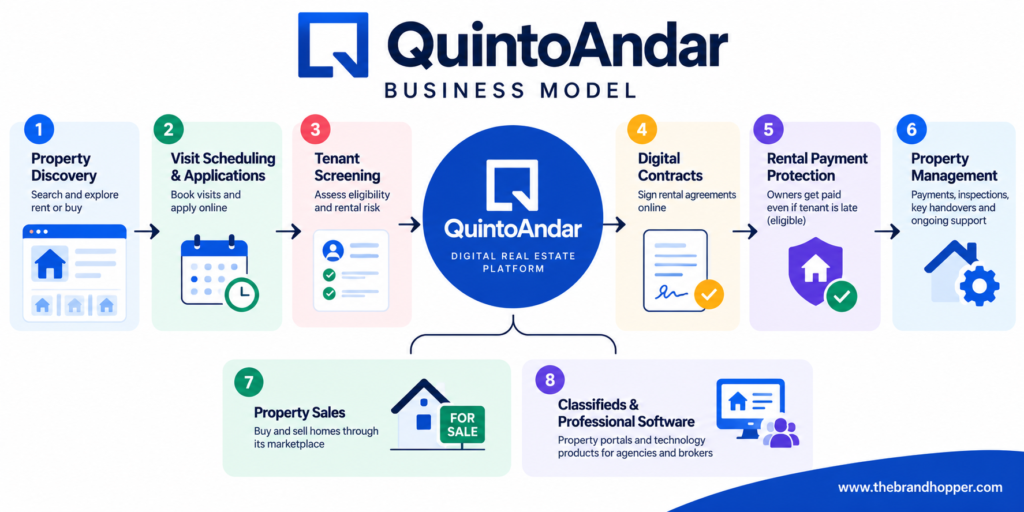
The main elements of the business model include:
- Digital-first platform: Property discovery, visit scheduling, applications, and contract processes are supported by digital tools.
- Tenant screening: Applicants undergo an evaluation process designed to assess their eligibility and rental risk.
- Rental payment protection: Eligible property owners receive payment protection under the applicable management agreement, even when a tenant is late.
- Digital contracts: The platform supports digital rental agreements, reducing the need for paper-based processes.
- Property management: Services include payment administration, property inspections, key handovers, and support with issues arising during a tenancy.
- Property sales: The company also facilitates home-buying and selling transactions through its marketplace and related services.
- Classifieds and professional software: Its wider group includes property portals and technology products serving real estate agencies and brokers.
QuintoAndar’s model combines software with operational services. Its ability to manage transactions and ongoing rental relationships is an important distinction from websites that primarily publish property listings.
Revenue Model and Revenue Streams
QuintoAndar earns revenue from several activities across its real estate ecosystem. Its rental business includes brokerage and property administration services, while its wider group operates property classifieds and software for real estate professionals.
The charges involved in a rental transaction depend on the service and contract. In Brazil, QuintoAndar’s published landlord guidance describes a brokerage fee equivalent to one full month’s rent and an administration fee of 9.3% of the applicable rental amount, subject to a minimum fee of R$160. The administration fee is calculated under the terms of the relevant contract; it should not be treated as a universal 8% charge.
| Revenue Stream | Description | Who Pays |
|---|---|---|
| Rental brokerage fee | A fee for arranging and formalising a rental contract, generally equivalent to one month’s rent under the published standard terms | Property owner, deducted from the rental proceeds as applicable |
| Monthly property administration | Ongoing services for rental management, payment administration, and tenant-landlord support | Property owner |
| Tenant service fees | Fees associated with maintaining and providing the digital rental platform and related services | Tenant, where applicable under the contract |
| Rental guarantee products | Certain contracts may include a separate guarantee product with individually calculated pricing | Tenant, where the product applies |
| Property sales commissions | Revenue from facilitating property purchase and sale transactions | Depends on the transaction and applicable agreement |
| Property classifieds | Listing and advertising services offered through the group’s real estate portals | Agencies, brokers, and other listing customers, depending on the product |
| Real estate software | Software and technology services for agencies and property professionals | Business customers |
The rental business creates opportunities for both one-time and recurring revenue. Brokerage services generate revenue when a contract is arranged, while property administration can generate recurring fees throughout the tenancy.
The classifieds and business software operations diversify the group beyond direct rental management. They allow QuintoAndar to serve professional customers as well as individual tenants, buyers, sellers, and property owners.
Product and Service Portfolio of QuintoAndar
QuintoAndar has expanded beyond its original rental platform into a broader ecosystem of residential real estate services. Its main activities include managed rentals, property sales, classifieds, and technology for real estate professionals.
1. QuintoAndar Rental Platform
The rental platform connects tenants with property owners and supports multiple stages of the rental process. Users can search for homes, arrange visits, submit applications, complete digital contract processes, and manage relevant payments and requests.
For property owners, the platform offers services intended to reduce the administrative burden of renting out a home. Depending on the contract, these can include payment administration, inspections, key handovers, and protection against certain rental payment risks.
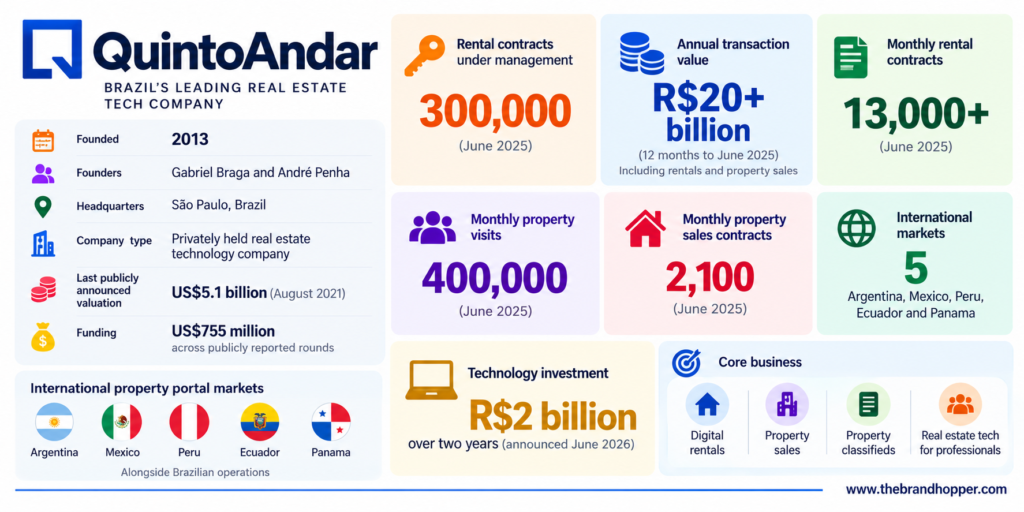
In June 2025, QuintoAndar announced that it had reached 300,000 rental contracts under management across Brazil. The company also reported more than 13,000 new rental contracts and approximately 400,000 rental property visits per month at that time.
2. QuintoAndar Property Sales Marketplace
QuintoAndar also operates a marketplace for people looking to buy or sell residential property. The service helps connect buyers and sellers and supports the property discovery and transaction process.
In June 2025, the company reported approximately 2,100 property sales contracts per month. It also reported around 100,000 scheduled property visits per month for the sales business.
The marketplace complements the rental operation by allowing the company to participate in more stages of the residential property journey. Rental and sales services, however, involve different processes, fees, and customer needs.
3. Navent Classifieds and Real Estate Technology
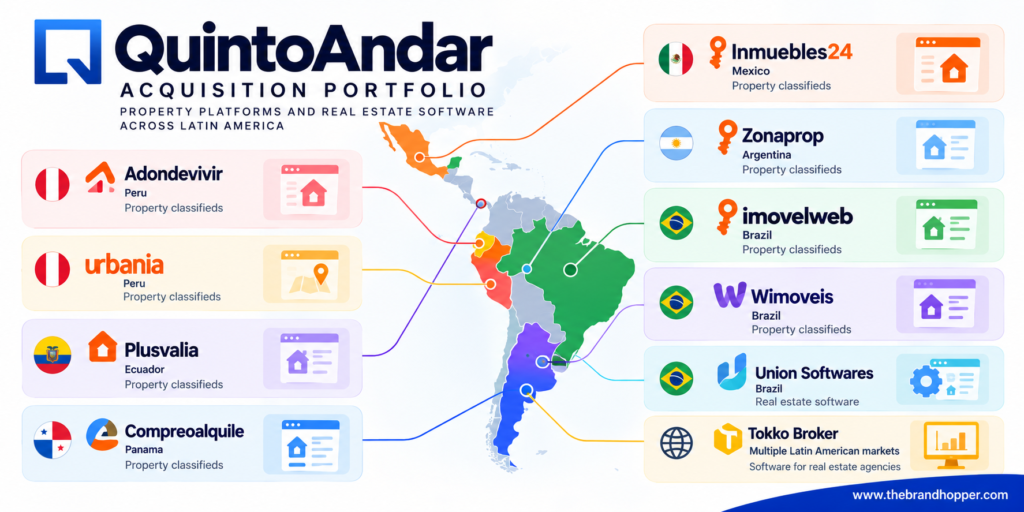
In December 2021, QuintoAndar acquired the real estate operations of Grupo Navent, expanding its presence in Latin American property classifieds and real estate software.
The acquired businesses give the group access to established local property marketplaces and professional customers. Their operating models can differ from QuintoAndar’s managed rental platform, even though they sit within the same wider group.
Tokko Broker and other real estate software offerings extend the business into the professional market. Such products can support agencies with property listings, customer relationships, lead management, and other operational workflows.
Financial Performance and Scale of QuintoAndar
QuintoAndar is privately held and does not publish the same level of regular financial disclosure as a publicly listed company. Its transaction metrics and business milestones therefore provide useful indicators of scale, but they should not be mistaken for audited revenue or profit figures.
In June 2025, the company announced that the total value transacted through its platform had exceeded R$20 billion over a 12-month period. This measure combined the value of properties sold through the platform with rental payments over the same period; it was not the company’s revenue.
The same announcement reported 300,000 rental contracts under management, more than 13,000 new rental contracts per month, around 400,000 rental visits per month, and approximately 2,100 property sales contracts per month.
| Metric | Publicly Reported Figure | Period or Qualification |
|---|---|---|
| Total transaction value | More than R$20 billion | 12 months, reported June 2025; includes rentals and property sales |
| Rental contracts under management | 300,000 | Announced June 2025 |
| New rental contracts | More than 13,000 per month | Announced June 2025 |
| Rental property visits | Approximately 400,000 per month | Announced June 2025 |
| Property sales contracts | Approximately 2,100 per month | Announced June 2025 |
| Sales property visits | Approximately 100,000 per month | Announced June 2025 |
| Technology investment | R$2 billion over two years | Announced June 2026 |
| Last publicly announced valuation | US$5.1 billion | August 2021 funding extension |
| Total funding | Approximately US$755 million in third-party databases | Estimates depend on which rounds and investments are counted |
The company’s scale is also reflected in its technology investments and expansion into business-to-business services. In June 2026, QuintoAndar announced plans to invest R$2 billion in technology over two years, with artificial intelligence expected to play a major role in the programme.
Because the company is private, claims about current profitability, margins, or cash generation should be included only when supported by a specific, reliable disclosure. Public transaction volume alone does not establish that a company is profitable.
Valuation, Funding, and Investors of QuintoAndar
QuintoAndar raised capital from several major venture investors as it expanded its platform and geographic reach. Its funding history includes rounds led by investors such as SoftBank, General Atlantic, Ribbit Capital, Greenoaks Capital, and Tencent.
The company reached unicorn status following its 2019 Series D round, which valued it at approximately US$1 billion. In May 2021, it announced a US$300 million Series E round at a US$4 billion valuation. In August 2021, it announced a further US$120 million extension, taking its publicly announced valuation to US$5.1 billion.
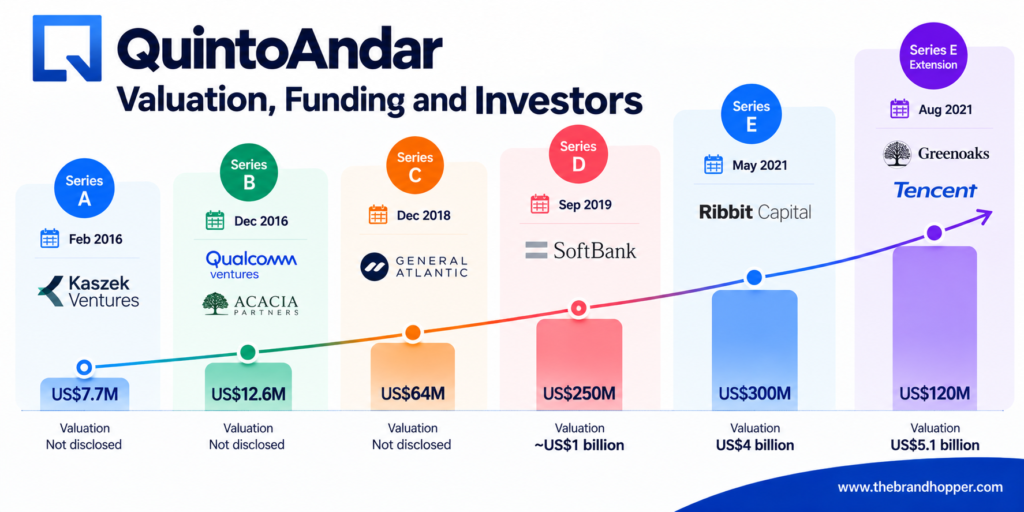
The rounds above represent major publicly reported financing announcements. Third-party databases may list additional investments or financing events, so totals can vary according to methodology.
The August 2021 valuation remains the last widely reported priced-round valuation identified for this article. It is a historical financing figure, not a current valuation or a guarantee of what the company would be worth in a future transaction.
Leadership Team of QuintoAndar
QuintoAndar was founded by Gabriel Braga and André Penha. Braga has served as the company’s CEO and has publicly discussed its strategy around technology, customer experience, and artificial intelligence.
| Name or Group | Role | Background |
|---|---|---|
| Gabriel Braga | Co-founder and CEO | Co-founded QuintoAndar and leads the company’s overall strategy |
| André Penha | Co-founder | Co-founded the company and contributed to its original technology and product development |
| Regional and business-unit leaders | Leadership across the group’s operations | Manage local markets, classifieds, software, and other business activities |
The company’s expansion has required capabilities beyond its original rental platform, including property sales, classifieds, software products, and operations across multiple markets. Its recent technology strategy also places greater emphasis on integrating AI into customer and business workflows.
In April 2026, QuintoAndar announced the appointment of a vice president dedicated to engineering for artificial intelligence. This was followed by its June 2026 announcement of a major technology investment programme.
Growth Strategy of QuintoAndar
1. Investing in Artificial Intelligence
In June 2026, QuintoAndar announced an investment of R$2 billion in technology over two years. The company said that artificial intelligence would account for a major part of the programme, which is intended to improve its products and operations.
The strategy includes making property discovery more conversational, improving recommendations, supporting customer service, and applying AI to parts of the property transaction journey. The company has also discussed using AI to improve property pricing and help professionals manage customer interactions more efficiently.
In reporting published in June 2026, CEO Gabriel Braga said that approximately 80% of the company’s code was being produced with AI assistance and that engineering productivity had increased by three to five times. These are management-reported figures, rather than independently audited productivity measures.
The investment signals an effort to make AI a more central part of the platform rather than treating it solely as an add-on feature. Its commercial impact will depend on how effectively these systems improve customer experience, transaction completion, and operating efficiency.
2. Deepening Its Brazilian Market Presence
Brazil remains central to QuintoAndar’s business. Its rental platform, property sales marketplace, and professional services give it multiple ways to serve tenants, property owners, buyers, sellers, and real estate agencies.
The company can continue to expand by improving the customer experience in markets where it already operates, increasing the supply of properties listed on its platforms, and building stronger relationships with real estate professionals.
The business also has opportunities to improve how buyers and tenants discover properties, arrange visits, and complete transactions. AI-powered search and pricing tools are part of this effort, although their long-term effects on conversion rates and market share will need to be evaluated using measurable results.
3. Expanding Through Latin American Classifieds
The December 2021 acquisition of Navent’s real estate operations was a significant step in QuintoAndar’s regional expansion. It brought established property classifieds brands and real estate software into the group, including Zonaprop, Inmuebles24, Imovelweb, Wimoveis, and Tokko Broker.
These businesses give QuintoAndar a presence in property markets beyond Brazil, including Argentina, Mexico, Peru, Ecuador, and Panama. The classifieds businesses also provide a route to serving agencies and brokers that may not use QuintoAndar’s managed rental service.
However, owning classifieds portals in several countries does not mean the company operates its complete Brazilian rental model in each of those markets. The products, customers, and services differ by country and business.
4. Building Products for Real Estate Professionals
QuintoAndar has also been developing services for agencies and independent brokers. On August 20, 2026, the company announced QuintoAndar for Business, an integrated ecosystem bringing together technology, AI, marketplace, classifieds, and CRM offerings.
The launch included Domi, an AI-powered assistant designed to help real estate agencies respond to customer enquiries, qualify leads, recommend properties, and schedule visits. The company positioned the service as a way to help agencies handle more opportunities while allowing brokers to focus on relationships and negotiations.
This strategy expands QuintoAndar’s role beyond consumer-facing property transactions. Business software and services can help the company build relationships with professional customers while supporting its wider classifieds and marketplace activities.
5. Expanding Rental Management Services
In August 2026, Grupo QuintoAndar announced Benvi, a separate operation focused on acquiring the administration rights for existing rental contracts from local real estate agencies. The model allows agencies to transfer management responsibilities without selling the agency itself.
Benvi is intended to handle day-to-day administration for the acquired contracts while preserving their existing contractual conditions, including rental values and agreed fees. The company described the operation as independent from the standard QuintoAndar-branded service.
This approach provides another way for the group to expand its managed rental portfolio. It also illustrates how the company is developing different operating models to serve landlords and real estate agencies.
Competitive Landscape of QuintoAndar
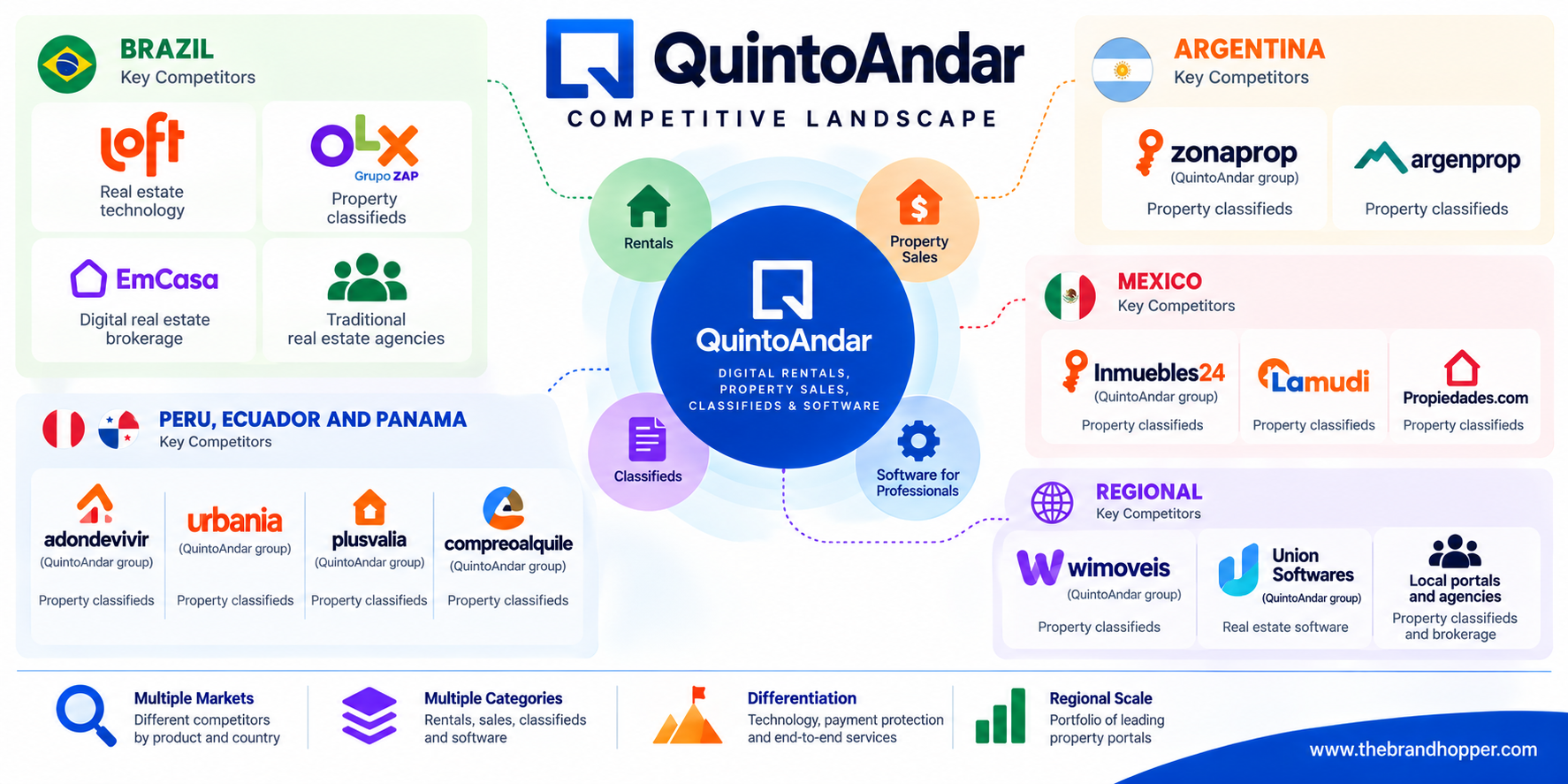
QuintoAndar competes across several related markets, including digital rentals, property sales, classifieds, and software for real estate professionals. The companies it faces differ according to the product and geography involved.
| Competitor or Group | Main Market | Category | Competitive Overlap |
|---|---|---|---|
| Loft | Brazil | Real estate technology and property transactions | Competes in selected property transaction and related services |
| OLX Brasil / Grupo ZAP | Brazil | Property classifieds and listings | Competes for listing supply, audience, and property-related advertising |
| Traditional real estate agencies | Brazil | Brokerage and property management | Compete for landlords, tenants, buyers, and sellers |
| EmCasa | Brazil | Digital real estate brokerage | Overlaps in selected property sales and brokerage services |
| Argenprop and other local portals | Argentina | Property classifieds | Compete with Zonaprop for property listings and audience |
| Lamudi, Propiedades.com, and other local portals | Mexico | Property classifieds | Compete with Inmuebles24 for property listings and online reach |
| Local property portals and agencies | Peru, Ecuador, and Panama | Classifieds and brokerage | Compete with the group’s local property portals and related services |
The competitive landscape is not uniform across these categories. A property classifieds portal primarily connects users with listings, while a managed rental platform can also handle screening, contracts, payments, and ongoing administration.
QuintoAndar’s differentiation comes from combining digital discovery with services that support transactions and rental management. Its payment protection arrangements, digital processes, and technology investments are part of this positioning, but the strength of each advantage depends on customer outcomes, service quality, pricing, and competitors’ responses.
Its regional classifieds portfolio also provides a different source of scale from its Brazilian rental platform. The group must balance local market needs and brands while developing technology that can be used across different business lines.
Frequently Asked Questions (FAQs)
1. What is QuintoAndar and what problem does it solve?
QuintoAndar is a Brazilian real estate technology company that provides digital services for renting and buying homes, alongside property classifieds and software for real estate professionals.
It was founded in 2013 to simplify the property rental process, including the traditional reliance on guarantors. Its platform uses tenant evaluation, digital contracts, and rental management services to make transactions easier to navigate.
2. How does QuintoAndar make money?
QuintoAndar generates revenue from rental brokerage and property administration, property sales, classifieds, and software products for real estate professionals.
Its standard landlord fee structure includes a brokerage fee associated with arranging a rental and an ongoing administration fee. Published guidance lists an administration fee of 9.3% of the applicable rental amount, with a minimum charge of R$160, subject to the relevant contract. Other fees and guarantee products may apply in specific circumstances.
3. How much funding has QuintoAndar raised, and who are its investors?
Public funding databases estimate that QuintoAndar has raised approximately US$755 million, although totals vary depending on the rounds and investments counted.
Its major publicly announced rounds include a US$250 million Series D in 2019, a US$300 million Series E in May 2021, and a US$120 million Series E extension in August 2021. The extension valued the company at US$5.1 billion. That figure is historical and should not be treated as a current valuation.
4. Which countries does QuintoAndar operate in?
QuintoAndar’s core managed rental and property transaction operations are based in Brazil. Through its acquisition of Navent’s real estate operations, the group also owns property classifieds brands serving Argentina, Mexico, Peru, Ecuador, and Panama.
Its brands include Zonaprop, Inmuebles24, Imovelweb, Wimoveis, Adondevivir, Urbania, Plusvalia, and Compreoalquile. Tokko Broker and related software products serve real estate professionals across multiple markets.
5. Is QuintoAndar profitable?
QuintoAndar is privately held, and this article does not establish its current profitability from publicly available audited financial statements. Claims about profitability should be tied to a specific company disclosure or reliable report that clearly states the period and definition used.
The company has reported substantial transaction activity and has announced a major technology investment funded, according to its public statements, from its own cash generation. Transaction volume and investment capacity, however, are not substitutes for a disclosed net profit figure.
6. What is QuintoAndar’s AI investment strategy?
In June 2026, QuintoAndar announced plans to invest R$2 billion in technology over two years, with a major focus on artificial intelligence.
The programme is intended to improve property search and recommendations, customer service, property pricing, and other parts of the real estate transaction process. The company has also discussed using AI to help real estate professionals manage customer enquiries and leads more effectively.
7. What was the Navent acquisition and why was it significant?
In December 2021, QuintoAndar acquired the real estate operations of Grupo Navent. The portfolio included property classifieds brands in Argentina, Mexico, Brazil, Peru, Ecuador, and Panama, as well as Tokko Broker and other software businesses.
The acquisition expanded QuintoAndar beyond its Brazilian managed rental platform and gave it established brands, audiences, and business customers in several Latin American markets. These businesses remain distinct from the company’s core rental service.
8. How does QuintoAndar compare with traditional real estate agencies in Brazil?
QuintoAndar uses digital tools to support property discovery, tenant evaluation, contracts, and rental administration. Traditional agencies may rely more heavily on in-person processes, although their services and levels of digitisation vary considerably.
QuintoAndar’s managed rental service can also offer payment protection and a rental process without a traditional guarantor, subject to its eligibility criteria and contract terms. Its technology-led approach is designed to reduce friction, but it should not be assumed to be universally cheaper or better for every landlord or tenant.
Conclusion
QuintoAndar has developed from a Brazilian rental startup into a broader real estate technology group. Its business combines managed rentals, property sales, classifieds, and software for real estate professionals, allowing it to serve different participants across the residential property market.
The company’s acquisition of Navent’s real estate operations in 2021 expanded its reach into several Latin American markets. Its subsequent initiatives—including the R$2 billion technology investment announced in 2026, QuintoAndar for Business, Domi, and Benvi—show that it is continuing to develop products for both consumers and real estate professionals.
The company’s longer-term performance will depend on its ability to improve customer experience, maintain trust in its rental guarantees, grow its marketplace, and deploy technology in ways that deliver measurable benefits. Its historical funding valuation and reported transaction volume demonstrate scale, but current profitability and valuation should not be inferred without newer, reliable disclosures.
For entrepreneurs and real estate professionals, QuintoAndar offers a useful case study in combining technology with operational services to address friction in a traditional market. Its next phase will test how effectively that model can expand across business lines while maintaining service quality and sustainable economics.
Also Read: SumUp: Business Model, Funding & How It Serves 4M+ Merchants
To read more content like this, subscribe to our newsletter
Go to the full page to view and submit the form.