



Nvidia’s journey from a small startup focused on 3D gaming graphics to becoming the driving force behind the global AI revolution represents one of the most significant technological pivots in corporate history. What began in a Denny’s restaurant near San Jose as a conversation about improving graphics for video games has transformed into a trillion-dollar company whose chips power the world’s most advanced artificial intelligence systems, including OpenAI’s ChatGPT. This remarkable evolution wasn’t accidental but resulted from strategic vision, technological innovation, and perfect market timing. Today, Nvidia’s hardware forms the backbone of the AI infrastructure transforming industries worldwide, with its latest fiscal year revealing staggering revenue of $130.5 billion-a 114% year-over-year increase. This article explores the fascinating journey of how a gaming graphics company became the cornerstone of the AI revolution.
Humble Beginnings: Three Engineers and a Vision
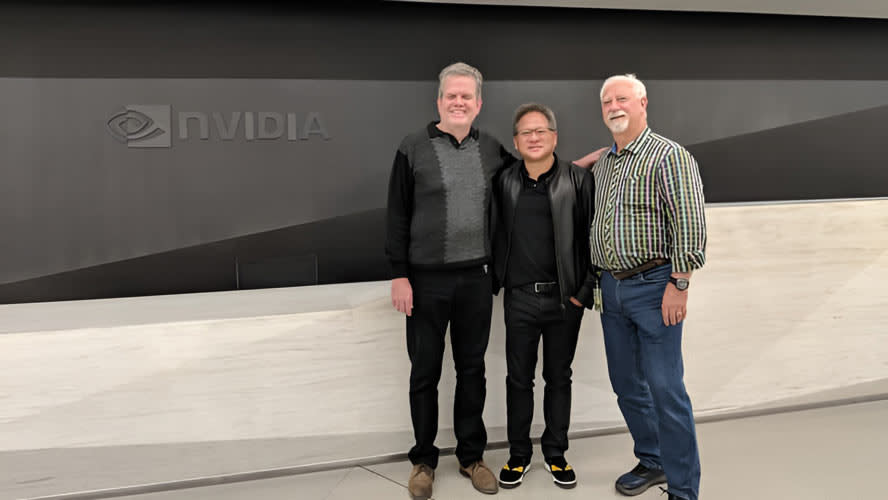
Nvidia’s story began on April 5, 1993, when three visionary engineers – Jensen Huang, Chris Malachowsky, and Curtis Priem – founded the company with a clear mission to bring advanced 3D graphics to gaming and multimedia markets. The founding moment occurred during a meeting at a Denny’s roadside diner in East San Jose, where the trio discussed their frustrations with existing technologies and opportunities in the graphics processing space. Jensen Huang, who had previously served as director of CoreWare at LSI Logic and worked as a microprocessor designer at AMD, became the company’s first CEO – a position he remarkably still holds today.

The name “Nvidia” itself reflects the company’s ambitious vision, combining elements of “invidia,” the Latin word for “envy,” and the acronym NV (short for “next vision”), which the company used in its early days to label files. This blend perfectly captured the founders’ aspirations to create technology that competitors would envy. Their early focus centered specifically on graphics-based processing as they observed that video games presented both computationally challenging problems and promised high sales volume – a rare combination that could fund massive R&D efforts.
With an initial investment of $20 million from venture capital firms including Sequoia Capital, Nvidia set out to revolutionize computer graphics. The founders envisioned graphics-based processing as the best trajectory for tackling challenges that had eluded general-purpose computing methods, positioning the company to eventually become a central player in the future technological landscape.
Early Struggles and Breakthroughs
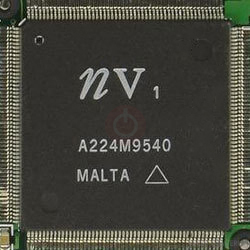
Nvidia’s path to success wasn’t without significant obstacles. The company’s first graphics accelerator, the NV1 released in 1995, was designed to process quadrilateral primitives (forward texture mapping) – a feature that differentiated it from competitors who preferred triangle primitives. This technical decision proved problematic when Microsoft introduced DirectX and announced that its Direct3D API would exclusively support triangles, causing the NV1 to fail in gaining market traction.

Adding to these challenges, Nvidia had partnered with Sega to supply graphics chips for the Dreamcast console and invested about a year in the project. However, as Nvidia’s technology fell behind competitors, Sega’s president Shoichiro Irimajiri personally visited Huang to inform him they had chosen another vendor. In what would prove to be a pivotal moment, Irimajiri convinced Sega’s management to invest $5 million in Nvidia, providing critical funding that kept the company afloat during this difficult period.
The situation became so dire that Jensen Huang was forced to lay off more than half of Nvidia’s employees, reducing headcount from 100 to 40, and focus remaining resources on developing a graphics accelerator optimized for triangle primitives: the RIVA 128. By the time this product was released in August 1997, Nvidia had only enough money left for one month’s payroll, giving rise to the company’s unofficial motto: “Our company is thirty days from going out of business“.
Fortunately, the RIVA 128 became an unexpected success, selling about a million units within four months and generating crucial revenue to fund future development. This success was followed by the release of the RIVA TNT in 1998, which further solidified Nvidia’s reputation as a leader in graphics technology.
Becoming a Gaming GPU Pioneer
The First True GPU and Public Company Status
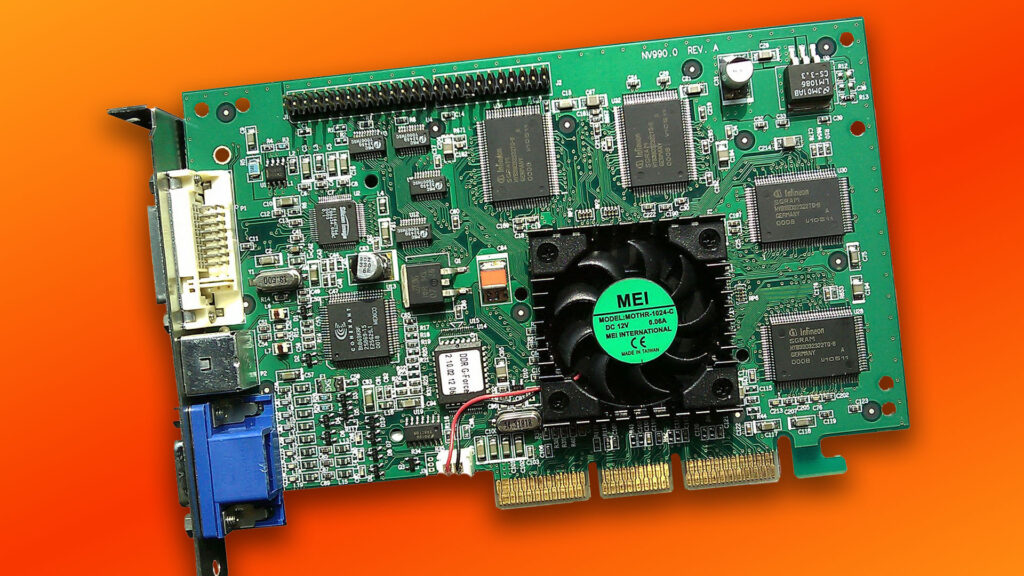
In late 1999, Nvidia achieved a significant milestone with the release of the GeForce 256, which the company marketed as the world’s first Graphics Processing Unit (GPU). Most notable for introducing onboard transformation and lighting (T&L) to consumer-level 3D hardware, the GeForce 256 ran at 120 MHz with four-pixel pipelines and implemented advanced video acceleration and motion compensation. This groundbreaking product outperformed existing offerings by a wide margin, cementing Nvidia’s position in the gaming market.
That same year, on January 22, 1999, Nvidia went public with its initial stock offering priced at $12 per share. The timing proved perfect as the success of its products led to Nvidia winning the contract to develop graphics hardware for Microsoft’s Xbox game console, earning the company a $200 million advance. By the end of 2001, Nvidia’s revenue exceeded $1 billion, and the company was added to both the Nasdaq 100 Index and S&P 500 Index, marking its arrival as a major technology player.
During this period, Nvidia continued to solidify its position in the gaming market. In December 2000, the company reached an agreement to acquire the intellectual assets of its one-time rival 3dfx – a pioneer in consumer 3D graphics technology that had led the field from the mid-1990s until 2000. This acquisition, finalized in April 2002, further strengthened Nvidia’s intellectual property portfolio and market position.
CUDA: The Pivotal Shift Beyond Gaming
Reimagining the GPU for General Computing
The year 2006 marked a transformative moment in Nvidia’s history with the introduction of CUDA (Compute Unified Device Architecture), a parallel computing platform and programming interface that would fundamentally alter the company’s trajectory. Originally an acronym for “Compute Unified Device Architecture” (though Nvidia later dropped the common use of the acronym), CUDA represented a visionary step toward expanding the application of GPUs beyond graphics processing.
CUDA was the brainchild of Ian Buck, who had previously created an 8K gaming rig using 32 GeForce cards while at Stanford in 2000. After joining Nvidia, Buck oversaw CUDA development with Jensen Huang’s ambitious goal of transforming Nvidia GPUs into general hardware for scientific computing. This initiative represented a profound shift in thinking about GPUs, moving them from specialized graphics tools to versatile parallel processing platforms capable of accelerating a wide range of computational tasks.
What made CUDA revolutionary was its accessibility for specialists in parallel programming who lacked expertise in graphics programming. Unlike prior APIs such as Direct3D and OpenGL that required advanced skills in graphics programming, CUDA was designed to work with common programming languages including C, C++, Fortran, Python, and Julia. This approach opened GPU resources to scientists, researchers, and developers across numerous fields, dramatically expanding Nvidia’s potential market beyond gaming enthusiasts.
The introduction of CUDA coincided with Nvidia’s release of the GeForce 8 Series featuring a Unified Shader Architecture that unified pixel and vertex shaders, allowing for more efficient resource allocation and contributing to more realistic and advanced graphics. This technical advancement enabled the parallel processing capabilities that would prove essential for CUDA’s success.
The Technical Foundation for AI Acceleration
Around 2015, CUDA’s focus began shifting significantly toward neural networks, laying the groundwork for Nvidia’s eventual dominance in AI computing. This strategic pivot proved prescient as deep learning algorithms were beginning to demonstrate unprecedented capabilities in areas like image recognition, natural language processing, and other AI applications that would soon transform numerous industries.
CUDA’s architecture made it particularly well-suited for the parallel processing demands of neural network training and inference. By allowing developers to harness thousands of small, efficient cores working in parallel, CUDA enabled massive acceleration of the matrix mathematics underlying deep learning algorithms. What might have taken days or weeks to compute on traditional CPUs could now be accomplished in hours or even minutes on CUDA-enabled GPUs.
Evolution of GPU Architecture for AI Dominance
From Graphics to Deep Learning Powerhouses
Nvidia’s hardware evolution perfectly complemented its software innovations, with each new GPU architecture bringing significant advancements specifically targeted at AI workloads. The introduction of tensor cores in Nvidia’s V100 GPUs represented a game-changing development for AI processing. These specialized cores were explicitly designed to accelerate the tensor operations that form the backbone of deep learning computations, enabling six times faster AI inference and twelve times faster AI training compared to previous generations.

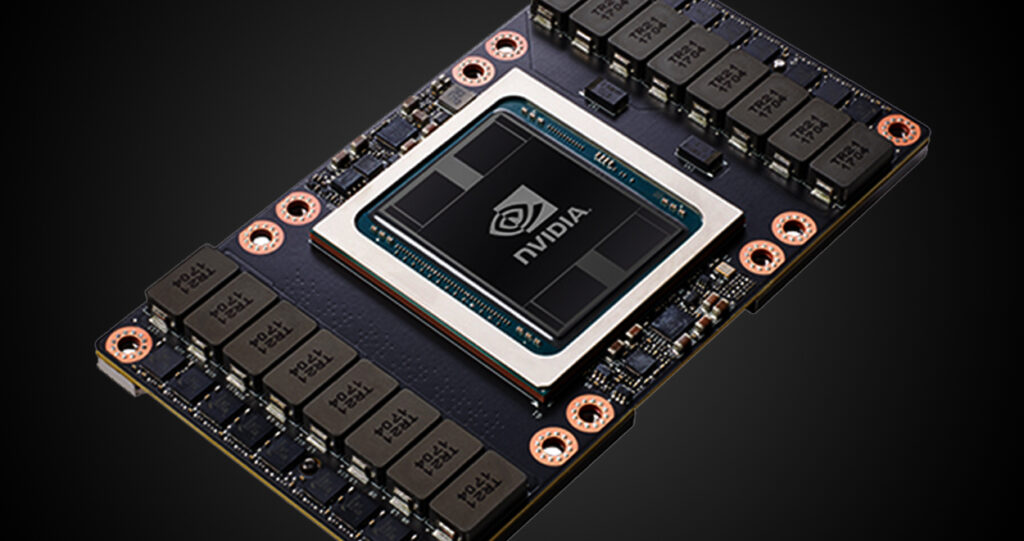
The subsequent release of the A100 GPU as part of the Ampere architecture marked another substantial leap forward, offering 2.5 times the performance of the V100. Crafted with 54 billion transistors on a 7-nanometer process, the Ampere architecture represented the largest 7nm chip ever built at the time and featured six groundbreaking innovations specifically targeted at accelerating AI workloads.
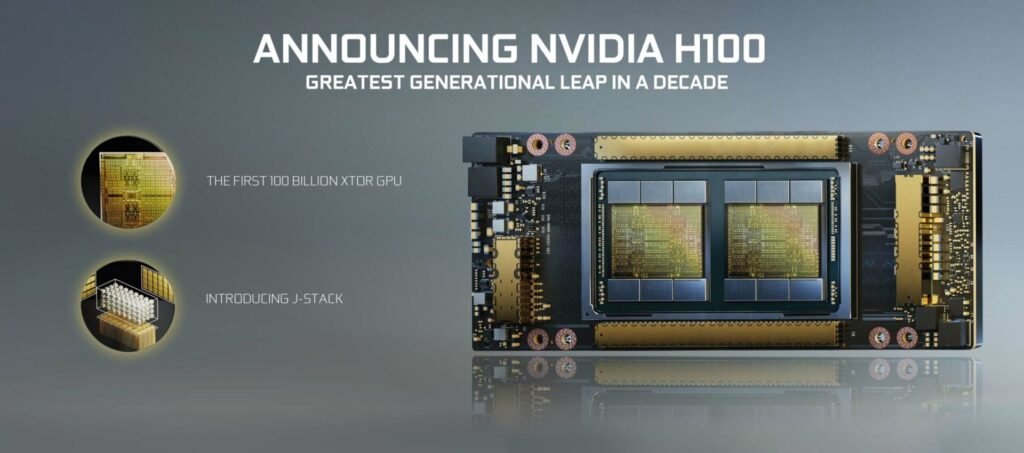
Most recently, Nvidia introduced the Hopper microarchitecture in 2022, named after computer scientist and United States Navy rear admiral Grace Hopper. Designed specifically for datacenters, the Hopper architecture improved upon its predecessors with a new streaming multiprocessor, faster memory subsystem, and a specialized transformer acceleration engine-features explicitly targeted at enhancing AI performance. The Nvidia Hopper H100 GPU, implemented using TSMC’s N4 process with 80 billion transistors, consists of up to 144 streaming multiprocessors and has become the backbone of modern AI infrastructure.

Powering ChatGPT and the AI Revolution
From GPT-3 to ChatGPT: The Hardware Behind the AI Boom
Nvidia’s evolving GPU technology has become the foundation for training and running today’s most sophisticated AI systems, including OpenAI’s ChatGPT. The journey began with GPT-3, for which Microsoft built a supercomputer exclusively for OpenAI that boasted more than 285,000 CPU cores and over 10,000 Nvidia V100 GPUs. This massive computational infrastructure enabled the training of what was, at the time, the most advanced language model ever created.
ChatGPT, an evolution of GPT-3 specialized for natural text-based conversations, was trained on Microsoft Azure infrastructure likely using Nvidia’s A100 GPUs from the Ampere generation. The scale of hardware required for running ChatGPT is staggering – estimates suggest it requires over 3,500 Nvidia A100 servers containing close to 30,000 A100 GPUs, with operating costs between $500,000 to $1 million per day.
The relationship between Nvidia and OpenAI runs deep. Jensen Huang, Nvidia’s founder and CEO, personally hand-delivered the world’s first Nvidia DGX AI system to OpenAI in the early days of the partnership. This collaboration has continued to flourish, with OpenAI CEO Sam Altman announcing in February 2025 that the company was adding “tens of thousands of GPUs” to support the rollout of ChatGPT version 4.5, with “hundreds of thousands” more to follow shortly after.
Technical Innovations Driving AI Performance
Nvidia’s latest GPUs have delivered remarkable performance improvements for large language models like ChatGPT. The H100 Tensor Core GPUs achieved 30 times higher performance in inferencing and 4 times higher performance for model training compared to previous generations. These advances were made possible through a data parallelism approach and the scaling of virtual machines with Nvidia Quantum-2 InfiniBand networking to meet the higher processing demands of large language models.
The technical architecture powering these AI systems has been carefully optimized to handle the unprecedented scale and complexity of models with hundreds of billions of parameters. Microsoft’s Azure CTO Mark Russinovich has explained that training such massive models requires efficient data center infrastructure – from increasing throughput and minimizing server failures to leveraging multi-GPU clusters for compute – intensive workloads.
Financial Transformation and Market Dominance
From Gaming Company to AI Titan
Nvidia’s strategic pivot toward AI has driven extraordinary financial growth. In the fiscal year ending January 2025, Nvidia reported staggering revenue of $130.5 billion, 114% increase from the previous year. This remarkable growth has fundamentally transformed the company’s revenue structure, with the data center segment generating $115.2 billion (89% of total revenue), while the gaming segment contributed $11.35 billion (9% of revenue).

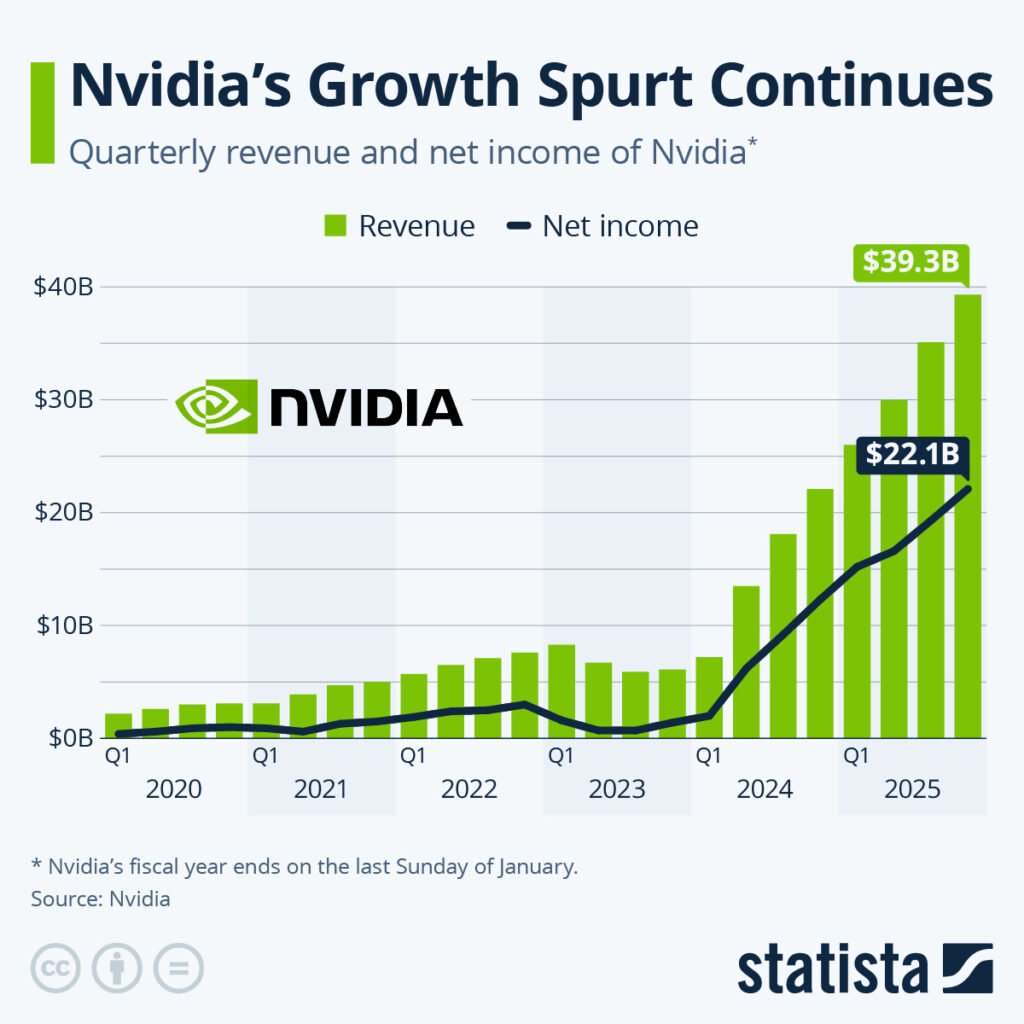
The fourth quarter of fiscal 2025 saw Nvidia’s datacenter segment continue to dominate earnings, generating $35.58 billion, up 16% quarter-over-quarter and 93% year-over-year. Notably, compute GPUs accounted for the lion’s share of Nvidia’s datacenter sales at $32.556 billion, with networking products totaling $3.024 billion. Sales of Nvidia’s next-generation Blackwell GPUs reached $11 billion in just the fourth quarter, significantly exceeding the company’s projections and demonstrating overwhelming demand for AI and high-performance computing hardware.
This financial transformation has elevated Nvidia to unprecedented heights in the corporate world. In 2023, Nvidia was recognized as the world’s most valuable chipmaker as demand for its AI chips more than doubled its income. By June 2024, the company had achieved an even more remarkable milestone, becoming the world’s largest public company by market capitalization.
Current Position and Future Outlook
AI’s Insatiable Appetite for Compute
The demand for Nvidia’s AI chips shows no signs of abating. Major tech companies continue to expand their AI infrastructure at a staggering pace, with Meta and Elon Musk’s xAI using super clusters of Nvidia chips comprising up to 100,000 AI processors to produce AI models more rapidly. Industry analysts project that big tech firms could require clusters of 300,000 chips in the coming year.
However, this explosive growth has created supply challenges. While Nvidia dominates the discrete desktop GPU market with an 80.2% share as of Q2 2023, the company has struggled to meet simultaneous demand across both its AI and gaming segments. In Q4 FY2025, Nvidia’s gaming revenue dropped to $2.54 billion, down 22% quarter-over-quarter and 11% year-over-year, due to supply constraints as the company prioritized production of high-margin AI processors over lower-margin gaming products.
Implications for the Future of AI
Nvidia’s transformation from a gaming-focused company to the powerhouse behind modern AI represents more than just a corporate success story. It signifies a fundamental shift in computing paradigms. The parallel processing capabilities that once rendered realistic graphics in video games now empower AI systems that can understand language, generate images, recognize patterns, and perform countless other cognitive tasks that were once the exclusive domain of human intelligence.
As AI continues to transform industries ranging from healthcare and transportation to finance and entertainment, Nvidia’s hardware and software ecosystem remains at the center of this revolution. The company’s journey from near bankruptcy to becoming the most valuable company in the world illustrates not just remarkable business acumen but also highlights how technological innovations in one domain can unexpectedly become the foundation for breakthroughs in entirely different fields.
Conclusion
Nvidia’s evolution from a struggling graphics card startup to the technological backbone of the AI revolution represents one of the most remarkable business transformations in modern history. The company’s success stems from a combination of visionary leadership under Jensen Huang, strategic technological pivots, and perfect positioning for the unexpected explosion of AI applications.
What began with three engineers discussing graphics processing at a Denny’s restaurant has evolved into a trillion-dollar company whose technologies power the most advanced AI systems on the planet, including ChatGPT. The introduction of CUDA in 2006 proved to be the critical turning point, transforming GPUs from specialized gaming hardware into general-purpose parallel processors capable of accelerating a vast range of computations.
As AI continues to advance and transform industries worldwide, Nvidia’s technology remains fundamental to this revolution. The company that once struggled to stay in business for more than thirty days now powers the world’s most sophisticated AI models, processing billions of parameters across tens of thousands of specialized chips. This remarkable journey from gaming to AI giant not only highlights Nvidia’s business agility but also demonstrates how innovations in one technological domain can unexpectedly become the foundation for revolutionary advances in entirely different fields.
Also Read: A Deep Dive into the Marketing Strategy of NVIDIA
Also Read: Top Competitors and Alternatives of NVIDIA
To read more content like this, subscribe to our newsletter
Go to the full page to view and submit the form.