



Mercury is a financial technology company that offers banking services tailored to startups and small businesses. Founded in 2017 and headquartered in San Francisco, Mercury provides FDIC-insured checking and savings accounts, debit and credit cards, and a suite of financial tools — all delivered through a modern, software-driven platform.
Importantly, Mercury itself is not a bank; instead, it partners with chartered banks (such as Choice Financial Group, Evolve Bank & Trust, and Column National Bank) to hold customer deposits and provide banking infrastructure.
This partnership model enables Mercury to offer up to $5 million in FDIC insurance per startup by sweeping deposits across multiple institutions, far above the standard $250,000.
Today, more than 200,000 businesses – from tech startups to e-commerce firms and venture funds – trust Mercury’s platform to manage their finances. Mercury has gained industry recognition as a leading online business banking solution, credited with streamlining financial operations for startups through its robust digital platform.
In an era where traditional banks often fall short for new companies, Mercury positions itself as a “bank for startups” – combining the security of regulated banking with the agility of a fintech.
The company’s vision is to turn the bank account into the central “operating system” for a startup’s finances, integrating all the ways businesses use money into a single, extraordinary user experience.
Founding Story of Mercury
Mercury’s origin story is rooted in its founders’ firsthand frustrations with traditional banking. Immad Akhund, Mercury’s CEO, conceived the idea as early as 2013 when he noticed a stark contrast in innovation: while tools for startups were rapidly improving (with companies like Stripe and Gusto streamlining payments and payroll), business banking remained painfully outdated.
As the co-founder of a prior startup (the mobile ad network Heyzap), Akhund experienced how cumbersome banking could hinder a growing business – from the paperwork of opening accounts to the ordeal of sending hundreds of wire transfers by hand each month.
After selling Heyzap in 2016, Akhund spent time as an angel investor and repeatedly saw other founders facing the same pain points: lengthy in-person bank visits, hidden fees, and poor online interfaces.
By 2017, convinced that startups needed a better banking solution, Akhund teamed up with two former colleagues from Heyzap – Max Tagher and Jason Zhang – to build Mercury.
The trio envisioned a “technology-first” bank account that would eliminate the friction they’d encountered, inspired in part by the rise of European fintech challengers that were redefining banking overseas.
Turning this vision into reality required overcoming significant hurdles. Akhund and his co-founders spent months meeting with over 60 banks and 100+ entrepreneurs to understand how to integrate fintech with the regulated banking system. They secured partnerships with a few forward-thinking banks (such as Evolve and Choice) willing to power Mercury’s backend infrastructure.
In mid-2017, Mercury raised an initial seed round to fund product development, but instead of rushing to market with a bare-bones app, the team of three founders (and eventually 9 early employees) focused on building what Akhund called a “minimum delightful product” – a fully functional digital bank account with all the basics (wires, ACH, multi-user access, modern UI) working seamlessly from day one.
After 18 months of development under the radar, Mercury launched in a private alpha in April 2019 and saw immediate validation: within the first week, one startup moved $1 million into its Mercury account. A public launch followed shortly thereafter, and Mercury’s user base grew 30–40% month-over-month in its early days.
This founding period cemented Mercury’s mission to “make banking magical” for startups. The team’s own experiences – feeling constrained by cash flow at Heyzap and watching peers struggle with antiquated banks – shaped Mercury’s product philosophy.
Banking would no longer be a bottleneck or source of anxiety for a founder; instead, Mercury would offer a frictionless, software-driven experience to help companies scale. By focusing relentlessly on startups’ needs and leveraging technology (like automation and APIs) to simplify finances, Mercury began to carve out its role as the startup world’s banking partner from its very inception.
Founders and Leadership Profiles of Mercury
Mercury was founded by a trio of entrepreneurs who combined technical prowess with firsthand startup experience:
Immad Akhund (Co-founder & CEO)


A serial entrepreneur originally from Pakistan and raised in the UK, Akhund studied at Cambridge before moving to Silicon Valley. He co-founded the social gaming ad platform Heyzap in 2008 and led it through multiple pivots, eventually achieving a $45 million acquisition in 2016.
After Heyzap’s exit, Akhund became an active angel investor in over 200 startups, which exposed him to the widespread banking frustrations that inspired Mercury. At Mercury, Akhund is the visionary at the helm, emphasizing profitability and long-term thinking.
He is known for a product-centric approach and famously kept Mercury’s fundraising sparse in its early years to focus on sustainable growth. Under his leadership, Mercury has already achieved 10 consecutive quarters of profitability and $500 million in annual revenue by 2024 – a rarity among fintech startups.
Maximilian “Max” Tagher (Co-founder & CTO)


Max Tagher is Mercury’s Chief Technology Officer and the technical backbone of the company. He was a senior software engineer at Heyzap (where he worked under Akhund) and brought deep experience in building scalable systems.
Tagher joined Akhund at Mercury’s founding in 2017, initially keeping the engineering team very lean – just a handful of coders working to build a robust banking platform from scratch.
Tagher’s focus on security, infrastructure, and integrations helped Mercury launch with a surprisingly complete product (including features like programmatic API access to accounts, something he helped implement from the first version).
As CTO, Tagher continues to oversee Mercury’s technology roadmap, ensuring the platform remains reliable and developer-friendly as it rapidly expands its features (e.g. the rollout of Mercury’s API, and later tools like bill pay and integrations with accounting software).
Colleagues often credit Tagher with instilling Mercury’s culture of building “banking software with an engineer’s mindset,” balancing fintech innovation with the rigor of banking security.
Jason Zhang (Co-founder & COO)

Jason Zhang serves as Mercury’s Chief Operating Officer and is often described as the “operational wizard” behind Mercury’s smooth user experience. Zhang has an unorthodox background – he studied biology in college – but found his way into tech through business roles.
He was Vice President of Business Development at Heyzap, where he worked closely with Akhund and Tagher. At Mercury, Zhang wears many hats: he drives product strategy, design, customer support, and day-to-day operations.
His influence is seen in Mercury’s emphasis on seamless onboarding and customer-centric design. Having personally dealt with the hassles of bank paperwork during Heyzap’s growth, Zhang made it Mercury’s hallmark to let founders open accounts quickly online – often in minutes, not weeks.
He also led Mercury’s approach to risk and compliance, turning fraud prevention into a “product” that uses algorithms to minimize red tape for legitimate customers.
Under Zhang’s operational leadership, Mercury has maintained a strong reputation for customer service despite its fast growth, and he has been key in scaling the company’s internal processes (the company grew from just 3 co-founders to over 800 employees by 2025 while preserving a culture of innovation and customer obsession).
Together, Akhund, Tagher, and Zhang form a complementary founding team: Akhund provides vision and industry credibility (as a multi-time founder and investor), Tagher brings engineering excellence, and Zhang ensures execution and customer experience. All three founders are startup “natives” who built Mercury as the bank they wished they’d had in their previous ventures.
They continue to lead Mercury’s strategy, backed by a growing executive team (including experienced hires like a new CFO/CCO in 2021) and a board of advisors that now features seasoned financial leaders (notably, former SVB CEO Tim Mayopoulos joined Mercury’s board in 2025 to guide its next phase).
This blend of startup grit and banking know-how in Mercury’s leadership is a significant asset as the company navigates the complex fintech landscape.
Business Model of Mercury
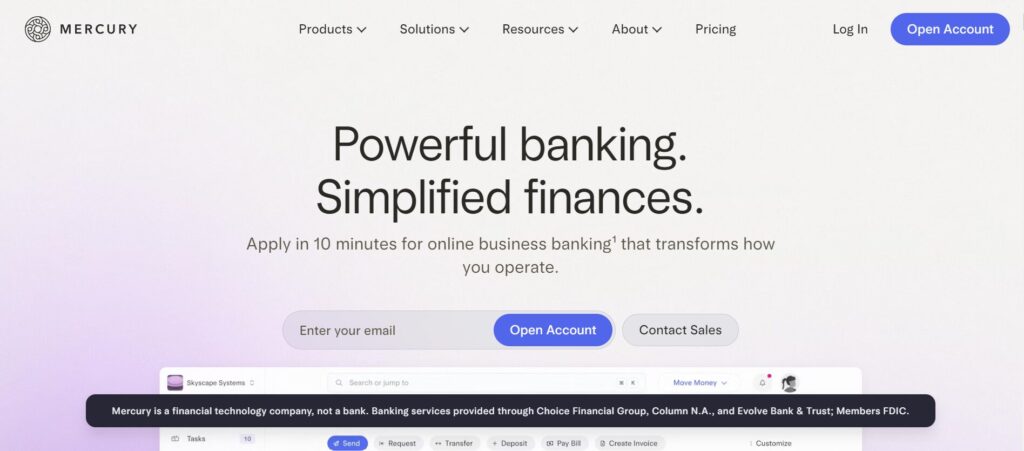

Mercury’s business model is built on providing a full-stack banking platform for startups – largely for free – and monetizing through value-added financial services. At its core, Mercury offers a business checking and savings account with a modern web interface and API, without the traditional fees.
The company does not charge any monthly account fees, minimum balance fees, or overdraft fees, and even standard transactions (ACH transfers, domestic wires, debit card usage, issuing multiple cards) are provided at no cost to the customer.
This approach lowers the barrier for cash-strapped startups to switch to Mercury and keeps them engaged on the platform. Mercury can afford this because, as a fintech, it partners with banks that handle the regulated aspects (holding deposits, FDIC insurance) while Mercury focuses on the software layer and customer relationship.
Essentially, Mercury acts as a “banking-as-a-service” aggregator: it integrates with regulated partner banks in the background, and presents a unified, tech-friendly banking experience to users on the front end.
Once startups are onboarded, Mercury’s model is to become their financial hub. The platform has expanded beyond basic bank accounts into a range of adjacent products – all accessible from the same dashboard.
Mercury offers cash management (treasury) for idle funds, credit cards, loans (venture debt and working capital), and a growing suite of financial operations tools (like bill pay, invoicing, and expense management). By bundling these services, Mercury increases each customer’s lifetime value and embeds itself deeper into their workflows.
The strategy is analogous to being an “operating system” for startup finances: once a company uses Mercury for banking, they are likely to use its other integrated tools rather than seek external providers. This not only creates convenience for the customer but also multiple revenue channels for Mercury.
A key element of Mercury’s business model is trust and safety, which is critical for a financial platform. Mercury leverages its partner-bank network to offer unique safeguards, such as Mercury Vault, which automatically spreads deposits across banks to insure up to $5 million.
This feature was rapidly rolled out in March 2023 in response to the Silicon Valley Bank crisis, demonstrating Mercury’s commitment to protecting its customers’ funds. Mercury also built features like customizable user roles/permissions and robust security (2FA, auditing tools) early on, catering to the operational needs of startups.
By addressing these concerns, Mercury positions itself as a reliable partner for young companies that might otherwise worry about trusting a startup with their money.
Finally, Mercury’s model is notable for what it doesn’t do: unlike traditional banks, Mercury does not lend out customer deposits directly (since it’s not a chartered bank). Instead, it partners with banks and investment firms (for treasury services) to provide yield or credit to customers.
Mercury earns revenue through sharing arrangements and fees (rather than interest spread from lending itself), which aligns its interests with customers’ success.
In summary, Mercury’s business model centers on acquiring startups with a superior free product, deepening the relationship with integrated financial solutions, and generating revenue through ancillary services rather than nickel-and-dime fees.
This model has been effective: Mercury’s customer base and deposits have grown rapidly (especially after 2023’s banking turmoil), fueling strong financial performance while maintaining a reputation for being “startup-friendly”.
Revenue Streams of Mercury
Mercury combines traditional banking revenue sources with fintech-style services to generate income. Its primary revenue streams include:
1. Interest Share on Deposits
Mercury earns a portion of the interest income generated on customer deposits by its partner banks. When users keep money in Mercury accounts, the partner banks invest those deposits (mostly in safe assets like treasuries), and through revenue-sharing agreements Mercury gets a cut of the interest yield.
This became especially lucrative as interest rates rose in 2022–2023, and is a major reason Mercury reached profitability; in fact, Mercury’s annual revenue hit $500 million in 2024, largely thanks to interest income on a growing deposit base.
2. Interchange Fees
Mercury provides both debit cards and its IO Mastercard credit card to customers, and earns interchange fees whenever those cards are swiped. Every time a Mercury customer spends on their card, merchants pay a small fee (set by Visa/Mastercard), and Mercury receives a share of that via its card-issuing partners.
The Mercury IO card, launched in 2022, has been particularly popular as it offers 1.5% cashback and dynamic limits based on deposits (attracting startups to use it for all spending) – driving interchange revenue for Mercury.
3. Foreign Exchange & Wire Fees
While domestic payments are free, Mercury charges 1% on currency exchange and international wires. For startups dealing in global payments or receiving international funding, these fees provide Mercury with another income source.
The transparent 1% fee is often lower than what big banks charge, making it palatable to users while still contributing to Mercury’s top line.
4. Lending Products (Origination & Interest)
Through offerings like venture debt loans and working capital loans, Mercury earns money from origination fees, interest on loans, and sometimes equity warrants. Mercury’s venture debt (launched in 2022) provides loans to VC-backed startups (typically 30–50% of their latest funding round), for which Mercury can earn interest income.
Its working capital loans for e-commerce businesses carry flat fees that effectively include interest. While Mercury doesn’t lend from its own balance sheet, it partners with financing providers and acts as a facilitator, taking a portion of loan-related revenues in return. These credit products also strengthen customer loyalty (founders who take a Mercury loan are likely to stick with the platform).
5. Premium Services & Subscriptions
In 2024 Mercury introduced paid tiers for some of its advanced software features. For example, the Mercury Treasury service (which helps companies earn higher yield on large cash balances by investing in money market funds) is free to use, but Mercury earns a management fee of about 0.15%–0.60% of assets under management.
Additionally, Mercury rolled out subscription plans for its financial operations tools (advanced versions of bill pay, invoicing, expense management) – charging businesses $35/month for basic and up to $350/month for full suite access to these time-saving features.
Mercury also launched Mercury Personal accounts for individual users in 2024 on an annual subscription of $240/year. While the core banking experience remains free, these premium software offerings create a SaaS-like revenue stream on top of Mercury’s banking platform.
In combination, these diverse revenue streams have enabled Mercury to be profitable while sustaining high growth. By 2023, Mercury’s annualized revenue run-rate was growing 4× year-over-year thanks to interest and interchange tailwinds, and the company has consciously avoided over-reliance on any single source.
This financial sustainability is a strategic advantage for Mercury, especially as many fintech peers struggle to achieve profitability. Mercury’s ability to make money through scale (many customers, many transactions) rather than heavy fees on each customer reinforces its brand as a founder-friendly banking partner.
Funding and Investment History of Mercury
Mercury’s journey is marked by relatively few funding rounds, reflecting a strategy of measured growth and early profitability. The company’s financing history began with a modest seed round in 2017, when Immad Akhund secured backing from top-tier investors even before Mercury had a launched product.
Akhund approached Andreessen Horowitz’s fintech expert Alex Rampell for advice at the idea stage, which quickly turned into a term sheet. Mercury raised $6 million in August 2017 led by Andreessen Horowitz (with participation from angel investors), giving it the runway to build out its banking platform.
Notably, the seed funding allowed Mercury to hire its initial team (expanding from the 3 co-founders to 9 people) and focus on product design – the first hire was a designer to emphasize Mercury’s intuitive UX.
After launching publicly and gaining traction in 2019, Mercury attracted significant investor interest. The startup secured a $20 million Series A in September 2019 led by CRV (Charles River Ventures), with an unusually large roster of around 40 investors joining the round.
This round included major Silicon Valley names and even celebrities: Andreessen Horowitz followed on, and individuals like Nick Jonas, Serena Williams (Serena Ventures), Will Smith (Dreamers Fund), Kevin Durant (35V), and several prominent founders (e.g. of Flexport, Thumbtack, Eventbrite, Superhuman) became investors.
The Series A buzz not only injected capital for Mercury’s growth but also helped bolster Mercury’s brand through these high-profile backers. Mercury channeled the funds into expanding its feature set (integrating with accounting tools like QuickBooks and adding security features) and hiring key team members (its first post-Series A hire was a recruiter to scale up staffing).
In July 2021, Mercury announced its Series B round of $120 million at a $1.62 billion valuation, officially granting it “unicorn” status. The Series B was led by Coatue Management (Dan Rose, a former Facebook VP, championed the deal) with participation from existing investors a16z, CRV, and others.
In a pioneering move, Mercury set aside $5 million of this round for its own customers to invest via a crowdfunding campaign on Wefunder. This gesture let hundreds of Mercury’s startup clients become shareholders, aligning Mercury even more closely with its user community.
The fresh capital from Series B was intended to accelerate Mercury’s product development and scale operations, and indeed Mercury’s growth surged around this time – by mid-2021 it had over 40,000 businesses onboard and $4 billion in customer deposits.
Yet, tellingly, Mercury did not raise any primary funding for the next four years, as the company was already generating revenue and even turned profitable by late 2022. Akhund has noted he was cautious about over-funding, preferring to raise only when it made strategic sense.
Mercury’s most recent raise came in March 2025, with a blockbuster Series C of $300 million led by Sequoia Capital. The Series C more than doubled Mercury’s valuation to $3.5 billion (from the Series B’s $1.62 billion), reflecting the company’s strong performance and the market’s renewed appetite for fintech.
Alongside Sequoia, new investors Spark Capital and Marathon joined the cap table, and all major prior investors (Coatue, CRV, Andreessen Horowitz) doubled down. Remarkably, this was Mercury’s first fundraise in over 3.5 years – a deliberate pace that underscores its focus on sustainable growth over hype.
By 2025, Mercury had the numbers to justify investor enthusiasm: it revealed it had over 200,000 customers, $156 billion in annual transaction volume, and was profitable with half a billion in revenue.
Akhund characterized the Series C as “opportunistic” – raising money not out of necessity but to seize future opportunities (such as potential acquisitions, new product lines, and international expansion). With this war chest, Mercury is well positioned to continue its ambitious roadmap (and the presence of Sequoia on its board brings added support for scaling to a much larger enterprise).
Below is a summary of Mercury’s key funding rounds, investors, and valuations to date:
| Date | Round | Amount Raised | Lead Investor(s) | Post-Money Valuation |
|---|---|---|---|---|
| Aug 2017 | Seed | $6 million | Andreessen Horowitz (Alex Rampell) | – (pre-launch) |
| Sept 2019 | Series A | $20 million | CRV (Saar Gur); participants included a16z, Nick Jonas, Will Smith’s fund, Kevin Durant’s fund, Serena Ventures, etc. | – (early-stage) |
| Jul 2021 | Series B | $120 million | Coatue (Dan Rose); with a16z, CRV, Sapphire Ventures, an.d others | $1.62 billion |
| Mar 2025 | Series C | $300 million | Sequoia Capital (Sonya Huang); with Spark Capital, Marathon, and existing major investors | $3.5 billion |
Mercury’s cap table thus includes many of Silicon Valley’s top venture firms and notable angels. This strong investor backing – combined with Mercury’s capital-efficient growth – gives the company both the credibility and the resources to compete against larger incumbents in banking.
Competitors of Mercury
In the quest to become the go-to financial platform for startups, Mercury faces competition on several fronts. Broadly, its competitors fall into three categories: other startup-focused fintech banks, wider fintech platforms offering financial services, and traditional banks that historically served the startup/SMB segment. Each poses different challenges:
1. Startup-Focused Neobanks
These are fintech companies, like Mercury, that provide online banking primarily for startups or small businesses, often partnering with banks in a similar model. Notable examples:
i. Brex


Founded in 2017, Brex began as a corporate card startup but later added a cash management account for businesses. Brex has raised over $1.5 billion and reached a $12.3 billion valuation in 2022.
In the wake of Silicon Valley Bank’s collapse, Brex (like Mercury) saw billions in deposit inflows from startups seeking alternatives. Brex and Mercury have a similar approach (both use partner banks and offer modern web interfaces), and they directly compete for venture-funded companies’ accounts.
However, Brex historically targeted slightly larger tech firms and offered spend-management software as a core product, whereas Mercury led with a bank account. As of 2025, Brex reportedly has around 30,000 business customers, which is a fraction of Mercury’s user count, suggesting Mercury has pulled ahead among early-stage companies.
ii. Novo


Founded in 2016, Novo is another digital banking platform for small businesses and entrepreneurs. It has raised nearly $300 million and was last valued around $700 million.
Novo differentiates by offering an app marketplace and integrations (similar to Mercury’s API ethos) and claims over 250,000 customers as of 2025. Novo’s customer base skews towards solo entrepreneurs and small merchants, whereas Mercury historically focused on funded startups.
Both emphasize low fees and a sleek UX, although Mercury offers a broader product suite (Novo, for instance, doesn’t provide venture debt or its own corporate card).
iii. Rho


Launched in 2018, Rho is a YC-backed startup that offers digital banking for startups, along with treasury and spend management features. Rho has raised about $190 million and touts a higher FDIC insurance coverage (up to $75 million via sweeps) to attract companies with large balance.
It competes on the upper end of Mercury’s market (larger startups) by promoting this higher insurance cap. However, Rho lacks some products Mercury has (for example, Rho does not provide venture debt loans).
Rho’s transaction volumes are also relatively small (a few billion annually) compared to Mercury’s $156 billion/year, indicating it remains a niche player.
2. Broader Fintech Platforms
These are companies that didn’t start strictly as “banks” but have expanded into offering banking or financial services to businesses, effectively becoming one-stop finance platforms. Key players include:
i. Ramp


Founded in 2019, Ramp is known for its corporate cards and expense management software. Ramp has raised over $2.3 billion and was valued at $13 billion in 2025. It has broadened into bill payments, procurement, travel booking, and even offering a treasury product – positioning itself as an all-in-one finance operations platform.
Ramp’s approach is software-first (integrating on top of bank accounts), whereas Mercury is bank-first (adding software around the bank account). As Ramp encroaches into managing business funds and payments, it competes with Mercury’s newer features (like bill pay and expense management).
However, Ramp does not actually hold deposits (many Ramp users could, for example, use Mercury or a bank as the underlying account). In fact, Mercury and Ramp can sometimes be complementary (some startups use Mercury for banking and Ramp for spend control), but their feature sets are converging, leading to direct competition in financial software.
ii. Navan (formerly TripActions)


Founded in 2015, Navan started in corporate travel booking and later added a corporate card and expense management after acquiring startup Divvy. With over $2.2 billion raised and a $9.2 billion valuation, Navan targets mid-sized and larger tech companies for integrated travel + expense solutions.
While not a bank, Navan’s expense card and software suite overlap with Mercury’s expense management and card offerings. Mercury’s advantage here is a native bank account and deposit services, whereas Navan’s strength is its specialized travel management capabilities. They compete for startups that want a unified solution; Mercury positions that its banking core plus add-ons can cover many needs, but some larger companies might use Navan for travel/expenses while banking elsewhere.
iii. Rippling

Founded in 2016 as an HR and IT platform, Rippling expanded into the finance realm by offering payroll, expense tracking, and even business banking accounts as part of its workforce management suite.
Rippling is valued around $13.5 billion and, like Mercury, it launched a business bank account feature (through bank partnerships) to complement its HR software. Rippling’s angle is that finance is part of an integrated employee management system. This is a different vector of competition: a company using Rippling might be tempted to use Rippling’s business account for convenience, instead of Mercury.
However, Rippling’s banking features are relatively new and not as feature-rich as Mercury’s (Rippling is more of a bundled offering for existing HR customers). Still, it signals that Mercury must continue to innovate to remain the dedicated choice for startups’ primary accounts against multi-product platforms like Rippling.
3. Traditional Banks (Incumbents)
These include both big national banks and specialized institutions that historically banked startups:
i. Big Banks (JPMorgan Chase, Bank of America, Wells Fargo, Citibank) – Large banks have SMB accounts but often lack the tailored approach or tech integrations that startups want. Some have begun offering improved digital interfaces, but opening an account with a traditional bank can still mean paperwork and branch visits, which is exactly the pain point Mercury capitalizes on.
Mercury’s 24/7 online sign-up and startup-friendly perks contrast sharply with the slow service many founders associate with incumbent banks. While big banks are not focused on early-stage startups (their startup divisions, if any, target later-stage or enterprise clients), they are always a competitive threat given their resources.
Mercury’s strategy to outcompete them is to offer a far superior user experience and personalized support for small companies, which large banks struggle to match.
ii. Silicon Valley Bank (SVB) and First Republic (Legacy Startup Banks): SVB (along with First Republic Bank) was long considered the go-to bank for tech startups and venture firms. However, SVB’s collapse in March 2023 abruptly changed the landscape.
Mercury and others leapt into the void – Mercury alone gained nearly 26,000 new customers in the four months after SVB’s failure. First Republic likewise failed in 2023. In essence, a “massive hole” was left in startup banking that Mercury is aiming to fill.
Some of SVB’s former clients have stayed with Mercury due to its quick response (increasing insurance, launching Vault during the crisis) and digital ease. However, some venture debt and larger services that SVB provided may still be areas where Mercury faces competition from other banks or new entrants.
Furthermore, newly emerged banks (or acquirers of SVB’s business) could attempt to win startups back. Mercury’s competitive play here is to continue expanding its services to cover what SVB offered – for example, Mercury now has venture debt and even a special offering for venture capital firms, akin to what SVB did.
Additionally, Mercury’s addition of experienced bankers (like ex-SVB executives on the board) aims to reassure the startup community that Mercury can be a stable anchor for them.
In summary, Mercury’s competitive landscape is dynamic. It leads in the pure-play startup banking segment (especially after 2023’s shakeup), but it faces well-funded fintech rivals like Brex and Ramp that are converging on similar markets.
Mercury also contends with incumbents’ massive scale but differentiates itself through agility and focus. According to one analysis, nearly 40% of new startups were choosing Mercury as of early 2024, including over half of Y Combinator companies – a strong sign of its competitive edge in that niche.
The company will need to keep leveraging its strengths (product depth, customer-centric design, and now, a track record of stability) to maintain this lead as competition stiffens.
Also Read: Brex – Business Model, Founders, Revenue, Funding & Competitors
To read more content like this, subscribe to our newsletter
Go to the full page to view and submit the form.