


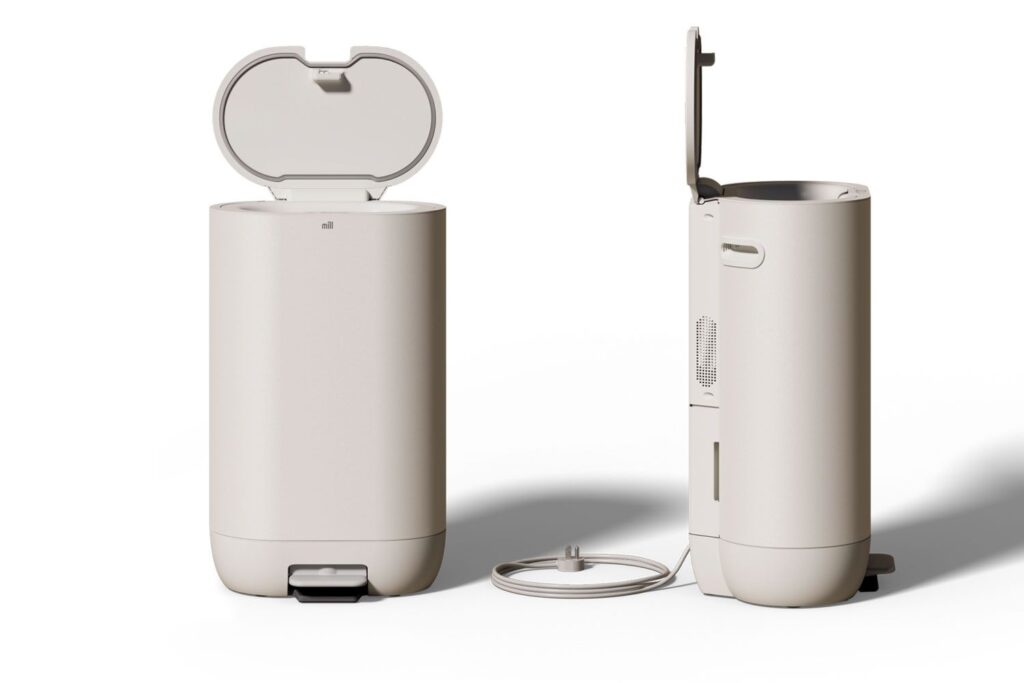
Mill is a climate-tech startup on a mission to “outsmart waste” by turning household food scraps into resources rather than landfill fodder. The company’s core product is a smart kitchen bin that dehydrates and grinds food scraps overnight.
Once full, the dry “Food Grounds” are sent back to Mill (via prepaid USPS shipping) and transformed into safe animal feed – essentially continuing the food’s lifecycle on a farm. This circular approach dramatically reduces waste: Mill estimates each household using its system can avoid roughly 0.5 metric tons of CO₂ emissions per year (including all bin manufacturing and shipping).
In short, Mill provides a Netflix-like membership for food waste: a sleek bin plus all accessories for a flat fee, helping homes keep scraps out of landfills and methane emissions under control.

Founding Story of Mill
Mill was founded in 2020 by two former Nest executives who wanted to tackle the large carbon footprint of food waste.
Matt Rogers (Nest co-founder and ex-Apple engineer) and Harry Tannenbaum (former Nest director and Google hardware lead) teamed up to build on lessons from the smart-home market.
After Nest, Rogers had taken time off, then in 2020 he and his wife Harry returned to tech with a focus on climate solutions – and they zeroed in on kitchen waste as “the most tractable of all climate problems”.
The Mill team spent 2020-2022 in stealth R&D, designing a prototype bin and logistics network. They hired engineers (even ex-Uber/Lyft staff for logistics) and consulted academic experts on livestock feed, carefully navigating the regulations to safely recycle scraps into feed. In early 2023 Mill emerged from stealth to start shipping its first product. January 2023 media coverage described the Mill bin as “a sleek trash can” that “gobbles up food scraps, dries them out, and grinds them to bits overnight”.
The founders raised major venture funding and began a rollout to U.S. homes in spring 2023, rapidly moving from pilot to public membership.
Founders of Mill
Matt Rogers (Co-founder & CEO)


Rogers was an early Apple engineer (iPod and original iPhone software) and co-founded Nest Labs (sold to Google in 2014 for $3.2B). At Nest he helped create the iconic Learning Thermostat, learning how to change home behaviors. After Nest and a stint at Google, he focused on philanthropy and climate issues before launching Mill. His vision for Mill is to apply Nest’s “behavior-change in the home” ethos to waste.
Harry Tannenbaum (Co-founder & President)


Tannenbaum was Nest’s hardware director and a key leader on Nest’s thermostat and other products. He also worked on consumer hardware at Google. At Mill he oversees product and technology, emphasizing practical solutions (“Food in landfills is one of the most solvable climate problems”). Together Rogers and Tannenbaum leverage deep consumer-tech experience to make Mill’s bin intuitive and appealing, encouraging users to adopt new waste habits.
Business Model of Mill
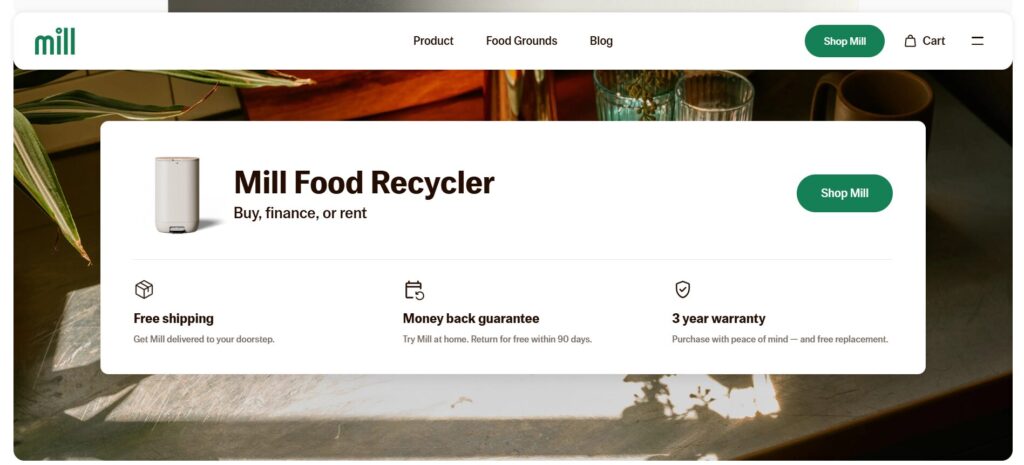
Mill operates on an all-inclusive subscription model, bundled as the “Mill Membership”. For about $35 per month ($420 per year), a member receives the Mill kitchen bin, regular charcoal filters (for odor control), and prepaid shipping supplies. The hardware itself and monthly consumables are free with the membership – there is no extra fee to own the bin.
Subscribers simply fill the bin with any mix of scraps (even meat or dairy, which many composters can’t handle), and the bin automatically dehydrates and grinds them overnight. When the bin is full (typically every 2–3 weeks), the user dumps out the sterile “food grounds” into a branded Mill box and schedules a USPS pickup via the app.
The empties box is picked up and transported back to Mill’s facility at no added cost.

Key aspects of Mill’s model include:
-
Full-service subscription – The membership fee covers the bin, replacement carbon filters, shipping boxes and postage, and a warranty. (If paid monthly, the fee is $35 + a one-time $75 bin delivery charge; annual plans waive that extra cost.)
-
Logistics via USPS – Instead of new trucks, Mill leverages U.S. Postal Service routes to collect waste. Because mail trucks run everywhere daily (often back empty), Mill gains instant scale and avoids additional delivery emissions. This keeps costs down and simplifies operations.
-
Circular end-market – Mill’s process is not composting: it keeps food “in the food system.” According to Mill, the dry grounds have been cleared by the FDA as a chicken feed ingredient. At their plant, Mill sanitizes and sifts the grounds to create a nutrient-rich feed additive. This unique reuse (sprinkling food back to animals) is Mill’s “exit strategy” for scraps.
In effect, Mill’s bin+service replaces the daily chore of taking out garbage and the methane pollution from landfills with a turnkey home recycling routine. As Rogers emphasizes, a simple change – put scraps in the Mill bin instead of the trash – can have a big climate impact.
Revenue Streams of Mill
Mill’s primary revenue comes from subscription fees – both from households and, increasingly, businesses. Each home subscriber pays ~$420/year, providing a predictable stream that covers not just the hardware but also ongoing logistics. In 2024 Mill expanded to B2B customers, offering the same device under enterprise contracts. Workplace customers pay a corporate subscription for multiple bins plus support services. In April 2025 Mill reported that office users also pay subscriptions and can receive installation/training support under those plans.
Additional revenue channels include:
-
Corporate solutions – “Mill for Workplace” sales and software subscriptions. The company now sells its system to offices, hotels and universities, bundling hardware with a software dashboard and analytics.
-
Future feed sales – While still small, Mill hopes to sell the processed chicken-feed ingredient back to agriculture partners. (This hasn’t been a major income driver yet but is part of the circular design.)
-
Potential hardware sales – Initially free with membership, Mill has begun offering a purchase option (e.g. a $999 outright purchase according to a 2025 review). This provides an alternate revenue stream for customers who prefer buying versus subscribing.
Overall, the consumer membership is the core driver, with emerging contracts and services for businesses as a growing secondary stream.
Funding and Investment History of Mill
Mill has attracted top climate-tech investors since its founding. In late 2022 and early 2023 it secured multiple venture rounds.
According to press reports, Mill had raised roughly $26 million by April 2023 and was in the process of a larger round. BusinessInsider reported that by early 2023 Mill “has raised about $100 million already” from VCs like Google Ventures (GV), Bill Gates’s Breakthrough Energy Ventures (BEV), Energy Impact Partners (EIP), Lowercarbon Capital, Prelude Ventures and others.
The biggest recent raise was a Series C in September 2023. Multiple sources say Mill closed $70 million in Series C funding around Sept 6, 2023. That round was led by Prelude Ventures with participation from existing backers (Breakthrough, Lowercarbon, GV, Energy Impact Partners). Axios noted Prelude and these firms as “existing investors” in the round.
In total, by mid-2025 Mill had raised on the order of $100–110M from investors. Founder Matt Rogers has said Mill’s finances are strong and that no immediate fundraising is needed for its expansion.
In summary, Mill progressed from seed funding (details not public) to a large Series B (early 2022) and a $70M Series C in 2023. Its investor list includes major climate funds and tech VCs, reflecting confidence in Mill’s mission and tech.
| Date | Round | Amount | Lead Investors (other participants) |
|---|---|---|---|
| Jan 2022 | Series B | Not disclosed | Breakthrough Energy Ventures, Google Ventures (GV) |
| Apr 2023 | Venture (seed) | $0.38M | – (small undisclosed round) |
| Sep 2023 | Series C | $70.0M | Prelude Ventures (lead); Breakthrough, Lowercarbon, Energy Impact Partners, GV |
Table: Major funding rounds for Mill Industries. (Sources: press coverage and funding databases.)
Competitor Analysis of Mill
Mill operates in a growing field of smart home waste recyclers. Notable competitors include: Lomi (by Pela), Vitamix’s FoodCycler, Reencle (Korea), and Tero, among others. Each offers a countertop “composter” but with different methods and business models.
The table below compares Mill to major rivals:
| Competitor | Method | Price (approx.) | Model / Key Notes |
|---|---|---|---|
| Lomi 2 (Pela, US) | Heat, grind & agitate waste (multimode) | ~$499 (one-time) | Powerful drying cycles; can compost certain bioplastics; no subscription (filters ~$50/45 cycles). |
| Vitamix FoodCycler | Dry and grind waste (cylindrical bucket) | ~$379 (one-time) | Compact design (separate bin/lid); handles meat/dairy; simple one-button use; no app needed. |
| Reencle Prime | Fermentation (microbe/Bokashi) | ~$499 (one-time) | Continuous operation (24h cycles); produces actual compost using microbes; accepts meat/dairy; quieter models available. |
| Tero | Grind & dehydrate countertop (Wi-Fi-enabled) | Base ~$449; Plus ~$589 (est.) | Kickstarter product in two versions (Plus has app); claims 90% volume reduction; subscription for filters. |
| CompostNow (service) | Professional compost pickup (service) | Varies by region | (Not a machine) Provides household pickup of sorted food waste; no hardware; different approach. |
Table: Comparison of Mill with other home/office food recycling solutions. (Sources: industry media and product sites.)
Competitive Advantage of Mill
Mill’s biggest advantages stem from its integrated, end-to-end solution and experienced team. Unlike a standalone composter, Mill provides everything “out of the box” in the subscription, removing friction for users. The service handles waste collection and processing, so consumers need only add scraps to the bin.
By partnering with USPS, Mill avoids building its own logistics fleet – a “gradual growth model” that scales nationwide without extra trucks. Technically, Mill’s bin is very effective: it reduces waste volume by up to 80% in a single cycle (around 40 lbs of wet food), and new AI-driven control optimizes each run for speed and energy.
The latest redesign in 2024 made the process faster and quieter – now cycles reliably finish by morning as promised, improving daily usability.
Mill also boasts strong impact credentials. The founders performed a full lifecycle analysis and confirm a net climate benefit: even counting energy and shipping, each household saves roughly 0.5 tons of CO₂ equivalent per year. (By comparison, installing LED lights in an office yields about one-tenth that reduction.)
Importantly, Mill’s output is FDA-approved as animal feed, giving it a legal and nutritional edge over unregulated composters. The combination of sleek, Nest-inspired design and real impact has earned Mill a “cult-favorite” reputation among users. In summary, Mill’s vertical integration (hardware + service + feed), seasoned leadership, and clear environmental ROI create a distinct moat versus DIY or appliance-only rivals.
Additional Strategic Insights of Mill
-
Workplace Expansion (2025): In April 2025 Mill launched “Mill for Workplace,” targeting commercial food waste (offices, hotels, universities, etc.). This B2B solution uses the same recycler hardware but adds enterprise software for facilities managers. Clients get a real-time dashboard to track waste diverted and CO₂ saved across sites, plus AI-driven run scheduling and account support. Early customers include Duolingo (NYC office), Vornado Realty (rollout to tenants) and Rosewood Hotels. By gamifying composting (as Duolingo notes), Mill helps organizations meet sustainability goals and waste bans.
-
Product and Growth: Since its public debut in 2023, Mill has scaled rapidly. As of early 2025 it reports “tens of thousands” of households signed up, generating over $20M in trailing-12-month revenue. To sustain growth, Mill is already planning new hardware sizes: larger units for restaurants or grocery stores, and smaller versions for apartments or compact kitchens. In addition, Mill continuously improves the bin – the 2024 version was explicitly redesigned so each grind/dry cycle reliably finishes by breakfast without excess noise.
-
Regulatory & Partnerships: The policy environment also favors Mill. In 2023, the U.S. launched its first National Food Waste Strategy, and over a dozen states have banned organics landfilling. Major retailers and food companies (Walmart, Kroger, Danone, etc.) have pledged to cut waste by 2030. Mill’s solution aligns directly: it can help municipalities and businesses comply with local waste bans (and even earn LEED/TRUE certification points). On the technical side, Mill has cleared key hurdles for scale. The FDA has approved Mill’s process for converting food scraps into chicken feed, and the company is in talks to secure consistent farm partners for its feed product.
-
Carbon Impact & Vision: Every Mill bin sold locks in climate benefits. The company often cites ~520 kg CO₂e saved per household per year. With tens of thousands of users, that translates to many thousands of metric tons avoided annually. CEO Matt Rogers notes that a single Mill appliance is roughly an order of magnitude more effective per dollar than typical efficiency fixes in buildings.
Looking ahead, Mill plans to continue broadening its offerings while keeping user experience front and center – in Rogers’s words, focusing on “making the right thing the easy thing” for consumers and businesses alike.
Also Read: Wayflyer – Founders, Business Model, Valuation, Competitors
To read more content like this, subscribe to our newsletter
Go to the full page to view and submit the form.