


Acceldata is a Silicon Valley–based enterprise software company specializing in data observability – the end‐to‐end monitoring and management of data pipelines, quality, infrastructure and cost.
Founded in 2018, Acceldata developed what it calls “the world’s first enterprise Data Observability Cloud”. Its platform leverages AI/ML to give large organizations real‑time visibility into data reliability at petabyte/exabyte scale and across hybrid–multi‑cloud environments.
In an era when enterprises invest heavily in data but often lack tools to ensure data trustworthiness, Acceldata positions itself as an integrated, all‑in‑one observability solution.
The company’s offerings span continuous data quality checks, data drift and schema monitoring, pipeline health, infrastructure and FinOps (cost) analytics, and even AI/LLM readiness. Acceldata’s platform is sold primarily on a subscription basis to global 2000 enterprises (notably Fortune 500 companies), often via cloud marketplaces and SI partnerships.
The result has been rapid growth: Acceldata reports “record year-to-date revenue growth,” with over 150% year‑over‑year Fortune 500 logo growth.
Acceldata’s rise reflects both market demand and its technical pedigree.
Its founders – seasoned data engineers from Hortonworks and other big-data firms – coined the term “data observability” and built the product out of their own enterprise experience. Backed by top VCs (Insight, March Capital, Lightspeed, etc.), Acceldata has raised over $100 million to date.
In parallel, the data observability category has blossomed; analysts and vendors now cite Acceldata alongside tools like Monte Carlo, Datadog, and AppDynamics as leading data observability solutions.
This article explores Acceldata’s brand story and business, covering its founding, leadership, product suite, go-to-market model, funding history, competitive landscape, and strategic advantages.
Founding Story of Acceldata
Acceldata was conceived in 2018 by a team of data veterans who had spent years grappling with the complexity of large-scale enterprise data systems.
CEO Rohit Choudhary explains that while serving as a Director of Engineering at Hortonworks, he repeatedly saw companies heavily invest in data platforms yet fail to deliver reliable data to decision-makers. The founders realized there was a blind spot: existing tools did not provide a unified way to monitor and remediate issues across the entire data supply chain.
Motivated by this gap, they left Hortonworks to build Acceldata. In their own words, “the industry needed to reimagine how to monitor, investigate, remediate and manage the reliability of data pipelines and data infrastructure in a cloud-first, AI-enriched world”. In fact, the team even coined the term “Data Observability” to describe this emerging category.
During its earliest stage (seed/2018–2019), Acceldata operated in stealth mode, focusing on prototyping a scalable observability platform. They validated the concept through pilot projects with large enterprises in fintech and telco.
By the time of its Series A fundraising in late 2020, the company had demonstrated significant traction: tripling revenue year-over-year and landing marquee Global 2000 customers like Oracle and PubMatic.
The founders’ deep Hadoop and big-data expertise (many were Apache Ambari/Zeppelin contributors) enabled early support for on-premise big-data environments, although the product quickly evolved for modern cloud data stacks.
Throughout its founding journey, Acceldata emphasized that data teams simply “didn’t have the time, resources, or capabilities” to build custom observability solutions, which justified a dedicated commercial platform.
The founding team’s technical credibility and domain insight earned them initial funding and enterprise customers, setting the stage for rapid growth.
Founders of Acceldata
Acceldata’s founding leadership is composed of four data-engineering veterans, all of whom worked together on distributed data systems:
Rohit Choudhary, Founder & CEO: A former Hortonworks engineering director and big-data systems architect, Choudhary leads the company’s vision. He drove the product strategy and co-authored the concept of data observability.


Ashwin Rajeeva, Co-Founder & CTO: Also ex-Hortonworks, Rajeeva oversaw engineering and product development. He has contributed to many Apache projects and spearheaded Acceldata’s platform innovations.


Raghu Mitra Kandikonda, Co-Founder & VP of Engineering: A senior engineer on the founding team, Raghu Kandikonda managed the core data-platform and scale architectures during Acceldata’s early years.


Gaurav Nagar, Co-Founder & Senior Architect: A lead data architect on the team, Nagar helped design the system’s distributed processing engine and data-plane.


These co-founders pooled their expertise in large-scale data platforms. A public interview notes “four of us co-founders… were all part of the same engineering team at Hortonworks,” which made them confident they could “build something really, really large and big”. Their shared background established Acceldata’s culture of engineering rigor from the start. Over time the leadership team expanded with executives from enterprise software firms (e.g. CRO Mike McQuaid from Birst/SAP, CMO Mahesh Kumar from GitLab), but the founders remain active in driving product innovation.
Business Model of Acceldata
Acceldata operates a primarily SaaS-based B2B model targeting large enterprises, especially Fortune 500 and Global 2000 companies. Its flagship offering, the Data Observability Cloud (ADOC), is delivered as a managed software platform (hosted either in customer cloud or via Acceldata’s cloud), reflecting a subscription licensing model.
The pricing page outlines tiered plans (“Pro” and “Enterprise”), indicating multi-year contracts for each deployment tier. There is also a 30-day free trial available, suggesting a land-and-expand strategy.
Revenue flows largely from platform subscriptions, which likely scale with data volume, number of pipelines, or connected sources. In practice, customers select packages based on needs (e.g. pipeline monitoring, data quality checks, or cost analytics) and then onboard via Acceldata’s sales teams or partner channels.
Indeed, Acceldata has actively integrated into cloud marketplaces – for example, it announced listing on the Google Cloud Marketplace in 2023 – to make purchasing easier for cloud-centric clients. The company also works with systems integrators (e.g. Wipro, mentioned in press releases) to handle large deployments.
Beyond software fees, Acceldata likely offers professional services and support contracts. Enterprise customers often require implementation assistance, custom integrations, and training when adopting new data platforms; while not publicized, Acceldata probably charges separately for such services.
The 2023 “record revenue” announcement hints at a healthy license-recognition pipeline, but specific services revenue is undisclosed. In short, Acceldata’s business model resembles a classic enterprise software play: subscription licenses for its all-in-one platform, plus ancillary services, targeting a relatively small number of high-value accounts (the mention of substantial Fortune 500 adoption confirms the focus on large deals).
Revenue Streams of Acceldata
While Acceldata does not publicly disclose detailed financials, available information indicates several key revenue streams:
-
Platform Subscriptions: The core revenue is recurring SaaS fees for the Data Observability Cloud (ADOC) and associated modules (e.g. FinOps analytics). Large enterprises typically sign multi-year contracts. The company’s growth statements (e.g. “150% Y/Y Fortune 500 logo growth” and record year-to-date revenue in 2023) suggest this is the main revenue engine.
-
Professional Services & Support: In line with enterprise software norms, Acceldata likely charges for deployment services, training and consulting. This is inferred from their target market and the complexity of data integration, though no specific citations are available. Executive hires (like a seasoned CRO and CPO) imply a scaling GTM operation, which typically includes service offerings.
-
Marketplace & Partnerships: Acceldata has expanded distribution via cloud marketplaces (Google Cloud Marketplace, AWS Marketplace) and channel partners. This can indirectly generate revenue by reaching new customers. The GCP press release suggests customers can use committed spend, implying possibly metered or bring-your-own-license deals.
Overall, the company’s statements emphasize platform adoption and customer logos rather than break out by segment, consistent with SaaS business models. The announced “record revenue growth” and extensive funding (~$100M+) imply that software licenses account for the bulk of income.
Funding and Funding Rounds of Acceldata
Acceldata has raised over $105–110 million through multiple funding rounds since inception (Table 1). The company’s funding history accelerated as the market recognized data observability:
| Round | Date | Amount | Lead Investors |
|---|---|---|---|
| Seed | Oct 2018 | $2.1M | Emergent Ventures, Lightspeed India Partners |
| Series A | Oct 2020 | $8.5M | Sorenson Ventures (lead); Lightspeed, Emergent |
| Series B | Sept 2021 | $35M | Insight Partners (lead); March Capital, Lightspeed, Sorenson |
| Series C | Feb 2023 | $50M | March Capital (lead); Insight, Sanabil, Industry Ventures |
| Series C (Ext.) | Oct 2023 | $10M | Prosperity7 Ventures (Aramco’s fund) |
| Total Raised | 2018–2023 | ~$105–110M | (Institutional VCs) |
-
The Seed round (2018) – shortly after the company’s founding – was modest ($~2M) and backed by Lightspeed India and Emergent Ventures. This capital allowed building an initial MVP.
-
The Series A (Oct 2020) raised $8.5M (led by Sorenson Ventures). In announcing A, the company noted it had tripled revenue from 2019 to 2020 and added major customers like Oracle and PubMatic.
-
The Series B (Sept 2021) raised $35M (led by Insight Partners). This round came as Acceldata claimed over 100 employees and customers in 8 countries. The Series B press emphasized accelerating product expansion across data quality, pipeline monitoring, and infrastructure.
-
The Series C (Feb 2023) brought in $50M (led by March Capital). By then the company said it had “raised nearly $100 million in funding”. The funds were earmarked for go-to-market expansion and product innovation. Accompanying the Series C, Acceldata achieved 100% YOY growth in Fortune 500 customers in 2022, demonstrating strong uptake in target accounts.
An additional $10M was announced in Oct 2023 (from Prosperity7 Ventures) to further fuel expansion, effectively bringing the Series C total to $60M.
Competitors of Acceldata
By 2025, the data observability market has several notable players. Acceldata is often cited alongside other enterprise monitoring tools in analyst write-ups. Key competitors include:
Monte Carlo (DataReliability)


A leading data observability vendor founded in 2019. Monte Carlo’s platform also emphasizes end-to-end data pipeline monitoring. It has raised hundreds of millions (Series D $135M, total ~$236M) and achieved unicorn status (>$1B valuation). Monte Carlo in Nov 2022 acquired competitor Bigeye, consolidating market share. Monte Carlo’s strength is ease-of-use in cloud data warehouses, but unlike Acceldata it originally lacked on-prem/hybrid visibility.
Collibra

A long-established data governance and catalog vendor (founded 2008). Collibra offers some data quality/observability capabilities (via data governance policies) but started from metadata/catalog origins. It competes for enterprise customers who need data cataloging and lineage. According to Acceldata’s own comparison, Collibra provides quality checks and on-prem/cloud support but does not natively observe pipelines, compute resources or costs. Collibra is venture-backed (raised several hundred million) and may IPO, but its core focus is governance rather than full-stack observability.
Anomalo


A startup (founded ~2018) focusing on automated data quality testing. It raised a Series B ($33M, totalling ~$72M) in 2022. Anomalo’s data observability focuses on anomaly detection in datasets, and it integrates with data warehouses. It competes more directly on the data quality end.
Databand.ai (now part of Databand by Detecta.ai)

A pipeline monitoring tool that uses metadata to track pipeline health. It raised over $50M before being acquired. Databand provides open-source integrations (like Cloudnative SD) and competes on workflow observability, but does not cover infrastructure or cost.
Open-Source Tools:
Projects like Great Expectations and Soda have gained popularity for data validation. These are not full platforms but can be used in observability stacks. (Note: Soda’s original startup was acquired by Tidemark, and Great Expectations is now owned by Snowflake.)
Infrastructure/Logging APMs:
Systems like Datadog, Splunk, or Elastic’s Observability are indirect competitors in that they can monitor servers, logs, and some metrics. Datadog (founded 2010) has expanded into data observability (e.g. database query monitoring), and is often listed among top observability tools in 2025. However, such tools typically focus on infrastructure/operations rather than the data-specific metrics of Acceldata.
Table 2 below compares some competitors to highlight Acceldata’s niche:
| Competitor | Founded | Focus | Funding/Status | Notes |
|---|---|---|---|---|
| Acceldata | 2018 | Enterprise data observability | ~$110M raised; unicorn-ish? (private) | All-in-one: quality, pipelines, infra, cost; hybrid/cloud; AI/LLM features. |
| Monte Carlo (DataReliability) | 2019 | Data pipeline reliability (cloud) | ~$236M total, unicorn ($1.6B valuation) | Cloud-first observability, strong ML/AI alerts; shorter to deploy in data warehouses; acquired Bigeye. |
| Collibra | 2008 | Data governance & catalog | ~$300M raised (pre-IPO) | Focus on metadata, compliance, quality; limited pipeline/infrastructure monitoring. |
| Anomalo | 2018 | Automated data quality | ~$72M raised (Series B) | Specialist in anomaly detection for datasets; integration with DBs; narrower scope. |
| Databand.ai | 2017 | Workflow/pipeline monitoring | ~$55M raised (acquired by Detecta.ai) | Tracks pipeline executions and status; open-source SDK; less on data quality or infra. |
| Datadog | 2010 | Cloud/infrastructure observability | Public (2019 IPO); revenue >$1B | Originally APM/logs; added database and RUM monitoring; broad observability platform, not specialized to data pipelines. |
| Others: Sifflet, Soda (acquired), Datafold, etc. | – | – | – | Various tools for data quality/observability; many focus on cloud or specific domains. |
Sources: Acceldata and competitor press materials; industry articles.
Products and Services of Acceldata
Acceldata’s offerings are centered around its Data Observability platform, which has evolved into two main products plus a suite of agents and modules:
-
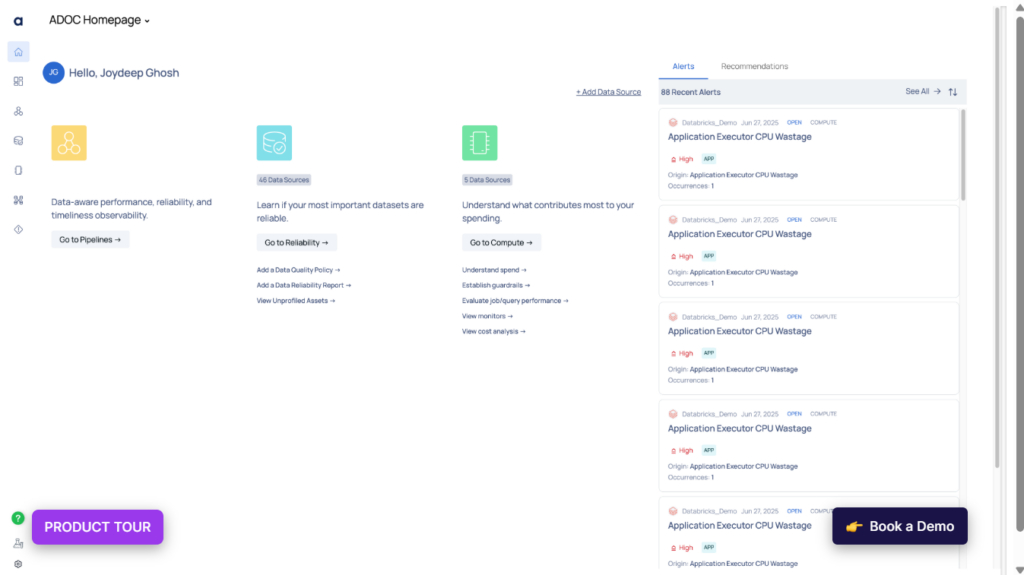
Acceldata Data Observability Cloud (ADOC): This is the core SaaS platform (often just called “Acceldata Platform”) that provides unified observability. It continuously monitors data pipelines, data quality, schema drift, and system infrastructure (compute, storage, network) in real time. ADOC also tracks costs by analyzing cloud bills and query usage. The platform is AI-driven, featuring built-in anomaly detection and alerting. It supports hybrid/multi-cloud setups and scales to exabytes of data. A useful way to see ADOC’s breadth is its tagline: it observes “data, pipelines, drift, quality, anomalies, spend, users, infrastructure, models, performance, [and] governance”. In practice, clients use ADOC to detect pipeline failures or data quality issues early (shift-left), trace root causes via lineage, enforce SLAs, and even manage data team productivity.

-
Agentic Data Management Platform (ADM): Launched more recently, ADM is an AI/agentic layer on top of ADOC. It provides intelligent automation and natural language interfaces. Key ADM features include AI Agents that can diagnose issues and suggest fixes, a “Business Notebook” for contextual insights, and integration with various LLMs under a governance layer. ADM also includes an “Agent Studio” where customers can build custom AI agents. Essentially, ADM aims to turn observability into closed‑loop data operations (e.g. auto-remediate failures) using AI. It caters to customers ready to experiment with generative AI for data ops.
-
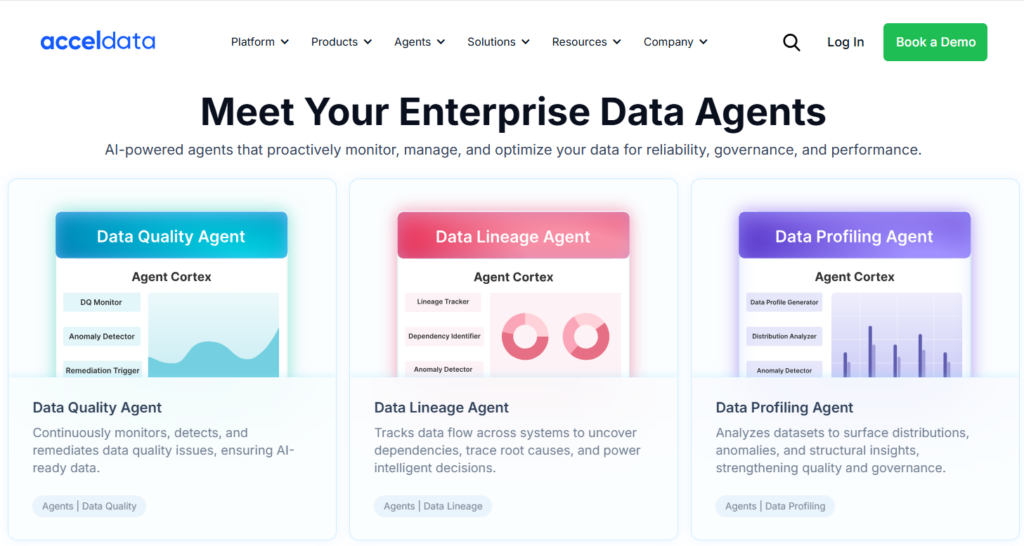
Data Agents (Plug-ins): Acceldata offers modular agents (often containerized or embedded components) that collect data and enforce policies. These include:
-
Data Quality Agent: Automates thousands of quality checks (format, freshness, reconciliation, etc.) via no-code/low-code rules. It can quarantine bad data, send alerts, and feed issues into workflows.
-
Data Lineage Agent: Tracks lineage automatically across batch and streaming sources. It helps impact analysis and auditing.
-
Data Pipeline Health Agent: Monitors ETL/ELT pipelines (success, latency, error rates) end-to-end. Offers root-cause analysis when jobs fail.
-
Data Profiling Agent: Continuously profiles datasets (e.g. row count, distribution) and detects schema changes or drift.
-
Cost Optimization Agent: (Part of FinOps offering) watches cloud service usage and query costs, providing dashboards and alerts for overspend.
-
Each agent feeds data into the ADOC platform for centralized analysis. These agents effectively allow Acceldata to plug into diverse data stacks (Snowflake, Redshift, Hadoop, Kafka, etc.) and instrumentation points.

-
Modules and Apps: In addition, Acceldata provides specialized modules: a FinOps/Cost App for cloud data cost management (with features like query-level spend and forecasting); an AI Observability App (for LLM/AI pipeline data monitoring); and soon, Data Governance functionality. These extend the core platform to address specific use cases.
-
Professional Services and Training: While not branded as products, Acceldata offers implementation services to configure and integrate the platform into customer environments. It also provides training and certification programs (evidenced by “Get Certified” on their site). These help customers adopt the tools effectively and likely contribute to revenue.
Overall, Acceldata’s product suite is designed as a single platform with multiple capabilities. Its marketing phrase is “deliver the promise of data quality and reliability at exabyte scale”. By comparison to competitors, Acceldata’s distinguishing products emphasize breadth and scale: for example, the February 2023 Series C press claimed ADOC is “the first and only data observability platform to address all four forms of data observability” (data quality, pipeline, infrastructure, usage). Its availability on cloud marketplaces (AWS, Google) and partnerships with Snowflake/Databricks make it easy for enterprise IT departments to buy and deploy at scale.
Conclusion
Acceldata has carved out a leadership position in the emerging data observability category by leveraging its founders’ expertise and aggressively funding product innovation. Its journey from a 2018 startup to a well-capitalized, global enterprise reflects both technical execution and market timing. By 2025, Acceldata’s vision is “shaping the rapidly expanding data observability category”, enabled by an AI-powered platform that claims unparalleled scope (from raw data to AI models) and scale (petabyte/exabyte processing).
Key factors have fueled Acceldata’s growth: a comprehensive product that addresses real, unmet needs in data engineering; strong enterprise traction (notably in finance, telecom, and internet companies); and substantial financial backing (over $100M) to continue innovating. Analysts note Acceldata’s market momentum — for example, Everest Group rated it a Leader in its 2024 data observability assessment. The company has also aligned itself with modern trends: it is expanding into GenAI use cases (via the Bewgle acquisition and its ADM platform) and integrating multi-cloud environments.
Looking ahead, Acceldata faces the challenge of sustaining growth in a competitive space. It must continually evolve its platform (especially in AI/LLM observability) and execute on global sales expansion. Its recent executive hires (CRO, CPO, CMO) and the Series C influx signal that the company is preparing for scale. Assuming execution goes smoothly, Acceldata is poised to capitalize on enterprises’ increasing focus on data reliability. As data platforms become more complex (hybrid clouds, streaming, AI models), the need for comprehensive observability will only grow. In summary, Acceldata’s brand story is one of technologist-turned-entrepreneur building a new software category, and its business case demonstrates a strong product-market fit that is backed by robust funding and customer momentum.
Also Read: Collibra – History, Founders, Business & Revenue Model, Funding
Also Read: BigID – Founders, Business Model, Funding & Competitors
To read more content like this, subscribe to our newsletter
Go to the full page to view and submit the form.