



Trainual is a Scottsdale, Arizona-based SaaS startup that provides a platform for small businesses to create online training manuals, document standard operating procedures (SOPs), and streamline employee onboarding. Founded in 2018, Trainual has positioned itself as the “world’s first business playbook software,” enabling organizations to easily capture their processes, policies, and company knowledge in one centralized system.
The company has experienced rapid growth by catering to the needs of small and mid-sized businesses (typically under 250 employees) that are “graduating from Google Docs and cluttered Dropbox folders” to a more structured solution. As of 2024, Trainual serves roughly 8,000 customers across over 170 countries.
This report provides a comprehensive brand story and business analysis of Trainual, covering its founding narrative, leadership, business model, revenue streams, funding history, competitive landscape, advantages, product offerings, and overall trajectory.
Founding Story of Trainual
Trainual’s origin story is rooted in founder Chris Ronzio’s personal entrepreneurial journey and firsthand insight into the importance of well-documented processes. Chris’s first business was a national event video production company that he started as a teenager and ran through his early twenties. Running that company taught him the critical value of standard operating procedures after a major project failure highlighted the chaos caused by a lack of organized systems.
Determined to prevent such issues, Chris developed detailed, repeatable processes and training materials so that no matter where an event took place or which crew was working, the client experience remained consistent. Over more than a decade, he “finessed the skill of building repeatable, scalable systems and fine-tuned training processes” until eventually he was able to step away from day-to-day operations and sell the video business.
After exiting his first company, Chris launched a boutique operations consulting firm to help other small business owners organize their processes and scale their teams. In the course of consulting, he and a small team built an early internal tool to house all the SOPs and training manuals they were creating for clients. This prototype proved very popular – clients started asking for the tool itself even more than Chris’s consulting time.
Realizing the broader need, Chris decided to stop consulting and focus fully on developing the software. He recalls that by late 2017, his clients “wanted Trainual more than my consulting services, [so] I knew I had something”. He and his team dove in to build a standalone product, and Trainual officially launched to the public in January 2018.
In the early days, Trainual’s resources were humble. Chris bootstrapped development using savings from his consulting business. The founding team of five worked out of a small room that “could hardly fit us all at once,” and the product’s very first cohort of customers was only around two dozen businesses who validated the concept. Nonetheless, growth came quickly once the product hit the market. Within the first year, Trainual had nearly 1,000 companies using the platform across the world. Chris’s emphasis on serving small businesses’ need to “capture and centralize who they are, what they do, and how they do it” clearly resonated.
By mid-2019, Trainual achieved profitability through organic growth – an unusual path for a SaaS startup – which gave the team confidence in the product-market fit before seeking outside capital. This early chapter of Trainual’s story established the company’s mission to make running a small business easier by providing a playbook for “every process, role, and responsibility” in one place.
Founders of Trainual
Chris Ronzio, Trainual’s founder and CEO, is the visionary behind the product and its purpose-built focus on small business systems. By the time he started Trainual, Chris already had 20+ years of entrepreneurial experience refining business processes and operations. His passion for efficiency and organization is evident in the company’s DNA. Chris often notes that Trainual is the culmination of everything he learned from scaling his first business and helping others organize theirs. As CEO, he leads Trainual’s strategic direction, manages investor relationships, and champions the company culture. He is also a thought leader outside the company – hosting the Organize Chaos podcast and authoring The Business Playbook, a bestselling book on creating business playbooks and systems. These endeavors reinforce Trainual’s brand message around empowering entrepreneurs with better processes.


Jonathan Ronzio, Chris’s younger brother, joined Trainual in the formative stage and is regarded as a co-founder and the Chief Marketing Officer (CMO) (as well as Chief Revenue Officer). Jonathan had worked with Chris from a young age – he helped at the video production company (eventually managing the Los Angeles office) and later assisted in Chris’s consulting projects by building brands and websites for clients. With a background as a creative storyteller (he is an award-winning filmmaker, musician, and adventurer), Jonathan brought the skills to “bring the brand and story to life” for Trainual. As CMO/CRO, he has been responsible for shaping Trainual’s marketing strategy, brand voice, and growth initiatives, leveraging an authentic and relatable style. Jonathan describes his mandate as “driving reputation and revenue” – blending creative direction with growth strategy.

Beyond the Ronzio brothers, Trainual’s early leadership team included key advisors and investors who have entrepreneurial backgrounds, but Chris and Jonathan remain the public faces of the brand. They have intentionally cultivated Trainual’s image as a relatable, small-business-focused company, often using humor and creativity in marketing. For example, in 2021 Chris and Jonathan orchestrated an attention-grabbing commercial shoot in which Daymond John (the Shark Tank investor who later became an investor in Trainual) appeared alongside the team, and even produced a parody remix of the 90’s hit “This Is How We Do It” with singer Montell Jordan to promote Trainual. This inventive approach to branding – blending business with pop culture and fun – reflects the founders’ personalities and has helped Trainual stand out in a traditionally dry B2B software market.
Business Model of Trainual
Trainual’s business model is a classic software-as-a-service (SaaS) targeting small and mid-sized organizations with a need for efficient training and process documentation. The core offering is a cloud-based platform sold via subscription. The company operates on a tiered subscription model where clients pay a monthly or annual fee based on the feature plan and number of users (employees) they onboard to the system. All plans include a base of 10 seats, and additional users can be added for a per-seat charge.
According to the company’s pricing information, the entry-level Core plan starts at $249 per month for 10 users (when billed annually), which works out to roughly $25 per user. Higher-tier plans (described in detail in the Products section) offer expanded functionality for an increased cost, although specific pricing for those tiers is typically obtained via sales consultations. Trainual’s pricing is positioned at a premium relative to generic documentation tools – one analysis noted $249/month is above average for HR/training tools – reflecting the value of its specialized features.

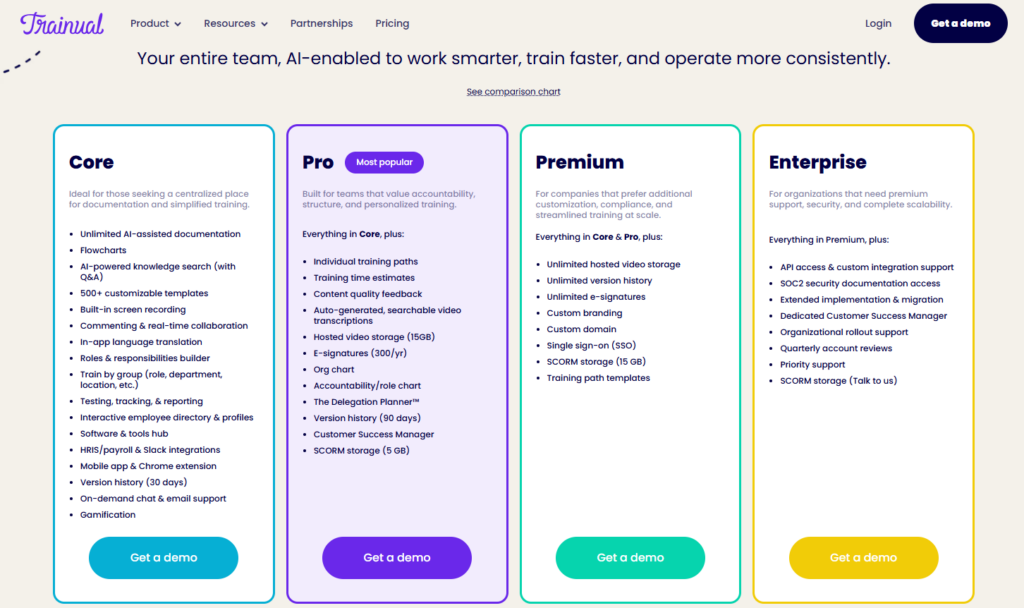
The company employs a product-led growth and inside sales approach. Prospective customers can try Trainual via a free demo or trial, but full use requires a paid subscription (a free trial period is often available via sales reps, although Capterra notes no always-on free trial). Trainual markets primarily to business owners, operations managers, and HR leaders in growing companies. A significant part of the model is content marketing and community engagement: Chris Ronzio’s book and podcast, Trainual’s blog (The Manual), webinars, and a large library of templates all serve to attract and educate small business customers.
Their creative advertising campaigns (viral videos, social media content, etc.) and partnerships have been notable in driving brand awareness. For instance, Trainual has run ads featuring flamethrowers, comedic skits with references to The Office, and other scroll-stopping visuals – a strategy to win attention in crowded social feeds. This direct marketing is coupled with word-of-mouth referrals from customers and a Certified Consultant program, which Trainual launched to train independent business consultants on the software. Through that program (bolstered by the 2022 acqui-hire of a consulting company called “The Process People”), Trainual extends its reach via consultants who implement the tool for their own small business clients, effectively adding a channel sales component to its model.
Trainual’s operations are predominantly U.S.-based – with its headquarters and the majority of its ~100+ employees in Arizona – but the company serves a global customer base. As a cloud platform, it can be adopted by teams anywhere. The company is remote-work friendly (a trait that helped it thrive during the COVID-19 pandemic when demand for remote onboarding tools spiked). In terms of customer support and service, Trainual provides dedicated onboarding assistance for new customers: every new client, particularly those on higher plans, works with an implementation specialist to migrate their content and roll out Trainual successfully (often involving a one-time onboarding fee). Ongoing support is delivered via in-app chat, a help center, and even phone support – the company emphasizes a high-touch approach, with a Customer Success team that actively engages to ensure adoption.
This focus on customer experience and support is integral to the model, as small businesses often need guidance to build their “playbooks.” Overall, Trainual’s model combines a subscription software product with strong enablement services and community resources to drive customer success and retention.
Revenue Streams of Trainual
Trainual generates revenue primarily through recurring subscription fees for its SaaS platform. The subscription revenue is structured around several plans (Core, Pro, Premium, and Enterprise), each with a bundled number of user seats and an annual billing commitment. Most customers pay annual licenses (monthly pricing exists but at a higher rate), locking in revenue upfront. The multi-tier pricing allows Trainual to capture different customer segments: smaller teams might stick to the Core plan, whereas larger or more process-heavy organizations upgrade for advanced features. In addition to base subscription fees, additional user licenses beyond the included seats are a secondary revenue component (priced approximately $3–$5 per extra user per month, depending on the plan).
Beyond the core software subscriptions, Trainual has a few ancillary revenue streams:
-
Premium Content Add-ons: Trainual offers an optional “Premium Course & Compliance Library” add-on, which provides access to 390+ pre-built training courses on HR, compliance, and employee development topics. This library, created by third-party experts, can be purchased to supplement a company’s custom Trainual content. It likely operates on an add-on subscription or one-time fee model, contributing incremental revenue for customers that need ready-made course content.
-
Professional Services: While Trainual is designed for self-service configuration, the company does charge for certain services. Notably, Enterprise-tier customers (or others who want hands-on help) pay a one-time implementation fee (around $1,000) for personalized setup assistance. Trainual also maintains a network of certified consultants (as mentioned) who can be hired to help businesses build out their playbooks. The consultants are third parties, so Trainual doesn’t book their fees as revenue, but the acqui-hire of The Process People indicates Trainual may offer more in-house onboarding services for a fee going forward.
-
Partnerships and Other: Trainual has engaged in strategic partnerships (e.g. with the Entrepreneurs’ Organization in 2021) to expand its reach. These are primarily marketing initiatives and not direct revenue streams, but they can drive subscription sales. The company does not appear to generate significant revenue from advertising or data (Trainual is a B2B product, and customer data is private), nor from merchandise or other sidelines. Any Trainual branded events or publications (like Chris’s book) are more marketing in nature. Thus, over 90% of Trainual’s revenue is likely pure software subscription income.
In terms of scale, Trainual’s revenue has grown sharply alongside its customer base. The company’s annual recurring revenue (ARR) milestones include reaching $2M ARR within the first 18 months of launch, then tripling in the year following its Series A. By 2022, the recurring revenue had exceeded $10M, and by late 2024, Trainual’s annual revenue was reported at $32.6 million. This underscores the successful monetization of its SaaS model, with revenue growth tracking new customer acquisition and upsells to higher plans.
Funding and Funding Rounds of Trainual
Although Chris Ronzio initially bootstrapped Trainual, the company has since raised multiple rounds of venture funding to accelerate its growth. Table 1 summarizes Trainual’s funding history:
| Round | Date | Amount | Key Investors / Notes |
|---|---|---|---|
| Seed/Bootstrapping | 2018 (launch) | – | Self-funded by founder (consulting revenues); achieved early profitability before VC funding. |
| Series A | Nov 2019 | $6.75 M | Led by 4490 Ventures, with participation from MATH Venture Partners and PHX Ventures. Brought on first external board members; helped fuel product development and marketing. |
| Series B | May 2021 | $27 M | Led by Altos Ventures. Notable new investors included Daymond John (CEO of The Shark Group), Rony Kahan (Indeed co-founder), Mikita Mikado (PandaDoc CEO), Matt Rissell (TSheets co-founder), and David Sipes (8×8 CEO). Series A backers 4490, MATH, PHX also joined. Used to scale product, team, and go-to-market in the wake of pandemic-fueled growth. |
Table 1: Trainual Funding History and Key Investors (Total funding raised = approx. $33.8 M).
Trainual’s fundraising strategy was somewhat conservative early on. Chris was initially skeptical of taking venture capital, given his experience watching some VC-backed startups flame out. He funded Trainual’s first two years through personal savings and revenues, focusing on building a sustainable business model. However, as demand grew and the vision expanded, the company decided to raise a Series A in late 2019 to invest in scaling sales and marketing. The $6.75 million Series A round (announced in December 2019) gave Trainual the capital to hire aggressively and enhance the product. Importantly, this round came just a few months before the COVID-19 pandemic – timing that proved fortuitous. When the pandemic hit in 2020 and companies rushed to improve remote onboarding and digital training, Trainual was well-funded and well-positioned with a product “to help businesses embrace remote work and onboard new hires from anywhere”. The result was accelerated growth: Trainual more than tripled its revenues and team size in the year after Series A.
Competitors of Trainual
Trainual operates in the intersection of several software categories – including training software, knowledge management, and process documentation – and thus faces competition from different fronts. Its primary competitors can be grouped into a few categories:
-
Specialized Process Documentation & SOP Software: These are tools designed specifically to help businesses document processes and train staff, often targeting similar SMB markets. Key competitors here include Whale, Process Street, SweetProcess, Waybook, and Scribe. Trainual and these platforms share many features (SOP templates, embedded media, quizzes, etc.), but with nuanced differences. For example, Whale is an SOP documentation platform that emphasizes AI-powered content creation and team collaboration, with a lower starting price point of around $99/month for 10 users (and even a free tier for very small teams). Process Street, by contrast, focuses on interactive checklists and workflow automation for processes; it can be integrated with thousands of apps and offers powerful automation, though it may lack Trainual’s structured training modules. Process Street’s pricing is in a similar range (often a few hundred dollars per month for SMB plans). SweetProcess is another competitor centered on easy SOP documentation, priced around $99/month (it offers unlimited users at that rate), which appeals to small teams for its simplicity. Waybook (a UK-based startup) provides a playbook builder akin to Trainual and is often cited as an alternative for creating online manuals. Scribe takes a different approach by automatically generating step-by-step guides from user actions (great for quick how-to documentation) and is priced per user (around $12–$23/user/month). Trainual distinguishes itself from these by providing a more comprehensive “system” (as the company says: “one is a tool, the other is a system” when comparing to simple tools) – meaning Trainual combines documentation, training delivery, testing, org charts, and more into one package, whereas competitors might focus on one aspect (like checklists in Process Street or visual SOPs in Whale).
-
General Knowledge Bases and Collaboration Tools: Some businesses consider generic documentation or intranet tools as alternatives to Trainual. The most notable are Notion and Confluence. Notion is a popular all-in-one workspace where companies create wikis, docs, and databases; it’s inexpensive (free for small teams, then ~$10 per user monthly) and very flexible. However, Notion lacks built-in training workflows (no testing, progress tracking, etc.), so using it for onboarding requires more manual oversight. Atlassian’s Confluence is a long-established wiki/intranet platform, also low-cost per user, often used by technical teams for documentation. Like Notion, Confluence provides great knowledge sharing but is not specialized for employee training or SOP enforcement. Trainual sees these not as direct apples-to-apples competitors but rather the “status quo” solutions that small companies often start with (shared Google Docs, wikis) until they outgrow them. Indeed, Trainual’s marketing explicitly frames itself as an upgrade when “it’s time to level up from Google Docs” for organizing business knowledge.
-
Corporate Learning Management Systems (LMS) and HR Platforms: On the higher end, Trainual edges into the territory of learning management and corporate training systems. Larger organizations might compare Trainual to platforms like Docebo, SAP Litmos, Lessonly (Seismic), or TalentLMS. These enterprise or mid-market solutions offer robust training course creation, certifications, and often compliance features. For instance, Lessonly (which was acquired by Seismic in 2021) was used by over 1,200 companies for employee training, especially in sales enablement. Such systems can be more complex and costly, and typically target companies with dedicated L&D (learning and development) departments.
-
Trainual’s competitive edge here is simplicity and speed for smaller teams – it may not have every advanced feature of a full LMS, but a review aptly noted that Trainual “gets the job done” for a small business even if it’s “not as robust…for a larger organization”. In fact, Trainual often wins customers who find big LMS platforms too overwhelming or who use all-in-one HR systems (like Zenefits or Gusto) that have basic training modules but need a more dedicated solution. Additionally, other specialized tools like Connecteam compete for the onboarding niche, especially for deskless and mobile workers. (Connecteam offers a mobile-centric training and operations app, with aggressively low pricing starting at $29/month for 30 users – highlighting the price sensitivity in the small business segment.)
In summary, Trainual faces a competitive landscape that ranges from do-it-yourself approaches (sharhttps://connecteam.com/ed documents) to direct rivals in SOP/training software and up to enterprise learning platforms. Trainual’s market opportunity exists because many small businesses find traditional LMS software too enterprise-oriented, while generic tools lack training structure. By focusing on the sweet spot of structured documentation + training for SMBs, Trainual has carved out a strong position. Its competitors each have their own angles – whether it’s lower cost (e.g. Whale’s cheaper plans, or free Notion usage), niche features (Scribe’s automatic guide generation, Process Street’s automations), or broader suites (LMS platforms) – but Trainual’s competitive strategy has been to offer an all-in-one playbook that is easy to implement and use without an IT department.
To illustrate how Trainual compares, Table 2 provides a brief comparison with a few notable competitors:
| Competitor | Focus & Strengths | Base Pricing | Trainual’s Edge vs. Competitor |
|---|---|---|---|
| Whale | SOP documentation with AI assistance; strong team collaboration features. | ~$99/month (10 users); Free plan up to 5 users. | More affordable for small teams; however, Trainual offers more integrated org charts and testing. |
| Process Street | Checklist-driven workflows and process automation; highly flexible integrations. | ~$415/month for 20 users (typical plan); offers free basic tier. | Process Street excels at workflow automation, but Trainual provides a more guided training structure (sequential learning, role assignments). |
| Notion | General-purpose workspace for notes, docs, wiki; extremely flexible and user-friendly. | $0 for small teams; ~$10 per user/month for Plus plan. | Notion is cheap and flexible, but lacks built-in quizzes, tracking, and organizational training tools that Trainual provides. |
| Lessonly (Seismic) | Comprehensive training LMS with courses and coaching (oriented to sales teams and mid-market). | Custom pricing (enterprise-scale); not SMB-focused. | Very robust feature set, but overkill for many small businesses. Trainual is simpler to deploy and focuses on all roles, not just sales. |
Table 2: Trainual and Selected Competitors – focus, pricing, and differentiators.
Competitively, Trainual has also benefited from the fragmentation of this market – many small competitors address parts of the problem, but few have become household names. Trainual’s early move to define itself as “business playbook” software gave it a unique identity. The company has received industry recognition (e.g., in 2020 it won a “Knowledge Base Platform of the Year” award for its innovation in small business training), further solidifying its credibility against rivals. Going forward, maintaining its ease-of-use advantage and continuing to introduce features (like the new AI-powered process document creator and built-in content library) will be key to fending off competition in this space.
Competitive Advantage of Trainual
Trainual’s competitive advantages stem from a combination of its product design, target-market focus, and brand execution. Here are the key factors that give Trainual an edge:
-
Small Business Focus and Simplicity: Unlike many training tools that are built for large enterprises or specific departments, Trainual is deliberately tailored to small and growing businesses across all industries. This focus means the platform is easy to implement without dedicated IT support. The interface is intuitive and the content structure is highly organized – companies can quickly create a hierarchy of Subjects → Topics → Steps in Trainual, which imposes a clear order to information that a simple Google Drive folder cannot. Reviews frequently cite Trainual’s ease of use and how it “gives us the ability to provide training modules for our staff on any topic… fairly easily”. By speaking the language of small business (even the term “playbook” in lieu of corporate-sounding “LMS”), Trainual built a product that feels accessible to entrepreneurs. This is a strong differentiator against generic tools and overly complex systems.
-
Comprehensive All-in-One System: Trainual combines features that would otherwise require multiple tools. It serves as a wiki/knowledge base (central repository of company info), an onboarding and training platform (with quizzes, videos, assignments, and certification tracking), and even an HR directory and org chart solution. Competitors often excel in one area (e.g., Process Street in process checklists, or Confluence in documentation), but Trainual’s advantage is in unifying these needs. For example, Trainual includes a built-in Roles & Responsibilities module to map out each position in the company and what that role needs to learn. It also provides testing and assessment features to verify knowledge retention – something a basic wiki lacks. The breadth of Trainual’s feature set means a small business owner can rely on it as a single source of truth for “how to run my business” instead of piecing together multiple apps. This one-stop-shop value is a key selling point.
-
Templates and Speed of Deployment: Recognizing that many small businesses are starting from scratch in writing SOPs, Trainual offers over 500+ pre-built templates for common business processes and policies. From HR policies to how to run a sales call, these templates provide a starting point that dramatically accelerates the time to value. Additionally, Trainual has embraced AI tools to help customers create content faster – for instance, users can input a prompt and have Trainual’s AI draft a process outline or quiz questions automatically. This focus on quick deployment and content creation is a competitive advantage, especially for busy small business owners who might otherwise procrastinate on documenting procedures. By lowering the friction (with templates, AI, and implementation support), Trainual differentiates itself as the fastest way to build an operations manual.
-
Engaging Brand and Community: Trainual has built a strong brand presence among entrepreneurs. Chris Ronzio’s thought leadership (podcasts, book) and the company’s vibrant marketing give Trainual a personality that sets it apart from more corporate competitors. Their marketing often uses humor and real-world small biz scenarios, making the brand relatable. Trainual’s content (blog articles, newsletters, the annual Playbook event) educates businesses on why process documentation matters, effectively creating more demand for its solution. Furthermore, Trainual’s customer success approach – including live training webinars and responsive support – has led to positive word-of-mouth. Being named to Inc. Magazine’s Best Workplaces and other culture awards in 2019–2021 also signal that Trainual is well-run internally, which can translate to better service for customers. In short, the company’s genuine advocacy for small business success (even their partnership with the Entrepreneurs’ Organization globally) strengthens its brand credibility and customer loyalty, which is hard for less focused competitors to replicate.
-
Continuous Innovation: Despite being smaller than some big software firms, Trainual has been nimble in rolling out new features that address user pain points. For instance, the company observed how the rise of remote work challenged onboarding, so they quickly launched features like public share (to share Trainual content externally) for remote contractors and emphasized its mobile app and integrations. They also listened to customer feedback on search functionality and in 2023 rolled out an AI-powered universal search and Q&A that lets users query the entire company knowledge base in natural language (mitigating prior search issues) – an innovative feature not commonly found in legacy training systems. This responsiveness and use of new tech (AI, integrations with HR systems, etc.) help maintain Trainual’s edge as a modern solution.
In combination, these advantages – ease-of-use for SMBs, an all-in-one platform, rapid content creation, a relatable brand, and an innovative mindset – give Trainual a defensible position. It can be difficult for a generic tool or a large enterprise system to suddenly pivot and appeal to the everyday small business user the way Trainual does. The company’s challenge will be to retain these advantages as it scales; so far, through 2025, Trainual has managed to do so, as evidenced by its low customer churn and enthusiastic reviews for making complex training “simple and efficient” for small companies.
Conclusion
Trainual’s journey from a small consulting project to a venture-backed SaaS leader encapsulates a classic startup brand story: identify a personal pain point, build a scrappy solution, and scale it into a product that thousands of businesses rely on. Chris Ronzio’s original mission – helping entrepreneurs find time by systematizing their operations – remains the North Star of Trainual’s brand. Through 2025, the company has successfully positioned itself as an indispensable tool for small businesses in the United States and beyond, effectively creating the category of a “business playbook” platform. The brand story is one of empowerment: Trainual enables business owners to step back from daily tasks by trusting that their team is trained and their processes are documented. This narrative resonates strongly in the SMB world, where founders often feel tethered to the minutiae of operations.
From a business analysis perspective, Trainual stands on solid ground. It has a clear value proposition in a growing market segment – the drive for better onboarding and remote training has only increased post-pandemic – and it has demonstrated the ability to capture that demand (with revenue doubling year-over-year and reaching into eight figures). The company’s prudent use of funding and focus on product development (e.g., leveraging AI to keep the platform modern) suggests a roadmap of continuous improvement. By concentrating on the U.S. market while also organically spreading to 180+ countries via online reach, Trainual balances depth and breadth. It serves mom-and-pop shops and tech startups alike, proving the universality of its solution wherever businesses need to scale people and processes.
Looking ahead, Trainual’s challenges will likely involve fending off competition in an increasingly crowded enablement software space and managing the transition from a scrappy startup to a mature company without losing its customer-centric culture. However, the competitive analysis indicates that Trainual has built significant moats through its community, brand, and product depth in the SMB niche. It has also shown adaptability – for instance, partnering with organizations like EO for global reach, and acquiring niche players (Process People) to enhance service capabilities. The company’s leadership, rooted in the Ronzio brothers’ complementary strengths, continues to personify the brand and connect with the audience on a personal level (even as the team surpassed 125 employees by 2025).
In conclusion, Trainual’s brand story is one of simplifying the complex art of running a business. By turning chaos into organized playbooks, Trainual has become a trusted partner for thousands of entrepreneurs pursuing growth. The business is backed by a solid model of recurring revenues and has attracted investors and accolades that affirm its potential. As of the end of 2025, Trainual stands as a prime example of a modern SaaS success story: it identified an unmet need in the market, executed with focus and flair, and scaled a product that not only earns revenue but genuinely improves the day-to-day operations of its clients. With its foundation firmly established and a continuous drive to innovate, Trainual is well-positioned to continue leading the playbook revolution for businesses globally in the years to come.
Also Read: Cosm – Founders, Business Model, Funding & Competitors
To read more content like this, subscribe to our newsletter
Go to the full page to view and submit the form.