


Clarity AI is a rapidly growing sustainability technology startup that provides advanced ESG (environmental, social and governance) data and analytics to financial institutions and corporations.
Founded in 2017, Clarity AI describes itself as a “globally recognized and awarded sustainability tech platform”. Its mission is to “bring societal impact to markets” by giving investors and organizations transparent, data-driven insights into the environmental and social impact of companies, portfolios and even consumer transactions.
In practice, Clarity AI’s cloud-based platform uses AI and big data to score and analyze tens of thousands of companies, funds and governments (over 300K+ companies, 450,000+ funds and nearly 400 countries or jurisdictions, by the company’s own figures). By contrast to legacy ESG vendors, Clarity AI’s platform is built to process and refresh data continuously (processing millions of data points in near-real time) rather than via infrequent analyst updates.
From a business standpoint, Clarity AI has gained significant backing and visibility. In late 2021 Clarity AI closed a $50 million funding round led by SoftBank’s Vision Fund 2 (along with new investor Fifth Wall ClimateTech), valuing the company at roughly $450 million. The round also included participation from existing backers, including BlackRock, which had earlier made a minority investment to integrate Clarity AI into its Aladdin platform.
In total Clarity AI has raised multiple rounds of funding (summarized below) from investors such as BlackRock, Deutsche Börse, Founders Fund, SoftBank and others, reflecting strong market interest in ESG data solutions. Clarity AI counts major financial institutions among its customers: for instance, BlackRock has embedded Clarity AI data into Aladdin, and the company has struck platform partnerships with Allfunds, Clearstream and others.
In short, Clarity AI positions itself as an AI-native SaaS provider of “evidence-based” ESG insights, helping organizations comply with evolving regulations (EU Taxonomy, SFDR, CSRD, etc.) and integrate sustainability analysis into portfolio decisions.
Its rapid growth, marquee funding and industry awards (e.g. Forrester Wave leader Q3 2024) have made Clarity AI one of the more prominent entrants in the booming ESG data market. The following sections detail its founding, leadership, business model, funding history, and place in the competitive landscape of ESG analytics.

Founding Story of Clarity AI
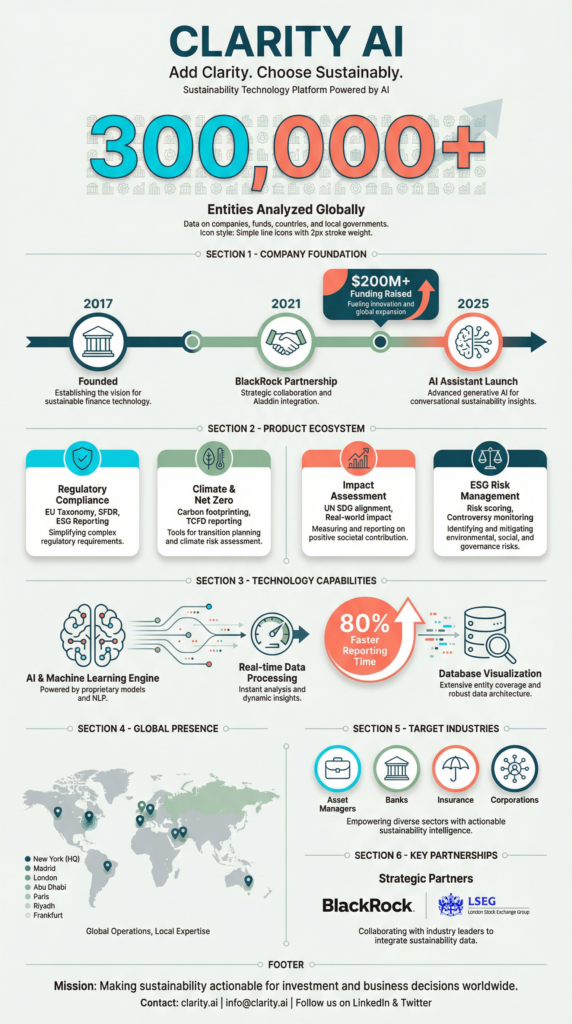
Clarity AI was incorporated in 2017, initially with offices in the U.S. (New York) and Europe (Madrid). Its founding purpose was to tackle the problem of inefficient and opaque capital allocation, by creating a scalable technology to measure companies’ social and environmental impact.
As founder Rebeca Minguela has said, Clarity AI’s purpose “is simple: to measure the impact of companies on our society and planet”. The startup built a minimum viable product in 2017 and launched a beta (with early pioneer clients) by 2018.
From the beginning, Clarity AI positioned itself as a “sustainability tech” company using AI and big data. It won early support through EU grants (Horizon 2020 funding in 2018) and awards (EU Seal of Excellence, World Economic Forum Technology Pioneer in 2020).
The first full product was released in 2019, and early clients (asset owners, managers and fund platforms) came on board as demand for impact data grew. By late 2020, Clarity AI was reporting traction: it claimed to have “attracted a client network representing in excess of $3T of assets” under management.
The company’s ethos has been one of rapid iteration and scientific rigor. As Clarity AI’s website emphasizes, it follows “scientific- and evidence-based methodologies” with a transparent, data-centric approach.
The team built the platform to gather millions of data points automatically (via ML algorithms and public sources), aiming to provide broader coverage and granularity than legacy ESG providers. Early on, Clarity AI also formed strategic partnerships – for example with Qontigo (Deutsche Börse’s index arm) and Allfunds in 2020 – to embed its data into financial systems.
By 2021 Clarity AI had become a fully operational “impact evaluation” SaaS business. That year, Deutsche Börse AG led a $15 million funding round and Clarity AI signed deals to integrate with major investment platforms like Aladdin. N
otably, Clarity AI’s platform went live on several industry utilities: in late 2021 it announced that its data was available in Aladdin, Clearstream and other systems used by fund managers and custodians. These developments reflected the founding vision of using technology to “illuminate a path to a more sustainable world”.
In summary, Clarity AI’s founding story is one of a Silicon Valley–style startup (AI, data, SaaS) focused squarely on ESG. The company was started by entrepreneur Rebeca Minguela in 2017 with the mission of turning sustainability impact into standardized, actionable information for capital markets. Leveraging early support from tech grants and progressive financial partners, Clarity AI rapidly built its product and customer base in the 2017–2021 period, setting the stage for its later growth and financing rounds.
Founders of Clarity AI
Clarity AI was founded and is led by Rebeca Minguela, a Spanish entrepreneur with a background in engineering and digital finance.
Minguela serves as Chief Executive Officer and has guided Clarity AI since inception. Prior to Clarity AI, Minguela was a recognized Silicon Valley entrepreneur: she co-founded Blink Booking (a mobile hotel app) which was acquired by Groupon, and later led digital transformation at Banco Santander.


Her track record includes leadership roles at Bain Capital, BCG and Siemens, and she holds an MBA from Harvard. Minguela’s vision for Clarity AI grew out of her experience in financial services: as she explains, Clarity AI “tries to solve the problem of inefficient and unequal allocation of capital” by building automated ESG analytics.
Although Clarity AI’s public materials emphasize its singular founding leadership, it also built a sizable team of data scientists, sustainability experts and engineers worldwide. By 2025 the company had on the order of a few hundred employees (the business media have estimated ~350 employees). The executive team includes veterans in finance and technology (for example, the head of data science and heads of product for its regulatory and climate solutions).
In July 2025, Clarity AI acquired ecolytiq, a Berlin-based startup, and took in its two co-founders as part of the deal – further bolstering Clarity AI’s consumer-facing business line. Thus, Clarity AI’s “founding” story includes both Minguela’s original vision and the broader team that has grown around her leadership.
Rebeca Minguela herself has received notable recognition for her entrepreneurship. She was named a World Economic Forum Technology Pioneer and appeared on lists of top young global leaders. Investors like SoftBank and Fifth Wall have been attracted by her leadership; for example, SoftBank’s Jimi Macdonald specifically praised “Rebeca and her team’s vision” in backing the company’s 2021 round.
In summary, Clarity AI’s founder is Rebeca Minguela – a proven tech entrepreneur – supported by a leadership team of data and sustainability specialists. Minguela’s background in finance and tech has shaped Clarity AI’s direction, and under her guidance the company has grown from a 2017 startup into a well-funded platform company. Key strategic hires and the recent ecolytiq deal have expanded the founding team’s expertise into consumer banking and retail finance.
Business Model of Clarity AI
Clarity AI operates a Software-as-a-Service (SaaS) business model focused on recurring subscription revenue. Clients pay ongoing fees to access Clarity AI’s data and analytics platform, which is delivered via cloud-based APIs, widgets or a web application. According to Clarity AI, “Clarity AI’s business model is based on subscriptions”. Customers can select which data modules and level of detail they need and integrate them into their systems (e.g. via API calls) or use them through Clarity AI’s portal.
The platform is highly modular: it comprises reusable “building blocks” for every sustainability use case, ranging from ESG ratings and risk analytics to regulatory reporting and consumer engagement tools. This modular, API-driven approach means clients can pick and mix services. For example, an asset manager might license only the ESG scoring and controversies modules, while a bank might pay for the regulatory compliance and retail banking (ecolytiq) modules. Clarity AI emphasizes that its model is “data-driven, not analyst-driven”. In other words, it charges for data feeds, scored insights and software capabilities rather than customized analyst reports.

Clarity AI serves a range of financial customers: asset managers, asset owners (pension funds, insurance), banks, wealth managers and even retail banking arms. It also targets corporations that need ESG oversight, and regulators or trustees may indirectly use its data through their advisors. Key partners include system integrators and distribution platforms: for instance, Clarity AI’s data is embedded in BlackRock’s Aladdin system and fund platforms like Allfunds and Clearstream. These partnerships extend Clarity AI’s reach: clients can subscribe on top of these platforms (e.g. as an add-on module in Aladdin) or via direct contracts.
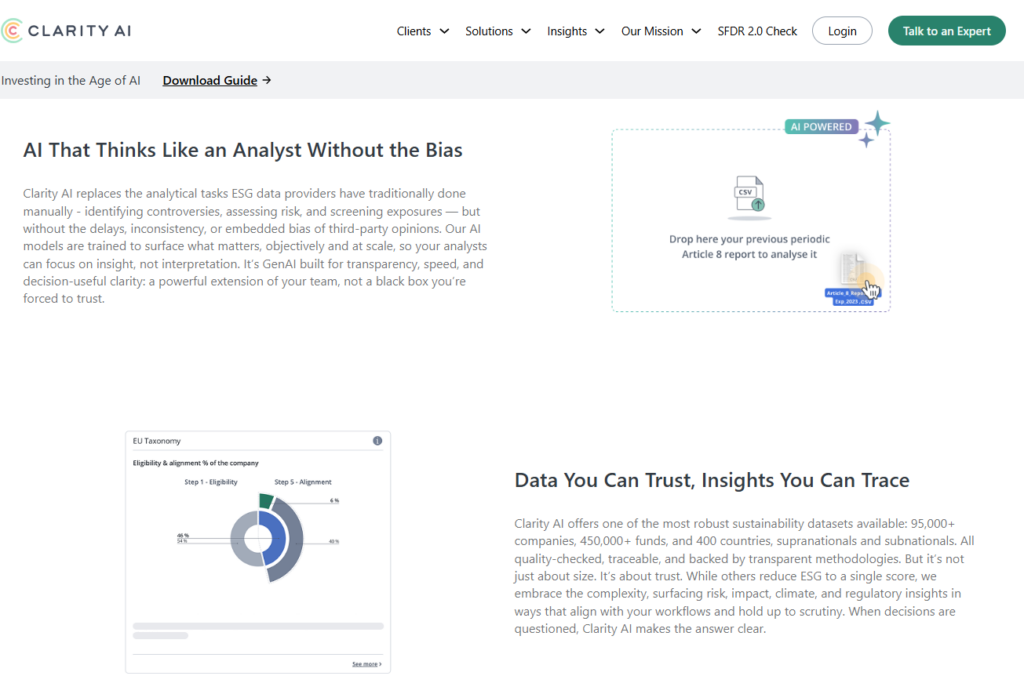
From a technical standpoint, Clarity AI’s model leverages scalable AI and big data. The platform ingests public financial disclosures, news and alternative data, applying machine learning to keep its datasets up-to-date (processing millions of data points continuously). Because of this high-frequency update capability, Clarity AI can offer customers near-real-time ESG insights (an advantage over legacy providers with slower update cycles). The focus on technology allows Clarity AI to maintain large coverage (on the order of 70,000–95,000 companies worldwide) and to deliver granular, traceable scores rather than opaque ratings.
In essence, Clarity AI’s business model is a scalable SaaS platform. Clients subscribe to the data feeds and analytics engines they need, and integration costs can be minimized by its cloud and API architecture. The company has positioned itself as a technology-first alternative to traditional ESG ratings agencies – marketing “fresh insights, transparency and control, not black-box scores”. Revenue is primarily recurring (annual subscription or license fees), and Clarity AI invests those proceeds in data acquisition, research, and platform development. Over time, this model also allows for cross-selling of new modules (e.g. the retail banking suite after the ecolytiq acquisition).
Revenue Streams of Clarity AI
Clarity AI’s revenues come mainly from subscriptions and licensing of its sustainability data and analytics platform. Key revenue streams include:
-
SaaS Subscriptions: The core revenue comes from enterprise clients (asset managers, pension funds, banks, etc.) that pay an annual or multi-year fee to access Clarity AI’s ESG data, scores and tools. This is the “subscriptions” model that Clarity AI itself highlights as its business model. Depending on the scope of data (number of assets, depth of analysis) and modules (regulatory compliance, risk, impact, etc.), subscription pricing can vary.
-
API and Data Feed Services: Many clients integrate Clarity AI data into their own systems via API. Fees here may be usage-based or tiered by data volume. Institutional platforms (like Aladdin or internal databases) can draw on Clarity AI feeds programmatically. The ability to white-label or embed widgets also generates licensing revenue, as customers embed Clarity analytics in their portals or reports.
-
Professional Services & Customization: Beyond raw data, Clarity AI offers implementation support, consulting and possibly tailored analyses. This might include onboarding assistance, custom scoring methodologies or bespoke reporting templates for large clients. While the bulk of revenue is SaaS, Clarity AI likely earns additional fees for these services – a common model for enterprise software. (For example, helping a large asset manager configure the platform to their ESG policies, or building custom dashboards.)
-
Partnerships and Strategic Alliances: Clarity AI expands its reach through strategic partnerships. For instance, its acquisition of ecolytiq included a deal with Visa, and the ecolytiq technology is now offered to Visa’s bank clients through Visa’s own sustainability products. In such cases, Clarity AI may gain revenue through revenue-sharing agreements or new subscription deals bundled via the partner. Similarly, relationships with index providers (e.g. Deutsche Börse/Qontigo) or fund distribution platforms (Allfunds) can open channels where Clarity AI’s data is packaged into index products or fund services.
-
Retail and Consumer Solutions: With the ecolytiq acquisition (July 2025) Clarity AI entered the consumer banking market. Ecolytiq’s in-app tools (carbon-tracking, rewards for green purchases, etc.) can be licensed to banks. Revenue here comes from licensing these “sustainable banking” features to retail banks and fintechs. Visa’s strategic partnership suggests future transactional revenue models (e.g. per-account fees for eco-insights).
In summary, Clarity AI monetizes its platform primarily through subscription-based licensing of its ESG data and analytics. Complementary streams include integration services and partner-delivered products. This model generates recurring revenue tied to assets under management or transaction volume, allowing the company to scale as clients expand their ESG usage. The company’s own statements confirm that clients “choose which information and level of detail they want to integrate into their system (via API calls or widget integration), or consume directly through the Clarity AI Web App” – underscoring the modular subscription approach.
Funding of Clarity AI
Clarity AI has raised several rounds of venture capital and strategic investment since its inception. These funds have supported product development, technology scaling, and global expansion. Key funding highlights include:
-
Seed and Early Investors (2017–2019): In its early years, Clarity AI secured seed and venture backing from prominent tech investors. Notably, Founders Fund (founded by Peter Thiel), Seaya Ventures, Kibo Ventures and others participated in early rounds. (For example, a 2020 press release notes these names among investors by that time.) These early checks funded the initial product build and early customer acquisition.
-
Series A – Deutsche Börse Lead ($15M, 2020): In October 2020 Clarity AI closed a $15 million Series A round led by Deutsche Börse (via its asset management subsidiary Qontigo) with co-investor Mundi Ventures. This round came as ESG investing gained momentum. The funds were earmarked for expanding Clarity AI’s data platform and accelerating growth. Deutsche Börse’s investment also led to strategic collaboration: Clarity AI worked with Qontigo on ESG indices and analytics.
-
BlackRock Strategic Investment (Jan 2021): In January 2021, BlackRock announced a minority investment in Clarity AI, integrating its analytics into BlackRock’s Aladdin system. (Exact amount was undisclosed.) Mary-Catherine Lader (Head of Aladdin Sustainability) said the partnership would help BlackRock clients understand portfolio ESG impact. Rebeca Minguela called it “transformative”, extending Clarity AI data to more investors. This deal reflected BlackRock’s ESG push and gave Clarity AI a significant anchor customer.
-
Series B – SoftBank Vision Fund 2 Lead ($50M, 2021): Later in 2021 Clarity AI raised $50 million in a round led by SoftBank Vision Fund 2, with participation from Fifth Wall ClimateTech and continued support from BlackRock. This Series B (announced Dec 2021) valued Clarity AI at about $450 million. The round was described as closing in August 2021. SoftBank’s investor Jimi Macdonald noted the rapidly growing sustainable investing market and said Clarity’s technology would help a larger network of stakeholders. The new capital was intended for accelerating product development, hiring, and global expansion.
-
Series B (Prosus-led, 2025): According to media reports (as of early 2026), Clarity AI pursued an additional Series B round in late 2025, reportedly led by Prosus Ventures. A business media profile notes this round expanded the investor roster to include Prosus, Jony Ive (as a backer), Balderton Capital and Fifth Wall ClimateTech. (Official details are scarce.) This infusion would support Clarity AI’s continued scaling in the ESG software market.
Overall, Clarity AI’s funding strategy has combined venture capital, strategic corporate investment, and grants. The company notes it has raised over $100 million across multiple rounds (some sources cite ~$117M total by 2026). A timeline from Clarity AI’s site lists major rounds (Deutsche Börse-led $15M in 2020; SoftBank-led $50M in 2021). Investors include top-tier funds (Founders Fund, SoftBank, Prosus), strategic financial firms (BlackRock, Deutsche Börse), and climate-tech funds. The capital raised has allowed Clarity AI to scale its technology and seize market share as demand for ESG analytics surges.
Funding Rounds of Clarity AI
The table below summarizes Clarity AI’s known funding rounds, lead investors and valuations (where available):
| Year / Round | Amount | Lead Investors | Notes / Valuation |
|---|---|---|---|
| 2020 (Series A) | $15 million | Deutsche Börse AG (via Qontigo), Mundi Ventures | Platform expansion; Deutsche Börse partnership |
| Jan 2021 (Strategic) | undisclosed | BlackRock (minority stake) | Integrated with BlackRock Aladdin |
| Aug 2021 (Series B) | $50 million | SoftBank Vision Fund 2 (lead), Fifth Wall ClimateTech, others | Post-money ~$450M |
| Sep 2025 (Series B)* | Confidential | Prosus Ventures (lead), Fifth Wall, Balderton, etc. | Media reports only; adds high-profile backers (Jony Ive) |
| Total (to date) | ~$117 million* | N/A | According to industry reports |
Competitors of Clarity AI
Clarity AI competes in the ESG data and analytics market against well-established financial data and ratings firms. Key competitors include:
-
MSCI ESG Ratings/Data: MSCI is a giant in the space, covering thousands of companies with ESG ratings and indexes. Its strength is broad global coverage and deep integration into financial indices. However, MSCI’s methodologies are largely proprietary and less customizable.
-
Morningstar Sustainalytics: Now part of Morningstar, Sustainalytics provides ESG risk ratings and controversy monitoring on public companies. It is widely used by asset managers to flag ESG risks and governance issues. Sustainalytics focuses on standardized risk scores and events but offers less raw data customization.
-
Refinitiv (LSEG): Refinitiv, now under London Stock Exchange Group, offers ESG scores and data on over 10,000 companies (including many smaller firms). It integrates ESG with its financial data terminals (e.g. Eikon). Its coverage is large, though methodology flexibility is limited compared to new fintech platforms.
-
S&P Global ESG (Trucost): S&P’s Sustainable1 platform provides ESG data, indices and climate risk analysis. It is known for consistency with S&P’s credit ratings and broad indices coverage. Many investors use it for benchmarking, but it also relies on fixed scoring models.
-
ISS ESG: Part of Institutional Shareholder Services, ISS ESG excels in governance data and proxy voting analytics, along with ESG ratings. It is often used by asset managers concerned with governance risks. Clarity AI competes by offering a wider, technology-driven approach that covers all ESG dimensions, not just governance.
-
Moody’s ESG Solutions: Moody’s combines ESG research with its credit risk expertise, focusing on climate risk scenarios and regulatory disclosure. Its tools align with risk management and credit analytics. Moody’s strength is in institutional credit risk integration, whereas Clarity AI emphasizes a fully traceable, customizable platform.
-
Bloomberg ESG: Bloomberg’s ESG data is accessible via its terminals. It is popular for real-time updates tied to market data. The downside is high cost and less flexibility. Clarity AI positions itself as more affordable and flexible, with a self-service model rather than terminal-driven.
-
FactSet, Nasdaq ESG, etc.: Other players include FactSet (financial analytics suite with ESG modules), Nasdaq ESG Hub (issuer-focused disclosure tools) and several niche providers (Datamaran, Greenomy, EcoVadis, etc.). However, the dominant competition in asset management tends to come from the above large data platforms.
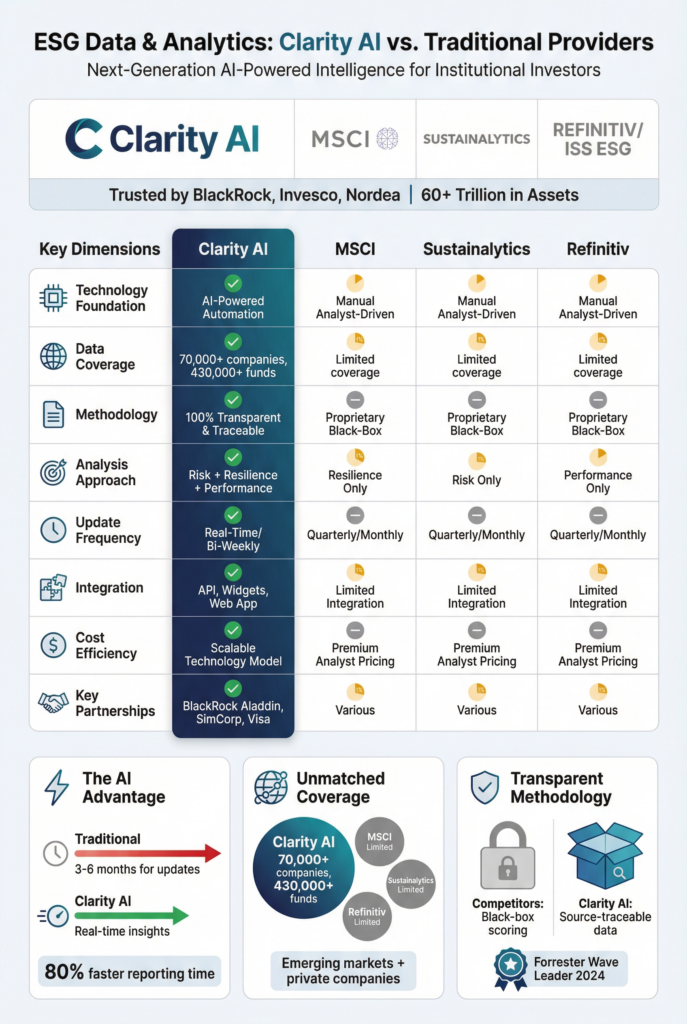
In short, Clarity AI’s competitive landscape is crowded with legacy data vendors. Clarity AI differentiates itself by being a pure-play tech platform. Whereas MSCI, S&P and Sustainalytics largely offer ratings with opaque methodologies, Clarity AI offers a fully AI-driven, modular SaaS system that lets clients trace every data point. It also claims coverage comparable to or exceeding the majors (tens of thousands of companies and funds). The providers listed above are often cited as market leaders. Clarity AI aims to challenge them on technology, flexibility, and the integration of social impact metrics alongside environmental data.

Products and Services of Clarity AI
Clarity AI’s product suite is broad, covering regulatory compliance, risk analysis, climate, impact measurement and even consumer engagement. Key offerings include:
-
ESG Data and Scores (Risk/Controversies): The core service provides ESG performance scores for companies and funds across multiple themes. The platform calculates risk scores, controversies flags, and exposure metrics. Users can apply either standard methodologies (aligned with EU and industry frameworks) or customize inputs and weightings. All scores are generated from data on emissions, labor practices, governance indicators, etc., in a fully traceable way.
-
Regulatory Reporting Tools: Clarity AI has a suite of regulatory modules to streamline disclosures. For example: SFDR (Sustainable Finance Disclosure Regulation) reporting includes calculation of Principal Adverse Impact (PAI) metrics; EU Taxonomy analysis helps determine taxonomy alignment; MiFID II sustainability preferences mapping; Pillar 3 ESG risk templates; and ESMA fund naming rules checks. Each of these is a “toolkit” with data and workflows built for that regulation. A major bank’s head of responsible investment noted that Clarity AI’s data provides “the best range of data available” for EU Taxonomy and SFDR reporting.
-
Climate Solutions: Clarity AI offers climate-specific analytics including carbon footprint calculators and scenario analysis. The platform can simulate climate transition risk under various scenarios (2°C, 4°C, etc.), and estimate companies’ exposure to climate change. It also includes tools for TCFD-aligned reporting and nature/biodiversity risk metrics. As noted in their materials, Clarity AI processes 2 million data points biweekly with machine learning – which supports these sophisticated climate modules.
-
Impact Measurement (SDGs, Societal Impact): Clarity AI provides social impact metrics mapped to frameworks like the UN SDGs. It can assess how a portfolio contributes to positive goals (e.g. affordable energy, education). This goes beyond ESG risk to measure “impact” in sustainability terms. The platform also tracks philanthropic commitments and corporate giving where data is available. The website highlights an emphasis on “people on the planet” alongside environmental metrics.
-
Retail Banking/Consumer Engagement (via Ecolytiq): In July 2025 Clarity AI acquired ecolytiq, incorporating its consumer-facing products. These tools calculate the carbon footprint of individual transactions, provide personalized climate saving tips, and offer features such as green loans or carbon credit purchasing within bank apps. For example, ecolytiq’s solutions (now Clarity AI’s retail-banking arm) allow consumers to see the environmental impact of their spending and earn rewards for sustainable behavior. This expands Clarity AI’s product line from institutional finance to retail banking, a unique differentiator.
-
Professional Services and Support: Clarity AI also delivers consulting, training and integration services. They help clients implement the platform, conduct materiality analyses, and customize dashboards. For large customers, Clarity AI’s experts will tailor the system to the client’s taxonomy and regulatory context. The company has case studies (Greenalia, etc.) showing it aids in green bond issuances and sustainability strategy development.
-
Sustainability Research and Insights: Beyond the software, Clarity AI publishes whitepapers, regulatory outlooks, and thought-leadership reports (e.g. on CSRD, SFDR) to help clients stay informed. These are marketing collateral but also value-adds. The company’s “Sustainability Report” (2025) highlights its own performance and data trends in ESG.
In summary, Clarity AI’s product suite offers end-to-end ESG functionality: from raw data collection to analytics to regulatory reporting and consumer engagement. A single “platform” underpins all these modules, ensuring a consistent experience. The acquisition of ecolytiq in 2025 notably broadened Clarity AI’s services, embedding sustainability at the consumer level (via Visa and banks) as well as at the institutional level. This makes Clarity AI one of the few providers covering the entire financial value chain – from asset managers and corporate issuers down to bank customers.
Conclusion
Clarity AI has established itself as a prominent sustainability tech player by combining AI-driven analytics with a broad ESG dataset. Since its founding in 2017, it has scaled from a small startup to a well-funded platform company valued near half a billion dollars, with marquee investors and clients. Its growth story is marked by large funding rounds (notably SoftBank-led in 2021) and strategic partnerships (BlackRock, Visa, etc.) that integrate its technology into mainstream finance.
From a business perspective, Clarity AI’s success hinges on its modular SaaS model and investment in data and technology. Revenue comes largely from subscriptions to its ESG platform, and it continually invests those proceeds in expanding coverage and features. The recent acquisition of ecolytiq and its Visa partnership exemplify Clarity’s strategy to build new revenue streams in consumer finance.
Looking at the competitive landscape, Clarity AI faces stiff competition from incumbents like MSCI, S&P Global, Sustainalytics and Bloomberg (as well as emerging fintechs). Its claimed advantage is agility and transparency: a fully automated, transparent model contrasts with more opaque legacy systems. It offers clients faster updates and customizable analytics, which are increasingly important as ESG regulations tighten. If Clarity AI can continue to deliver high-quality, up-to-date data and meaningful insights, it is well positioned to capture a growing share of the ESG intelligence market.
In the dynamic field of sustainable finance, Clarity AI’s brand story is that of a “technology-first” innovator. Its leadership has repeatedly emphasized that “impact assessment is at the forefront” of investors’ minds and that Clarity AI’s platform is “on the right side of a real trend”. With $117M+ raised and partnerships across the industry, Clarity AI has the resources and vision to be a long-term player in ESG analytics. As sustainability moves from niche concern to central investment criterion, Clarity AI’s blend of data science and ESG expertise aims to help capital markets allocate resources toward positive social and environmental outcomes.
Also Read: Persefoni – Founders, Business Model, Funding & Competitors
To read more content like this, subscribe to our newsletter
Go to the full page to view and submit the form.