


Pathstream is an education technology startup on a mission to “unlock the unrealized human potential of the frontline workforce.” Founded in 2018 and based in San Francisco, Pathstream partners with tech companies and higher-education institutions to deliver career-focused training and coaching to workers.
Its platform provides project-based, software-centric learning – including certified programs in areas like digital marketing and data analytics – designed to help non-traditional students and employees move into in-demand, higher-paying roles.
To date, Pathstream has worked with over 100 partner companies and served more than 36,000 learners, boasting a 94% success rate of students meeting their career goals and a Net Promoter Score above 65.
Major corporations such as Amazon, Citibank, Mastercard, Centene, Salesforce and Nestlé are among its customers, reflecting Pathstream’s focus on Fortune 500 clients and frontline teams.
The company’s rapid growth – from zero revenue in 2018 to about $9 million in annual revenue by 2024 – underscores strong market demand for its unique upskilling approach.
Founding Story of Pathstream
Pathstream was born out of a recognition that many young adults and frontline workers lack direct pathways from education into meaningful, high-growth careers. Its roots trace back to Entangled Group, a venture studio and higher-education consultancy in San Francisco.
In 2018, Entangled’s founders (co-founder Eleanor Cooper later described it as one of the portfolio companies of Entangled Group) spun out Pathstream to tackle the college-to-career gap. The idea was to partner directly with Silicon Valley technology companies to build certificate courses that colleges could offer for credit.
Pathstream’s first programs were co-designed with firms like Facebook and Unity, covering skills in digital marketing and immersive design.
By mid-2019, the early traction was clear: Pathstream had lined up 21 college partners in just four months, serving roughly 300 students during the summer of 2019. These inaugural programs – for example, a Facebook-branded Digital Marketing certification and a Unity VR/AR design course – proved that colleges could rapidly deploy new tech-focused courses in response to student interest.
Empowered by this validation, Pathstream’s founders raised a $12 million Series A round in August 2019 (led by TDM Partners, Hereditas Capital, Bisk Ventures, New Ground Ventures, and Rethink Education). This funding, on top of an earlier seed round, brought the company’s total financing to about $13 million at that time.
From these beginnings, Pathstream refined its offering. While its initial focus was building stackable college certificates, the founders observed similar skill gaps across businesses as well. They gradually shifted toward serving corporate clients who wanted to upskill and retain front-line employees.
As Pathstream’s 2019 press release noted, the company was explicitly created “to smash the false dichotomy between the long-term value of a degree and the tech skills that employers are asking for today”.
In short, Pathstream’s founding story is one of bridging industry and education: launched at a venture studio, validated through college partnerships, and rapidly expanded by partnering with employers and universities to deliver practical training that leads directly to jobs.
Founders of Pathstream
Pathstream was co-founded by Eleanor Cooper and Lauren Pizer.
Eleanor Cooper serves as CEO and was previously a higher-education consultant for the Bill & Melinda Gates Foundation, focusing on developmental education in community colleges. She started her career in finance (investment banking and private equity) before moving into education ventures. Cooper holds an MBA from Stanford and an economics degree from UNC Chapel Hill. Her background – combining finance, education consulting, and startup incubation – equipped her to build Pathstream’s business model.


Lauren Pizer is a co-founder and leads user experience at Pathstream (SVP of UX). She came to Pathstream with over 11 years of experience in learning design and student experience at Stanford University and various education startups. At Stanford’s School of Medicine and other programs, Lauren designed online curricula and support systems for learners. She holds a master’s in Education Policy, Organization & Leadership from Stanford GSE.


Together, Cooper and Pizer blend entrepreneurial, educational, and technical expertise. (A third co-founder, often cited in early articles as Head of Learning Experience, was Pizer herself; no other co-founders are publicly mentioned.)
Under their leadership, the early team of about 35 employees was split roughly between curriculum development and platform/product work. Today Pathstream employs over 100 people, including specialists in instructional design, software engineering, coaching, and sales.
Business Model of Pathstream
Pathstream’s business model centers on B2B partnerships and B2C delivery.
B2C Partnerships
Initially, it worked through higher-education institutions: Pathstream would co-create career-aligned certificates with a tech company and license the curriculum to colleges. The universities, in turn, offered these courses for credit in their catalogs (often covering them with student tuition or workforce development grants).
EdSurge reported that by 2019 Pathstream’s certificate programs were integrated into normal college courses (typically 3 semesters long), with costs “follow[ing] the typical price of courses at the colleges that offer [Pathstream] programs”.
In those cases, Pathstream earned revenue from university partners (either via per-student fees or revenue-share agreements), and courses could often be subsidized by federal workforce grants (e.g. WIOA funding) to make them free or low-cost for learners. Thus, one revenue stream was the tuition or grant funding flowing through partnered colleges for these workforce courses.
B2B Partnerships
Over time, Pathstream shifted to selling direct-to-enterprise. It now primarily partners with companies (especially those with large frontline or non-degree workforce) to offer Pathstream’s learning platform as an employee benefit.
In this model, Pathstream provides the platform, content (courses on skills like data analysis, digital marketing, project management, etc.), coaching and career guidance, and charges the corporate client a licensing or subscription fee for access.
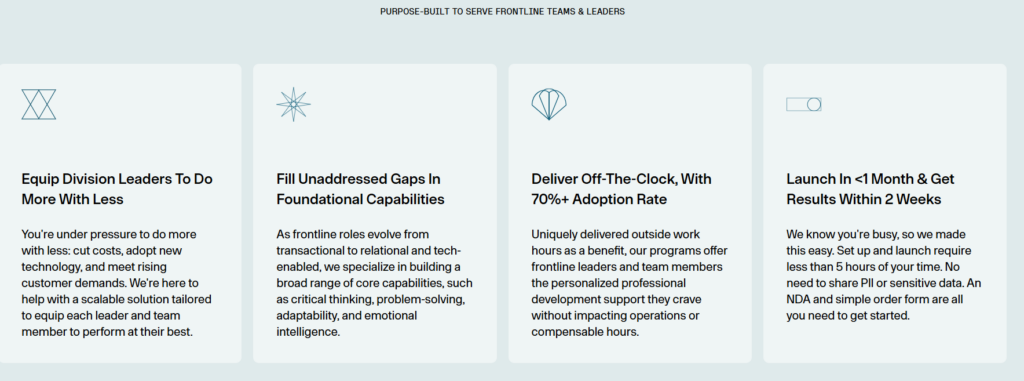
The company’s website emphasizes that courses are delivered “outside of work hours” and free for eligible employees at partner companies, which implies Pathstream’s clients pay for broad employee access.
This approach aligns with trends in corporate learning: firms like Guild Education (for tuition benefit management) and LinkedIn Learning (for skills training) similarly sell enterprise solutions for employee development. Pathstream’s “frontline workforce” focus – offering high-touch, active-learning solutions to non-managerial roles – differentiates it within this market.

In summary, Pathstream derives revenue from a mix of sources: education partnerships (colleges paying for course development and delivery), government or grant funding (subsidizing workforce education), and increasingly enterprise contracts (corporate clients licensing the Pathstream platform and programs). As CEO Cooper has noted, “the company makes money on student fees and some students are eligible for workforce grants”. In the current model, employee fees are generally covered by their employer, reflecting Pathstream’s pivot from a college-centric to a corporate-upskilling business model.
Revenue Streams of Pathstream
Pathstream’s revenues come from multiple channels, reflecting its hybrid education/business model:
-
College/University Programs: In its early model, Pathstream earned revenue through fees from partner institutions. Colleges paid Pathstream to create and manage certificate courses in areas like Salesforce administration or data analytics. These fees were often funded by student tuition payments or federal/state workforce grants (such as WIOA funds) allocated to eligible training programs. For example, the University of San Diego noted that its Pathstream-powered certificates were eligible for Workforce Innovation and Opportunity Act funding.
-
Corporate Partnerships: Today, a major revenue stream is corporate L&D contracts. Pathstream charges enterprises (especially Fortune 500 companies) to license its learning platform, content, and coaching for their frontline employees. The company markets this as a scalable benefit – programs are “delivered outside of work hours” to increase adoption – and likely uses per-employee or tiered subscription pricing. Employees access the training for free, but the employer pays for the service.
-
Program Services: Pathstream also provides accompanying career services (coaching, portfolio support, placement assistance). While these services are bundled into its corporate offerings, they could potentially generate additional revenue via premium packages or partnerships with hiring firms, though specifics are not public.
-
Grants and Partnerships: At times, Pathstream or its university partners have tapped state/federal education grants or private foundation funds to subsidize courses. This is less a steady revenue stream and more a funding source to expand access (e.g. during pilot programs).
A table of Pathstream’s revenue sources might look like:
| Revenue Stream | Description | Example/Citation |
|---|---|---|
| College Program Fees | Fees from partner colleges/universities to license certificate courses (paid via student tuition or workforce grants). | Colleges offer Pathstream certificates for credit; eligible for WIOA funds. |
| Corporate Subscriptions | Enterprise licensing fees from companies for platform access and training content. | Employers pay Pathstream to train frontline teams (employees enroll at no cost). |
| Grant Funding | Federal or state workforce-development grants for eligible programs (through education partners). | USD noted Pathstream programs are on Eligible Training Provider Lists (WIOA funding). |
| Service Fees | (Potential) fees for additional services (e.g. custom course development or placement services). | Not publicly detailed; could be part of corporate agreements. |
Each of these revenue streams ties back to Pathstream’s core mission of workforce training. Over time, the balance has shifted toward corporate subscriptions, but the legacy education-partnership model still underpins much of its curriculum development.
Funding of Pathstream
Pathstream has raised multiple rounds of venture capital since its founding.
In August 2019, it announced a Series A of $12 million, led by investors such as TDM Partners, Hereditas Capital, Bisk Ventures, New Ground Ventures and Rethink Education. This round brought the company’s cumulative funding to about $13 million.
Pathstream later raised additional financing; notably, a mid-2021 round (often cited as a Series B, though amount was not publicly disclosed) brought in investment from entities like Citi (through its venture arm Citi Ventures), Strada Education Network, New Markets Venture Partners, as well as continuing backers Entangled Ventures, Rethink Education and others.
In June 2023, Pathstream closed a large Series B round of about $38.8 million, according to public filings. This 2023 round appears to have been co-led by Strada Education Network and Rethink Capital (among others listed), reflecting confidence from both education-focused and impact investors.
In total, Pathstream has raised on the order of $50–$51 million through four known rounds. (Private databases cite totals of ~$51.8M or $50.8M over four rounds, consistent with EdSurge’s $13M plus later $38–39M funding.)
The equity investors in Pathstream include venture funds and education investors. Beyond Strada and Rethink, backers have included Citi Ventures, Entangled Ventures (the affiliated incubator), New Markets Venture Partners (an impact fund), HCM Strategists (founded by Michael Moe), Bisk Ventures (education tech), and college partnerships like Northwestern Mutual Future Ventures.
Funding Rounds of Pathstream
| Date | Round | Amount | Lead Investors & Notes |
|---|---|---|---|
| Jan 2018 | Seed | ~$1.0M (est.) | Early angel/seed investors (unannounced) |
| Aug 2019 | Series A | $12.0M | Led by TDM Partners, Hereditas Capital, Bisk Ventures, New Ground Ventures, Rethink Education. |
| Aug 2021 | Series B | Undisclosed | Led by Citi Ventures, Strada Education Network, New Markets VP; existing backers Entangled & Rethink participated. |
| Jun 2023 | Series B | $38.8M | Co-led by Strada Education Network & Rethink Capital (per filings). |
Table: Pathstream’s major funding rounds. Amounts and investors are drawn from press reports and public filings.
Competitors of Pathstream
Pathstream operates in the broader market of corporate upskilling and career development.
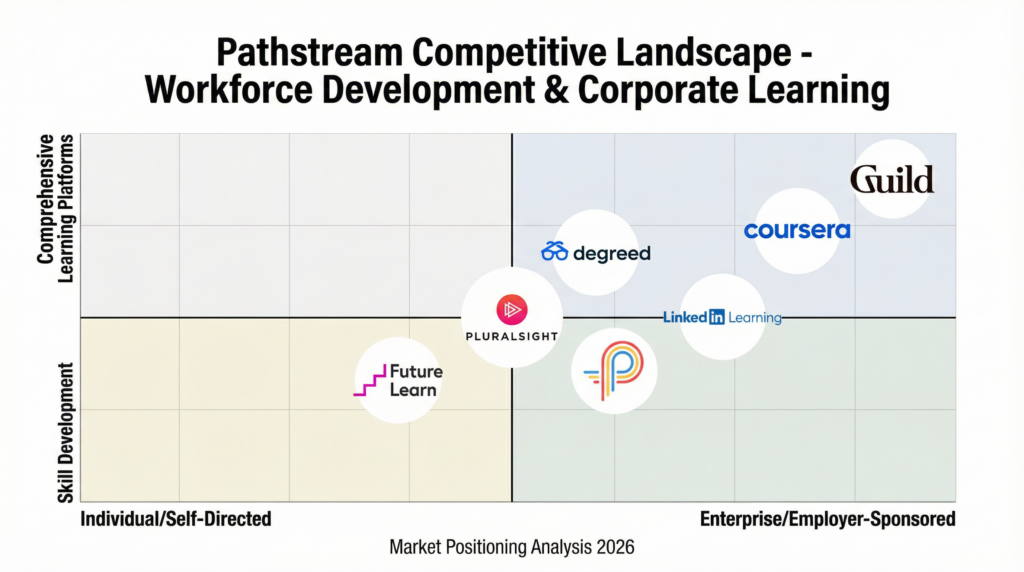
Its most direct competitors are other workforce-training platforms and online learning companies. For example, business intelligence sources list Adjacent, FutureLearn, and Pluralsight as peer companies in the upskilling space. Adjacent (US) and Pluralsight (now part of Vista Equity Partners) both focus on technology skill training, while FutureLearn is a UK-based MOOC platform that has corporate partnerships.
In addition, Pathstream competes with major learning platforms such as Degreed (formerly EdCast), Coursera for Business, and LinkedIn Learning, which offer enterprise solutions for employee development.
Degreed is a skills platform that aggregates learning content, Coursera has a business arm partnering with universities, and LinkedIn Learning (Lynda) provides a large content library. The DistrictAngels market report explicitly groups “Pathstream” in the same category as Degreed and LinkedIn Learning.
Other related competitors include large tuition-benefits providers like Guild Education, which designs education benefits for corporations, and specialized bootcamp-style platforms (e.g. Udacity, General Assembly) that offer course-to-employment pathways.
Importantly, many of Pathstream’s competitors overlap only partially with its niche. For instance, while Coursera and LinkedIn Learning target a broad base of knowledge workers, Pathstream specifically tailors to frontline hourly roles and offers a more coach-driven, project-based approach. Its competitors vary in focus: some target college students (College League), others target tech professionals (Pluralsight, Udacity), and others target corporate L&D broadly (Degreed, 2U/GWU/Gateway).

| Competitor | Focus / Offering |
|---|---|
| Adjacent | Workforce-development platform (upskilling frontline workers). Cited as a competitor. |
| FutureLearn | Online course/MOOC platform (used by colleges & corporates). Listed by Owler. |
| Pluralsight | Online tech skill training (courses on software/dev). Top competitor. |
| Degreed | Enterprise learning experience platform (aggregates courses/credentials). Named alongside Pathstream in reports. |
| LinkedIn Learning | Corporate learning library (video courses). Cited in market analysis. |
| Coursera for Business | Corporate online courses from universities/companies. Comparable market segment. |
| Guild Education | Manages education and upskilling benefits for employers. Indirect competitor in corporate L&D. |
Table: Selected competitors and parallels. Sources include company intelligence profiles and industry reports.
Competitive Advantage of Pathstream
Industry Partnerships
Pathstream’s key competitive strengths stem from its industry partnerships, hands-on approach, and focus on outcomes. Unlike many generic e-learning platforms, Pathstream co-develops content with leading tech companies and offers learners credentials from those companies. For example, its programs include certificates co-branded with Facebook (Meta), Salesforce, Asana, Unity, and others.
By embedding the actual software tools into its online platform (i.e. streaming live versions of Adobe, Salesforce, Tableau, etc.), Pathstream enables a “learn-by-doing” experience. According to the company’s descriptions, its web-based platform “streams our tech partner’s high-powered software and allows students to dive right into building their skills,” eliminating setup barriers and mirroring real job tasks. This hands-on, project-centric training is more immersive than video courses.
Personalized Coaching
Another advantage is personalized coaching and support. Pathstream combines online coursework with 1:1 coaching and career guidance for each learner. This combination – a dedicated learning coach plus career advising – is rare among purely content-driven platforms. The emphasis on personal guidance likely contributes to Pathstream’s strong results: it claims a 65+ Net Promoter Score and reports that 94% of participants are “prepared to meet career goals” after completing the program. High adoption and satisfaction rates (e.g. >70% employee enrollment, per its site) are also touted, suggesting Pathstream’s programs engage learners effectively.
Strategic Focus on Frontline Roles
Finally, Pathstream’s strategic focus on frontline roles sets it apart. Many corporate training solutions target corporate or technical employees; Pathstream explicitly markets itself as serving “frontline teams and leaders”. Its programs build not only technical skills but also core capabilities (critical thinking, problem-solving, emotional intelligence) needed in evolving customer-facing roles. By addressing an underserved segment – hourly and non-managerial staff – Pathstream occupies a niche. Its mission-driven narrative (empowering non-degree workers with tech-enabled career paths) resonates with both employers and workforce-development policymakers, providing an edge over competitors focused only on traditional degree-holders or white-collar professionals.
In short, Pathstream’s competitive advantages include its deep corporate and academic partnerships, its active learning platform with real software, strong learner outcomes (NPS 65+), and a clear market niche in frontline upskilling. As co-founder Eleanor Cooper noted, the company “partners with leading tech companies to deliver branded digital-skills career programs through community college and university partnerships,” bridging the gap between education and employer needs. This alignment of content, coaching, and credentialing gives Pathstream a unique position in the workforce development landscape.
You can also explore: BillionToOne – Founders, Business Model, Funding & Competitors
Products and Services of Pathstream
Pathstream offers a suite of learning programs, coaching services, and technology tools aimed at building career skills. Its core products include:
-
Career Certificate Programs: Pathstream partners with tech firms to create accelerated certificate courses in high-demand fields. For example, it offers programs like Facebook Digital Marketing, Asana Project Management, Salesforce Administrator, and Unity Immersive Design. Each program typically spans one to two college semesters’ worth of curriculum and is delivered online via the Pathstream platform. Upon completion, learners earn co-branded certificates (often with credit through a college partner and endorsement from the tech company). These certificates are highly practical – students work on real software projects and build portfolios – which helps them qualify for “gateway” careers that pay well (the company targets roles over $50K starting salary).
-
Online Learning Platform: Pathstream’s web-based platform is central to its services. It combines interactive course modules, live software simulations, and learning management. Technical simulations stream the actual tools (Adobe, Tableau, etc.) into a browser, so students learn by doing rather than watching videos. The platform also tracks learner progress, hosts assignments, and integrates coaching check-ins. As described by one source, “the company’s platform delivers education programs that prepare learners for the jobs of tomorrow,” emphasizing its role as a workforce upskilling system.
-
1:1 Coaching and Support: A distinguishing service is personalized support for each learner. Pathstream assigns coaches or mentors who hold regular sessions (via chat or video) with employees to discuss course material, career goals, and job search strategies. This human touch augments the digital content. The company cites “1:1 Coaching” as a flagship offering in its product portfolio. Learners receive individual help in understanding concepts, overcoming challenges, and translating skills into career steps.
-
Career Guidance and Success Services: Beyond technical training, Pathstream provides career counseling. Services include resume and portfolio reviews, interview preparation, and connections to hiring resources. The aim is to help graduates actually transition into new roles. For example, after completing a data analytics certificate, a learner might get help applying for data analyst jobs. This end-to-end support (from learning to placement) adds value for both individuals and employer clients.
-
Corporate Implementation Services: For enterprise customers, Pathstream offers solutions for rollout and engagement. This includes setting up cohorts by department or division, aligning courses with company goals, and measuring impact. Their “easy setup” approach claims less than one month from contract to launch. These professional services ensure that corporate clients can integrate Pathstream into tuition assistance or training budgets smoothly.
In summary, Pathstream’s products and services blend active online learning modules (with software simulations), certification programs co-developed with industry, and high-touch coaching/career services. As one description notes, “Pathstream offers a comprehensive portfolio of products and services, including 1:1 Coaching, AI Simulations, and Career Guidance”. The combination of skill-building courses plus personal support is designed to ensure measurable employee development and retention.
Conclusion
In less than a decade, Pathstream has built a distinct brand at the intersection of education and workforce training. From its origins as an Entangled Group venture solving the college-to-career gap, it has grown into an enterprise learning platform serving tens of thousands of learners. Its partnerships with major tech companies (e.g. Facebook, Salesforce, Unity) and with dozens of colleges gave it early credibility; today its alliances with Fortune 500 firms like Amazon and Mastercard underpin its corporate model. Financially, Pathstream’s trajectory has been robust: after starting with almost no revenue in 2018, it achieved roughly $4.9M in 2023, nearly doubling to $9M in 2024. These figures, along with a team exceeding 100 employees and multiple high-value funding rounds, indicate strong momentum.
More importantly, Pathstream tells a human story. Co-founder Eleanor Cooper often emphasizes that the goal is to democratize access to tech careers: “If you’re 25 and have a GED, you should have access to a broad set of new opportunities in the economy,” she remarked in 2019. By building day-one job skills into its platform and by providing ongoing guidance, Pathstream has positioned itself as a bridge between “everyday workers” and “everyday wins” – the micro-successes that advance careers. Its brand narrative highlights how an entry-level cashier or customer-service rep can gain Facebook-certified marketing skills or Salesforce credentials, all while earning college credit.
Looking ahead from 2026’s vantage point, Pathstream seems poised to continue expanding. The global upskilling market is growing (as noted by HolonIQ and EdWeek) and companies face increasing pressure to retain talent, especially on the front lines. Pathstream’s high outcomes (e.g. 94% of learners meeting goals) and turnkey corporate solutions should help it win new contracts. Challenges remain – competition is fierce and edtech funding is more selective than in the 2020 boom – but Pathstream’s strategic blend of learning science, coaching, and industry alignment gives it staying power. In sum, Pathstream’s brand story is one of transforming workforce development through tech-enabled education: from a startup venture to a recognized learning partner for businesses, it has crafted a mission-driven narrative backed by strong funding, growing revenues, and measurable impact.
Also Read: Novakid – Founders, Business Model, Funding & Competitors
To read more content like this, subscribe to our newsletter
Go to the full page to view and submit the form.