



CyberFOX is a rising cybersecurity startup specializing in privileged access management (PAM) and identity management solutions tailored for managed service providers (MSPs) and small-to-medium businesses.
Launched as a unified brand in 2022, CyberFOX gained recognition by bringing together two MSP-focused security products – AutoElevate for endpoint privilege management and Password Boss for password management – under one umbrella.
Headquartered in Tampa, Florida, and led by channel veteran David Bellini, CyberFOX positions itself as a one-stop provider of identity access management tools that help MSPs control user access to critical information and reduce cyber risks.
In just a few years, the company has rapidly expanded its partner base and product suite, serving over 4,000 customers worldwide as of early 2026. CyberFOX’s mission is to deliver “affordable, practicable security” for MSPs and their clients by focusing on ease-of-use, cost-effectiveness, and comprehensive protection against threats.
This story delves into CyberFOX’s origins, the founders’ vision, its business model and revenue streams, funding milestones, competitive landscape, and the products and services that drive its success – all painting a picture of how a savvy startup blended storytelling and business strategy to carve out a niche in the cybersecurity market.
Founding Story of CyberFOX
CyberFOX’s founding story is one of convergence and foresight. The seeds of the company were planted through the combination of two niche security startups, each born from real-world problems faced by MSPs.
Password Boss was originally founded in 2014 by Steve Wise, an MSP industry veteran who “struggled to find a password management solution that met the needs of how his MSP operated”. Frustrated by inadequate tools, Wise built Password Boss as a multi-tenant password manager “by an MSP for MSPs,” incorporating features like secure password sharing, role-based access, and dark web monitoring to help service providers protect their clients’ credentials.
On the other side, AutoElevate was co-founded by MSP owners Todd Jones and Dave Sibiski to tackle the risks of excessive admin privileges. AutoElevate’s software embodies the principle of least privilege – automatically elevating end-user rights only when running approved applications – thus allowing MSPs to remove local admin access and secure client endpoints.
Both products gained modest traction among security-conscious MSPs, but their founders realized they could achieve far more with additional resources and channel expertise.
The turning point came when David “Dave” Bellini, a well-known figure in the MSP community, stepped in. Bellini is a co-founder of ConnectWise (a pioneering MSP software firm) and had decades of experience scaling technology solutions in the IT channel.
After ConnectWise was acquired by private equity in 2019, Bellini was looking for a new venture where he could leverage his channel know-how. In 2020, he and a group of investors acquired Password Boss, installing Bellini as CEO. Shortly thereafter in August 2021, the same group acquired AutoElevate. These strategic acquisitions set the stage for unifying the two companies under a single brand.
As Bellini recounted, the original founders of Password Boss and AutoElevate “came to us and said, ‘I need to get to that next layer…to grow this company.’ We were able to identify some really good security products and then take them to that next level”. By blending the two solutions, Bellini saw the opportunity to create a more powerful platform that could “quickly innovate and scale…more effectively and efficiently” than either could alone.
In June 2022, the CyberFOX brand officially launched, marking the culmination of this founding journey. Tampa-based CyberFOX emerged as a new identity access management vendor with Bellini at the helm as CEO. The announcement framed CyberFOX as “a global cybersecurity company” bringing together “two best-in-class IAM security companies – Password Boss and AutoElevate – under a single brand”.
This one-stop approach promised MSPs greater efficiency and innovation speed across both solutions. The timing was ideal: cybersecurity threats were growing and MSPs were facing increasing pressure to bolster defenses for their small-business clients. By unifying password management and privileged access management (often considered two critical pillars of cyber defense), CyberFOX positioned itself as an essential layer in MSPs’ security stack.
The founding story of CyberFOX is thus a narrative of identifying synergy – visionary channel leaders recognizing that two MSP-built tools could be stronger together, and acting quickly to integrate them into a single, agile startup. It’s a story of leveraging deep industry experience to address unmet needs in the market and “take MSPs to the next level” in security.
Founders of CyberFOX
At the core of CyberFOX’s brand are its founders and leadership team, who bring a rich legacy from the MSP software world. David Bellini, CyberFOX’s CEO, is arguably the linchpin of the venture.


Bellini co-founded ConnectWise in the 1980s alongside his brother Arnie, transforming their small IT services company into a global software leader for MSPs. As ConnectWise’s Chief Operating Officer and later President of International Sales, Bellini gained a reputation for understanding the MSP business model inside-out and spearheading international growth.
After ConnectWise’s sale in 2019, Bellini leveraged his industry clout and resources to acquire Password Boss (2020) and AutoElevate (2021), setting the foundation for CyberFOX. His return as a startup CEO demonstrates a hands-on leadership style – Bellini is frequently quoted emphasizing simplification and partner-centricity: “We’re really servicing that MSP market…We’re the go-to for a lot of these companies”. His decades of channel experience give CyberFOX instant credibility and a vast network of MSP relationships to tap into.
Joining Bellini is Adam Slutskin, CyberFOX’s Chief Revenue & Strategy Officer and co-founder. Slutskin is another ConnectWise alumnus known in the IT channel; he previously served as Chief Revenue Officer at ConnectWise and later helped grow Liongard, a startup providing MSP automation software. Slutskin’s focus is on driving sales strategy and aligning products to market needs.


Together, Bellini and Slutskin form a veteran duo – described by one investor as having “impeccable pedigree serving both MSPs and non-MSP customers”, referencing their successes at ConnectWise and Liongard. Notably, the company’s February 2026 funding announcement explicitly calls Bellini and Slutskin CyberFOX’s founders, underscoring their leadership role in building the venture from the ground up.
In summary, the founders and leaders of CyberFOX blend veteran business leadership with practitioner expertise. Bellini and Slutskin supply the strategic vision and go-to-market acumen honed at ConnectWise, while Wise, Jones, and others provide the ground-level understanding of MSP challenges and technical innovation. This combination of talents forms the backbone of CyberFOX’s brand identity – one built on trust in proven people.
Business Model of CyberFOX
CyberFOX operates a channel-centric, subscription-based SaaS business model built specifically around Managed Service Providers (MSPs). Rather than selling directly to end businesses, the company positions itself as a vendor to MSPs, enabling them to deliver identity and access security solutions—such as password management, privileged access control, and DNS filtering—to their SMB clients at scale. This indirect distribution model allows CyberFOX to expand rapidly through partner networks while embedding itself deeply into the MSP ecosystem.

Channel-First SaaS Distribution
At the core of CyberFOX’s model is cloud-delivered, multi-tenant software designed for centralized management. Each product includes a unified portal that allows MSPs to deploy, configure, and manage services across multiple client organizations from a single interface. Solutions such as Password Boss and AutoElevate are built to integrate directly with widely used MSP tools like RMM and PSA platforms, including ConnectWise, Datto, and Kaseya. This seamless integration ensures that security workflows—such as privilege elevation approvals or credential management—fit naturally into technicians’ daily operations.
By embedding into existing MSP toolkits, CyberFOX reduces friction during onboarding and increases platform stickiness. The deeper the operational integration, the harder it becomes for partners to switch vendors, strengthening long-term retention.
Recurring Subscription Revenue Model
CyberFOX generates revenue primarily through recurring monthly subscriptions, typically priced per user or per endpoint. This structure aligns directly with MSP billing models, enabling partners to bundle CyberFOX’s solutions into their own managed service packages. As MSPs grow their client base or expand security offerings, CyberFOX’s revenue scales proportionally.
A defining element of the model is affordability. CyberFOX aims to deliver the majority of enterprise-grade functionality at a significantly lower cost, targeting the economic realities of small and midsize businesses. Instead of high per-seat enterprise licensing fees, the company offers right-sized pricing that allows MSPs to maintain healthy margins while providing meaningful protection to clients. This balance between capability and cost is central to CyberFOX’s competitive positioning and adoption strategy.
Partner Program and Ecosystem Development
CyberFOX strengthens its channel model through a structured partner program that includes tiered benefits, marketing support, training resources, and volume-based incentives. By offering Silver, Gold, and Platinum-style partnership levels, the company incentivizes deeper engagement and higher product penetration across MSP client portfolios.
Beyond pricing incentives, CyberFOX actively nurtures its partner ecosystem through education initiatives, best-practice frameworks, and regular engagement events. Feedback from MSP partners directly influences product development, creating a collaborative innovation loop. This partner-driven roadmap approach ensures that new features and product expansions align closely with real-world operational needs rather than theoretical enterprise use cases.
Scalability and Growth Engine
The channel-led approach provides CyberFOX with built-in scalability. Each MSP partner effectively becomes a distribution node, bringing multiple end customers onto the platform. As partners onboard new SMB clients or upsell additional security layers, CyberFOX benefits from compounded growth without maintaining a large direct sales force targeting individual businesses.
Rapid expansion in partner count and platform adoption demonstrates the effectiveness of this strategy. Growth has been driven not only by acquiring new MSPs but also by expanding usage within existing partner ecosystems, reinforcing the strength of recurring SaaS economics.
Strategic Business Model Positioning
In summary, CyberFOX’s business model is anchored in subscription-based software delivered exclusively through MSP partnerships. The company combines deep workflow integration, flexible pricing aligned with SMB economics, and a structured partner ecosystem to create a scalable and defensible growth engine. By enabling MSPs to offer enterprise-caliber security without enterprise-level complexity or cost, CyberFOX establishes a mutually reinforcing value chain—where partner success directly drives platform expansion and recurring revenue stability.
Revenue Streams of CyberFOX
CyberFOX generates revenue primarily through recurring subscriptions to its security software, with multiple complementary products contributing to its income. The table below outlines the major revenue streams and their characteristics:
| Revenue Stream | Description | Model and Notes |
|---|---|---|
| MSP Licensing – Password Management | Subscription fees for the CyberFOX Password Boss platform, which MSPs deploy to manage passwords for their clients. | Priced per user (or per vault) per month; MSPs often bundle this into their service packages for SMB customers. Multi-tenant portal enables one MSP to manage many end-client accounts. |
| MSP Licensing – Privileged Access (PAM) | Subscription fees for AutoElevate, the privileged access management tool that MSPs install on client endpoints. | Typically priced per endpoint or per managed device per month. Eases MSPs’ burden by automating admin privilege control – valued as an add-on service that MSPs can upsell. (E.g., industry sources indicate AutoElevate is competitively priced around ~$1 per endpoint monthly.) |
| MSP Licensing – DNS Filtering | Subscription fees for CyberFOX DNS Filtering, a web security service introduced in 2025 to block malicious domains and content. | Priced per user or per protected device per month. Provides MSPs a new revenue opportunity by adding DNS-level protection for clients (often packaged alongside the PAM and password services). This became CyberFOX’s third product line, immediately contributing to ARR growth once launched. |
| Tiered Partner Program & Bundles | Indirect revenue benefits from partner tier incentives and product bundles. While not a separate “stream,” CyberFOX’s partner program encourages MSPs to sell more seats to attain Gold/Platinum status. | By offering volume discounts or co-marketing funds at higher tiers, CyberFOX drives larger deployments. Bundled pricing (e.g., offering a discounted suite of Password Manager + AutoElevate + DNS Filter) helps increase average revenue per partner. |
| Professional Services & Support | Minor revenue from services like training, premium support, or implementation help. | CyberFOX’s solutions are generally self-service, so services are not a large revenue source. However, bespoke onboarding for large partners or occasional consulting (e.g., security audits using CyberFOX tools) can provide additional one-time fees. |
Most of CyberFOX’s income falls under the first three categories, all of which are SaaS recurring revenues. The company’s annual recurring revenue (ARR) has grown dramatically as these streams expanded: by early 2026 CyberFOX reported a 20x increase in ARR since its formation through the acquisitions. This growth is attributed to scaling subscription sales across its expanding customer base. For instance, in 2022 (its first full year as a combined entity), CyberFOX generated over $5 million in revenue. By the end of 2023, the company expected to hit $11 million in sales with the surge in MSP partners and cross-selling of its solutions. The addition of DNS Filtering in late 2025 likely opened another revenue tap, as MSPs opted to purchase a third service from the same vendor for convenience. CyberFOX’s own messaging emphasizes that it “proudly serves many of the largest, fastest-growing…technology organizations” in the MSP space, suggesting that landing big MSP partners can significantly boost recurring revenues (one MSP partner can translate into hundreds of end-user licenses).
Funding of CyberFOX
Funding Rounds of CyberFOX
The following table summarizes CyberFOX’s key funding and investment events since inception, as publicly reported:
| Date | Funding Event | Details | Source |
|---|---|---|---|
| 2020 (Q4) | Founder-Led Acquisition (Seed Stage) | Password Boss acquired by David Bellini and investors. Bellini becomes CEO of Password Boss. This effectively injects seed capital and leadership into the venture. | Bellini & group acquire Password Boss (undisclosed sum). |
| Aug 2021 | Follow-on Acquisition | AutoElevate acquired by the same Bellini-led group, to complement Password Boss. Todd Jones (AutoElevate co-founder) retained to run operations/tech. This broadened the product base under what would become CyberFOX. | Acquisition of AutoElevate in Aug 2021 (undisclosed). |
| June 2022 | Official Launch (Bootstrapped) | CyberFOX brand launched, unifying Password Boss and AutoElevate with no new external funding at launch. Effectively bootstrapped by founder investments and product revenues. | CyberFOX launches under single brand. |
| Feb 2, 2026 | Growth Investment (Series A) | Nine-figure investment led by Level Equity, with Radian Capital and founders participating. Estimated $100M+ range. Aimed at accelerating growth (AI R&D, international expansion, acquisitions). This is CyberFOX’s first institutional funding round. | CyberFOX secures major funding to scale up. |
Notes: Prior to 2026, CyberFOX did not raise traditional VC rounds; the company was funded via internal means (founder funds and operating cash flow). The “Series A” label is applied by observers given the size and timing, though the company simply termed it a “growth investment”. The nine-figure round underscores significant investor confidence, and it provides runway for the company to potentially reach new markets or even consider future rounds or an exit, depending on growth post-2026.
Competitors of CyberFOX
CyberFOX operates in a competitive cybersecurity landscape spanning privileged access management, password management, DNS filtering, and broader identity security. Its competitors range from MSP-focused niche vendors to large enterprise security platforms. While many rivals excel in specific categories, CyberFOX differentiates itself through MSP-centric design, integration breadth, and cost efficiency.
Privileged Access Management (Endpoint Elevation) Competitors
In endpoint privilege management, AutoElevate competes directly with solutions such as Admin By Request and ThreatLocker. Admin By Request is widely adopted among small IT teams and offers a free tier for limited endpoints, making it attractive for smaller environments. However, as deployments scale, costs increase and the platform lacks some advanced multi-tenant features required by MSPs managing numerous client environments. It is generally positioned more for internal IT departments than large-scale MSP operations.
ThreatLocker represents a more comprehensive zero-trust security platform, combining application allow-listing with privilege control. While it is praised for strong security enforcement and customization, it is also known for operational complexity and often requires dedicated engineering oversight. In contrast, AutoElevate is positioned as a purpose-built MSP solution—integrating seamlessly with RMM and ticketing systems while remaining relatively easy to deploy and manage. Compared to enterprise-grade PAM vendors such as CyberArk or BeyondTrust, AutoElevate offers a lighter, cost-effective alternative tailored to SMB environments rather than enterprise infrastructure.
Password Management Competitors
Within password management, CyberFOX’s Password Boss competes with both MSP-specific and general business password managers. A close competitor is N-able Passportal, a cloud-based credential and documentation management solution designed for MSPs. Passportal offers strong integration with N-able’s broader ecosystem and includes password automation and secure storage features similar to Password Boss. However, its integration strength can also limit flexibility for MSPs that prefer vendor-neutral solutions.
Keeper Security, through KeeperMSP, also targets managed service providers, emphasizing strong encryption standards and compliance capabilities while promoting password management as a recurring revenue opportunity for MSPs. Additionally, established business password managers such as LastPass, Dashlane, and Bitwarden appear in competitive scenarios, though many lack MSP-specific multi-tenant segmentation or PSA integration features.
Password Boss differentiates itself through its MSP-native architecture, ease of deployment, white-label capability, and operational alignment with MSP workflows. Its origins as a solution built specifically for MSPs provide credibility and functionality tailored to managing multiple client environments at scale.
DNS Filtering and Web Protection Competitors
With the launch of CyberFOX DNS Filtering in 2025, the company entered a crowded but essential security segment. Competitors include Cisco Umbrella, Webroot DNS Protection, and DNSFilter. Cisco Umbrella is a widely adopted enterprise-grade solution known for robust protection but often associated with higher costs. Webroot’s DNS protection is commonly bundled within its endpoint security suite, appealing to MSPs already using its antivirus platform.
DNSFilter, a newer MSP-focused competitor, emphasizes AI-driven detection and flexible deployment models similar to CyberFOX’s approach. The differentiator for CyberFOX lies in integration and bundling advantages. By combining DNS filtering with password management and privileged access control under one platform, CyberFOX simplifies vendor management and operational oversight. Its AI-driven threat detection and multi-tenant design further reinforce its MSP-focused positioning.
Enterprise PAM and Identity Vendors
At a broader level, CyberFOX competes indirectly with enterprise PAM providers such as CyberArk, Delinea (formerly Thycotic), and BeyondTrust. These vendors offer comprehensive privileged access suites covering session monitoring, vaulting, and server credential management. However, their pricing models and complexity often place them outside the practical reach of SMBs and many MSP-managed environments.
CyberFOX positions itself as a streamlined alternative, delivering essential IAM functionality without the heavy infrastructure requirements and cost structures of enterprise platforms. By targeting the underserved MSP and SMB segment, CyberFOX occupies a strategic middle ground between lightweight tools and enterprise-grade systems.
Overall Competitive Landscape
CyberFOX operates within a multi-layered competitive environment that includes specialized MSP tools, enterprise security giants, and emerging AI-driven startups. Its most direct competitors are MSP-centric vendors such as Admin By Request, ThreatLocker, Passportal, and KeeperMSP. Meanwhile, larger vendors represent aspirational or indirect competition in higher market tiers.
CyberFOX’s strategy centers on differentiation through MSP-native design, operational simplicity, integration breadth, and bundled security offerings. By continuously expanding its product suite—most notably with DNS filtering—and maintaining affordability aligned with SMB economics, the company strengthens its ability to compete across multiple fronts.
As of 2026, CyberFOX’s integrated, channel-focused approach allows it to compete effectively against both niche players and enterprise vendors, positioning it as a strong contender within the evolving MSP cybersecurity ecosystem.
Competitive Advantage
CyberFOX’s competitive advantage lies in its MSP-centric DNA, integrated platform strategy, economic accessibility, and early strategic positioning within the managed security ecosystem. Together, these elements create a differentiated value proposition that is difficult for traditional cybersecurity vendors to replicate.
1. MSP-Centric Design and Usability
At the core of CyberFOX’s edge is its “built by MSPs, for MSPs” philosophy. Both flagship products emerged directly from real-world MSP operational pain points, and the founding team’s extensive industry experience ensures tight alignment with technician workflows. This results in solutions that are intuitive, quick to deploy, and operationally practical rather than overly complex enterprise tools adapted downward.
AutoElevate and Password Boss are frequently recognized for ease of implementation, streamlined policy management, and minimal training overhead. CyberFOX prioritizes usability because adoption determines effectiveness; security controls only create value if they are actually implemented and consistently used. By simplifying privilege management and credential security, CyberFOX removes friction that often prevents MSPs from enforcing best practices at scale. This balance between security depth and operational simplicity gives CyberFOX a meaningful functional advantage.
2. Integrated Security Platform Strategy
Another defining advantage is CyberFOX’s integrated approach. Rather than specializing narrowly in password management, PAM, or DNS filtering, the company delivers a cohesive suite that addresses multiple identity and access security layers under one umbrella.
This consolidation reduces vendor sprawl for MSPs and increases operational efficiency through shared deployment models, multi-tenant management, and integrations with widely used PSA and RMM platforms. By aligning with tools such as ConnectWise and Datto, CyberFOX embeds itself directly into MSP workflows. The platform strategy not only simplifies procurement and management but also positions CyberFOX as a long-term strategic partner rather than a single-purpose vendor.
As regulatory requirements and cyber insurance mandates expand baseline security expectations, having an integrated solution that covers credential management, privilege control, and DNS-layer protection strengthens CyberFOX’s competitive positioning.
3. Economic Accessibility and Partner Value
CyberFOX competes strongly on value and affordability. While many enterprise cybersecurity vendors focus on large organizations, CyberFOX intentionally serves MSPs supporting small and midsize businesses. Flexible pricing structures enable MSPs to deliver meaningful security improvements without exceeding client budgets, preserving both client affordability and MSP margins.
This economic positioning transforms CyberFOX from a product provider into a growth enabler for MSPs. High partner satisfaction levels and strong Net Promoter Scores indicate loyalty driven by both product reliability and channel-focused support. The company’s leadership, composed of experienced channel veterans, understands MSP economics and provides training, enablement, and relationship-driven support that reinforces long-term partnerships.
By aligning product pricing with the realities of SMB markets, CyberFOX creates a sustainable competitive moat rooted in accessibility and partner trust.
Strategic Timing and Market Positioning
CyberFOX also benefits from early recognition of a growing gap in MSP-focused identity and access security. As cybersecurity insurance requirements, compliance frameworks, and ransomware threats intensified, MSPs required practical tools tailored to their operating models. Larger vendors often underserved this segment, creating an opportunity for a specialized, channel-first provider.
By assembling its integrated platform ahead of broader market shifts, CyberFOX established a strong foothold in the MSP security tools segment. Continued investment, including expansion into AI-driven capabilities and global scaling, strengthens its ability to maintain momentum while competitors attempt to adapt.
This timing advantage positions CyberFOX not only as a participant in the MSP security ecosystem but as a category shaper within identity-focused managed security solutions.
Overall Competitive Position
CyberFOX’s competitive strength can be distilled into four pillars: MSP-native design that prioritizes usability and deployment speed; an integrated multi-solution platform that reduces complexity; accessible pricing aligned with SMB economics; and leadership credibility within the managed services channel.
These advantages combine to create a durable strategic position in the MSP cybersecurity market. While competition exists across individual product categories, CyberFOX differentiates itself through cohesion, channel alignment, and continuous innovation — enabling it to remain a trusted partner in an increasingly complex security landscape.
Products and Services
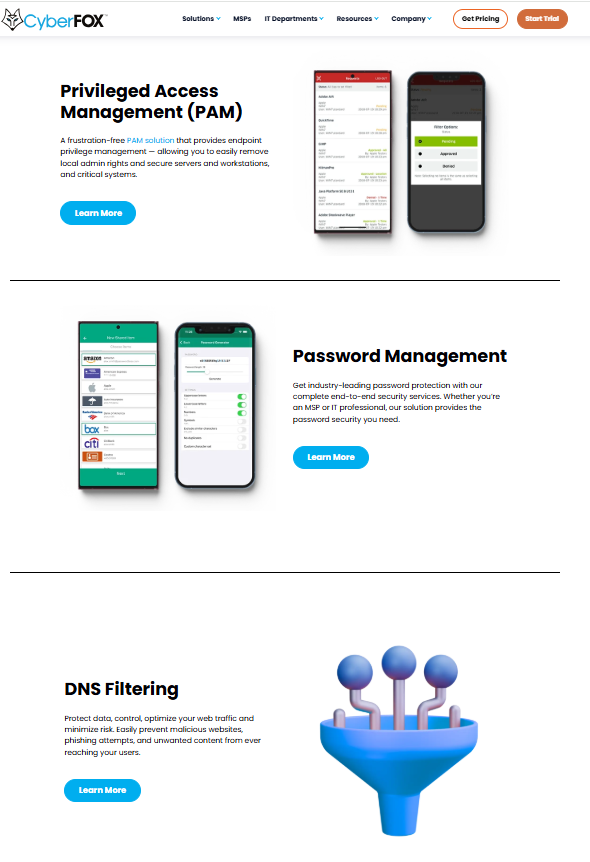
As of 2026, CyberFOX’s product portfolio centers on three integrated security solutions built specifically for Managed Service Providers (MSPs) and their small-to-midsize business clients. The company focuses on identity security, privileged access control, and web-layer threat protection, delivering a unified, multi-tenant, cloud-based ecosystem. Each solution is designed to align with MSP workflows, simplify deployment, and improve security posture without adding operational complexity.
1. CyberFOX Password Boss (Password Management)
Password Boss serves as CyberFOX’s dedicated password management platform and a core pillar of its identity security strategy. Built with MSP operations in mind, the platform operates on a multi-tenant architecture that enables providers to manage multiple client password environments from a centralized console. This structure allows MSPs to deploy and oversee password vaults across numerous customer sites efficiently, often through automated scripts or direct RMM integration.
The solution provides enterprise-grade security features including encrypted password vaults, role-based access controls, multi-factor authentication, and dark web monitoring to detect compromised credentials. Reporting tools such as password health audits and usage logs help MSPs demonstrate compliance improvements and measurable security gains to their clients. By eliminating insecure password storage methods such as spreadsheets or ad hoc tools, Password Boss addresses one of the most common entry points for cyberattacks—compromised credentials.
Since becoming part of CyberFOX’s broader ecosystem, Password Boss has benefited from deeper product integration and enhanced development resources. It continues to function as a foundational element in CyberFOX’s IAM approach, giving MSPs a scalable, brandable, and operationally streamlined way to secure client credentials.
2. CyberFOX AutoElevate (Privileged Access Management)
AutoElevate focuses on endpoint privilege management and embodies the principle of least privilege. Rather than granting users permanent administrative rights, the platform ensures users operate as standard users by default, with administrative access elevated only when necessary and approved.
The software intercepts privilege requests—such as software installations or system changes—and processes them according to predefined policies or real-time technician approval. This automation significantly reduces the risks associated with standing admin privileges while maintaining productivity. Integration with ticketing systems creates a detailed audit trail for each elevation request, supporting compliance requirements and accountability. Deployment is streamlined through RMM integrations, enabling MSPs to implement the solution across multiple client environments efficiently.
AutoElevate not only enhances security by limiting potential malware escalation pathways but also reduces operational overhead. By automating approval workflows and minimizing manual intervention, MSPs can decrease labor costs while improving endpoint control. Ongoing enhancements such as just-in-time admin access and intelligence-driven blocking of known malicious executables keep the platform aligned with evolving threat landscapes.
3. CyberFOX DNS Filtering (Web Protection)
Introduced in late 2025, CyberFOX DNS Filtering expands the company’s security footprint into network-layer protection. The solution operates at the DNS level, blocking access to malicious domains associated with ransomware, phishing campaigns, malware distribution, and other online threats before users can establish connections.
The platform combines traditional domain filtering with AI-powered pattern recognition to identify emerging threats in real time. This machine learning capability helps detect newly registered malicious domains that may not yet appear on static blocklists. In addition to threat protection, DNS Filtering allows granular content control, enabling MSPs to configure policies based on individual client needs, user groups, or locations.
Built with scalability in mind, the service supports IPv6 environments and operates through a global anycast DNS infrastructure to ensure reliability and performance. Real-time dashboards and reporting tools provide visibility into web traffic and blocked threats, allowing MSPs to demonstrate proactive protection measures. By integrating DNS Filtering into its broader ecosystem, CyberFOX complements its identity-focused tools with preventative web-layer defense, reinforcing a Zero Trust security posture.
Integrated Ecosystem and Partner Services
Beyond its three primary solutions, CyberFOX provides a centralized management portal, unified billing, customer support, and training resources tailored to MSP partners. The company also promotes structured security best practices, such as its “Simple 7” framework, designed to help MSPs implement layered protection efficiently.
Future expansion areas may include security awareness training and additional automation capabilities, all expected to follow CyberFOX’s established philosophy: cloud-native, multi-tenant, affordable, and operationally aligned with MSP workflows.
Portfolio Positioning and Strategic Coverage
Collectively, CyberFOX’s product suite addresses three critical security vectors. Password Boss protects credentials and identity data. AutoElevate governs privileged access and endpoint administrative actions. DNS Filtering safeguards internet activity and blocks external threats at the network entry point. Together, these solutions create a cohesive security framework under a single vendor relationship.
By consolidating identity management, privileged access control, and DNS-layer defense, CyberFOX enables MSPs to strengthen client security posture while reducing vendor sprawl and operational friction. The portfolio reflects the company’s core mission: to simplify and improve end-user security experiences by delivering affordable, practical, and scalable protection in an increasingly complex threat environment.
Conclusion
CyberFOX’s brand story is a testament to the power of focus and integration in the cybersecurity industry. In a short span, this startup has crafted a narrative of empowering the under-served MSP and SMB segment with enterprise-grade security tools made simple. From its founding moment – uniting two niche solutions born in the trenches of MSP work – to its current status as a fast-growing platform backed by significant investment, CyberFOX has balanced storytelling with business acumen. The founders’ reputation as channel champions gave the brand immediate authenticity, and they capitalized on that by addressing a timely need: the “perilous IT environment” where small organizations are targeted by cybercriminals. By weaving together Password Boss and AutoElevate into a cohesive offering, CyberFOX told MSPs, “We understand your challenges and we’ve combined the best tools to solve them.” This resonated strongly, fueling triple-digit growth and an expanding suite of services.
Analytically, CyberFOX shows how a clear business model (subscription SaaS via partners) and a relentless focus on customer segment (MSPs) can carve out a competitive moat even against larger players. Its revenue streams are recurring and growing; its competitive advantages in MSP-centric design and pricing are hard for enterprise-focused competitors to match without blurring their own models. The substantial funding in 2026 serves as an external validation of CyberFOX’s approach and opens a new chapter – one where the company can innovate faster (especially by infusing AI into its products), explore new markets, and perhaps consolidate other point solutions into its ecosystem. Challenges remain, of course: cybersecurity is a crowded space and attackers constantly up the ante, meaning CyberFOX must keep evolving to protect its clients. Yet, the brand’s trajectory so far – from a bold idea to blend identities, to a thriving business with thousands of partners and global reach – suggests it is well-equipped to do so.
In conclusion, the story of CyberFOX is both inspirational and instructive. It’s about identifying a critical gap (affordable IAM for SMBs), leveraging experience and community (MSP know-how at the core), and executing with agility (launching new products like DNS filtering to stay ahead). As of February 2026, CyberFOX stands at an inflection point, primed to define its category in the years ahead. The cunning fox in its name is apt – through clever strategy and adaptation, CyberFOX has maneuvered into a leadership role in MSP cybersecurity solutions. Its brand story continues to unfold, but already it offers a clear narrative: a startup that dared to do things differently in cybersecurity, and in doing so, is helping thousands of businesses stay safe in an increasingly dangerous digital world.
Also Read: ArmorCode – Founders, Business Model, Funding & Competitors
To read more content like this, subscribe to our newsletter
Go to the full page to view and submit the form.