


Founded in 2019, Deel has rapidly become a leading global payroll and HR technology platform that enables companies to hire, manage, and pay employees and contractors in over 150 countries. Rather than relying on fragmented local vendors, Deel delivers a unified “operating system for work” that automates the entire payroll stack through software. Its platform handles hiring paperwork, payroll, taxes, benefits, and compliance – all in one place.

Today Deel processes tens of billions of dollars in payroll every year (over $22 billion as of 2025) and serves tens of thousands of customers (over 30,000 by late 2025).
Major global companies ranging from Instacart and OpenAI to Coinbase, Intercom, and Shopify use Deel to tap international talent by ensuring compliant payments in local currency across the world. By automating cross-border payroll and compliance, Deel makes it effortless for businesses of any size to build a global workforce – a mission increasingly vital in an era of remote and distributed work.
Founding Story of Deel
The seed of Deel grew from the founders’ personal experiences. Co-founders Alex Bouaziz and Shuo Wang (both immigrants – Bouaziz from France and Wang from China) had each built and sold startups by 2018, only to repeatedly hit walls trying to hire international team members.
Bouaziz, studying at MIT in 2013, watched classmates get high-paying Silicon Valley offers while others with equal skills were unable to due to visa barriers. Wang, who moved to the U.S. as a teenager, had founded a robotics company that was acquired by iRobot, yet still faced the same hiring hurdles globally.
In their previous ventures they saw the same pattern: the best talent often lived abroad, but companies were encumbered by paperwork, local entities and regulatory complexity. In late 2018 they sketched an idea for a global payroll platform. By 2019, armed with this vision, Bouaziz and Wang pitched to Y Combinator and officially launched Deel.
Their initial product focused on international contractors (using smart digital contracts), but customer demand soon drove them to expand. A client request in Canada led them to build a formal Employer-of-Record (EOR) service in 2019 that would legally hire employees on behalf of companies. When the COVID-19 pandemic accelerated remote work, demand for their global hiring tools surged.
In Bouaziz’s words, they realized the shift to a “default-global” workforce was inevitable – and set out to create the universal payroll rails to empower it.
Founders of Deel
Alex Bouaziz (Co-founder & CEO)


A French native with family roots in Israel, Bouaziz studied engineering at MIT and previously co-founded startups in logistics and travel. He led Deel’s product vision from the start, defining the global-first strategy. As CEO, he has steered fundraising and culture, often emphasizing the principle that “unless we own every inch of the chain, we cannot deliver on our promise to the client”. He remains a vocal advocate for remote work and global talent.
Shuo Wang (Co-founder & CRO)


Wang hails from China and also attended MIT. Before Deel, she founded a robotics hardware company that was acquired by iRobot, giving her deep operational experience. As Chief Revenue Officer, Wang has led Deel’s growth, working with early customers and investors. Her own immigrant background (learning English at age 16) has informed Deel’s mission to give workers worldwide equal opportunity.
Early Team: Deel’s early leadership team included Dan Westgarth (often cited as COO/founder) and other former executives from fast-growing tech companies. Dan Westgarth (ex-TravelPerk COO) helped scale operations, though Bouaziz and Wang have been the public faces. Today, Deel remains a fully distributed company with employees and leadership spread globally, reflecting its product.
Business Model of Deel
Deel operates a platform-as-a-service model combined with value-added HR services. Its core business is subscription-based software for global workforce management, but it also provides end-to-end staffing services. Key aspects of Deel’s business model include:
Employer-of-Record (EOR) Services: Deel legally hires workers on behalf of client companies in each jurisdiction. This means Deel becomes the official employer in a country, taking on tasks like payroll processing, tax withholding, benefits administration and compliance with local labor laws. Clients pay Deel an EOR fee (typically a markup or fixed monthly rate) covering onboarding, local payroll filings, health insurance and other benefits. This lets companies “plug in” international employees without setting up local entities.
Contractor Management & Payments: For freelance contractors, Deel provides a streamlined portal for issuing compliant contracts, tracking time/invoices, and making payouts in local currency. Deel charges fixed fees per contractor transaction or a small percentage of payments. The platform automates tax forms and invoices, and it offers a pricing model (per-seat monthly fees) for contractor management — e.g. early pricing started around $35 per contractor per month.
Global Payroll Software: Deel sells its SaaS payroll platform to companies with existing local employees. In this model, Deel’s software (and sometimes back-office) runs regular payroll across multiple countries. Its payroll engine supports 120+ currencies and simplifies conversions and payments. Customers pay a subscription fee per user (employee) per month for this service. Deel’s platform contrasts with incumbent providers by being fully automated and vertical-integrated, “eliminating the need for humans in the loop”.
Add-on HR & IT Services: Beyond core payroll, Deel sells additional services. These include an integrated HRIS/Talent Management suite (such as onboarding, performance reviews and intranet communications via “Deel Engage”), HR support lines, and talent mobility tools. Deel also introduced IT services (“Deel IT”), offering device lifecycle management and global IT support for employees, priced per user/device (for example, standard device management at ~$10–$18 per device per month). Other add-ons include worker insurance packages, legal advisory, and even on-demand financing (like salary advances or crypto-based payouts).
Payment and FX Fees: Deel handles large cross-border money flows, so it can earn on currency conversions and payment processing. The company advertises competitive exchange rates, but it still collects minimal fees when converting client funds into local currencies. Additionally, optional “Deel Card” and expense features generate transactions fees on corporate spending.

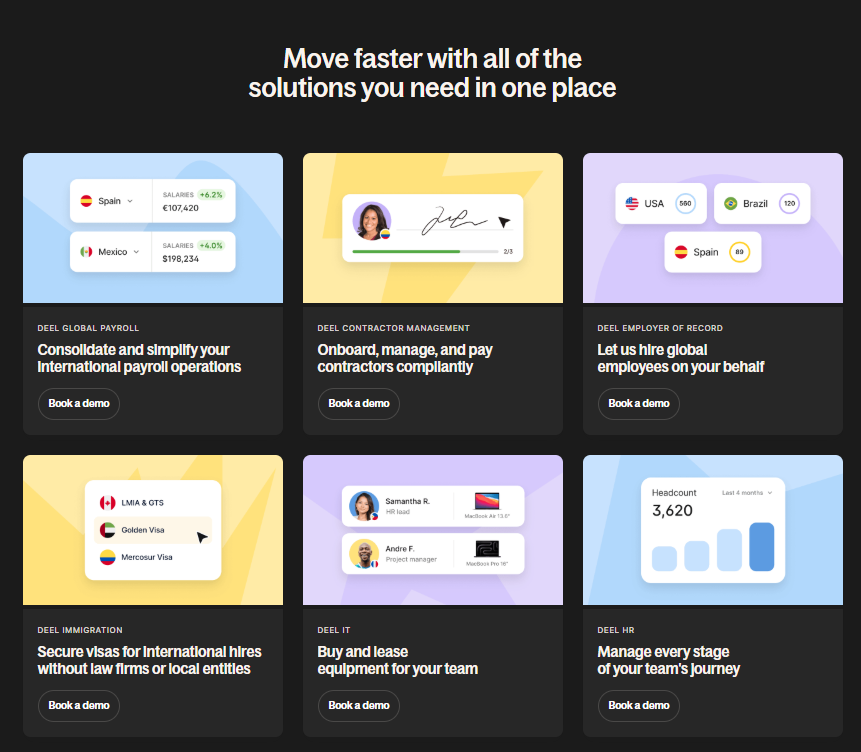
Overall, Deel’s model blends SaaS subscriptions (per-user or per-seat fees for the platform and services) with service and transaction fees tied to payroll volume and add-on options. As of 2025, Deel reports that almost all of its revenue comes from these ongoing contracts rather than one-time fees, giving it a predictable, recurring-revenue model.
Revenue Streams of Deel
Deel monetizes its offering through multiple channels:
Subscription & Platform Fees: Clients pay monthly or annual subscriptions for access to Deel’s software and basic services. This typically scales with team size: a startup or enterprise pays per employee or contractor on the platform. For example, early pricing started at roughly $35 per contractor per month, though enterprise deals are custom. Subscriptions cover platform access, compliance tools, and basic support.
Payroll/EOR Service Fees: When acting as employer of record, Deel adds a fee (often 10–15% of the payroll or a fixed fee per country) to cover legal liability, local registrations, and benefits management. This fee is part of the employee’s cost to the company but goes to Deel for handling payroll and compliance. As Deel owns the local payroll operations, it effectively captures margin on salary processing while also driving recurring revenue.
Transaction and FX Margins: Deel charges nominal fees on currency conversions and payment transfers. While it advertises competitive rates, even a 0.5–1% spread on multi-billion-dollar payroll flows adds up. Deel’s integration with stablecoins (see below) also opens new financial margins.
Add-on Services: Specialized offerings like immigration/visa processing, equipment procurement, and IT support generate separate fees. For instance, immigration support might be a flat fee or a percentage of salary; managed laptop services are billed per device; premium 24/7 support carries additional per-user costs. These services deepen vendor lock-in and boost average revenue per customer.
Equity and Referral Incentives: While not a core revenue line, Deel has offered equity incentives and referral bonuses to customers and partners to drive growth. For example, in 2024 Deel ran a referral program rewarding referrers with stock units, effectively subsidizing customer acquisition.

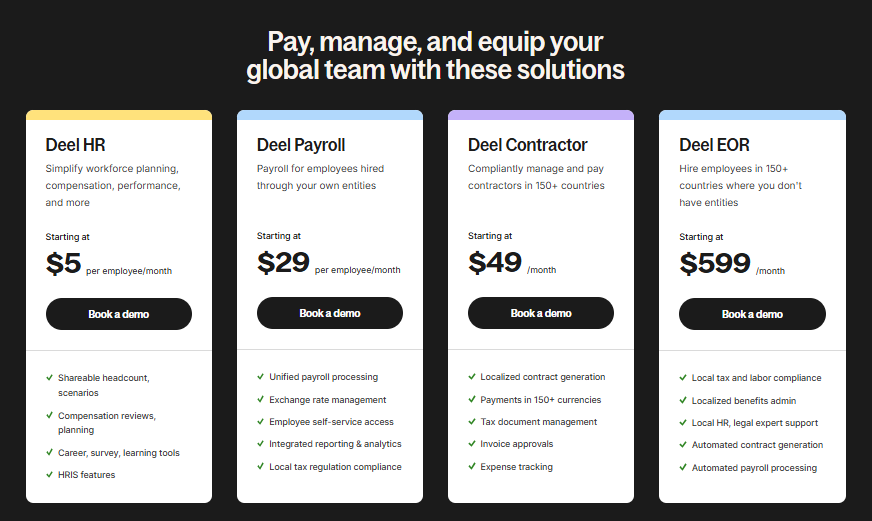
By diversifying revenue streams, Deel avoids dependence on any single line of business. The largest pieces remain platform subscriptions and EOR payroll fees, but fast-growing segments include professional services (visa/immigration) and financial products (digital payroll cards and crypto payouts).
Funding History of Deel
Deel has raised nearly $1 billion in equity funding over successive rounds from top investors. Key financing milestones include:
-
May 2020 – Series A: $14 million led by Andreessen Horowitz, shortly after Deel’s founding. This seed capital helped build the initial global hiring platform.
-
September 2020 – Series B: ~$30 million led by Spark Capital (followed by participation from existing investors including A16Z). The Series B validated early product-market fit and funded expansion of payroll/compliance tools. After this round, Deel had raised about $48M in total.
-
April 2021 – Series C: $156 million led by Y Combinator Continuity and joined by Andreessen Horowitz and Spark. This round (at a $1.25 billion valuation) was a major inflection: Deel reported 20x growth in 2020 and crossed unicorn status. The fresh funds were earmarked to scale globally – adding more country coverage and deepening the engineering team.
-
October 2021 – Series D: $425 million led by Coatue and DST Global. The Series D (valuing Deel at $5.5 billion) brought the total raised to over $630M. Coatue’s Rahul Kishore and Lucas Swisher co-led the round, joined by A16Z, Spark and others. The capital fueled an aggressive push into new markets and product lines (like HR software and visa services) and covered hundreds of new hires.
-
May 2022 – Strategic Round: ~$50 million at a ~$12 billion valuation (often called a Series D extension), led by Emerson Collective. This round, which quietly closed around mid-2022, affirmed Deel’s accelerating growth (the valuation jumped from $5.5B to $12B) and brought in mission-driven backers.
-
Series E (October 2025): $300 million co-led by Ribbit Capital and Andreessen Horowitz, with participation from Coatue, General Catalyst and existing investors. This round valued Deel at $17.3 billion and came on the heels of Deel exceeding $1 billion in ARR. Deel has stated it will use the funds to acquire complementary companies, expand its proprietary payroll infrastructure (targeting real-time payroll in 100+ countries by 2029), and continue R&D on AI-driven products. (Separately, in early 2025 Deel conducted a $300M secondary share sale for employees and early investors, which brought General Catalyst and Mubadala onto the cap table.)
The table below summarizes these rounds:
| Date | Round | Amount | Lead Investors | Purpose |
|---|---|---|---|---|
| May 2020 | Series A | $14M | Andreessen Horowitz | Build initial contractor/payroll platform and hire engineering team |
| Sep 2020 | Series B | $30M | Spark Capital | Scale global compliance/payroll tools, expand to more countries |
| Apr 2021 | Series C | $156M | YC Continuity, A16Z | Fuel global expansion; product development to support full-time employees |
| Oct 2021 | Series D | $425M | Coatue, DST Global | Accelerate hiring, add HR/immigration features, enter new markets |
| May 2022 | Ext (D+) | $50M | Emerson Collective | Support continued growth at $12B valuation (new service lines) |
| Oct 2025 | Series E | $300M | Ribbit Capital, A16Z | Build global payroll infra (100+ countries), acquisitions, AI-driven products |
In total, Deel has attracted over 40 investors, including a raft of well-known technology funds (Nat Friedman, Alexis Ohanian, Coatue, Ribbit, YC Continuity and others). The steady inflow of capital has allowed Deel to invest aggressively: by 2025 it had established 250+ legal entities worldwide and builds its own global payroll engine, rather than piecing together third parties. Deel CEO Alex Bouaziz has stated that this vertical integration strategy – built with the funding – is a “unique competitive advantage”.
Competitors of Deel
Deel operates in a crowded HR/payroll ecosystem, with both direct and indirect competitors:
Direct Competitors (Global EOR/Payroll): Other startups and services specializing in international hiring. Key rivals include Rippling (also offering global payroll and HR software), Remote.com, Papaya Global, Pebbl (PEO provider), OysterHR, Multiplier, and Globalization Partners. These companies similarly act as employer-of-record or global payroll platforms. For U.S. and smaller-scale payroll, providers like Gusto and ADP indirectly compete, especially for simpler domestic payroll needs. Established HR platforms (Workday, Ceridian) also pose indirect competition if customers build their own global payroll via integrations.
Indie/Localized Players: In each country Deel serves, there are local payroll firms and HR consultants. Deel’s value comes from bundling and tech scale, but in niche markets competitors may surface. Also, contractor marketplaces (Upwork, Toptal) or recruitment firms can overlap on sourcing talent (though they don’t handle payroll).
Adjacent Software: Tools like Slack, Zoom and OKR systems are not competitors but complementary platforms that power remote work. Deel positions itself as foundational below these, noting that productivity tools are moot if you can’t hire or pay people.
Despite competition, Deel has differentiated itself through deep integration and scale (see below). However, rivalry with Rippling has even spilled into legal battles: in 2025 Rippling sued Deel alleging industrial espionage and trade-secret theft, illustrating how fierce this market has become. Deel counters that it remains focused on product and growth – indeed, both companies continued to raise capital (Rippling’s Series G was $450M in mid-2025) despite the litigation.
Products & Services of Deel
Deel’s product suite is broad and continues to expand. Major offerings include:
-
Employer of Record (EOR) Services: Deel’s flagship service allows companies to legally employ staff in 100+ countries without setting up foreign subsidiaries. Through the EOR, Deel handles all compliance: it drafts local employment contracts, manages payroll and taxes, and administers benefits (healthcare, retirement, etc.). Deel’s EOR fees cover these services. This service turns each hire into a turnkey process – companies can have a new international employee up and running in minutes instead of months. In user reviews, Deel highlights that it provides all required documentation and filings so employers can focus on the work, not bureaucracy.
-
Contractor Management: For gig workers and consultants, Deel offers specialized contractor contracts and payment processing. The platform includes a library of contract templates compliant with local labor laws, automated invoice management, and global payment disbursements. Employers can engage contractors in over 150 countries and pay them in their local currency. Deel’s contractor features also include KYC/AML checks and tax form automation. (Note: in many countries, contractors do not need benefits, so Deel’s role here is mainly payroll & compliance.) Early on, Deel focused on contractors and it still serves many startups that only use the contractor module.
-
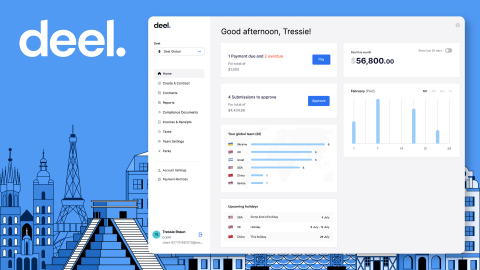
Global Payroll Engine: Deel’s unified payroll software lets companies consolidate all their payrolls – across countries and currency zones – into one system. The UI dashboard (see image above) shows global headcount, upcoming payroll runs, and compliance alerts in one place. Clients can run payroll in multiple currencies with a single click. Because Deel built its own backend, it can support advanced features like ad-hoc payroll or event-based pay changes. Companies that were once stuck with local spreadsheets or multiple vendors can replace them with Deel’s single platform. This extends to decentralized teams: for example, Deel’s recent global HRIS product (Deel Engage) offers centralized onboarding, performance review and policy management for distributed workforces.
-
Immigration & Visa Services: Deel helps companies relocate employees and contractors internationally. It provides support for visas, work permits and resident permits in 50+ countries through partnerships and in-house experts. For example, Deel can help an employer file a work visa application in the UK or handle permanent residency paperwork in Singapore. These services remove another barrier to mobility: rather than companies dealing with consulates and lawyers, Deel manages the process (for a fee). This immigration feature is integrated into the hiring workflow on the platform.
-
HRIS/Talent Management (Deel Engage): Deel offers a built-in human resources information system. Through Deel Engage, employers get tools for global HR operations: centralized employee records, goal tracking, performance reviews, and a company directory. Engage also includes an intranet-style newsfeed so HR teams can broadcast announcements company-wide across offices. The goal is to replace standalone HR software (like Workday) for international teams. Deel has promoted Engage as a way to “manage payroll, HR, and equity and drive performance for your entire global team on one platform”. For many customers, Deel now serves as the single control center for HR and payroll across countries.
-
Device & IT Management (Deel IT): A newer offering, Deel IT provides a managed solution for employee hardware and software. Customers can order laptops or phones through Deel; devices are shipped pre-configured to the employee’s location. Deel handles inventory, secure retrieval and re-deployment when employees leave. It also offers mobile device management (MDM) and endpoint protection. This service is aimed at companies that hire remote staff globally and want a single vendor to manage hardware. (Unlike many local IT providers, Deel can ship devices to dozens of countries from one portal.) Pricing is per-device and typically ranges from $10–$20 per device per month.
-
Expense & Payment Innovations: Deel has introduced fintech features for its workforce. For example, Anytime Pay allows employees to access earned wages instantly (instead of waiting for payday) – Deel simply advances the payment and settles it next payday. Deel also offers corporate credit cards and expense management (similar to Brex or Ramp) in some regions. Notably, in 2026 Deel launched a cryptocurrency payroll feature: through a partnership with MoonPay, employees in the UK, EU and soon the U.S. can elect to receive pay in stablecoins (such as USD Coin) directly to their crypto wallets. This caters to fast, borderless payments and to workers without reliable banking. Such crypto payroll options (and dollar-linked cards) differentiate Deel for tech-forward workforces.
In summary, Deel’s platform spans payroll, HR, benefits, mobility, performance, and IT in a single interface. It enables any worker type – full-time, part-time, contractor, or expatriate – to be hired and paid compliantly in one ecosystem. The tight integration (contracts from Deel’s template library, then automated payroll, then optional visa support) means employers do not need multiple vendors. As one official summary puts it: “Deel has built the standard [to power global work]… One platform for payroll, HR, benefits, mobility, performance, and device management across 150+ countries”.
Conclusion
As of 2026, Deel stands as a mature yet fast-growing player in HR tech. The company boasts over 40,000 enterprise customers and processes over $20 billion in payroll annually. Remarkably, it has achieved this scale while remaining profitable (Deel reported $1B+ ARR and positive EBITDA by 2025). This sustainability, combined with its multi-product strategy, has given Deel a solid foundation: in late 2025 it hit profitability for three straight years and reported a single month of $100M+ in revenue.
Strategically, Deel is positioned at the intersection of two long-term trends: the globalization of work and the digitization of finance. As companies worldwide continue to hire international talent, Deel’s all-in-one solution addresses a growing need. Leadership is doubling down on global expansion: for example, it aims to support real-time payroll in 100+ countries by 2029. Deel also plans to pursue acquisitions to fill gaps (it spent up to $500M earmarked for acquisitions in 2025). Indeed, Deel has already integrated a London-based competitor (Omnipresent) in 2023, demonstrating consolidation ambitions.
Looking ahead, analysts note that Deel could pursue an IPO once growth is steady. Its deep investor roster (A16Z, Coatue, GC, Ribbit, etc.) and high valuation ($17.3B in 2025) make an eventual public listing plausible. In the meantime, Deel is reinvesting in product innovation: its R&D focuses include AI-driven hiring tools and more flexible payroll options (such as crypto payouts and on-demand pay) to stay ahead of both startups and incumbents.
Also Read: From Onboarding to Optimization: The Rippling Story
Also Read: Gusto – Success Story, History, Business Model, Growth, Competitors, Funding & Future
To read more content like this, subscribe to our newsletter
Go to the full page to view and submit the form.