



Few brands in the American food landscape have earned the kind of enduring trust that Breyers has built over more than 150 years. Founded in 1866 by William A. Breyer, a young Philadelphia entrepreneur who began selling homemade ice cream from a hand-cranked freezer out of his kitchen, the brand grew from a neighborhood treat into a household name distributed across the entire country. Breyer’s early philosophy was disarmingly simple: use the best ingredients, keep the recipe clean, and let the flavors speak for themselves. That philosophy, born in a modest Philadelphia kitchen, became the ideological bedrock on which all of Breyers’ subsequent marketing would eventually rest.
By the early twentieth century, Breyers had expanded well beyond Philadelphia, opening production facilities and establishing itself as a trusted regional brand across the northeastern United States. The company was acquired by the Kraft Foods Group in 1993 and later transferred to Unilever in 1997, where it remains today as part of one of the world’s largest consumer goods portfolios. Despite the shifts in ownership, Breyers has maintained a remarkably consistent brand identity – one rooted in naturalness, simplicity, and the wholesome pleasure of a good bowl of ice cream. The transition to Unilever’s stewardship brought with it significant marketing muscle, global distribution networks, and data-driven consumer insights, allowing Breyers to compete more aggressively in a crowded frozen dessert category.
The ice cream market Breyers operates in today is fiercely competitive. Premium players like Häagen-Dazs and Ben & Jerry’s compete at the top of the price spectrum, while private-label store brands undercut on price at the bottom. Health-forward disruptors like Halo Top (now owned by Wells Enterprises) and Enlightened have carved out significant share by appealing to calorie-conscious consumers, while novelty brands experiment with exotic flavors and formats to attract adventurous younger shoppers. Breyers occupies a unique and strategically important middle ground — mass-market accessible in price, yet premium in its ingredient story and heritage narrative. Navigating that space effectively has required a sophisticated, multi-layered marketing approach.
What makes Breyers particularly fascinating from a marketing perspective is how the brand has repeatedly managed to reinvent itself without ever abandoning its core identity. Whether it was doubling down on its “All Natural” positioning in the 1980s and 1990s, pivoting toward health-conscious product lines like CarbSmart and Breyers Delights in the 2010s, or engaging consumers through digital storytelling and influencer partnerships in recent years, Breyers has shown a consistent ability to evolve with the cultural moment. Each reinvention has been anchored by the same underlying promise: that Breyers is ice cream you can feel good about eating, made with ingredients you recognize.
This article examines the top marketing strategies that have defined Breyers’ success across its long history and into the present day. From its legendary clean-label positioning to its targeted health-and-wellness pivots, from nostalgic storytelling to digital-age influencer marketing, Breyers offers a masterclass in how a legacy brand can remain culturally relevant across generations. Understanding these strategies is not just a lesson in ice cream — it is a lesson in how simplicity, consistency, and consumer empathy can power a brand for over a century and a half.
Top Marketing Strategies of Breyers
1. Clean-Label Positioning: The Power of “You Can Pronounce Every Ingredient”
Long before “clean eating” became a mainstream consumer movement, Breyers was already building its brand around ingredient transparency. The company’s famous pledge that its ice cream contains only ingredients you can pronounce was one of the most distinctive and powerful positioning moves in the packaged food industry. This commitment to simplicity — real milk, real cream, real sugar, real vanilla — differentiated Breyers sharply from competitors who relied on artificial flavors, stabilizers, and extended ingredient lists. It gave the brand an authenticity that money cannot easily manufacture.
The centerpiece of this strategy was the “Pledge” campaign, which ran in various iterations across television advertising for decades. In these spots, children — selected specifically because of their innocent authority on simplicity — were shown reading the ingredient labels of competing ice cream brands, stumbling over chemical names and artificial additives. They would then effortlessly read the Breyers label, pronouncing each natural ingredient with ease. The contrast was striking, humorous, and deeply persuasive. The campaign won multiple advertising awards and is still cited in marketing literature as a gold standard example of comparative advertising done elegantly, without ever naming competitors directly.


What made this clean-label positioning so durable was that it tapped into a genuine and growing consumer anxiety about processed food. As awareness of food additives, artificial preservatives, and ultra-processed ingredients grew through the 1970s, 1980s, and 1990s, Breyers’ long-standing natural positioning became increasingly valuable — not because the brand had changed, but because the cultural conversation had caught up with what Breyers had always stood for. This is a rare marketing achievement: a brand whose existing identity becomes more relevant over time simply because consumer values evolve toward it.
In more recent years, Breyers has had to navigate some tension in this positioning. After Unilever reformulated certain flavors — reducing the dairy content to the point where some products were technically classified as “frozen dairy dessert” rather than ice cream — there was notable consumer backlash. Critics and loyal fans accused the brand of betraying its clean-label promise. Breyers’ response was instructive: rather than abandon the clean-label strategy, the brand doubled down on it for its core ice cream lines, clearly distinguishing between products that meet the full “ice cream” standard and those that are frozen dairy desserts. The episode underscores a critical marketing lesson — that a positioning built on authenticity must be defended with operational integrity, not just advertising language.
2. Heritage and Nostalgia Marketing: Selling More Than Ice Cream, Selling Memories
Breyers understands, perhaps better than most food brands, that its most valuable asset is not its supply chain or its distribution network — it is the emotional memories that generations of Americans associate with a tub of Breyers on a summer evening. Heritage marketing, the deliberate activation of a brand’s history and legacy as a competitive differentiator, is central to how Breyers maintains relevance among older consumers while signaling credibility to younger ones. Few brands can honestly claim 155+ years of continuous operation, and Breyers has been smart enough to treat that longevity as a story worth telling.
Anniversary campaigns have been a recurring vehicle for this strategy. For Breyers’ 125th anniversary in 1991 and its 150th anniversary in 2016, the brand launched campaigns that drew explicit connections between William Breyer’s original Philadelphia kitchen and the pints sitting in modern American freezers. These campaigns used archival photography, historical footage, and testimonials from long-time consumers to stitch together a narrative of unbroken quality and tradition. The emotional resonance of these campaigns was significant — they reminded existing consumers why they trusted the brand and introduced newer consumers to a heritage story that modern competitors simply cannot replicate.
Nostalgia also operates at the product level. Breyers has been deliberate about maintaining its classic flavors — Vanilla, Chocolate, Strawberry, and Neapolitan — as cornerstones of its lineup, even as it has expanded into hundreds of new varieties. These original flavors serve as emotional anchors for consumers who grew up eating them. By keeping these flavors prominently available and consistently marketed, Breyers ensures that the brand remains a fixture in the ice cream aisle for shoppers of all ages. There is a powerful intergenerational dynamic at work: a grandparent who buys Breyers Vanilla for a grandchild is not just purchasing ice cream, they are passing down a piece of their own childhood.

Social media has given Breyers new platforms to activate nostalgia in real time. The brand has encouraged consumers to share memories and photographs associated with Breyers on Instagram, Twitter, and Facebook, using branded hashtags to aggregate user-generated content into living archives of shared experience. Campaigns prompting followers to share their “first Breyers memory” or “summer ice cream ritual” have generated authentic, emotionally resonant content at relatively low cost — and have reinforced the sense that Breyers is not merely a product but a multigenerational family tradition. In an era where consumers are skeptical of brand advertising, the authenticity of real consumer stories is marketing gold.
3. Health-Conscious Product Innovation: Meeting Consumers Where Their Values Are
One of the most significant strategic pivots in Breyers’ modern history has been its aggressive expansion into health-conscious product segments. Recognizing that a growing cohort of American consumers wanted indulgent treats that aligned with their dietary goals — whether that meant fewer calories, less sugar, lower carbohydrates, or higher protein — Breyers developed purpose-built product lines to capture this demand without abandoning the core brand promise of real, simple ingredients.
The CarbSmart line, launched to appeal to consumers following low-carbohydrate diets including Atkins and later keto-style eating patterns, was one of the earliest manifestations of this strategy. CarbSmart offered flavors like Vanilla, Chocolate, and Butter Pecan with significantly reduced net carbohydrates compared to standard ice cream. The line’s marketing leaned explicitly into dietary lifestyle messaging, using language and imagery consistent with the health-and-fitness world. By launching CarbSmart under the Breyers masterbrand rather than as a standalone sub-brand, the company was able to transfer Breyers’ existing credibility in natural, quality ingredients to a new consumer segment without the costly challenge of building brand awareness from scratch.


The even more significant innovation came with Breyers Delights, launched in 2017 as a direct competitive response to the explosive growth of Halo Top. Breyers Delights offered pints of ice cream with approximately 260–360 calories per pint, high protein content (around 20 grams per pint), and no sugar alcohols — directly addressing the nutritional profile that had made Halo Top a cultural phenomenon. The marketing for Breyers Delights was notably more modern and digitally forward than traditional Breyers campaigns: it featured vibrant, Instagram-ready packaging, social media-first advertising, and messaging targeted squarely at millennial women who followed fitness influencers and counted macros. The launch was supported by partnerships with registered dietitians and fitness personalities who shared Delights content with their health-conscious followers.
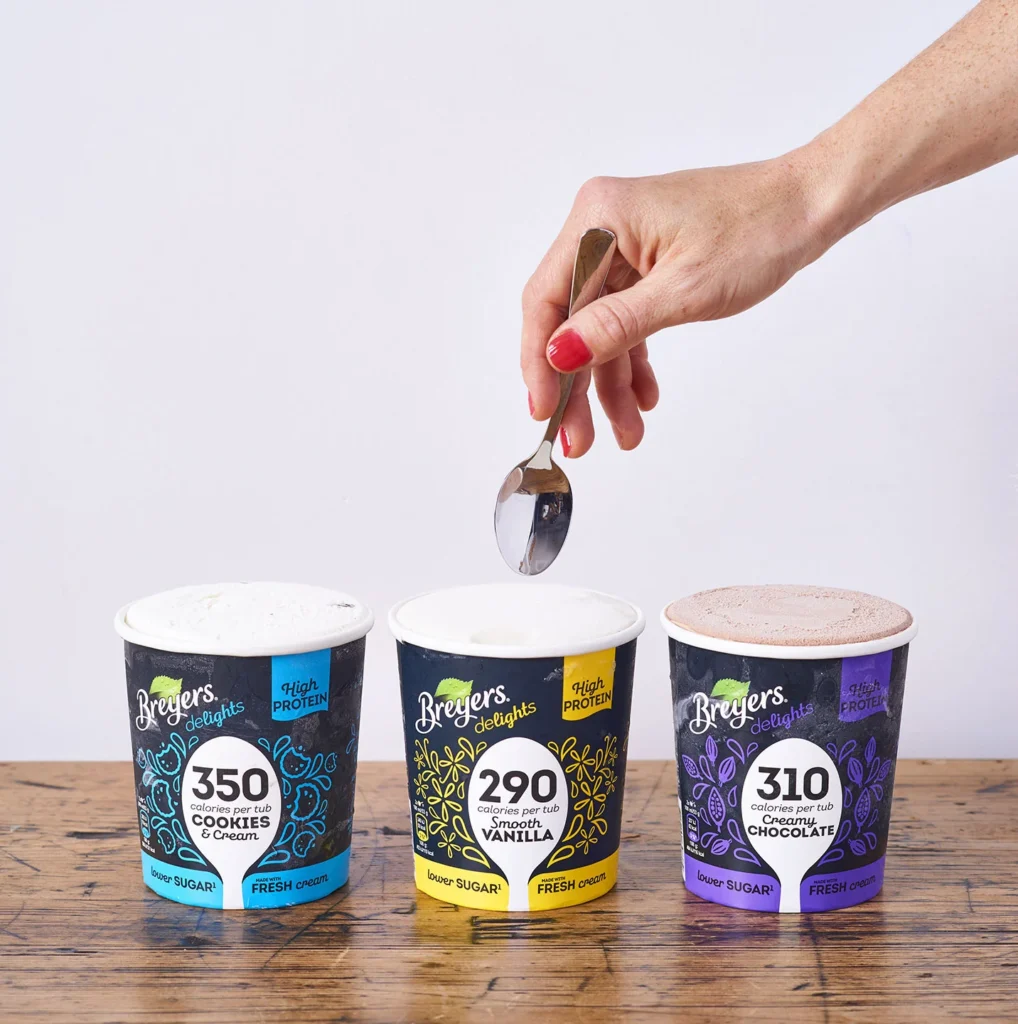

The Delights launch demonstrated Breyers’ capacity for competitive agility — the speed at which a legacy brand moved to credibly enter an entirely new product segment was impressive. It also demonstrated the value of the Breyers masterbrand equity: consumers who might have been skeptical of a new low-calorie ice cream brand were more willing to trust a line from Breyers, a name with 150 years of quality behind it. The strategy of extending trusted legacy brands into health-conscious segments, rather than building new brands to fight health-forward disruptors, is a playbook that has paid significant dividends for Breyers and offers broader lessons for food and beverage marketers facing similar disruption.
4. Celebrity Partnerships and Spokesperson Marketing
Breyers has a long and successful history of using celebrity partnerships to enhance its visibility, extend its cultural relevance, and signal its brand values to specific consumer audiences. Rather than relying solely on its ingredient story, Breyers has periodically amplified that story through personalities that consumers already love and trust — leveraging borrowed equity to reach new audiences and reinforce existing ones.
One of the most memorable and enduring examples was the brand’s long-running partnership with American football legend Jim Brown in the 1970s and 1980s. Brown appeared in multiple Breyers television commercials during a period when celebrity athlete endorsements were a dominant advertising format. His association with the brand reinforced themes of quality, strength, and American values that fit naturally with Breyers’ positioning. More recently, the brand has worked with personalities whose appeal is more contemporary and digitally native, reflecting the shift in how celebrity influence operates in the media landscape.
Breyers made a high-profile move in 2020 when it partnered with Khloe Kardashian to promote its low-calorie Breyers Delights line. Kardashian, who had built a significant personal brand around fitness, body transformation, and healthy lifestyle content through her reality television work and social media presence, was a strategically logical choice for the Delights line. The partnership generated substantial earned media coverage, reached tens of millions of followers across Instagram and Twitter, and positioned Breyers Delights as a credible option for consumers navigating the balance between indulgence and health consciousness. The collaboration included sponsored social posts, television appearances, and digital content that integrated naturally with Kardashian’s existing lifestyle content.
Beyond mega-celebrities, Breyers has increasingly worked with mid-tier influencers and content creators — food bloggers, family lifestyle vloggers, and fitness accounts with highly engaged niche audiences. This micro-influencer strategy, common across the food and beverage industry in recent years, allows the brand to reach specific consumer segments (parents of young children, fitness enthusiasts, budget-conscious millennials) with messages tailored to each audience’s priorities. The authenticity and engagement rates achievable through micro-influencer partnerships often exceed those of traditional celebrity campaigns at a fraction of the cost, making it an efficient complement to Breyers’ broader marketing mix.
5. Family-Centered Marketing and Emotional Storytelling
At its emotional core, Breyers has always been a family brand. The imagery of parents serving their children a bowl of Breyers after dinner, of grandparents sharing ice cream with grandchildren on a summer porch, of families gathering around a tub at a birthday party — these have been recurring motifs in Breyers’ advertising for generations. This consistent focus on family as the primary context for ice cream consumption has allowed the brand to cultivate deep emotional resonance across demographic groups and life stages.
Breyers’ television advertising has consistently centered on warm, realistic family vignettes rather than the fantastical or aspirational imagery favored by some premium competitors. The brand has deliberately portrayed families that look like actual American families — diverse in ethnicity, multigenerational, living ordinary lives enriched by small moments of shared joy. This grounded, relatable approach to storytelling builds genuine emotional connections in ways that polished, aspirational advertising cannot. When consumers see their own family dynamics reflected in a brand’s advertising, the emotional association formed is significantly stronger and more durable.

The “Happy Tastes Good” campaign, which ran across multiple platforms in the early 2020s, was one of the more refined expressions of this family-and-happiness strategy. The campaign used short-form video content — optimized for digital platforms as well as traditional broadcast — that depicted simple moments of family happiness in which ice cream was present but not the forced centerpiece. The ice cream was incidental to the happiness rather than the cause of it, which gave the content an authenticity that overtly product-focused advertising often lacks. By positioning itself as a quiet partner in life’s best moments rather than a dominant actor demanding attention, Breyers reinforced its identity as a trusted, low-ego presence in the American household.

Digital platforms have also enabled Breyers to invite consumers into the family storytelling process as co-creators. User-generated content campaigns asking families to share ice cream moments, summer traditions, or creative recipes have generated enormous volumes of organic content that extends the brand’s narrative reach far beyond what any paid advertising budget could achieve alone. The social currency of sharing food moments — particularly visually appealing ice cream content — is exceptionally high on platforms like Instagram and TikTok, and Breyers has been effective at creating the structural prompts (contests, hashtag campaigns, branded challenges) that encourage consumers to participate actively in brand storytelling.
6. Strategic Retail Partnerships and Shelf-Presence Optimization
In the consumer packaged goods world, marketing does not end at the media buy — it extends all the way to the moment a shopper stands in front of a freezer case and makes a purchase decision. Breyers, backed by Unilever’s scale and sophisticated trade marketing capabilities, has invested heavily in ensuring that its products are not just present on retail shelves but optimized for maximum visibility, accessibility, and purchase conversion.
Breyers’ relationship with major national retailers — Walmart, Kroger, Target, Costco, Publix, and others — reflects a category management approach in which the brand actively partners with retailers to design freezer-case layouts, promotional schedules, and pricing architectures that drive category growth. As one of the leading brands in the ice cream segment by volume, Breyers has the leverage to negotiate premium shelf placement — including eye-level positioning, end-cap displays during peak summer and holiday seasons, and prominent placement in weekly circular advertising. These retail-level marketing investments are often invisible to consumers but have enormous impact on purchase behavior.
Seasonal promotions have been a particularly effective tool in Breyers’ retail marketing arsenal. The brand has consistently tied its promotional calendar to culturally significant moments — summer grilling season, the Fourth of July, back-to-school, Halloween, Thanksgiving, and the winter holiday period — with in-store displays, digital coupons, and promotional pricing timed to peak ice cream consumption periods. Breyers has also been an active participant in retailer-specific loyalty programs, offering digital coupons through platforms like the Kroger app or Target Circle that drive trial among new consumers while rewarding loyalty among existing ones. These targeted digital promotions have the added advantage of generating first-party consumer data that can inform future marketing decisions.
The e-commerce and direct-delivery dimension of retail has grown significantly for Breyers since the COVID-19 pandemic accelerated consumer adoption of grocery delivery platforms. The brand has optimized its product listings on Instacart, Amazon Fresh, Walmart Grocery, and similar platforms, investing in high-quality product photography, keyword-optimized descriptions, and sponsored placement within these digital storefronts. As the “digital shelf” has become as important as the physical one for driving consumer purchase decisions, Breyers has adapted its retail marketing strategy to ensure strong representation in both environments. The ability to appear at the top of a search for “vanilla ice cream” on Instacart is now as strategically important as having the best freezer-case position at a major grocery chain.
7. Digital and Social Media Marketing: Reaching the Next Generation of Ice Cream Lovers
The rise of social media and digital marketing has required Breyers to significantly evolve its communications strategy over the past decade. A brand that built its reputation through television advertising and in-store presence had to develop genuine competency in content creation, community management, social advertising, and digital analytics — capabilities that did not exist when Breyers was at the height of its mid-twentieth-century dominance. The results of this evolution have been mixed but trending strongly positive as the brand has found its digital voice.
Breyers’ Instagram presence exemplifies this evolution. The brand’s account features high-production food photography and videography — melting scoops, colorful parfaits, and recipe-forward content — that performs well in the visually competitive social media environment. The account actively showcases recipe ideas featuring Breyers products as an ingredient rather than simply as a serving suggestion, which expands the brand’s perceived versatility and gives food-enthusiast followers genuinely useful content. Recipe content featuring Breyers ice cream incorporated into milkshakes, sundaes, ice cream sandwiches, and even baked goods regularly generates high engagement, driving both awareness and purchase intent among culinary-minded consumers.
TikTok has emerged as a particularly important frontier for Breyers’ efforts to reach younger consumers. The platform’s short-form video format and virality mechanics are well-suited to food content, and Breyers has participated in food trend moments on the platform with agility. When “nice cream” (blended frozen banana-based ice cream) was trending, Breyers content teams created relevant content positioning Breyers products as an upgrade to the trend. When sundae customization and “build your own” food content surged in popularity, Breyers leaned into that format with creative prompts and branded challenges. This trend-awareness and rapid response capability is essential for legacy brands seeking to remain culturally relevant on platforms where trend cycles move in days rather than months.
The brand has also invested in performance digital marketing — targeted display advertising, search engine marketing, and programmatic video — to drive measurable purchase behavior at scale. Using Unilever’s sophisticated data and analytics infrastructure, Breyers is able to target consumers based on purchase history, dietary preferences, household composition, and even weather patterns (promoting ice cream more heavily to consumers in regions experiencing heat waves, for example). This precision targeting makes Breyers’ digital advertising spend significantly more efficient than broad-reach television buys, and the measurability of digital channels allows the brand to optimize campaigns in real time based on performance data.
Conclusion
Breyers’ enduring success in one of America’s most competitive food categories is not the product of any single campaign or any one brilliant marketing idea. It is the result of a sustained, disciplined commitment to a handful of core strategic principles — ingredient transparency, family-centered emotional storytelling, health-conscious innovation, and the careful stewardship of a heritage that most competitors simply cannot match. Each of the marketing strategies examined in this article reinforces and amplifies the others, creating a brand identity that is coherent, credible, and emotionally resonant across a remarkably diverse consumer base.
What Breyers teaches marketers, above all, is the compounding value of consistency. A brand that means one clear thing — real ingredients, real families, real moments — and communicates that thing across every channel, every product line, and every campaign for 150 years creates a reservoir of trust and familiarity that is extraordinarily difficult for any competitor to replicate. Breyers has not always been perfect, and the tensions between commercial pressures and brand purity have sometimes created stumbles. But the brand’s fundamental identity has remained intact, and that identity continues to drive both loyalty among existing consumers and credibility among new ones.
In a marketing landscape increasingly defined by rapid trend cycles, digital fragmentation, and consumer skepticism of brand claims, Breyers’ story is a reminder that the most durable competitive advantage is not the cleverest campaign — it is the deepest truth.
To read more content like this, subscribe to our newsletter
Go to the full page to view and submit the form.