



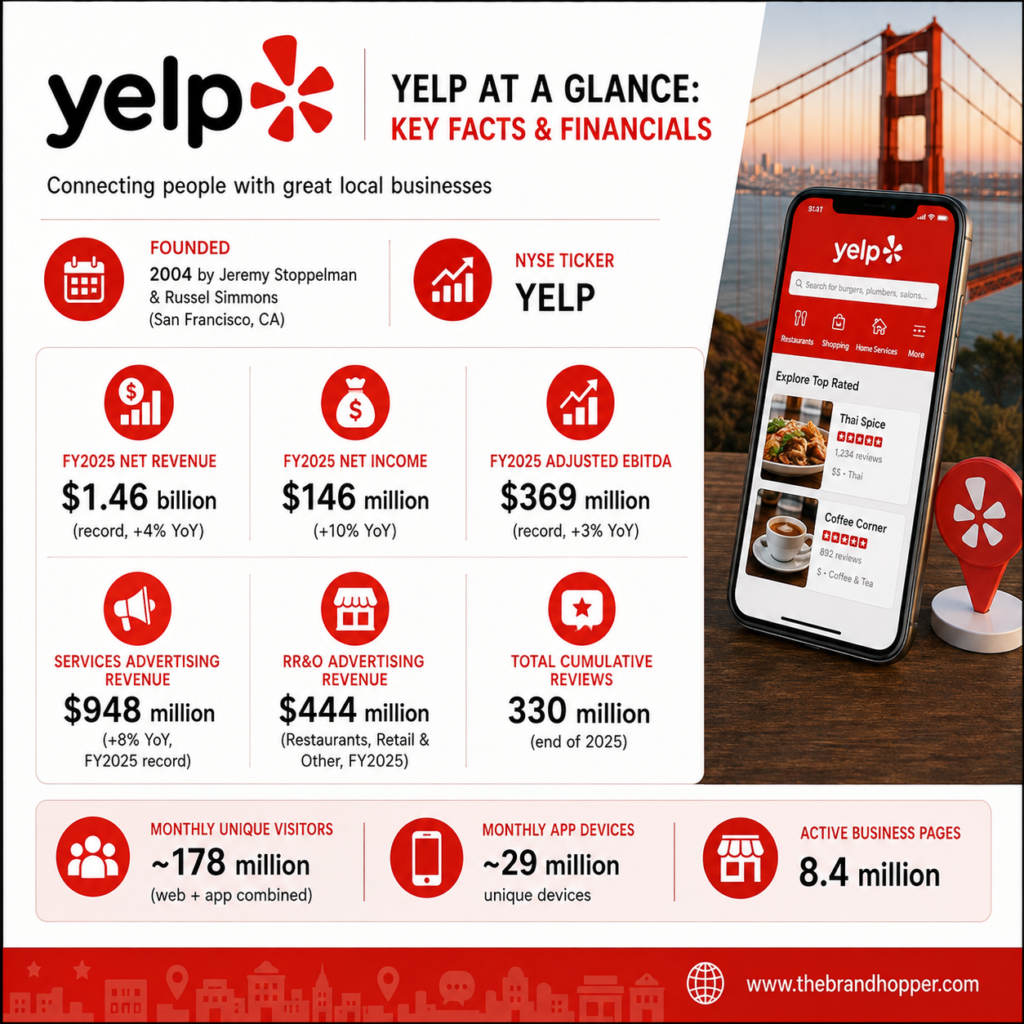
In an era where consumers trust strangers’ reviews over brand advertisements, one company turned that human instinct into a $1.41 billion business. Yelp, the crowd-sourced local business review platform founded in 2004 by former PayPal employees Jeremy Stoppelman and Russel Simmons, has spent two decades building one of the most influential marketing ecosystems in local commerce — one that now shapes purchasing decisions for hundreds of millions of consumers annually.
Yelp’s premise was elegantly simple: give real customers a megaphone to share genuine experiences with local businesses. What followed was the creation of the internet’s most trusted local business database — 308 million cumulative reviews spanning restaurants, home services, healthcare, automotive, beauty, and virtually every category of local commerce. The platform now attracts 178 million unique monthly visitors across its website and mobile app, with approximately 29 million unique devices accessing the Yelp app each month.
This article dissects Yelp’s marketing strategy from first principles — examining how it deploys user-generated content, SEO, advertising, AI innovation, partnerships, and social media to sustain growth, attract businesses, and maintain its position as the definitive local business discovery platform.

What’s New With Yelp: AI, Product & Platform Innovations
Yelp has undergone one of the most significant product transformations in its history over 2024-2025, launching more than 80 new features in 2024 alone — followed by a major AI-powered fall product release in 2025 that fundamentally changed how consumers interact with local business information. The throughline connecting all of this innovation: making local business discovery faster, smarter, and more personalized through artificial intelligence.
1. Yelp Assistant — AI-Powered Home Services Concierge
Launched in spring 2024, Yelp Assistant is an AI-powered conversational interface that helps consumers diagnose home services projects and connects them with qualified local professionals. Rather than requiring users to know exactly what type of contractor they need, Yelp Assistant asks diagnostic questions — “What’s the problem? Where is it located? How long has it been happening?” — and matches users with relevant service professionals based on their specific situation. By 2026, Yelp Assistant had evolved further: consumers can now ask natural-language questions directly on business pages for restaurants, bars, retailers, and more, with answers drawn from reviews, photos, business page data, and even business websites via large language models.
2. Review Insights — LLM-Powered Sentiment Analysis
One of Yelp’s most strategically important AI features, Review Insights uses large language models to surface reviews and information tailored to exactly what a consumer is looking for. For restaurants, Review Insights can distinguish reviewer sentiment about food quality, service, ambiance, wait time, and drinks — breaking down the aggregate star rating into granular sentiment dimensions. Initially launched for restaurants, Review Insights expanded to services categories in 2025, now surfacing sentiment about customer experience, pricing, facilities, and job quality.
3. Menu Vision — Camera-Based Dish Discovery
Launched as part of Yelp’s 2025 product expansion, Menu Vision lets diners scan physical restaurant menus with their phone camera to instantly see photos and user reviews of specific dishes. This eliminates the friction of searching for dish-specific information and brings the intelligence of Yelp’s 308 million reviews directly into the ordering moment.
4. Yelp Host & Yelp Receptionist — AI for Business Operations
Yelp launched Yelp Host and Yelp Receptionist to automate inbound call handling and triage for businesses. These AI tools answer and route incoming calls so restaurant and service business staff can remain focused on customers in front of them rather than being interrupted by the phone. This directly addresses one of the most common pain points Yelp hears from business owners, and creates a new revenue stream in AI-powered business software.
5. Smart Budgets — AI-Optimized Advertising
For advertising businesses, Yelp’s Smart Budgets feature uses machine learning to automatically allocate ad spend across the most effective placements and time windows in a local market. Rather than requiring businesses to manually set bids and budgets, Smart Budgets learns from performance data and optimizes autonomously — making Yelp Ads accessible to businesses with limited marketing sophistication while improving ROI for more sophisticated advertisers.
Target Audience of Yelp
Understanding Yelp’s audience is essential to understanding its marketing strategy — because the platform’s content, advertising products, and growth initiatives are all calibrated to serve a very specific type of consumer. Yelp targets high-intent, research-oriented consumers who rely on peer reviews to make decisions rather than responding to brand advertisements. The demographic profile of this audience makes them exceptionally valuable to local businesses.
| Audience Dimension | Key Data Point |
| Purchase Intent | 83% of Yelp users convert browsing into action — hiring a service or buying from a business |
| Research Behaviour | 90% of users actively compare options on Yelp before committing to a business |
| Education Level | 60% of Yelp users hold college degrees |
| Income Bracket | 55% of users earn over $100,000 annually |
| Social Connectivity | 80% of users are active on social media (Facebook, X/Twitter, Instagram) |
| Primary Use Case | Finding local restaurants, home service providers, healthcare, beauty & retail |
This demographic profile — high income, high education, high social media engagement — makes Yelp users among the most commercially valuable consumer audiences in local advertising. For a home services business, a restaurant, or a healthcare provider, reaching a consumer who has already decided to act and is comparing local options is far more valuable than reaching someone who may not need the service for months. This is the core insight that powers Yelp’s advertising value proposition: its users are in-market, not just browsing.
Marketing Strategy of Yelp
Yelp’s marketing strategy is built around a virtuous cycle: more user reviews attract more consumers, more consumers attract more businesses, more businesses create more advertising revenue, and more revenue funds the platform improvements that attract more users. Every marketing initiative — whether it’s a UGC campaign, an SEO optimization, or an AI feature launch — ultimately serves to accelerate this flywheel. Here’s how each strategy layer works:
1. User-Generated Content (UGC): The Foundation of Everything


User-Generated Content is not merely one tactic in Yelp’s marketing playbook — it is the marketing strategy. The 308 million cumulative reviews on the platform as of end-2024 represent billions of dollars’ worth of authentic, search-indexed, consumer-created content that Yelp has never had to produce itself. Every review is simultaneously a piece of product, a search engine signal, a trust signal for other consumers, and a reason for both users and businesses to return to the platform.
Yelp actively manages its UGC ecosystem through a combination of technology and human moderation. The platform’s Recommendation Software continuously evaluates the relevance and reliability of reviews, surfacing the most useful ones and filtering out those that exhibit patterns consistent with fraud, incentivization, or spamming. This moderation work is not peripheral — it is central to maintaining the trust that makes UGC valuable. Yelp’s 2025 Trust & Safety Report revealed that automated systems filtered nearly 500,000 suspected AI-generated reviews and placed 491 Compensated Activity and Suspicious Review Activity Alerts on business pages — a direct response to the rise of AI-assisted fake review generation.
Yelp also deploys targeted UGC campaigns to deepen content in specific categories and communities. Initiatives such as “Yelp for Women-Owned Businesses” and the broader “Yelp for Good” program encourage users to focus review activity on underrepresented business categories, generating high-quality UGC in segments where the platform has historically had thinner coverage. These campaigns serve dual purposes: they deepen content depth and they reinforce Yelp’s brand positioning as a community-driven platform that values diversity and local economic vitality.
Why UGC Works as a Marketing Engine
- Trust at scale: 308 million authentic reviews create a credibility moat that no paid advertising platform can replicate.
- SEO flywheel: Each new review adds unique, keyword-rich content that helps Yelp listing pages rank for long-tail local search queries.
- Network effect: Each additional reviewer makes the platform more valuable for the next consumer, creating compounding growth.
- Zero content cost: Yelp’s content production cost for its core product is effectively borne by its users — an extraordinary structural advantage.
2. SEO and Organic Traffic: Owning Local Search
Yelp’s organic search engine strategy is one of the most sophisticated in the local search industry. The platform does not compete for individual business name searches — it competes for the category + location queries (“best Italian restaurant near me,” “plumber in Austin reviews,” “dental clinic open now”) that represent the highest commercial intent in local search. This strategy has made Yelp listing pages omnipresent in local business search results across Google and other major search engines.
Keyword Targeting Strategy
Yelp builds its keyword architecture around three core query patterns: “best [business type] in [city]”, “[business name] reviews”, and “[business type] near me”. By maintaining category pages, neighbourhood pages, and individual business listing pages for each of these query patterns across every major US metro, Yelp creates a virtually infinite long-tail SEO footprint. A bakery in San Francisco, for example, benefits from Yelp’s category authority for “bakeries in San Francisco” — appearing in results because Yelp has built the aggregated content and domain authority that would take the individual bakery years to achieve.
Content-Rich Listings as SEO Assets
Every element of a Yelp business listing is simultaneously a user experience feature and an SEO asset. Business descriptions, menus, photos with alt text, hours of operation, attributes (“good for groups,” “outdoor seating,” “dog-friendly”), and above all the cumulative text of user reviews — all of this creates rich, structured content that helps search engines understand and rank Yelp listing pages for relevant queries. A restaurant page with 500 reviews discussing specific dishes by name will naturally rank for those dish names, creating a long-tail SEO advantage that no individual restaurant website could match.
Review Velocity as a Ranking Signal
Fresh user reviews signal to search engines that a business is active and the platform is current — a critical quality signal in local search where stale information (closed businesses, changed hours, discontinued menus) is a common problem. Yelp’s 21 million new reviews added in 2024 provide a constant stream of fresh content signals that maintain the platform’s search relevance and freshness scores. This creates a virtuous dynamic: higher search rankings drive more traffic, which drives more reviews, which maintain search rankings.
Localization and Personalization
Yelp tailors search results based on the user’s location, past activity, and stated preferences. When a user in Chicago searches for “coffee shops,” Yelp surfaces Chicago-area cafes ranked by a combination of review quality, recency, relevance, and proximity — not cafes in New York or Los Angeles. This localized ranking ensures that Yelp search results are immediately useful, keeping users on the platform rather than bouncing back to Google to refine their search.
3. Partnerships and Integrations: Expanding the Yelp Ecosystem

Yelp’s partnership strategy is designed to answer one question: how does Yelp become present at every moment in the local commerce journey, not just the review-reading moment? By integrating with complementary platforms — booking systems, order management software, travel apps, email marketing tools — Yelp positions itself as the connective tissue of local commerce rather than just a review destination.
Commerce & Ordering
The partnership between Yelp and Grubhub allows users to transition seamlessly from reading reviews to placing online food orders — all within the Yelp interface. This removes the friction of platform-switching that typically costs businesses conversion rates, and makes Yelp directly relevant to the transaction rather than merely the pre-transaction research phase. The integration deepens Yelp’s value to restaurants and expands its role in the food commerce ecosystem.
Reservations & Guest Management
Yelp Guest Manager — Yelp’s restaurant reservation and waitlist management platform — integrates with Toast POS systems to give restaurants a unified view of their front-of-house operations. Diners can book through Yelp, and those reservations flow directly into the restaurant’s existing Point of Sale infrastructure. The “Reserve with Google” integration extends this capability to Google Search — meaning a consumer who finds a restaurant via Google can complete a reservation through Yelp Guest Manager without ever visiting Yelp.com.
Marketing Technology
Yelp’s integration with Mailchimp and Realtor.com exposes Yelp’s local business data to entirely new user bases — MetLife insurance customers discover local dentists and healthcare providers, while prospective homebuyers find local service professionals through their home search platform. These are not user acquisition campaigns — they are distribution deals that embed Yelp’s platform functionality into contexts where its data is immediately relevant.
Agency & Advertising Technology
Yelp’s partnership with AgencyAnalytics equips marketing agencies with tools to track and optimize Yelp advertising performance for their clients — effectively creating a B2B channel that brings the expertise of professional marketers to Yelp’s advertising platform. By making its ad platform accessible through agency tooling, Yelp gains access to business clients that would not otherwise consider running Yelp Ads independently.
Travel & Discovery
The Roadtrippers integration embeds Yelp’s local business discovery capabilities into a travel planning context — where consumers have an immediate, location-specific need to find restaurants, gas stations, and attractions while navigating unfamiliar territory. This partnership extends Yelp’s reach to a high-intent audience that the platform would struggle to reach through its own marketing alone.
4. Advertising Solutions: The Revenue Engine

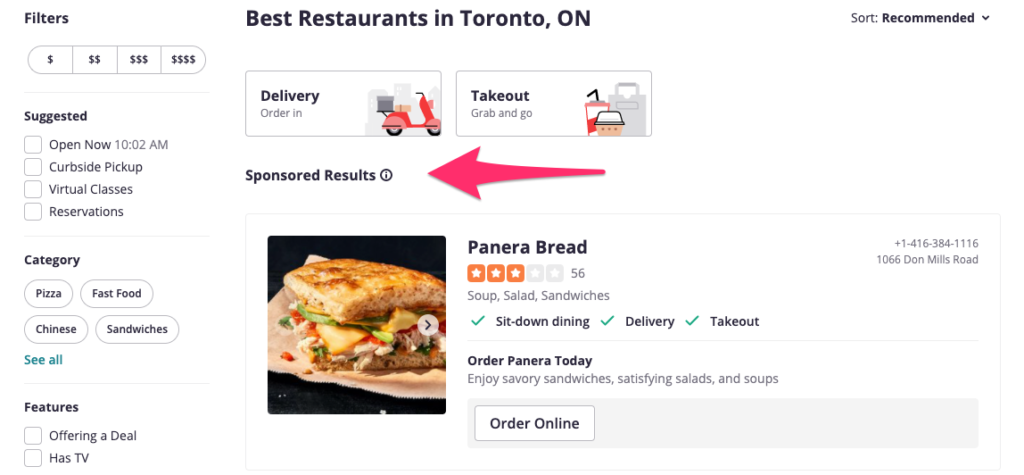
Yelp’s advertising business is the commercial output of its entire platform — and its FY2024 performance underscores why local advertising on Yelp is compelling. Total advertising revenue reached $1.35 billion in FY2024, with the Services advertising segment delivering $879 million in record revenue (+11% YoY). The platform’s advertising model is specifically designed for local businesses — accounting for the budgetary constraints, limited marketing expertise, and location-specific targeting needs that make national advertising platforms a poor fit for most of its advertiser base.
Pay-Per-Click Model
Yelp Ads operate on a pay-per-click (PPC) model — businesses pay only when a user actively clicks on their advertisement, not for impressions. This model is particularly well-suited to the local business context because it aligns the cost of advertising with genuine consumer intent: a click on a Yelp ad represents a user who has already decided to explore this specific business. The PPC model also removes the risk that budget-conscious small businesses associate with traditional advertising where payment is required regardless of results.
Precise Geographic Targeting
Yelp’s advertising platform uses the same location intelligence that powers its consumer search results to ensure ads reach users who are geographically relevant to the advertiser’s business. A plumber in Dallas pays to appear in searches from Dallas-area users — not statewide or nationally. This geographic precision is more valuable to local businesses than broad demographic targeting, because physical proximity is the single most important factor in whether a consumer can actually become a customer.
AI-Powered Smart Budgets
The Smart Budgets feature represents Yelp’s most significant recent advertising innovation. Using machine learning models trained on performance data across millions of local business advertising campaigns, Smart Budgets automatically allocates a business’s daily advertising budget across the highest-performing placements, time windows, and search queries in their local market. For businesses without dedicated marketing staff, Smart Budgets effectively provides the optimization work of a professional paid search manager at no additional cost.
Advertiser ROI and Reporting
Yelp provides businesses with detailed campaign performance reports — showing user actions taken after viewing or clicking an ad (profile views, phone calls, messages, map/direction requests, check-ins) — not just clicks. This action-oriented reporting connects advertising investment to concrete business outcomes, making the ROI case for Yelp Ads tangible and specific. The “User Actions” reporting metric tracks the total consumer engagement generated by a business’s combination of organic Yelp presence and paid ads, giving businesses a holistic view of their Yelp marketing performance.
Important context: 83% of Yelp consumers contact or visit a business they found on Yelp. This post-search action rate — among the highest in local advertising — is the primary reason why Yelp’s advertising business commands premium CPCs despite being a smaller platform than Google or Facebook.
5. Social Media Strategy: Community as Competitive Advantage
Yelp’s social media strategy serves a different purpose than most consumer platforms’ social strategies. Where many brands use social media primarily for brand awareness, Yelp uses it to reinforce its community identity — the idea that Yelp is not just a search tool but a community of people who care about quality local experiences and want to share them. This distinction matters because it determines the longevity and depth of user engagement with the platform.
Cross-Platform Content Distribution
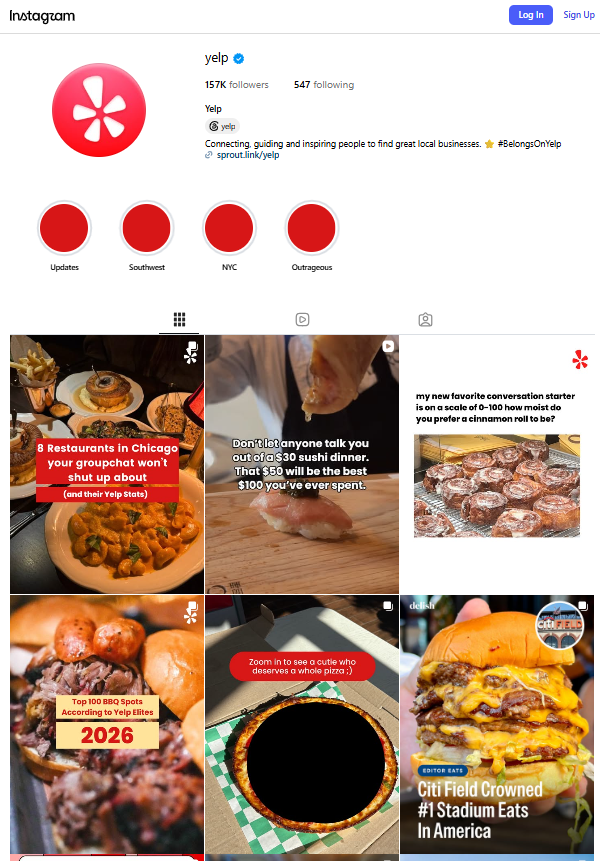
Yelp actively promotes its content — Best Of lists, standout reviews, local business features, seasonal guides — across Facebook, X (formerly Twitter), Instagram, and TikTok. Each piece of social content serves as a entry point for users who may not be in an active review-reading phase but who are interested in local business discovery as a form of content consumption. A “Best Hidden Gem Restaurants in New York” post on Instagram, for example, reaches users who are casually browsing and may not have initiated a Yelp search that day — but it keeps Yelp top-of-mind for when they are ready to search.

Elite Squad & Community Events
Yelp’s Elite Squad program — a recognition program for prolific, high-quality reviewers — is one of the platform’s most distinctive social features. Elite members are recognized publicly on their profiles, invited to exclusive Yelp events (restaurant openings, exclusive tastings, cultural experiences), and given additional visibility within the platform. In return, Elite members tend to write more detailed, more frequent, and more influential reviews — making them both the platform’s most valuable content contributors and its most effective word-of-mouth ambassadors.
Yelp Connect: Business-to-Consumer Social
Yelp Connect allows business owners to post updates, news, and promotional content directly to followers within the Yelp platform. This creates a social media-like engagement layer specifically within the Yelp context — meaning businesses can reach users who are already in a local-discovery mindset, rather than competing for attention in the general social media feed. Connect posts include engagement analytics, allowing businesses to measure response rates and refine their community communication strategy.
6. Trust & Safety: The Marketing Value of Credibility
One of Yelp’s most underappreciated marketing strategies is its systematic, public investment in review integrity. In an era when consumers are increasingly skeptical of online reviews — particularly as AI-generated fake reviews proliferate — Yelp’s active, transparent stance on review authenticity is itself a powerful marketing differentiator.
The 2025 Trust & Safety Report (covering calendar year 2025) revealed the scale of Yelp’s content moderation efforts: automated systems filtered nearly 500,000 suspected AI-generated reviews. Yelp closed over 1.3 million user accounts for Terms of Service violations — a 138% increase versus the prior year — and removed more than 889,800 fake phone support accounts linked to airline scams. More than 50,700 potential new business pages were rejected for spam-associated behavior (+29% YoY). Yelp also made over 1,020 cross-platform reports to social media platforms about review manipulation schemes, with 60% of those reports resulting in action.
Publicly releasing this data through the annual Trust & Safety Report is itself a sophisticated marketing move. It signals to consumers that Yelp takes the integrity of its reviews seriously — and that the reviews they read have survived a rigorous filtration process. For a platform whose entire value proposition rests on trustworthiness, demonstrating active stewardship of that trust is more powerful than any advertising campaign could be.
7. Mobile-First Strategy: Meeting Consumers in the Moment

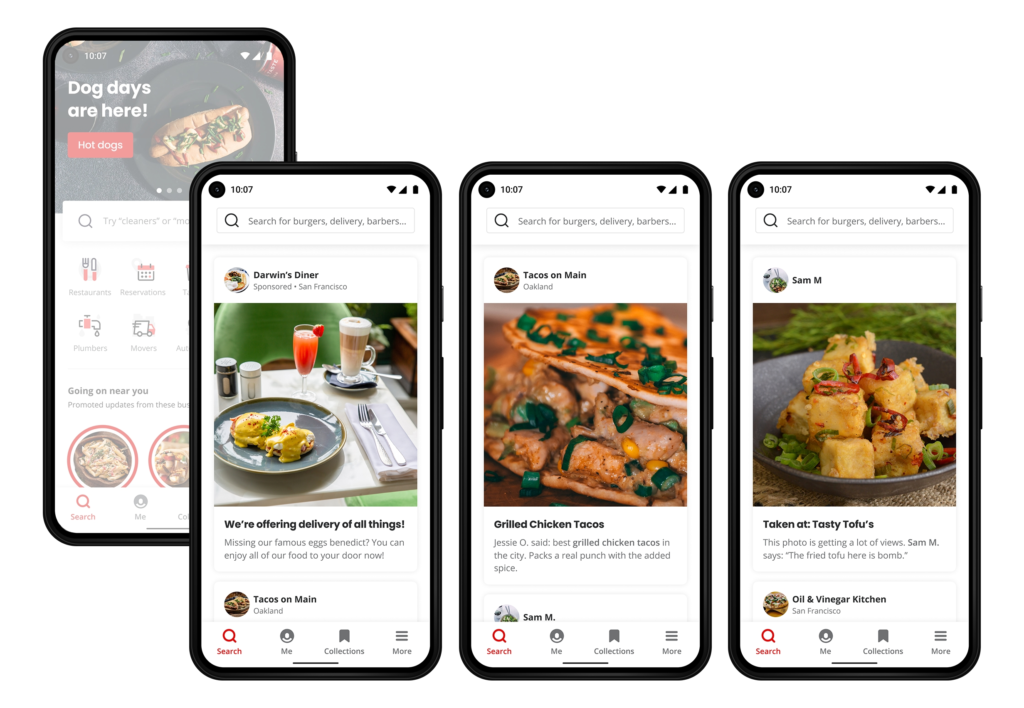
With 29 million unique devices accessing Yelp via mobile app each month, mobile is not just a distribution channel for Yelp — it is the primary context in which local business discovery decisions are made. The intersection of mobile usage, location awareness, and immediate purchase intent (searching for a restaurant while walking through a neighborhood; finding a plumber during an emergency) creates a context that Yelp’s mobile product is specifically designed to exploit.
Yelp’s mobile app is engineered for low-friction, high-speed decision making: search results load instantly, business contact options (call, message, get directions) are one tap away, and features like “Request a Quote” — originally launched as a web feature but now fully mobile-native — allow users to initiate conversations with service businesses in seconds. The “Projects” feature lets users track ongoing service projects, communicate with contractors, and manage progress all within the app.
Yelp “Request a Quote” feature (blog.yelp.com/news/yelp-request-a-quote/) allows users to gather competitive bids from multiple home service businesses simultaneously — a feature that addresses one of the highest-friction moments in local services: comparing options for project work.
Marketing Mix of Yelp (4Ps Analysis)
Yelp’s marketing mix — the combination of Product, Price, Place, and Promotion decisions that define its market position — is a carefully calibrated system where each element reinforces the others. Understanding the 4Ps reveals why Yelp’s business model is both durable and difficult for competitors to replicate.
1. Product: A Multi-Sided Platform for Local Commerce
Yelp’s product is not simply a review website — it is a multi-sided platform that simultaneously serves three distinct user groups: consumers seeking reliable local business information, businesses seeking customers and online visibility, and advertisers seeking high-intent local audiences. The product must serve all three simultaneously, and improvements for one side of the platform should ideally create value for the others.
Consumer-Facing Product Features
- Review & rating system with 308 million cumulative user-generated reviews
- AI-powered Review Insights — sentiment analysis by dimension (food, service, ambiance, price)
- Yelp Assistant — conversational AI for home services diagnosis and matching
- Menu Vision — camera-based dish photo and review lookup for restaurant menus
- Business profiles with photos, menus, hours, attributes, and owner responses
- Request a Quote — competitive bidding for service projects
- Projects — project tracking and contractor communication tool
- Reservations via Yelp Guest Manager and Reserve with Google integration
- Integrated food ordering via Grubhub partnership
- Personalized feed based on user location, history, and preferences
Business-Facing Product Features
- Free business profile with basic information, photo gallery, and review management
- Yelp Ads — targeted PPC advertising with AI-powered Smart Budgets
- Yelp Guest Manager — restaurant reservations, waitlist, and seating management
- Yelp Host & Yelp Receptionist — AI-powered inbound call handling
- Yelp Connect — social posting and follower engagement within the platform
- Business analytics — insights on profile visits, consumer actions, and competitive benchmarking
- Response tools — owner response to reviews and customer messages
2. Price: Freemium with Premium Upsell
Yelp employs a freemium pricing architecture that maximizes platform participation on both the consumer and business sides. This pricing strategy is deliberately structured to minimize friction for new platform entrants while creating a natural commercial progression as engagement deepens.
Consumer Pricing
Core Yelp functionality — searching for businesses, reading reviews, browsing photos, accessing business information — is entirely free. Yelp offers an optional premium subscription with perks including ad-free browsing, exclusive discounts from businesses, and enhanced search filtering. The freemium model is critical: it ensures that Yelp’s consumer-facing content (the reviews, the search results) is accessible to the maximum possible audience, which in turn makes the advertising platform more valuable for businesses.
Business Pricing
Basic business profiles on Yelp are free to claim and manage. Paid options include: (1) Yelp Ads on a PPC model with flexible daily budgets; (2) Enhanced Profile features (removing competitor ads from your page, adding a call-to-action button, uploading a business video); and (3) Yelp Guest Manager as a subscription service for restaurant reservation and front-of-house management. This tiered structure ensures even the smallest business can have a presence on Yelp, while creating natural upgrade paths as businesses see ROI from the free features.
3. Place: Omnipresent Across the Local Discovery Journey
Yelp’s distribution strategy aims to be present at every touchpoint in the local business discovery journey — not just on Yelp.com. Through partnerships, API integrations, and first-party mobile development, Yelp’s data and functionality appear in contexts far beyond its own platform.
- Direct channels: yelp.com website, iOS and Android mobile apps (~29M monthly device users)
- Search engine visibility: Yelp listing pages appear prominently in Google, Bing, and other search engine results for local business queries
- API partnerships: Yelp data powering local business information in travel apps (Roadtrippers), real estate platforms (Realtor.com), and other third-party services
- Commerce integrations: Grubhub (ordering), Toast (POS/reservations), Reserve with Google (reservations)
- Email marketing: Mailchimp integration for targeted local business discovery
- Agency platform: Available through AgencyAnalytics for professional marketers managing local business advertising
4. Promotion: A Multi-Channel Organic-First Strategy
Yelp’s promotional strategy is distinctive for its heavy reliance on earned and organic media rather than paid advertising. Because Yelp’s core product is content created by users (not by Yelp), its promotional engine is largely self-fueling — every review posted is both product content and a promotional asset that attracts new users through search engines and word-of-mouth.
Organic & SEO
Yelp’s SEO-first approach means its primary promotional investment is in product quality and content depth — more reviews, more accurate business information, better structured data — rather than paid search. High-quality listing pages that rank for local business queries drive the majority of Yelp’s consumer traffic without ongoing media spend.
Brand Campaigns & PR
Yelp periodically runs broad brand awareness campaigns to reinforce its positioning as the trusted local business authority, particularly targeting younger consumers who may be accustomed to using Google Maps or social media for local discovery. PR around its annual Trust & Safety Report, product launches (Yelp Assistant, Menu Vision), and Best Of lists generates significant earned media coverage — effectively delivering brand messaging at no media cost.
Performance Marketing for App Downloads
For user acquisition on mobile, Yelp runs targeted performance marketing campaigns on other platforms (including Facebook and Google) to drive app downloads — particularly in service categories and geographies where it identifies gaps in mobile penetration. These campaigns are measurable, ROI-driven, and concentrated on high-intent audiences rather than broad awareness.
Porter’s Five Forces Analysis of Yelp
Porter’s Five Forces framework maps the competitive pressures Yelp faces from all directions — new competitors, substitute products, buyer power, supplier power, and competitive rivalry. For a platform business like Yelp, this analysis reveals both the structural strengths that make its market position defensible and the vulnerabilities that require ongoing strategic attention.
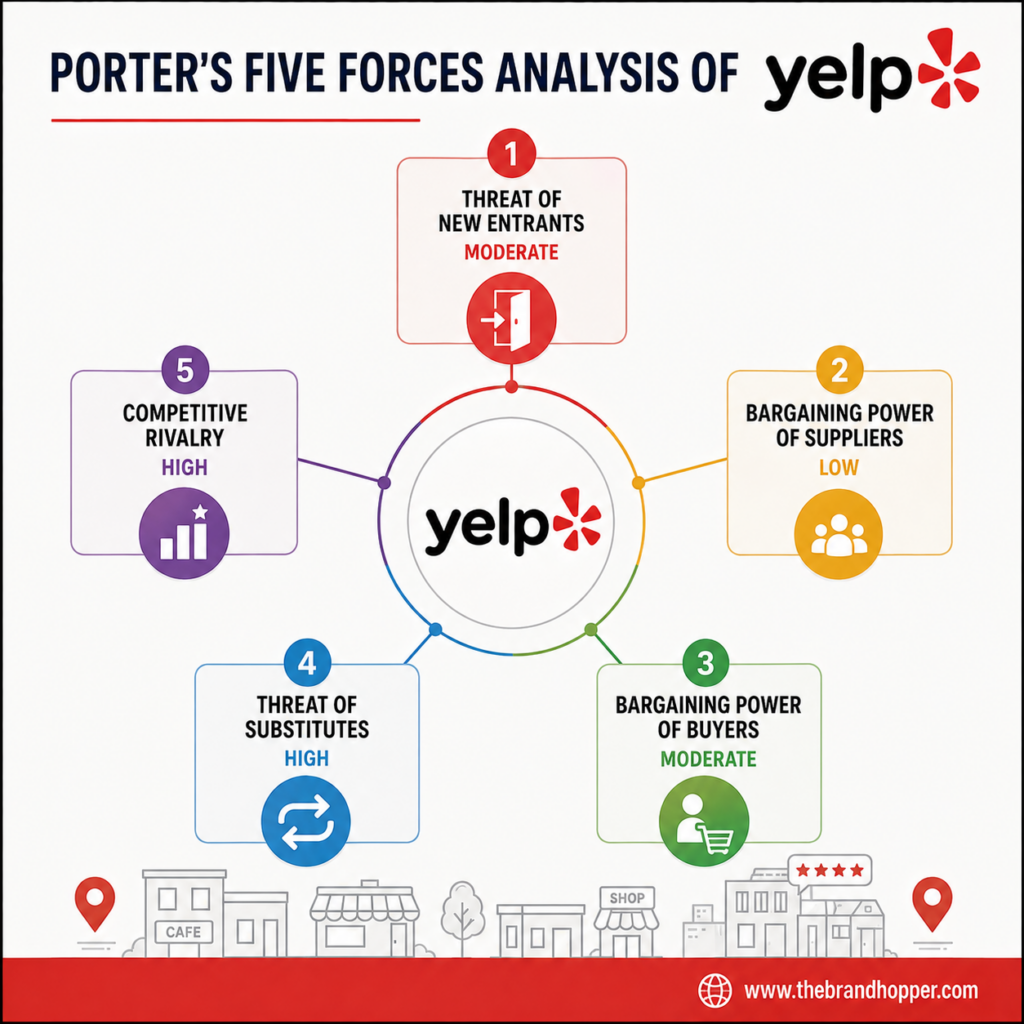
1. Threat of New Entrants — Moderate
Building a local business review platform is technically straightforward. Building a trusted one is not. The core barrier to entry for potential Yelp competitors is not technology but accumulated social capital: 308 million reviews that took two decades to accumulate, an established reputation for review integrity, and millions of consumers who have developed habitual usage of the platform. A new entrant would need to either match this content depth (requiring years of user acquisition) or differentiate on a dimension where Yelp is weak (e.g., hyper-niche categories or non-English markets). The AI-powered features Yelp has invested in since 2024 add further differentiation that raises the imitation bar.
2. Bargaining Power of Suppliers — Low
Yelp’s “suppliers” are primarily the local businesses whose listings populate the platform. Individual small businesses have almost no leverage over Yelp — they depend on Yelp’s traffic more than Yelp depends on any individual business. Even larger chain businesses (restaurant groups, home service networks) cannot realistically threaten to withdraw from Yelp without losing access to a significant consumer discovery channel. The only partial exception is large business clients that represent meaningful advertising revenue — but even these clients face significant switching costs in terms of consumer reach if they disengage from the platform.
3. Bargaining Power of Buyers — Moderate
Yelp’s consumer users have meaningful alternatives (Google Maps, TripAdvisor, Facebook) and zero switching costs — they can simply stop using Yelp without losing anything. This creates constant pressure on Yelp to maintain product quality and user experience. However, habit and content network effects moderate buyer power significantly: users who have found reliable recommendations on Yelp repeatedly tend to return by default, and the sheer volume of Yelp reviews often exceeds what they can find elsewhere for niche categories. For business advertisers, Yelp’s freemium model reduces the cost of initial engagement, moderating their buyer power for premium features.
4. Threat of Substitutes — High
The threat of substitute products is the most significant competitive pressure Yelp faces. The primary substitutes include:
- Google Maps & Google Business Profile — integrates local business search with navigation, photos, and user reviews directly within Google’s dominant search ecosystem. This is Yelp’s most formidable competitor: Google processes far more local search queries and has superior distribution.
- TripAdvisor — covers restaurants, travel, and hospitality with a similar review model and significant international presence.
- Meta (Facebook & Instagram) — business pages with user ratings and reviews, increasingly integrated with local commerce features.
- Apple Maps — integrated local business information on iOS devices with growing review capabilities.
- Specialized vertical platforms — Houzz (home services), Zocdoc (healthcare), OpenTable (restaurants) compete in specific categories where Yelp has broad but shallower coverage.
- AI-powered search — tools like Google’s AI Overviews, ChatGPT search, and Perplexity increasingly answer local business questions directly, potentially bypassing review platforms altogether.
Yelp’s response to the substitute threat has been to invest aggressively in its own AI capabilities — making the platform more conversational, more personalized, and more deeply integrated into the local commerce transaction rather than merely the pre-transaction research phase.
5. Competitive Rivalry — High
The local business discovery space has significant competitive intensity, dominated by the rivalry between Yelp and Google. Google’s local search dominance — powered by Google Maps, Google Business Profile, and AI-enhanced local results — means Yelp cannot compete for the top-of-funnel local search query. Instead, Yelp’s strategy is to own the depth layer: consumers who want more than a star rating and address — who want to read detailed reviews, compare options, understand specific attributes, and engage directly with businesses. This niche is defensible because Google’s model incentivizes breadth over depth. Yelp’s competitive moat is the quality and volume of its reviews in the US market — a moat reinforced by every new review written and every new AI feature that makes those reviews more useful.
Conclusion: The Yelp Marketing Model — Built to Last
Yelp’s enduring market position is the product of a marketing strategy that is simultaneously simple in concept and complex in execution. The core idea — give consumers a trusted space to share genuine experiences, and build a commercial ecosystem around that trust — has proven remarkably durable across two decades of digital transformation, the rise of social media, the dominance of Google, and now the emergence of AI-powered search.
The record $1.41 billion in FY2024 net revenue, the 15th consecutive quarter of double-digit Services advertising growth, and the 308 million cumulative reviews on the platform all validate that Yelp’s marketing strategy continues to generate durable competitive advantage. The platform’s AI pivot — Yelp Assistant, Review Insights, Menu Vision, Smart Budgets — represents the next chapter in that strategy: using artificial intelligence not to replace the human review but to make it more accessible, more actionable, and more immediately useful at every stage of the local commerce journey.
For marketers and business strategists, Yelp offers a masterclass in platform marketing: how to build a trust-based content ecosystem, monetize consumer intent without destroying the user experience, and use technological innovation to deepen rather than commoditize a human-centered value proposition.
Also Read: The Rise of PayPal: A Look at its Disruptive Financial Ecosystem
Frequently Asked Questions (FAQs)
Q: How does Yelp make money?
A: Yelp generates revenue primarily through advertising sold to local businesses. In FY2024, total advertising revenue reached approximately $1.35 billion. The core product is Yelp Ads — a pay-per-click advertising system where businesses pay when users click on their promoted listings. Yelp also earns revenue from enhanced business profile features (removing competitor ads, adding video), Yelp Guest Manager subscriptions for restaurants (reservation and front-of-house management software), and Yelp Connect (social posting for businesses). Consumer subscriptions represent a smaller portion of revenue. Services advertising (home services, auto, professional services) was Yelp’s fastest-growing segment in FY2024 at $879 million, up 11% year-over-year.
Q: What is Yelp’s annual revenue?
A: Yelp reported record net revenue of $1.41 billion for the full year 2024 — a 6% increase year-over-year. Net income reached $133 million (+34% YoY) with a 9% net income margin. Adjusted EBITDA was $358 million (record, +8% YoY). For FY2025, Yelp has guided for net revenue in the range of $1.470 billion to $1.485 billion. Source: Yelp FY2024 Earnings Release, ‘Growth in Services Drove Yelp’s 2024 Results,’ published February 2025 via businesswire.com.
Q: What marketing strategies does Yelp use?
A: Yelp deploys seven core marketing strategies: (1) User-Generated Content — 308 million reviews serve as both product and marketing asset; (2) SEO — Yelp listing pages dominate local business search results for category+location queries; (3) Partnerships — integrations with Grubhub, Toast, Mailchimp, Realtor.com, Roadtrippers extend Yelp’s reach; (4) Advertising solutions — PPC Yelp Ads with AI-powered Smart Budgets for local businesses; (5) Social media — community content distribution across Facebook, Instagram, TikTok, and X; (6) Trust & Safety as marketing — public Trust & Safety Reports build consumer confidence; (7) AI innovation — Yelp Assistant, Review Insights, Menu Vision, and Yelp Receptionist differentiate the platform in an AI-first era.
Q: Who are Yelp’s main competitors?
A: Yelp’s primary competitors include: (1) Google Maps/Google Business Profile — the most direct and formidable competitor, with superior distribution through Google’s search dominance; (2) TripAdvisor — covers restaurants, travel, and hospitality with a similar review model; (3) Meta (Facebook/Instagram) — business pages with reviews and increasingly local commerce integration; (4) Apple Maps — growing review capabilities integrated into Apple’s iOS ecosystem; (5) Vertical specialists — Houzz (home services), Zocdoc (healthcare), OpenTable (restaurants); (6) AI-powered search tools (ChatGPT, Perplexity, Google AI Overviews) — potentially bypassing review platforms for local business queries.
Q: How does Yelp use AI in its platform?
A: Yelp has made AI a central element of its product strategy since 2024. Key AI features include: (1) Yelp Assistant — a conversational AI that diagnoses home services projects and connects consumers with service professionals; (2) Review Insights — large language models that analyze review sentiment by specific dimension (food quality, service, ambiance, price) to give consumers nuanced summaries; (3) Menu Vision — camera-based scanning of physical menus to surface dish photos and reviews; (4) Smart Budgets — machine learning-optimized advertising spend for business advertisers; (5) Yelp Host & Yelp Receptionist — AI call answering and triage for service businesses; (6) AI-powered review filtering — detecting and removing AI-generated fake reviews (nearly 500,000 filtered according to the 2025 Trust & Safety Report).
Q: How many reviews does Yelp have?
A: As of the end of 2024, Yelp had 308 million cumulative user-generated reviews across its platform. Approximately 21 million new reviews were added in 2024. These reviews span restaurants, home services, healthcare, beauty, retail, automotive, and virtually every category of local business. Yelp’s Recommendation Software continuously evaluates these reviews for usefulness and authenticity — filtering those that exhibit fraud patterns, are incentivized, or are suspected to be AI-generated. The platform lists approximately 8.4 million active business pages.
Q: What is Yelp’s target audience?
A: Yelp targets high-intent, research-oriented consumers. Key audience characteristics: 83% of Yelp users convert their browsing into action (hiring a service or making a purchase); 90% actively compare options before committing; 60% hold college degrees; 55% earn over $100,000 annually; 80% are active on social media. This demographic — educated, high-income, research-driven — makes Yelp’s users exceptionally valuable to local businesses because they are in-market consumers with the spending power and intent to follow through on their research.
Q: How does Yelp prevent fake reviews?
A: Yelp uses a multi-layered approach to review integrity. Its automated Recommendation Software evaluates reviews based on quality, reliability, and helpfulness signals — filtering out those that exhibit suspicious patterns. The 2025 Trust & Safety Report revealed that Yelp filtered nearly 500,000 suspected AI-generated reviews, closed over 1.3 million user accounts for Terms of Service violations, removed 889,800 fake phone support accounts linked to scams, rejected 50,700+ spammy business page applications, and made 1,020+ reports to other platforms about review manipulation schemes (with 60% resulting in action). Yelp also places Compensated Activity Alerts on business pages where review manipulation is detected.
Q: What is Yelp Guest Manager?
A: Yelp Guest Manager is Yelp’s restaurant front-of-house management platform — covering online reservations, waitlist management, seating, and guest notifications. It integrates with Toast POS systems and connects to Reserve with Google, allowing restaurants to receive and manage bookings from both Yelp and Google without switching platforms. For restaurants, Guest Manager is both an operational tool (reducing front-of-house friction) and a marketing asset (appearing in Yelp and Google searches as ‘reservations available’). It represents Yelp’s expansion from a review-only platform to an end-to-end local commerce infrastructure provider.
Q: Is advertising on Yelp worth it for small businesses?
A: Yelp advertising is generally most effective for local businesses in services categories (home services, legal, dental, medical, auto) and for restaurants, particularly those with strong existing review profiles. The data supporting Yelp’s advertising case: 83% of Yelp users take action after discovering a business on the platform; 90% compare options before choosing — meaning businesses that appear prominently in Yelp searches are being considered by high-intent consumers actively deciding where to spend. Yelp’s PPC model (pay only for clicks) and AI-powered Smart Budgets reduce the risk of wasted spend. The most important success factor for Yelp advertising is an existing profile with strong, recent reviews — advertising amplifies an already-positive Yelp presence but cannot substitute for it.
To read more content like this, subscribe to our newsletter
Go to the full page to view and submit the form.