


Alphabet Inc. is a multinational technology holding company headquartered in Mountain View, California. It is, by market capitalisation, one of the five most valuable corporations on earth — a club it shares with Nvidia, Microsoft, Apple, and Meta. In September 2025, Alphabet became only the fourth company in history to surpass $3 trillion in market capitalisation, cementing its status as one of the defining commercial forces of the modern era.
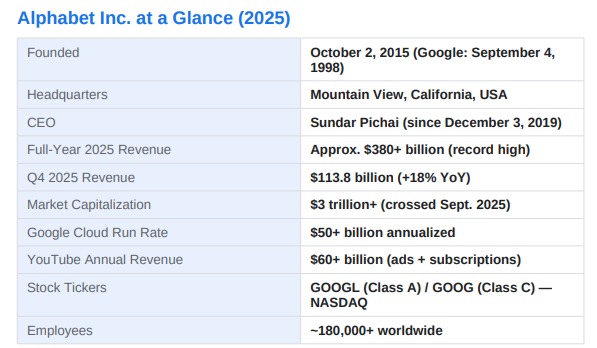

At its core, Alphabet is the parent company of Google — the search engine that processes more than 8.5 billion queries every single day. But Alphabet is far more than a search company. Under its umbrella sit autonomous vehicle pioneer Waymo, AI research powerhouse Google DeepMind, life-science subsidiary Verily, drone delivery company Wing, longevity research unit Calico, and a portfolio of early-stage bets that range from climate technology to drug discovery.
To understand Alphabet fully — its origins, its structure, its ambitions — you need to go back more than two decades, to a small office above a garage in Menlo Park, California, and two graduate students who believed they could organise the world’s information.
The Birth of Google: 1995–2004
The story of Alphabet begins with Google. In 1995, Larry Page and Sergey Brin met as graduate students at Stanford University. Page was considering Stanford for his PhD; Brin was assigned as his campus tour guide. By 1996, they were collaborating on a research project called BackRub — a search engine that ranked web pages based on the number and quality of links pointing to them, rather than the frequency of keyword matches. This approach, which would evolve into the PageRank algorithm, was a revolutionary departure from the search engines of the day.

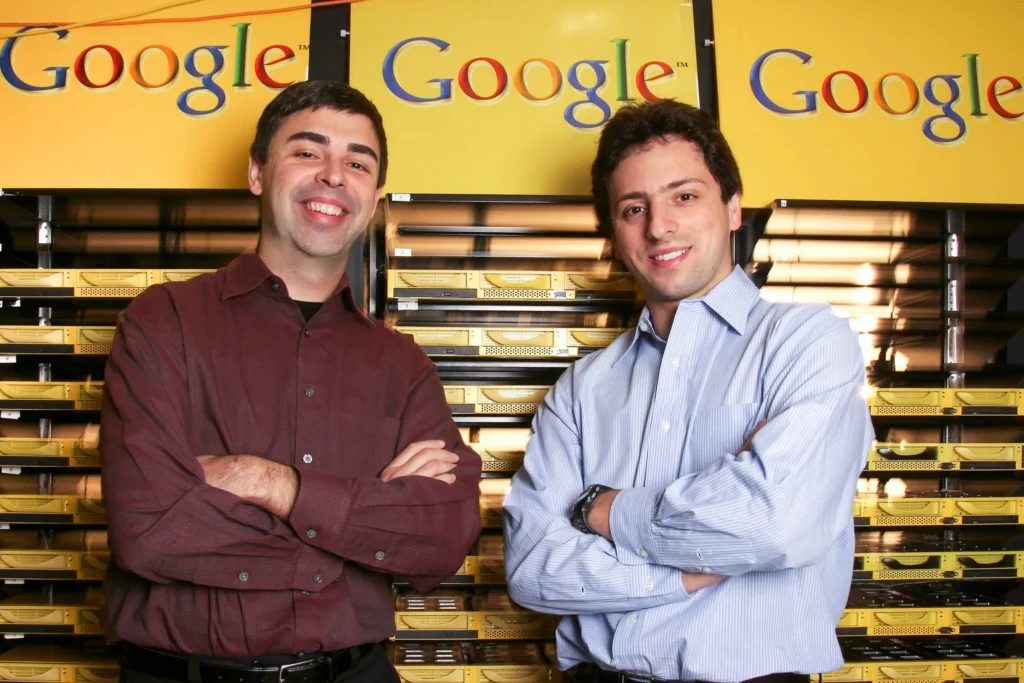
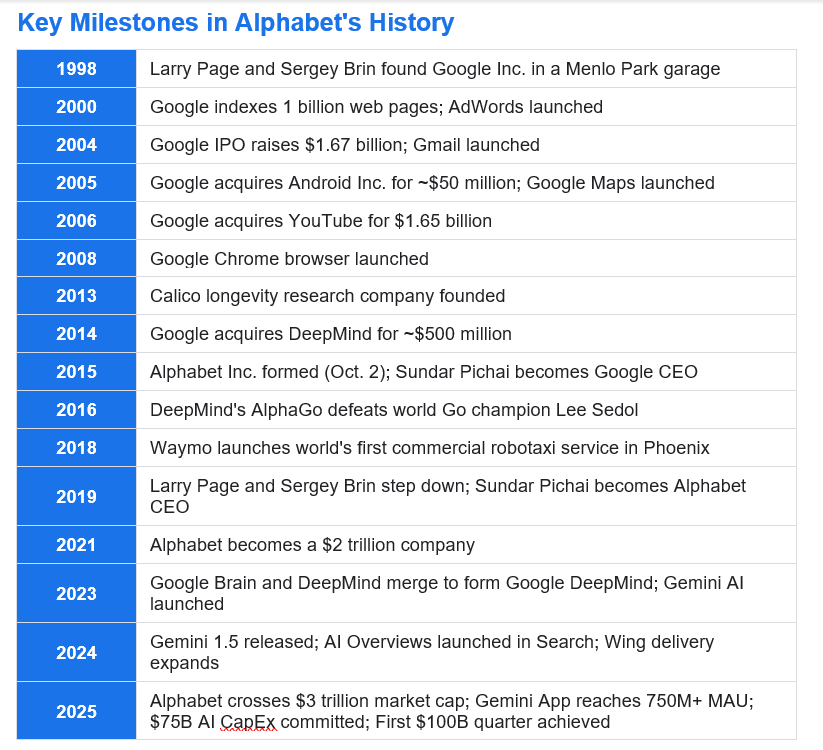
On September 4, 1998, Page and Brin officially incorporated Google Inc. and set up shop in a Menlo Park garage rented from Susan Wojcicki (who would later become CEO of YouTube). The name ‘Google’ was a play on ‘googol’, the mathematical term for the number 1 followed by 100 zeros — a nod to their mission of organising the seemingly infinite information on the web.
Google’s early growth was breathtaking. By 2000, the company had indexed more than one billion web pages. In 2004, Google launched Gmail, upended the webmail market with 1 GB of free storage, and completed one of the most watched IPOs in Silicon Valley history, raising $1.67 billion and valuing the company at $23 billion. Page and Brin were billionaires before they turned 32.
Why Google Reorganised Into Alphabet (2015)
By the mid-2010s, Google had grown into a sprawling enterprise that was simultaneously operating a global search and advertising business, developing self-driving cars, launching balloons to provide internet access in remote regions, researching human longevity, and building smart home devices. The breadth of these activities created a management, accountability, and transparency problem. Investors found it difficult to evaluate the core advertising business when it was lumped together with experimental, capital-intensive moonshot projects with no clear path to revenue.
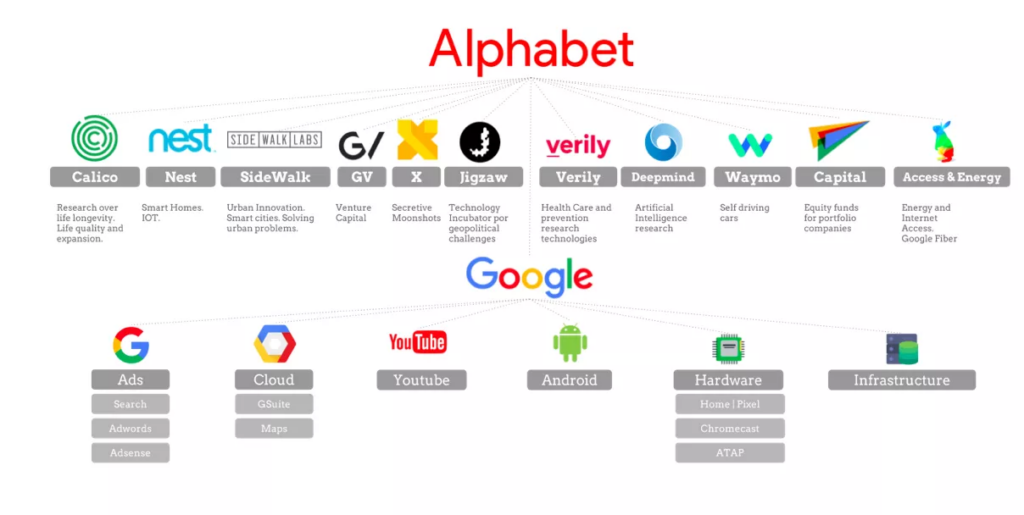
The solution was elegant in its simplicity: create a new holding company — Alphabet — and move Google’s non-core businesses under it as independent subsidiaries. Google itself would be slimmed down to its core internet products: Search, Ads, Maps, YouTube, Android, and the Play Store. Everything else — Waymo, Nest, Verily, Fiber, X (the moonshot factory), and others — would sit as separate companies under the Alphabet umbrella, each with its own CEO, budget, and accountability.
“Alphabet is mostly a collection of companies. The largest of which, of course, is Google. This newer Google is a bit slimmed down, with the companies that are pretty far afield of our main internet products contained in Alphabet instead. Fundamentally, we believe this allows us more management scale, as we can run things independently that aren’t very related.” — Larry Page, August 10, 2015
On August 10, 2015, Google CEO Larry Page announced the formation of Alphabet Inc. in a blog post. The reorganisation was completed on October 2, 2015. From that date, Alphabet Inc. began trading on the NASDAQ under the former Google ticker symbols GOOGL (Class A, voting shares) and GOOG (Class C, non-voting shares), preserving Google’s stock price history.
The Warren Buffett Connection
The structural inspiration for Alphabet was not Silicon Valley but Omaha, Nebraska. Former Google executive chairman Eric Schmidt has publicly credited Warren Buffett’s Berkshire Hathaway as the model for Alphabet’s holding-company architecture. Schmidt recounted that he had urged Page and Brin to visit Buffett personally to observe how Berkshire Hathaway functioned as a holding company of independent subsidiaries, each led by trusted CEOs given wide operational latitude. The Alphabet structure closely mirrors this: a lean holding company at the top, with self-managing operating units below.
How the Alphabet Inc.’s Restructuring Worked
The legal mechanics of the reorganisation were handled under Delaware General Corporation Law, which permitted a holding company restructuring without a shareholder vote — a significant convenience that allowed the transition to happen swiftly and without disruption to the stock market.
Technically, Google Inc. was first constituted as the owner of the new Alphabet entity. A placeholder subsidiary was then formed to hold Alphabet’s ownership interests, and that subsidiary was subsequently merged with Google. As a result, Google became a wholly-owned subsidiary of Alphabet. Google’s shares were converted into Alphabet shares on a one-for-one basis, meaning existing shareholders simply found themselves holding Alphabet stock with no effective change to their economic interest.
Post-restructuring, Alphabet’s financial reporting was reorganised into three segments: Google Services (search, ads, YouTube, Android, hardware), Google Cloud, and Other Bets (everything else). This cleaner segmentation gave analysts — and investors — a far clearer picture of where Alphabet’s profits were coming from and what the moonshot projects were costing.
Leadership of Alphabet Inc. : The People at the Top
Sundar Pichai — CEO, Alphabet Inc. & Google

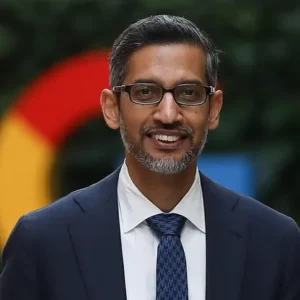
Sundar Pichai, born in Chennai, India in 1972, is arguably the most powerful executive in the technology industry today. He joined Google in 2004 and quickly distinguished himself as a product leader, most notably championing the development of the Google Chrome browser — which today commands over 65% of global browser market share. He was appointed CEO of Google in August 2015, the same month Alphabet was announced, and elevated to CEO of Alphabet on December 3, 2019, when founders Larry Page and Sergey Brin stepped down from their executive roles.
Under Pichai’s leadership, Alphabet has undergone its most significant transformation: from an advertising company with side projects to a vertically integrated AI company whose products touch nearly every aspect of digital life. His 2025 compensation package is benchmarked to aggressive performance targets, with potential total compensation reported at up to $692 million — reflecting the scale of the enterprise he oversees.
Larry Page & Sergey Brin — Co-Founders & Controlling Shareholders
Though Larry Page and Sergey Brin stepped down from their executive positions in December 2019, they remain co-founders, employees, and board members of Alphabet. More importantly, they retain super-voting Class B shares that give them majority control over the company’s strategic direction. Their departure from day-to-day management was widely interpreted as a signal of confidence in Pichai and a desire to pursue more personal projects — but their oversight role over the long-term direction of the company endures.
Alphabet’s Three Business Segments in 2026
1. Google Services
Google Services is Alphabet’s engine room, generating the overwhelming majority of the company’s revenue and all of its profit. It encompasses Google Search and its $100B+ advertising ecosystem, YouTube (which crossed $60 billion in combined ad and subscription revenue in 2025), Google Maps, Google Play, the Pixel hardware line, and Google’s subscription products including Google One, YouTube Premium, and YouTube TV.
In Q4 2025, Google Services revenue reached $95.9 billion — a 14% year-on-year increase. Google Search alone grew 17% in the same quarter, demonstrating that even as AI transforms the search landscape, Alphabet’s core advertising business remains structurally dominant.
2. Google Cloud
Google Cloud has transformed from a distant third in the cloud market to a genuine challenger to AWS and Microsoft Azure. By 2025, Google Cloud’s annualised revenue run rate had surpassed $50 billion, driven by enterprise AI adoption, the integration of Gemini models into Google Workspace, and strong growth in data analytics and infrastructure services.
The division reported double-digit year-on-year growth throughout 2025 and reached operating profitability, marking a significant milestone for a business that historically ran at a loss as Alphabet invested in data centre infrastructure and sales capabilities.
3. Other Bets
Other Bets is Alphabet’s portfolio of high-risk, high-reward ventures that sit outside Google’s core internet business. While these companies collectively operate at a loss (a known and accepted cost of long-term innovation), several are approaching commercialisation at scale.
Key Alphabet Subsidiaries: A Deep Dive

Google DeepMind — The AI Research Giant
In 2023, Alphabet merged Google Brain and DeepMind into a single entity: Google DeepMind, led by DeepMind co-founder Demis Hassabis. The merger was a strategic response to the competitive pressure of OpenAI and marked a decisive moment in Alphabet’s AI-first pivot. Google DeepMind is responsible for the Gemini family of AI models — Alphabet’s answer to GPT-4 and its successors.
By the end of 2025, Gemini 2.5 had been released as the company’s most capable model to date, and the Gemini App had accumulated over 750 million monthly active users. AI Overviews — the AI-generated summaries that appear at the top of Google Search results — reached 2 billion monthly users across more than 200 countries. AlphaFold, DeepMind’s protein-structure prediction model, continues to be used by hundreds of thousands of researchers worldwide and has been credited with accelerating drug discovery timelines by years.
Waymo — The World’s Leading Autonomous Vehicle Company
Waymo, formerly the Google Self-Driving Car Project, has become the global benchmark for commercial autonomous vehicle deployment. By late 2025, Waymo was completing over 250,000 fully autonomous, paid ride-hailing trips per week across its operational cities — Phoenix, San Francisco, and Los Angeles — with planned expansions to additional markets.
In a notable convergence of Alphabet’s AI capabilities, Waymo began testing Google’s Gemini AI as an in-car assistant in its robotaxi fleet in late 2025, allowing passengers to control cabin temperature, ask questions, and interact with the vehicle using natural language. Waymo’s valuation in recent funding rounds has been estimated at over $45 billion.
Verily — Precision Health and Life Sciences
Verily (formerly Google Life Sciences) applies data analytics, AI, and wearable technology to improve health outcomes at a population scale. The company partners with pharmaceutical companies, health systems, and academic institutions on projects including continuous glucose monitoring, mental health platforms, and clinical trial management. Verily has attracted billions in external investment from leading healthcare and pharmaceutical partners.
Wing — Drone Delivery
Wing operates commercial drone delivery services, delivering packages ranging from groceries to medical supplies in markets including the United States, Australia, and Finland. In 2024 and 2025, Wing expanded its delivery network significantly, becoming one of the few drone delivery companies to operate profitably in select markets. Wing’s drones are designed to complete deliveries in under 10 minutes — a proposition that positions it as a direct competitor to Amazon Prime Air.
Calico — Longevity Research
Calico (California Life Company) is Alphabet’s moonshot into human longevity. Founded in 2013, Calico conducts basic research into the biology of aging with the explicit goal of extending healthy human lifespan. The company operates in partnership with AbbVie and takes a long-term, secretive research approach that is unusual even by Silicon Valley standards. While commercial results remain distant, the scientific insights Calico generates feed directly into Alphabet’s broader health and AI ecosystem.
GV and CapitalG — Alphabet’s Investment Arms
GV (formerly Google Ventures) is a venture capital fund that has backed some of the most consequential technology companies of the past two decades, including Uber, Slack, Stripe, Robinhood, and Flatiron Health. CapitalG (formerly Google Capital) focuses on growth-stage investments in established companies. Together, these vehicles extend Alphabet’s influence well beyond its own product portfolio, making it a central node in the global startup ecosystem.
X (The Moonshot Factory)
X is Alphabet’s internal research lab for radical, transformative technologies — what the company calls ‘moonshots’. X alumni have spawned or inspired several of Alphabet’s current subsidiaries, including Wing and Waymo. Current projects at X span areas such as advanced energy storage, next-generation internet connectivity, and climate monitoring. X operates under the explicit understanding that most projects will fail, and celebrates those failures as valuable learning.
Alphabet’s AI-First Strategy in 2025
If there is a single theme that defines Alphabet in 2025, it is artificial intelligence. The company has committed $75 billion in capital expenditure for 2025 alone — an unprecedented investment in AI infrastructure, data centres, and custom AI chips (the Tensor Processing Units, or TPUs, that power Google’s own AI workloads and are available to cloud customers via Google Cloud).
The integration of AI into Google’s core products has been transformational. AI Overviews, which provide AI-generated summaries at the top of search results, have scaled to over 2 billion monthly users across 200+ countries in 2025. AI Mode — a conversational, multi-step search experience — has seen daily queries per user double since its launch by Q4 2025.
Beyond search, Gemini is being embedded throughout Google’s product ecosystem: into Gmail, Google Docs, Google Sheets, Google Meet, Android, and Pixel hardware. The Gemini App itself — a standalone AI assistant — has become one of the world’s most-used AI products, with over 750 million monthly active users by end-2025. Alphabet’s 2025 delivered its first-ever $100 billion single-quarter revenue milestone, with AI-driven products playing a material contributing role.
Financial Performance: How Alphabet Makes Its Money
Alphabet’s financial story in 2025 is one of accelerating growth at extraordinary scale. The company’s Q4 2025 revenue of $113.8 billion represented an 18% year-on-year increase — and this growth came atop an already massive revenue base, making it one of the most impressive periods of growth in the company’s history.
The revenue mix reflects both the enduring strength of Google’s advertising franchise and the growing contribution of subscription and cloud businesses. Google Search and advertising continue to account for the largest share of total revenue. But YouTube’s combined ad and subscription revenue crossing $60 billion in 2025 — and Google Cloud’s annualised run rate exceeding $50 billion — signal a meaningful diversification of Alphabet’s income streams.
The company crossed the $3 trillion market capitalisation threshold in September 2025, making it the fourth company in history to do so, joining Nvidia, Microsoft, and Apple. This milestone reflects the market’s recognition of Alphabet not merely as an advertising company, but as the world’s leading AI infrastructure and services provider.
Alphabet’s capital allocation in 2025 has been heavily weighted toward AI investment. The $75 billion CapEx commitment is more than any prior year in the company’s history, and management has signalled that elevated infrastructure spending will continue into 2026 as competition for AI talent, compute, and market share intensifies.

Alphabet in the Big Five: Competitive Landscape
Alphabet is one of five companies — alongside Amazon, Apple, Meta, and Microsoft — that together define the landscape of global technology. In terms of market capitalisation, Alphabet ranked fourth in the Big Five in September 2025, trailing Nvidia ($3.4T+), Microsoft, and Apple, but ahead of Meta.
In the AI race specifically, Alphabet occupies a unique position: it is simultaneously competing with Microsoft (which has integrated OpenAI’s technology into Bing and Azure), Amazon (AWS with Bedrock and Claude via Anthropic), and Meta (open-source LLMs via LLaMA). Alphabet’s competitive advantage lies in the depth of its proprietary data — the trillions of search queries, YouTube videos, and Gmail messages that have trained its AI models over decades — combined with the distribution power of Google Search and Android, which reach more than 5 billion users globally.
Alphabet faces genuine regulatory challenges across major markets. The U.S. Department of Justice has pursued antitrust action against Google’s dominance in search and advertising. The European Union has levied multi-billion-euro fines for a range of competition issues. These regulatory headwinds represent a real risk but also validate the scale of Alphabet’s market power.
Challenges and Controversies
Despite its extraordinary success, Alphabet navigates a complex landscape of challenges. Regulators in the United States and Europe have increasingly scrutinised Alphabet’s market power. The DOJ’s landmark antitrust case — which a federal judge in 2024 ruled that Google had illegally maintained a monopoly in online search — represents one of the most serious legal threats in the company’s history. A remedies trial is ongoing, with potential outcomes ranging from forced divestiture of Chrome to restrictions on default-search agreements with device manufacturers like Apple.
On the advertising side, the rise of TikTok and other short-form video platforms has introduced genuine competition for digital advertising budgets, particularly among younger demographics. While Google and YouTube remain dominant, the competitive pressure from ByteDance’s platform has been real and sustained.
Internally, Alphabet has navigated workforce reductions — particularly in 2023 and into 2024 — as it restructured to align investment with AI priorities. These layoffs, affecting tens of thousands of employees, generated significant reputational friction for a company that had long prided itself on being one of the world’s best employers.
The AI transition itself carries risk. As AI Overviews replace traditional blue-link search results, there is a structural question about whether advertisers’ cost-per-click models will hold in an AI-native search world. Alphabet has managed this transition with considerable skill so far, but the long-term monetisation of AI search is still being worked out.
The Road Ahead: Alphabet’s Future Outlook
The trajectory of Alphabet in the second half of the 2020s will be shaped by three converging forces: the commercialisation of artificial general intelligence, the expansion of autonomous systems (both vehicular and aerial), and the continued evolution of cloud computing as the foundational infrastructure of the global economy.
On AI, Alphabet’s investment in Gemini, Google DeepMind, and AI infrastructure positions it as a first-tier competitor in what may be the most consequential technological transition in history. The Gemini model family is expected to continue iterating rapidly, with multimodal, agentic AI capabilities becoming central to both consumer and enterprise products.
Waymo’s trajectory — from limited city deployments to nationwide autonomous mobility — could, if realised fully, represent a business as large as Google Ads. The integration of Gemini AI into Waymo’s vehicles is an early indicator of how Alphabet intends to leverage synergies across its portfolio.
Google Cloud’s ascent, combined with the explosion of enterprise AI demand, positions it for continued double-digit growth. As more enterprises seek AI-native infrastructure and seek to run custom AI models on sovereign cloud infrastructure, Google Cloud’s combination of TPU hardware, Vertex AI platform, and Gemini models gives it a differentiated offering.
For investors and industry observers alike, the central question is not whether Alphabet will remain relevant — its products are too deeply embedded in daily life for that — but whether it can successfully navigate the transition from an advertising-first company to an AI-first company without disrupting the revenue engine that funds everything else.
Frequently Asked Questions (FAQs)
Q: What is Alphabet Inc. and how is it different from Google?
A: Alphabet Inc. is a holding company created on October 2, 2015, as the result of a corporate restructuring of Google. Google became a wholly-owned subsidiary of Alphabet. Alphabet owns Google and a range of other businesses including Waymo, Google DeepMind, Verily, Wing, and Calico, among others. When you use Google Search, Gmail, or YouTube, you are using a Google product — but that product is owned by Alphabet Inc.
Q: Why did Google become Alphabet in 2015?
A: Google co-founder and CEO Larry Page announced the creation of Alphabet to make Google’s core internet business ‘cleaner and more accountable’ while giving greater autonomy to non-internet subsidiaries. The restructuring also improved financial transparency, allowing investors to separately evaluate Google’s profitable advertising business and the capital-intensive moonshot projects in Other Bets. Eric Schmidt has credited Warren Buffett’s Berkshire Hathaway as the structural inspiration for Alphabet.
Q: Who is the CEO of Alphabet Inc. in 2025?
A: Sundar Pichai is the CEO of both Alphabet Inc. and Google as of 2025. He was appointed Google CEO in August 2015 and elevated to Alphabet CEO on December 3, 2019, when co-founders Larry Page and Sergey Brin stepped down from their executive roles. Page and Brin remain board members and controlling shareholders.
Q: What is Alphabet’s revenue in 2025?
A: In Q4 2025, Alphabet reported revenues of $113.8 billion — an 18% increase year-on-year — making it the first quarter in company history to surpass $100 billion. For the full year 2025, Alphabet’s revenue is estimated to have exceeded $380 billion, driven by Google Search advertising, YouTube, and the fast-growing Google Cloud segment. YouTube alone generated over $60 billion in combined ad and subscription revenue in 2025.
Q: What companies does Alphabet own?
A: Alphabet’s primary subsidiaries include Google (Search, Ads, YouTube, Android, Maps, Chrome, Google Cloud), Waymo (autonomous vehicles), Google DeepMind (AI research), Verily (health and life sciences), Wing (drone delivery), Calico (longevity research), X (the moonshot factory), Isomorphic Labs (AI drug discovery), and investment arms GV and CapitalG. Each subsidiary operates with significant independence under Alphabet’s holding company structure.
Q: Is Alphabet a $3 trillion company?
A: Yes. In September 2025, Alphabet became the fourth company in history to surpass a $3 trillion market capitalisation, joining Nvidia, Microsoft, and Apple in that exclusive club. This milestone reflected strong investor confidence in Alphabet’s AI strategy, the continued dominance of Google Search and YouTube, and the rapid growth of Google Cloud.
Q: What is Waymo and how does it relate to Alphabet?
A: Waymo is Alphabet’s autonomous vehicle subsidiary, originally launched as the Google Self-Driving Car Project in 2009. It was spun out as an independent Alphabet subsidiary in 2016 and rebranded as Waymo. As of late 2025, Waymo was completing over 250,000 fully autonomous paid trips per week in Phoenix, San Francisco, and Los Angeles, and was testing Gemini AI as an in-car assistant. Waymo is widely considered the world’s most advanced commercial autonomous vehicle operator.
Q: What is Alphabet’s AI strategy?
A: Alphabet’s AI strategy centres on Google DeepMind’s Gemini family of models, which are integrated across Google Search (AI Overviews), the Gemini App (750M+ MAU), Google Workspace (Gmail, Docs, Sheets), Google Cloud (Vertex AI), Android, and Waymo. Alphabet committed $75 billion in capital expenditure in 2025 for AI infrastructure, including data centres and custom Tensor Processing Unit (TPU) chips. AI Overviews in Search have reached over 2 billion monthly users in 200+ countries.
Q: Where is Alphabet headquartered?
A: Alphabet Inc. is headquartered at 1600 Amphitheatre Parkway, Mountain View, California — the campus known as ‘Googleplex’. The company is incorporated in the state of Delaware, as are most major American corporations, due to Delaware’s favourable corporate law framework.
Q: What stock exchange is Alphabet listed on and what are its ticker symbols?
A: Alphabet is listed on the NASDAQ stock exchange. It trades under two ticker symbols: GOOGL (Class A shares, which carry voting rights) and GOOG (Class C shares, which carry no voting rights). These are the same ticker symbols that Google Inc. used before the Alphabet restructuring in 2015, as Alphabet retained Google’s complete stock price history.
Conclusion
Alphabet Inc. is one of the most consequential enterprises in human history. In under three decades, it has grown from a Stanford research project into a $3 trillion conglomerate whose products are used by more than half the world’s population every single day. Its journey from Google to Alphabet — from a search company to an AI-first technology holding company — mirrors the broader arc of the digital age itself.
The 2015 restructuring was a pivotal moment of organisational clarity. By separating the core Google business from the moonshot bets, Alphabet gave itself the governance structure to pursue both disciplined profitability and radical long-term innovation. A decade later, that structure has proven its worth: Google’s advertising revenues continue to grow, Google Cloud is now a genuine market force, and subsidiaries like Waymo and DeepMind are reshaping entire industries.
The challenges ahead — regulatory scrutiny, AI competition, the monetisation of a transformed search landscape — are real and complex. But Alphabet enters the second half of the 2020s with extraordinary financial resources ($75 billion in annual CapEx), world-class AI capabilities (Google DeepMind and Gemini), unmatched distribution (5+ billion Google and Android users), and a holding company structure that has proven remarkably resilient. The story of Alphabet is far from over — in many ways, its most consequential chapters are still being written.
Also Read: Beyond Search: Exploring Google Diversified Business Model
To read more content like this, subscribe to our newsletter
Go to the full page to view and submit the form.