


Domino’s is often described as a technology-led pizza company. That idea helps explain how it became the world’s largest pizza company by global retail sales, using digital ordering, operations technology, and a large franchise network to compete.
Founded in 1960 by Tom Monaghan and his brother James Monaghan in Ypsilanti, Michigan, Domino’s began as a single store purchased with a $900 loan and a simple obsession with fast delivery.
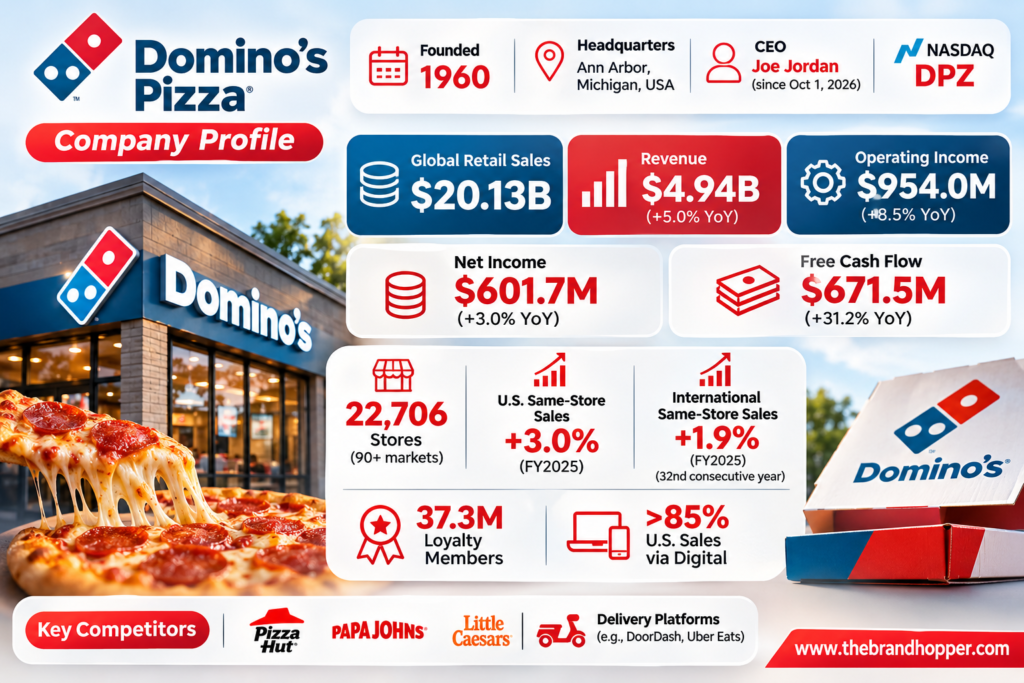
More than six decades later, the company had 22,706 stores across over 90 markets as of September 6, 2026. Global retail sales reached $20.13 billion in fiscal 2025 and exceeded $20.6 billion over the trailing four quarters ended June 14, 2026.
Domino’s Rewards ended 2025 with 37.3 million active users.
Fiscal 2025 results show continued growth. Total revenues reached $4.94 billion, up 5.0% year-on-year; operating income increased 8.5% to $954.0 million; and free cash flow rose 31.2% to $671.5 million.
U.S. same-store sales grew 3.0% for the year and 3.7% in Q4, while international same-store sales increased 1.9% for the year, marking the 32nd consecutive year of international same-store sales growth.
Domino’s opened 776 net new stores globally in 2025: 172 in the U.S. and 604 internationally.
These results reflect a marketing and operating system built around value, convenience, digital ordering, and franchise execution.
In the latest reported quarter, Q3 2026, revenue was $1.19 billion, up 3.4%, and operating income was $241.8 million, up 8.3%.
Global retail sales grew 3.2% excluding currency effects, while U.S. same-store sales rose 0.3% and international same-store sales rose 0.2%. Joe Jordan became CEO in 2026.

This article examines Domino’s marketing approach: the strategies that helped turn a Michigan pizza shop into a global leader, the marketing mix that balances value with innovation, the segmentation and positioning used across markets, and campaigns such as Pizza Turnaround, AnyWare, Paving for Pizza, and Emergency Pizza.
Marketing Strategies of Domino’s Pizza
Domino’s marketing success rests on a foundation of technology-led thinking, customer obsession, and a willingness to experiment with formats and channels that most QSR brands have been slow to adopt. The following strategies define how Domino’s has built and sustained its competitive position.
1. Digital-First Strategy and Technology as a Marketing Tool
Domino’s most defining strategic choice was to build its business around technology and digital convenience. From the early 2010s onward, the company increasingly used digital ordering, operational technology, and customer-facing innovation to differentiate itself in the competitive pizza market.
This strategy is reflected in its latest reported results. In 2025, more than 85% of Domino’s U.S. retail sales came through digital channels, primarily its website and mobile apps.
This digital share was built through years of investment in ordering infrastructure and customer experience. Domino’s introduced online and mobile ordering in 2007, followed by its Domino’s Tracker in 2008.
The Domino’s website and mobile app now serve as important customer-facing platforms for ordering, loyalty engagement, and promotions. The company has continued to update its e-commerce experience, including a website and mobile-web redesign launched in 2025 and an updated mobile app rollout.
Digital ordering also creates opportunities to understand customer interactions, such as order preferences and engagement with loyalty offers. Domino’s Rewards supports this relationship by allowing members to earn points on qualifying orders and redeem them for menu items.
Domino’s technology strategy extends beyond customer-facing apps. Its Domino’s Operating System (DOM OS) combines tools, processes, and technologies designed to coordinate store operations and order flow. The system includes its proprietary PULSE point-of-sale platform, which supports operational efficiency across the franchise network.
The company has also experimented with voice ordering and connected-device integrations as part of its innovation history. However, current company disclosures emphasize its website, mobile apps, and operating technology rather than presenting an Alexa-based DOM AI assistant as a current core offering.
One of Domino’s most recognizable digital innovations is the Domino’s Tracker, launched in January 2008. It allows customers to follow their order through preparation and delivery or pickup stages.

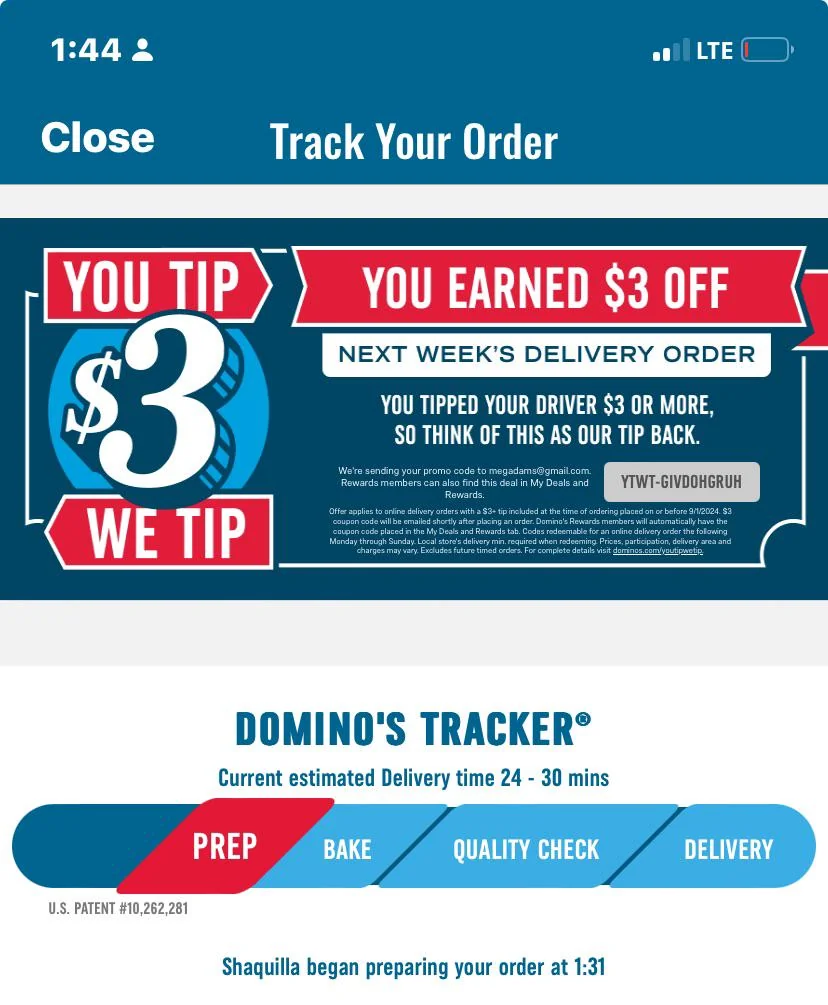
The Tracker has continued to evolve. In March 2026, Domino’s introduced an updated version featuring a more precise ready-time estimate using AI technology, Live Activities for iOS users, and a clearer view of order progress.
By making order progress visible, the Tracker turns delivery transparency into part of the customer experience. It reduces uncertainty while reinforcing Domino’s broader positioning around convenience, reliability, and technology-enabled service.
2. Domino’s AnyWare: Ordering on Every Platform (2015)
In 2015, Domino’s expanded its AnyWare initiative into a major marketing campaign built around a simple idea: customers should be able to order pizza through the devices and platforms they already use.
The campaign positioned ordering convenience as a competitive advantage. Rather than requiring customers to open a website or app every time, Domino’s sought to make ordering possible through a variety of connected devices and interfaces.
Domino’s introduced several AnyWare ordering options in 2015, including Twitter, text message, Samsung Smart TV, Pebble and Android Wear smartwatches, Ford SYNC in-car systems, and voice ordering with Dom. Customers generally needed a Domino’s Pizza Profile with a saved “Easy Order” to use these quick-order features.

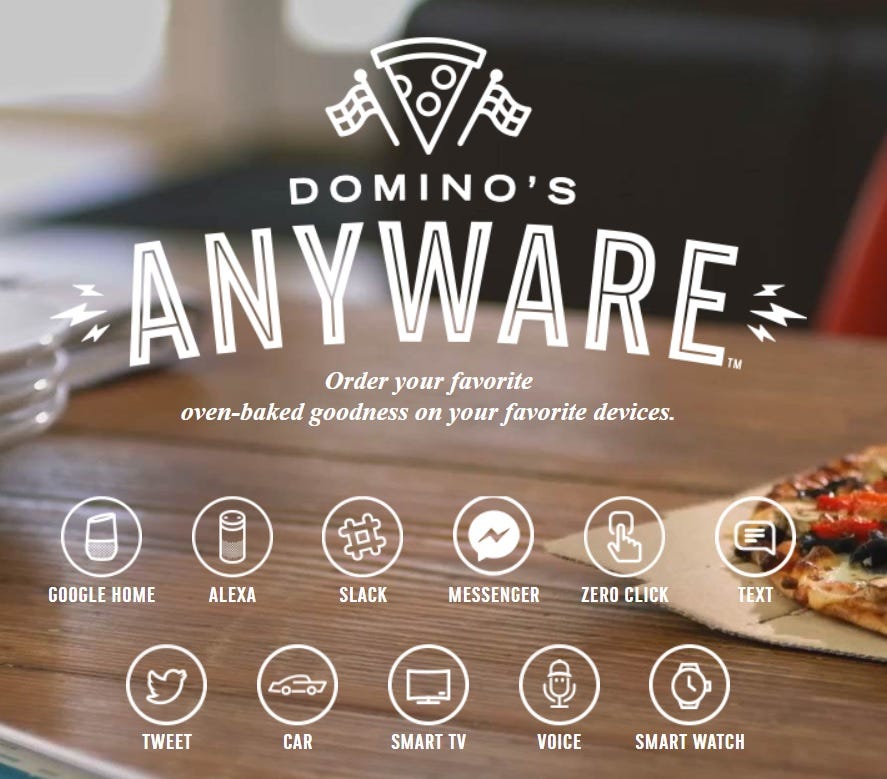
One of the campaign’s most memorable innovations was Tweet to Order. Launched in May 2015, it allowed customers with a saved Easy Order to reorder by tweeting the pizza emoji or #EasyOrder to @Dominos.
Domino’s also introduced ordering by text message in June 2015. Customers could send the pizza emoji or “Easy Order” to the company’s designated number to reorder their saved meal.
The AnyWare initiative was supported by a national television campaign launched in August 2015. The commercials featured celebrities such as Eva Longoria, Sarah Hyland, Richard Sherman, and Clark Gregg demonstrating different ordering methods.
The campaign generated substantial earned media attention. A campaign case study reported approximately 2 billion earned media impressions and more than 500,000 visits to DominosAnyWare.com.
Domino’s reported 10.5% U.S. same-store sales growth in Q3 2015, the quarter during which the AnyWare television campaign ran. However, the company’s financial results do not establish that AnyWare alone caused this growth; sales performance reflected multiple marketing and operational factors.
AnyWare’s broader strategic significance was its demonstration that reducing friction at the point of ordering can itself be a marketing advantage. The initiative helped reinforce Domino’s image as a digital-ordering innovator, not simply a traditional pizza chain.
The underlying principle continues to shape Domino’s digital strategy: make ordering easier, faster, and more accessible across customer touchpoints. Each new ordering interface can serve both as a convenience feature and as a signal of the brand’s commitment to technology-led customer experience.
Historical note: Amazon Echo ordering was added to Domino’s AnyWare options in 2016, rather than being part of the original 2015 launch.
3. The Pizza Turnaround: Radical Transparency as Marketing (2009-2010)
In late 2009, Domino’s made a bold decision that many consumer brands would consider reputationally risky: it openly acknowledged that customers were dissatisfied with its pizza.
Rather than defend its existing product, the company used customer criticism as the starting point for a major product and marketing turnaround. The campaign, known as “Pizza Turnaround,” was built around the idea that Domino’s had listened to its customers and was prepared to make meaningful changes.
The campaign featured real customer feedback, including complaints that the pizza crust tasted like cardboard. Domino’s employees and executives were shown confronting this criticism and explaining how the company had worked to improve its core pizza recipe.

The reformulated pizza included changes to the crust, sauce, and cheese. Domino’s introduced the new recipe in the United States in late December 2009, supported by a documentary-style advertising campaign and the message “Oh Yes We Did.”

The campaign’s television advertisements directed viewers to an online documentary explaining the product reinvention process. Domino’s also used its campaign website to share customer feedback and comments from social media, including both positive and negative reactions to the new pizza.
The campaign was notable for its willingness to make criticism part of the brand’s public communication. Instead of presenting only polished product claims, Domino’s showed the problem, the response, and the effort to improve the product.
Domino’s reported $23.6 million in net income for Q4 2009, compared with $11.0 million in the prior-year quarter. The quarter included a 53rd week, and the company’s results reflected several business factors. The campaign should therefore not be treated as the sole cause of the increase.
The campaign received significant recognition in the advertising industry. It won the 2011 David Ogilvy Award from the Advertising Research Foundation and a D&AD Yellow Pencil. ARF Pizza Turnaround case study · D&AD award record
The strategic lesson of Pizza Turnaround was that acknowledging a weakness can strengthen a brand when it is accompanied by credible action. Domino’s did not rely on messaging alone; it connected its admission to a tangible product improvement.
The campaign helped establish a more direct and self-aware brand personality—one willing to engage with criticism rather than simply deflect it. It remains a widely discussed example of using transparency, customer feedback, and product reformulation as the foundation of brand communication.
4. Paving for Pizza: When Brand Purpose Meets Brand Utility (2018)
“Paving for Pizza” is one of Domino’s most distinctive brand utility campaigns. Launched in June 2018, it was built around a simple customer insight: potholes and damaged roads can disrupt a pizza during the journey home, particularly for carryout customers.
Instead of treating road conditions as a problem outside its control, Domino’s decided to help address it. The company partnered with local municipalities and provided grants to support pothole repairs and road paving in communities across the United States.
The campaign invited customers to nominate their towns through a dedicated website, PavingForPizza.com. The idea connected a practical community problem with Domino’s core promise of getting pizza safely from the store to the customer.
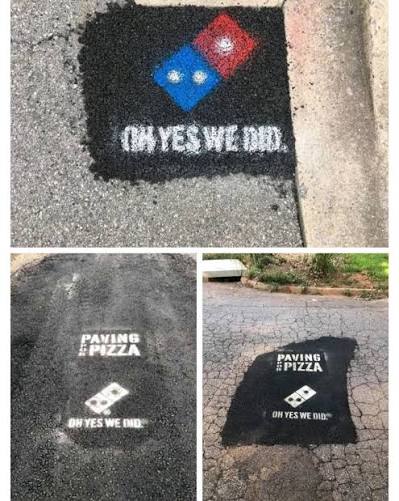

The response was substantial. By August 2018, Domino’s reported receiving more than 137,000 nominations from 15,275 ZIP codes across all 50 states. Following the response, the company expanded the initiative to provide paving grants in communities across the country.
The campaign also generated strong publicity and community participation. Local road crews carried out repairs with support from Domino’s grants, while campaign materials and branded roadwork vehicles helped make the initiative visible in participating communities.
“Paving for Pizza” received industry recognition, including Gold Lions at the 2019 Cannes Lions International Festival of Creativity in Brand Experience & Activation and Outdoor.
The campaign worked because it combined a genuine customer benefit with a memorable brand idea. Domino’s was not simply advertising pizza quality; it was taking action on a problem that could affect the product before customers even opened the box.
Strategically, “Paving for Pizza” demonstrated how a brand can turn an everyday customer frustration into a meaningful marketing platform. It connected product quality, community involvement, public relations, and customer experience through one clear idea: helping customers get their pizza home in better condition.
5. Emergency Pizza: Loyalty and Promotional Campaign (2023-2025)
“Emergency Pizza” became one of Domino’s most recognizable loyalty promotions in recent years. Launched in October 2023, the campaign gave customers a memorable way to use a free pizza offer whenever they experienced a “pizza emergency.”
The promotion offered eligible customers a free medium, two-topping pizza to redeem later. Customers needed to place a qualifying online order and be enrolled in Domino’s Rewards, subject to the offer’s terms.

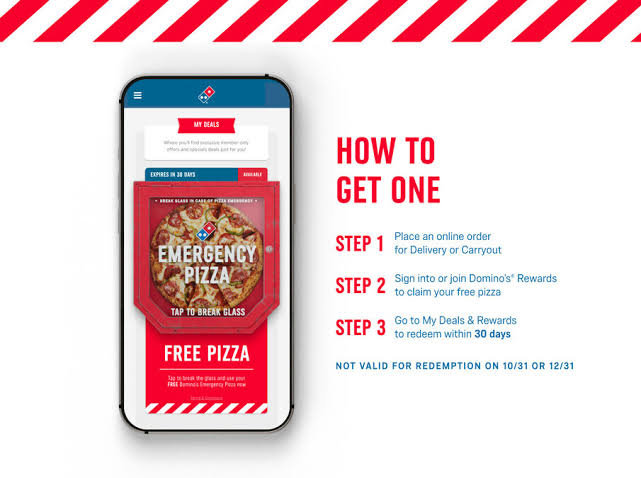
The campaign was built around a relatable idea: sometimes dinner plans fail, unexpected guests arrive, or people simply need an easy meal. Domino’s turned these everyday situations into a branded reason to order pizza.
Emergency Pizza also supported Domino’s loyalty strategy. The company relaunched Domino’s Rewards in September 2023, making it easier for members to redeem rewards across different menu categories.
Domino’s reported that the revamped program enrolled approximately 2 million new members since September 2023 and ended the year with around 33 million active members. In its 2023 Annual Report, the company said Emergency Pizza drove incremental orders and helped jump-start the Rewards relaunch.
Domino’s U.S. same-store sales increased 2.8% in Q4 2023. The company reported positive sales momentum during the quarter, but the sales increase should not be attributed solely to Emergency Pizza.
The promotion returned in October 2024 with a broader set of partnerships and activations. Domino’s collaborated with Amazon’s Twitch, the beauty brand Olive & June, and Netflix’s Squid Game to bring the Emergency Pizza concept into gaming, beauty, and entertainment.
One of the campaign’s most notable activations involved NFL player Stefon Diggs. Domino’s announced a promotion offering $1 million worth of Emergency Pizzas to eligible fantasy-football players who had Diggs on their roster.
The campaign also coincided with continued growth in Domino’s Rewards. The program had approximately 33 million active members at the end of 2023, grew to 35.7 million at the end of 2024, and reached 37.3 million by the end of 2025.
Emergency Pizza demonstrated how a promotional offer can do more than generate a short-term order. By tying the reward to Domino’s Rewards, the campaign encouraged customers to join the loyalty program, return for another purchase, and maintain a relationship with the brand.
The U.S. Emergency Pizza campaign has since ended, according to Domino’s current campaign page. Its broader marketing lesson remains relevant: a simple, emotionally relatable promotion can create brand engagement while supporting customer acquisition and repeat purchasing.
6. Aggregator Partnership Strategy: Uber Eats and DoorDash
For years, Domino’s Pizza resisted listing its products on third-party delivery platforms such as Uber Eats and DoorDash. The company preferred to drive orders through its own website and mobile app, where it could maintain direct customer relationships and have greater control over the ordering experience.
That strategy began to change in late 2023, when Domino’s announced a partnership with Uber Eats and Postmates. The rollout began with a Las Vegas pilot before expanding across the United States in 2024.
The move gave Domino’s access to customers who discover restaurants through delivery marketplaces, including occasional pizza buyers and customers who may not have the Domino’s app installed. Rather than replacing its own digital channels, the company positioned aggregators as an additional way to reach potential customers.
The partnership delivered an early contribution. In Q1 2024, Domino’s reported 5.6% U.S. same-store sales growth. The company highlighted its revamped Domino’s Rewards program as a major driver of the quarter’s performance, while its CEO also discussed Uber Eats as an important new channel for customer acquisition. It would be more accurate to describe the quarter as a strong result supported by multiple initiatives, rather than attributing the entire sales increase to Uber Eats.
Domino’s later reported that Uber Eats accounted for approximately 3% of U.S. sales in 2024, marking its first full year in the aggregator channel. In its 2024 Annual Report, the company described aggregators as the other side of its “Renowned Value barbell strategy”—complementing the value and customer relationship it builds through its own ordering channels.
In April 2025, Domino’s announced a partnership with DoorDash. The U.S. nationwide rollout was scheduled to begin in May 2025, with orders placed through DoorDash Marketplace fulfilled by Domino’s own drivers. The company said the partnership would help it reach incremental customers, particularly in suburban and rural markets.
Domino’s subsequently reported that the DoorDash launch, together with Uber Eats, expanded its presence on the two largest U.S. aggregator platforms and supported its efforts to reach new customers and increase order growth.
The strategy is not simply to shift all orders to third-party platforms. Domino’s continues to operate its own website and app, while using aggregators to make the brand more visible to customers who prefer ordering through a marketplace.
This creates a two-channel approach: owned channels support direct customer engagement and loyalty, while aggregators extend reach and help acquire incremental customers. Domino’s has identified the aggregator marketplace as a significant growth opportunity, while continuing to leverage its established delivery network.
The broader marketing lesson is that third-party platforms do not have to replace a brand’s direct digital ecosystem. When managed as an additional acquisition and ordering channel, they can help a company reach new customers while preserving its own channels for ongoing engagement and repeat business.
7. Domino’s Rewards: The Loyalty Engine Powering Digital Growth
Domino’s Rewards is a key part of Domino’s customer retention strategy. The program was previously known as Piece of the Pie Rewards and was redesigned in September 2023 to make earning and redeeming rewards more accessible.
Domino’s Rewards is designed to encourage customers to order more frequently by offering points and rewards for qualifying purchases. The program also supports the company’s broader strategy of building direct relationships with customers through its website and mobile app.

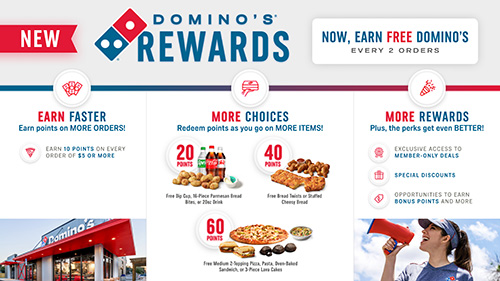
The program reached 37.3 million active members by the end of 2025, according to Domino’s CEO. That represented nearly 20% growth compared with the program’s relaunch in 2023, demonstrating the scale of the company’s loyalty ecosystem.
The September 2023 relaunch addressed a limitation of the previous loyalty structure: customers generally needed to order six times before earning a free pizza. This made it difficult for lower-frequency customers to receive a meaningful reward within a reasonable period.
Domino’s lowered the minimum spend required to earn points from $10 to $5, making the program more accessible to customers placing smaller orders, including carryout purchases.
The company also introduced 20-, 40- and 60-point redemption tiers, allowing members to redeem points for different menu items before reaching the highest reward threshold. The lower tiers included items such as beverages, Parmesan Bread Bites and dipping cups, while higher tiers offered items such as pizza, sandwiches and pasta.
These changes were intended to attract light users and strengthen the company’s carryout business. Domino’s discussed this objective in its 2023 Annual Report, noting that customers could now access rewards after fewer purchases.
Domino’s Rewards also gives the company a substantial base of members it can engage through targeted marketing. In its 2024 Annual Report, Domino’s said its 35.7 million active members at the end of 2024 provided an opportunity to drive order frequency through targeted and personalized marketing efforts.
The loyalty program can help Domino’s understand customer engagement through purchase and redemption activity, while encouraging members to return through points and offers. The company’s 2025 Annual Report describes the program as a way for customers to earn points on qualifying orders and redeem them for a wide selection of menu items.
By combining accessible rewards with personalized engagement, Domino’s Rewards supports the company’s broader retention strategy. It gives customers a tangible reason to return while helping Domino’s encourage repeat purchases and strengthen its direct relationship with its customer base.
8. Social Media Marketing and Influencer Partnerships
Domino’s uses social media as an important part of its brand communication, customer engagement and promotional strategy. Its social presence spans platforms such as Facebook, Instagram, X, YouTube and TikTok.
The brand’s social media voice is often direct, playful and self-aware. This tone reflects the transparency-led approach established by its Pizza Turnaround campaign, in which Domino’s openly addressed customer criticism and showed how it was improving its pizza.
Social media serves several purposes for Domino’s. It helps the company tell brand stories, distribute promotional offers, respond to customer questions and complaints, and participate in conversations around food and popular culture.
Domino’s has also used social media to connect with audiences beyond traditional food advertising. Its 2024 Emergency Pizza campaign included a partnership with Twitch and its gaming experience The Glitch, alongside collaborations with Netflix’s Squid Game, NFL player Stefon Diggs and beauty brand Olive & June. These partnerships helped bring the promotion into gaming, entertainment and lifestyle conversations.
The brand also adapts its content to individual platforms. For example, Domino’s has worked with creators and used TikTok-first formats to promote product launches, including its Domino’s Fuego campaign in Mexico, which incorporated creator videos and user participation.
Social media is also an important customer service channel. In 2021, Domino’s selected Emplifi’s social engagement platform to help identify customer posts requiring attention across platforms such as Twitter and Facebook. This supported a more organized approach to responding to customer questions and feedback.
Domino’s social strategy increasingly emphasizes short-form video and active community management. In a recent social agency collaboration, the brand focused on TikTok, Instagram and YouTube Shorts, using food-led videos, playful content and proactive replies to engage younger audiences. The agency reported increased audience interactions following the rollout.
Overall, Domino’s social media marketing combines entertainment, promotional communication and customer interaction. Rather than relying only on conventional advertising, the brand uses creator partnerships, platform-native content and responsive community management to remain visible in consumers’ everyday digital conversations.
9. Menu Innovation as a Marketing Catalyst
Menu innovation is an important part of Domino’s marketing strategy. New products and limited-time offers (LTOs) give customers fresh reasons to order, help attract lapsed customers and create opportunities for promotional campaigns across paid, owned and earned media.
Limited-time offers can create urgency by giving customers a reason to try a product before it leaves the menu. Permanent menu additions, meanwhile, help broaden the brand’s appeal and increase the number of occasions when customers may consider ordering from Domino’s.
Domino’s regularly introduces new crusts, toppings and menu items to appeal to different customer preferences. In April 2024, the company launched its New York Style Pizza, featuring thin, hand-stretched dough and large, foldable slices.

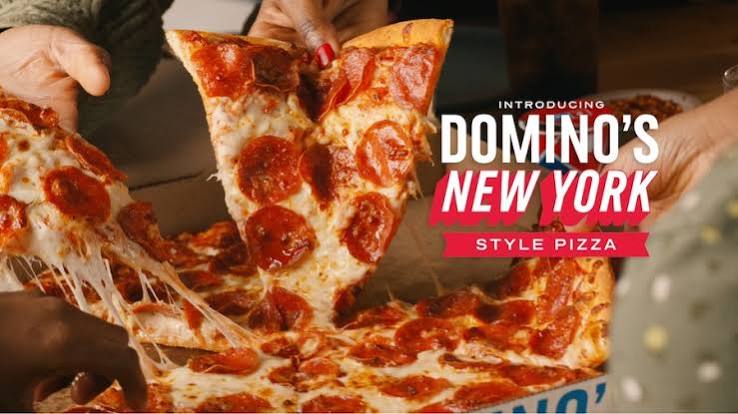
At launch, Domino’s supported the product with promotional offers. Members of Domino’s Rewards could redeem 60 points for a free medium two-topping New York Style Pizza, connecting menu innovation with its loyalty program.
In March 2025, Domino’s introduced Parmesan Stuffed Crust, its first-ever stuffed crust pizza in the U.S. The launch was supported by a campaign offering $250,000 worth of free pizzas to customers who had previously ordered stuffed crust from competitors.
The product became a significant contributor to the company’s U.S. sales performance. Domino’s reported that its 2025 U.S. same-store sales increased 3.0%, with higher transaction counts and average ticket both driven in part by the launch of Parmesan Stuffed Crust. The company also credited its “Best Deal Ever” promotions with supporting transaction growth.
Domino’s menu extends beyond traditional pizza to include items such as pasta, chicken, bread bites, desserts and other sides. Products such as Stuffed Cheesy Bread and Chocolate Lava Crunch Cakes give customers additional choices for snacks, sides and desserts.
This broader menu helps Domino’s position itself as more than a pizza-only brand. Customers can combine pizza with sides and desserts, creating opportunities to increase order value and appeal to different meal occasions.
Menu variety also provides the company with more products to feature in promotional offers, seasonal campaigns and loyalty rewards.
New menu items can serve as both products and marketing assets. A distinctive crust, indulgent topping combination or visually appealing side can provide material for advertising, social media videos, creator partnerships and limited-time promotions.
Domino’s Parmesan Stuffed Crust launch illustrates this approach: the product itself became the central message of the campaign, while the competitor-focused giveaway helped generate additional attention around the launch.
Domino’s also offers customers extensive pizza customization through its online ordering platform, allowing them to select crusts, sauces, cheeses and toppings. This flexibility gives customers greater control over their orders and creates a more personalized ordering experience.
Overall, Domino’s menu innovation strategy combines product development with promotional marketing. By introducing new products, linking them to loyalty rewards and supporting launches with integrated campaigns, the company uses menu innovation to encourage trial, increase order value and give customers fresh reasons to return.
10. The “You Got 30 Minutes” Legacy and Delivery Speed Marketing
Fast delivery has long been central to Domino’s brand identity. The company’s early focus on delivery speed helped establish it as a convenient option for customers looking for pizza delivered to their homes.
One of the most recognizable examples was Domino’s “30 Minutes or Free” guarantee, introduced in the 1980s. The promotion promised free pizza if an order did not arrive within 30 minutes, subject to its terms and conditions.

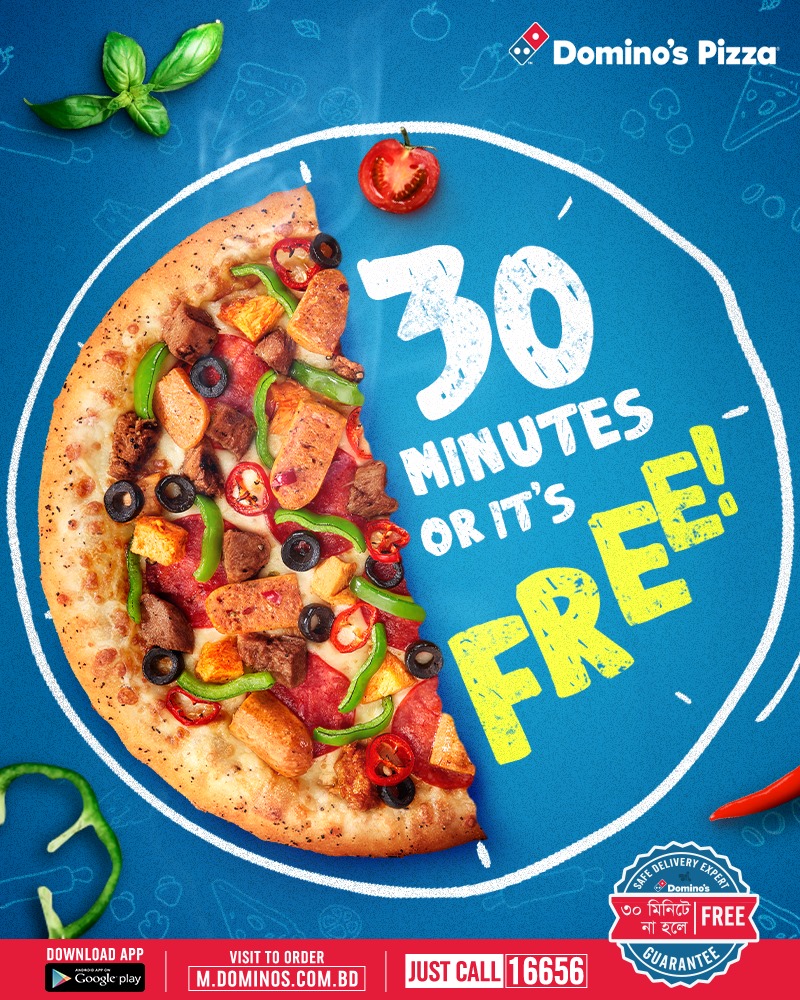
The guarantee became closely associated with the brand’s positioning around speed. However, Domino’s discontinued it in 1993 amid concerns about delivery driver safety and the risks created by strict delivery-time pressure.
In 2007, Domino’s revisited the 30-minute theme through its “You Got 30 Minutes” campaign. Unlike the original guarantee, this campaign did not promise delivery within 30 minutes.
Instead, it focused on the time customers gained by ordering pizza rather than preparing a meal themselves. Domino’s described the campaign as a way to build on its delivery heritage while emphasizing convenience and the value of customers’ free time.
Today, Domino’s communicates its delivery convenience through technology rather than a strict delivery-time guarantee. Its Pizza Tracker was introduced in 2008, allowing customers to follow their order from placement through preparation and delivery or pickup.
The Tracker provides updates as an order progresses through stages such as preparation, baking and being out for delivery. Domino’s says the tool has tracked more than 2.5 billion orders since its launch.
In March 2026, Domino’s updated the Tracker with a clearer interface, more detailed order-progress information and a more precise ready time using AI technology. The update reinforces the role of order visibility in the customer experience.
The Tracker is more than an operational feature. By showing customers what is happening with their order, it helps make the waiting period more transparent and gives customers a reason to interact with Domino’s digital platforms after placing an order.
Domino’s also supports its convenience positioning through its “fortressing” strategy—opening additional stores in selected markets to improve geographic coverage and bring stores closer to customers.
A denser store network can help reduce delivery distances in targeted areas and support more efficient delivery operations. This approach connects store expansion with the customer experience, rather than treating new locations only as a way to increase sales.
Domino’s continued to expand its U.S. network in 2025, opening 172 net new U.S. stores during the fiscal year. The company reported 776 net new stores globally. These figures demonstrate continued network expansion, although the annual report does not attribute the U.S. store openings specifically to fortressing or quantify their effect on delivery speed.
Overall, Domino’s delivery strategy has evolved from a bold time-based guarantee to a combination of delivery heritage, digital order tracking and a growing store network. The brand continues to market convenience, while relying on technology and operations to support the customer experience without promising a fixed delivery time.
11. Promotional Offers, Gamification, and Value Marketing
Domino’s promotional strategy combines value pricing, loyalty rewards and limited-time offers to give customers multiple reasons to order. Its value-focused deals are designed to attract price-conscious customers while encouraging them to add more items to their orders.
The company uses promotions not only to drive immediate sales, but also to encourage repeat purchases and maintain customer engagement throughout the year.
One of Domino’s most recognizable value promotions is its Mix & Match Deal, which allows customers to choose two or more qualifying menu items at a set price per item.
The offer typically includes a selection of pizzas, sides and other menu items, with certain products or crusts carrying an additional charge. Prices and participation can vary by location.
By allowing customers to combine different items, Mix & Match encourages group ordering and gives customers flexibility when building a meal. It also provides Domino’s with a recurring promotional platform that can be refreshed through new products and seasonal advertising.
Domino’s also uses other value-focused promotions, including carryout offers and its Best Deal Ever campaign. In March 2026, the company brought back the offer during the college basketball tournament, promoting pizzas with any toppings for $9.99 each.
Domino’s uses Domino’s Rewards to encourage customers to return and place qualifying orders. Members earn points and can redeem them for menu items, creating an additional incentive to order directly through Domino’s digital channels.
The company also uses limited-time offers and campaign-based promotions to create reasons to order beyond everyday meal occasions. These promotions can be linked to new product launches, seasonal events or broader brand campaigns.
Domino’s has experimented with interactive promotional concepts, but features such as spin wheels, scratch cards and leaderboards should only be described as active when confirmed for the specific market and campaign period.
Domino’s frequently connects promotions with major sporting and cultural moments, when consumers gather to watch games or share meals. College basketball tournament season, football and other high-interest events provide opportunities for value-led advertising and group-ordering messages.
In March 2026, Domino’s tied its Best Deal Ever promotion to the college basketball tournament, using the event to encourage customers to order pizza while watching games with friends and family.
In December 2024, Domino’s partnered with NFL wide receiver Stefon Diggs for a fantasy-football promotion offering $1 million worth of free Emergency Pizzas.
The campaign targeted fantasy football players who had drafted Diggs and were affected by his season-ending injury. Eligible participants could submit proof of having Diggs on their fantasy roster for a chance to win a free pizza.
The promotion connected a real football storyline with Domino’s Emergency Pizza concept, turning disappointment among fantasy players into a humorous brand moment. It also gave Domino’s an opportunity to engage with the fantasy-football community during the season’s playoff period.
Fantasy football had an estimated audience of around 30 million players in the U.S., giving the campaign access to a highly engaged sports audience. However, that figure represents the broader fantasy-football audience, not the number of people reached by the promotion itself.
Overall, Domino’s promotional strategy combines everyday value offers with loyalty incentives and event-driven campaigns. By using promotions that fit different occasions—from routine family meals to major sporting events—the brand creates recurring reasons for customers to choose Domino’s.
12. Food Blog Collaboration and Creator Economy Partnerships
Domino’s uses creator partnerships to bring its products into the food, entertainment and lifestyle content that audiences already enjoy. Collaborating with creators allows the brand to communicate through familiar voices and formats, including product reviews, food challenges, social storytelling and promotional content.
These partnerships take different forms across markets. In the UK, Domino’s worked with student-focused creators on TikTok to introduce its Ultimate Chicken Mexicana pizza. According to the campaign partner, four influencers helped generate awareness among Gen Z audiences, with the campaign recording a 34% year-on-year increase in views and 38% increase in clicks.
Domino’s has also used creators to contribute directly to product development. In Spain, the brand partnered with Twitch streamer Ibai on The Toughest, a campaign built around an unusual pizza recipe created by the influencer. Ibai shared the story with his community before Domino’s made the pizza available, then amplified the campaign through YouTube.
In France, Domino’s worked with creator Matteo Larzize for a BeReal campaign during the football World Cup period. Rather than relying only on conventional brand advertising, the campaign featured creator-led content designed to fit the platform’s style. BeReal reported that the creator assets achieved a 17% higher click-through rate than the campaign’s other assets.
Domino’s has increasingly incorporated creators into broader promotional campaigns, rather than limiting partnerships to standalone sponsored posts. In March 2026, the brand promoted its Best Deal Ever through a social-first campaign featuring creators’ personal pizza customizations, including those of Jesser, Trisha Paytas and Courtney Cook. Consumers could explore and order the featured combinations through a dedicated landing page.
This approach gives audiences a more personal way to engage with a promotion: they can discover a creator’s preferred combination and try it themselves. It also connects creator content with a clear purchase opportunity, helping the campaign move beyond awareness and into product consideration and ordering.
Creator partnerships can also support product launches and limited-time offers. However, the available examples show that campaign formats and launch sequencing vary by market; they do not establish that Domino’s routinely runs a creator-seeding program before every product launch or consistently releases creator content before paid advertising begins.
Overall, Domino’s creator marketing demonstrates how the brand can use platform-native storytelling, creator participation and product-focused promotions to reach audiences in relevant digital environments. The strongest examples combine a creator’s established content style with a clear Domino’s product, offer or campaign objective.
13. Franchisee Network Support and Co-operative Marketing
Domino’s marketing strategy is built around a partnership between corporate brand leadership and independently operated franchise locations. As of December 28, 2025, approximately 99% of Domino’s global stores were owned and operated by franchisees, making franchisee participation central to the execution of the company’s marketing strategy.
Domino’s corporate team establishes brand standards and provides franchisees with ongoing support, including training, marketing assistance and consultation. Franchisees also operate within the company’s broader brand and operating system, which helps maintain consistency across the network while allowing local business owners to manage their stores.
The company’s franchise model combines system-wide brand direction with local execution. Domino’s requires franchisees to follow specified operating and brand standards, while franchisees generally retain discretion over customer pricing and are responsible for adapting marketing activity to their local markets.
In the United States, Domino’s national marketing is supported by contributions from franchise stores to the Domino’s National Advertising Fund (DNAF). U.S. stores generally contribute 6% of sales toward national and market-level advertising, although certain incentives or waivers may result in lower contributions.
The fund supports more than media buying. According to the company’s annual report, it also helps finance market research, field communications, public relations, commercial production, talent payments and other activities that promote the Domino’s brand.
Alongside national advertising, U.S. stores generally invest additional funds in local store marketing (LSM). This allows individual stores to support neighborhood-level promotions and customer engagement while reinforcing the brand’s broader advertising message.
Domino’s also uses market-level advertising contributions and, where applicable, local or regional advertising cooperatives. These arrangements allow stores in participating markets to pool resources for campaigns that complement national marketing. However, cooperative structures and requirements can vary by market and franchise arrangement.
Domino’s international marketing model gives local franchisees and master franchisees an important role in adapting the brand to regional markets. The company’s 2025 Annual Report explains that international franchisees adapt Domino’s operating model to local eating habits and consumer preferences.
This structure allows Domino’s to maintain a recognizable global brand while offering market-specific products, promotions and messaging. Local franchise partners bring knowledge of consumer behavior, culture, competition and market conditions, helping the brand remain relevant in different countries.
Technology is a central part of Domino’s franchise operating system. The company’s proprietary Domino’s PULSE point-of-sale system and broader Domino’s Operating System (DOM OS) integrate tools and processes that help stores manage orders and operations. Domino’s says these systems are designed to support operating efficiency and help franchisees manage their businesses independently.
Digital ordering is also a major part of the company’s marketing ecosystem. In 2025, more than 85% of U.S. retail sales came through digital channels, according to Domino’s 2025 Annual Report. This makes the effective use of digital ordering platforms, loyalty features and online promotions important to franchise-level execution.
Domino’s also uses regional franchise teams, franchise advisory groups and materials that help stores comply with company standards. These mechanisms support communication between corporate leadership and franchisees, although specific digital marketing training modules or aggregator-management playbooks are not detailed in the public disclosures cited here.
Large campaigns such as Emergency Pizza, launched in 2023, illustrate why coordination between corporate marketing and individual stores is important. The promotion offered eligible Domino’s Rewards members a free Emergency Pizza for use with a qualifying order, combining a national customer-facing offer with store-level fulfillment.
For a promotion of this scale, stores must be able to recognize the offer, process eligible redemptions and fulfill orders in line with the advertised terms. Domino’s public announcement confirms the campaign and its customer offer, but does not disclose the specific franchisee operational protocols, marketing playbooks or performance benchmarks described in the original draft.
Overall, Domino’s franchise marketing model balances centralized brand direction, system-wide advertising investment and local market execution. Its scale depends not only on national campaigns, but also on franchisees’ ability to deliver the product, service and promotional experience promised by the brand.
Marketing Mix of Domino’s Pizza (4Ps Analysis)
The marketing mix framework—comprising Product, Price, Place, and Promotion—provides a structured lens through which to understand how Domino’s creates and delivers customer value across its global footprint.
Product
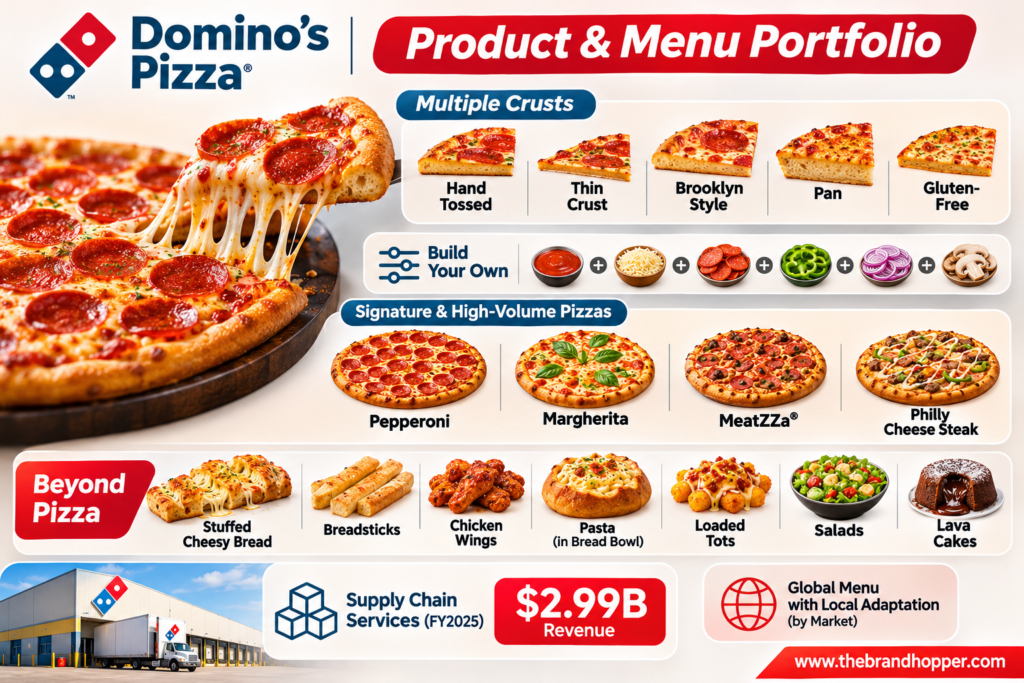
Domino’s core product is pizza, available across a range of formats that have expanded significantly over the brand’s history. The current menu architecture spans multiple crust options (Hand Tossed, Thin Crust, Brooklyn Style, Pan, Gluten-Free), a wide range of specialty and classic pizza recipes, and an extensive customization platform through which customers can build any combination of sauce, cheese, and toppings from a comprehensive ingredients library. The New York Style Pizza, Stuffed Cheesy Bread, and specialty items like the Philly Cheese Steak and MeatZZa are among the highest-volume menu items alongside the perennially popular Pepperoni and Margherita classics.
Beyond pizza, Domino’s has built a substantial complementary menu: breadsticks, Stuffed Cheesy Bread, chicken wings (bone-in and boneless, multiple sauces), pasta in a bread bowl, loaded tots, salads, and a rotating dessert lineup including lava cakes and cinnamon breadsticks. This “meal solution” positioning is strategically important: it increases the average transaction value, makes Domino’s a suitable option for group orders with diverse preferences, and reduces reliance on the pizza category’s competitive intensity.
Product consistency is supported by standardized sourcing and specifications, particularly through Domino’s Supply Chain Services in the U.S. and parts of Canada. The supply chain segment generated approximately $2.99 billion in revenue in fiscal 2025 and supplied food and products to thousands of stores. International franchisees also follow brand standards while adapting menus and ingredients to local markets; therefore, menu offerings are not identical in every country.
Price
Domino’s pricing strategy operates on a value architecture designed to capture customers across a wide income and spending spectrum. At the entry level, the brand offers value through promotions such as Mix and Match, which allows customers to combine qualifying menu items at a set promotional price. At the mid-tier, specialty pizzas and combo deals deliver a “value for money” proposition that positions Domino’s favorably against both premium pizza competitors (Pizza Hut’s Stuffed Crust) and fast-food alternatives. At the premium tier, Domino’s premium specialty pizzas and add-on items (wings, desserts, beverages) allow higher-spending customers to build large orders with significant item variety.
Domino’s pricing and promotions can vary by market, order channel, and offer. App and website deals can encourage digital ordering, which is central to the brand’s customer experience and loyalty strategy. Domino’s Rewards members receive additional price advantages through points-based redemptions—a free medium pizza every time 60 points are accumulated—creating a perceived discount for loyal customers without permanently reducing headline prices.
Promotional pricing, limited-time offers, and event-based deals allow Domino’s to respond to competitive pressure and encourage orders while maintaining its value positioning. The aggregator channel (Uber Eats, DoorDash) adds a layer of pricing complexity: Pricing and fees on aggregator platforms can differ from Domino’s direct channels by market, platform, and promotion. These partnerships expand customer reach but add commercial and operational considerations.
Place
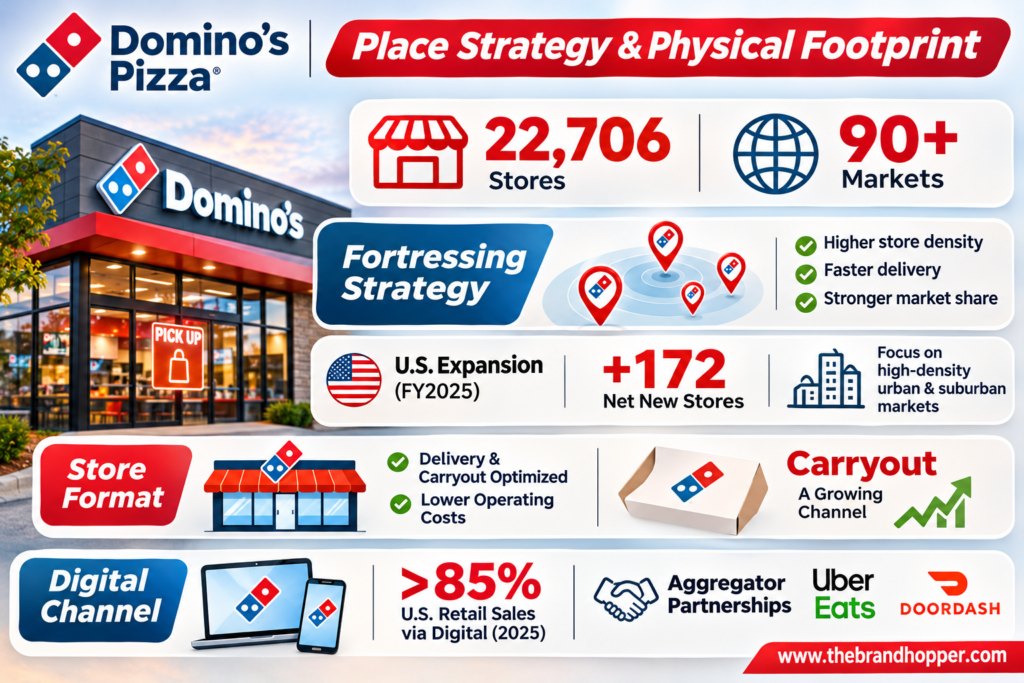
Domino’s physical footprint—22,706 stores in more than 90 markets as of September 6, 2026—represents the brand’s foundational place strategy. Store locations are planned around delivery coverage, local demand, market potential, and operating efficiency. The brand’s “Fortressing” strategy deliberately increases store density in existing successful markets—accepting some cannibalization of individual store sales in exchange for shorter delivery distances, faster service, and market share protection against competitors. The 172 net new U.S. stores opened in fiscal year 2025 contributed to continued fortressing in high-density urban and suburban markets.
The brand’s store format is primarily delivery-and-carryout optimized—most Domino’s stores are designed for operational efficiency rather than dine-in capacity. This layout reduces occupancy costs significantly compared to full dine-in QSR formats, enabling Domino’s to maintain lower prices while sustaining healthy unit economics. Carryout has grown as a share of Domino’s business, with the loyalty program’s inclusion of carryout orders (a 2023 change) accelerating this trend—carryout has become an important growth channel, supported by the loyalty program’s inclusion of carryout orders.
The digital channel is a parallel “place” dimension: Domino’s website and mobile apps generated more than 85% of U.S. retail sales through digital channels in 2025. Aggregator partnerships with Uber Eats and DoorDash extend its presence to customers who prefer third-party platforms. International franchise operations adapt the place strategy to local infrastructure, delivery norms, and regulatory environments—resulting in diverse store formats across markets while maintaining consistent brand standards.
Promotion
Domino’s promotional strategy is one of the most sophisticated and multi-layered in the QSR industry, integrating paid advertising (television, digital, out-of-home), owned media (app, email, in-store), earned media (PR, influencer partnerships, social media), and loyalty-based promotions into a unified communications ecosystem. National television remains a significant investment—Super Bowl adjacency, NFL game breaks, and primetime television reach the broad consumer base that digital-only campaigns miss—while digital advertising (programmatic display, social media, search, connected TV) enables the precision targeting and performance measurement that television cannot provide.
The brand’s promotional calendar is structured around cultural moments (sporting events, holidays, back-to-school, college football season), new product launches, and loyalty program activations. Each promotional moment typically integrates across all channels: a television spot drives awareness, digital ads provide personalized reminders, app push notifications create urgency for loyalty members, social media content drives organic sharing, and in-store point-of-sale materials support the carryout channel. This integrated approach ensures that the promotional message reaches customers at multiple touchpoints across their daily media consumption patterns.
Domino’s also invests significantly in public relations—generating earned media through campaign launches (Paving for Pizza, Emergency Pizza), product innovation announcements, and community initiatives that attract coverage in mainstream consumer media, food trade publications, and marketing industry outlets. When Domino’s campaigns earn major creative-industry awards, the resulting coverage can add credibility to the consumer-facing advertising investment.
STP Analysis of Domino’s Pizza
The STP framework—Segmentation, Targeting, and Positioning—explains how Domino’s identifies, pursues, and communicates with the specific customer groups that drive its business growth.
Segmentation
Domino’s segments its market across four primary dimensions:
a. Demographic Segmentation
Domino’s primary demographic segments span a broad age range—families with children (seeking a convenient, crowd-pleasing meal), college students and young adults (value-oriented, digitally native, spontaneous orderers), and working professionals (time-pressed, recurring meal planners). Income segmentation is served by the brand’s tiered pricing structure: value deals capture budget-conscious consumers, while specialty pizzas and premium sides attract mid-to-high income spenders who want quality alongside convenience. Family-size consideration drives large pizza and bundle deal promotions, while single-person ordering occasions are addressed through individual-serve items and digital ordering minimums.
b. Geographic Segmentation
Domino’s geographic segmentation operates at both macro (country/region) and micro (neighborhood/ZIP code) levels. At the macro level, the brand adapts its menu to local taste preferences: Indian stores offer paneer toppings and regional spice profiles, UK stores feature unique pizza varieties, and Australian stores have local specialty items. At the micro level, the Fortressing strategy creates hyperlocal delivery zones with optimized delivery times, and local marketing programs (community sponsorships, school partnerships, local sports team deals) are calibrated to neighborhood-level demographics and preferences.
c. Psychographic Segmentation
Domino’s targets consumers who value convenience as a primary decision driver for meal choices—people who want excellent food without the planning, cooking, or clean-up overhead. This group spans income levels and demographics but is united by a lifestyle orientation toward efficiency and experience over process. Tech-forward consumers—those who embrace digital tools, prefer app-based interactions, and value real-time transparency in their transactions—represent a psychographic sweet spot for Domino’s digital-first ordering strategy. The brand also targets social eaters: groups ordering for parties, sports events, and shared meals where variety and volume matter more than individual customization.
d. Behavioral Segmentation
Domino’s behavioral segmentation distinguishes between high-frequency loyalists (who order weekly or more frequently and are the primary target for the Rewards program), mid-frequency regulars (who order monthly and respond well to promotional triggers), and lapsed or occasional customers (who ordered historically but have reduced frequency and require re-engagement campaigns). The 2023 loyalty relaunch was specifically designed to lower the barrier to meaningful rewards for mid-frequency and occasional orderers—historically a segment underserved by the previous point accumulation structure. Behavioral data from the Domino’s Rewards program enables the brand to track and respond to changes in individual purchase frequency with targeted re-engagement offers.
Targeting
Based on its segmentation analysis, Domino’s focuses its primary marketing investment on four core target segments:
• Convenience Seekers: Busy families, students, and working professionals who prioritize fast, reliable, and predictable meal delivery over price or extreme product diversity. This is Domino’s largest and most commercially valuable segment.
• Tech-Savvy Digital Orderers: Consumers who prefer app-based or aggregator-based ordering and value seamless digital experiences. This segment aligns with Domino’s more than 85% share of U.S. retail sales through digital channels in 2025.
• Value-Oriented Consumers: Price-conscious customers who seek quality pizza at the best available price, responding strongly to Mix and Match deals, promotional offers, and loyalty point redemptions.
• Social and Group Orderers: Friends, families, and colleagues ordering for shared consumption occasions (sports events, parties, game nights) where variety and volume are primary decision criteria.
Positioning
Domino’s competitive positioning has evolved significantly since the Pizza Turnaround campaign of 2009-2010, when the brand deliberately reset its positioning from “value pizza that arrives quickly” to “quality pizza delivered by a technology company.” Domino’s positioning can be described through four reinforcing pillars:
a. Technology Leader in Food Delivery
Domino’s positions itself as a technology-led pizza delivery brand. It was an early national pizza chain to introduce real-time order tracking, developed AnyWare ordering options across connected devices, and generated more than 85% of U.S. retail sales through digital channels in 2025. This positioning is supported by continued investment in its website, mobile apps, and store technology.
b. The “Hungry for More” Growth Brand
CEO Russell Weiner’s “Hungry for More” strategic framework—introduced in 2023 as the guiding philosophy for the brand’s growth plan—positions Domino’s as a company with a growth mentality across all dimensions: more digital, more innovative, more loyal customers, more stores, more international. The framework gives the brand an aspirational positioning that communicates ambition without sacrificing the accessibility and value associations central to its core customer relationships.
c. Transparent, Authentic Brand Character
The Pizza Turnaround established that Domino’s is willing to acknowledge its own failures and change publicly. This transparency—unusual in a consumer brand context—has become a durable competitive advantage: customers trust a brand that is honest about its imperfections more than one that claims perfection. Domino’s maintains this positioning through direct, self-aware advertising, responsive social media engagement, and campaigns like Paving for Pizza that turn product limitations into marketing opportunities.
d. Value and Generosity
Through Emergency Pizza, Domino’s Rewards, and consistent promotional offers, Domino’s positions itself as the most generous brand in the pizza category—the company that gives you free pizza when you have an emergency, rewards your loyalty with meaningful redemptions, and always offers a deal worth ordering for. This “generosity positioning” is particularly powerful in an inflationary consumer environment where every dollar of food spending is scrutinized more carefully than in prior years.
| STP Dimension | Domino’s Approach |
|---|---|
| Segmentation | Demographic (age, family, income), Geographic (local taste), Psychographic (convenience-led), Behavioral (order frequency) |
| Primary Target | Convenience seekers, tech-savvy digital orderers, value-oriented consumers, social group orderers |
| Positioning Pillars | Technology leader, Hungry for More ambition, transparent authenticity, value & generosity |
| Brand Promise | The best pizza delivered fastest, most conveniently, and with the most rewarding loyalty experience in the category |
| Key Differentiator | Digital-first ordering ecosystem, 85%+ digital sales share, 37.3M loyalty members, real-time Pizza Tracker |
Frequently Asked Questions (FAQ)
1. What is Domino’s overall marketing strategy?
Domino’s marketing strategy can be understood through three pillars: digital-first ordering (more than 85% of U.S. retail sales through digital channels in 2025), loyalty-led growth (37.3 million active Rewards users at year-end 2025), and campaign-driven brand relevance (Emergency Pizza, Paving for Pizza, and AnyWare). The “Hungry for MORE” strategy, introduced under former CEO Russell Weiner, combines menu innovation, store growth, technology investment, and aggregator partnerships to drive sales and customer acquisition. Joe Jordan became CEO in 2026.
2. How has Domino’s used technology as a marketing tool?
Domino’s has consistently used technology as a marketing differentiator since its digital ordering expansion in the late 2000s. Key examples include the Tracker (2008), AnyWare (2015, which offered ordering through channels such as tweet, text, smartwatch, and connected devices), and its current website and mobile apps, which generated more than 85% of U.S. retail sales through digital channels in 2025. These tools combine operational convenience with a clear brand message about ease of ordering.
3. What was the Emergency Pizza campaign and why was it so effective?
Emergency Pizza launched in October 2023 as a Rewards-linked offer that gave eligible customers a free medium two-topping pizza after a qualifying online order, subject to its terms. It worked by using a relatable “pizza emergency” insight, encouraging Rewards enrollment, and supporting the September 2023 loyalty program relaunch. Domino’s reported more than 2 million new Rewards members after the relaunch; U.S. same-store sales grew 2.8% in Q4 2023, with Emergency Pizza cited as a contributor. Rewards reached 37.3 million active users at year-end 2025.
4. What is Domino’s STP strategy?
Domino’s can be analyzed through demographic (age, income, family size), geographic (urban density and local tastes), psychographic (convenience-led lifestyles and digital habits), and behavioral (order frequency and channel preference) segmentation. It targets convenience seekers, digital-native orderers, value-oriented consumers, and social group orderers as its primary segments. Its positioning rests on four pillars: technology leadership in food delivery, the “Hungry for More” growth philosophy, transparent brand authenticity (rooted in the Pizza Turnaround), and value and generosity (through Emergency Pizza and Domino’s Rewards).
5. How does Domino’s compare to its competitors in terms of size and digital sophistication?
Domino’s is the world’s largest pizza company by global retail sales, with $20.13 billion in fiscal 2025 from more than 22,100 stores in over 90 markets at year-end. It reported more than 85% of U.S. retail sales through digital channels in 2025, reflecting a long-term investment in online ordering and customer experience. Comparisons with Pizza Hut’s digital share should use consistent definitions and verified data. Its 37.3 million active Domino’s Rewards users at year-end 2025, the Emergency Pizza campaign’s proven customer acquisition mechanics, and its successful aggregator partnership strategy (Uber Eats, DoorDash) represent marketing capabilities that competitors have been unable to replicate at comparable scale.
Conclusion
Domino’s Pizza’s transformation from a Michigan delivery shop into a $20+ billion global retail sales powerhouse is, at its core, a marketing story. The company did not outcompete Pizza Hut and Papa John’s by having better pizza (though the Pizza Turnaround addressed that criticism decisively). It won by understanding earlier than any competitor that the future of food delivery would be digital, that loyalty program design would determine customer lifetime value, that transparency is more persuasive than perfection, and that every touch point in the ordering and delivery journey is a marketing opportunity.
The campaigns that define Domino’s marketing legacy—Pizza Turnaround, AnyWare, Paving for Pizza, Emergency Pizza—share a common characteristic: they are rooted in a genuine product or customer insight that the brand had the courage to act on publicly. This insight-to-action discipline, executed consistently across two decades and reinforced by an increasingly sophisticated digital and loyalty infrastructure, is what separates Domino’s from its competitors in the marketing arena.
With $20.13 billion in global retail sales in fiscal 2025, 37.3 million active Rewards users at year-end 2025, more than 85% of U.S. retail sales through digital channels, and 22,706 stores as of September 6, 2026, Domino’s continues to build on its marketing heritage. Future loyalty and promotional campaigns, the expansion of its aggregator partnerships with Uber Eats and DoorDash, and the forthcoming marketing programs supporting the “Hungry for More” strategy suggest that the most compelling chapters of Domino’s marketing story may still be ahead of it.
Also Read: Subway Marketing Strategy: Fresh Thinking Meets Global Scale
To read more content like this, subscribe to our newsletter
Go to the full page to view and submit the form.