


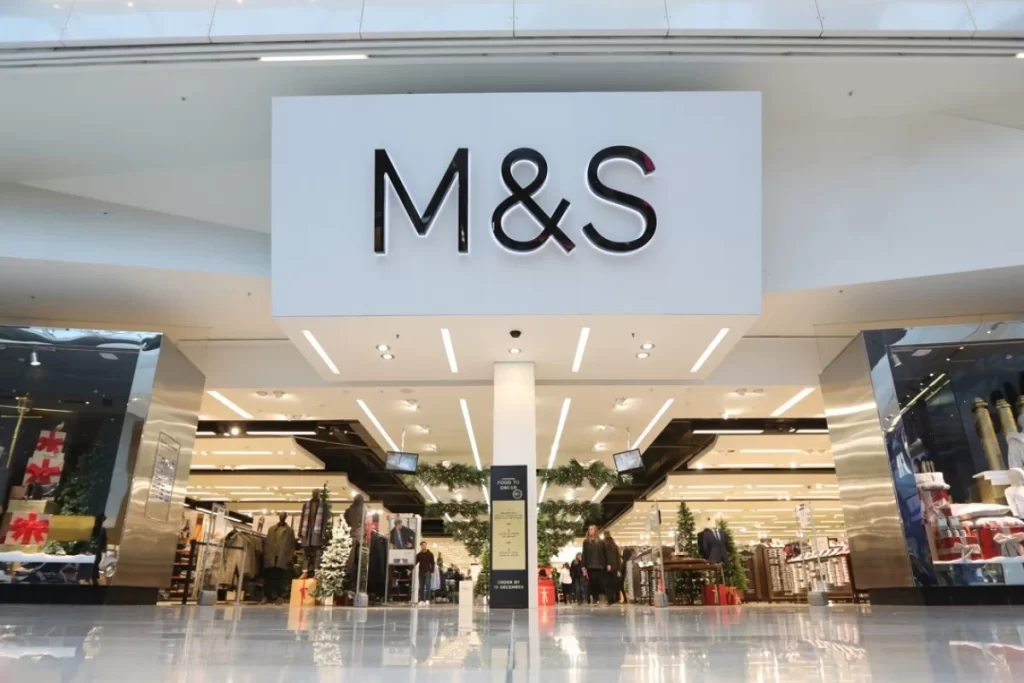
Marks & Spencer (M&S) is one of Britain’s most iconic retailers, with over 140 years of history. Founded in 1884 by Michael Marks and Thomas Spencer, it evolved from a Leeds penny market stall into one of the UK’s most recognised multi-category retail brands, operating across food, clothing, home and beauty.


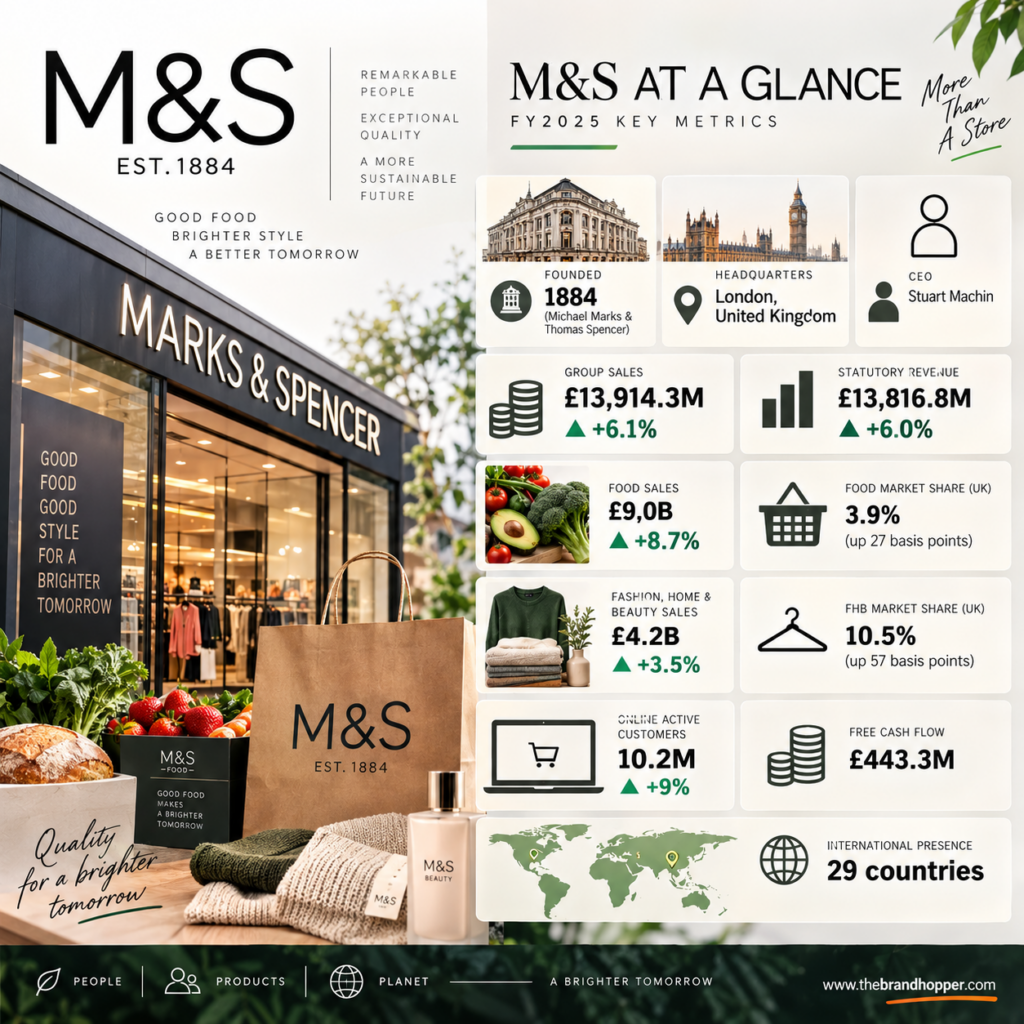
In FY2025, M&S reported group sales of £13.9 billion, a 6.1% increase year-on-year. Profit before tax and adjusting items reached £875.5 million — the highest in over 15 years, representing a third consecutive year of growth in sales, market share and profitability.
This performance is not accidental. It is the product of a deliberate, multi-layered marketing strategy centred on quality-led brand repositioning, digital acceleration, data-driven loyalty, sustainability credentials and carefully curated collaborations.

STP Analysis of Marks & Spencer
Understanding M&S’s marketing strategy begins with its Segmentation, Targeting and Positioning (STP) framework. These three dimensions define who M&S serves, how it reaches them, and what promise it makes to each customer group.
Segmentation
M&S segments its market across demographic, psychographic and geographic dimensions. Demographically, its core food customer tends to be aged 35-65 with mid-to-upper income levels. In Fashion, Home & Beauty (FHB), the brand has broadened its demographic appeal through improved style credentials, contemporary partner brands and an upgraded digital experience.
Psychographically, M&S targets quality-conscious shoppers who value trusted brands and are willing to pay a modest premium for better products. These customers prioritise genuine quality, innovation and brand reliability — and they are highly sensitive to any decline in those attributes.
Geographically, M&S operates across the UK and Republic of Ireland, and through franchise partnerships in 29 countries internationally. The Ocado Retail JV extends M&S Food’s reach to an online-first customer segment that values delivery convenience alongside quality grocery options.
Targeting
M&S’s primary food target is the “shopping list family” — households that want everyday essentials alongside quality treats from a single trusted retailer. The FY2025 result of larger basket shops growing 13% year-on-year confirms this strategy is resonating strongly.
In FHB, the primary target is professional men and women aged 30-60 who value quality, versatility and understated style. M&S is actively broadening this base to attract younger shoppers through social media investment, digital campaigns featuring virtual influencer Mira, and contemporary partner brands like Tommy Hilfiger and Calvin Klein.
For its international segment, M&S targets quality-conscious consumers who associate British provenance with product credibility. Premium food and fashion in markets like the Middle East, India and Republic of Ireland form the core of this targeting.
Positioning
M&S positions itself as the most trusted British retailer for quality products at genuine value. CEO Stuart Machin describes this internally as “protecting the magic of M&S while modernising the rest” — a phrase that captures the brand’s positioning philosophy precisely.
In FHB, M&S has moved from ranked #6 for style to #2 in just three years through systematic improvements to buying, design and range management. This repositioning has delivered the third consecutive year of market share growth, with FHB market share reaching 10.5% in FY2025.
In food, M&S positions itself as a premium-yet-accessible “shopping list retailer” — a credible alternative to Waitrose for quality-conscious families. Customer perception of M&S food value for money reached a ten-year high in FY2025, confirming the positioning is landing.
Marketing Mix (4Ps) of Marks & Spencer
The 4Ps framework — Product, Price, Place and Promotion — provides a structured view of how M&S brings its strategy to life across every customer touchpoint.
| 4P | M&S Approach | Key Evidence (FY2025) |
| Product | Quality-led innovation in food; style and premium positioning in fashion; sustainable sourcing throughout | 1,400+ new food lines; Autograph +47%; partner brands >£200m for first time |
| Price | “First price, right price” in fashion; “dropped and locked” value staples in food; premium positioning on speciality lines | Food value perception at 10-year high; FHB market share +57bps |
| Place | UK stores (~600), MS.com (34% of FHB sales), Ocado Retail (£2.8bn revenue, 30.3% of volumes) | Renewal stores 15-35% ahead of plan; 2 new Full Line stores opened FY2025; 29 international markets |
| Promotion | TV advertising, social media, influencer marketing (virtual influencer Mira), Sparks loyalty, seasonal campaigns, Plan A cause marketing | Online active customers 10.2m (+9%); online transactions +16%; “She’s Back” campaign viral reach |
Product
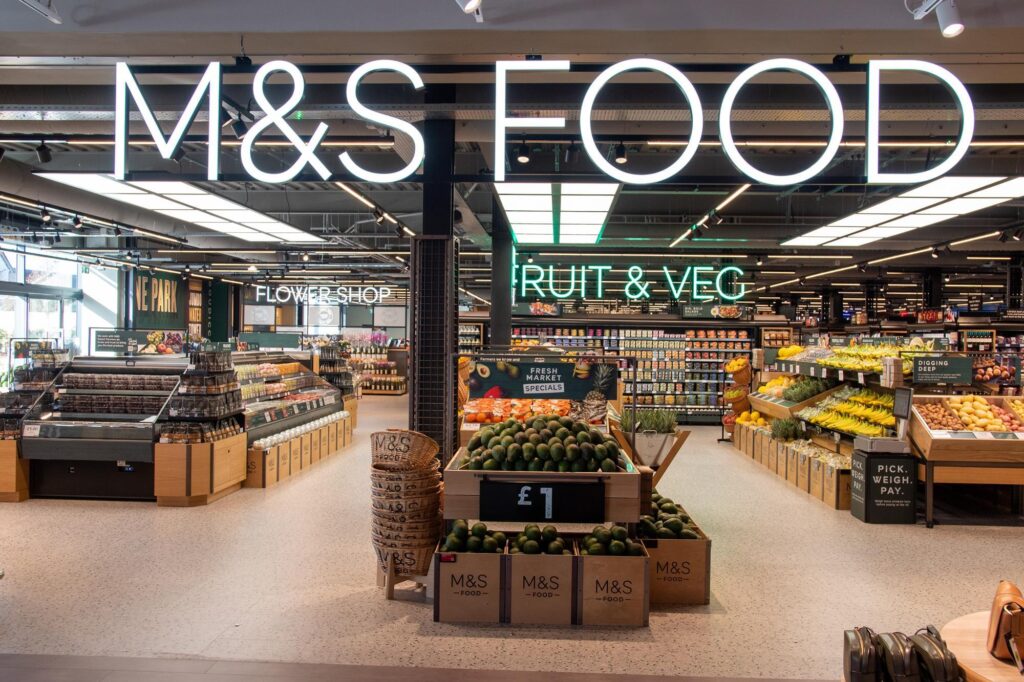
M&S operates two core product businesses. Food covers fresh produce, ready meals, bakery and seasonal innovations — with more than 1,400 new lines launched in FY2025 alone. Product quality was upgraded on over 1,000 existing lines, including Indian meals, Gastro ranges and pizza. These improvements widened M&S’s quality premium versus peers and drove three consecutive years of food volume share growth.
Viral product hits — pistachio crème, lemon hot cross buns, in-store bakery cookies — generated organic social media coverage that extended the brand’s reach well beyond its traditional customer base. This illustrates the marketing power of genuine product quality: the product itself becomes the advertisement.
In FHB, Autograph (premium fashion sub-brand) grew 47% in FY2025. Men’s Autograph alone reached approximately £200 million in sales, up from just £50 million three years ago. Partner brand fashion sales online grew 42%, and the overall brands business exceeded £200 million for the first time following the addition of Hush, Tommy Hilfiger and Calvin Klein.
Price
M&S positions itself in the mid-to-premium tier. In food, it uses “dropped and locked” pricing on key staples (salmon fillets, soups, potatoes, tinned tomatoes) while maintaining its premium feel on speciality, seasonal and treat products. This combination of trusted value and quality indulgence is what makes M&S Food uniquely positioned in the market.
In fashion, M&S applies a “first price, right price” strategy — removing promotional discounting and offering everyday competitive pricing on essentials, while holding premium price points on Autograph and quality-led lines. The removal of promotional activity clarifies the brand value proposition and improves margin predictability.
The pricing strategy in both businesses is supported by structural cost reductions. M&S delivered approximately £120 million in structural cost savings in FY2025 (cumulative £300 million over three years), reinvesting a portion back into quality and value — a virtuous cycle that sustains the pricing position.
Place
M&S reaches customers through three primary channels: physical stores, MS.com and Ocado Retail. The UK store estate includes approximately 600 locations, with a long-term programme to create 420 bigger, fresher Food stores (typically c.15,000 sq ft) and a productive group of 180 Full Line stores.
Store renewals consistently outperform targets. Food sales at the renewed Chancery Lane store were up approximately 35% on previous levels. New Full Line stores at Dundee and Washington Galleries traded 15% ahead of plan in FY2025. Nine renewal Food stores and one extension also traded ahead of target, demonstrating the programme’s reliability.

Online FHB accounted for 34% of FHB sales in FY2025, with a medium-term ambition to reach 50%. Ocado Retail — the 50/50 JV with Ocado Group — reported revenue of £2.8 billion in the 12 months to March 2025, with M&S products representing 30.3% of total Ocado volumes and growing 20.2% year-on-year. M&S participation reached approximately 50% in fresh categories such as produce and poultry.
Promotion
M&S’s promotional mix spans TV advertising, social media, influencer marketing (including virtual influencer Mira), the Sparks loyalty programme, seasonal campaigns and cause-related marketing through Plan A. In FY2025, marketing investment was significantly rebalanced towards brand and social channels.
This digital rebalancing drove a 9% increase in online active customers (to 10.2 million), a 16% increase in online transactions, and an 8.6% increase in purchase frequency — quantifiable evidence that the promotional shift is delivering results.
Marketing Strategies of M&S
1. Brand Positioning: Quality, Value and Style
M&S has built its brand around three mutually reinforcing pillars: quality, value and style. For decades, the brand was well-regarded for quality and value but had fallen behind on style. Between 2022 and 2025, a systematic overhaul of buying, design and range management moved M&S from #6 to #2 for style in the UK — a repositioning that is both rapid and durable.

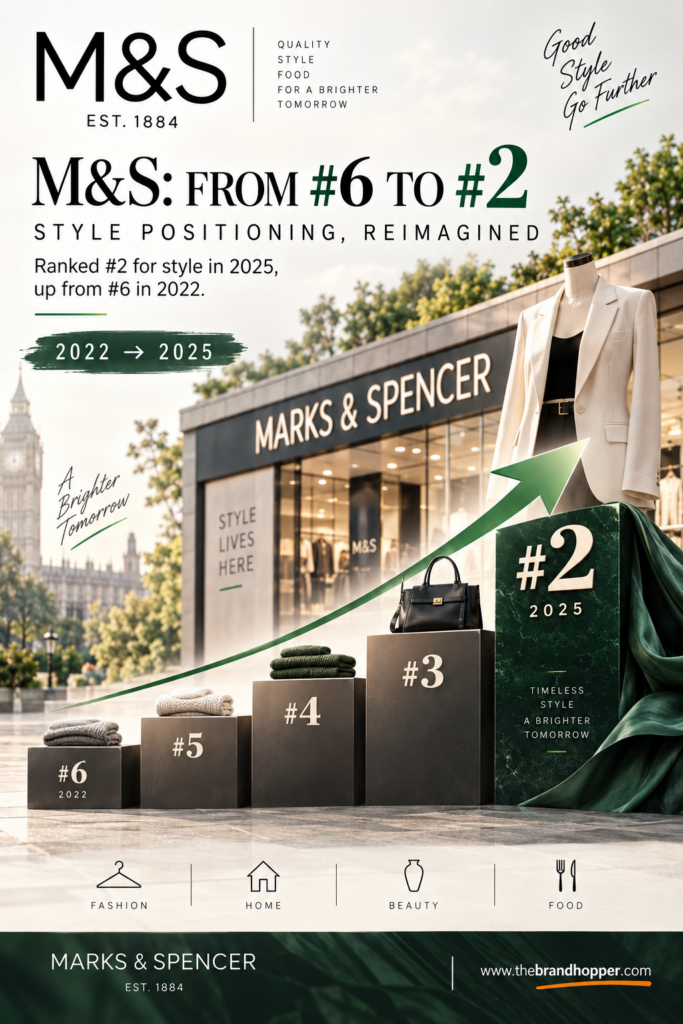
The style repositioning was achieved through several interlocking actions: upgrading design and buying capability, investing in seasonal campaigns that showcased the product improvement, launching high-profile collaborations (Ghost, Kelly Hoppen, Tommy Hilfiger), and introducing partner brands online that signal fashion credibility to new customer segments.
Brand improvements are evidenced by market share data. Food market share rose 27 basis points to 3.9% in FY2025. FHB market share rose 57 basis points to 10.5%. Both represent the third consecutive year of gains — meaning the improvements are structural, not seasonal.
Quality-led positioning creates a self-reinforcing dynamic. Customers who trust M&S products as genuinely worth the price return more frequently, spend more per visit (larger basket shops up 13% in food), and recommend the brand organically. This reduces dependence on paid promotions and builds equity over time — the most valuable form of marketing return.
The brand has also improved perceptions across key qualitative dimensions. Autograph sales growing 47% signals that customers are willing to pay more when they believe the product merits the price. The “Dine In” proposition in food grew as customers increasingly see M&S as a genuine alternative to eating out — a powerful positioning that competitors struggle to match.
2. Product Innovation and Range Diversification
Innovation is central to M&S’s competitive strategy. In food, the brand maintains a consistent weekly drumbeat of new product launches, with more than 1,400 new lines introduced in FY2025. This volume of innovation — averaging over 25 new products per week — keeps the in-store and online experience fresh and gives customers a reason to visit regularly.


Viral product hits have had a disproportionate marketing impact in recent years. Products like pistachio crème, lemon hot cross buns and in-store bakery cookies generated significant organic social media coverage without paid media investment. This demonstrates that at M&S, the product quality is the marketing — an alignment that is both efficient and authentic.
In fashion, range diversification has accelerated. The partner brand model — selling third-party fashion brands on MS.com alongside M&S own-brand lines — grew 42% in FY2025. This approach expands the addressable customer base, introduces younger demographics to the M&S platform, and generates data on emerging preferences that M&S can use to inform its own product development.
Autograph continues to be M&S’s clearest indicator of premiumisation success. Sales grew 47% in FY2025, with Men’s Autograph reaching approximately £200 million — up from just £50 million three years ago. The growth of Autograph reflects a customer who is buying more deeply into quality and trusting M&S to deliver at the premium end of its own range.
In kidswear — a market that declined overall — M&S achieved share growth by applying a “first price, right price” approach: removing promotional complexity and offering competitive everyday prices. This proves that pricing innovation is as strategically important as product innovation.
Home and Beauty, while in earlier growth stages, offer significant upside for range diversification. The Kelly Hoppen collaboration in Home performed well in FY2025, and Beauty grew own-brand fragrance sales. Both categories are being refocused under new leadership with a view to long-term growth in currently underpenetrated segments.
3. Sustainability Marketing: Plan A
M&S launched Plan A in 2007 — one of the first comprehensive corporate sustainability programmes from a major UK retailer. The name reflects the principle that there is no “Plan B” for the planet. It covers carbon net zero, circularity, responsible sourcing, biodiversity, and social impact across the supply chain and store estate.

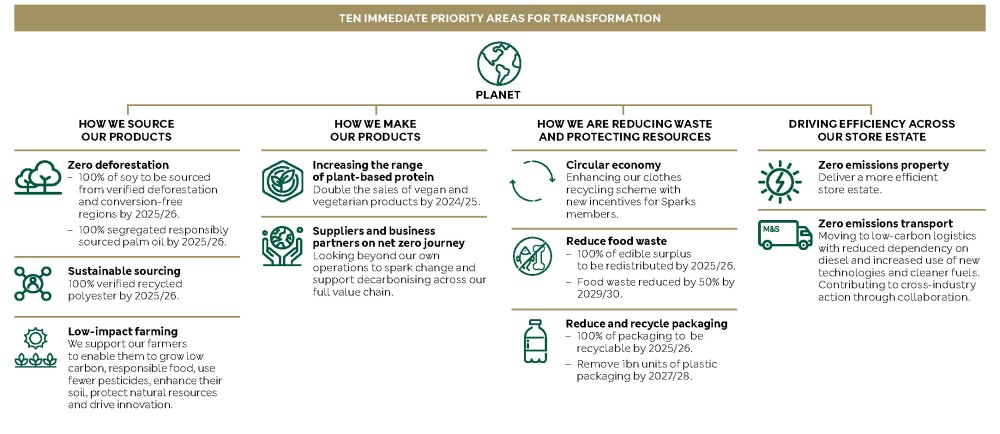
Plan A is not a peripheral CSR initiative — it is integral to M&S’s brand identity and a genuine point of competitive differentiation. For M&S’s core demographic of quality-conscious consumers, a brand’s environmental and ethical credentials increasingly influence purchasing decisions. M&S’s nearly two-decade sustainability track record gives it authentic authority that newer programmes cannot replicate.
On responsible sourcing, M&S has committed to sustainable acquisition of all key fashion materials including cotton (via the Better Cotton Initiative), polyester, denim, man-made cellulosic fibres and animal-derived materials. All food suppliers must meet responsible sourcing standards, and M&S actively supports UK farmers through long-term agricultural partnerships that protect supply quality.
M&S’s Net Zero commitment covers both its own operations and its supply chain. Annual progress is reported through a detailed ESG framework covering scope 1, 2 and 3 emissions, circular economy initiatives, plastic and packaging commitments, and community programmes. This transparency builds credibility with investors, customers, and regulators.
From a marketing perspective, Plan A delivers a unique form of brand equity: it cannot be bought or faked, and it takes time to build. Competitors launching sustainability programmes today cannot match M&S’s authority on these issues. This makes Plan A a long-term marketing asset as well as a genuine ethical commitment.
Sustainability is also embedded into physical store investments. New and renewed stores are built with improved energy efficiency, reduced packaging in food operations, and more sustainable logistics flows. This operational integration ensures Plan A is woven into the brand’s daily practices — not just communicated in campaigns.
4. Digital Transformation and Omnichannel Strategy
M&S’s digital transformation is one of the most significant strategic pivots of the past five years. Online Fashion, Home & Beauty accounted for 34% of FHB sales in FY2025. The medium-term target is 50% — a level that would make MS.com one of the largest online clothing platforms in the UK.

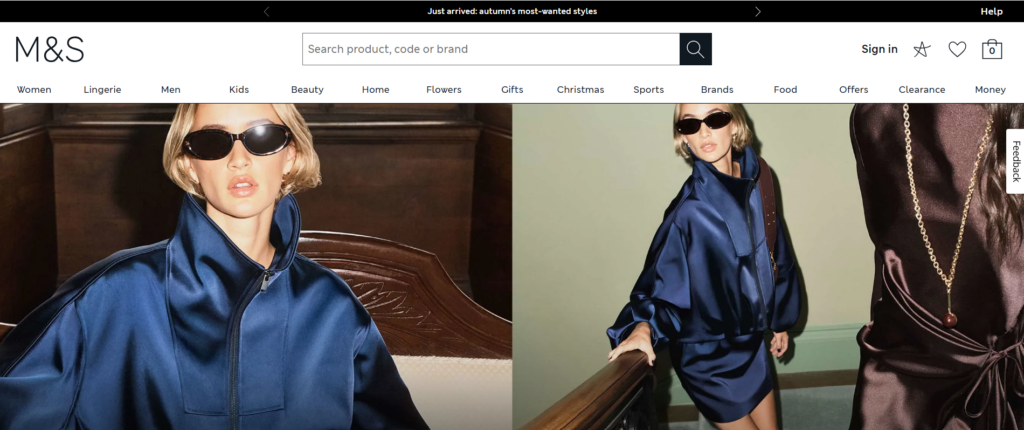
Active online customers grew to 10.2 million in FY2025, up 9% year-on-year. Purchase frequency increased 8.6% and total online transactions reached 38.5 million — a 16% increase. This growth stems from targeted marketing investment in social and brand channels, improved website functionality, and the addition of top-tier partner brands to the online offer.
Key digital improvements included upgraded product imagery and navigation, better size availability online, and a strengthened social marketing presence. The customer experience on MS.com was enhanced through personalisation features and improved search. Partner brand fashion online grew 42%, reflecting the impact of adding credible brands that attract new customer segments.
M&S has strategically rebalanced marketing investment from traditional broadcast channels towards social media. This shift generates measurable performance data, enables audience targeting and retargeting, and allows rapid creative iteration — capabilities that TV advertising cannot match. Instagram and TikTok have been particularly effective for FHB, reaching audiences aged 25-40.


The Ocado Retail partnership is the centrepiece of M&S’s food digital strategy. Ocado’s automated fulfilment centres, combined with M&S product quality, drove M&S volumes through the platform up 20.2% in the 12 months to March 2025. M&S products represented 30.3% of total Ocado Retail volumes — and approximately 50% in fresh categories such as produce and poultry. Ocado Retail revenue reached £2.8 billion, confirming the partnership’s commercial scale.
Looking ahead, M&S is investing in a new Fashion, Home & Beauty planning platform linking all activities from buying and budgeting to replenishment. This system will enable more personalised online ranging, improve availability, and support the logistics needed for efficient online order fulfilment — critical to achieving the 50% online ambition.
The Sparks loyalty app is the bridge between physical stores and digital channels. Digital receipts, personalised offers and app-based rewards create a seamless omnichannel experience. Customers who use the app shop with greater frequency and spend more than non-app users, making digital loyalty a key commercial driver as well as a data asset.
5. Strategic Collaborations and Partnerships
Collaborations have been one of the most powerful accelerants of M&S’s brand repositioning. By associating with credible designer names, lifestyle brands and contemporary cultural figures, M&S has compressed what would otherwise take a decade of repositioning into three years.

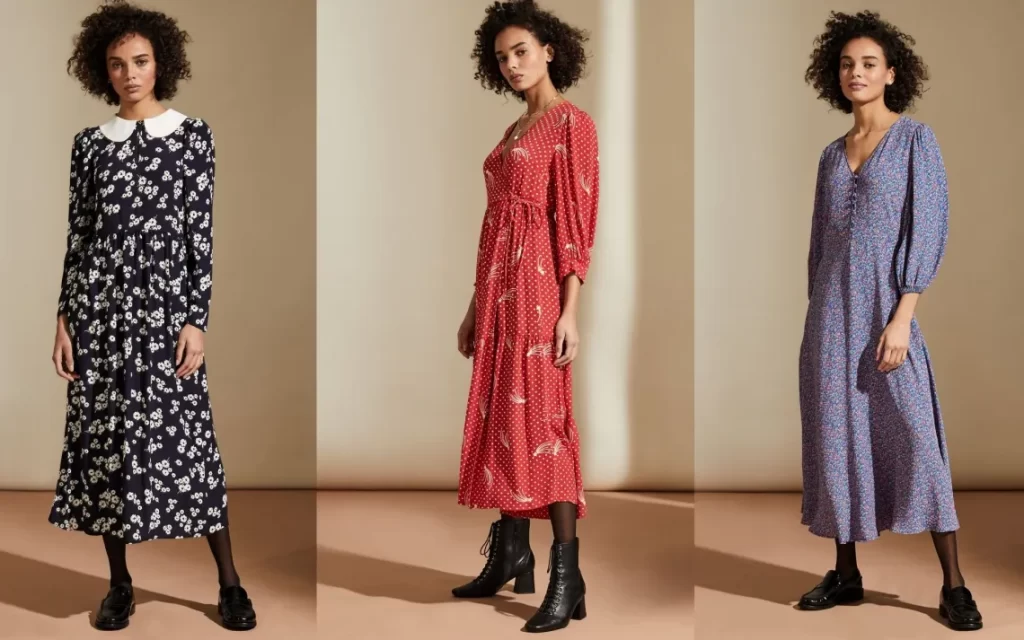
The collaboration with Ghost — a British luxury fashion label — was a defining moment in M&S’s style repositioning. By bringing a prestige brand to its high streets, M&S communicated unambiguously that it was a legitimate fashion destination, attracting style-conscious customers who might previously have overlooked it.
Collaborations in Home (Kelly Hoppen) and Beauty have extended the repositioning beyond clothing. Kelly Hoppen’s association with M&S Home in FY2025 delivered good growth and introduced a new design-conscious customer segment to the home category. These collaborations are selected not for short-term publicity but for strategic alignment with the target customer’s aspirations.
M&S also leverages its Insider program — a curated community of real M&S customers and brand advocates who authentically showcase products and lifestyle content across social media platforms. Insider content generates the kind of trusted, peer-level recommendation that polished brand advertising cannot replicate, making it an effective tool for social-first brand building with younger demographics.
The online partner brand strategy is the most scalable form of collaboration. Partner brand fashion online grew 42% in FY2025, with the total brands business exceeding £200 million for the first time. Brands including Hush, Tommy Hilfiger and Calvin Klein bring their own audiences to MS.com, effectively expanding the platform’s reach and credibility simultaneously.
M&S’s collaboration strategy is disciplined: partnerships are chosen for their strategic fit with the brand’s quality and style positioning, not for tabloid notoriety. This consistency ensures that each collaboration builds cumulative brand equity rather than generating short-term noise that fades quickly.
6. Sparks Loyalty Programme: Building a First-Party Data Asset
The Sparks loyalty programme is central to M&S’s customer retention, personalisation and data strategy. Free to join and accessible via the M&S app, Sparks allows customers to earn points on purchases, receive personalised offers based on their purchase history, access exclusive savings, and donate rewards to charity partners — covering both food and fashion across all channels.

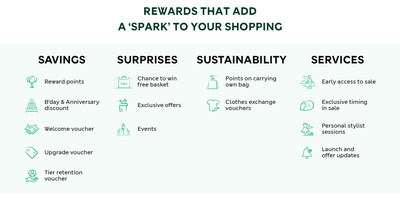
Unlike traditional loyalty programmes that defer value to a future redemption event, Sparks is designed around immediate, personalised rewards. A customer who shops in food twice a week receives very different offers from one who shops primarily in FHB. This level of personalisation drives meaningful incremental behaviour — more visits, larger baskets, higher frequency — rather than simply rewarding spend that would have happened anyway.
Strategically, Sparks is a first-party data asset of considerable value. In an era when third-party cookies are being phased out and digital advertising costs are rising, owned first-party customer data provides M&S with an irreplaceable competitive advantage. The programme provides real-time visibility into customer preferences, shopping frequency, category behaviour, and price sensitivity.
This data informs decisions across the business: range planning (which products to invest in), promotional strategy (which offers to deploy and to whom), store operations (which categories need more space in which locations), and digital marketing (which customer segments to target with which creative). No competitor without an equivalent dataset can match M&S’s ability to make these decisions precisely.
The integration of Sparks into the M&S app makes loyalty rewards visible and actionable across both in-store and online shopping journeys. Digital receipts, push notifications and in-app personalised recommendations create a continuous engagement loop that keeps M&S top-of-mind and incentivises the next purchase.
7. Advertising, Campaigns and Promotions
M&S has a long heritage of high-impact advertising that is embedded in British cultural memory. The food campaigns — characterised by close-up product photography and sensory, indulgent descriptions — have been among the most recognised in UK retail advertising for over two decades. More recently, M&S has made a strategic shift towards fashion-forward seasonal campaigns that have reset brand perceptions.
The “She’s Back” Autumn/Winter campaign, developed with creative agency Mother, was a standout cultural moment for the brand. The campaign celebrated personality, confidence and self-assurance in a way that resonated authentically with M&S’s target customer — and generated significant earned media coverage well beyond the paid media investment. It exemplifies the brand’s shift from functional product advertising towards emotional brand storytelling.

M&S has pioneered the use of a virtual influencer, Mira, in digital and social media campaigns aimed at younger demographics.
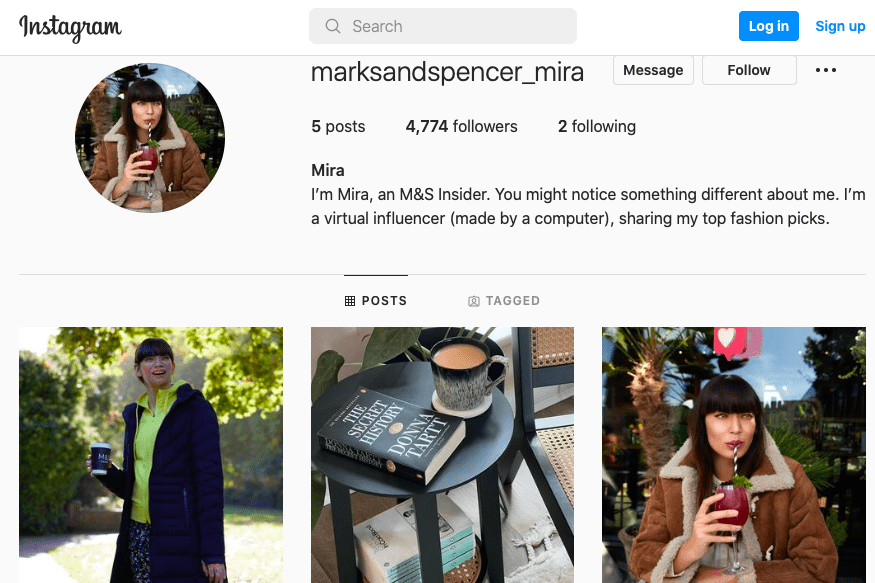
Mira enables M&S to produce scalable, always-on digital content at a fraction of the cost of traditional photoshoots, while maintaining visual consistency across social platforms. The use of a virtual influencer also signals a willingness to innovate in marketing — reinforcing the perception that M&S is a modern, forward-looking brand, not just a heritage retailer.
Seasonal food campaigns remain a cornerstone of the promotional calendar. M&S invests heavily in food advertising around Christmas, Easter and summer, consistently leveraging its reputation for quality and sensory appeal. These campaigns deliver measurable uplift in both short-term sales and medium-term brand preference metrics.
M&S also integrates cause-related marketing through Plan A, weaving sustainability credentials into product campaigns. This approach reinforces brand values and creates a meaningful narrative beyond price and quality — increasingly important for consumers who expect brands to stand for something.
For a comparable analysis of how other fashion and lifestyle brands build their marketing strategies, see our article on Exploring Marketing Strategies of GAP.
8. International Expansion Strategy
M&S operates internationally across 29 countries, primarily through a capital-light franchise partner model. This approach enables the brand to reach global customers without the operational and capital burden of fully owned retail in every market — an important strategic choice as M&S reinvests domestically in its core UK businesses.
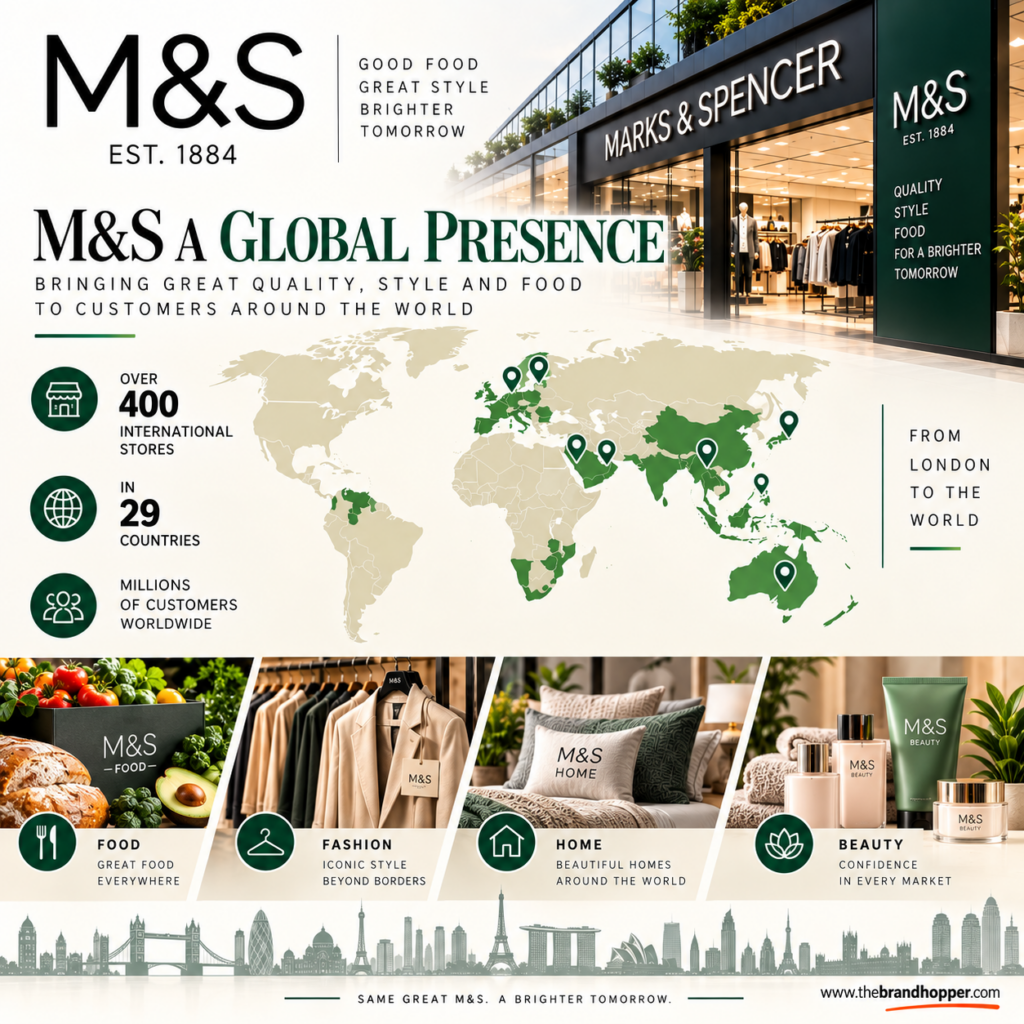
In FY2025, international sales totalled £658 million, down 8.5% (7.1% at constant currency). The decline was driven primarily by franchise partner de-stocking in FHB and challenging trading conditions in owned stores in India. However, Food franchise sales grew and performance improved in the second half of the year, pointing to gradual stabilisation.
The International reset strategy focuses on three priorities. First, deepening existing franchise partnerships: M&S is working with established partners to improve operating principles, invest in trusted value positioning, and drive volume in existing markets without new capital deployment. Second, expanding online through European and global marketplaces: M&S is using partners’ established fulfilment capabilities to serve online customers, reducing the need for owned infrastructure. Third, identifying selective wholesale opportunities in new markets.
India — one of M&S’s largest owned international markets — is undergoing a reset under new local leadership. The shift to a full-price trading approach, combined with a focus on cost reduction and range rationalisation, is designed to build a sustainable platform for long-term growth in one of the world’s largest and fastest-growing retail markets.
The M&S brand travels well internationally, particularly in markets where quality-conscious consumers value British provenance and trust the M&S name as a quality signal. The strategic challenge is consistently delivering the M&S quality premium across markets with very different supply chains, consumer preferences and competitive dynamics.
9. Competitive Positioning
M&S competes across two distinct retail categories — food and fashion/home/beauty — each with different competitive dynamics. Its marketing strategy must address both simultaneously while maintaining a coherent overall brand identity.
Food: Quality, Innovation and Freshness
In food, M&S’s closest premium competitor is Waitrose, while its “shopping list” growth ambition places it in competition with the premium product lines of major supermarkets: Tesco Finest and Sainsbury’s Taste the Difference. Unlike full-range supermarkets, M&S is not yet a primary weekly shop destination for most customers — its strategy is to progressively earn a larger share of the family shopping basket through quality and innovation.
M&S holds a 3.9% UK food market share — up 27 basis points in FY2025, representing a third consecutive year of volume and value share growth. Its food quality premium is protected by long-term supplier partnerships that enable investment in product quality and innovation. The acquisition of Gist (logistics) has delivered improved supply chain service and contributed more than £60 million to profit, creating the foundation for further supply chain investment.
The Ocado Retail partnership is a key competitive differentiator. No other premium food retailer has an equivalent online-first, automated fulfilment capability that can reach customers nationwide with next-day or same-day grocery delivery. This is a significant structural advantage in a market where online grocery is growing rapidly.
Fashion: Quality, Style and Value Against Next, John Lewis and Zara
In fashion, M&S’s primary competitor is Next — the UK’s largest clothing retailer by market share. M&S has been consistently gaining ground on Next through its quality improvement, style repositioning and digital investment. John Lewis, Zara, H&M and ASOS are secondary competitors occupying different positions in the quality-price-style matrix.
M&S’s “first price, right price” approach is a strategic differentiator versus the promotions-heavy model prevalent in mid-market fashion retail. Customers who trust M&S pricing do not wait for sales — they buy at full price when they need, which improves margin, demand predictability and stock management. This also aligns with the brand’s quality positioning: frequent discounting undermines perceptions of product worth.
Against fast fashion competitors (Zara, H&M, ASOS), M&S competes on durability, quality and ethical sourcing — not on trend speed or lowest price per unit. This positioning is sustainable and increasingly valued by consumers who are growing more conscious of fashion’s environmental impact. Plan A provides the credibility needed to make this argument authentically.
Key Takeaways: What Marketers Can Learn from M&S
M&S’s marketing strategy is a masterclass in disciplined brand evolution. Over three years of consistent execution, the brand has moved from a trusted but stagnant retailer to one of the UK’s fastest-improving high street names — growing market share in both food and fashion simultaneously, while delivering the highest adjusted profit in over 15 years.
The core strategic insight is that quality and value are complementary, not competing, priorities. Customers who trust that M&S products are genuinely worth the price return more often, spend more per visit, and recommend the brand organically. FY2025 data confirms this: food basket shops up 13%, food LFL growth 8.6%, fashion LFL growth 4.4%.
Digital, sustainability, loyalty and collaboration are not separate marketing initiatives — they are interconnected levers in a single customer-centric strategy. Sparks data improves personalisation. Plan A reinforces brand values. Collaborations drive new customer acquisition. Digital investment enables scalable growth. Each lever amplifies the effectiveness of the others.
The M&S story also illustrates that brand repositioning takes time. The style improvement from #6 to #2 happened over three years — not through a single campaign, but through consistent investment in product quality, design capability, range management and marketing communications. Speed was enabled by execution consistency, not by shortcuts.
Finally, M&S demonstrates the value of a balanced approach to traditional and digital marketing. TV advertising builds broad awareness and cultural salience; social and digital marketing delivers precision targeting, measurable performance and younger audience reach. Neither alone would have delivered the results M&S has achieved.
Frequently Asked Questions
Q1: What is the marketing strategy of Marks & Spencer?
A: M&S’s marketing strategy centres on quality-led brand positioning, consistent product innovation, digital transformation, the Sparks loyalty programme, Plan A sustainability credentials, and strategic collaborations. In FY2025 (52 weeks ended 29 March 2025), this approach drove group sales of £13.9 billion, food sales of £9.0 billion (+8.7%), and the highest adjusted profit before tax in over 15 years (£875.5 million). Source: M&S Full Year Results, May 2025.
Q2: What is M&S’s brand positioning?
A: M&S positions itself as the most trusted British retailer for quality products at genuine value. In food, it aims to be a “shopping list retailer” for quality-conscious families. In Fashion, Home & Beauty, it targets professional adults aged 30-60 seeking quality, versatility and style. As of FY2025, M&S is ranked #2 for style in the UK — up from #6 in 2022 — following three years of systematic product and brand investment.
Q3: What is Plan A at Marks & Spencer?
A: Plan A is M&S’s sustainability programme, launched in 2007. The name reflects the principle that there is no “Plan B” for the planet. It covers commitments to carbon net zero, responsible sourcing (cotton via Better Cotton Initiative, sustainable polyester, certified denim), circularity, packaging reduction, biodiversity and social impact. M&S reports annual progress through a detailed ESG framework available at corporate.marksandspencer.com/esg.
Q4: How does the Sparks loyalty programme work?
A: Sparks is M&S’s free loyalty programme, accessible via the M&S app and in-store. Members earn points on food and fashion purchases, receive personalised offers based on their individual purchase history, access exclusive savings, and can donate rewards to charity partners. Sparks is also a first-party data asset that enables M&S to personalise communications, inform range planning, and optimise promotional strategy across all channels.
Q5: Who is M&S’s target customer?
A: M&S targets quality-conscious consumers aged 30-65. In food, the primary target is mid-to-upper income families seeking quality, innovation and convenience. In Fashion, Home & Beauty, the primary target is professional men and women who value quality, versatility and style. M&S is actively broadening its appeal to younger demographics through social media marketing, virtual influencer Mira, and contemporary partner brand collaborations (Tommy Hilfiger, Calvin Klein, Hush).
Q6: What are M&S’s FY2025 financial results?
A: In FY2025 (52 weeks ended 29 March 2025), M&S reported: group sales £13,914.3 million (+6.1%); food sales £9.0 billion (+8.7%); Fashion, Home & Beauty sales £4.2 billion (+3.5%); adjusted profit before tax £875.5 million (+22.2%) — the highest in over 15 years; adjusted ROCE 16.4%; free cash flow £443.3 million; dividend per share 3.6p (+20%). Source: M&S Group Full Year Results, 19 May 2025 (corporate.marksandspencer.com).
Q7: How has M&S used digital marketing to grow its online business?
A: M&S rebalanced marketing investment significantly towards social and digital channels in FY2024/25. This drove active online customers to 10.2 million (+9%), purchase frequency up 8.6%, and total online transactions to 38.5 million (+16%). Key initiatives included upgraded website imagery and navigation, social media campaigns featuring virtual influencer Mira, addition of top-tier partner brands (Tommy Hilfiger, Calvin Klein), and improved personalisation through the Sparks app. Online FHB accounted for 34% of FHB sales, targeting 50%.
Q8: What are M&S’s most notable collaborations?
A: M&S’s notable collaborations include Ghost (fashion, British luxury), Kelly Hoppen (home interiors), and online partner brands Tommy Hilfiger, Calvin Klein and Hush. The total brands business exceeded £200 million for the first time in FY2025, with online partner brand fashion sales growing 42%. M&S also operates an Insider programme featuring real customer advocates, and has used virtual influencer Mira in digital campaigns. The Autograph premium sub-brand, elevated through campaign collaborations, grew 47% in FY2025.
Q9: How does M&S approach sustainability in its marketing?
A: M&S integrates sustainability through Plan A — a nearly two-decade programme covering net zero carbon, responsible sourcing, circularity and social impact. Sustainability messaging is woven into product campaigns, packaging and annual reporting rather than treated as a separate initiative. M&S uses cause-related marketing to highlight Plan A credentials to eco-conscious consumers, and publishes detailed annual ESG reports covering scope 1, 2 and 3 emissions, supply chain standards and community programmes. This gives M&S authentic authority that competitors launching newer programmes cannot match.
Q10: What is M&S’s international expansion strategy?
A: M&S operates internationally across 29 countries, primarily through a capital-light franchise partner model. The current strategy — labelled “International Reset” — focuses on: (1) investing in trusted value positioning in existing franchise markets; (2) expanding online through leading European and global marketplace partners using their existing fulfilment capabilities; (3) identifying selective wholesale opportunities. India, an owned market, is being reset under new local leadership with a shift to full-price trading and cost discipline. International sales were £658 million in FY2025.
To read more content like this, subscribe to our newsletter
Go to the full page to view and submit the form.