


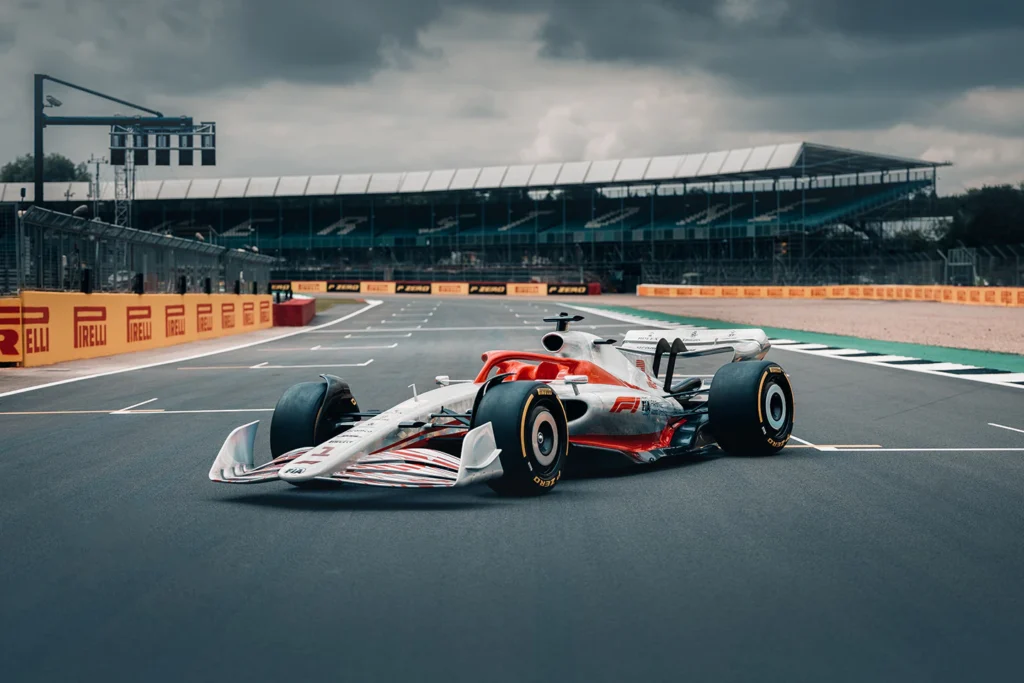
Formula 1 is not just the pinnacle of motorsport — it is one of the most sophisticated and rapidly growing commercial ecosystems in professional sport. Behind the wheel-to-wheel battles and champagne podium celebrations lies a multi-billion-dollar financial machine that keeps ten elite teams competing at the cutting edge of technology.
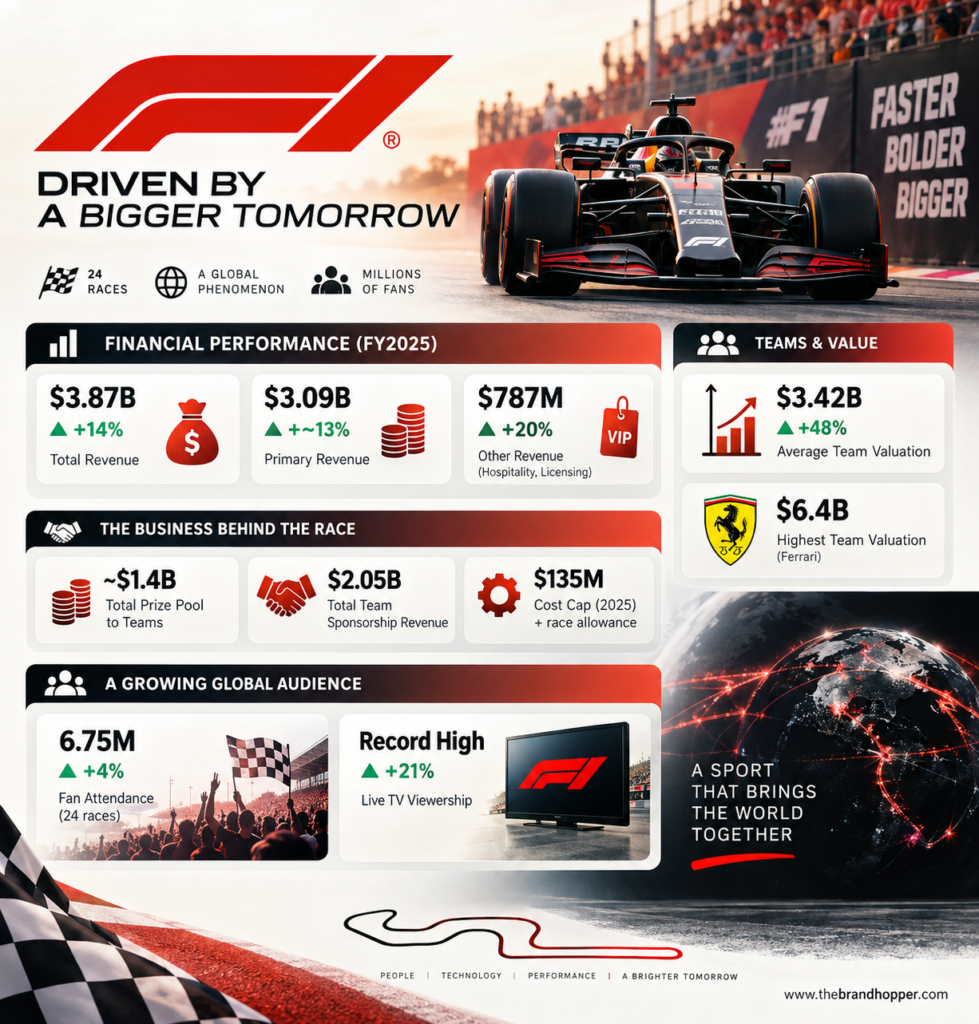
In FY2025, Formula One’s total revenue reached $3.87 billion — a 14% increase over the previous year and the fifth consecutive year of revenue growth under Liberty Media’s ownership. Primary revenue (race promotion, media rights, and sponsorship) grew to $3.09 billion, with sponsorship crossing 21.7% of primary revenue for the first time since Liberty acquired the sport in 2017. Total fan attendance hit 6.75 million across the 24-race calendar, and live TV viewership surged 21% year-on-year.
The ten teams on the grid in 2025 are now collectively worth more than $34 billion — an average valuation of $3.42 billion per team, up 48% in a single year. Ferrari leads the pack at $6.4 billion, while McLaren’s valuation has risen 203% in just two years following their 2025 Constructors’ and Drivers’ Championship double.
This article breaks down the core revenue streams that fund Formula 1 teams and explains how the world’s most technically demanding sport has evolved into one of sport’s most compelling business models.

1. Revenue from Formula 1 Prize Money and the Concorde Agreement
At the core of every F1 team’s income is the Formula 1 prize money, distributed according to the Concorde Agreement — a confidential, long-term contract between Formula 1, the FIA (Fédération Internationale de l’Automobile), and all ten competing teams. The current Concorde Agreement runs through the 2025 season, with a successor agreement governing competition from 2026 onward.
Under the agreement, Formula One distributes approximately 45% of its annual revenues back to the teams as prize money. With F1’s FY2025 revenue reaching $3.87 billion, the total prize pool available to teams was approximately $1.4 billion — making it the largest distribution in F1 history. This pool is divided into several distinct categories.
Breakdown of Prize Money
- Column 1 Payments (Equal Share): A fixed, equal payment to every team that has finished in the top 10 in two of the past three seasons. This base payment ensures all qualifying teams receive guaranteed income regardless of race performance.
- Column 2 Payments (Performance-Based): Based on a team’s final position in the Constructors’ Championship. The Champion receives approximately 14% of the total prize pool; the team finishing 10th receives approximately 6%. The higher the final standing, the larger the cheque.
- Long Standing Team (LST) Bonus — Ferrari Heritage Payment: Ferrari receives a separate heritage bonus — worth approximately 5% of the total prize pool — in every Concorde Agreement as the only constructor to have competed in every F1 season since the World Championship began in 1950.
- Historical Performance Bonuses: Additional performance-based bonuses are allocated to teams with strong historical results. This structure means the total distribution is not purely meritocratic — teams with heritage status and long track records earn significantly more.
The most striking illustration of how this system works came in the 2025 season: Ferrari earned an estimated $277.7 million in prize money despite McLaren winning both the Constructors’ and Drivers’ championships. McLaren, as champion, received approximately $165.8 million. The gap — over $111 million in Ferrari’s favour — reflects Ferrari’s heritage bonus, its higher column position, and the complex multi-year averaging used in the Concorde Agreement’s calculations.
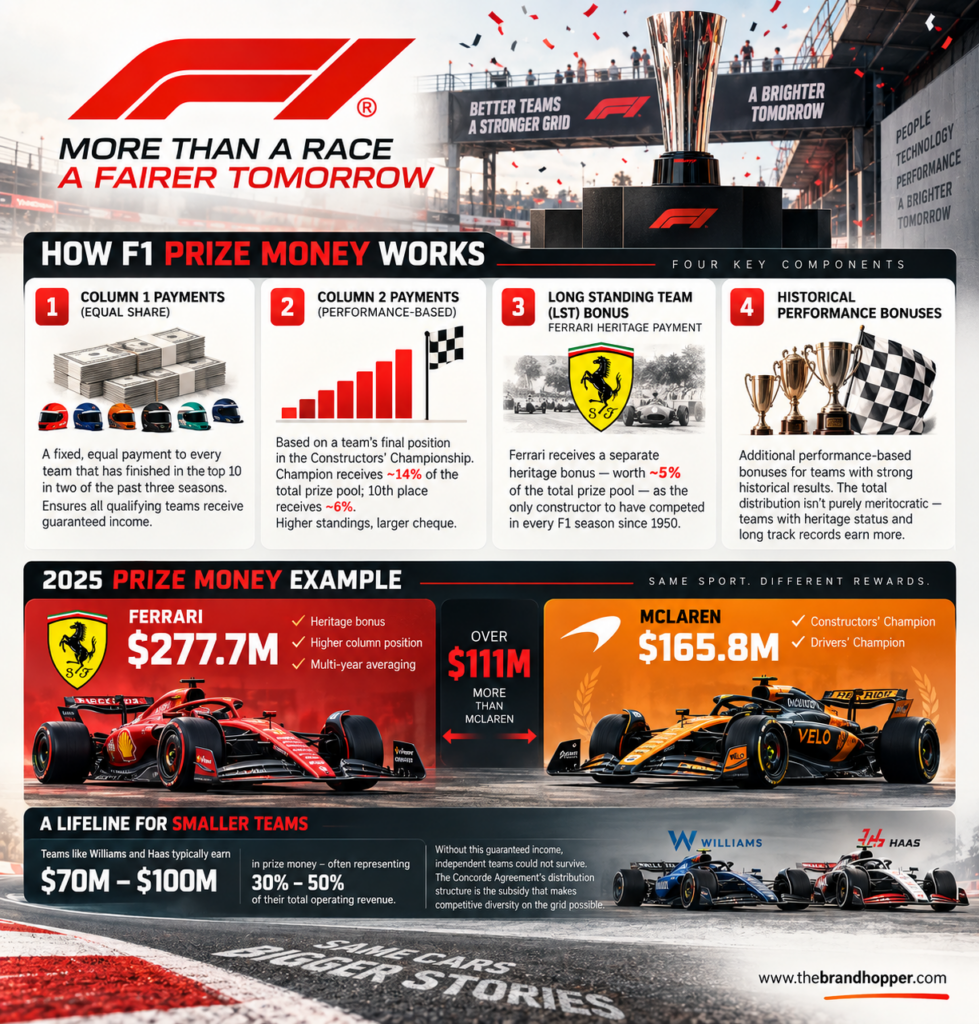
For mid-field and lower teams, prize money remains existential. Smaller teams like Williams and Haas typically earn $70-100 million in prize money — often representing 30-50% of their total operating revenue. Without this guaranteed income, independent teams could not survive. The Concorde Agreement’s distribution structure is, in essence, the subsidy that makes competitive diversity on the grid possible.
2. Sponsorships and Branding
Sponsorship is Formula 1’s most visible — and for most teams, largest — revenue stream. Every surface of an F1 car, driver suit, helmet, team uniform, garage, hospitality suite, and transporter truck is prime commercial real estate, generating global exposure across television broadcasts reaching hundreds of millions of viewers.
In FY2025, F1 teams generated a combined $2.05 billion in sponsorship revenue. The average F1 team sponsorship deal is worth $6.22 million — more than eight times the average sponsorship deal with an NFL team. This premium reflects F1’s global reach, its affluent audience demographics (high household incomes, strong purchasing power), and its positioning as a technology and innovation platform rather than simply a sporting competition.

Tiered Sponsorship Model
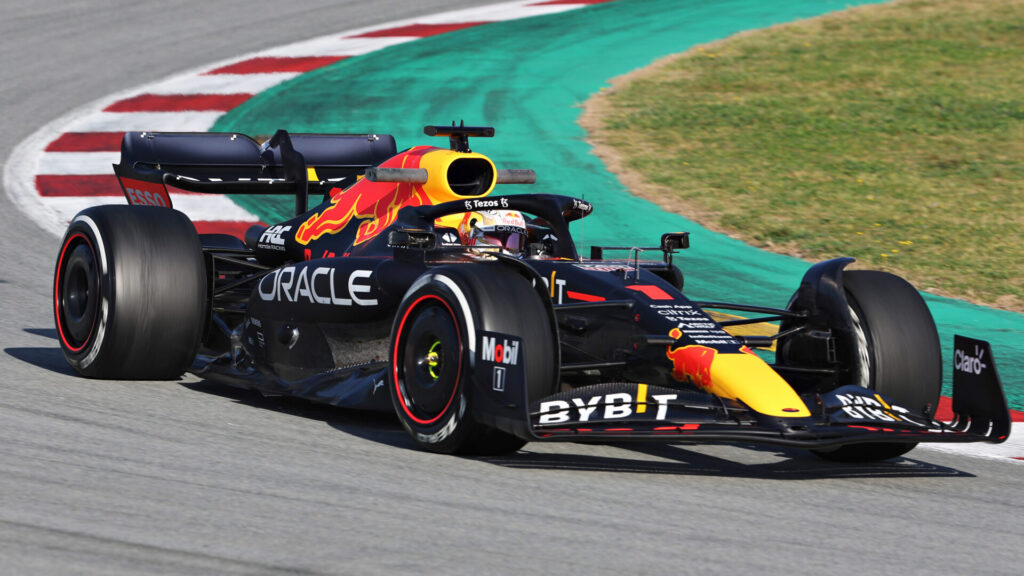
Title Sponsors: These companies secure naming rights to the team (e.g., Oracle Red Bull Racing, HP Scuderia Ferrari, Petronas Mercedes-AMG F1 Team). Oracle’s original five-year deal with Red Bull (signed 2022) was reportedly worth $300 million in total. HP’s landmark deal with Ferrari, signed ahead of the 2025 season, is understood to be worth approximately $100 million per year — matching or exceeding Oracle’s annual contribution to Red Bull — making HP and Oracle the joint-largest title sponsors in F1 history.
Principal / Platinum Partners: Brands like Petronas (Mercedes, ~$70M/year), Aramco (Aston Martin, ~$75M/year), Shell (Ferrari), and Santander operate at the highest tier below title sponsorship. These partnerships typically include technical collaboration — for example, fuel and lubricant suppliers develop products in partnership with the team’s engineers that feed directly into the road-car supply chain.
Official Suppliers / Secondary Sponsors: Companies like Pirelli (official tyre supplier), Richard Mille (luxury watches), Puma (team apparel), and LVMH brands contribute $1-10 million annually for logo placement and association rights. The prestige of F1 association is itself a marketing asset for luxury brands.
Associate Partners: Dozens of smaller brands appear on rear wings, floor edging, and driver helmets, contributing $500K-$2M per season. For technology companies, appearing on an F1 car — broadcast globally across 24 race weekends — offers exceptional brand visibility for the investment.
Sponsorship is particularly crucial for private teams without manufacturer backing. Williams F1, Haas F1 Team, and similar independent outfits can derive 60-80% of their total revenue from sponsor income. The rise of the United States as F1’s fastest-growing market — driven by Netflix, three US race venues (Miami, Austin, Las Vegas), and a new generation of American fans — has dramatically increased the pool of North American brands willing to invest at the F1 level.
Sponsorship is also becoming more sophisticated. Modern deals increasingly include data analytics partnerships, innovation collaborations, co-branded marketing campaigns, and performance bonuses tied to race results. Title sponsors no longer simply buy logo placement; they buy into the team’s engineering culture, its sustainability credentials, and its digital content machine.
3. Manufacturer Funding and Parent Companies
Several teams on the F1 grid are owned or backed by major automotive manufacturers, which fund their operations as part of a broader brand strategy. Manufacturer investment in F1 is not philanthropy — it is a calculated marketing expenditure justified by the global brand exposure and the direct return on investment from technology transfer to road cars.
Mercedes-AMG Petronas F1 Team: Part-owned by Mercedes-Benz AG, the team functions as the motorsport marketing arm of one of the world’s most prestigious car brands. Seven Constructors’ championships in seven consecutive seasons (2014-2020) generated incalculable brand value. Mercedes uses F1 to showcase its AMG performance sub-brand, and technology developed for its F1 hybrid power units has fed directly into its commercial electric vehicle programmes.
Scuderia Ferrari: Ferrari is unique in that its F1 team and its road-car business are intertwined at the corporate level. Ferrari’s FY2025 annual revenue was €7.146 billion — a 7% increase, with its Sponsorship, Commercial and Brand segment reaching €800 million (up 22%). Ferrari explicitly notes in its annual reports that higher F1 performance rankings translate directly into higher commercial revenues. F1 success is embedded in Ferrari’s brand DNA and valuation.
Alpine F1 Team: Funded by Renault’s Alpine performance brand, this team serves as the primary motorsport showcase for Alpine’s road-car aspirations. Alpine sold a 24% stake in the F1 team in 2023 — to investors including actor Ryan Reynolds — for $218 million, valuing the team at approximately $900 million at the time.
Aston Martin Aramco F1 Team: Financed by Canadian billionaire Lawrence Stroll (team chairman) and Saudi Aramco, which provides an estimated $75 million per year in sponsorship. Aramco’s involvement aligns with its strategy to associate itself with innovation and high performance as it navigates the energy transition narrative.
Audi F1 (Stake F1 Team / Sauber): Audi AG acquired a stake in the Sauber F1 team and is the title sponsor for the 2025 season, with plans to enter as a full works team from 2026 using Audi power units. This represents a €1 billion+ long-term commitment by the Volkswagen Group to F1.
Manufacturer teams benefit from substantial R&D cost-sharing. Technology developed for F1 — particularly in aerodynamics, lightweight materials, hybrid energy recovery, battery management, and thermal management — flows into road cars, justifying the sport’s enormous engineering spend as an R&D investment rather than pure marketing cost.
Also Read: From Racing Roots to Luxury Cars: The Story of Mercedes-Benz
4. Merchandising and Licensing
Formula 1 merchandising has transformed from a peripheral activity into a meaningful and fast-growing revenue stream, driven by the globalisation of the F1 fanbase — particularly in the United States, where Netflix’s Drive to Survive series opened the sport to an entirely new demographic of younger, fashion-conscious fans.
Revenue Streams from Merchandising
Official Team Stores: All ten teams operate e-commerce stores and trackside retail operations at every race weekend. Race-day merchandise — caps, t-shirts, replica race suits, and jackets — generates significant impulse purchases from the 6.75 million fans who attended races in 2025.
Fashion Collaborations: Teams have moved aggressively into lifestyle and fashion. McLaren’s Papaya-branded streetwear, Ferrari’s Puma x Ferrari collaboration, and Red Bull’s lifestyle merchandise range attract buyers who may never watch a race. Ferrari’s lifestyle and licensing business alone contributes hundreds of millions of euros to its annual revenue.
Die-cast Models and Collectibles: Scale model cars — particularly from manufacturers like Amalgam, Spark, and Minichamps — command premium prices. Amalgam’s ultra-detailed 1:8 scale Ferrari F1 cars sell for thousands of pounds each and are highly profitable for both the model-maker and the team.
Driver-Branded Merchandise: Star drivers generate merchandise revenue independently of team brands. Max Verstappen, Lewis Hamilton (now at Ferrari), and Lando Norris (2025 World Champion) all have dedicated merchandise programmes. A champion’s helmet replica can retail for $500-$1,000+ and sell in the thousands.
Teams typically retain 50-70% of the margin on licensed products. For Ferrari, which operates as both an F1 team and a global luxury brand, merchandising and lifestyle licensing generates tens of millions of euros annually — a figure growing each year as the Ferrari brand extends further into fashion, watches, and accessories. For smaller teams, trackside and online merchandise may contribute $5-15 million per season — supplemental but increasingly important.
5. Driver-Linked Revenue and Sponsorships
In Formula 1’s unique commercial ecosystem, individual drivers often bring substantial sponsorship money to their teams — sometimes as a condition of securing their race seat. This practice is most visible at the back of the grid, where smaller teams rely on driver-associated funding to bridge budget gaps, but it operates at virtually every team level.
Lance Stroll at Aston Martin: Stroll is the son of Lawrence Stroll, the billionaire fashion magnate who bought a majority stake in the Aston Martin F1 team. Lawrence Stroll’s investment — hundreds of millions of dollars — directly funds the team’s operations and secures Lance’s driving position. This represents an extreme version of driver-linked revenue, where family investment underwrites an entire team.
Sergio Pérez and Mexican Brands: Throughout his career at Racing Point and Red Bull, Sergio Pérez brought commercial partnerships with Mexican brands including Telmex, Telcel, and Claro to his teams. At Red Bull, Pérez’s Mexican fanbase attracted dedicated Mexican sponsor programmes that generated significant incremental commercial value for the team.
Nikita Mazepin at Haas (2021): Haas signed Mazepin with his family’s Uralchem/Uralkali fertiliser business as title sponsor — a deal reportedly worth over $20 million annually. The deal collapsed after Russia’s invasion of Ukraine in February 2022, illustrating the financial and reputational risks of driver-linked sponsor arrangements in geopolitically sensitive contexts.
Pay Drivers at Mid-Field Teams: Teams like Haas, Williams, and Sauber (now Audi F1) have historically allocated at least one seat to a driver who brings commercial backing. The minimum threshold for a “pay driver” seat has risen significantly as F1’s commercial value has grown, but the practice remains a structural feature of the sport’s financial model.
The driver-linked revenue model creates a nuanced dynamic: the fastest driver is not always the one who gets the seat. For smaller teams operating close to the financial margin, a driver who brings $5-15 million in sponsor money can be more valuable than a marginally faster driver who brings nothing. The cost cap has moderated this dynamic somewhat by capping what teams can spend — but it cannot cap what drivers bring commercially.
6. Technology and Engineering Services
Formula 1 teams are among the most advanced engineering organisations in the world, and several have turned their technical expertise into standalone commercial businesses. The knowledge accumulated in pursuit of tenths of a second per lap — in aerodynamics, materials science, simulation, data analytics, and manufacturing — has direct applications in aerospace, defence, medicine, and consumer technology.

Notable Examples
Mercedes Applied Science: Mercedes’ applied technologies division has delivered projects far beyond motorsport. Most notably, it designed and built thousands of continuous positive airway pressure (CPAP) devices during the COVID-19 pandemic in 2020 — in collaboration with University College London — in under 100 hours, demonstrating the speed and capability of F1 engineering. The division also works on sustainable transport, advanced cycling technology (including bikes used at the Tour de France), and industrial optimisation.
McLaren Applied: McLaren Applied Technologies is a distinct commercial business that licenses McLaren’s sensor, electronics, and data analytics technology to sectors including electric vehicle manufacturers, motorsport series, cycling, and e-sports. McLaren’s Electronic Control Unit (ECU) is the standard electronic brain mandated for use by every car on the F1 grid — a significant B2B contract with FOM. McLaren Applied has built systems for Jaguar Racing in Formula E and for multiple international racing series.
Red Bull Advanced Technologies: Red Bull’s advanced engineering subsidiary has collaborated on the Aston Martin Valkyrie hypercar (for which Red Bull engineers designed the aerodynamics), OX Delivers (a flat-pack truck for humanitarian logistics), and various aerospace projects. These collaborations generate both commercial income and brand association with innovation.
Williams Advanced Engineering: Williams’ engineering consultancy has developed battery technology for the Formula E racing series, worked on EV battery system optimisation, and delivered aerospace components. The consultancy model generates B2B engineering fees that supplement Williams’ race team income.
Technology licensing and applied engineering typically contribute $10-50 million per year to the leading teams, while generating B2B relationships and reputational value that attract further sponsorship from technology companies wanting to be associated with F1’s innovation platform.
7. Hospitality and VIP Experiences
Formula 1’s combination of glamour, exclusivity, and global spectacle makes it a premium venue for corporate hospitality. Major race weekends — Monaco, Silverstone, Singapore, Las Vegas, Abu Dhabi — are among the most sought-after corporate entertainment events in the world, and teams monetize this demand aggressively.

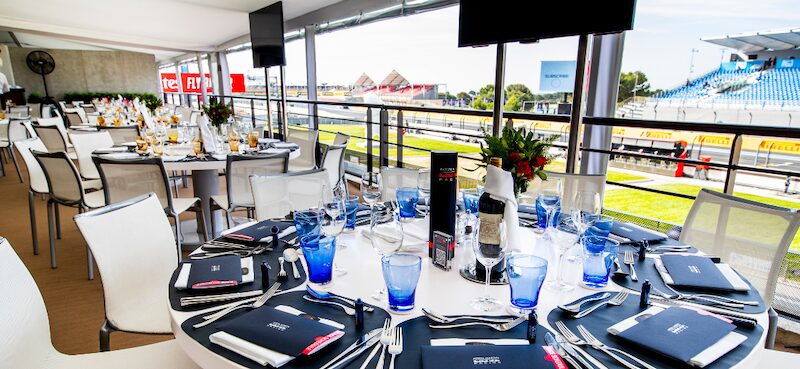
Offerings Include
Paddock Club Access: The F1 Paddock Club is Formula One Management’s flagship hospitality product, offering premium race-weekend access from elevated grandstand suites overlooking the pit lane. Passes range from $5,000 to $10,000+ per person per weekend at premium circuits. Access includes fine dining, open bars, exclusive viewing areas, and interaction with team representatives. The F1 Paddock Club is considered one of sport’s premier premium hospitality experiences.
Team Motorhomes and Hospitality Suites: At major European circuits, F1 teams operate multi-storey motorhome complexes (the “Paddock”) that serve as bases for sponsor entertainment. The top teams — Red Bull, Mercedes, Ferrari — deploy motorhomes that cost millions of euros and can host hundreds of guests over a race weekend. Access is by invitation and is tied to sponsorship relationships.
Factory Tours and Behind-the-Scenes Access: Teams offer exclusive factory visits to sponsors, VIP guests, and premium fan experiences. McLaren’s Technology Centre in Woking, Mercedes’ Brackley campus, and Ferrari’s Maranello factory are all iconic facilities that command premium access fees.
Driver Meet-and-Greets and Simulator Experiences: Some teams offer paid simulator experiences and driver interaction for premium sponsors and fan club members, generating additional income streams while deepening sponsor engagement.
Hospitality income is typically bundled into sponsor packages rather than sold as a standalone product — a dinner with an F1 principal or a day in a team’s factory is part of what justifies a $10 million sponsor deal rather than a $5 million one. Consequently, hospitality income is difficult to isolate but is a material value multiplier for all team commercial relationships.
8. Media Rights and Digital Content
Teams do not earn direct revenue from F1’s global broadcasting rights — those are negotiated and retained exclusively by Formula One Management (FOM). The primary commercial media rights fee income in FY2025 represented 31.3% of Formula One’s primary revenue ($3.09 billion), making media rights the single largest primary revenue component — approximately $967 million. This money flows to FOM, not to individual teams.
However, the indirect financial benefits of media rights to teams are enormous. Television coverage across 180+ countries on networks including ESPN (US), Channel 4 (UK), Sky Sports (UK, Germany, Italy), Canal+ (France), and Fuji TV (Japan) generates hundreds of millions of dollar in advertising value equivalency (AVE) for every sponsor appearing on an F1 car. When Oracle’s logo is broadcast to 500 million viewers, the commercial value to Oracle of that exposure is worth a multiple of what they pay Red Bull.
Drive to Survive and the Netflix Effect
No single piece of content has transformed F1’s commercial profile more than Netflix’s Formula 1: Drive to Survive documentary series. Now in its seventh season (released March 7, 2025 covering the 2024 season), Drive to Survive has fundamentally re-shaped who watches Formula 1 and why.
Season 7 attracted 10.4 million views on Netflix — making it the most-watched sports documentary on the platform — despite a slight decline from Season 6’s peak. Season 8 covering the 2025 season has already been confirmed.
Drive to Survive is credited with a significant portion of F1’s US audience growth. When Liberty Media acquired F1 in 2017, the US was a minor market. Today it hosts three Grands Prix (Miami, Austin, Las Vegas), and NBC/ESPN ratings are at record highs.
The show drives indirect commercial value: it deepens sponsor engagement, attracts new lifestyle brands as sponsors, and creates viral social content that teams monetize through their own channels.
Teams’ own digital content businesses are growing rapidly. Red Bull Racing, McLaren, Ferrari, and Mercedes collectively have tens of millions of social media followers and YouTube subscribers. Their combined digital content — including behind-the-scenes factory footage, driver personality content, race reaction videos, and technical deep-dives — generates advertising revenue, brand deals, and most critically, the fan engagement that drives merchandise sales and sponsor value.
9. Strategic Investments and Equity Sales
As F1 team valuations have soared, equity stakes have become significant capital-raising events. Teams that once survived on thin margins are now assets worth billions of dollars, attracting institutional investors, private equity, and celebrity-backed funds.
McLaren Group: MSP Sports Capital holds a minority equity stake in the McLaren Racing division, having invested $185 million in 2020-2021. McLaren’s valuation has since risen approximately 203% to $4.73 billion, delivering exceptional returns for its investors. McLaren is also considering an IPO of its racing operations, which would further crystallise the financial value of its championship-winning position.
Williams Racing / Dorilton Capital: Private equity firm Dorilton Capital acquired Williams F1 from the founding Williams family in 2020, injecting fresh investment and restructuring the team’s commercial operations. Williams’ valuation has risen from its pre-acquisition distress levels as the team has stabilised and grown commercially.
Alpine F1 Team / Ryan Reynolds Stake: In 2023, Alpine sold a 24% stake to a consortium that included actor and Wrexham FC owner Ryan Reynolds, legendary filmmaker John Sylvain, and others — for $218 million, valuing Alpine at approximately $900 million at the time of transaction. Reynolds’ celebrity profile has since significantly amplified Alpine’s social media presence and US fan engagement.
Audi’s Sauber Acquisition: Audi AG has progressively acquired a controlling stake in the Sauber F1 team, with a view to fielding a full works Audi F1 team from 2026 using Audi-developed power units. The total investment has been reported at over $1 billion, reflecting Audi’s long-term commitment to F1 as a platform for EV technology development.
Ferrari’s Dual Stock Market Listing: Ferrari N.V. is publicly listed on both the New York Stock Exchange and the Milan Stock Exchange. Its market capitalisation regularly exceeds €70 billion — more than many mainstream automotive manufacturers despite selling only ~14,000 cars per year. F1 performance is a direct input into Ferrari’s stock price, linking motorsport outcomes to shareholder returns in a uniquely direct way.
The surge in team valuations — the average rose 48% to $3.42 billion in 2025 alone — reflects growing investor confidence that F1 is a durable, premium global sport with asymmetric growth characteristics. Unlike most sports properties, F1 has a 24-race international calendar, operates in 30+ countries, reaches 500+ million global viewers, and benefits from the structural tailwinds of entertainment globalisation and growing emerging market wealth.
10. Team Valuations: The $34 Billion Grid
Team valuations represent the culmination of all revenue streams into a single metric of commercial success — the price a willing buyer would pay to own a team. In 2025, F1 team valuations reached historic levels, with the combined grid value exceeding $34 billion according to Sportico’s annual valuation report.

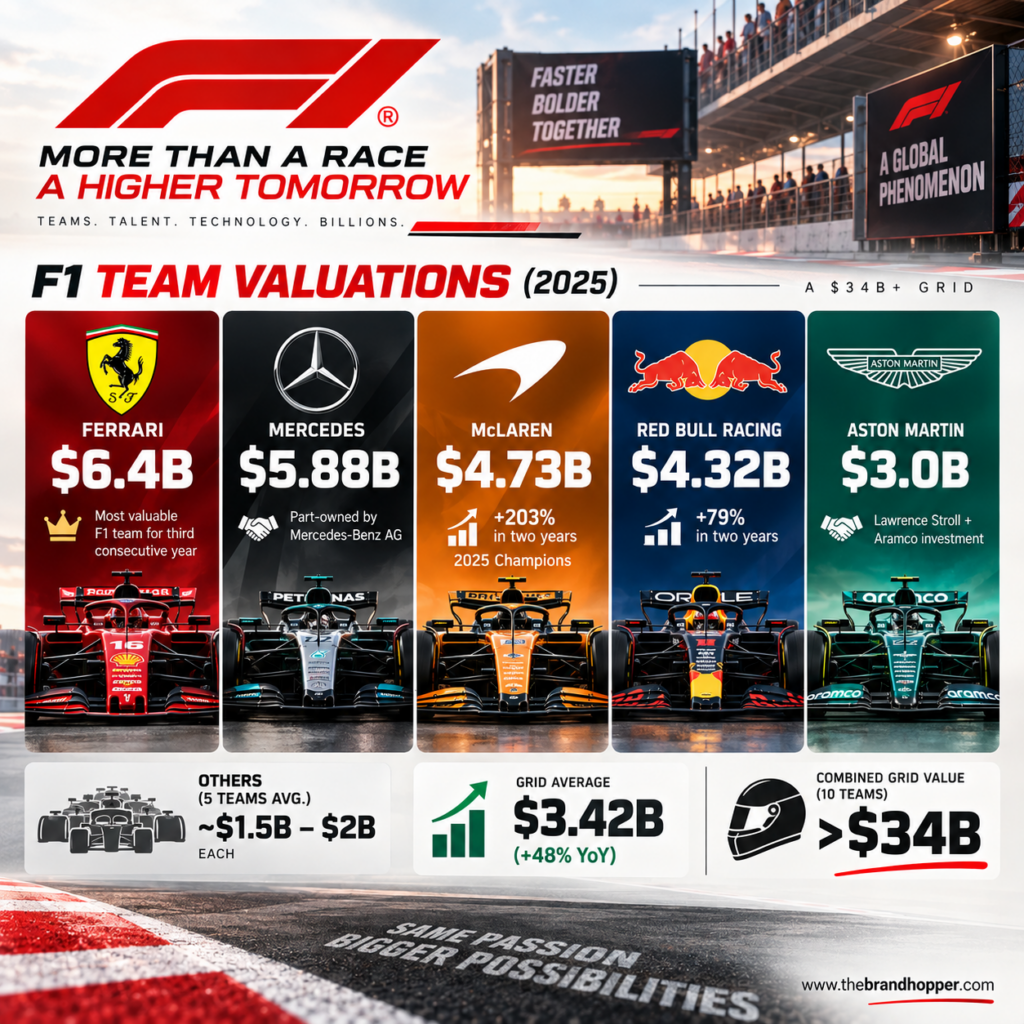
The valuation surge is driven by several compounding factors: F1’s global fan growth, the addition of three US race weekends (Las Vegas debuted in 2023 and proved commercially transformative), the record-breaking sponsorship environment driven by the tech sector, and the proven ability of the cost cap to create a pathway to profitability for well-managed teams.
McLaren’s remarkable 203% valuation increase in two years — driven by Lando Norris’s 2025 championship and the team’s resurgent on-track performance — demonstrates how rapidly racing success translates into commercial value. A championship can be worth $500M-$1B in incremental team valuation in the current F1 environment.
11. Cost Cap and the Path to Profitability
One of the most significant structural changes in F1’s business model was the introduction of the Financial Regulations (cost cap) from the 2021 season. Before the cap, top-tier teams like Mercedes and Ferrari routinely spent $400-500 million per year on their racing operations, while smaller teams survived on $120-150 million. The gap in spending was the primary driver of competitive disparity on track.
How the Cost Cap Works
- 2025 Cap Level: $135 million as the base cap, with a per-race supplement of $225,000 for each race beyond 21 in the calendar. With 24 races in 2025, teams received an additional $675,000, bringing the effective cap to approximately $135.675 million.
- Exclusions from the Cap: Driver salaries, the top three paid employees’ salaries, marketing costs, and commercial division costs are all excluded from the cap. Power unit (engine) costs are governed by a separate Power Unit Financial Regulations cap. This means total team spending, including excluded items, is significantly higher than the headline $135 million figure.
- 2026 Cap Increase to $215 Million: For 2026, the cap rises to $215 million. This appears to be a large increase but is broadly neutral in practice — several previously excluded items are now counted within the cap, including depreciation on capital equipment, additional staff costs, and other items that were previously accounted for separately. The net increase in real available spending is more modest than the headline figure suggests.
- Power Unit Cap: For 2026 (the year of the new power unit regulations with increased electrification), the engine cap rises to $190 million, with additional allowances for new or under-performing manufacturers to support competitive parity.
The cap’s most significant impact has been financial rather than purely competitive. Mid-field teams that previously burned through $200-300 million annually while delivering poor on-track results are now constrained to similar spending levels as top teams (who are forced to operate at cap). This compression has made F1 teams dramatically more commercially viable and investable — a direct contributor to the valuation explosion of 2023-2025.
The FIA enforces the cap through detailed financial reporting, independent auditing, and a Cost Cap Administration team. Breach of the cap carries significant sporting penalties — Red Bull Racing were fined $7 million and received a 10% reduction in wind tunnel testing time in 2022 following a minor cap breach in 2021, demonstrating that enforcement is taken seriously.
12. F1’s Global Expansion: The New Revenue Frontier
Liberty Media’s strategic transformation of Formula 1 since its 2017 acquisition has been the foundational driver of every revenue and valuation metric discussed in this article. Under Liberty’s ownership, F1 has pivoted from a secretive, European-centric sport into a global entertainment franchise modelled on NFL and NBA commercial principles.
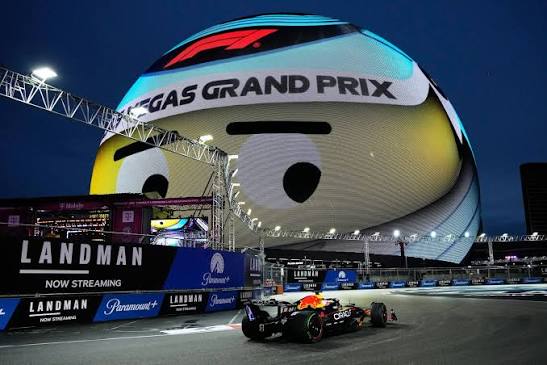
US Market Expansion: The Las Vegas Grand Prix (debut 2023) was F1’s most commercially ambitious race in history. The circuit runs down the Las Vegas Strip, hosting over 100,000 fans per day, with hospitality packages selling for $10,000-$150,000 per weekend. The race generated an estimated $1 billion in economic activity for Las Vegas. Three US races now run annually (Austin, Miami, Las Vegas).

Race Calendar Expansion: The 24-race calendar for 2025 is the largest in F1 history, with F1 charging track promoters an average of $20-65 million per year in race hosting fees. F1 Primary revenue from race promotion represented 26.7% of primary revenues in FY2025 ($3.09B), implying approximately $825 million from race promotion alone.
Liberty Media’s Broader Sports Strategy: In 2024, Liberty Media completed its acquisition of MotoGP (motorcycle racing’s premier series). MotoGP’s first results were included in F1’s financial reporting from 2025, adding a further revenue dimension to the Liberty Media sports portfolio.
New Team Entries and the $200M Entry Fee: From 2026, Audi (via Sauber) enters as a full works team. The FIA has also approved General Motors (Cadillac) as an 11th team from 2026. Entry fees for new teams are structured to reflect F1’s growing commercial value, potentially exceeding $200 million. New team entries expand the total prize pool, increase sponsor inventory, and generate new market opportunities.
The commercial model Liberty has built — premium live events, subscription media rights, a global entertainment franchise, trackside retail, and a robust digital ecosystem — mirrors what has made the NFL worth $150+ billion and the NBA worth $10+ billion. F1’s trajectory suggests it has years of growth ahead before reaching anything close to saturation.
Frequently Asked Questions (FAQs)
Q1: How much money does Formula 1 generate in total revenue?
A: In FY2025, Formula One Group generated total revenues of $3.87 billion — a 14% increase year-on-year and the fifth consecutive year of revenue growth. Primary revenue (from race promotion, media rights, and sponsorship) reached $3.09 billion, while other revenue (hospitality, licensing, and other) contributed $787 million. F1’s revenue has grown by more than $2 billion since Liberty Media acquired the sport in 2017.
Q2: How is F1 prize money distributed among teams?
A: F1 prize money is distributed under the Concorde Agreement, which governs the relationship between Formula 1, the FIA, and the teams. Approximately 45% of annual revenues — roughly $1.4 billion in FY2025 — is returned to teams. The distribution combines equal Column 1 payments (ensuring every qualifying team gets a base share), Column 2 payments based on Constructors’ Championship position, and additional bonuses for historical performance and longevity. Ferrari earned an estimated $277.7 million in 2025 prize money — significantly more than championship-winning McLaren ($165.8 million) — due to Ferrari’s heritage bonus and historical performance weighting.
Q3: What is the biggest sponsorship deal in Formula 1 history?
A: The largest single-team sponsorship deals in F1 are Oracle’s arrangement with Red Bull Racing and HP’s partnership with Ferrari, both reported at approximately $100 million per season. Oracle’s original deal (signed 2022) was a five-year arrangement reportedly worth $300 million in total. HP’s Ferrari deal, commencing 2025, is understood to be worth approximately $100 million annually — matching Oracle and making HP and Oracle the joint-largest team sponsors in F1 history.
Q4: How much are F1 teams worth?
A: F1 team valuations reached historic levels in 2025. Ferrari leads the grid at $6.4 billion, followed by Mercedes at $5.88 billion and McLaren at $4.73 billion. Red Bull Racing is valued at $4.32 billion and Aston Martin at $3.0 billion. The average valuation across all ten teams is $3.42 billion — up 48% in just one year — and the combined grid value exceeds $34 billion. McLaren’s valuation rose 203% in two years following their 2025 championship success.
Q5: What is the F1 cost cap and how does it work?
A: The F1 Financial Regulations (cost cap), introduced in 2021, limit how much teams can spend on their racing operations. In 2025, the cap is set at $135 million, plus $225,000 for each race beyond 21 in the calendar — giving teams approximately $135.7 million to work with across the 24-race season. Driver salaries, the top three paid employees, marketing costs, and power unit costs are excluded from the cap. From 2026, the headline cap rises to $215 million, but the change is broadly cost-neutral as several previously excluded items are now counted within it.
Q6: How does Drive to Survive make money for F1 teams?
A: Teams do not directly earn from the Netflix deal (which FOM negotiates centrally), but the show creates enormous indirect commercial value. Drive to Survive Season 7 (released March 2025) attracted 10.4 million views — making it the most-watched sports documentary on Netflix. The show drives US audience growth, attracts new sponsors (particularly American lifestyle and tech brands), increases merchandise sales, and generates viral digital content that teams monetize through their own social media channels. Season 8 has already been confirmed.
Q7: Do F1 teams make a profit?
A: Before the cost cap (introduced 2021), even the most successful F1 teams rarely made an operating profit — most manufacturer teams ran at losses of $100-300 million annually, subsidised by parent companies for brand value rather than return. The cost cap, combined with rising revenues, has changed this dramatically. Well-managed mid-field teams can now approach breakeven or modest profitability. Top manufacturer teams continue to run at net losses on their racing operations but generate brand and technology value that justifies the investment. Private teams increasingly view F1 as a viable investment asset given the surge in team valuations.
Q8: What is the Concorde Agreement?
A: The Concorde Agreement is the foundational commercial contract that governs Formula 1 — signed between Formula One Management (FOM), the FIA, and all ten competing teams. It defines how prize money is distributed, what regulatory powers each party holds, and the commercial terms under which teams participate. The agreement is named after the Place de la Concorde in Paris, where it was first signed in 1981. The current agreement runs through the 2025 season; a new Concorde Agreement governing racing from 2026 is in place alongside the new technical and power unit regulations.
Q9: How much do F1 drivers earn?
A: F1 driver salaries are not covered by the cost cap — they are a separate, excluded expense. The highest-paid drivers in F1 (including base salary and bonuses) can earn $50-70 million per year. Lewis Hamilton’s contract with Ferrari (from 2025) is reportedly worth approximately $50-60 million per year. Max Verstappen’s Red Bull contract is widely reported as the richest in F1 history, valued at $50-70 million annually. Mid-grid drivers typically earn $2-10 million, while junior or pay drivers may earn far less. In addition to race salaries, top drivers earn significant income from personal sponsorships, brand deals, and social media monetisation.
Q10: How does the Las Vegas Grand Prix make money for F1?
A: The Las Vegas Grand Prix, which debuted in November 2023, is F1’s most commercially ambitious event. The race runs on a circuit around the Las Vegas Strip, with over 100,000 fans per day. Hospitality packages range from $10,000 to $150,000+ for premium experiences. The event generated approximately $1 billion in economic activity for Las Vegas in its debut year. F1 charges track promoters a race hosting fee (typically $20-65 million annually for major venues), and the sport generates additional revenue from sponsorship, hospitality, merchandise, and media rights associated with the event. The Las Vegas race is expected to be one of F1’s highest-grossing events annually.
Conclusion
Formula 1’s financial model is more sophisticated, more diversified, and more profitable than at any point in the sport’s 75-year history. The combination of prize money, sponsorship, manufacturer funding, merchandise, technology licensing, hospitality, digital content, strategic investment, and the structural discipline of the cost cap has created an ecosystem where even mid-field teams can be viable businesses — and where the top teams are global commercial powerhouses worth billions of dollars.
The numbers tell the story most clearly. FY2025 revenue of $3.87 billion. A $1.4 billion prize pool. Sponsorship deals reaching $100 million annually. Team valuations averaging $3.42 billion, up 48% in a single year. Six million fans at circuits across six continents. Drive to Survive still the most-watched sports documentary on Netflix. A cost cap that has created an unprecedented pathway to profitability for well-managed teams.
For teams like Mercedes, Red Bull, and Ferrari, Formula 1 is simultaneously a marketing juggernaut, a technology laboratory, a luxury brand, and an increasingly valuable financial asset. For independent teams like McLaren — now worth $4.73 billion after their 2025 championship triumph — F1 is proof that patient investment, technical brilliance, and commercial strategy can turn a racing team into a global sports franchise of the first order.
And with Liberty Media continuing to expand the calendar, grow the US market, add new teams, and invest in digital and entertainment properties, the financial trajectory of Formula 1 points in one direction only: further, faster, and more profitable than ever before.
To read more content like this, subscribe to our newsletter
Go to the full page to view and submit the form.