



Introduction: What is Inditex?
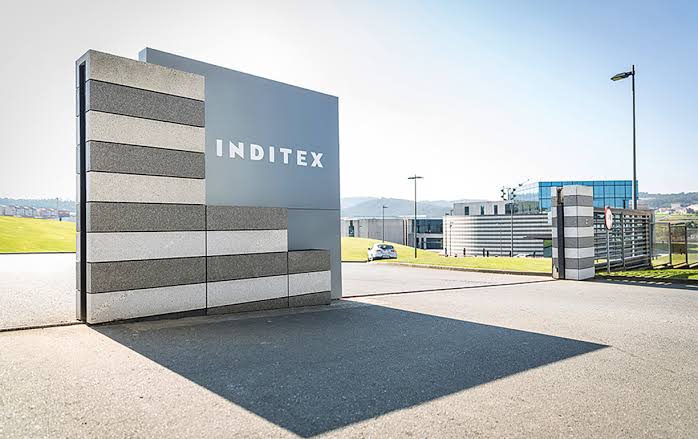
Inditex — formally Industria de Diseño Textil, S.A. — is one of the world’s largest fashion retail groups and the company behind some of the most recognisable clothing brands on the high street. Headquartered in Arteixo, a small town near A Coruña in the north-west of Spain, the group operates eight distinct fashion and lifestyle brands across more than 5,400 stores in 97 countries, while simultaneously running one of the most advanced e-commerce operations in global fashion.
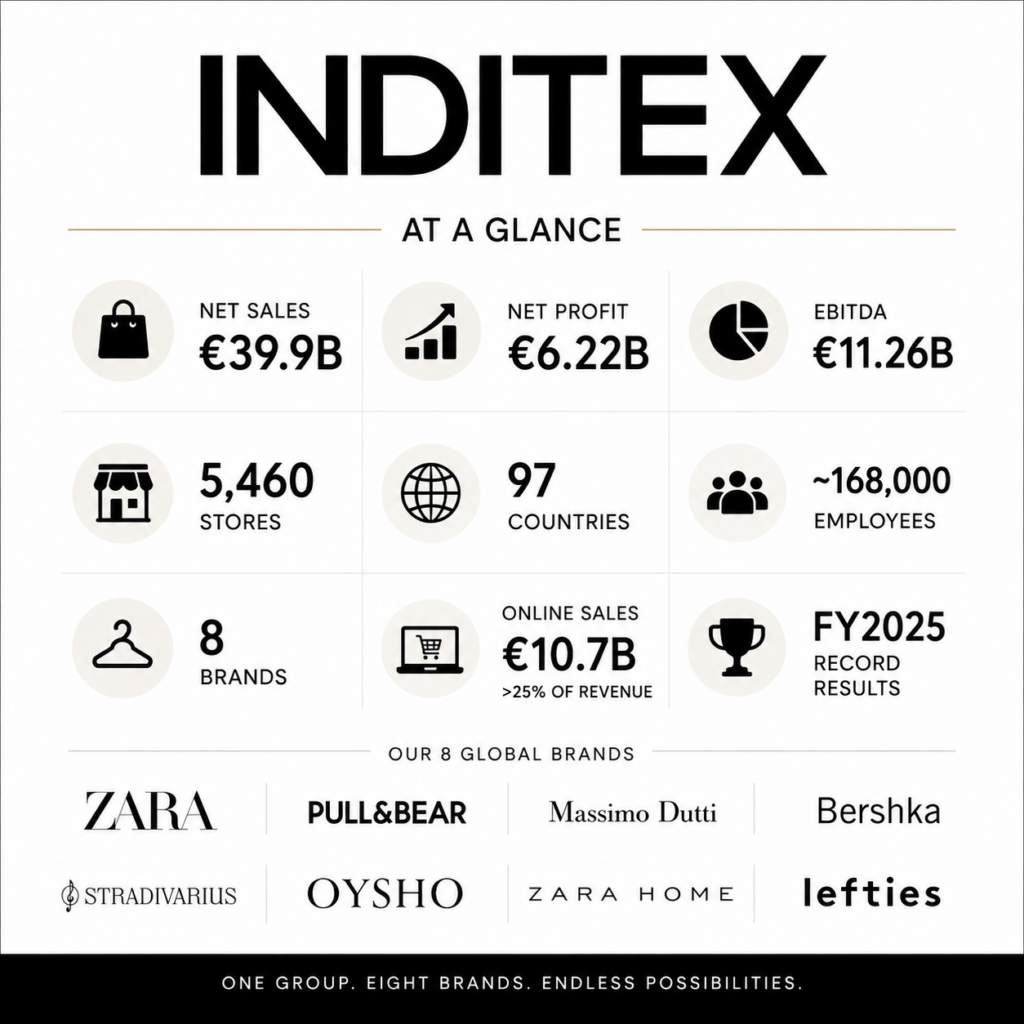
For most consumers, Inditex means Zara. But the group’s portfolio extends well beyond its flagship — encompassing youth-focused brands, premium fashion, lingerie and activewear, home décor, and an expanding budget format. Together, these eight brands generated net sales of approximately €39.9 billion in the most recent full fiscal year, with net profit of €6.22 billion — both record highs. Online sales now account for more than a quarter of total revenue, with digital commerce reaching €10.7 billion.
At the heart of Inditex’s competitive advantage is a business model that has redefined the global fashion industry: near-vertical integration of design, manufacturing, and distribution, combined with a supply chain so responsive that new designs can travel from concept to store shelf in two to three weeks. This ‘fast fashion’ model — first perfected by Zara — has since been adapted and applied across all eight brands, allowing each to operate with genuine speed-to-market while maintaining its distinct identity and target consumer.

Founding Story: From Bathrobe Factory to Global Fashion Empire
The story of Inditex begins with Amancio Ortega Gaona, the son of a railway worker who left school at 13 and began his career as a gofer in a shirt shop in A Coruña. Ortega’s instinct for the business side of fashion grew steadily through the 1960s, and in 1963 he founded his first company, Confecciones Goa, making bathrobes and lingerie for local retailers. The venture gave him direct insight into two things that would define his empire: the value of making your own products, and the danger of being too far removed from the final consumer.


In 1975, Ortega opened the first Zara store on A Coruña’s central shopping street. The concept was simple but radical: offer fashionable clothing at accessible prices, with new designs arriving constantly rather than twice a year. The store was an immediate success. Zara expanded across Spain through the 1980s, and in 1985 Ortega restructured his growing constellation of manufacturing and retail businesses under a single holding company — Industria de Diseño Textil, S.A. — which became known universally as Inditex.
International expansion accelerated in the 1990s, with Zara opening in Portugal (1988), the United States (1989), France (1990), and Mexico (1992). By the turn of the millennium, Inditex had listed on the Spanish stock exchange, had established its multi-brand portfolio, and was growing at a pace that would eventually make it the world’s largest fashion retailer by market capitalisation. Ortega stepped back from day-to-day management in 2011 and from the chairmanship in 2022, remaining the group’s controlling shareholder with approximately 59% of shares.
Leadership Today: Marta Ortega and the Next Generation
Inditex entered a new leadership era in April 2022, when the Board of Directors appointed Marta Ortega Pérez as Chairwoman of the Group. The daughter of founder Amancio Ortega, Marta had been part of Inditex since 2007, beginning on the shop floor across multiple brands before taking on strategic roles in buying, creative direction, and brand identity — most notably leading Zara’s elevated fashion repositioning. She works alongside CEO Óscar García Maceiras, a lawyer by training who joined Inditex’s legal team in 2014 and was appointed to the CEO role in November 2021.

The Ortega-García Maceiras partnership reflects a deliberate separation of creative vision (Marta) from operational and financial execution (Óscar) — a model that mirrors the structure used effectively during Pablo Isla’s long tenure as CEO under Amancio Ortega’s chairmanship. Under this leadership team, Inditex has continued to post record results while investing heavily in physical store upgrades, digital integration, and sustainability initiatives.
Inditex’s Business Model: The Engine Behind the Brands
What makes Inditex structurally different from nearly every fashion retailer of comparable scale is its degree of vertical integration. Where most fashion groups outsource design to agencies, manufacturing to distant factories, and logistics to third-party operators, Inditex controls — or closely coordinates — each of these steps internally. Design teams work in-house at each brand’s headquarters. Approximately 50% of production is handled by owned or closely associated factories in Spain, Portugal, Morocco, and Turkey, enabling far shorter turnaround times than rivals who rely entirely on Asian mass production.
The supply chain philosophy is built around flexibility rather than scale. Rather than placing massive orders months in advance based on seasonal trend forecasts, Inditex produces smaller batches of each design and reorders rapidly based on actual sales data. Store managers send real-time feedback on what’s selling; design teams respond within days; new inventory arrives at stores twice a week. This system minimises unsold stock (a chronic problem for conventional fashion retailers) while ensuring that what customers find in store is genuinely fresh.
Inditex’s logistics infrastructure is equally distinctive. The group operates vast distribution centres in Arteixo and Zaragoza that serve as the nerve centres for its global retail network. All products — regardless of where they are made — are shipped to these hubs for processing and onward distribution to stores and online customers worldwide. This centralised model gives Inditex unprecedented control over inventory allocation and replenishment speed.
- Speed to market: New designs can move from concept to store in 2-3 weeks
- Vertical integration: Design, production coordination, logistics all in-house
- Small-batch production: Reduces overstock; builds perceived scarcity
- Twice-weekly deliveries: Constant store refresh drives repeat footfall
- Real-time data: Store managers and POS data inform design and replenishment daily
Inditex at a Glance: Key Financial Snapshot
| Metric | Value |
| Net Sales (FY2025) | €39.9 billion (+3.2% year-on-year) |
| Net Profit (FY2025) | €6.22 billion (record) |
| EBITDA (FY2025) | €11.26 billion (+5%) |
| Gross Profit | €23.2 billion (+3.9%) |
| Online Sales | €10.7 billion (>25% of total revenue) |
| Total Stores | 5,460 stores globally |
| Total Markets | 97 countries |
| Total Selling Space | 4.72 million sq metres (+5.3%) |
| Total Employees | ~168,000 worldwide |
| Dividend per Share | €1.75 (ordinary €1.20 + special €0.55) |
| Headquarters | Arteixo, A Coruña, Galicia, Spain |
| Number of Brands | 8 |
The 8 Brands of Inditex Group
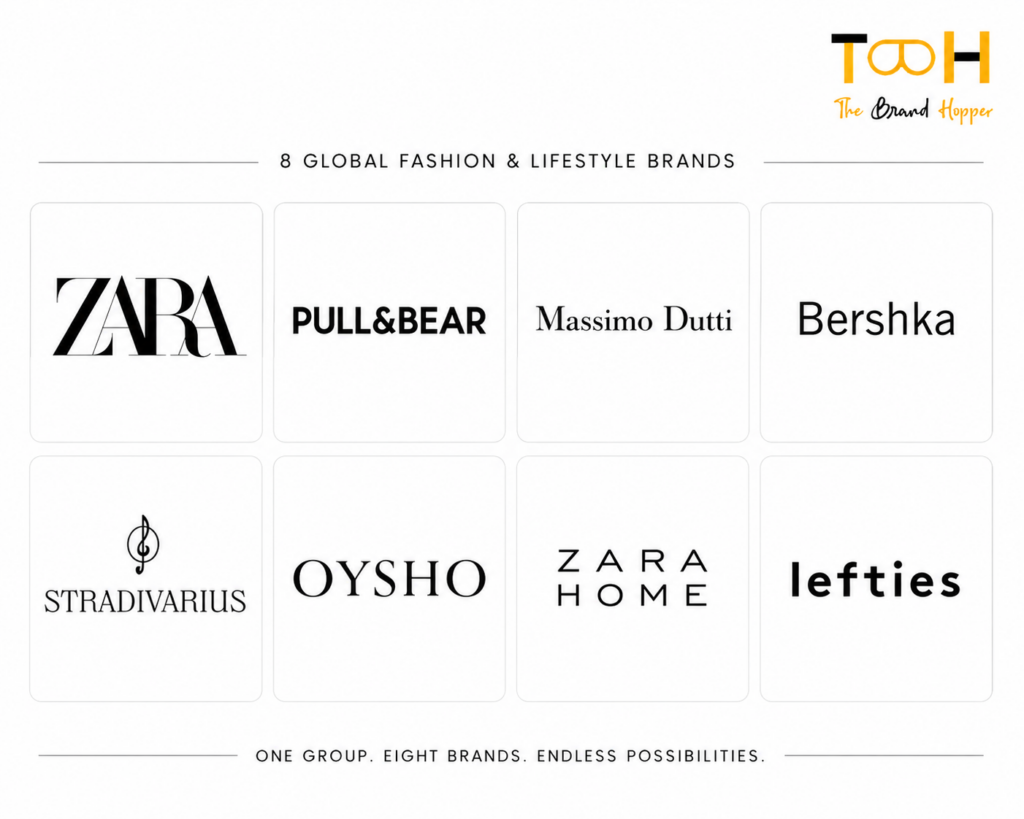
Each Inditex brand has been designed with a distinct consumer in mind — a specific age range, lifestyle, price sensitivity, and aesthetic. Together they cover the market from budget essentials to premium tailoring, from teenage streetwear to luxury-adjacent design, from intimate apparel to home interiors. This portfolio breadth is a deliberate strategic choice: rather than diluting one mega-brand across all consumer segments, Inditex runs eight separate identities, each with its own store design, creative team, pricing architecture, and marketing voice.
| BRAND 1 OF 8
Zara The flagship. Fast fashion’s most iconic brand. |

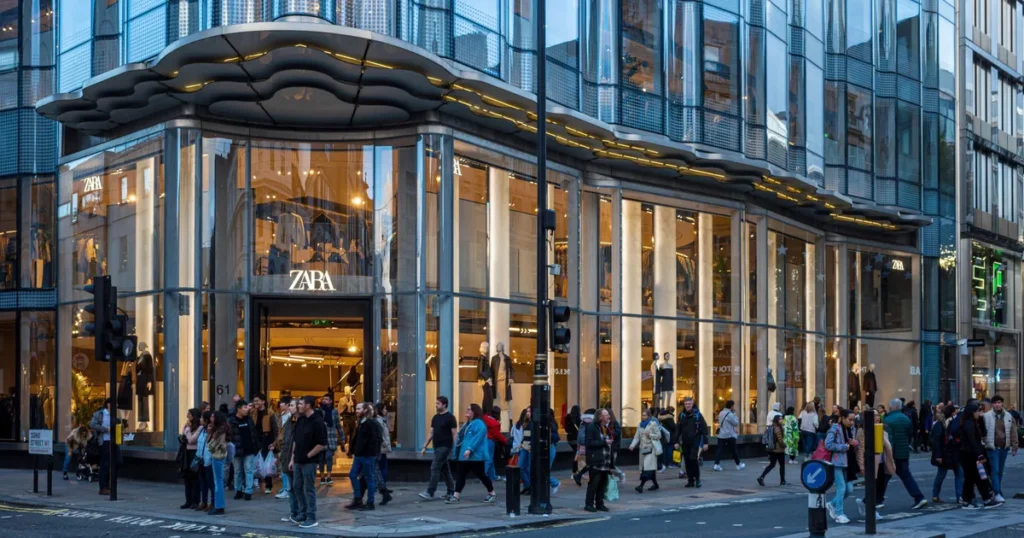
Zara is the flagship brand of the Inditex Group and, by most metrics, the most influential fashion brand of the past four decades. Founded in A Coruña in 1975 by Amancio Ortega, Zara created and continues to define the concept of fast fashion — the ability to move runway-inspired designs into affordable, accessible retail at a speed that the industry had previously considered impossible. The brand now operates approximately 1,528 stores across major global markets and generates the vast majority of Inditex’s total revenue.
Zara’s product range covers womenswear, menswear, and childrenswear (Zara Kids), with collections refreshed continuously rather than seasonally. The brand is positioned at the accessible premium tier — more expensive than Primark or H&M, cheaper than Mango or COS — and its design language draws direct inspiration from the luxury runways, interpreted for the high street within weeks of the original shows. This design velocity is Zara’s defining competitive advantage: by the time a competitor has identified a trend and ordered production, Zara has already delivered it and moved on.
Beyond its retail stores, Zara has invested heavily in its online channel, which now represents a meaningful and growing share of brand revenue. The app and e-commerce platform are among the most sophisticated in fashion retail, offering augmented reality features, same-day delivery in select cities, and personalised styling integrations. Zara’s physical stores have also undergone major upgrades — the group’s strategy of absorbing smaller stores into larger, technologically enhanced flagship formats has steadily increased average store productivity even as total door count has modestly declined.
Founded: 1975 (A Coruña, Spain)
Target audience: Fashion-forward women and men, 18-45
Price positioning: Accessible premium; mid-market
Stores: ~1,528 globally
Sustainability: Zara Pre-Owned (repairs, resale, donation); Join Life sustainable material labelling; 88% of fibres certified organic/recycled
| BRAND 2 OF 8
Pull&Bear Urban youth culture and casual cool. |

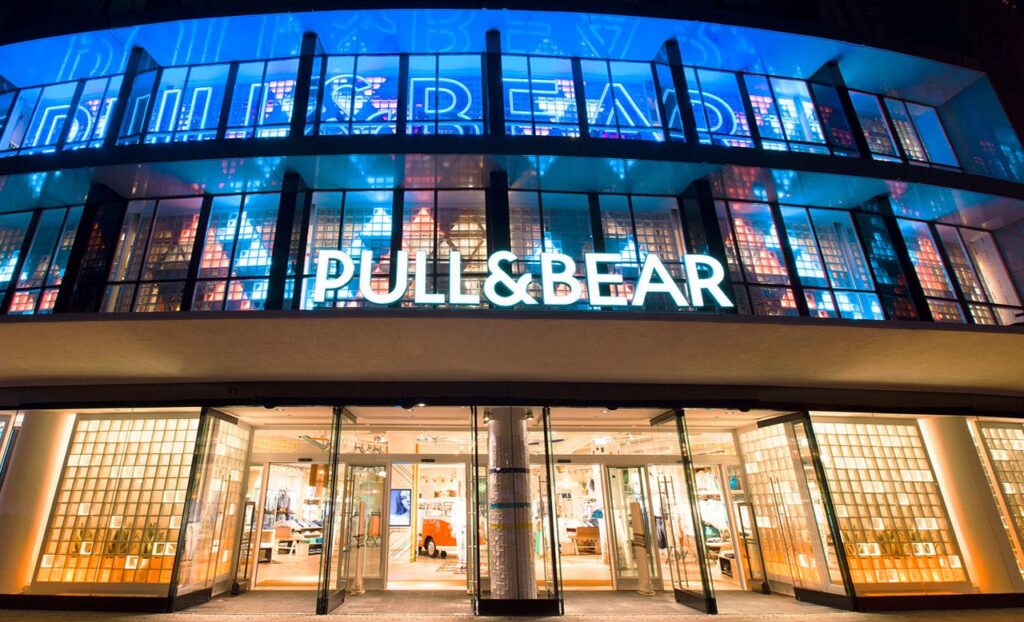
Pull&Bear was launched by Inditex in 1991 to address a growing gap in the market: a brand specifically designed for teenagers and young adults who wanted relaxed, casual clothing at affordable prices with a distinctly urban character. Where Zara speaks the language of fashion and trend, Pull&Bear speaks the language of youth culture — streetwear, denim, surfwear, and laid-back basics that feel at home equally on a skateboard or in a college lecture hall.
The brand’s aesthetic is anchored in casual simplicity: slim-fit jeans, graphic tees, hoodies, bomber jackets, and footwear with a streetwear sensibility. Pull&Bear has historically been very strong on denim — positioning itself as a go-to destination for affordable quality jeans across multiple cuts and washes. It caters to both men and women with broadly comparable ranges, and its price points sit below Zara while offering a more trend-conscious sensibility than purely budget alternatives.
Pull&Bear’s store network currently numbers approximately 800 locations globally, with a strong presence in Europe (particularly Iberia, France, Italy, and Eastern Europe) and growing reach in Latin America and the Middle East. The brand has embraced digital commerce aggressively and maintains a strong social media presence targeting Gen Z consumers. Its store concept is contemporary and energetic — open layouts, bold visual merchandising, and music-led in-store atmosphere.
Founded: 1991
Target audience: Teenagers and young adults, 14-28
Price positioning: Value to accessible; below Zara
Stores: ~800 globally
| BRAND 3 OF 8
Massimo Dutti Premium quality. Sophisticated style. |

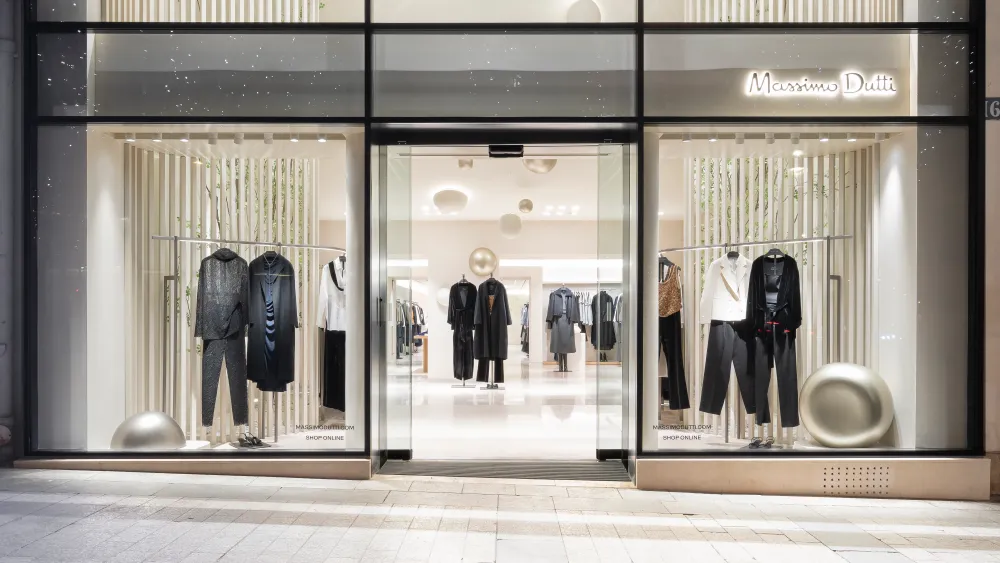
Massimo Dutti occupies the premium end of the Inditex brand spectrum, offering sophisticated, high-quality clothing for both men and women who prioritise enduring style over trend velocity. Originally a Spanish menswear brand founded in 1985, Massimo Dutti was acquired by Inditex in 1991 and gradually extended to include womenswear (added in 1995) and accessories. Today it is arguably Inditex’s most elevated mainstream brand — the closest the group gets to genuinely premium fashion territory, positioned above Zara but without the price premium of a luxury label.
The brand’s design language is characterised by clean lines, quality fabrics, and restrained colour palettes — Mediterranean in spirit, with a focus on versatile pieces that work across both professional and leisure contexts. A Massimo Dutti customer is typically a professional adult who wants genuinely well-made clothing that lasts multiple seasons, rather than the runway-inspired fast-turn items that define Zara or Bershka. Tailored blazers, fine-knit knitwear, premium leather goods, and elevated casualwear are the brand’s core strengths.
Massimo Dutti also absorbed the smaller Uterqüe brand in 2021, integrating Uterqüe’s accessories, shoes, and premium lifestyle positioning into the Massimo Dutti universe. The brand operates approximately 519 stores globally, with a concentration in major European cities, the Middle East, and select Asian markets. Unlike Zara, Massimo Dutti deliberately maintains a more restrained store count, prioritising premium locations and larger, experience-focused formats.
Founded: 1985 (acquired by Inditex 1991)
Target audience: Urban professionals, 28-45
Price positioning: Premium; above Zara
Stores: ~519 globally
| BRAND 4 OF 8
Bershka Bold. Trend-first. Maximum youth energy. |

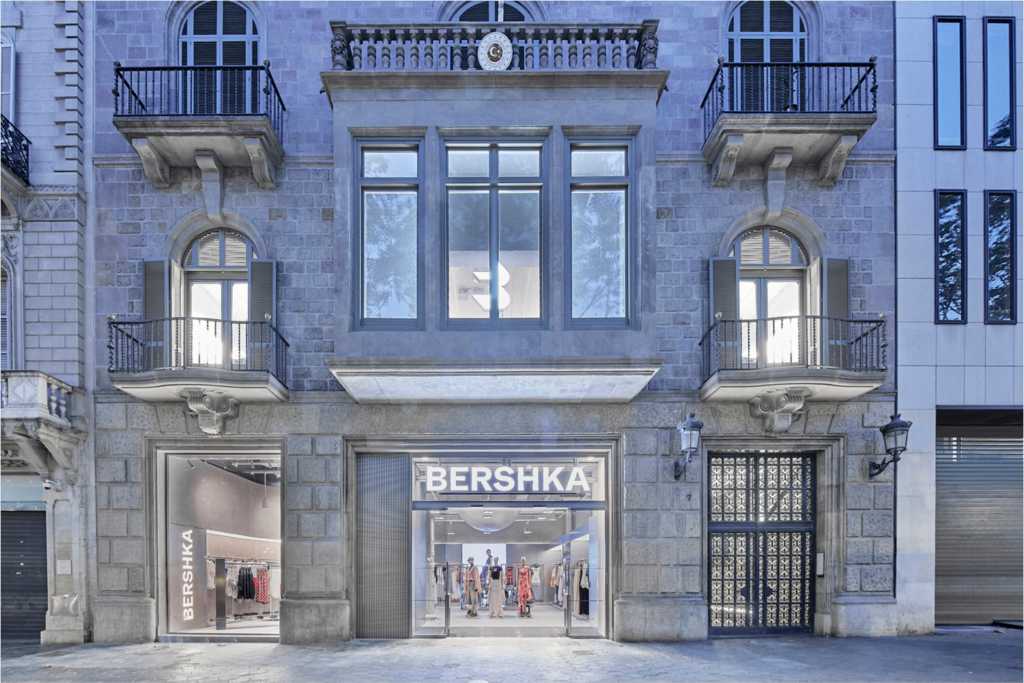
Bershka is the most trend-forward and youth-centric of all the Inditex brands — a label designed explicitly for the Gen Z consumer who wants the absolute latest in fashion at the lowest possible price point within the Inditex portfolio. Launched in 1998 to compete more directly with brands like H&M and Topshop at the youth end of the market, Bershka’s design philosophy is simple: identify a trend the moment it emerges on social media or the runway, produce it immediately, sell it at an accessible price.
Bershka’s aesthetic is bolder and more maximalist than Zara or Pull&Bear — the brand embraces colour, print, statement silhouettes, and trend-led styling that would feel at home in a TikTok post. Its target customer is young (primarily 16-24), digitally native, heavily social-media-influenced, and shopping for the dopamine of a new outfit rather than the longevity of a classic wardrobe. Bershka has been particularly successful in bridging the gap between online trend culture (where micro-trends emerge and die within weeks) and physical retail delivery.
Bershka was one of the few Inditex brands to grow its store count in recent periods, with the brand actively expanding in new markets as part of Inditex’s strategic portfolio diversification. It caters to both men and women and has a strong online presence, with its social media following among the most engaged in the Inditex portfolio.
Founded: 1998
Target audience: Teenagers and young adults, 16-24
Price positioning: Value to accessible; most affordable within Inditex alongside Lefties
Stores: Growing network globally
| BRAND 5 OF 8
Stradivarius Feminine. Free-spirited. Fashion-forward. |
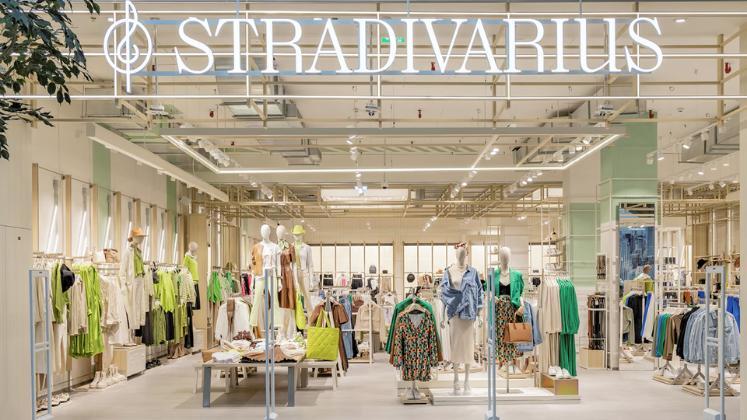

Stradivarius is Inditex’s dedicated womenswear brand for young women who gravitate toward a more feminine, expressive, and free-spirited aesthetic than the broader trend-chasing of Bershka or the accessible sophistication of Zara. Originally a Spanish fashion chain founded in 1994, Stradivarius was acquired by Inditex in 1999 and has since been developed into one of the group’s most distinctive brand identities.
The brand’s visual language is romantic and bohemian — floral prints, flowing silhouettes, delicate embroidery, earthy tones, and accessories with artisanal character. Stradivarius leans into femininity rather than away from it, and its collections reflect a woman who expresses her personality through her wardrobe rather than simply following trend cycles. The brand regularly collaborates with emerging designers and artists to inject creative freshness, and its campaigns typically feature a lifestyle sensibility — outdoor settings, travel, art — rather than conventional fashion editorials.
Stradivarius operates approximately 839 stores globally and has a particularly loyal following in Southern Europe, Eastern Europe, the Middle East, and Latin America. Its price positioning is comparable to Bershka and Pull&Bear — accessible to younger consumers — but its brand identity is more cohesive and distinctive, creating genuine loyalty among its target customer.
Founded: 1994 (acquired by Inditex 1999)
Target audience: Young women, 18-30
Price positioning: Accessible; comparable to Bershka/Pull&Bear
Stores: ~839 globally
| BRAND 6 OF 8
Oysho Intimate, active, and at-home. |
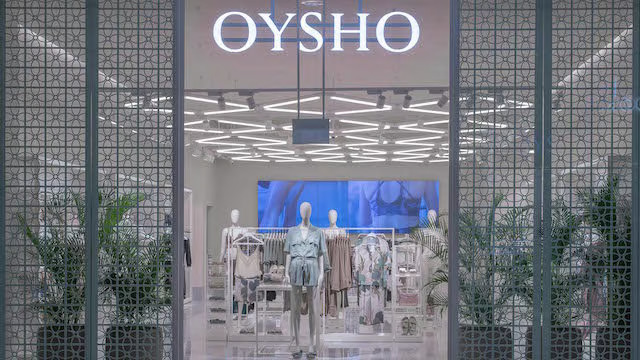
Oysho is Inditex’s brand for intimate apparel, loungewear, and activewear — a specialist focused on how women dress at home, at rest, and in motion. Launched in 2001, Oysho emerged to fill a specific gap: stylish, affordable underwear, pyjamas, swimwear, and fitness wear for women who wanted the design sensibility of the Inditex group applied to these more personal wardrobe categories.
Over the past decade, Oysho has undergone a significant strategic evolution, shifting its emphasis substantially toward activewear and sportswear to capitalise on the global athleisure boom. The brand now competes meaningfully against specialist sportswear brands in yoga, pilates, running, and fitness categories, while retaining its core intimates and loungewear offer. This dual positioning — comfort for home, performance for sport — has resonated strongly with its target audience of women aged 18-35 who lead active lifestyles.
Oysho’s store design reflects this evolution: clean, spa-like interiors with natural materials, tactile product displays, and a calm atmosphere that contrasts with the more energetic visual environments of Bershka or Pull&Bear. The brand operates approximately 389 stores and has been one of the faster-growing Inditex brands in the online channel, where its intimate and activewear categories translate particularly well to digital browsing and buying.
Founded: 2001
Target audience: Women 18-35; active lifestyle and comfort focus
Price positioning: Accessible to mid-range
Stores: ~389 globally
| BRAND 7 OF 8
Zara Home Zara’s style — for every room of your home. |
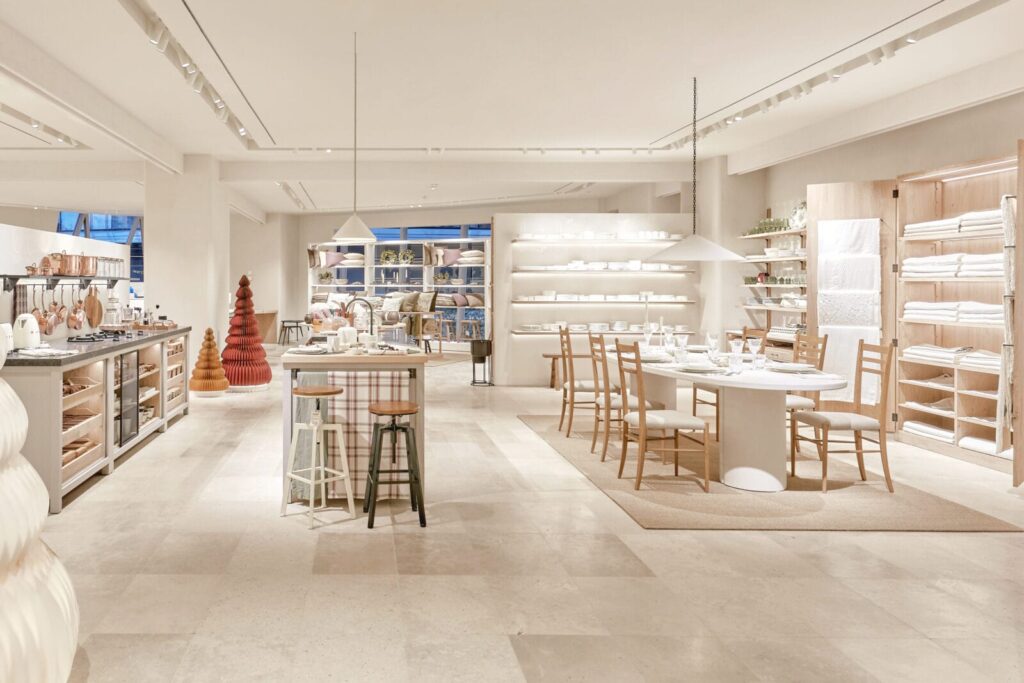
Zara Home is Inditex’s extension of the Zara design aesthetic into the home interiors category — applying the same philosophy of accessible, design-led, frequently refreshed product to bedding, bath textiles, tableware, decorative items, furniture, and lighting. Launched in 2003, Zara Home was one of the first fashion-brand home collections to successfully transfer the fast-fashion model into the home category, and it remains one of the most recognisable names in affordable home décor globally.
The brand’s design language is in many ways identical to the mother brand: Mediterranean in inspiration, clean and contemporary in execution, with a seasonal palette that changes frequently and collections that allow customers to refresh their living spaces as often as they would their wardrobe. Zara Home is particularly strong in bed linens, bath towels, and kitchen/table accessories — product categories where the brand’s combination of quality fabrics and accessible price points gives it a genuine competitive advantage over both mass-market homeware retailers and specialist home brands.
In many markets, Zara Home has been progressively integrated into Zara stores as Inditex rolls out its larger-format flagship model, which combines Zara, Zara Home, and sometimes Zara Kids under one roof. Standalone Zara Home stores continue to operate in markets where the flagship integration has not yet occurred, with the brand running approximately 380 dedicated locations. The Zara Home online channel is one of the strongest in the home category.
Founded: 2003
Target audience: Home decorators, 25-50; Zara brand loyalists extending into interiors
Price positioning: Accessible premium; above IKEA, below premium home brands
Stores: ~380 standalone stores (plus integration into Zara flagship formats)
| BRAND 8 OF 8
Lefties Inditex’s budget brand — expanding fast. |
Lefties is the youngest brand in the Inditex portfolio and the group’s answer to ultra-affordable fashion — the closest Inditex gets to competing directly with Primark, H&M, and Shein on price. What began as an outlet channel for Zara excess stock has evolved into a standalone brand with its own design identity, store concept, and increasingly international ambitions.
The brand offers minimalist, Gen Z-friendly fashion at strikingly low prices: jeans from €12.99, tops from €7.99, with a full range spanning womenswear, menswear, kids’ clothing, and — more recently — home décor (a budget alternative to Zara Home). The aesthetic is clean and contemporary without being fashion-forward, prioritising wearable basics over trend-driven statement pieces. Lefties has historically been concentrated in Spain and Portugal, with a growing presence in markets like Turkey, Italy, Saudi Arabia, and UAE.
The big news for Lefties is its accelerated Western European expansion. The brand entered Germany, France, and the United Kingdom in recent periods — marking a significant strategic push by Inditex to grow its budget offering in markets where competitors like Primark are well established. In the UK, Lefties opened on Oxford Street and at major shopping centres including Westfield London, Lakeside, and Bluewater. This expansion signals Inditex’s intent to fight for the value-conscious consumer segment rather than ceding it to rivals.
Lefties currently operates approximately 210 stores across more than 15 countries, making it the smallest brand by store count in the portfolio — but one of the fastest-growing. Its digital presence is developing alongside its store network, and the brand’s low price points make it an effective entry point for younger or more price-sensitive consumers into the broader Inditex ecosystem.
Founded: 1990s (as Zara outlet channel; repositioned as standalone brand)
Target audience: Value-conscious shoppers, primarily Gen Z; teens to young adults
Price positioning: Budget; direct competitor to Primark and value fast fashion
Stores: ~210 globally; expanding actively in Western Europe
Recent expansion: Germany, France, UK (Oxford Street, Westfield London, Lakeside, Bluewater)
All 8 Inditex Brands at a Glance
| Brand | Founded | Target Consumer | Price Tier | Approx. Stores | Category |
| Zara | 1975 | Fashion-forward adults 18-45 | Accessible premium | ~1,528 | Full fashion |
| Pull&Bear | 1991 | Youth casual 14-28 | Accessible | ~800 | Casual/streetwear |
| Massimo Dutti | 1985 (acq. 1991) | Professionals 28-45 | Premium | ~519 | Smart/premium fashion |
| Bershka | 1998 | Gen Z 16-24 | Value/accessible | Growing | Trend-led youth |
| Stradivarius | 1994 (acq. 1999) | Young women 18-30 | Accessible | ~839 | Feminine/bohemian |
| Oysho | 2001 | Active women 18-35 | Accessible/mid | ~389 | Intimates/activewear |
| Zara Home | 2003 | Home decorators 25-50 | Accessible premium | ~380 | Home & lifestyle |
| Lefties | 1990s (rebranded) | Budget-conscious teens/adults | Budget | ~210 | Budget fashion |
Sustainability: Inditex’s Strategy for a More Responsible Fashion Future
Inditex has made sustainability a core strategic pillar, responding to growing regulatory pressure, consumer expectations, and investor scrutiny of fashion’s environmental footprint. The group’s sustainability commitments are among the most ambitious in the industry, though — like most fast fashion companies — it faces the structural tension of building a business on volume and velocity while simultaneously pursuing environmental goals.
Sustainable fibres: In the most recent reporting period, 88% of fibres used across Inditex collections were certified as organic, regenerative, recycled, or other lower-impact alternatives. Of these, 47% were recycled fibres and 30% derived from organic or regenerative sources.
Carbon reduction: Inditex has committed to reducing absolute greenhouse gas emissions by 50% by 2030 (from a 2018 baseline), aligned with Science Based Targets initiative (SBTi) requirements.
Zara Pre-Owned: Launched across key markets, the Zara Pre-Owned programme offers in-store repair services, customer-to-customer resale facilitation, and clothing donation collection — moving the brand toward a more circular model.
Join Life label: Zara’s “Join Life” collection label identifies garments made with certified organic cotton, recycled polyester, Tencel lyocell, and other more sustainable material choices, giving shoppers a clear sustainability signal within the standard range.
Packaging: Inditex targets 100% recycled or sustainable-sourced packaging materials across the group.
Water: Partnership with Air Fiber Washer technology aims to reduce microfibre shedding from synthetic garments by up to 60%.
Inditex partnered with biotech firm Circ to develop collections using recycled blended textiles — one of fashion’s most technically challenging recycling problems, as garments made of cotton-polyester blends have historically been nearly impossible to recycle. This partnership signals a serious R&D investment in next-generation material circularity that goes beyond the incremental commitments most fashion brands make.
Personalisation and Self-Expression: The Consumer Beyond the Brand
One of the most enduring aspects of fashion culture — and one that plays directly into the appeal of accessible brands like Zara, Bershka, and Pull&Bear — is the impulse to personalise and individualise clothing beyond what the original brand provides. Across the Inditex brand portfolio, consumers frequently adapt and customise their purchases to create something uniquely their own.
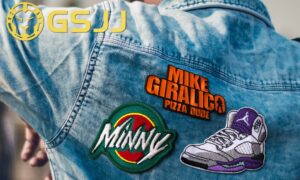
A popular customisation method is the addition of custom patches — embroidered, woven, or printed designs applied to denim, denim jackets, bags, and other items. By adding patches, consumers can incorporate additional patterns, colours, or textures, enriching their garments with personal meaning that transcends the original design. This customisation culture has become a significant counterpoint to fast fashion’s standardisation — a way for consumers to reclaim individuality within a mass-market wardrobe.
Frequently Asked Questions
Q: How many brands does Inditex own?
A: Inditex currently owns and operates 8 brands: Zara, Pull&Bear, Massimo Dutti, Bershka, Stradivarius, Oysho, Zara Home, and Lefties. Historically, the group also owned Uterqüe, which was folded into Massimo Dutti in 2021, and Tempe, a shoe brand that operates as a B2B supplier to other Inditex brands rather than as a consumer-facing chain.
Q: What is the parent company of Zara?
A: Zara is owned by Inditex (Industria de Diseño Textil, S.A.), a Spanish multinational fashion group headquartered in Arteixo, Galicia, Spain. Inditex is listed on the Madrid Stock Exchange (IBEX 35) and is one of the world’s largest fashion retailers. Zara accounts for the majority of Inditex’s total revenue and is the group’s flagship brand.
Q: What is Inditex’s annual revenue?
A: In its most recent full fiscal year (FY2025, covering February 2025 to January 2026), Inditex recorded net sales of approximately €39.9 billion, representing 3.2% growth year-on-year. Net profit reached €6.22 billion — a record for the group. Online sales exceeded €10.7 billion, accounting for more than 25% of total revenue. Inditex operates approximately 5,460 stores across 97 countries.
Q: Who is the CEO of Inditex?
A: The CEO of Inditex is Óscar García Maceiras, who was appointed to the role in November 2021. The Chairwoman is Marta Ortega Pérez, the daughter of Inditex founder Amancio Ortega, who became Chair in April 2022. Amancio Ortega remains the controlling shareholder with approximately 59% of the company’s shares.
Q: Is Lefties an Inditex brand?
A: Yes. Lefties is one of Inditex’s 8 official brands, though it is the least well-known outside of Spain and Portugal. It operates as the group’s budget fashion brand — offering very low prices comparable to Primark — and is currently undergoing significant international expansion, with new stores opening in Germany, France, and the United Kingdom.
Q: What happened to Uterqüe?
A: Uterqüe, which was an Inditex brand specialising in premium accessories, shoes, and leather goods, was discontinued as a standalone brand in 2021. Its product ranges and concept were absorbed into the Massimo Dutti brand, which took on some of Uterqüe’s premium accessories and lifestyle positioning. This merger reduced the total Inditex brand count from 9 to 8.
Q: How does Inditex make clothes so fast?
A: Inditex’s speed to market comes from near-vertical integration of its supply chain. The group controls or closely coordinates design, production (with approximately 50% of manufacturing near its headquarters in Spain, Portugal, Morocco, and Turkey), and logistics internally. Rather than committing to large seasonal orders months in advance, Inditex produces small batches rapidly based on real-time sales feedback, then reorders what is selling. New designs can move from concept to store shelves in as little as 2-3 weeks.
Q: Where is Inditex headquartered?
A: Inditex is headquartered in Arteixo, a municipality near A Coruña in the Galicia region of north-west Spain. The group’s design studios, key logistics operations, and executive offices are all based in or around Arteixo. It is also the location of the original Zara manufacturing operations.
Conclusion
Inditex’s journey from a single bathrobe factory in Galicia to the world’s most dominant fashion conglomerate is a story of operational genius applied at extraordinary scale. The eight brands that now constitute the group — Zara, Pull&Bear, Massimo Dutti, Bershka, Stradivarius, Oysho, Zara Home, and Lefties — collectively address almost every segment of the fashion and lifestyle market, from budget essentials to elevated tailoring, from teen streetwear to sophisticated homewares.
What unifies these brands is not their aesthetic — which varies enormously across the portfolio — but the shared operational infrastructure that supports them: the same logistics network, the same near-real-time supply chain responsiveness, the same commitment to physical-digital integration, and increasingly, the same sustainability agenda. With record revenues of €39.9 billion, record net profit of €6.22 billion, and a clear growth strategy anchored in store upgrades, online expansion, and the international rollout of Lefties, Inditex enters its next chapter from a position of genuine financial and operational strength.
For students of fashion, business, and supply chain management, Inditex remains one of the most instructive and fascinating companies in the world — a business that built its empire by doing almost everything differently from the rest of the industry, and proved that those differences were right.
Under the Inditex Group, you can find practically every type of apparel you like. If you feel like DIYing your clothing, you can apply custom patches to your clothing. Custom Patches can be designed based on personal preferences, brand logos, or specific themes to give the clothing a unique aesthetic.
By adding patches, you can add additional patterns, colors, or textures to the clothing, enriching the details and layering of the clothing. Adding custom wear-resistant patches to the easily worn parts of the clothing can extend its life. You can repair clothing that has been damaged or worn by adding custom patches to make it look brand newX. Custom patches can be applied to different types of clothing, such as T-shirts, jackets, jeans, etc., to suit different wearing occasions and style needs.

Also Read: The Magic of LVMH: Exploring the Marketing Strategy Of Luxury Empire
To read more content like this, subscribe to our newsletter
Go to the full page to view and submit the form.