


The global memory and semiconductor market is experiencing one of the most significant growth cycles in its history, propelled by the AI revolution, data centre expansion, and the proliferation of edge computing devices. Memory — DRAM, NAND flash, and High Bandwidth Memory (HBM) — sits at the centre of every major computing workload, from cloud AI training to autonomous vehicles to 5G smartphones. The global memory market is forecast to surpass $200 billion in annual revenue by 2030, with HBM alone projected to grow from a $35 billion total addressable market in 2025 to approximately $100 billion by 2028.
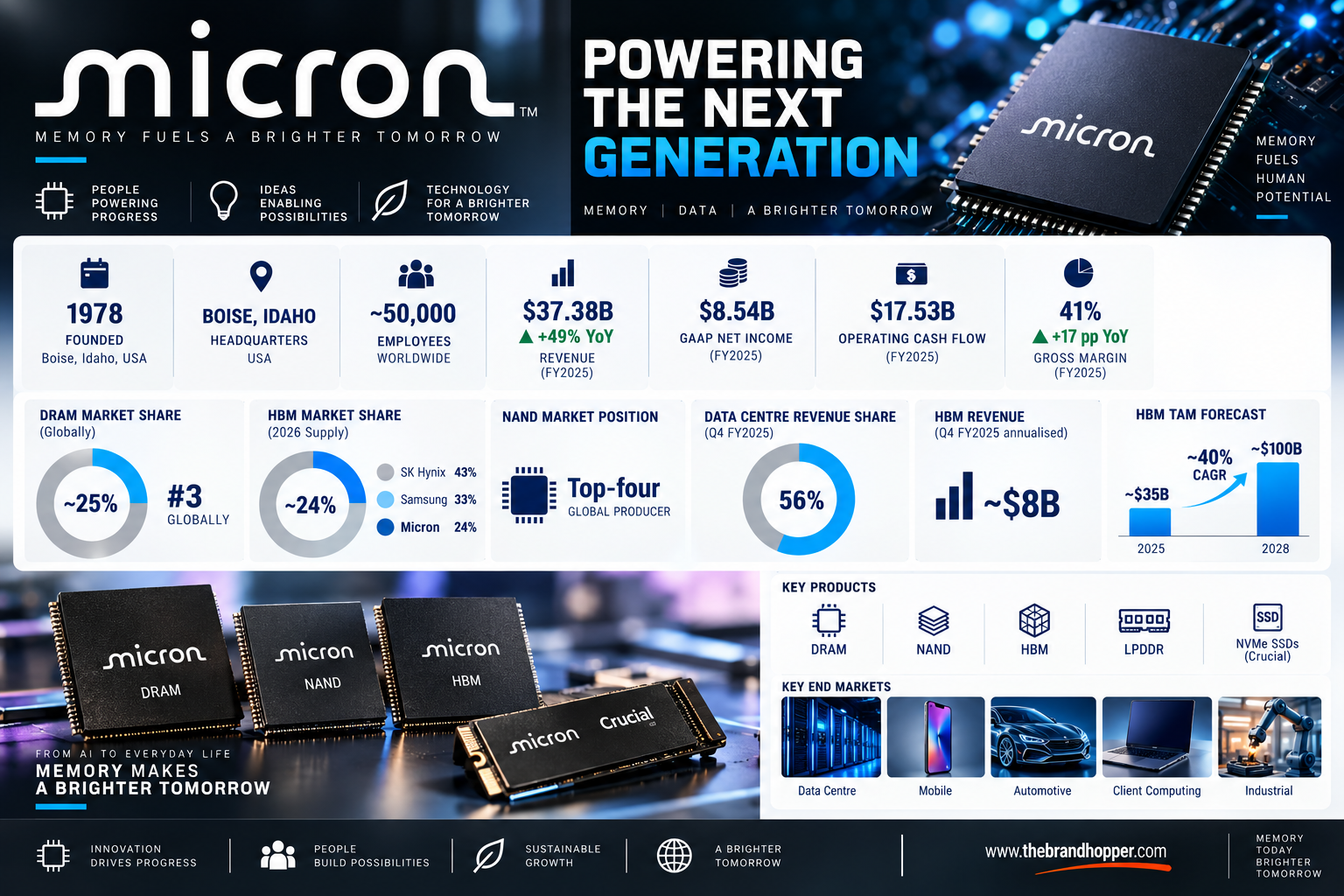
Micron Technology, founded in 1978 and headquartered in Boise, Idaho, is one of only three companies in the world capable of producing advanced DRAM at scale — alongside Samsung Electronics and SK Hynix. Micron is also a leading NAND flash producer and the fastest-growing supplier of HBM3E for AI applications. In fiscal year 2025 (ended August 2025), Micron delivered its strongest annual performance in company history: revenue of $37.38 billion, up 49% year-over-year, with a 41% gross margin and operating cash flow of $17.53 billion. Its data centre business grew to 56% of total Q4 FY2025 revenue, and HBM generated nearly $2 billion in that quarter alone — approximately $8 billion annualised.
Despite this momentum, Micron competes in one of the world’s most demanding and concentrated industries. Samsung and SK Hynix together hold approximately 70% of global DRAM market share. The HBM race is accelerating faster than any memory technology since DDR3. And beyond the pure-play memory producers, semiconductor giants including NVIDIA, AMD, Qualcomm, and Intel shape demand trajectories, define memory specifications, and in some cases develop alternative memory architectures that could redirect long-term purchasing patterns. A new dynamic arrived in February 2025 when Sandisk Corporation separated from Western Digital — creating a focused NAND competitor now listed on Nasdaq under SNDK.
This article analyses all Micron’s most significant competitors across DRAM, NAND, HBM, embedded memory, and storage — covering their financials, technologies, strategies, and competitive pressure on Micron.

Global Memory & Semiconductor Competitive Landscape
The semiconductor memory market is dominated by a small number of players with enormous capital requirements for fabrication, R&D, and process technology. In DRAM, three companies — Samsung, SK Hynix, and Micron — account for more than 95% of global supply. In NAND flash, six primary producers (Samsung, SK Hynix, Kioxia, Sandisk/WD, Micron, and YMTC) share a more fragmented market. HBM, the fastest-growing and highest-value memory sub-segment, is currently split among Samsung, SK Hynix, and Micron.
Beyond these direct memory competitors, Micron faces indirect competitive pressure from companies that shape demand, develop alternative compute-memory architectures, or offer integrated memory solutions that displace discrete purchases. The full competitive map is summarised below.
Top 16 Competitors of Micron Technology
1. Samsung Electronics

Website: https://www.samsung.com/
Samsung Electronics is the world’s largest memory semiconductor manufacturer and Micron’s most formidable direct competitor across every major product category. In FY2025, Samsung’s total group revenue reached approximately ₩333.61 trillion (approximately $233.3 billion), with its Device Solutions (DS) Division, encompassing DRAM and NAND production, generating record quarterly DRAM revenue of ₩27.7 trillion (approximately $19.2 billion) in Q4 2025 alone. Samsung holds approximately 36% of global DRAM market share as of Q4 2025, widening to approximately 38% in Q1 2026 as it reclaimed the category lead.
Samsung’s manufacturing scale remains its most decisive competitive advantage. The company operates state-of-the-art fabs in South Korea and the United States producing an estimated 490,000 wafers monthly, compared to Micron’s approximately 330,000-unit capacity. Its annual R&D investment exceeds $20 billion — significantly more than Micron’s entire R&D budget — funding continuous advances in process node, cell architecture, and packaging.
The most important competitive battleground between Samsung and Micron is HBM. Samsung has regained momentum in HBM3E mass production and is aggressively developing HBM4 and HBM4E to compete with SK Hynix’s lead and Micron’s fast-growing supply. Samsung is also the only company in the semiconductor industry with a complete vertical integration from wafer fabrication to chip design to final packaging, which gives it a structural cost advantage that Micron must offset through process leadership and execution speed.
Samsung’s leadership in EUV lithography for advanced DRAM nodes, combined with its 290+ layer NAND stack production targets, means that the technological gap between Samsung and Micron is continuously contested. Every basis point of market share in DRAM is worth billions of dollars, and Samsung’s scale means it can deploy resources to defend and expand its position that no other competitor can match.
2. SK Hynix

Website: https://www.skhynix.com/
SK Hynix delivered its most exceptional performance in company history in FY2025: revenue of 97.1 trillion won (approximately $65 billion), operating profit of 47.2 trillion won, representing a staggering 49% operating margin, and net profit of 42.9 trillion won. These numbers reflect the company’s unmatched position in HBM — the highest-value, fastest-growing memory subsegment in the AI era.
SK Hynix commands approximately 58–62% of global HBM revenue as of 2025, thanks to its flawless execution of HBM3E mass production and its exclusive partnership as NVIDIA’s primary HBM supplier. This partnership alone contributed 24% of SK Hynix’s total 2025 sales, and the United States — anchored by that NVIDIA relationship — now generates 65% of the company’s total revenue. SK Hynix’s strategic $9 billion acquisition of Intel’s NAND business in 2020 expanded its NAND flash capabilities significantly, establishing it as a full-stack memory competitor to Micron across every product category.
SK Hynix holds approximately 34% of global DRAM market share (second behind Samsung). Its DRAM revenue more than doubled year-on-year in FY2025, driven equally by HBM and conventional DDR5 server memory demand. The company’s 238-layer 4D NAND is among the highest layer-count NAND in mass production, and it is already sampling HBM4 to key customers for next-generation AI accelerators.
For Micron, SK Hynix represents the most acute competitive threat in the near term. With HBM supply for 2026 and 2027 already sold out across all three suppliers, the competition is less about the existing market and more about who captures the largest share of the HBM4 and HBM5 generations. SK Hynix’s head start in HBM3E quality and yield rates gives it a compounding advantage that Micron is working aggressively to close.
3. Kioxia
Website: https://www.kioxia.com/
Kioxia, which emerged from Toshiba’s memory division and was rebranded in 2019, is the world’s third-largest NAND flash producer, commanding approximately 13.9% of global NAND market share as of Q1 2026. The company listed on the Tokyo Stock Exchange Prime Market in December 2024 — completing one of the most anticipated IPOs in the Japanese semiconductor sector — with its full FY2025 revenue reaching ¥2.338 trillion (approximately $15.5 billion). In Q3 FY2025 (ended December 2025), Kioxia posted record quarterly revenue of ¥543.6 billion, up 21.3% quarter-on-quarter and 20.8% year-on-year. The company has also confirmed that its 2026 NAND production capacity is fully booked.
Kioxia’s foundational technology is its BiCS FLASH (Bit Cost Scalable) 3D NAND architecture. Current production implements over 162 layers and development is underway for even denser configurations. The company pioneered Penta-Level Cell (PLC) NAND technology — storing five bits per cell compared to the three bits in conventional TLC — enabling higher storage density at lower cost per gigabyte, which directly pressures Micron’s NAND economics.
Kioxia competes with Micron most directly in enterprise SSDs, consumer NAND (under the brand licensing arrangement through partner brands), and data centre QLC NAND for hyperscale customers. Its public listing gives Kioxia access to fresh capital for accelerating R&D in advanced node NAND and 3D integration, making it a more formidable and better-capitalised competitor going forward than it was as a private company.
4. Western Digital

Website: https://www.westerndigital.com/
Western Digital completed a defining corporate transformation in February 2025 when it separated its Flash business into an independent entity, Sandisk Corporation, retaining a 19.9% stake and focusing exclusively on hard disk drives (HDD). In FY2025 (ended June 2025), Western Digital reported revenue of $9.52 billion, up 51% year-over-year, with the cloud segment accounting for 88% of total revenue at $8.34 billion (up 65%). Gross profit more than doubled to $3.69 billion, and operating income reached $2.33 billion compared to a loss in the prior year.
As a pure-play HDD company, Western Digital’s competitive relationship with Micron now centres primarily on enterprise and cloud storage infrastructure. Where Micron competes in enterprise SSDs, Western Digital competes in high-capacity spinning disk — a segment that has proven resilient despite solid-state competition because of its unmatched cost-per-terabyte for cold and warm data archival at hyperscale. Western Digital’s OptiNAND technology, which integrates NAND flash into its hard drives as a cache layer, represents one indirect area of overlap.
The separation from its Flash business has simplified Western Digital’s story and focused its capital allocation, making it a leaner and more focused competitor in the storage infrastructure segment where Micron’s NVMe SSD products (marketed under the Crucial brand) face HDD alternatives for specific workloads.
5. Sandisk Corporation

Website: https://www.sandisk.com/
Sandisk Corporation is one of the most significant new competitive developments in the memory market. On February 21, 2025, Western Digital completed the separation of its Flash business unit, creating Sandisk Corporation as an independent public company listed on the Nasdaq Stock Market under the ticker SNDK. The company specialises entirely in NAND flash memory products, including consumer and enterprise SSDs, consumer flash (memory cards, USB drives), and embedded storage — competing directly with Micron’s Crucial-branded consumer NAND products and its enterprise NAND lineup.
Since its Nasdaq debut in early 2025, Sandisk’s shares have surged more than 1,000%, reflecting the market’s enthusiasm for a pure-play NAND company riding the AI-driven storage demand wave. Its Q2 FY2026 revenue grew 60% year-over-year, and its Edge market segment (consumer storage) generated $12.16 billion in FY2026, up 195% from FY2025 levels as AI and data centre growth drove extraordinary capacity absorption.
Sandisk’s competitive significance goes beyond its own market position. It inherits Western Digital’s long-standing joint manufacturing partnership with Kioxia — operating shared fabrication facilities in Japan that together account for approximately 35% of global NAND supply. This production alliance gives Sandisk a cost and capacity foundation that few standalone NAND producers can replicate, making it a structurally important and well-funded competitor to Micron in every NAND product category.
6. Intel

Website: https://www.intel.com/
Intel’s relationship with Micron has evolved significantly. Having divested its NAND memory business to SK Hynix in 2020, Intel is no longer a direct DRAM or NAND competitor. However, its competitive impact on Micron remains material through two channels: its position as the dominant enterprise server platform provider and its continued relevance in memory interface standards.
In FY2025, Intel reported total revenue of $52.85 billion (essentially flat year-over-year). Its Data Centre and AI (DCAI) segment generated $16.125 billion at a 9% operating margin — the division that specifies the memory architecture, bandwidth requirements, and socket compatibility of every Intel-based server. When Intel designs a new Xeon processor generation, it effectively sets the DRAM standards (DDR5 spec, number of channels, maximum capacity) that Micron must engineer to. Intel Gaudi AI accelerators, which compete with NVIDIA H100 and H200, require memory solutions that Micron can supply — but the pace of Intel’s data centre momentum affects how much HBM vs. DDR5 demand exists in a given year.
Intel’s advanced packaging technologies — Foveros 3D stacking and EMIB (Embedded Multi-die Interconnect Bridge) — enable sophisticated memory integration that competes with traditional discrete DRAM in certain high-performance computing use cases. Intel’s cross-licensing agreements with major memory producers also give it intellectual property leverage in the ecosystem. Intel’s longer-term Integrated Memory and Cache (IMC) development programmes represent an area to watch, as continued investment in near-memory computing could affect discrete DRAM demand in the data centre over a 5–10 year horizon.
7. NVIDIA
Website: https://www.nvidia.com/
NVIDIA is not a memory manufacturer, but it is arguably the single most important force shaping the global memory market today. As the dominant supplier of AI training and inference GPUs, NVIDIA’s product roadmap directly determines the specifications, volumes, and performance requirements of HBM — the highest-value memory product and the segment where Micron is most actively investing.
In FY2026 (ended January 2026), NVIDIA achieved record quarterly revenue of $68.1 billion in Q4 alone, representing 73% year-over-year growth. The company’s full FY2026 annual revenue surpassed $220 billion, driven by the Blackwell GPU architecture. Each Blackwell B100 GPU die requires a stack of HBM3E that consumes enormous bandwidth: the H200 contains 141GB of HBM3e with 4.8 TB/s bandwidth, while Blackwell B200 GPUs push this higher. NVIDIA designs its own memory interface — NVLINK and the HBM stack specification — and qualifies specific HBM suppliers on a product-by-product basis. When NVIDIA qualifies Micron’s HBM3E, it directly enables Micron to capture revenue from the fastest-growing end market in semiconductor history.
NVIDIA’s competitive relationship with Micron is therefore one of co-dependence and specification control. NVIDIA controls the memory requirements that Micron must meet to stay in the supply chain. At the same time, NVIDIA depends on Micron (alongside SK Hynix and Samsung) to produce HBM in sufficient volume to satisfy GPU shipment targets. Micron has confirmed that its entire 2026 HBM supply is sold out with pricing locked in, and its HBM4 (the next generation, entering high-volume production in Q2 FY2026) is already being qualified by NVIDIA for future Blackwell+ and Rubin architectures. NVIDIA’s Blackwell sales being “off the charts” and cloud GPUs being “sold out” means that memory demand will remain structurally elevated.
8. AMD (Advanced Micro Devices)
Website: https://www.amd.com/
AMD delivered a landmark FY2025: revenue surged 34.3% to $34.6 billion and net income more than doubled to $4.3 billion, driven by extraordinary data centre and AI chip demand. R&D investment reached $8.09 billion — approximately 23.4% of revenue—reflecting the company’s commitment to closing the performance gap with NVIDIA’s GPU dominance. AMD’s operating cash flow grew 153.5% year-over-year to $7.71 billion.
AMD’s competitive significance to Micron mirrors NVIDIA’s: as a major GPU and CPU provider for AI and data centre workloads, AMD’s products define the memory specifications and HBM demand from a growing share of the server market. In October 2025, AMD signed a landmark product purchase agreement with OpenAI to deploy 6 gigawatts of AMD GPUs — potentially one of the largest single-customer GPU commitments in semiconductor history. Each Instinct MI300X GPU contains 192GB of HBM3 across eight HBM stacks. As AMD grows its data centre GPU market share, its HBM purchasing volumes grow proportionally, creating an incremental demand pool that benefits all three HBM producers, including Micron.
AMD’s EPYC server CPUs also compete indirectly with Intel Xeon processors, and their memory channel and speed specifications influence how much DDR5 is deployed in a given server generation. AMD’s dual role as memory customer and architectural specifier makes it both a demand driver and an indirect competitor to Micron’s server DRAM business.
9. Texas Instruments

Website: https://www.ti.com/
Texas Instruments is the world’s largest analog and embedded processing semiconductor company, reporting FY2025 revenue of $17.68 billion, up 13% year-over-year, with its Analog segment generating $14.01 billion and Embedded Processing $2.70 billion. Net income reached $5.00 billion and operating cash flow was $7.15 billion. TI competes with Micron specifically in embedded memory markets, particularly in automotive and industrial applications.
TI’s embedded memory solutions — including Flash and SRAM integrated directly into its microcontrollers and processors — reduce the need for external discrete memory in automotive systems such as ADAS (Advanced Driver Assistance Systems), infotainment controllers, and battery management systems. Micron actively competes in these same automotive markets with its automotive-qualified LPDDR5X, NAND flash, and NOR flash products, which must meet AEC-Q100 Grade 1 or Grade 0 reliability standards.
TI’s 300mm manufacturing strategy, which has significantly reduced its per-unit production costs, has made it increasingly price competitive in embedded contexts. Its vertical integration — controlling chip design, wafer fabrication, and global distribution — gives it the ability to offer automotive and industrial OEMs a one-stop supply relationship that pure-play memory producers like Micron cannot easily replicate. As the automotive semiconductor market expands rapidly with ADAS, EV power electronics, and vehicle compute, TI’s embedded memory share in this segment represents ongoing competitive pressure for Micron.
10. Qualcomm


Website: https://www.qualcomm.com/
Qualcomm reported FY2025 revenue (fiscal year ended September 2025) of $44.3 billion, up 14% year-over-year, with its QCT (chip) division delivering record annual revenues across handsets ($7.0 billion), IoT ($1.8 billion), and Automotive ($1.1 billion). The company’s Snapdragon 8 Elite Gen 5 platform, powering premium Android smartphones from Samsung, Xiaomi, and OPPO, continued to expand its content per device including onboard LPDDR5X memory controllers and UFS 4.0 storage interfaces.
Qualcomm competes with Micron indirectly but materially: its Snapdragon SoCs determine the LPDDR and UFS memory specifications required by every Android smartphone they power, and as Qualcomm extends into on-device AI (featuring dedicated NPU cores and local LLM inference), the memory bandwidth requirements per device continue to increase, expanding the DRAM content per smartphone. This is broadly positive for Micron’s LPDDR5X demand, but Qualcomm’s design choices about in-package vs. discrete memory, onboard caching, and memory subsystem architecture shape the addressable market for Micron’s mobile DRAM.
Qualcomm’s growing Automotive segment — up 17% to $1.1 billion in FY2025 — encompasses Snapdragon Ride platforms for ADAS and digital cockpit applications, which specify significant amounts of LPDDR and NOR flash. Apple, Samsung, and Xiaomi each accounted for 10%+ of Qualcomm’s consolidated revenues in FY2025, indicating the scale of smartphone-driven memory co-dependence between Qualcomm and its supply chain partners including Micron.
11. MediaTek
Website: https://www.mediatek.com/
MediaTek is the world’s largest fabless semiconductor company by volume, powering approximately 37% of all global smartphones with its Dimensity SoC platforms. In 2025, MediaTek reported full-year revenue of NT$595.97 billion (approximately $18.6 billion), up 12.3% year-over-year. In Q4 2025, the quarter was driven by the strong ramp of the flagship Dimensity 9500 platform and a favourable exchange rate environment. Smartphone chipset revenues for MediaTek crossed $10 billion for Q4 2025 alone.
MediaTek’s competition with Micron is structural rather than direct. Its SoC designs integrate LPDDR5X memory controllers, UFS 4.0 storage interfaces, and in some cases embedded flash for bootloader and security functions. As MediaTek expands into premium flagship SoCs with the Dimensity 9500, it both increases the required LPDDR5X memory speed and capacity per device (expanding Micron’s addressable mobile DRAM market) and continues developing capabilities that could in future reduce reliance on external discrete memory in mid-range segments.
MediaTek’s expansion into automotive (Dimensity Auto Ultra), IoT, and smart home with chips like the MediaTek Genio series creates additional end-market overlap with Micron’s industrial and automotive memory product lines. MediaTek’s 2025 automotive revenue grew at double-digit rates as it began appearing in infotainment and ADAS systems alongside traditional automotive MCU suppliers, creating a new front in the embedded memory competitive landscape.
[IMAGE: Marvell Technology — Data Centre Silicon and Storage Controller Leader | Source: Marvell Technology Investor Relations | investor.marvell.com]
12. Marvell Technology

Website: https://www.marvell.com/
Marvell Technology reported FY2025 revenue (fiscal year ended February 2025) of $5.77 billion, driven by 88% year-over-year growth in its data centre business. By Q4 FY2025, data centre revenue accounted for 75% of Marvell’s total business. AI-related revenue represented approximately 50% of data centre revenue in FY2025, up from less than 10% just two years prior. The company generated record operating cash flow of $1.68 billion.
Marvell competes with Micron in storage infrastructure. Its NVMe SSD controllers, SAS/SATA storage controllers, and RAID-on-Chip solutions are used in data centre drives, enterprise SSDs, and hyperscale storage arrays — the same platforms where Micron sells its NAND and enterprise SSD products. A customer choosing Marvell’s controller technology for an SSD will also be choosing the NAND supplier for that drive; how Marvell optimises its firmware and controller reference designs can influence whether Micron or a competitor’s NAND is preferred.
Marvell’s most significant competitive overlap with Micron lies in custom silicon for hyperscalers. Marvell designs custom AI accelerators (CSPs, custom ASICs for Amazon, Google, Microsoft) that include on-chip or near-chip memory. As hyperscalers develop increasing amounts of their own silicon with embedded memory subsystems, the boundary between where a Marvell chip ends and a Micron DRAM begins is becoming a critical design decision. Marvell’s FY2026 revenue trajectory (up 58% in Q2 alone) shows that this custom silicon wave is accelerating.
13. Nanya Technology
Website: https://www.nanya.com/
Nanya Technology is Taiwan’s only large-scale DRAM producer and the world’s fourth-largest, holding approximately 1–2% of global DRAM market share. Despite its small market share relative to Samsung, SK Hynix, and Micron, Nanya delivered its strongest financial performance in company history in 2025: revenue of NT$66.59 billion, up 95.1% year-on-year, with net profit of NT$6.61 billion and EPS of NT$2.13. December 2025 alone saw revenue of NT$12.017 billion, up nearly 445% year-on-year.
Nanya’s extraordinary 2025 recovery was driven by a structural supply shortage in DDR4 and legacy DRAM. As Samsung, SK Hynix, and Micron redirected manufacturing capacity toward higher-margin HBM and DDR5, supply of DDR3 and DDR4 tightened sharply, pushing prices upward and generating exceptional profitability for a producer that specialises in these legacy nodes. Nanya focuses on DDR4, LPDDR4X, and DDR3 — with DDR5 representing only approximately 10% of its revenue mix — making it a beneficiary rather than a driver of the AI memory transition.
While Nanya does not compete with Micron in HBM or enterprise DRAM, it does compete in consumer and industrial DRAM applications where DDR4 remains relevant. As AI-driven demand pulls Samsung, SK Hynix, and Micron further up the memory performance curve, Nanya occupies a growing niche in the legacy DRAM market that the larger players are vacating. The company has invested in DDR5 development and is gradually transitioning capacity, but it will remain a niche competitor at the legacy end of Micron’s product portfolio for the foreseeable future.
14. Realtek

Website: https://www.realtek.com/
Realtek is one of Taiwan’s leading fabless semiconductor companies, generating approximately $2.5 billion in annual revenue from its networking ICs (Ethernet controllers, Wi-Fi chips), multimedia SoCs (audio codecs, display drivers), and storage controller ICs. While not a traditional memory manufacturer, Realtek competes with Micron at the system integration level — its SoC architectures increasingly incorporate sophisticated on-chip SRAM caches, memory management units, and direct connectivity to external DRAM and NAND via memory interfaces that Realtek designs and optimises.
In networking applications (routers, managed switches, broadband gateways), Realtek’s SoCs often pair with external DDR3, DDR4, or LPDDR4 from suppliers including Micron. The design decisions Realtek makes about supported memory bus widths, speeds, and densities influence which Micron DRAM products are designed into end products. If Realtek migrates networking SoCs to integrated LPDDR4 in future nodes, it could displace standalone Micron DRAM in that segment.
Realtek’s storage controller IC portfolio, which includes PCIe Gen 4 NVMe controllers for consumer SSDs, competes with Marvell, Silicon Motion, and Phison in the controller market that sits on top of Micron’s NAND. Realtek-based SSD controllers are paired with various NAND suppliers, and controller preference can influence NAND purchasing decisions for SSD OEM customers.
15. Kingston Technology

Website: https://www.kingston.com/
Kingston Technology is the world’s largest independent memory module and storage manufacturer, a privately held company headquartered in Fountain Valley, California, with estimated annual revenue of approximately $13–14 billion. Unlike Micron, Kingston does not manufacture DRAM dies; instead, it purchases DRAM from producers including Micron, Samsung, and SK Hynix, and assembles these into DRAM DIMMs (DDR4, DDR5), SO-DIMMs for laptops, and consumer and enterprise SSDs sold under the Kingston and HyperX brands.
Kingston competes with Micron in the consumer and enterprise memory module market. Micron’s Crucial brand — a direct-to-consumer DRAM module and SSD brand — competes head-to-head with Kingston’s memory and storage product lines in retail channels (Amazon, Newegg, Best Buy), OEM procurement, and data centre upgrades. This competition is particularly sharp in DDR5 DRAM DIMMs for consumer and workstation PCs, and in NVMe SSDs for system upgrades, where Kingston’s retail brand strength and competitive pricing give it advantages that Micron’s Crucial brand must work to overcome.
Kingston’s HyperX brand targets gaming enthusiasts with high-frequency DDR5 kits and high-performance SSDs. As gaming PC hardware grows, this segment represents a high-value overlap with Crucial’s premium DRAM modules. Kingston’s scale — reportedly shipping over 1 billion memory modules since founding — gives it purchasing relationships and channel depth that make it one of Micron’s most tenacious indirect competitors in consumer-facing memory markets.
16. ADATA Technology
Website: https://www.adata.com/
ADATA Technology is one of Asia’s leading memory module and storage solution providers, traded on the Taiwan Stock Exchange and reporting annual revenue of approximately NT$45–50 billion (approximately $1.4–1.6 billion), though revenue has fluctuated significantly with memory market cycles. ADATA competes with Micron’s Crucial brand in consumer DRAM modules (DDR4, DDR5, SO-DIMM), M.2 NVMe SSDs, portable SSDs, and flash storage (SD cards, USB drives) across Asia, Europe, and the Americas.
ADATA, like Kingston, is primarily an assembler and brander rather than a DRAM die manufacturer — purchasing DRAM and NAND from major producers including Micron itself and assembling into finished modules and drives. Its competitive edge lies in aggressive pricing, a wide SKU range covering mainstream to overclocking-grade products, and strong distribution in Asia’s price-sensitive consumer electronics market.
ADATA’s XPG (Xtreme Performance Gear) brand competes in the gaming and enthusiast segment — the same space targeted by Crucial’s Ballistix line and Kingston’s HyperX. DDR5 overclocking kits, PCIe 4.0 and 5.0 NVMe SSDs, and RGB aesthetics define this category. As DDR5 adoption accelerates through the PC upgrade cycle of 2025–2027, ADATA is a consistent price-competitive challenger to Micron’s Crucial brand in the channels that matter most for consumer DRAM revenue.
Key Competitive Battlegrounds: Where Micron Wins and Loses
1. HBM: The AI Memory War
High Bandwidth Memory is the most strategically important segment in the global memory market. The HBM total addressable market was approximately $35 billion in 2025 and is projected to reach approximately $100 billion by 2028, representing a 40% compound annual growth rate. Micron projects this TAM and confirms the entire 2026 HBM supply is sold out, with pricing locked. In this market:
| Supplier | Estimated HBM Market Share (2025) | Key Advantage | Key AI Customers |
| SK Hynix | ~58–62% | First HBM3E mover; NVIDIA preferred supplier; 49% operating margin in FY2025 | NVIDIA (24% of SK Hynix total revenue) |
| Samsung | ~33% (recovering) | Manufacturing scale; own foundry; HBM4 roadmap | AMD, Google, Microsoft |
| Micron | ~24% (2026 supply projection) | HBM3E yield improvements; HBM4 entering high-volume production Q2 FY2026; fastest-growing share | NVIDIA, major cloud CSPs |
Source: Counterpoint Research Global DRAM and HBM Market Share; Micron Technology Q4 FY2025 Earnings Call.
2. NAND Flash: A Six-Player Race
The global NAND flash market is more competitive than DRAM, with six primary suppliers: Samsung (~32% share), SK Hynix (~20%), Kioxia (~14%), Sandisk/WD (formerly combined ~15%), Micron (~16%), and YMTC (China, ~11%). In NAND, Micron must compete not just on performance but on cost-per-bit, which requires continuous layer count increases and cell efficiency improvements. Kioxia’s partnership with Sandisk gives the combined entity approximately 29–35% of global NAND supply when shared fab output is counted, making it the largest single production alliance in NAND.
3. Automotive and Embedded: A Growing Battlefield
Automotive memory is one of the fastest-growing segments for Micron. Every modern vehicle requires LPDDR for ADAS processing, NOR flash for boot storage, and NAND for infotainment — with autonomous vehicle and EV architectures requiring 8x to 16x more memory per vehicle than traditional ICE cars. Texas Instruments, Infineon, and Renesas all compete in automotive embedded memory by integrating flash directly into their MCU platforms. Micron counters with its Auto LP5X and G series NOR products that meet the highest automotive qualification grades.
Master Competitor Comparison Table (FY2025 / Latest Available Data)
| Company | HQ | Revenue (FY2025) | Primary Overlap with Micron | DRAM Share | NAND Share |
| Micron Technology | Boise, Idaho | $37.38B | DRAM, NAND, HBM, SSDs | ~25% | ~16% |
| Samsung Electronics | Suwon, S. Korea | ₩333.61T (~$233B total) | DRAM, NAND, HBM | ~36–38% | ~32% |
| SK Hynix | Icheon, S. Korea | ₩97.15T (~$65B) | DRAM, HBM, NAND | ~34% | ~20% |
| Kioxia | Tokyo, Japan | ¥2.34T (~$15.5B) | NAND | N/A | ~14% |
| Western Digital | San Jose, CA | $9.52B | HDD / enterprise storage | N/A | N/A (post-spinoff) |
| Sandisk Corp. | San Jose, CA | Post-spinoff (Feb 2025) | NAND, consumer flash | N/A | ~15% |
| Intel | Santa Clara, CA | $52.85B | Enterprise platforms, memory specs | N/A | N/A |
| NVIDIA | Santa Clara, CA | ~$225B+ (FY2026) | HBM demand driver | N/A | N/A |
| AMD | Santa Clara, CA | $34.6B | HBM & DRAM demand driver | N/A | N/A |
| Texas Instruments | Dallas, TX | $17.68B | Embedded/automotive memory | N/A | N/A |
| Qualcomm | San Diego, CA | $44.3B | Mobile LPDDR & UFS specs | N/A | N/A |
| MediaTek | Hsinchu, Taiwan | NT$595.97B (~$18.6B) | Mobile LPDDR specs | N/A | N/A |
| Marvell Technology | Santa Clara, CA | $5.77B | Storage controllers, custom AI silicon | N/A | N/A |
| Nanya Technology | Taoyuan, Taiwan | NT$66.59B (~$2.1B) | Legacy DRAM (DDR4/DDR3) | ~1–2% | N/A |
| Realtek | Hsinchu, Taiwan | ~$2.5B | Networking SoC, storage controllers | N/A | N/A |
| Kingston Technology | Fountain Valley, CA | ~$13–14B (private) | DRAM modules, SSDs (vs. Crucial) | N/A | N/A |
| ADATA Technology | Taipei, Taiwan | ~$1.5B | Consumer DRAM modules, SSDs (vs. Crucial) | N/A | N/A |
Industry Outlook: The Memory Market Through 2028
Several structural forces will define the competitive landscape surrounding Micron over the next three to five years.
1. AI’s Insatiable Memory Appetite
Generative AI model sizes have grown exponentially: GPT-4 is estimated to have approximately 1.76 trillion parameters; future frontier models may require 10x or 100x more. Each parameter requires memory, and inference at scale requires even more. NVIDIA’s Blackwell GB200 NVL72 rack systems consume multiple terabytes of HBM per rack. The HBM TAM forecast of $100 billion by 2028 is not aspirational — it is based on already-ordered GPU roadmaps. Micron’s trajectory in this environment is strongly positive, subject only to its ability to deliver HBM4 and HBM4E at the yields and bandwidths that AI accelerator customers require.
2. NAND Flash Oversupply Risk
While HBM supply is structurally tight, NAND faces periodic oversupply risks as all six major producers invest in capacity. The 2022–2024 NAND downturn saw multiple producers record operating losses. The 2025 recovery — with Kioxia confirming 2026 capacity fully booked and Sandisk reporting 60% revenue growth — suggests the market has rebalanced, but overcapacity risk returns if AI-driven storage demand grows slower than expected. Micron’s NAND strategy focuses on enterprise SSDs (higher margin, more stable demand) rather than consumer NAND, which mitigates but does not eliminate cyclicality risk.
3. Chinese Competition: YMTC and CXMT
A risk not yet fully captured in this analysis is the rising competitive threat from Chinese memory producers. YMTC (Yangtze Memory Technologies) has developed 232-layer NAND and is expanding capacity, though US export controls have significantly restricted its access to leading-edge equipment. CXMT (ChangXin Memory Technologies) is developing DDR5 DRAM capability. If US export restrictions are loosened, or if Chinese producers find alternative equipment suppliers, they could become material competitors to Micron — particularly in the Asia-Pacific markets where price sensitivity is highest. This is a medium-term (3–5 year) risk rather than an immediate one.
4. The PC Replacement Cycle and DDR5 Adoption
The PC installed base is approaching a replacement cycle as Windows 10 end-of-life (October 2025) drives consumer and enterprise hardware upgrades. DDR5, which is standard in systems built on Intel Meteor Lake and Arrow Lake as well as AMD Zen 5 platforms, delivers twice the bandwidth of DDR4 — and Micron is the only US-based producer of DDR5 at scale. This replacement cycle represents a meaningful demand tailwind for Micron’s consumer and workstation DRAM through 2026–2027, with Kingston, ADATA, and other module makers serving as the channel through which Micron’s DRAM reaches end customers.
Also Read: Top MediaTek Competitors: Who’s Challenging the Chip Giant
Frequently Asked Questions (FAQs)
Q1. Who is Micron Technology’s biggest competitor?
A: Samsung Electronics is Micron’s largest and most direct competitor. Samsung leads global DRAM production with approximately 36–38% market share, compared to Micron’s approximately 25%, and is also the #1 NAND flash producer. Samsung’s manufacturing scale, R&D investment (exceeding $20 billion annually), and vertical integration from wafer to packaging give it competitive advantages across every memory category. SK Hynix is the second-most formidable competitor, holding approximately 34% of DRAM and 58–62% of HBM revenue in FY2025. Source: Counterpoint Research; Samsung FY2025 Annual Results; SK Hynix FY2025 Annual Results.
Q2. What is Micron Technology’s revenue for FY2025?
A: Micron Technology reported FY2025 revenue (fiscal year ended August 2025) of $37.38 billion, representing 49% year-over-year growth from $25.11 billion in FY2024. GAAP net income was $8.54 billion, operating cash flow was $17.53 billion, and gross margin reached 41% — up 17 percentage points from the prior year. The data centre business reached 56% of total revenue in Q4 FY2025, and HBM revenue reached approximately $2 billion in Q4 alone, representing approximately $8 billion annualised. Source: Micron Technology FY2025 Annual Results; SEC Form 8-K, September 2025.
Q3. How does SK Hynix compare to Micron in HBM?
A: SK Hynix leads the global HBM market with approximately 58–62% of global HBM revenue as of 2025. Micron holds approximately 24% of projected 2026 HBM supply, with Samsung at approximately 33%. SK Hynix’s advantage stems from its role as NVIDIA’s primary HBM3E supplier and its faster ramp of high-yield HBM3E production. Micron is closing the gap: its HBM4 product entered high-volume production in Q2 FY2026 and is already being qualified by NVIDIA for next-generation Blackwell+ architectures. All three suppliers have confirmed their 2026 HBM supply is fully sold out. Source: Counterpoint Research; Micron Technology Q4 FY2025 Earnings Call; SK Hynix FY2025 Annual Results.
Q4. What is Sandisk Corporation and how does it compete with Micron?
A: Sandisk Corporation is the independent NAND flash company that Western Digital spun off in February 2025. Listed on Nasdaq under SNDK, Sandisk focuses exclusively on NAND flash products including enterprise SSDs, consumer SSDs, and flash storage (memory cards, USB drives) — competing directly with Micron’s NAND lineup and Crucial brand. Sandisk inherits Western Digital’s joint NAND manufacturing partnership with Kioxia, giving it access to fabrication facilities in Japan that produce approximately 15% of global NAND supply. Sandisk shares surged more than 1,000% after the spinoff, and its Q2 FY2026 revenue grew 60% year-over-year. Source: Sandisk Corporation; Western Digital Corporation; SEC filings.
Q5. How large is the global DRAM market and what share does Micron have?
A: The global DRAM market was worth approximately $90–95 billion in 2025 and is growing rapidly, driven by DDR5 server upgrades, AI HBM demand, and mobile LPDDR5X adoption. The market is highly concentrated: Samsung holds approximately 36–38% share, SK Hynix approximately 34%, and Micron approximately 25%. These three companies together account for more than 95% of global DRAM supply. Nanya Technology holds approximately 1–2%, and the remainder is from smaller suppliers. Source: Counterpoint Research Global DRAM and HBM Market Share; TrendForce.
Q6. Why is NVIDIA important to Micron’s business?
A: NVIDIA is the dominant provider of AI training and inference GPUs, which require High Bandwidth Memory (HBM). NVIDIA’s Hopper H100/H200 GPUs and Blackwell B100/B200 GPUs each require multiple stacks of HBM3E, making NVIDIA the largest single source of HBM demand in the world. For Micron to sell HBM3E, it must be qualified by NVIDIA (alongside SK Hynix and Samsung). Micron has confirmed its entire 2026 HBM supply is sold out — primarily to AI accelerator customers including NVIDIA. In FY2026 (ended January 2026), NVIDIA reported quarterly revenue of $68.1 billion in Q4 alone, representing 73% year-over-year growth, driven by Blackwell GPU demand. This demand directly benefits Micron’s HBM revenue. Source: NVIDIA FY2026 Q4 Results; Micron Technology Q4 FY2025 Earnings Call.
Q7. Does Kioxia compete directly with Micron in NAND flash?
A: Yes. Kioxia (formerly Toshiba Memory) is one of the world’s top three NAND flash producers, holding approximately 13.9% of global NAND market share as of Q1 2026. It listed on the Tokyo Stock Exchange in December 2024 and reported FY2025 revenue of approximately ¥2.338 trillion ($15.5 billion). Kioxia competes with Micron in enterprise SSDs, hyperscale data centre NAND, consumer NAND, and embedded storage. Its BiCS FLASH 3D NAND technology (162+ layers) is directly competitive with Micron’s NAND architecture. Through its joint manufacturing partnership with Sandisk, Kioxia has access to one of the largest NAND production networks in the world. Source: Kioxia Holdings FY2025 financial results; TrendForce NAND market share reports.
Q8. What are the main end markets where Micron faces the most competition?
A: The four primary competitive battlegrounds for Micron are: (1) HBM for AI data centres, where SK Hynix leads and Samsung and Micron compete; (2) DDR5 server DRAM, where Samsung and SK Hynix both have scale advantages; (3) Enterprise NAND / NVMe SSD, where Kioxia, Sandisk, and Samsung all compete aggressively; and (4) Consumer DRAM modules and SSDs, where Kingston Technology, ADATA, and Samsung’s retail brands (through Crucial competitors) are major forces. Automotive and embedded memory is a growing fifth battleground, with Texas Instruments and Renesas competing via integrated flash in their MCU platforms.
Q9. How does MediaTek compete with Micron in mobile markets?
A: MediaTek competes with Micron indirectly in mobile markets. As the world’s largest mobile SoC designer by volume (approximately 37% of global smartphones), MediaTek’s Dimensity chips specify the LPDDR5X memory and UFS 4.0 storage standards that smartphone OEMs must use. MediaTek’s 2025 annual revenue was NT$595.97 billion (~$18.6 billion, up 12.3%). Its flagship Dimensity 9500 drives premium Android smartphone demand for fast, high-density LPDDR5X — a product Micron supplies. However, as MediaTek develops higher levels of integration, including embedded LPDDR in future SoC packages, it could reduce the addressable market for discrete mobile DRAM in mid-range and entry-level segments, creating long-term competitive pressure on Micron’s mobile business. Source: MediaTek Q4 2025 Earnings Release.
Q10. What is Micron’s competitive position going into FY2026?
A: Micron enters FY2026 in what management describes as its “most competitive position in company history.” Its HBM4 is in high-volume production from Q2 FY2026, with Micron targeting an expanded share of the AI HBM supply chain. Its entire 2026 HBM supply is sold out with pricing agreed. The company’s data centre business, now 56% of total revenue, is growing at triple-digit rates. FY2025 gross margin of 41% is a record, and operating cash flow of $17.53 billion gives Micron the capital to invest in its next-generation Idaho, Singapore, and Hiroshima fabs. Key risks include NAND cyclicality, HBM qualification timelines, and Chinese memory competitor development. Source: Micron Technology Q4 FY2025 Earnings Call; Micron FY2025 Annual Report.
Conclusion
The competitive landscape surrounding Micron Technology in 2025 and beyond is defined by extraordinary scale concentration at the top and rapid disruption from new entrants, AI-driven demand shifts, and corporate restructurings at the bottom. In DRAM and HBM, the market will remain a three-player race among Samsung, SK Hynix, and Micron, with the HBM sub-segment likely representing the most critical battleground of the decade. Micron’s accelerating HBM momentum, bolstered by its HBM4 production ramp and full 2026 supply commitments, positions it as a genuine contender for a larger slice of the AI memory pie.
In NAND, competition has intensified with Sandisk’s independence, Kioxia’s IPO providing fresh capital, and the Kioxia–Sandisk manufacturing alliance controlling approximately a third of global NAND supply. Micron must continue to differentiate on quality-per-bit, enterprise reliability, and system-level integration to defend its NAND margin profile against a well-resourced field.
The indirect competitive pressures — from NVIDIA shaping HBM specifications, AMD and Qualcomm defining mobile and data centre memory requirements, MediaTek and Realtek integrating more memory on-chip, and Kingston and ADATA contesting the consumer channel — mean that Micron’s competitive environment is broader and more multi-dimensional than a simple DRAM producer comparison would suggest.
For Micron to sustain and extend its FY2025 momentum into the next cycle, the imperatives are clear: continue HBM4 and HBM4E execution with NVIDIA-grade yields, expand data centre NAND share with enterprise-class QLC products, defend automotive memory leadership through AEC-Q100 qualification discipline, and grow the Crucial brand in the consumer and prosumer channel against Kingston’s dominant position. The memory market has never been more valuable — or more contested.
To read more content like this, subscribe to our newsletter
Go to the full page to view and submit the form.