


Quick answer: Stripe is generally cheaper and more powerful for developers, SaaS businesses, and global online sales. PayPal is simpler to set up, more trusted by consumers at checkout, and reaches more countries. Neither is “better” outright — the right pick depends on whether you value lower fees and customization, or brand trust and ease of use.
Almost every online business eventually asks this question. Both PayPal and Stripe move trillions of dollars a year, but they were built for different people: PayPal for shoppers who already trust the brand, Stripe for developers who want full control over the checkout experience. Here’s how they actually compare in 2026.
Fees: Stripe Is Cheaper, Especially Internationally
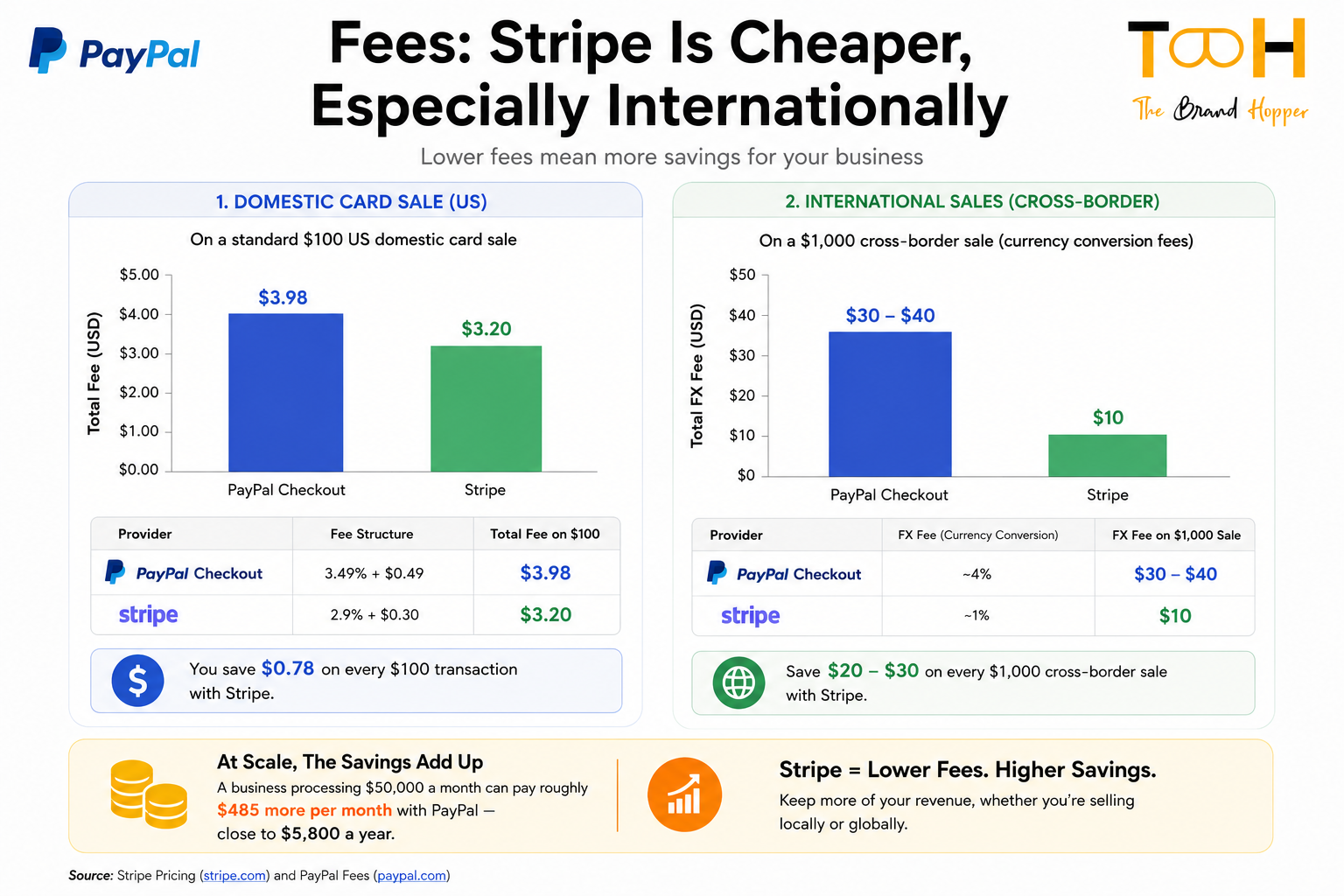
On a standard $100 US domestic card sale, Stripe charges 2.9% plus $0.30 (about $3.20), while PayPal Checkout charges 3.49% plus $0.49 (about $3.98). That gap widens fast at scale: a business processing $50,000 a month can pay roughly $485 more per month with PayPal — close to $5,800 a year.
The difference is even sharper on international sales. PayPal’s currency conversion typically runs around 4%, versus roughly 1% for Stripe. On a $1,000 cross-border sale, that’s about $10 in fees on Stripe versus $30 to $40 on PayPal.

Reach and Consumer Trust: PayPal’s Home Turf
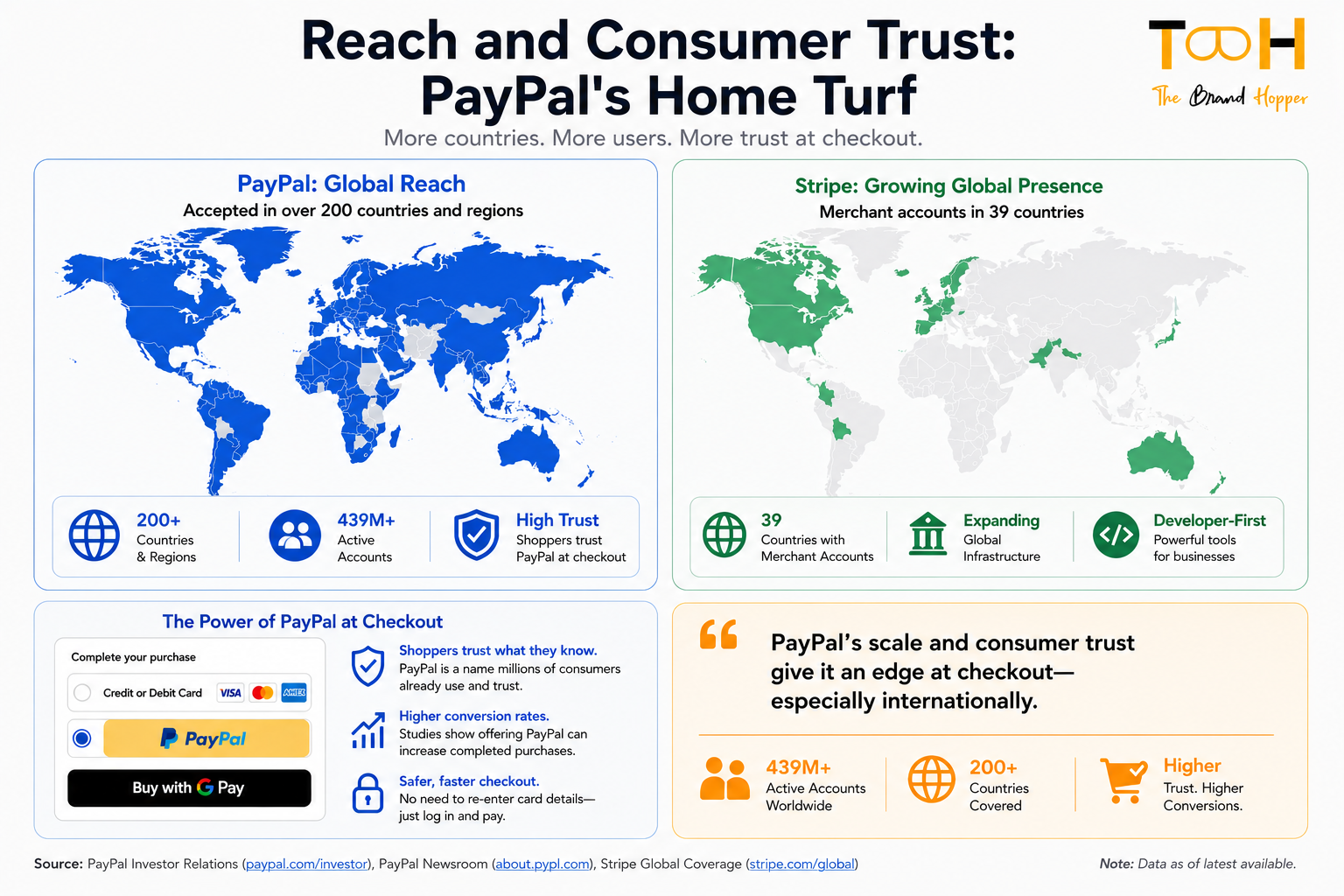
Fees aren’t the whole story. PayPal has more than 439 million active accounts and is accepted in over 200 countries — a scale advantage Stripe, with merchant accounts in 39 countries, doesn’t match.
That recognition matters at checkout: several studies suggest offering PayPal as an option can noticeably lift completed purchases, since shoppers trust an account they already have over entering fresh card details.
Developer Experience: Stripe’s Clear Advantage
For anyone building custom checkout flows, subscription billing, or a marketplace, Stripe is widely considered the stronger platform. Its API and documentation are often cited as the industry benchmark, and integrations are typically faster to build than PayPal’s. PayPal’s APIs work and cover the basics well, but advanced, custom integrations tend to take more engineering effort.
For simple “Buy Now” buttons with no code, though, PayPal is still hard to beat.
Company Scale: Stripe’s Private Boom vs. PayPal’s Public Steadiness
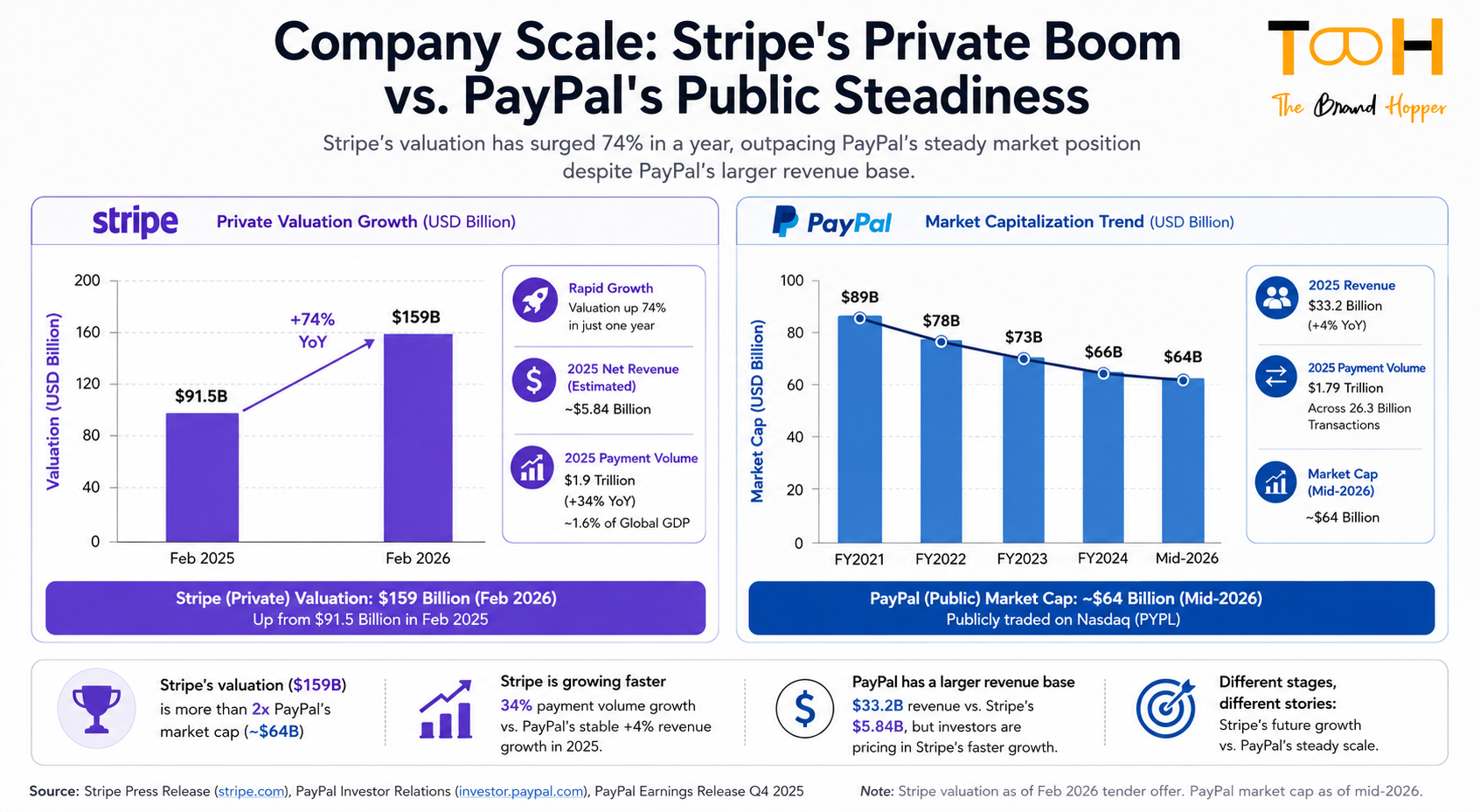
Stripe remains privately held, but it isn’t small. A February 2026 tender offer valued the company at $159 billion, up 74% from $91.5 billion a year earlier, after Stripe processed $1.9 trillion in payment volume in 2025 (up 34% year over year) — around 1.6% of global GDP. Net revenue for 2025 is estimated at roughly $5.84 billion.
PayPal, a public company on Nasdaq (PYPL), processed $1.79 trillion in payment volume in 2025 across 26.3 billion transactions, generating $33.2 billion in revenue, up about 4% year over year. Its market cap sits around $64 billion as of mid-2026 — smaller than Stripe’s private valuation despite PayPal’s larger revenue base, a gap that reflects investors pricing in Stripe’s faster growth.

PayPal vs Stripe at a Glance
| Category | PayPal | Stripe |
| Ownership | Public (Nasdaq: PYPL) | Private ($159B valuation, Feb 2026) |
| 2025 payment volume | $1.79 trillion | $1.9 trillion |
| 2025 revenue | $33.2 billion | ~$5.84 billion (net) |
| Standard online fee | 3.49% + $0.49 | 2.9% + $0.30 |
| Typical FX fee | ~4% | ~1% |
| Countries reached | 200+ | 39 (merchant accounts) |
| Best for | Simplicity, consumer trust, fast setup | Developers, SaaS, custom checkouts, global scale |
Which Should You Actually Choose?
If you’re a small business or solo seller who wants to start accepting payments today with no code and maximum buyer trust, PayPal is the simpler, safer default. If you’re a developer, SaaS company, subscription business, or anyone selling internationally at real volume, Stripe’s lower fees and superior tooling will save real money as you grow. Many businesses ultimately use both — Stripe for the core checkout, PayPal as an added option to capture shoppers who prefer it.
Frequently Asked Questions
Q. Is Stripe cheaper than PayPal?
A. Yes, for most standard transactions. Stripe charges 2.9% plus $0.30 per US card transaction versus PayPal’s 3.49% plus $0.49, and the gap grows significantly on international payments due to PayPal’s higher currency conversion fees.
Q. Which is better for small businesses, PayPal or Stripe?
A. PayPal is generally easier for small businesses and non-technical sellers to set up quickly, while Stripe suits businesses with some technical resources that want lower fees and more customization as they scale.
Q. Is Stripe or PayPal more trusted by customers?
A. PayPal, with over 439 million active accounts worldwide, has stronger brand recognition, and offering it at checkout has been shown to increase completed purchases for many merchants.
Q. Can I use both PayPal and Stripe together?
A. Yes. Many online stores offer both, using Stripe for card processing and PayPal as an alternative payment method to capture customers who prefer it.
Q. Is Stripe publicly traded like PayPal?
A. No. PayPal is a public company on the Nasdaq (PYPL). Stripe remains privately held, most recently valued at $159 billion in a February 2026 tender offer.
Q. Which processes more payment volume, Stripe or PayPal?
A. Stripe edged ahead in 2025, processing $1.9 trillion versus PayPal’s $1.79 trillion, though PayPal still generates significantly more reported revenue.
Also Read: The Inspiring Success Story and History of PayPal
To read more content like this, subscribe to our newsletter
Go to the full page to view and submit the form.