


Reliance Jio Infocomm Limited, popularly known as Jio, is an Indian mobile network operator owned by Reliance Industries Limited (RIL) and headquartered in Mumbai, Maharashtra. What began as an audacious bet on India’s digital future has, over the course of a single decade, transformed into the world’s largest data network by mobile data consumption — and one of the most consequential technology businesses ever built in Asia.
As of 2026, Jio commands a subscriber base exceeding 524 million users, operates the world’s fastest-deployed 5G network, and is marching toward what promises to be one of the largest initial public offerings (IPOs) in history. The story of Jio is not just a corporate success story — it is the story of how 1.4 billion people came online.
Origins: A Bet on Broadband
The company was registered in Ahmedabad, Gujarat on 15 February 2007 as Reliance Jio Infocomm Limited. The seeds of the idea, however, were planted years later in a far more personal setting. “The idea of Jio was first seeded by my daughter, Isha, in 2011. She was a student at Yale and was home for holidays. She wanted to submit some coursework and she said, ‘Dad, the internet in our house sucks,'” Mukesh Ambani, chairman of Reliance Industries, recalled. That frustration became a multi-billion-dollar mission.
In June 2010, Reliance Industries bought a majority 95% stake in Infotel Broadband Services Limited (IBSL) for Rs. 4,800 crore. IBSL was the only company at the time that had won broadband spectrum in all 22 telecom circles in India in the 4G auction held earlier that year — making it the perfect vehicle for a national network. In January 2013, IBSL was renamed Reliance Jio Infocomm Limited (RJIL).
The company took an unconventional approach from the very beginning: it decided to build a purely 4G LTE network, skipping 2G and 3G entirely. Voice calls would be delivered over Voice over LTE (VoLTE), rather than traditional circuit-switched technology. It was a high-risk, high-reward architecture that required India’s devices to catch up — and, in time, they did.
The Launch That Shook India (2015–2016)
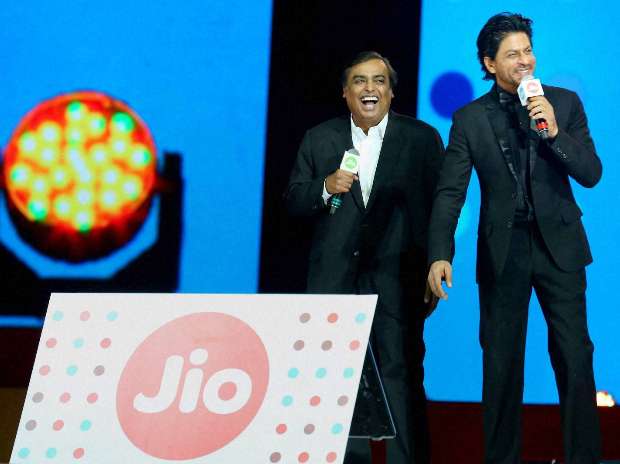
Jio soft-launched on 27 December 2015 — the eve of what would have been the 83rd birthday of Reliance Industries founder Dhirubhai Ambani — with a beta launch for partners, staff, and their families. Bollywood actor Shah Rukh Khan, Jio’s brand ambassador, kicked off the launch event at Reliance Corporate Park in Navi Mumbai, joined by A R Rahman, Ranbir Kapoor, and filmmaker Rajkumar Hirani in front of more than 35,000 RIL employees connected virtually from over 1,000 locations.

The commercial launch followed on 5 September 2016, and the impact was immediate and seismic. Within the first month, Jio announced 16 million subscribers — the fastest ramp-up ever recorded by any mobile operator anywhere in the world. It crossed 50 million subscribers in just 83 days, a milestone that had taken Airtel 12 years and Vodafone and Idea 13 years each to reach. By February 2017, Jio had surpassed 100 million subscribers. By October 2017, the number stood at 130 million.
The terms of Jio’s entry were devastating for incumbents: unlimited free voice calls, 4G data, and messaging at prices that undercut the market by an order of magnitude. The cost of mobile data in India plummeted from Rs. 250 per GB or more to less than Rs. 15 per GB almost overnight. State-run BSNL was forced to slash rates and dust off 700,000 kilometres of underutilised fibre network. Airtel, Vodafone, and Idea scrambled to cut tariffs and shore up balance sheets. The industry was never the same again.
The Great Consolidation (2017–2021)
Jio’s arrival triggered one of the most dramatic episodes of industry consolidation in global telecom history. What had been a thirteen-player market in 2014 shrank to effectively three private operators — Jio, Bharti Airtel, and Vodafone Idea — plus the state-run BSNL, by the early 2020s. Dozens of smaller operators either shut down or were absorbed. Aircel, Telenor India, and Tata Teleservices all exited the market. Vodafone and Idea merged in 2018 in a desperate bid to survive, creating what was briefly India’s largest telecom company before Jio overtook it.
For Jio, the years from 2017 to 2021 were about building on its initial disruption. The company expanded beyond connectivity into an ecosystem of digital services: JioTV for live television, JioCinema for on-demand streaming, JioSaavn for music, JioMeet for video conferencing, and JioMart for e-commerce. It also extended its reach into hardware with the JioPhone — a feature phone capable of running 4G VoLTE — priced at a refundable deposit of just Rs. 1,500, specifically designed to bring first-time internet users online.
On 5 July 2018, Mukesh Ambani announced JioGigaFiber at the company’s Annual General Meeting, laying the groundwork for a home broadband service that would eventually become JioFiber. Launched commercially in 2019, JioFiber brought high-speed fixed broadband to millions of Indian homes, once again at prices that undercut the market.
Then came the pivotal moment of 2020. During the first wave of the COVID-19 pandemic, with Reliance Industries carrying significant debt, Jio Platforms — the parent entity housing all of Jio’s digital assets — raised over Rs. 1.52 lakh crore (approximately $20 billion) in less than three months. Facebook (now Meta) invested Rs. 43,574 crore for a 9.99% stake. Google invested Rs. 33,737 crore for a 7.73% stake. Saudi Arabia’s Public Investment Fund, Abu Dhabi Investment Authority, Silver Lake, Vista Equity, General Atlantic, KKR, and others followed in rapid succession. It was a statement of extraordinary confidence in Jio’s position as the gateway to India’s digital economy.
By the end of FY2021, Jio had approximately 440 million subscribers and was generating revenues of around Rs. 80,000 crore annually.
India Goes 5G — and Jio Leads the Charge (2022–2023)
The next chapter began on 1 October 2022, when Prime Minister Narendra Modi inaugurated India’s 5G services at the India Mobile Congress in New Delhi. Reliance Jio and Bharti Airtel were among the first to launch commercially, with Jio formally switching on its True5G network in Delhi, Mumbai, Kolkata, and Chennai on 5 October 2022.
Jio had committed to spending $25 billion on its 5G infrastructure — a staggering sum that reflected both its ambition and its conviction that 5G would define the next decade of Indian telecommunications. Crucially, Jio chose to build its 5G network on Standalone (SA) architecture — meaning the 5G core was built from scratch, rather than layering 5G over an existing 4G core as most global operators had done. This gave Jio’s network lower latency, greater capacity, and stronger performance credentials from day one.
The rollout pace was breathtaking. By the end of 2022, Jio had covered most major cities. By March 2023, 5G service was live in 365 cities. By August 2023, coverage extended to over 7,000 towns and cities, with Jio announcing plans to complete its national rollout by the end of that year — a target it broadly met. For context, the rollout of Jio’s 5G network was among the fastest of any operator globally, a feat made possible by the sheer scale of Jio’s investment and the dense fibre backbone it had already built for its 4G network.
Subscriber growth continued apace. Jio’s total mobile subscriber base crossed 430 million in early 2023, with the company’s share of wireless telecom subscribers in India rising to 37.6%, up from 35.4% the previous year.
JioAirFiber: Bringing Broadband Beyond the Cities (2023–2024)
While 5G grabbed the headlines, Jio was quietly staging another revolution in fixed broadband. At Reliance Industries’ Annual General Meeting in August 2023, Mukesh Ambani announced JioAirFiber — a Fixed Wireless Access (FWA) service that delivers high-speed home broadband using 5G radio signals, without the need to lay physical fibre cables to every home.
JioAirFiber addressed one of India’s most persistent connectivity challenges: the tens of millions of homes in smaller towns, semi-urban, and rural areas that fibre-optic cables had never reached. By plugging a small router-like device into a power socket — no technician needed, no digging up roads — households could instantly access broadband speeds that previously required an expensive underground fibre connection.
The take-up was rapid. By September 2025, JioAirFiber had attracted nearly 9.5 million subscribers, making it the largest Fixed Wireless Access service in the world. Strikingly, more than 70% of new JioAirFiber additions came from cities and towns that had previously been underserved by broadband — validating the product’s design from the outset.
Combined with traditional JioFiber connections, Jio’s total fixed broadband base reached 27 million by mid-2025, with the company adding close to 10 million new broadband customers in a single financial year.
5G at Scale: 268 Million Users and Counting (2024–2025)
Jio’s 5G subscriber numbers tell a story of explosive adoption. The company reached 100 million 5G users by early 2024 — less than 18 months after launch. By August 2024, 108 million of Jio’s 481 million total subscribers were on 5G. By the end of 2024, that figure had climbed to 170 million. And by September 2025, Jio’s 5G user base stood at a remarkable 234 million, with a total 5G subscriber count of 268 million by early 2026.
This trajectory made Jio the largest 5G operator outside of China — a title that would have seemed implausible when the company launched its first 4G network a decade earlier.
The financial implications of 5G adoption began to crystallise in 2024. In July 2024, Jio announced a tariff revision — an increase of between 12% and 25% across its plans, the first significant hike since the company’s commercial launch. It was a deliberate shift: having spent the first phase of its existence building subscriber scale through aggressive pricing, Jio was now pivoting toward revenue quality. Average Revenue Per User (ARPU), long a weak spot relative to global benchmarks, began climbing steadily. By October 2025, Jio’s ARPU had risen to Rs. 211.4, a figure that would have seemed impossible during the Rs. 50-per-month free-service era of 2016.
The Entertainment Empire: JioHotstar and the Disney Merger (2024–2025)
While Jio was cementing its dominance in connectivity, it was simultaneously building what may prove to be India’s most powerful entertainment business.
In February 2024, Reliance Industries, Viacom18, and The Walt Disney Company signed binding agreements to combine the businesses of Viacom18 and Star India in a joint venture valued at $8.5 billion including synergies. The deal, which closed in November 2024, created JioStar — a media entity in which Reliance holds a 63.16% stake and Disney holds the remaining 36.84%. Nita Ambani was appointed chairperson of the new entity, with media veteran Uday Shankar as vice-chairperson.
On 14 February 2025, JioStar merged the streaming services JioCinema and Disney+ Hotstar into a single platform: JioHotstar. The new service combines the vast content libraries of both predecessors, offering Indian and international films, live sports including the Indian Premier League and international cricket, original series, and children’s programming — all under one roof.

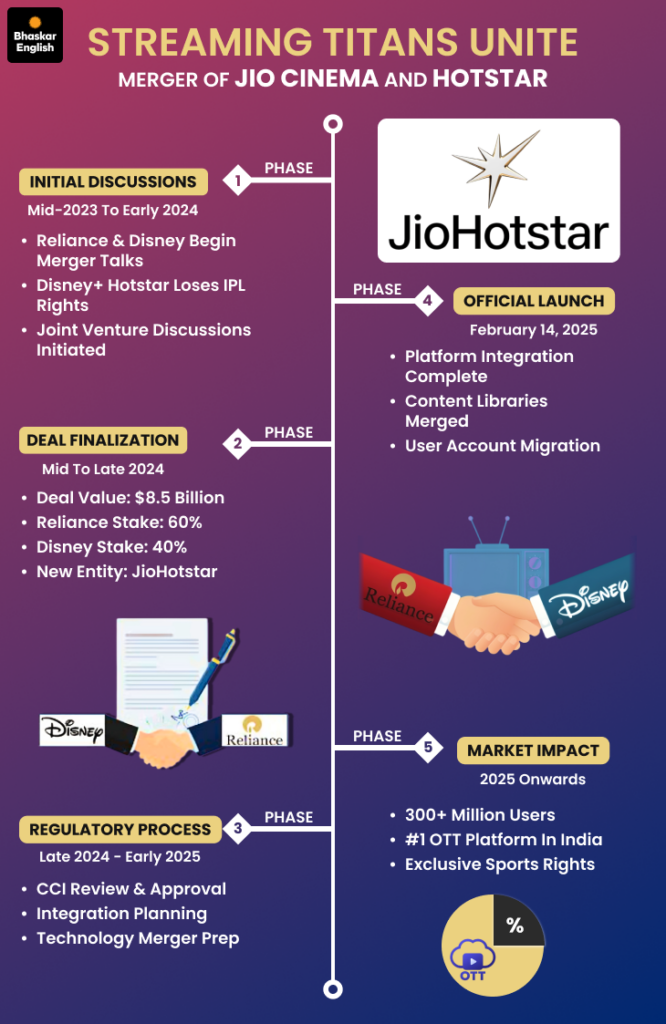
The early numbers were extraordinary. JioHotstar attracted 600 million users within its first three months of launch, with 300 million paying subscribers, making it the second-largest streaming platform in the world by subscriber count. For a country where paid digital content had long been treated as a niche proposition, this was a landmark moment — a sign that India’s middle class was willing to pay for premium entertainment when the right product at the right price existed.
The Numbers Today: A Giant’s Footprint
As of early 2026, the scale of Jio’s business is difficult to fully comprehend.
Jio’s total subscriber base exceeds 524 million, making it not just India’s largest telecom operator by a wide margin, but one of the largest in the world. The company commands the largest revenue market share in India’s mobile market, ahead of Bharti Airtel, the only other operator that has invested heavily in 5G. Vodafone Idea, once a formidable rival, continues to struggle for survival, underlining how completely the competitive dynamics of Indian telecom have shifted in Jio’s favour.
On the financial side, Jio Platforms reported revenue close to Rs. 1.3 trillion (approximately $15.5 billion) in fiscal year 2024. For FY2025-26, revenue grew approximately 17% year-on-year in the first half, with EBITDA growing at roughly 10%, reflecting the benefits of tariff increases and improving monetisation across both mobile and broadband segments.
The Indian telecom market, once home to thirteen operators, is now effectively a three-player private market — Jio, Airtel, and a diminished Vodafone Idea — a consolidation story that Jio both triggered and accelerated.
The IPO: India’s Biggest Listing on the Horizon
Perhaps the most anticipated development in Jio’s journey is the one that has not yet happened: its initial public offering. At Reliance Industries’ 48th Annual General Meeting in August 2025, Mukesh Ambani confirmed that Jio would launch its IPO by the first half of 2026, ending years of speculation about when the company would seek a public listing.
Analyst estimates place Jio’s valuation at between $120 billion and $180 billion, which would make it one of the most valuable telecommunications companies in the world, and the IPO — expected to involve the sale of approximately 2.5% of equity, raising around $4 billion — would rank among the largest public listings in Indian history.
The IPO is significant beyond the financial mechanics. It will provide the first truly transparent public window into Jio’s financials, subscriber economics, and long-term strategy. It will also be a moment of reckoning for the Indian technology and telecom investment community, which has watched Jio’s growth largely from the outside for a decade.
A Decade of Transformation: What Jio Changed
It is worth pausing to reflect on what Jio has actually accomplished since 2016 — because the changes it has wrought extend far beyond a single company’s balance sheet.
India’s mobile data consumption, among the lowest in the world when Jio launched, now ranks as the highest per capita of any major nation. The cost of 1 GB of mobile data in India remains one of the lowest globally — a direct legacy of the price war Jio ignited in 2016. Digital payments, online education, telemedicine, e-commerce, and government digital services have all scaled dramatically on the back of the cheap, ubiquitous data connectivity that Jio created.
The JioPhone brought hundreds of millions of first-time internet users online. JioFiber and JioAirFiber extended broadband to homes and towns that had never previously had access. JioHotstar is reshaping how India consumes entertainment. And Jio Platforms, with strategic investments from Meta, Google, and some of the world’s largest sovereign wealth funds and private equity firms, is the infrastructure layer on which much of India’s digital economy now runs.
Jio’s journey from a beta launch on a December evening in 2015 to a 524-million-subscriber giant preparing to go public is, in many respects, the defining corporate story of modern India. It is the story of how one company, with enormous capital, enormous ambition, and an unusually long time horizon, bet on the proposition that India’s one billion people deserved world-class connectivity — and changed everything by making that bet pay off.
The next chapter — 5G monetisation, JioAirFiber expansion, the IPO, and whatever comes after — is still being written. But the first decade has already secured Jio’s place as one of the most consequential telecommunications businesses of the twenty-first century.
Frequently Asked Questions (FAQs)
1. When did Reliance Jio officially launch in India?
Jio soft-launched on 27 December 2015 as a beta service for employees and partners. It became publicly available on 5 September 2016, offering free voice calls and 4G data that triggered a nationwide telecom revolution.
2. How many subscribers does Jio have in 2026?
As of early 2026, Jio’s total subscriber base exceeds 524 million, making it India’s largest telecom operator and one of the largest mobile networks in the world.
3. When did Jio launch its 5G network?
Jio commercially launched its True5G services on 5 October 2022 in Delhi, Mumbai, Kolkata, and Chennai. The rollout expanded to over 7,000 cities and towns by the end of 2023. By early 2026, Jio had over 268 million 5G subscribers — the largest 5G operator outside of China.
4. What is JioAirFiber and how is it different from JioFiber?
JioFiber delivers home broadband over physical fibre-optic cables. JioAirFiber, launched in 2023, is a Fixed Wireless Access (FWA) service that provides high-speed broadband using Jio’s 5G network — without any cable installation. It simply plugs into a power socket, making it ideal for smaller towns and areas where laying fibre is not practical. JioAirFiber is now the largest FWA service in the world with nearly 9.5 million subscribers.
5. What is JioHotstar?
JioHotstar is Jio’s flagship streaming platform, launched on 14 February 2025. It was created by merging JioCinema and Disney+ Hotstar following Reliance’s $8.5 billion joint venture with The Walt Disney Company in 2024. JioHotstar offers movies, live sports, originals, and international content, and attracted 600 million users within its first three months of launch.
6. Is Jio planning an IPO?
Yes. Mukesh Ambani confirmed at Reliance Industries’ Annual General Meeting in August 2025 that Jio will launch its Initial Public Offering (IPO) by the first half of 2026. Analyst estimates value Jio at between $120 billion and $180 billion, potentially making it one of the most valuable telecom companies in the world.
7. How did Jio change the cost of mobile data in India?
Before Jio’s launch, 1 GB of mobile data in India cost upwards of Rs. 250. Jio’s entry drove that price down to less than Rs. 15 per GB — a drop of over 90% — making India one of the cheapest countries in the world for mobile data.
8. Who owns Reliance Jio?
Reliance Jio Infocomm Limited is a subsidiary of Jio Platforms, which is in turn owned by Reliance Industries Limited (RIL), chaired by Mukesh Ambani. Strategic investors in Jio Platforms include Meta (Facebook), Google, Saudi Arabia’s Public Investment Fund, KKR, Silver Lake, and several other global funds, who collectively invested over $20 billion in 2020.
9. Does Jio offer 2G or 3G services?
No. Jio operates exclusively on 4G LTE and 5G networks. Voice calls are delivered via Voice over LTE (VoLTE) technology. Jio deliberately skipped 2G and 3G when it launched, betting on a fully 4G-native future.
10. What is Jio’s ARPU as of 2025–26?
Jio’s Average Revenue Per User (ARPU) rose to Rs. 211.4 by October 2025, up significantly from the sub-Rs. 100 levels of its early years, driven by the 2024 tariff hike and a growing share of higher-value 5G and postpaid subscribers.
Data and figures in this article are sourced from Reliance Industries’ official financial disclosures, TRAI subscriber data, and publicly reported research as of May 2026.
Also Read: List of Diverse Businesses & Interests of Reliance Industries
To read more content like this, subscribe to our newsletter
Go to the full page to view and submit the form.