



Introduction: What is Richemont?
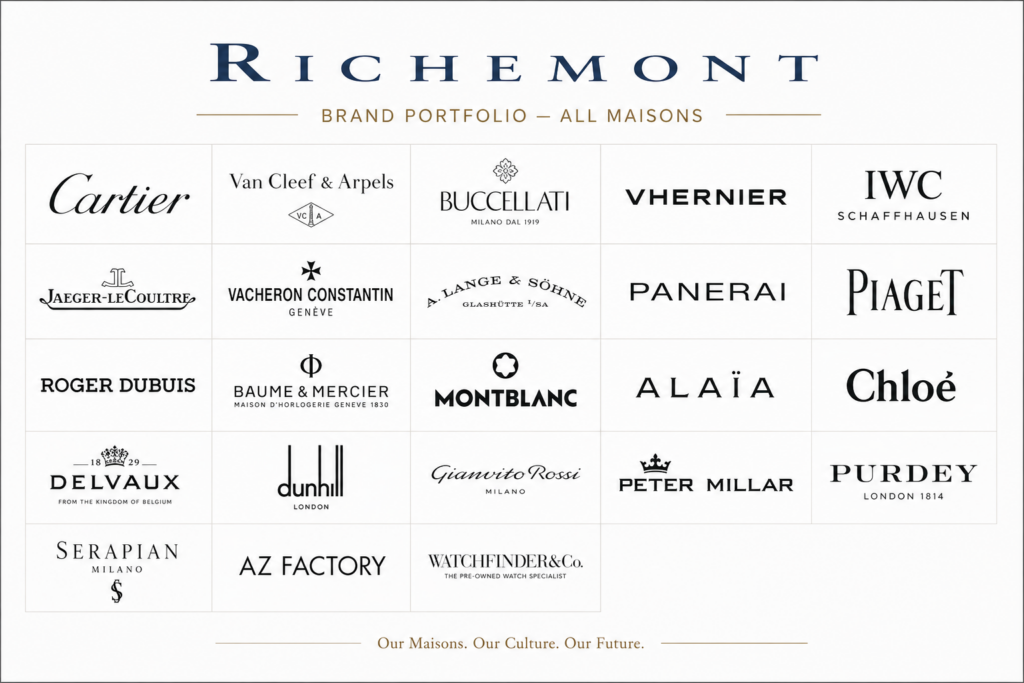
Compagnie Financière Richemont SA — known universally as Richemont — is the world’s second-largest luxury goods group by revenue, surpassed only by LVMH. Headquartered in Geneva, Switzerland, and listed on the SIX Swiss Exchange, Richemont is the custodian of some of the most storied names in the history of jewellery, watchmaking, fashion, and luxury accessories. Its portfolio spans more than twenty Maisons, from Cartier — arguably the world’s most famous jewellery brand — to Jaeger-LeCoultre, the ‘watchmakers’ watchmaker’, to Montblanc, Delvaux, Chloé, and Alaïa.
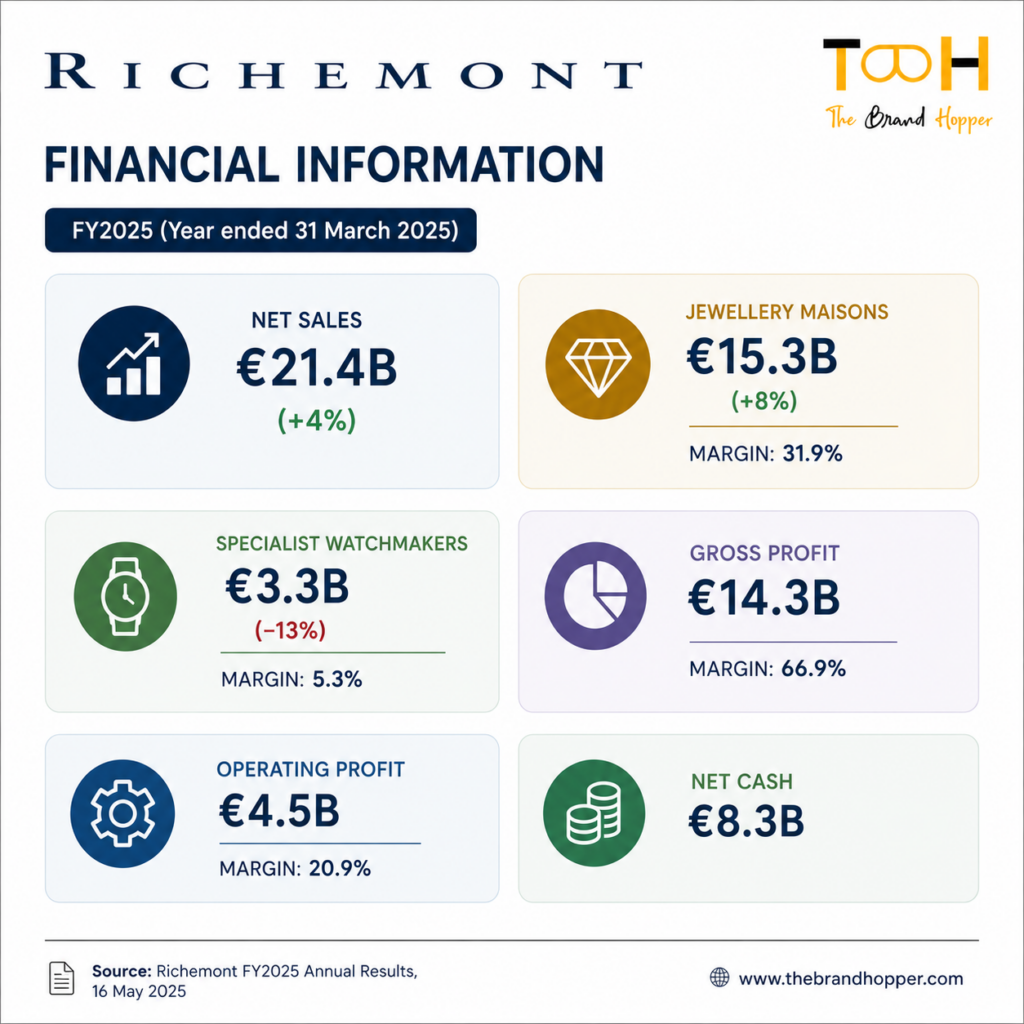
Unlike the more diversified LVMH — which spans fashion, wine, spirits, retail, and hotels — Richemont has built its empire with a sharper, more focused mandate: pre-eminent luxury, primarily in jewellery and watchmaking. In its most recent full fiscal year ended March 31, 2025, the group generated net sales of €21.4 billion, with its Jewellery Maisons alone accounting for €15.3 billion (€15,328 million) — a concentration of revenue around the hard luxury segment that is unmatched by any rival. Gross margin stands at a remarkable 66.9%, reflecting the combination of exceptional craftsmanship, pricing power, and vertical manufacturing integration that characterises the group.
This article provides a complete, up-to-date guide to every brand in the Richemont portfolio — organised by business category, enriched with founding histories, heritage highlights, and the strategic context that explains why each Maison matters to the group’s overall position.

Founding & History: Johann Rupert and the Making of a Luxury Empire
Richemont was founded in 1988 by South African businessman Johann Rupert, the son of Anton Rupert — the founder of the Rembrandt Group and one of South Africa’s most influential industrialists. The Richemont name derives from the Rupert family’s ancestral estate near Boschendal in the Western Cape, and the company was formed when Johann Rupert spun off the family’s international luxury goods and tobacco interests from the broader Rembrandt Group into a separate entity listed in Switzerland.

The seeds of Richemont’s luxury portfolio had been planted in the years prior, most notably through Cartier — which the Rupert family had acquired a stake in during the 1970s. The Cartier brand, along with other early acquisitions including Piaget, Baume & Mercier, and Alfred Dunhill, gave the new group immediate credibility and scale in the luxury goods market. Through the 1990s and 2000s, Richemont added watch Maisons including IWC Schaffhausen, Jaeger-LeCoultre, A. Lange & Söhne, Roger Dubuis, and Vacheron Constantin, progressively establishing itself as the most powerful portfolio of specialist watchmakers in the world.
The 2010s saw Richemont diversify into digital luxury with the acquisition of Yoox Net-a-Porter (YNAP), the leading online luxury retailer. However, the digital commerce experiment proved challenging, and in 2024 Richemont transferred 100% of YNAP to Mytheresa in exchange for a 33% equity stake in the combined entity, effectively exiting direct ownership of the platform while retaining significant financial exposure to the digital luxury market.
More recently, Richemont has returned to its roots in hard luxury, adding the Italian jeweller Vhernier (acquired September 2024) to its Jewellery Maisons and footwear brand Gianvito Rossi to its Fashion & Accessories portfolio. Johann Rupert continues as Executive Chairman and the Rupert family retains voting control of the group through a dual share structure.
| Metric | Detail |
| Founded | 1988 (by Johann Rupert) |
| Headquarters | Geneva, Switzerland (operational HQ: Bellevue, Geneva) |
| Listed | SIX Swiss Exchange (CFR); ADRs on OTC Markets (CFRUY) |
| Group Sales FY2025 | €21,399 million / €21.4 billion (+4% YoY) |
| Gross Profit FY2025 | €14,319 million (gross margin: 66.9%) |
| Operating Profit FY2025 | €4,467 million (margin: 20.9%) |
| Net Cash Position (31 Mar 2025) | €8,257 million / €8.3 billion |
| Cash from Operations FY2025 | €4,443 million |
| Number of Maisons | 20+ brands across three business areas |
| Employees (excl. YNAP) | ~35,000+ globally (per FY2025 Annual Report) |
| Key Figure | Johann Rupert — Executive Chairman; Rupert family controls voting |
| Industry Position | World’s 2nd largest luxury goods group (after LVMH) |
Richemont’s Three Business Areas
Richemont organises its portfolio into three distinct business areas, each with its own management structure, growth dynamics, and consumer proposition. Understanding this structure is essential to understanding the group — because unlike LVMH (which reports by category) or Kering (which is predominantly fashion), Richemont’s architecture reflects its fundamental conviction that jewellery and watchmaking are different businesses requiring different capabilities.
Jewellery Maisons: Cartier, Van Cleef & Arpels, Buccellati, and Vhernier. This segment generates the vast majority of group revenue (€15.3 billion in FY2025) and underpins Richemont’s market position as the world’s leading jewellery luxury group.
Specialist Watchmakers: Eight watch brands covering the full spectrum of mechanical watchmaking from entry-accessible (Baume & Mercier) to ultra-exclusive (A. Lange & Söhne, Vacheron Constantin). Swiss and German watchmaking expertise at its most concentrated.
Fashion & Accessories Maisons: A diverse collection including Alaïa, AZ Factory, Chloé, Delvaux, Dunhill, Gianvito Rossi, Montblanc, Peter Millar, Purdey, Serapian, Watchfinder & Co., and TimeVallée. This segment adds breadth and diversification to the portfolio.
FY2025 Segment Financial Performance
The following segment breakdown is sourced directly from Richemont’s FY2025 Annual Results announcement (year ended 31 March 2025), released 16 May 2025.
| Business Area | FY2025 Sales (€m) | YoY Change | Operating Result (€m) | Operating Margin | Brands |
| Jewellery Maisons | €15,328m | +8% | €4,896m | 31.9% | Cartier, Van Cleef & Arpels, Buccellati, Vhernier |
| Specialist Watchmakers | €3,283m | -13% | €175m | 5.3% | A. Lange & Söhne, Baume & Mercier, IWC, Jaeger-LeCoultre, Panerai, Piaget, Roger Dubuis, Vacheron Constantin |
| Other (F&A + Watchfinder) | €2,788m | +7% | €(102)m | -3.7% | Alaïa, Chloé, Delvaux, Dunhill, Gianvito Rossi, Montblanc, Peter Millar, Purdey, Serapian, Watchfinder & Co. |
| Corporate / Unallocated | — | — | €(453)m | — | Central management & functions |
| GROUP TOTAL | €21,399m | +4% | €4,467m | 20.9% | Source: Richemont FY2025 Annual Results (16 May 2025) |
| Jewellery Maisons drove 71.6% of total group sales and 109.6% of total operating profit in FY2025. Specialist Watchmakers were impacted by a 27% decline in Asia Pacific (their largest region), while Fashion & Accessories continues to invest in long-term brand building. Source: Richemont FY2025 Annual Results. |
JEWELLERY MAISONSCartier · Van Cleef & Arpels · Buccellati · Vhernier |
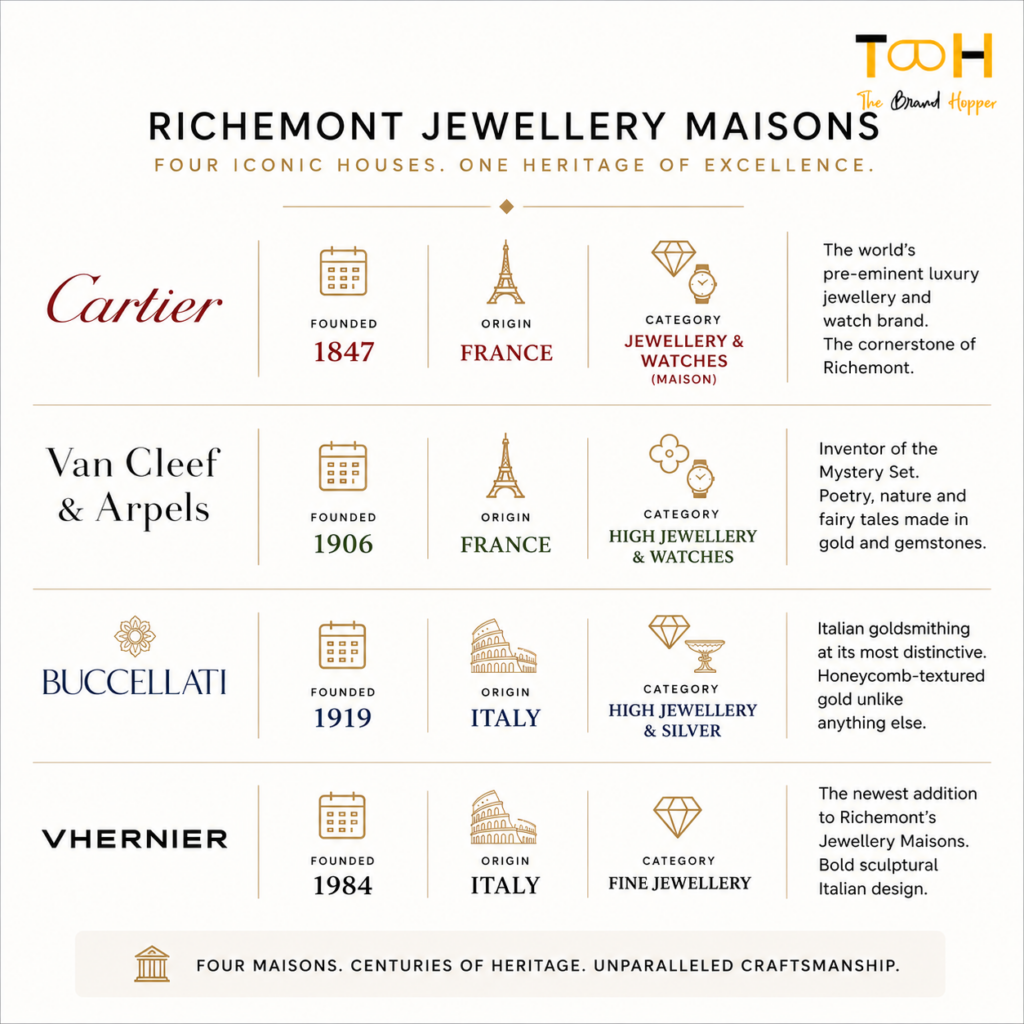
Richemont’s Jewellery Maisons are the crown of the group — four exceptional brands that between them define the global standard for luxury jewellery. Cartier alone is widely regarded as the world’s most valuable jewellery brand. Together, the four Maisons generated €15.3 billion in net sales in FY2025, representing approximately 72% of group revenue. Their combined portfolio of iconic designs — from the Cartier Love Bracelet to Van Cleef & Arpels’ Alhambra to Buccellati’s honeycombed gold — represents some of the most recognised and reproduced jewellery in the world.
1. Cartier
Cartier is the jewel in Richemont’s crown — and by most assessments, the world’s most recognised and commercially powerful luxury jewellery brand. Founded in Paris in 1847 by Louis-François Cartier, the Maison built its early reputation as jeweller to European royalty, earning the title ‘Jeweller of Kings, King of Jewellers’ from Edward VII of England in 1904. This royal patronage established Cartier’s brand mythology in a way that no marketing campaign could replicate.
Today, Cartier operates more than 200 boutiques across 120+ countries and generates the dominant share of Richemont’s Jewellery Maisons revenue. Its product universe spans high jewellery, fine jewellery, watches (including the iconic Tank and Santos collections), and accessories. The three most powerful products in its commercial portfolio — the Love Bracelet, the Juste un Clou, and the Trinity ring — have achieved the rare status of genuine cultural objects, crossing from jewellery into broader fashion and self-expression.
Cartier’s watches are equally significant: the Maison pioneered the wristwatch for men (the Santos, designed for aviator Alberto Santos-Dumont in 1904 at his request), and its Tank collection, conceived in 1917, remains one of the most imitated watch designs in history. Cartier’s dual jewellery and watch positioning is unique among the Jewellery Maisons and gives the brand exceptional commercial breadth.
Founded: 1847, Paris, France
Acquired by Richemont: Rupert family acquired stake in Cartier in the 1970s; fully part of Richemont at its 1988 formation
Iconic products: Love Bracelet, Juste un Clou, Trinity, Tank watch, Santos watch, Panthère, Ballon Bleu
Global footprint: 200+ boutiques in 120+ countries
2. Van Cleef & Arpels
Van Cleef & Arpels is one of the great names in French haute joaillerie — a Maison defined by an extraordinary sense of poetry, lightness, and narrative. Founded in 1906 on the Place Vendôme in Paris through the marriage of Estelle Arpels and Alfred Van Cleef, the house built its identity around a distinctive aesthetic: jewellery that tells stories through nature, ballet, fairies, and the garden.
The Maison’s technical innovations are as celebrated as its aesthetic vision. Van Cleef & Arpels invented the Mystery Set in 1933 — a setting technique in which precious stones float with no visible prongs or metalwork, creating an effect of pure gemstone surface that remains fiendishly difficult to execute and has never been replicated by a competitor. The Minaudière evening bag (1933) was another invention, and the Zip necklace — designed at the suggestion of the Duchess of Windsor — transforms into a working zip fastener.
Among the Maison’s contemporary icons, the Alhambra collection (launched 1968) stands apart — a four-leaf clover motif available in multiple materials and iterations that has become one of the most commercially successful jewellery designs of the 20th century, continuously in production for nearly six decades. Van Cleef & Arpels is also known for its Van Cleef & Arpels L’École school of jewellery arts, established to educate the public about the culture and history of jewellery.
Founded: 1906, Place Vendôme, Paris, France
Acquired by Richemont: 1999
Iconic products: Alhambra collection, Mystery Set, Zip necklace, Frivole, Perlée
Notable: L’École Van Cleef & Arpels — jewellery education school operating worldwide
3. Buccellati
Buccellati is Italian luxury jewellery at its most distinctive and most artisanal. Founded in Milan in 1919 by Mario Buccellati, the Maison developed a unique signature in goldsmithing: a technique of hand-engraved texturing — including the now-legendary rigato (linear grooves), telato (linen-weave texture), and tulle-like openwork patterns — that gives Buccellati pieces a surface quality unlike any other jewellery in the world. The effect is of fabric rather than metal, delicate and architectural simultaneously.
Buccellati has historically attracted an extraordinary clientele: Pope Pius XI, Gabriele D’Annunzio, the Duke and Duchess of Windsor, Elizabeth Taylor, Sophia Loren, and multiple generations of European royalty have all commissioned or collected Buccellati pieces. The brand is also celebrated for its silverware and table objects — a category in which Buccellati’s hand-engraved silver represents perhaps the finest contemporary silversmithing in the world.
Richemont acquired Buccellati in September 2019, completing the deal at a significant moment — the brand’s centenary year. The acquisition added a distinctly Italian voice to Richemont’s otherwise predominantly French jewellery maisons.
Founded: 1919, Milan, Italy
Acquired by Richemont: September 2019 (centenary year)
Signature technique: Hand-engraved gold texturing (rigato, telato, tulle patterns)
Iconic products: Macri collection, Opera collection, silverware and table objects
4. Vhernier
| NEW ADDITION: Vhernier was acquired by Richemont in September 2024. It is now the fourth Maison in the Jewellery Maisons business area. |
Vhernier is the newest member of Richemont’s Jewellery Maisons — and arguably the most exciting acquisition the group has made in the jewellery space since Van Cleef & Arpels. Founded in Valenza, Italy in 1984 and headquartered in Milan, Vhernier was built around a design philosophy that stands in deliberate contrast to the narrative-led, nature-inspired approach of Van Cleef or the honeycomb textures of Buccellati: Vhernier’s jewellery is boldly sculptural, inspired by the curves of the human body and the essential geometry of modern sculpture.
The brand is particularly known for its unconventional material combinations — placing precious gemstones alongside titanium, bronze, ebony, or rock crystal in ways that challenge the conventions of traditional fine jewellery. The Calla Lily ring, the Abbraccio bangle, and the Fuseau earring are among its most recognisable designs. Vhernier had been owned by the Traglio family since 2001, and was acquired by Richemont in a private transaction completed on September 13, 2024. Johann Rupert described the acquisition as an opportunity to realise the brand’s ‘full potential in the burgeoning branded jewelry market’.
Founded: 1984, Valenza, Italy
Acquired by Richemont: September 2024
Design signature: Sculptural geometry; precious metals with unconventional materials (titanium, ebony, bronze)
Iconic designs: Calla Lily, Abbraccio, Fuseau
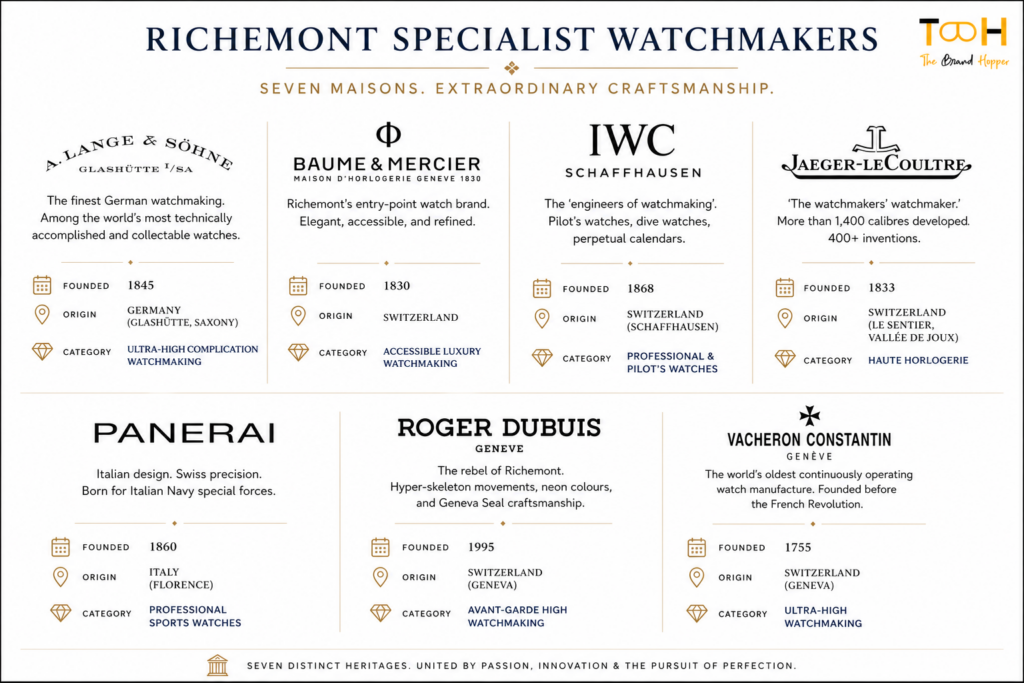
SPECIALIST WATCHMAKERSA. Lange & Söhne · Baume & Mercier · IWC Schaffhausen · Jaeger-LeCoultre · Panerai · Piaget · Roger Dubuis · Vacheron Constantin |
Richemont’s Specialist Watchmakers division constitutes the most comprehensive collection of prestige mechanical watchmaking brands under a single ownership anywhere in the world. Eight brands spanning three centuries of watchmaking history — from Vacheron Constantin, the world’s oldest continuously operating watch manufacture (founded 1755), to Roger Dubuis, founded as recently as 1995. Together they cover price points from €2,000 (Baume & Mercier) to several million euros (Vacheron Constantin grand complications), and stylistic territories from dressy and precious (Piaget) to rugged and professional (Panerai, IWC) to technically avant-garde (Roger Dubuis, A. Lange & Söhne).
1. Lange & Söhne
Lange & Söhne represents the pinnacle of German watchmaking — a brand that makes a compelling argument that Switzerland does not hold a monopoly on horological excellence. Founded in Glashütte, Saxony in 1845 by Ferdinand Adolph Lange, the manufactory established the Glashütte tradition of watchmaking as a genuine rival to the Swiss. The brand was nationalised during the East German era and its workshop was destroyed in World War II, but was re-founded by Walter Lange (Ferdinand’s great-grandson) in 1990, immediately after German reunification.
Since its 1994 commercial relaunch, A. Lange & Söhne has built a reputation as one of the most technically accomplished and aesthetically coherent watchmakers in the world. Its signature design language — two-tier movement architecture, glashütte ribbing, three-quarter plates, and hand-engraved balance cocks — is instantly recognisable and unlike any Swiss competitor. Key models include the Lange 1 (which introduced the outsize date window), the Datograph (widely regarded as one of the finest chronographs ever made), the Zeitwerk (which displays jumping digits), and the Tourbograph Perpetual — a staggering tour de force of mechanical complexity.
Founded: 1845 (refounded 1990); commercial relaunch 1994
Origin: Glashütte, Saxony, Germany
Acquired by Richemont: 1996
Iconic models: Lange 1, Datograph, Zeitwerk, Saxonia, Richard Lange
2. Baume & Mercier
Baume & Mercier occupies a distinctive position in the Richemont watchmaking portfolio: it is the group’s most accessible brand, offering Swiss mechanical and quartz watches at price points that begin in the range of €2,000–€3,000 — compared to the five- and six-figure starting prices of the group’s ultra-premium watch Maisons. Founded in 1830 by two brothers, Louis-Victor and Célestin Baume, in the Jura region of Switzerland, the brand was later merged with the Mercier family’s Geneva-based house and has maintained a commitment to accessible elegance ever since.
Baume & Mercier’s design philosophy emphasises clean, classic aesthetics over technical complexity — its watches are more likely to be chosen for their elegance at a formal dinner than for their complication count. Key collections including Clifton, Riviera, Hampton, and Classima address different lifestyle contexts from vintage-inspired dress watches to sports-casual, making the brand one of the more versatile in the Richemont stable.
Founded: 1830, Les Bois, Jura, Switzerland
Acquired by Richemont: 1988 (at Richemont’s formation)
Key collections: Clifton, Riviera, Hampton, Classima
3. IWC Schaffhausen
IWC Schaffhausen stands apart from virtually every other Swiss watch brand in one crucial respect: it was founded by an American. Florentine Ariosto Jones, an engineer from Boston, established the International Watch Company in Schaffhausen in 1868, choosing the location for its access to Rhine waterpower and the skilled local workforce. Jones’s vision was to combine American precision engineering with Swiss watchmaking tradition — a combination that has defined IWC’s identity ever since.
IWC is particularly celebrated for three watch families: its pilot’s watches (which include the legendary Big Pilot’s Watch with its massive onion crown and its association with aviation history), its Aquatimer dive watches (robust, pressure-resistant, functional), and its Portuguese collection (named for the Portuguese navigators who commissioned the first examples in the 1930s, favoured for its clean, oversized dial). The brand also produces some of the finest perpetual calendar complications in the industry, most notably the Portugieser Perpetual Calendar.
Founded: 1868, Schaffhausen, Switzerland
Acquired by Richemont: 2000
Key collections: Pilot’s Watch, Portugieser, Portofino, Aquatimer, Da Vinci, Ingenieur
4. Jaeger-LeCoultre
Jaeger-LeCoultre carries perhaps the most revered title in watchmaking: ‘the watchmaker of watchmakers’. Founded in 1833 by Antoine LeCoultre in the Vallée de Joux — the remote Swiss valley that is the cradle of haute horlogerie — the manufactory has, over nearly two centuries, developed more than 1,400 calibres and registered more than 400 patents. It supplies movement components and ébauches to many other prestigious watch brands, which is partly why it earned its extraordinary industry sobriquet.
Jaeger-LeCoultre’s greatest achievement is arguably the Reverso — a rectangular watch with a pivoting case designed in 1931 so that British polo players in India could protect their crystal during matches. The Reverso is one of the most beautiful and most emotionally resonant watch designs ever created, and the use of the blank case back as a canvas for personalisation (engravings, miniature paintings, portraits) has made it an heirloom object unlike any other. Other landmark models include the Atmos clock (a clock wound by atmospheric pressure changes), the Gyrotourbillon, and the Master Ultra Thin series.
Founded: 1833, Le Sentier, Vallée de Joux, Switzerland
Acquired by Richemont: 1988 (at formation)
Iconic products: Reverso, Atmos, Master Ultra Thin, Gyrotourbillon, Memovox
Notable: 1,400+ calibres developed; 400+ patents; ‘watchmaker of watchmakers’
5. Panerai
Panerai occupies one of the most distinctive brand territories in watchmaking: bold Italian design, anchored in a genuine military heritage, executed with Swiss mechanical precision. The Maison was founded in Florence in 1860 by Giovanni Panerai as a watchmaker, precision instrument supplier, and diving school on the Ponte alle Grazie — a location that explains its early relationship with the Italian Navy. For most of the 20th century, Panerai supplied watches exclusively to the Italian Naval special forces (the Comando Raggruppamento Subacquei e Incursori, or COMSUBIN), and the design of these watches — massive cushion cases, crown-protecting bridge, luminous dials readable at depth — was classified military information.
When Panerai went civilian in 1993, releasing its first public collection, the watches became an immediate cult object. The combination of the outsized case (40mm was small; 47mm was the norm), the industrial masculinity of the design, the Italian heritage, and the Swiss mechanical movement created a proposition unlike anything else on the market. Panerai is owned by Richemont, and today operates a global boutique network while maintaining the essential character — overscale, robust, historically meaningful — that made its reputation.
Founded: 1860, Florence, Italy
Military heritage: Exclusive supplier to Italian Navy special forces (COMSUBIN) for most of the 20th century
Acquired by Richemont: 1997
Iconic collections: Luminor, Submersible, Radiomir, Luminor Due
6. Piaget
Piaget sits at the intersection of two worlds — fine watchmaking and jewellery — which makes it unique even within Richemont’s diverse portfolio. Founded in 1874 by Georges Piaget in La Côte-aux-Fées, in the Swiss Jura, the brand spent decades as a movement supplier before developing its own finished watches. Its defining technical achievement is the ultra-thin movement: Piaget has set more than thirty records for watch thinness over its history, establishing itself as the world’s pre-eminent maker of ultra-thin mechanical watches. The Altiplano Ultimate Concept, for example, achieves a total case thickness of just 2mm.
Equally important is Piaget’s jewellery dimension. The Possession collection (inspired by a spinning ring) and the Sunlight collection are among its jewellery successes, while watches from the Limelight Gala and Limelight Jazz Party lines blend high jewellery with timekeeping in a way that only Piaget can claim as a genuine core competency. The result is a brand that appeals to customers who want both perfect watchmaking and jewellery-calibre aesthetics — typically affluent women who might as easily buy from Van Cleef as from a specialist watchmaker.
Founded: 1874, La Côte-aux-Fées, Switzerland
Acquired by Richemont: 1988 (at formation)
Known for: Ultra-thin movements; 30+ world thickness records; jewellery-watches
Iconic collections: Altiplano, Possession, Polo, Limelight Gala
7. Roger Dubuis
Roger Dubuis is the most unconventional brand in Richemont’s watchmaking portfolio — deliberately provocative, maximalist, and technically extreme in ways that contrast sharply with the classical restraint of Vacheron Constantin or the austere German precision of A. Lange & Söhne. Founded in Geneva in 1995 by watchmaker Roger Dubuis and businessman Carlos Dias, the brand was built around the idea that the Geneva Seal (the prestigious quality certification requiring 12 strict technical criteria) could be applied to watches that were also wildly creative and visually dramatic.
Roger Dubuis produces watches with fully skeletonised movements — cases that reveal layers of hand-finished mechanical architecture in extraordinary visual complexity — combined with coloured sapphire, rubber, carbon fibre, and titanium in combinations that feel as much supercar as watch. The Excalibur collection (named for the legendary sword) is the brand’s flagship, and collaborations with Lamborghini and other automotive and motorsport partners have extended its reach into a hyper-luxury, performance-lifestyle audience.
Founded: 1995, Geneva, Switzerland
Acquired by Richemont: 2008
Key features: Geneva Seal on all movements; hyper-skeletonised architecture; bold materials
Iconic collections: Excalibur, Velvet
8. Vacheron Constantin
Vacheron Constantin holds a distinction that no other watch brand can claim: it is the world’s oldest continuously operating watch manufacture, with production records traceable to 1755 — pre-dating the American Declaration of Independence, the French Revolution, and the steam engine. Founded in Geneva by Jean-Marc Vacheron, the Maison has never stopped making watches in any of the 270+ years since, surviving every war, economic crisis, and technological disruption that has ended the production of every other 18th-century watchmaker.
This longevity is not merely a historical footnote — it is the source of Vacheron Constantin’s commercial authority. The brand’s motto, ‘Do better if possible, and it is always possible’ (attributed to founder Jean-Marc Vacheron), establishes an aspiration toward perpetual improvement that underpins its contemporary positioning as one of the three members of watchmaking’s unofficial ‘Holy Trinity’ (alongside Patek Philippe and Audemars Piguet). Key collections include the Overseas (a luxury sport watch), the Traditionnelle (a classical dress watch), the Patrimony (ultra-thin), and the extraordinary Les Cabinotiers one-of-a-kind creations.
Founded: 1755, Geneva, Switzerland — the world’s oldest continuously operating watchmaker
Acquired by Richemont: 1996
Motto: ‘Do better if possible, and it is always possible’
Iconic collections: Overseas, Traditionnelle, Patrimony, Historiques, Les Cabinotiers
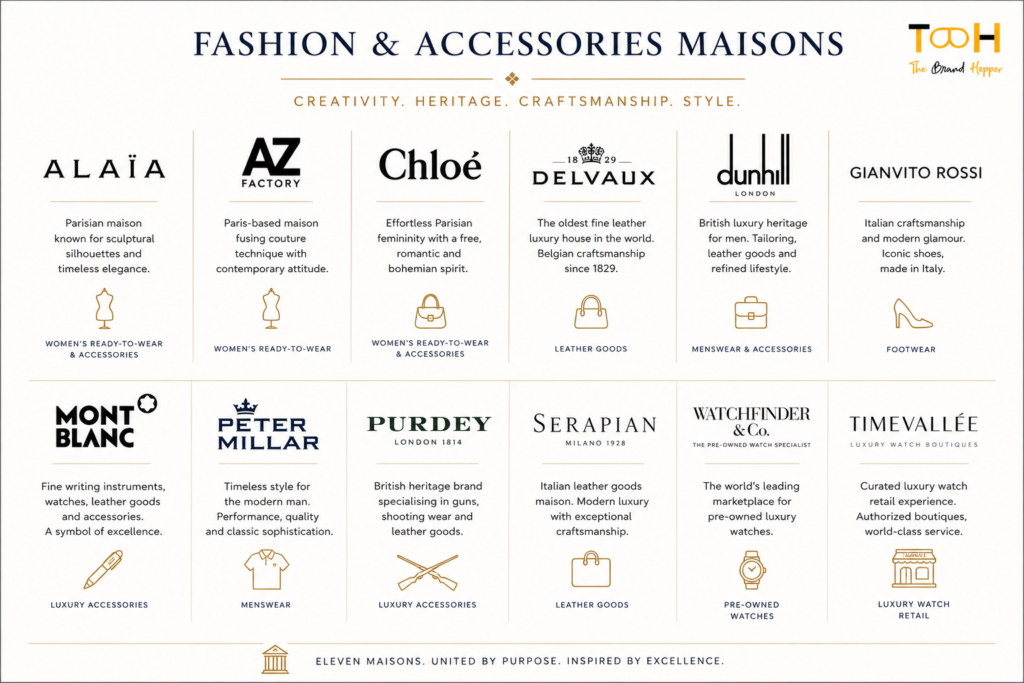
FASHION & ACCESSORIES MAISONSAlaïa · AZ Factory · Chloé · Delvaux · Dunhill · Gianvito Rossi · Montblanc · Peter Millar · Purdey · Serapian · Watchfinder & Co. · TimeVallée |
Richemont’s Fashion & Accessories Maisons is the most diverse segment of the group’s portfolio, encompassing fashion houses, leather goods specialists, a luxury pen and accessories brand, a golf brand, a British gunmaker, a pre-owned watch platform, and a multi-brand watch retail concept. While this segment contributes a smaller share of group revenue than the Jewellery Maisons, it is strategically important for extending Richemont’s presence across luxury lifestyle categories and age demographics.
1. Alaïa
Alaïa is a luxury fashion brand that bears the name of the late Azzedine Alaïa — a Tunisian-born couturier based in Paris whose work was characterised by an extraordinary mastery of construction, draping, and body-conscious tailoring. Alaïa was renowned for making women look and feel architecturally beautiful — his dresses, achieved through complex cuts and unexpected materials including leather and knitted fabrics, were technically unprecedented. Clients including Naomi Campbell, Tina Turner, and Michelle Obama wore Alaïa as a form of devotion rather than fashion.
Azzedine Alaïa passed away in November 2017, and Richemont acquired a majority stake in the Maison in 2020, committing to preserving the brand’s codes and creative integrity under new creative direction. The house has continued to operate from Alaïa’s historic Paris studio on rue de Moussy, maintaining close ties to the founder’s archives and design DNA. Creative direction has been passed to Pieter Mulier, a protégé of Raf Simons, who has continued Alaïa’s tradition of rigorous construction and body-celebrating design.
Founded: 1980, Paris, France
Acquired by Richemont: 2020 (majority stake)
Known for: Body-conscious construction; architectural draping; couture quality at its most rigorous
2. AZ Factory
AZ Factory is a fashion brand with a deeply poignant origin story. It was founded in 2021 by the late Alber Elbaz — the Israeli-Moroccan designer who had led Lanvin for 14 years and transformed it into one of Paris’s most beloved fashion houses. Elbaz conceived AZ Factory as a ‘maison de couture for the people’ — a brand that used the principles of haute couture precision to create clothing that was genuinely wearable, inclusive, and comfortable. The ‘AZ’ refers to Elbaz’s initials and his belief that fashion should work ‘from A to Z’ for real women.
Tragically, Alber Elbaz passed away in April 2021, just weeks after the brand’s first collection launch. Richemont, which owns the brand, has continued AZ Factory as a tribute to Elbaz’s vision, including through its AZ Academy training programme for emerging fashion designers. The brand remains active, carrying forward Elbaz’s foundational principles of inclusivity (extended sizing, accessible design) and joy in fashion.
Founded: 2021, New York/Paris
Founder: Alber Elbaz (1961–2021)
Philosophy: Couture precision for real women; inclusive sizing; joyful fashion
3. Chloé
Chloé is one of the most recognisable names in French luxury fashion — a house with a distinct identity built on feminine, free-spirited romanticism and a progressive commitment to sustainability. Founded in 1952 by Egyptian-French designer Gaby Aghion, who wanted to liberate women’s fashion from the stiff conventions of mid-century couture, Chloé pioneered the concept of luxury ready-to-wear: beautifully made, beautifully designed clothes that could be worn by real women.
Today, Chloé holds a unique position among fashion houses: it is B Corp certified (since October 2021), making it the first luxury fashion house in the world to achieve this sustainability accreditation, which requires meeting rigorous standards of social and environmental performance. The house’s creative direction has in recent years emphasised circularity, responsible sourcing, and craftswomen partnerships in emerging markets. Commercially, the Paddington Bag and the Marcie bag were defining IT bags of their era, and the house’s fragrance line — particularly Chloé Eau de Parfum — is one of the best-selling luxury perfumes globally.
Founded: 1952, Paris, France
Acquired by Richemont: 1985
Notable: First luxury fashion house to achieve B Corp certification (2021)
Iconic products: Paddington bag, Marcie bag, Chloé Eau de Parfum
4. Delvaux
Delvaux holds a remarkable distinction in the world of leather goods: it is the world’s oldest fine leather goods house in continuous operation, having been founded in Brussels in 1829 — four years before Hermès, eight years before Louis Vuitton, and a full century before Celine. The brand invented the modern handbag (filing the world’s first leather handbag patent in 1908) and has served as Official Purveyor to the Royal Court of Belgium since 1883, a relationship maintained through seven successive Belgian monarchs.
Delvaux’s archive spans more than 3,000 designs and nearly two centuries of leather craftsmanship. Its emblematic creations — the Brillant (1958), the Tempête (1967), the Pin (1972), and the Lingot — are works of extraordinary technical precision, each requiring dozens of hours of hand-stitching by the house’s Belgian artisans. Richemont acquired Delvaux in June 2021 for a reported €250 million, recognising the brand’s unique position as the last genuinely independent, large-scale leather goods house with both deep heritage and significant growth potential in the Asia-Pacific market.
Founded: 1829, Brussels, Belgium — world’s oldest fine leather goods house
Acquired by Richemont: June 2021 (reported ~€250 million)
Iconic designs: The Brillant, The Tempête, The Pin, The Lingot
Royal connection: Official Purveyor to the Royal Court of Belgium since 1883
5. Dunhill
Alfred Dunhill — known in the market simply as ‘dunhill’ (lowercase branding adopted in recent years) — is a British luxury goods brand founded in 1893 by Alfred Dunhill in London. The brand was originally built around gentlemen’s motoring accessories — supplies for the Edwardian motorist: goggles, leather coats, clocks, and pipes. From this foundation, dunhill evolved into a comprehensive British luxury house for men, offering tailoring, leather goods, pens, lighters, cufflinks, and accessories that epitomise a certain English archetype of understated, assured sophistication.
Under Richemont’s ownership, dunhill has expanded and refocused its product range, with a particular emphasis on leather goods (the iconic Bourdon bag), tailoring, and accessories. The brand operates from its London flagship on Bourdon Street in Mayfair, with a presence in major global cities. dunhill’s positioning — British, masculine, heritage-rich — provides a counterpoint to Richemont’s predominantly French and Swiss portfolio.
Founded: 1893, London, United Kingdom
Acquired by Richemont: 1967 (partial); full control as part of 1988 formation
Known for: British men’s luxury; leather goods, tailoring, accessories, tobacco accessories
6. Gianvito Rossi
Gianvito Rossi is the newest arrival in Richemont’s Fashion & Accessories portfolio and the group’s first footwear Maison. Founded by Gianvito Rossi — a third-generation shoemaker from the Rossi family behind the storied Sergio Rossi brand — Gianvito Rossi launched his eponymous label in 2006 and rapidly established himself as one of the most sophisticated shoe designers of his generation. The brand is known for its architectural heel constructions (particularly the signature transparent PVC-panel heels), exceptional Italian leatherwork, and a design sensibility that prioritises elongation, elegance, and technical precision.
Richemont acquired a controlling stake in Gianvito Rossi as part of its strategy to extend the Fashion & Accessories portfolio into new luxury categories. Gianvito Rossi himself retained a stake and remained as CEO and Creative Director of the Maison, ensuring continuity of the creative vision. The acquisition gives Richemont a strong foothold in the luxury footwear segment — a category where the main competitive landscape includes Christian Louboutin, Manolo Blahnik, Jimmy Choo, and Roger Vivier.
Founded: 2006, Italy
Founder: Gianvito Rossi (grandson of Sergio Rossi; from a three-generation shoemaking family)
Acquired by Richemont: Controlling stake; founder retains stake and creative role
Known for: Architectural heels, transparent elements, Italian craftsmanship
7. Montblanc
Montblanc is the most commercially significant brand in Richemont’s Fashion & Accessories portfolio and, in many ways, the most versatile — a luxury lifestyle house that spans writing instruments, watches, leather goods, fragrance, eyewear, and technology accessories with genuine credibility in each category. Founded in Hamburg in 1906, Montblanc’s first product was a fountain pen — and the Meisterstück (German for ‘masterpiece’), launched in 1924, remains the world’s most recognised and most sold luxury pen. The gold nib, the distinctive white star on the cap, the black resin barrel — these design elements are as internationally legible as any luxury logo.
But Montblanc is far more than a pen company. Under Richemont’s ownership (since 1993), the brand has built a watch collection that is taken seriously by collectors (the TimeWalker and 1858 collections are particularly strong), a leather goods range that competes meaningfully with Dunhill and Montblanc’s own peers in travel goods, and a fragrance portfolio that includes some of the best-selling masculine perfumes at the accessible luxury price point. The brand’s tagline, ‘The art of writing’, has evolved into a broader commitment to the art of meaningful expression — whether via ink on paper or a finely finished leather briefcase.
Founded: 1906, Hamburg, Germany
Acquired by Richemont: 1993
Flagship product: Meisterstück fountain pen (launched 1924)
Known for: Writing instruments, watches, leather goods, fragrance, accessories
8. Peter Millar (including G/FORE)
Peter Millar is an American luxury lifestyle brand that occupies an unusual niche in the Richemont portfolio: golf and country club culture at the premium end. Founded in 2001, Peter Millar specialises in luxury clothing, sportswear, and accessories with a distinctly American preppy aesthetic — quality cashmere sweaters, performance polo shirts, refined outerwear, and tailored pants designed for the golf course, the clubhouse, and beyond. The brand is particularly successful in the United States, where its distribution through high-end country clubs, luxury resort pro shops, and premium multi-brand retailers gives it strong brand equity among affluent American consumers.
Richemont acquired Peter Millar in 2012 as part of its strategy to extend into American luxury lifestyle markets. The brand subsequently expanded to include G/FORE, a high-fashion golf brand known for its bold colourways, statement shoes, and the crossover positioning that appeals to younger golfers and fashion-conscious consumers who want performance golf product with genuine style credentials.
Founded: 2001, United States
Acquired by Richemont: 2012
Includes: G/FORE (high-fashion golf brand)
Known for: Luxury golf and country club apparel; cashmere; performance sportswear
9. Purdey
Purdey is one of the world’s great specialist luxury brands — an institution in the field of British bespoke gunmaking that dates to 1814, when James Purdey established his workshop in London. For more than two centuries, Purdey has made hand-built shotguns and rifles to commission for royalty, aristocracy, and sporting gentlemen worldwide. A Purdey gun can take two or more years to complete and costs well over £100,000 — and the waiting list for a new commission can stretch to years. The brand holds Royal Warrants from multiple British monarchs and has equipped shooting parties at the great estates of England and Scotland for generations.
Building on its sporting heritage, Purdey has developed a complementary range of heritage apparel, leather goods, and countryside accessories under the Purdey brand — practical luxury items for the field sports enthusiast. Richemont acquired Purdey in 1994, and the brand represents perhaps the most specialised and quintessentially British asset in the group’s portfolio.
Founded: 1814, London, United Kingdom
Acquired by Richemont: 1994
Known for: Bespoke shotguns and rifles; Royal Warrants; British field sports heritage
10. Serapian
Serapian is an Italian luxury leather goods brand founded in Milan in 1928 by Stefano Serapian. The Maison is known for its distinctive hand-stitched leather bags and accessories, and most particularly for the mosaic stitch — a complex interlocking woven leather technique that is Serapian’s signature and requires extraordinary artisanal skill to execute. Serapian’s bags combine Milanese elegance with robust craftwork, and the brand has a devoted following among collectors of fine Italian leather goods who appreciate craft heritage as much as brand visibility.
Richemont acquired Serapian in November 2017. The brand operates from Milan and distributes primarily through its own boutiques and a carefully selected network of luxury multi-brand retailers. It sits alongside Delvaux as one of two heritage leather goods Maisons in the Richemont portfolio, each with a distinct national tradition (Belgian versus Italian) and a distinct aesthetic signature.
Founded: 1928, Milan, Italy
Acquired by Richemont: November 2017
Known for: Mosaic stitch leather technique; Milanese leather goods tradition
11. TimeVallée
TimeVallée is a Richemont-created multi-brand watch retail concept launched in 2015. Unlike the other brands in the portfolio, TimeVallée is not a heritage Maison but a retail platform — a curated watch boutique format operated by strategic partners across China, South Korea, the Middle East, and Europe. The concept brings together Richemont’s own watch Maisons (A. Lange & Söhne, Baume & Mercier, IWC, Jaeger-LeCoultre, Panerai, Piaget, Roger Dubuis, Vacheron Constantin) alongside other prestigious independent watchmakers in a single boutique environment designed for the discerning watch collector and enthusiast.
With more than 30 partner-operated boutiques globally, TimeVallée serves both as a commercial channel for Richemont’s watches in markets where standalone Maison boutiques may not yet be viable, and as an education and discovery platform for serious watch consumers who want to compare and explore the full spectrum of prestige watchmaking in a single location.
Founded: 2015 (by Richemont)
Format: Multi-brand luxury watch retail — operated by strategic partners
Markets: China, South Korea, Middle East, Europe (30+ boutiques globally)
12. Watchfinder & Co.
Watchfinder & Co. is the leading platform for the buying, selling, and part-exchange of premium pre-owned watches. Founded in 2002, it operates online and through physical boutiques in the UK and internationally, and has established itself as the most trusted and recognised brand in the secondary luxury watch market. Watchfinder’s proposition rests on rigorous quality assurance — all watches are inspected and certified by expert watchmakers before resale — and a transparent, consumer-friendly buying experience that has made the pre-owned watch market accessible to a much broader audience than traditional auction houses serve.
Richemont’s acquisition of Watchfinder is strategically significant: it gives the group a formal stake in the secondary market for its own watches, creating a service ecosystem (sale, resale, service, repair) around its Maisons that adds value for consumers and deepens brand relationships over time. As the secondary market for luxury watches has grown into a multi-billion-euro category — with platforms like Chrono24, eBay, and Bob’s Watches competing — Watchfinder’s position within the Richemont ecosystem provides both commercial and strategic advantage.
Founded: 2002, United Kingdom
Acquired by Richemont: 2018
Known for: Pre-owned watch certification, buying, selling, part-exchange; online and retail
Richemont’s Complete Brand Portfolio at a Glance
| Brand | Country of Origin | Founded | Business Area | Notable For |
| Cartier | France | 1847 | Jewellery Maisons | World’s most recognised luxury jewellery brand; Love Bracelet, Tank watch |
| Van Cleef & Arpels | France | 1906 | Jewellery Maisons | Mystery Set; Alhambra; L’École jewellery school |
| Buccellati | Italy | 1919 | Jewellery Maisons | Hand-engraved gold textures; extraordinary silverware |
| Vhernier | Italy | 1984 | Jewellery Maisons | Sculptural geometry; unconventional material combinations |
| A. Lange & Söhne | Germany | 1845 | Specialist Watchmakers | Finest German watchmaking; Lange 1, Datograph |
| Baume & Mercier | Switzerland | 1830 | Specialist Watchmakers | Accessible Swiss watches; Clifton, Riviera |
| IWC Schaffhausen | Switzerland | 1868 | Specialist Watchmakers | Pilot’s watches; Portugieser; American-founded |
| Jaeger-LeCoultre | Switzerland | 1833 | Specialist Watchmakers | Reverso; 1,400+ calibres; watchmaker of watchmakers |
| Panerai | Italy | 1860 | Specialist Watchmakers | Italian Navy heritage; Luminor; bold case design |
| Piaget | Switzerland | 1874 | Specialist Watchmakers | Ultra-thin movements; jewellery-watches; Altiplano |
| Roger Dubuis | Switzerland | 1995 | Specialist Watchmakers | Hyper-skeleton; Geneva Seal; Excalibur |
| Vacheron Constantin | Switzerland | 1755 | Specialist Watchmakers | World’s oldest continuous watchmaker; Overseas, Patrimony |
| Alaïa | France | 1980 | Fashion & Accessories | Body-conscious couture; Pieter Mulier creative direction |
| AZ Factory | USA/France | 2021 | Fashion & Accessories | Founded by Alber Elbaz; inclusive fashion |
| Chloé | France | 1952 | Fashion & Accessories | First luxury B Corp; feminine ready-to-wear |
| Delvaux | Belgium | 1829 | Fashion & Accessories | World’s oldest leather goods house; The Brillant |
| Dunhill | United Kingdom | 1893 | Fashion & Accessories | British men’s luxury; leather goods, tailoring |
| Gianvito Rossi | Italy | 2006 | Fashion & Accessories | Luxury footwear; architectural heels |
| Montblanc | Germany | 1906 | Fashion & Accessories | Meisterstück pen; watches, leather goods |
| Peter Millar (incl. G/FORE) | USA | 2001 | Fashion & Accessories | Golf luxury; cashmere; country club lifestyle |
| Purdey | United Kingdom | 1814 | Fashion & Accessories | Bespoke British gunmaking; Royal Warrants |
| Serapian | Italy | 1928 | Fashion & Accessories | Mosaic stitch leather; Milanese heritage |
| TimeVallée | Switzerland | 2015 | Fashion & Accessories | Multi-brand luxury watch retail concept |
| Watchfinder & Co. | United Kingdom | 2002 | Fashion & Accessories | Pre-owned watch certification and resale |
Richemont vs. LVMH: How the Two Luxury Giants Compare
| Metric | Richemont | LVMH |
| Annual Revenue | ~€21.4B (FY2025) | ~€84.7B (FY2024) |
| Core Strength | Jewellery & Watchmaking | Fashion, Leather Goods & Cognac |
| Flagship Brand | Cartier | Louis Vuitton |
| Number of Brands | 20+ | 75+ |
| Watch Brands | 8 (most of any luxury group) | TAG Heuer, Zenith, Hublot, Bulgari watches |
| Jewellery Brands | 4 (Cartier, VCA, Buccellati, Vhernier) | Bulgari, Chaumet, Fred, Tiffany |
| Gross Margin | ~66.9% | ~68% (approx.) |
| HQ | Geneva, Switzerland | Paris, France |
| Control Structure | Rupert family (dual-class shares) | Arnault family (LVMH Group) |
Frequently Asked Questions
Q: How many brands does Richemont own?
A: Richemont currently owns more than 20 brands (Maisons) across three business areas: four Jewellery Maisons (Cartier, Van Cleef & Arpels, Buccellati, and the newly acquired Vhernier), eight Specialist Watchmakers (A. Lange & Söhne, Baume & Mercier, IWC Schaffhausen, Jaeger-LeCoultre, Panerai, Piaget, Roger Dubuis, and Vacheron Constantin), and a Fashion & Accessories segment (Alaïa, AZ Factory, Chloé, Delvaux, Dunhill, Gianvito Rossi, Montblanc, Peter Millar including G/FORE, Purdey, Serapian, TimeVallée, and Watchfinder & Co.).
Q: What is Richemont’s annual revenue?
A: For the fiscal year ended 31 March 2025 (FY2025), Richemont reported group net sales of €21.4 billion, representing 4% growth year-on-year. Gross profit was €14.3 billion (gross margin: 66.9%), and operating profit reached €4.5 billion. Richemont’s Jewellery Maisons alone generated €15.3 billion. Full financial data is available at Richemont Revenue History (Macrotrends).
Q: Who owns Richemont?
A: Richemont is controlled by the Rupert family through a dual-class share structure. Johann Rupert, son of Richemont’s founder Anton Rupert, serves as Executive Chairman and the family holds a majority of voting rights. The company is listed on the SIX Swiss Exchange (ticker: CFR) and its depositary receipts (CFRUY) trade on OTC markets in the United States. No other single shareholder group comes close to the Rupert family’s voting control.
Q: Is Cartier owned by Richemont?
A: Yes. Cartier is owned by Richemont and is the group’s most valuable and commercially significant brand. The Rupert family first acquired an interest in Cartier in the 1970s, and the brand became a core Richemont asset when the group was formed in 1988. Cartier is the world’s most recognised luxury jewellery brand and generates the dominant share of Richemont’s Jewellery Maisons revenue.
Q: What happened to YNAP (Yoox Net-a-Porter)?
A: Yoox Net-a-Porter (YNAP) is no longer a Richemont-owned entity. In October 2024, Richemont and Mytheresa (the Munich-based digital luxury platform) announced a binding agreement for Mytheresa to acquire 100% of YNAP. In exchange, Richemont received a 33% equity stake in the combined Mytheresa group. YNAP had previously been Richemont’s digital luxury commerce venture, but the transaction reflected both the challenges of running a large-scale digital platform profitably and Mytheresa’s stronger operational track record in digital luxury.
Q: What is Vhernier and when did Richemont acquire it?
A: Vhernier is an Italian fine jewellery Maison founded in Valenza in 1984, known for its bold sculptural designs inspired by the curves of the human body and modern sculpture, and for its unconventional material combinations (precious gems alongside titanium, ebony, and bronze). Richemont completed the acquisition of 100% of Vhernier on 13 September 2024, adding a fourth Maison to its Jewellery Maisons business area. The brand is now reported within the Jewellery Maisons segment alongside Cartier, Van Cleef & Arpels, and Buccellati.
Q: What is Richemont’s most valuable brand?
A: Cartier is unquestionably Richemont’s most valuable brand. It is the world’s pre-eminent luxury jewellery brand, operates more than 200 boutiques in over 120 countries, and generates the dominant share of Richemont’s total Jewellery Maisons revenue (which was €15.3 billion in FY2025 across all four Jewellery Maisons). Cartier’s brand value has consistently ranked among the top 10 most valuable luxury brands globally in third-party brand valuation studies.
Q: What is the world’s oldest watch brand owned by Richemont?
A: Vacheron Constantin, founded in 1755 in Geneva, is the world’s oldest continuously operating watch manufacture — and it is owned by Richemont. The brand has made watches without interruption for more than 270 years, surviving every historical disruption including wars, economic crises, and technological shifts. Richemont acquired Vacheron Constantin in 1996.
Conclusion
Richemont’s portfolio represents something genuinely rare in the global business landscape: a curated collection of the world’s most important luxury Maisons, assembled not through financial opportunism but through a coherent vision of what luxury means at its finest. From Cartier, the jeweller of kings, to Jaeger-LeCoultre, the watchmaker of watchmakers; from Vacheron Constantin, founded before the French Revolution, to Vhernier, the sculptural Italian jeweller acquired in 2024; from Delvaux, the world’s oldest leather goods house, to Chloé, the first luxury B Corp — the group’s portfolio is a study in both breadth and depth.
With FY2025 net sales of €21.4 billion, gross margins of 66.9%, and a net cash position of €8.3 billion, Richemont is financially robust and strategically positioned for sustained growth. The concentration of revenue in jewellery (72% from Jewellery Maisons) reflects the group’s fundamental conviction that hard luxury — jewellery and watches — offers the most durable value proposition in the luxury market: products that hold their value, accumulate meaning over time, and transcend fashion cycles.
For students of luxury, business, and design history, Richemont’s Maisons are a living archive of human craftsmanship at its most extraordinary — and for investors and analysts, they represent one of the world’s most compelling positions in the premium consumer goods sector.
Also Read: A Deep-Dive into Iconic Brands Owned by Luxottica Group
To read more content like this, subscribe to our newsletter
Go to the full page to view and submit the form.