


The Global Ride-Hailing Market
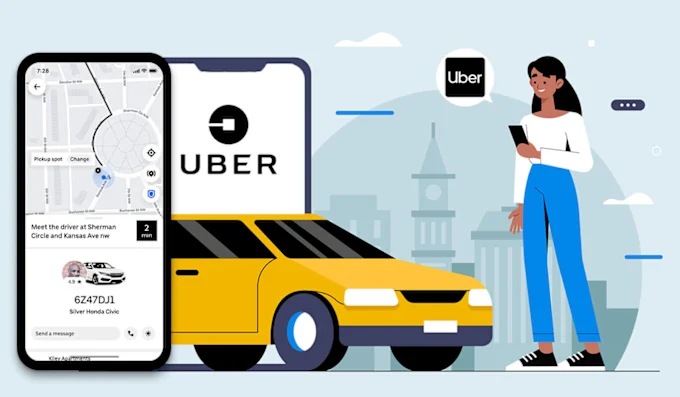
Uber did not just build a business — it created an entirely new category of consumer behaviour. Before 2010, ‘hailing a ride’ meant waving at a passing taxi or calling a dispatcher. After Uber, it means tapping an app, watching your driver approach in real time, paying cashlessly, and rating the experience — a workflow now so natural that billions of people take it for granted.
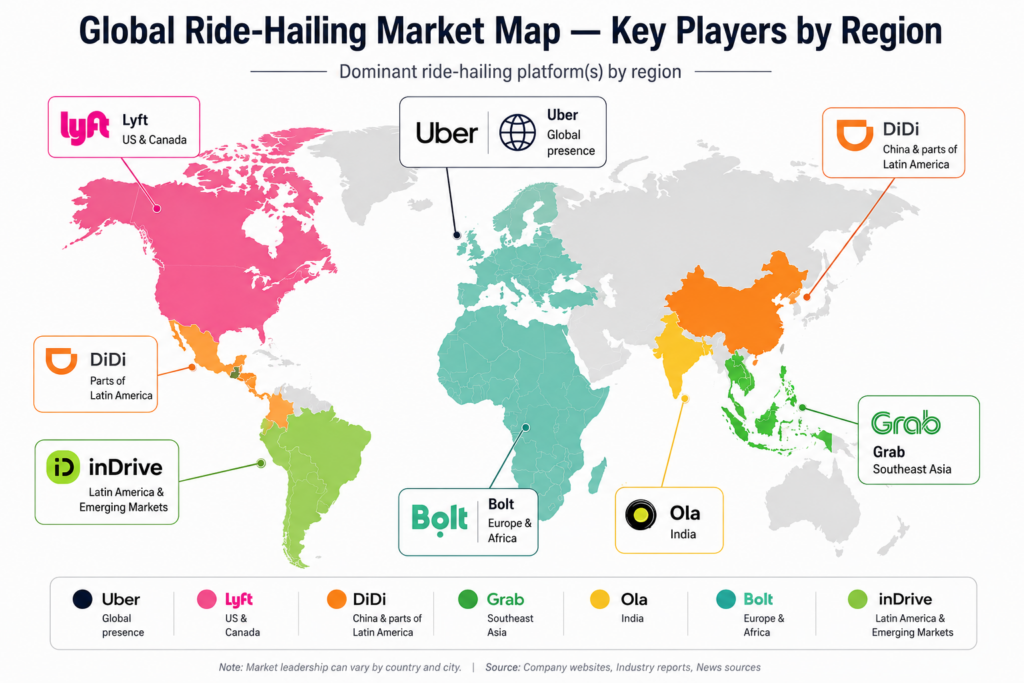
But precisely because Uber proved the model works, it attracted intense competition from every direction. Regional specialists with deeper local knowledge, better-funded national champions backed by sovereign wealth, and nimble challengers targeting price-sensitive emerging markets have all carved out formidable positions. Understanding who is challenging Uber, how, and where, is essential context for anyone analysing the mobility industry.
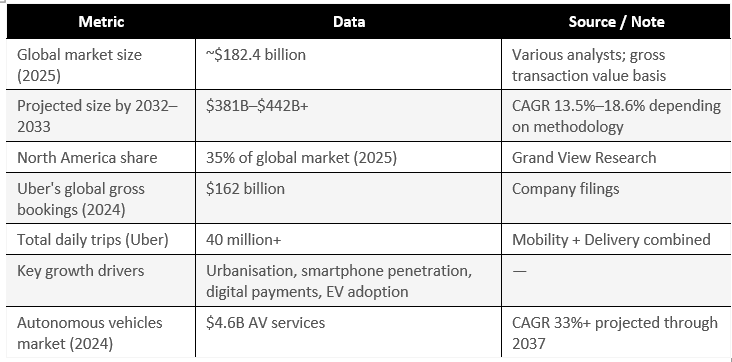
Global Ride-Hailing Market Snapshot


Why Uber Faces Fierce Competition
Uber’s structural advantages — global brand, network effects, proprietary driver base, and vast logistics infrastructure — are formidable. But they do not translate uniformly across geographies, cultures, or regulatory environments. Three forces explain why competition thrives despite Uber’s scale.
Local Knowledge Advantage: Ride-hailing is deeply local. Driver availability, price sensitivity, payment preferences (cash vs. digital), language, and regulatory frameworks vary enormously between countries and even cities. Didi dominates China by understanding Chinese consumer behaviour at a granular level that Uber, then operating from San Francisco, could not replicate. The same dynamic applies to Grab in Southeast Asia and Ola in India.
Regulatory Fragmentation: Uber has been banned, severely restricted, or forced to restructure in multiple markets — London (TfL licence revocations), Germany, Spain, Hungary, Bulgaria, and others. Local competitors benefit from regulatory environments calibrated against Uber, not for it.
Price Sensitivity in Emerging Markets: Uber’s global pricing architecture is not always competitive in cost-sensitive markets. InDrive’s fare-negotiation model and Bolt’s driver commission undercut — both capturing riders and drivers who find Uber’s standard pricing too high.
Uber’s Top Competitors — Detailed Analysis
1. Lyft


| Founded: 2012 | HQ: San Francisco, USA | Markets: US and Canada | US Market Share: ~24% |
Lyft is Uber’s most direct head-to-head competitor — the only ride-hailing company that operates in the same geographies, targets the same riders, and fights for the same driver supply. Founded in 2012 by Logan Green and John Zimmer, Lyft launched as a friendlier, community-oriented alternative to Uber, complete with pink mustaches on car hoods in its early days.
Today, Lyft is a leaner, more financially disciplined business. It achieved GAAP profitability for the first time in the full year 2024 — a significant milestone that validated its restructuring and cost-discipline strategy. Q3 2024 revenue reached $1.52 billion, up 32% year-over-year, and Q4 2024 revenue hit $1.55 billion, up 27%.
| Lyft Key Metrics | Data |
| FY2024 Revenue (forecast) | ~$5.44 billion |
| Q4 2024 Revenue | $1.55B (+27% YoY) |
| Q3 2024 Revenue | $1.52B (+32% YoY) |
| US Market Share | ~24% (as of early 2025) |
| GAAP Profitability | Achieved first full-year GAAP profit in 2024 |
| Free Cash Flow (Q3 2024) | $242.8 million — positive |
| Operations | 600+ cities in US and Canada |
| Revenue sources | ~85% ride-hailing; remainder from Flexdrive, media, other |
Lyft’s competitive strategy rests on three pillars: focus, efficiency, and driver loyalty. By operating exclusively in North America, Lyft avoids the complexity of multi-continent regulatory and cultural adaptation that costs Uber enormous management bandwidth. Its driver satisfaction programmes, consistently higher driver ratings in independent surveys, help it maintain supply quality without matching Uber’s global recruiting spend.
Lyft has also been aggressive in public transit integration — partnering with cities and transit agencies to position ride-hailing as a complement to buses and subways rather than a replacement. This civic positioning opens partnership revenue streams unavailable to Uber.
2. Didi Chuxing

| Founded: 2012 | HQ: Beijing, China | Markets: China, Brazil (99), Mexico, Australia, South Africa, others | Revenue 2025: $32.8B (USD) |
Didi Chuxing is, by gross transaction volume, the largest ride-hailing company in the world after Uber — and the company that demonstrated Uber could be beaten on its own terms. Founded in 2012 by Cheng Wei, Didi was formed through a merger of Didi Dache and Kuaidi Dache, backed by Alibaba and Tencent respectively. It defeated Uber in China so comprehensively that Uber sold its Chinese operations to Didi in 2016 in exchange for a stake.
Didi’s 2025 financial results illustrate the scale of its recovery following China’s 2021 regulatory crackdown (which forced Didi to delist from the NYSE and halt new user registrations). Revenue reached RMB 226.7 billion ($32.8B USD), up 9.6% year-over-year. Core platform transaction value rose 14.8% to RMB 450.8 billion ($65.2B USD). China Mobility revenue grew 24.6% year-on-year in Q1 2025.
| Didi Key Metrics | Data |
| Revenue 2024 | $28.73B (USD) |
| Revenue 2025 | $32.8B (USD) | +9.6% YoY |
| Core Platform Transaction Value (2025) | RMB 450.8B (~$65.2B) |
| China Mobility Revenue Growth (Q1 2025) | +24.6% YoY |
| International Revenue Growth (Q1 2025) | +13.2% YoY |
| International GTV Contribution | ~12% of total GTV and growing |
| Operating Cash Flow (2025) | RMB 9.8B ($1.4B) |
| Key international markets | Brazil (via 99), Mexico (top-2), Australia, South Africa |
Beyond China, Didi is pursuing a methodical international strategy — operating through local brand names (99 in Brazil) rather than imposing the Didi brand in markets where it lacks recognition. It has invested in or partnered with regional players globally, creating a portfolio approach to international mobility that mirrors its domestic playbook.
Didi is also a major investor in autonomous driving R&D, operating robotaxi trials in multiple Chinese cities. CEO Cheng Wei has committed to increased AV investment, positioning Didi as China’s primary contender in the autonomous mobility race — directly paralleling Uber’s own AV ambitions.
3. Grab

| Founded: 2012 | HQ: Singapore | Markets: 8 SE Asian countries | Revenue 2025: $3.37B | First-ever net profit: $200M (2025) |
Grab is the defining technology company of Southeast Asia — a super app that began as a taxi-booking service in Kuala Lumpur and has evolved into a platform spanning ride-hailing, food delivery, grocery delivery, financial services, and digital payments across 8 countries: Singapore, Indonesia, Malaysia, Thailand, Vietnam, Philippines, Cambodia, and Myanmar.
Founded in 2012 by Harvard Business School classmates Anthony Tan and Tan Hooi Ling, Grab defeated Uber in Southeast Asia so decisively that Uber sold its regional operations to Grab in 2018 for an equity stake. Grab’s victory was built on superior local knowledge: understanding that Southeast Asian users prefer cash payments, need motorcycle-taxi options (GrabBike), and respond to deeply localized marketing.
| Grab Key Metrics | Data |
| Revenue 2025 | $3.37B (+20% YoY) — record high |
| Net Profit 2025 | $200M — first-ever full-year profit since IPO |
| Adjusted EBITDA 2025 | $500M (+$187M vs $313M in 2024) |
| Gross Transaction Value 2025 | $22B (+21% YoY from $18B in 2024) |
| Monthly Active Users | 47M (2025), up from 41M in 2024 |
| Mobility Revenue 2025 | $1.22B |
| Deliveries Revenue 2025 | $1.8B (largest segment) |
| Financial Services Revenue 2025 | $347M |
| Revenue Guidance (next year) | $4.04B–$4.10B (+20–22%) |
Grab’s most significant achievement is its transformation from a ride-hailing company into a financial services platform. GrabPay and GrabFinancial Group serve millions of unbanked and underbanked consumers across Southeast Asia — a demographic that global banks have historically underserved. This financial layer creates switching costs that pure ride-hailing competitors cannot replicate: a driver whose loan is on GrabFinancial and whose savings are in GrabPay is unlikely to switch platforms for a marginal earnings difference.
The milestone of achieving its first-ever net profit of $200 million in 2025 — four years after its high-profile SPAC IPO — is a pivotal moment that validates Grab’s super-app model and positions it for sustained expansion. Revenue guidance of $4.04–4.10 billion for the following year signals continued momentum.
4. Ola


| Founded: 2010 | HQ: Bangalore, India | Markets: India (primary), UK, Australia, NZ | Revenue FY2024: ~₹2,368 crore (~$284M) |
Ola was, for much of the 2010s, India’s dominant ride-hailing platform — an early-mover advantage built on deep understanding of India’s uniquely complex transportation landscape. Founded in 2010 by Bhavish Aggarwal and Ankit Bhati, Ola uniquely offers not just cars but auto-rickshaws (Ola Auto), motorcycles (Ola Bike), and outstation travel — catering to transport modes that Uber does not offer in India.
However, Ola’s ride-hailing business has faced increasing headwinds. Revenue from operations for FY2024 stood at approximately ₹2,368 crore, down from ₹3,000 crore in FY2023 — a decline attributable to Uber’s strengthening position in India and the rapid rise of Rapido, an aggressive two-wheeler focused rival. Job cuts in 2024 signalled a ‘profitability push’ restructuring.
| Ola Key Metrics | Data |
| Founded | 2010 by Bhavish Aggarwal & Ankit Bhati |
| FY2024 Revenue (ride-hailing) | ~₹2,368 crore (~$284M) — down from ₹3,000Cr in FY2023 |
| India city coverage | 250+ cities |
| International markets | UK, Australia, New Zealand |
| EV arm | Ola Electric — listed on NSE/BSE |
| Differentiation | Auto-rickshaws, bike rides, outstation travel — unique to India |
| Key challenge | Losing ground to Uber and Rapido; restructuring underway |
| Founder’s parallel ventures | Ola Krutrim (AI), Ola Electric |
Ola Electric, the company’s electric two-wheeler spin-off, became India’s largest EV two-wheeler manufacturer and completed a high-profile IPO. However, post-IPO challenges — quality concerns, service delays, and competition from legacy two-wheeler brands entering EVs — have weighed on the company. Founder Bhavish Aggarwal has simultaneously been building Ola Krutrim, an AI and semiconductor company, raising questions about focus.
Despite challenges, Ola’s brand recognition, driver network depth, and unique service categories (auto-rickshaw, bike rides) keep it relevant in a market that Uber has not fully penetrated. India remains the world’s most complex and price-sensitive ride-hailing market — one where no single player is likely to achieve the dominance Didi has in China or Grab in Southeast Asia.
5. Bolt


| Founded: 2013 | HQ: Tallinn, Estonia | Markets: 45+ countries, 600+ cities | Revenue 2025: $2.57B | Valuation: $6.82B |
Bolt is the most underestimated competitor in the Uber conversation. Founded in 2013 by Markus Villig — then just 19 years old — in Tallinn, Estonia, Bolt has grown into a pan-European and pan-African mobility platform with a $6.82 billion valuation and revenues of $2.57 billion in 2025, up 19% from $2.15 billion in 2024.
Bolt’s core competitive weapon is price. By charging drivers a lower commission than Uber — typically 15–20% versus Uber’s 25%+ — Bolt attracts more drivers to its platform, which in turn allows it to offer lower prices to riders. This flywheel has been devastatingly effective in price-sensitive European and African markets where Uber’s pricing has felt extractive.
| Bolt Key Metrics | Data |
| Revenue 2025 | $2.57B (+19% YoY) |
| Revenue 2024 | $2.15B (+17% YoY) |
| Valuation | $6.82B (following 2025 secondary share sale) |
| Countries | 45+ |
| Cities | 600+ |
| Driver commission | ~15–20% (vs Uber’s ~25%+) |
| Services | Ride-hailing, food delivery (Bolt Food), e-scooters, e-bikes, car-sharing |
| Profitability | Reached full-year profitability for first time |
| Recent expansion | Toronto ride-hailing (Feb 2025), Washington D.C. e-scooters (Jan 2025) |
Bolt’s service diversification mirrors Uber’s own playbook: ride-hailing (core), Bolt Food (food delivery), Bolt Drive (car-sharing), and Bolt Scooter (micromobility). This breadth creates a comprehensive mobility ecosystem that retains users even as their transportation need shifts — from a commute ride to a scooter for a short hop to a food delivery at home.
North America entry in 2025 — ride-hailing in Toronto and scooters in Washington D.C. — represents Bolt’s most aggressive geographical bet yet, taking the competition directly into Uber’s home market. Bolt has raised this challenge while simultaneously achieving its first-ever full-year profitability, a combination that positions it as a well-funded, sustainable challenger rather than a cash-burning upstart.
6. InDrive

| Founded: 2013 | HQ: Mountain View, CA (operations in emerging markets) | Markets: 48 countries, 888+ cities | Revenue 2025: $601.6M (+31% YoY) |
InDrive (formerly inDriver) occupies a uniquely disruptive position in the ride-hailing landscape. Where Uber sets algorithmic prices that riders must accept, InDrive gives riders and drivers the ability to negotiate the fare directly — a model that appeals strongly to price-conscious markets in Latin America, South Asia, Eastern Europe, and Africa.
Founded in 2013 in Siberia, Russia (and now headquartered in Mountain View), InDrive has become one of the fastest-growing mobility companies in the world. Revenue grew 31% to $601.6 million in 2025. The company operates in 888+ cities across 48 countries, with more than half of its business in Latin America — its primary growth region.
| InDrive Key Metrics | Data |
| Revenue 2025 | $601.6M (+31% YoY) |
| Countries | 48+ |
| Cities | 888+ |
| Valuation (2025) | ~$4.8B |
| Primary market | Latin America (50%+ of business) |
| Key differentiator | Fare negotiation — riders and drivers agree on price directly |
| Expansion | Grocery delivery in Pakistan & Kazakhstan; growing food delivery |
| Driver commission | Lower than Uber standard; negotiation model reduces need for surge |
The negotiation model is more than a novelty — it directly addresses the two most common complaints from both sides of the ride-hailing marketplace. Riders complain about surge pricing. Drivers complain about platform commissions. InDrive eliminates the opaque algorithmic price and lets market forces determine the fare. In markets where consumers distrust algorithmic pricing and have low digital trust, this transparency is a significant brand advantage.
InDrive is now expanding beyond ride-hailing into freight, courier, and home services — positioning itself as a broader marketplace for local services using the same negotiation-based model.
7. Via

| Founded: 2012 | HQ: New York, USA | Focus: Shared rides, Mobility-as-a-Service (MaaS), public transit integration |
Via represents a fundamentally different vision of ride-hailing — one built around shared transportation and integration with public transit rather than the private ride model that Uber popularised. Founded in 2012 by Daniel Ramot and Oren Shoval, Via partners with municipalities and transit agencies to run on-demand shared bus services, paratransit, and school transportation.
Via’s algorithm dynamically routes shared vehicles in real time, matching multiple passengers travelling in similar directions. This produces higher vehicle occupancy, lower per-passenger cost, and reduced congestion compared to single-occupancy ride-hailing — characteristics that make Via attractive to cities concerned about the traffic impact of Uber and Lyft.
- Key partnerships: LA Metro Micro (on-demand shuttle), Berlin, Sydney, and 80+ cities and transit agencies worldwide.
- MaaS positioning: Via sells its technology platform to transit authorities — a B2B model that differs entirely from Uber’s B2C marketplace.
- Competition angle: Via competes not with Uber’s core private ride business but with UberPool/Share — and with public transit budgets for technology investment.
8. DoorDash
| Founded: 2013 | HQ: San Francisco, USA | US Food Delivery Market Share: 67% | Revenue 2024: $10.7B |
Uber Eats — Uber’s food delivery arm — is one of the company’s fastest-growing segments and a critical revenue driver. But in the United States, Uber Eats is firmly in second place behind DoorDash, and that gap has been widening rather than narrowing.
DoorDash holds 67% of the US food delivery market. Uber Eats trails at approximately 23%. DoorDash generated approximately $10.7 billion in revenue in 2024, processing 2.5 billion orders with $80.1 billion in gross order value. Its subscription programme, DashPass (unlimited deliveries for a monthly fee), has built a locked-in subscriber base that drives repeat order frequency well above the industry average.
| DoorDash vs. Uber Eats — US Comparison | DoorDash | Uber Eats |
| US market share | 67% | ~23% |
| 2024 Revenue | ~$10.7B | Part of Uber’s $44B+ Delivery GBs |
| Gross Order Value 2024 | $80.1B | Included in Uber total GBs |
| Subscription product | DashPass | Uber One |
| Geographic focus | US-dominant; expanding internationally | Global from day one |
| Restaurant partnerships | Broad; suburban-heavy | Urban-heavy; global chains |
DoorDash’s suburban-first strategy was the masterstroke that differentiated it from Uber Eats’ urban-centric approach. By building dense driver networks in suburban zip codes that other platforms ignored, DoorDash captured meal-ordering occasions from millions of households that Uber Eats simply didn’t reach. This suburban depth is now a structural competitive moat.
9. Zomato (Eternal)


| Founded: 2008 | HQ: Gurugram, India | Market: India and select international markets | Position: Acquired Uber Eats India in 2020 |
Zomato — now rebranded as Eternal to reflect its broader business — is the dominant food delivery platform in India and the reason Uber Eats has no meaningful presence in the country. In January 2020, Uber sold its Indian food delivery operations to Zomato in exchange for a ~9.99% stake — a public concession that it could not compete with Zomato’s local scale and consumer trust.
Zomato’s advantages in India are substantial: a restaurant discovery database built over a decade, a nationally recognised brand, deep integration with Indian consumer payment habits (UPI, cash-on-delivery), and a logistics network calibrated for India’s chaotic but vibrant urban foodscape. Swiggy is Zomato’s primary rival in India; Uber Eats is not in the picture.
- Blinkit: Zomato’s quick commerce arm delivers groceries in 10–15 minutes — expanding far beyond restaurant food delivery and creating an entirely new competitive dimension.
- Global expansion: Zomato operates selectively in Middle East markets where Indian diaspora and local appetite for online food ordering overlap.
10. Other Notable Competitors
Cabify — Premium Latin America
Cabify, founded in Spain in 2011, is the premium ride-hailing operator across Spanish-speaking Latin America and Spain. Operating in 11 countries and 40+ cities, Cabify targets the business traveller and premium urban commuter segment — a niche Uber covers but does not own. Its model emphasises vetted, professional drivers, fixed pricing, and corporate accounts, differentiating from Uber’s broader market positioning.
Curb — Licensed US Taxi Network
Curb bridges traditional taxi services and modern app-based ride-hailing. Operating in 65+ US cities, Curb connects riders to licensed, insured taxi drivers through a modern app interface. It competes for the segment of riders who specifically prefer licensed taxis (for insurance, regulatory compliance, or airport pick-up reasons) over Uber’s TNC model.
Gett — Corporate Ground Transportation
Gett focuses on enterprise clients, aggregating premium taxi and black car services for corporate travel programmes. Its B2B model — offering guaranteed service levels, consolidated billing, and travel policy compliance tools — targets the corporate mobility budget rather than the consumer ride-hailing market. Gett competes with Uber for Business, Lyft Business, and traditional corporate travel management companies.
Rapido — India’s Two-Wheeler Challenger
Rapido has emerged as a significant disruptor in India’s ride-hailing market, specifically targeting the bike-taxi and auto-rickshaw segments. With lower pricing than Ola and Uber for short urban distances, Rapido has captured significant daily commuter volume in Indian tier-1 and tier-2 cities — contributing to Ola’s market share erosion and putting pressure on Uber’s India growth strategy.
Head-to-Head Competitor Comparison
| Company | Primary Market | Key Revenue/Size | Model | Uber’s Direct Overlap |
| Lyft | US & Canada | ~$5.44B (FY2024 revenue) | Ride-hailing | Direct — same geographies & services |
| Didi Chuxing | China, LatAm | $32.8B revenue (2025) | Ride-hailing, AV, EV | China (defeated Uber), LatAm via 99 |
| Grab | SE Asia (8 countries) | $3.37B revenue (2025) | Super app — rides, delivery, fintech | SE Asia (defeated Uber), food delivery |
| Ola | India | ~$284M ride revenue (FY2024) | Ride-hailing, EV (Ola Electric) | India — auto, bike, car |
| Bolt | Europe, Africa, Canada | $2.57B revenue (2025) | Rides, food, scooters, cars | Europe, Africa, entering N. America |
| InDrive | LatAm, emerging markets | $601.6M revenue (2025) | Negotiated-fare ride-hailing | LatAm, South Asia, E. Europe |
| DoorDash | US (primarily) | $10.7B revenue (2024) | Food delivery | vs. Uber Eats in US |
| Zomato (Eternal) | India | Listed; strong growth | Food + quick commerce | vs. Uber Eats India (Uber exited) |
| Via | US, Europe, Australia | B2B / MaaS platform | Shared rides, transit tech | vs. UberPool; transit budgets |
| Cabify | Spain, Latin America | 11 countries, 40+ cities | Premium rides, corporate | vs. Uber Black, Uber for Business |
How Competitors Challenge Uber — Strategic Patterns
1. The Regional Exit Pattern
Uber’s clearest strategic vulnerability is the geographic market it has abandoned under competitive pressure. China (2016 exit to Didi), Southeast Asia (2018 exit to Grab), and India’s food delivery segment (2020 exit to Zomato) each represent markets where a well-funded local competitor with superior local knowledge out-executed Uber. The pattern is consistent: Uber enters aggressively, subsidises growth, faces a well-resourced local rival doing the same, and eventually trades its operations for an equity stake in the winner.
This pattern has not necessarily been bad for Uber’s shareholders — equity stakes in Didi, Grab, and Zomato have generated significant returns. But it illustrates the limits of Uber’s global ambition. Uber is not a winner-take-all company globally; it is a winner in the markets it retained (North America, Europe, Middle East, Australia, parts of Latin America) and a financial investor in the markets it conceded.
2. The Price Undercutting Strategy
Bolt and InDrive represent a different competitive archetype: the price challenger. Neither has the capital to out-subsidise Uber at scale, but both have built structural cost advantages — lower driver commissions (Bolt), elimination of algorithmic surge (InDrive) — that allow them to offer meaningfully better value to both riders and drivers without operating at loss indefinitely.
This is a more sustainable competitive strategy than the subsidy wars of the 2010s. The winner is the platform with the lower structural cost base, not the one with the largest venture capital cheque.
3.The Super App Expansion
Grab’s transformation into a super app is the most complete example of how a ride-hailing competitor can escape the commoditisation trap. By adding financial services to mobility and delivery, Grab has built switching costs that no ride-hailing-only competitor can match. A user whose salary is credited to GrabPay, whose loan is with GrabFinancial, and who uses GrabFood daily will not switch platforms over a 10% ride price difference.
Uber has attempted a version of this with Uber One (subscription bundling rides and delivery discounts) and Uber Eats integration — but it has not built the financial services layer that makes Grab’s ecosystem genuinely sticky. This gap is most consequential in Southeast Asia, where Grab has established an insurmountable lead.
Future Trends Reshaping the Competitive Landscape
1. Autonomous Vehicles — The Next Battleground
Autonomous vehicles represent the most consequential long-term competitive variable in mobility. The marginal cost of an autonomous ride is dramatically lower than a human-driven one — no driver earnings, no downtime, 24/7 availability. The platform that deploys AVs at scale first will have a structural cost advantage that no pricing strategy can overcome.
- Uber x Cruise: In August 2024, Uber and Cruise announced a strategic alliance to integrate Cruise’s autonomous Chevy Bolt-based vehicles into the Uber platform.
- Waymo on Uber: Waymo’s robotaxis are available to book through the Uber app in select US cities — a model that partners AV technology with Uber’s demand platform.
- Didi AV: Didi is running active robotaxi trials in China and has committed to increased AV R&D investment.
- Tesla Robotaxi: Tesla’s plans for a robotaxi network (Cybercab) could introduce an entirely new competitor with a direct-to-consumer model, bypassing existing platforms.
2. Electric Vehicle Transition
Uber’s pledge of 100% electric rides in the US, Canada, and Europe by 2030 is both a sustainability commitment and a competitive necessity. Bolt is already investing heavily in EVs across Europe. Ola Electric is building India’s largest EV two-wheeler fleet. The operator that can transition its driver fleet to EVs fastest — through financing programmes, charging infrastructure, and preferential dispatch — will have a lower operational cost structure that feeds into pricing competitiveness.
3. Super App Convergence
The super app model pioneered by Grab in Southeast Asia is influencing strategic thinking across all major ride-hailing platforms. Bolt’s expansion into food delivery, DoorDash’s expansion into grocery and last-mile logistics, and Zomato’s pivot to quick commerce (Blinkit) all reflect the same thesis: a platform that owns multiple daily consumer touch points is more defensible than one that owns a single use case.
4. Emerging Market Expansion
The next 500 million ride-hailing users are in Africa, South Asia, and Latin America. InDrive’s rapid growth in these markets (888+ cities across 48 countries) illustrates the opportunity. Bolt’s African footprint (significant presence in South Africa, Kenya, Nigeria, and other markets) positions it well. Uber’s emerging market strategy has been inconsistent — strong in South Africa and parts of Latin America, absent or weak in much of Sub-Saharan Africa and South Asia.
Frequently Asked Questions
Q: Who is Uber’s biggest competitor globally?
A: Globally, Didi Chuxing is Uber’s largest competitor by gross transaction volume — generating $32.8B in revenue in 2025 and dominating China’s ride-hailing market. In the US, Lyft is the primary competitor with roughly 24% market share. Regionally, Grab leads Southeast Asia, Ola leads India’s ride-hailing landscape, and Bolt leads in Europe and Africa.
Q: Why did Uber exit China and Southeast Asia?
A: Uber exited China in 2016, selling its operations to Didi Chuxing in exchange for a stake in the company. It exited Southeast Asia in 2018, selling to Grab. In both cases, Uber faced well-funded local competitors with superior local knowledge, deeper regulatory relationships, and more tailored product offerings. Rather than continue cash-intensive subsidy wars with no clear path to dominance, Uber chose financial returns through equity stakes over operational ownership.
Q: Is Lyft profitable?
A: Yes. Lyft achieved GAAP profitability for the first time on a full-year basis in 2024 — a significant milestone after years as a high-growth, cash-burning business. Q3 2024 revenue grew 32% year-over-year and generated $242.8 million in positive free cash flow, confirming the underlying financial discipline of the restructured business.
Q: What is InDrive and how is it different from Uber?
A: InDrive (formerly inDriver) is a ride-hailing app operating in 48 countries and 888+ cities, primarily in Latin America, South Asia, and Eastern Europe. Its core differentiator is the fare negotiation model: instead of accepting an algorithmic price set by the platform, riders propose a fare and nearby drivers can accept, counter-offer, or decline. This gives both sides more control and transparency, and appeals strongly in price-sensitive markets where algorithmic surge pricing generates distrust.
Q: How does Grab differ from Uber?
A: Grab started as a ride-hailing app but has evolved into Southeast Asia’s leading super app — a single platform encompassing ride-hailing, food and grocery delivery, digital payments (GrabPay), lending and insurance (GrabFinancial), and other services. Its financial services layer creates switching costs that pure ride-hailing apps cannot match. Grab achieved its first-ever net profit of $200M in 2025, with revenue of $3.37B.
Q: What is Bolt’s competitive advantage over Uber?
A: Bolt’s primary advantage is pricing: it charges drivers lower commission rates (typically 15–20% vs Uber’s ~25%+), enabling it to offer lower fares to riders while still attracting driver supply. This pricing flywheel is particularly effective in the price-sensitive European and African markets where Bolt operates. It has also achieved full-year profitability in 2025 while growing revenues to $2.57B — demonstrating the model’s sustainability.
Q: Who is winning the US food delivery market?
A: DoorDash dominates the US food delivery market with approximately 67% market share, compared to Uber Eats’ roughly 23%. DoorDash’s key advantages include: its DashPass subscription programme, a suburban-first expansion strategy that reached geographies Uber Eats ignored, and a gross order value of $80.1 billion in 2024. Uber Eats remains a major global player but trails significantly in the US specifically.
Q: What happened to Uber Eats in India?
A: Uber sold its Indian food delivery operations to Zomato in January 2020 in exchange for a ~9.99% stake in Zomato. Zomato’s local network, brand, and consumer trust in India were too entrenched for Uber Eats to overcome. Zomato (now rebranded Eternal) has since become India’s dominant food delivery and quick commerce platform, alongside rival Swiggy. Uber Eats has no meaningful presence in India today.
Q: What are the key trends shaping the ride-hailing industry?
A: Five trends are reshaping the competitive landscape: (1) Autonomous vehicles — Uber-Waymo and Uber-Cruise partnerships signal the coming shift to AV-based rides; (2) Electric vehicles — all major platforms have EV transition pledges; (3) Super app convergence — ride-hailing + delivery + fintech under one roof; (4) Emerging market expansion — Africa, South Asia, and LatAm are the next growth frontiers; (5) Profitability discipline — the subsidy-war era is over, with platforms now competing on sustainable unit economics.
Q: Can any competitor dethrone Uber globally?
A: No single competitor is positioned to replace Uber as a global platform. The more likely long-term structure is a regionalised oligopoly: Uber dominant in North America, Europe, Middle East, and Australia; Didi dominant in China; Grab dominant in Southeast Asia; Ola and Rapido sharing India; Bolt as the European challenger; and InDrive growing across emerging markets. Autonomous vehicles are the variable that could most dramatically reshape these positions — whichever platform deploys AVs at scale first gains a structural cost advantage that could redraw the entire competitive map.
Q: What is the total size of the global ride-hailing market?
A: Estimates vary by methodology, but the global ride-hailing market is broadly valued at approximately $182 billion in gross transaction terms as of 2025, growing at a CAGR of roughly 13–18% depending on the research firm. Uber alone generated $162 billion in gross bookings in 2024. The market is projected to reach $381 billion to over $440 billion by the early 2030s, driven by urbanisation, smartphone penetration, digital payment adoption, and the long-term transition to EV and autonomous vehicles.
Conclusion
Uber’s competitive story is one of the most instructive case studies in modern business. It invented a category, achieved global scale in under a decade, and then discovered that its own success had trained the world’s best entrepreneurs to build against it. Every market Uber entered produced a local champion — Didi, Grab, Ola, Bolt — equipped with local knowledge, local capital, and the template Uber had already proven worked.
The result is a global mobility landscape that is neither Uber’s to lose nor any single competitor’s to win. It is a regional oligopoly: Uber dominant in the markets it retained, sophisticated local champions dominant in the markets it conceded, and a new generation of price-focused and model-innovative challengers (Bolt, InDrive) putting continuous pressure on Uber’s margins in the markets it still holds.
The autonomous vehicle transition is the wildcard that could redraw every line on this map. The platform that cracks AV deployment at scale — whether Uber, Waymo, Didi, or an entirely new entrant like Tesla — will have a cost structure so different from today’s driver-dependent model that the current competitive dynamics may become largely irrelevant. What is certain is that the ride-hailing industry will continue to be one of the most competitive, most innovative, and most consequential sectors in the global economy.
Also Read: The Rise and Challenges of Uber: A Story of Disruption
To read more content like this, subscribe to our newsletter
Go to the full page to view and submit the form.