


Emerging from the basement of a former University of Maryland football player in 1996, Under Armour has spent nearly three decades building, stumbling, and rebuilding its identity as one of the world’s premier sports performance brands. The company that disrupted Nike and Adidas with a moisture-wicking compression shirt now finds itself in the middle of its most consequential strategic reset — and the playbook Kevin Plank is running is as aggressive as the brand’s original founding story.
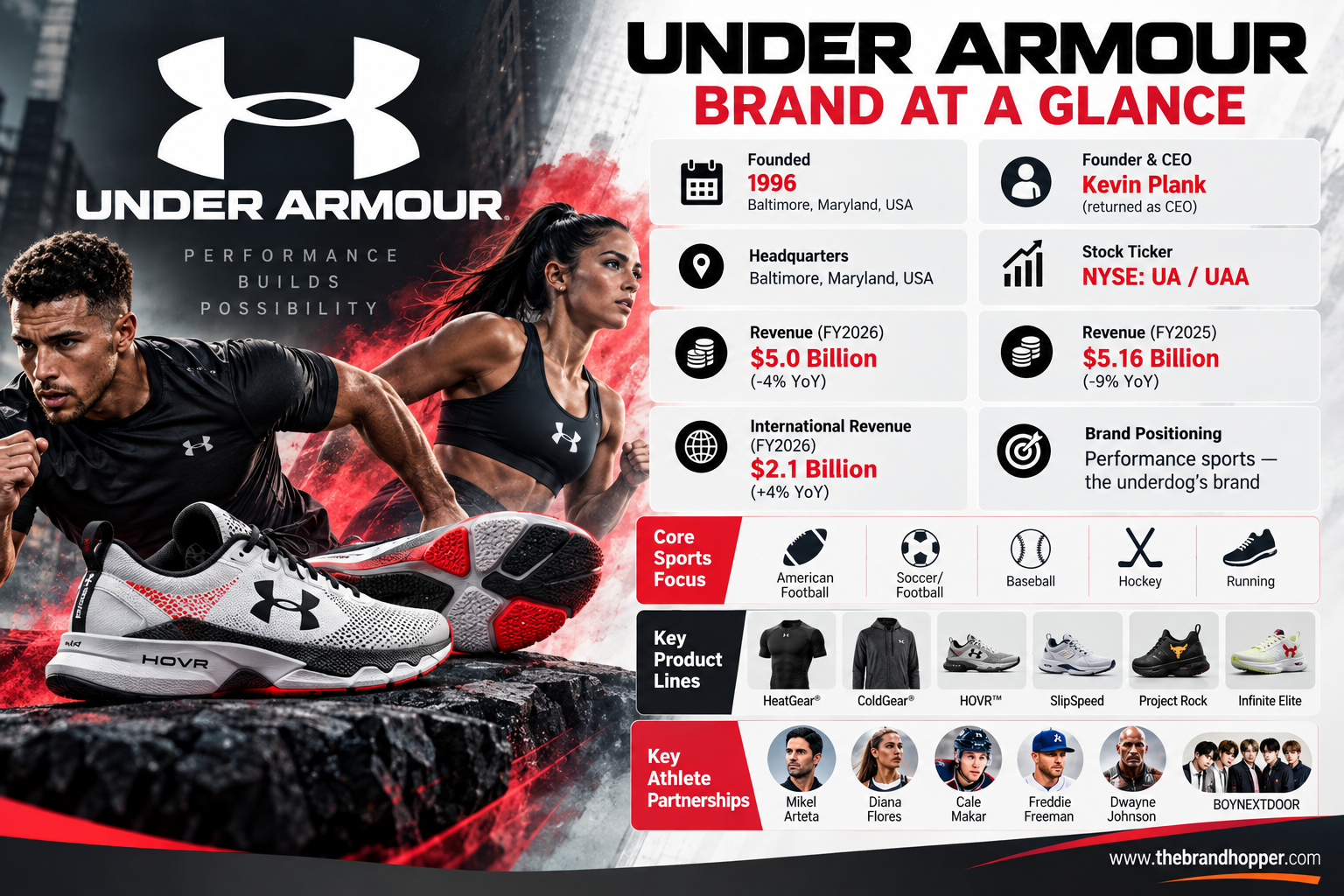
Under Armour closed its fiscal year 2026 (ended March 31, 2026) with $5.0 billion in revenue. That number tells only part of the story. The brand is simultaneously shedding the habits that diluted it — excessive discounting, too many SKUs, over-distribution in off-price retail — while rebuilding the premium performance identity that made it famous. Gross margins are rising. International revenue grew 4 percent in FY2026. The promotional mix inside DTC has inverted from two-thirds discounts to two-thirds full-price.
This article provides a comprehensive analysis of Under Armour’s marketing strategy — covering strategy pillars plus “Protect This House” campaign revival, the Project Rock partnership, UA Next youth sports strategy, STP analysis, competitive positioning, and a 10-question FAQ.

The Under Armour Story: From a Basement to a $5B Brand
The story of Under Armour begins in 1996, when Kevin Plank — a then-23-year-old special teams captain on the University of Maryland football team — became frustrated with the way cotton T-shirts absorbed sweat during intense training and became heavy and uncomfortable. Working out of the basement of his grandmother’s house in Washington D.C., Plank experimented with moisture-wicking fabrics originally used in women’s undergarments to develop a form-fitting compression shirt that stayed dry.
Plank loaded the shirts into his car and drove to NFL training camps, selling directly to players. He made his first team sale — $17,000 worth of shirts to Georgia Tech — from the back of that car. The product worked. Word spread through locker rooms. A pivotal moment came when USA Today ran a photo of an Oakland Raiders player in what appeared to be a blue compression shirt with a logo barely visible — the image generated immediate inquiries and orders.
Under Armour grew explosively through the early 2000s on the back of its breakthrough HeatGear® and ColdGear® fabric technologies, which regulated temperature and moisture in ways that traditional cotton and polyester could not. The brand went public in 2005 (NYSE: UA) and expanded from undergarments into a full portfolio of apparel, footwear, and accessories. By 2015, Under Armour had surpassed Adidas to become the number two sports brand in North America by revenue.
The second half of the 2010s was harder. An over-expansion into lifestyle and fashion, aggressive discounting through outlet channels, ill-timed acquisitions of connected fitness companies, and slowing consumer spending on performance wear all conspired to erode the brand’s premium positioning. Revenue peaked, then stalled. Kevin Plank stepped back from the CEO role in 2019. Two subsequent CEOs followed. By 2023, Plank was back as Executive Chairman and then returned as CEO, declaring that Under Armour would refocus on its core: performance sport for serious athletes, disciplined pricing, and fewer but better products.


The split with Stephen Curry — announced in November 2025 and one of the most prominent athlete-brand partnerships in sports — was the clearest signal yet of where Kevin Plank intends to take the brand. Rather than sustaining a sub-brand inside Under Armour, Plank chose to consolidate around the core UA identity and give Curry Brand the freedom to chart its own course. It was a bold, disciplined decision that underscored the strategic reset underway.
Marketing Strategy of Under Armour
Under Armour’s marketing strategy operates on multiple interlocking pillars, each reinforcing a single core thesis: Under Armour is the brand for athletes who are defined by their work ethic, not their podium. The “underdog” positioning — explicitly embraced by Kevin Plank upon his return — is not just a slogan. It organises the brand’s media investments, athlete partnerships, product development philosophy, and go-to-market channels.
1. Brand Positioning: The Sports House and the Underdog Identity
Under Armour describes itself as a “sports house” — a brand that competes in performance sport rather than lifestyle fashion. This distinction matters enormously. Where Nike and Adidas have diversified aggressively into streetwear, sneaker culture, and fashion collaborations, Under Armour under Kevin Plank is deliberately narrowing its focus to performance-first athletes in football, soccer, baseball, hockey, and running.
The “underdog” positioning is central to how Under Armour communicates this sports-house identity. Plank has described the target customer as “the kid that wasn’t chosen first” — the athlete who earns their place through relentless effort rather than natural gifts or pre-existing status. This is an emotionally powerful position in the sports market, because it speaks to the overwhelming majority of athletes who are not household names: the high school player grinding before dawn, the weekend warrior pushing past their limits, the team athlete who shows up every day and demands more of their gear.
This underdog positioning is expressed through campaigns, athlete partnerships, product naming, and community programmes. The “Be The Problem” football campaign — launched in August 2025 — exemplifies this ethos: it invites athletes to be the disruptive force, the unexpected challenger, the one opponents weren’t ready for. The creative direction is aggressive, aspirational, and entirely performance-oriented, with no lifestyle or fashion softening.

Under Armour has also made a deliberate strategic call to reduce the number of SKUs (individual product variants) in its range. Fewer, better products are easier to market consistently, easier to sell at full price, and easier to build iconic status around. This SKU discipline is as much a marketing decision as a commercial one: it concentrates the brand’s storytelling energy rather than spreading it thin.
2. Target Audience
Under Armour’s core target audience is the serious sports participant: athletes aged 14–35 who train regularly, compete in organised sport, and treat their gear as a tool rather than a fashion accessory. This differs subtly but importantly from the aspirational athlete consumer that Nike and Adidas frequently target — Under Armour specifically wants the person who is actually playing the sport, not merely watching it or dressing like they do.

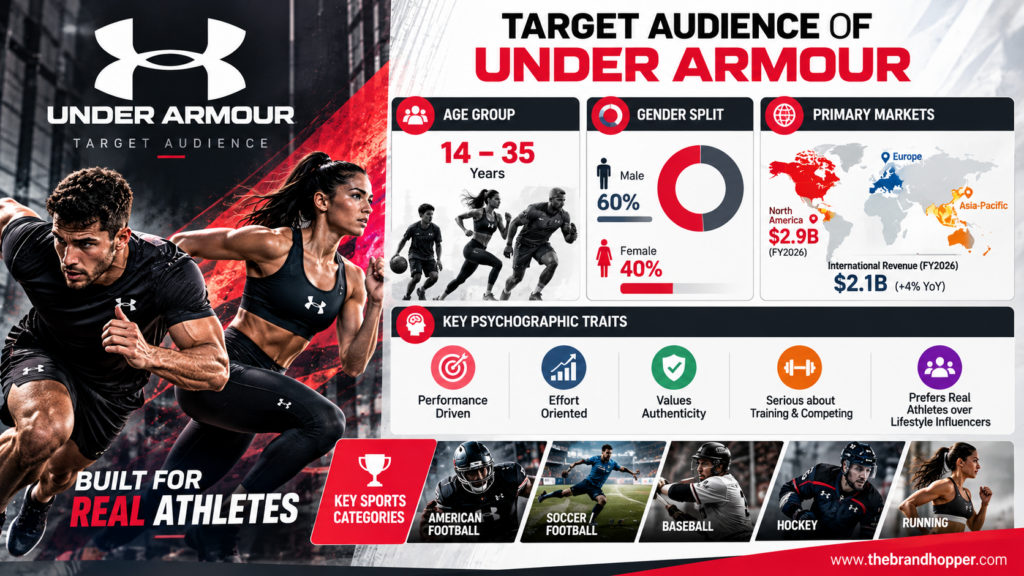
Demographically, Under Armour skews toward male consumers aged 18–34 in its primary markets, though the women’s category has been a significant growth focus since the mid-2010s. The UA Next programme and youth sports sponsorships extend the brand’s reach to athletes aged 14–18, cultivating brand loyalty at the point when young athletes are forming their first serious brand preferences.
Psychographically, Under Armour’s ideal consumer is effort-oriented, performance-driven, and values authenticity over image. They are sceptical of fashion-industry marketing and respond to real athletic performance. They are more likely to follow a collegiate or pro athlete whose work ethic they respect than a lifestyle influencer. They make brand decisions based on whether a product will actually improve their training or game-day performance.
Geographically, Under Armour’s largest market is North America, which generated $2.9 billion in FY2026 revenue despite an 8 percent decline year-over-year. International markets — at $2.1 billion and growing 4 percent in FY2026 — represent an increasing share of the brand’s revenue base, with particular strength in Europe and Asia-Pacific.
3. Product Innovation: HeatGear to HOVR to SlipSpeed
Product innovation has been Under Armour’s most consistent marketing weapon since its founding. Every major product platform the brand has launched has been a genuine technological advance — not a cosmetic update — and the marketing storytelling around each has translated technical benefits into athlete-relevant emotional value.
The original innovation — moisture-wicking compression fabric (HeatGear®) — remains the foundation of Under Armour’s apparel business. HeatGear® pulls sweat away from the skin through polyester microfibers, keeping athletes cool and dry. Its cold-weather counterpart, ColdGear®, traps and redistributes body heat to maintain warmth without adding the bulk of traditional insulation layers. Together, these two fabric platforms account for the bulk of Under Armour’s $3.4 billion apparel revenue.
In footwear, Under Armour’s HOVR™ technology platform has been the primary innovation story for running. HOVR™ foam delivers energy return to each stride, reducing the energy cost of running and providing a responsive, cushioned ride. The Infinite Elite — one of the brand’s current hero running shoes — uses an updated HOVR+ foam that delivers an energy return rate of approximately 62.6 percent, placing it competitively against the leading foam technologies from Nike and Adidas.
The UA SlipSpeed is perhaps the most creatively designed shoe in Under Armour’s recent portfolio. Its defining feature is a convertible heel that transitions from a standard training shoe (heel up, lace locked) into a slide-style recovery shoe (heel folded down) within seconds. The SlipSpeed is engineered with Iso-Chill™ technology inside the collar and features a BOA Fit System for a fast, personalized fit. It is the kind of dual-purpose product that generates genuine word-of-mouth among athletes who appreciate engineering ingenuity over logo placement.


Under Armour’s apparel innovation pipeline includes advances in compression technology, anti-microbial fabric treatments, four-way stretch materials that do not restrict movement, and smart fabric integration for biometric sensing. While the Connected Fitness app ecosystem has been restructured (UA sold its MyFitnessPal platform in 2020), the brand continues to develop products that integrate with MapMyRun and MapMyFitness for performance tracking and coaching.
The Project Rock collaboration with Dwayne Johnson has also been a productive product innovation channel. Johnson co-designed a line of footwear, apparel, and accessories with Under Armour that combines the brand’s performance engineering with aesthetic choices reflecting Johnson’s personal brand identity. The first Project Rock shoe released in 2018 sold out in under 24 hours, setting a template for subsequent limited-release drops that the brand continues to replicate across collaborations.
4. Celebrity Endorsements and Sponsorships: A New Roster for a New Era
Celebrity endorsements have been a cornerstone of Under Armour’s marketing since its earliest years. Strategic partnerships with renowned athletes, such as basketball legend Stephen Curry, helped Under Armour build credibility across multiple sports simultaneously. The Curry Brand partnership, launched in 2013, became one of the most celebrated athlete-brand relationships in basketball — the Curry shoe line grew into a sub-brand within Under Armour, and Curry’s public advocacy for the brand was genuine and consistent. In November 2025, Under Armour and Stephen Curry parted ways by mutual agreement. Kevin Plank framed the split as a disciplined refocus: “For Under Armour, this moment is about discipline and focus on the core UA brand during a critical stage of our turnaround.” The Curry 13, the final shoe produced under the partnership, was released in early 2026.
The new roster Under Armour has assembled reflects the brand’s global sports-house ambitions and its deliberate pivot toward a wider range of sports beyond basketball. Key signings include:
Mikel Arteta — the Arsenal FC manager — joined Under Armour as a Global Ambassador in August 2025. Arteta’s addition is significant for multiple reasons: it gives Under Armour a prominent figure in global football (soccer), a sport the brand is now explicitly prioritising; and Arteta’s reputation as an intense, demanding, detail-oriented coach aligns exactly with the “effort over everything” ethos that defines Under Armour’s current brand positioning.


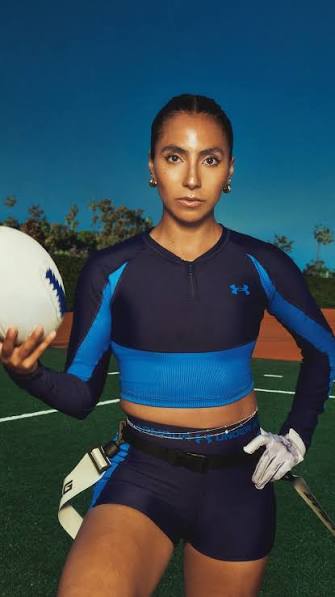
Diana Flores — world flag football champion and one of the most globally recognized women’s athletes in the sport — joined Under Armour as a Global Ambassador, becoming the first flag football athlete in the Under Armour family. Flores is a powerful choice: flag football was officially added to the LA 2028 Olympic programme, making Flores a brand ambassador with Olympic-cycle relevance for the years ahead.

Dwayne Johnson’s Project Rock partnership remains one of Under Armour’s most commercially productive athlete collaborations. Johnson co-develops footwear, apparel, and accessories with Under Armour and promotes the line to his vast social media following (over 100 million Instagram followers). The Project Rock line generates genuine purchase intent among consumers who might not otherwise engage with Under Armour’s pure performance products.
In football (American), Under Armour signed “the next wave of football elite” ahead of the NFL Draft in April 2025, continuing its long tradition of partnering with college and professional football players at the moment they enter the professional spotlight. In baseball, Freddie Freeman (Los Angeles Dodgers, World Series champion) wears Under Armour on the biggest stage in the sport. In hockey, Cale Makar (Colorado Avalanche) represents one of the game’s most exciting young stars. K-pop group BOYNEXTDOOR joined as global brand ambassadors, expanding Under Armour’s reach into South Korean and broader Asian youth markets.
Coach RAC (Ray Anthony Cornils) — one of the most respected coaches in NFL skill player development — joined the roster in July 2025, giving Under Armour a credible voice in the athlete development community rather than purely in athlete celebrity. Tinx (Christina Najjar), a creator and lifestyle personality, was added in June 2026, signalling an expansion into creator-led marketing that can reach audiences outside traditional sports media.
5. “Protect This House” and “Be The Problem”: Campaign Strategy
“Protect This House” is the most important piece of creative real estate Under Armour has ever developed. Originally launched in 2003, the slogan — born from a genuine instinct to defend territory against bigger, better-funded opponents — captured something authentic about the brand’s personality that no amount of focus-group testing could have manufactured. The phrase became cultural shorthand for competitive intensity and defensive pride, and it resonated far beyond sport into military, first responder, and community contexts.

The campaign was revived and modernised in 2023 with a new generation of athletes: NBA star Stephen Curry, WNBA All-Star Kelsey Plum, then-South Carolina basketball star Aliyah Boston, and emerging athlete Bryson Tucker. The updated campaign ditched the original’s adversarial “us versus them” framing in favour of a more inward-looking narrative about athletes overcoming the pressure of their roles and defending their standards against internal doubt as much as external competition. Campaign ads ran during March Madness, NBA games, and across Instagram, Facebook, TikTok, Snapchat, and YouTube.
“Be The Problem” — launched in August 2025 with Under Armour’s first collaboration with its new lead global creative agency Zambezi — is the most ambitious marketing campaign in the brand’s recent history. The campaign calls athletes not just to protect what they have but to actively disrupt the opposition — to be the force that opponents didn’t plan for and can’t contain. The messaging is deliberately confrontational in the best athletic sense: confident, focused, aggressive in pursuit. It aired across broadcast television during major NFL and college football windows, as well as across all major digital and social media platforms.
Together, these two campaign platforms encapsulate Under Armour’s brand voice: internal discipline (“Protect This House”) meeting external disruption (“Be The Problem”). This dual messaging architecture allows the brand to speak simultaneously to the athlete’s inner game (work ethic, preparation, focus) and outer game (performance, competition, winning) — a more complete emotional story than either campaign could tell on its own.
6. Digital Marketing Strategy
Digital marketing is the primary demand-generation channel for Under Armour in today’s media environment. The brand maintains active, content-rich presences across Instagram, TikTok, YouTube, Facebook, X (formerly Twitter), Pinterest, and regional social platforms in key international markets.
Instagram serves as Under Armour’s primary visual brand-building platform — a gallery of campaign imagery, athlete moments, product launches, and behind-the-scenes content that communicates the brand’s aesthetic and values to its most engaged audience. Under Armour’s Instagram strategy prioritises authenticity and intensity over polish, using real training footage, locker-room candor, and game-day adrenaline to create content that feels earned rather than staged.

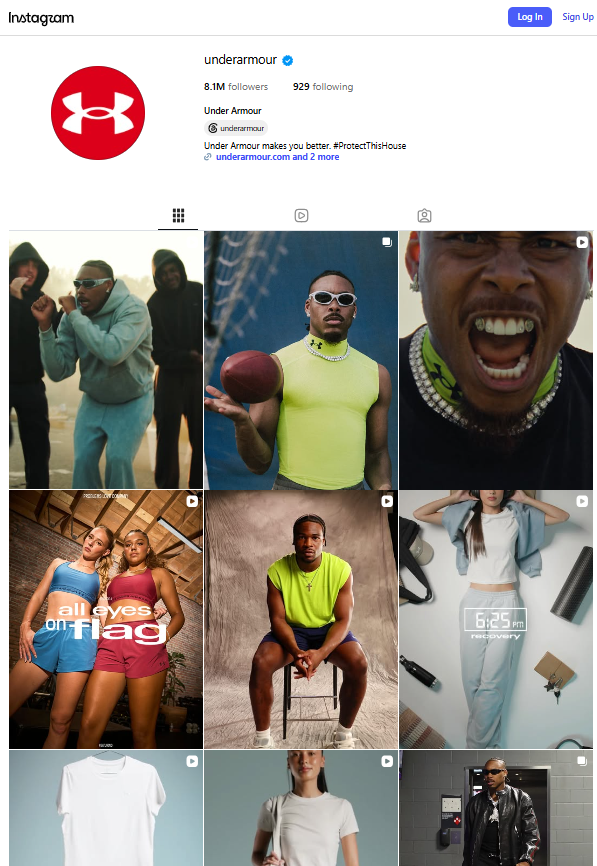
TikTok has become an increasingly important channel for Under Armour to reach younger audiences (under 25) who discover brands through short-form video content. Under Armour’s TikTok strategy blends campaign content with creator partnerships and organic athlete content, leaning into the platform’s preference for raw, unfiltered moments that television advertising cannot replicate. The BOYNEXTDOOR ambassador partnership specifically targets the platform’s large K-pop and Asian youth audience, extending the brand’s TikTok reach into markets where Under Armour has historically been less prominent.
YouTube is used for long-form campaign films, documentary-style content (including the “Protect This House” documentary series), athlete training features, and product launch content. Long-form YouTube content allows Under Armour to tell deeper stories about athletes and the brand’s values — stories that cannot be compressed into a 30-second television spot or a 15-second TikTok video.
Search engine optimisation (SEO) and paid search are managed to ensure that Under Armour appears prominently for high-intent queries around performance apparel, running shoes, training gear, and sport-specific equipment. Email marketing remains an important customer retention and loyalty channel, with segmented campaigns delivering personalised product recommendations, exclusive early access, and time-limited promotions to loyalty programme members.
In Under Armour’s DTC e-commerce channel, the most significant recent development has been the inversion of the promotional mix. Under Armour previously operated a DTC channel that was dominated by discount messaging — approximately two-thirds of DTC communications were promotional in nature. Under Kevin Plank’s leadership, the brand has inverted this ratio to approximately two-thirds full-price messaging, reserving promotional offers for loyalty programme members and clearance windows rather than using them as the primary conversion driver. This has increased average order values and improved the brand’s perceived premium status with online shoppers.
7. Connected Fitness and Technology
Under Armour’s relationship with connected fitness and technology has evolved significantly over the past decade. At its peak, the company operated a suite of four digital health and fitness platforms — MapMyFitness, MapMyRun, Endomondo, and MyFitnessPal — that together claimed over 200 million registered users. This connected fitness ecosystem was central to Under Armour’s vision of being the definitive data layer for sports performance.

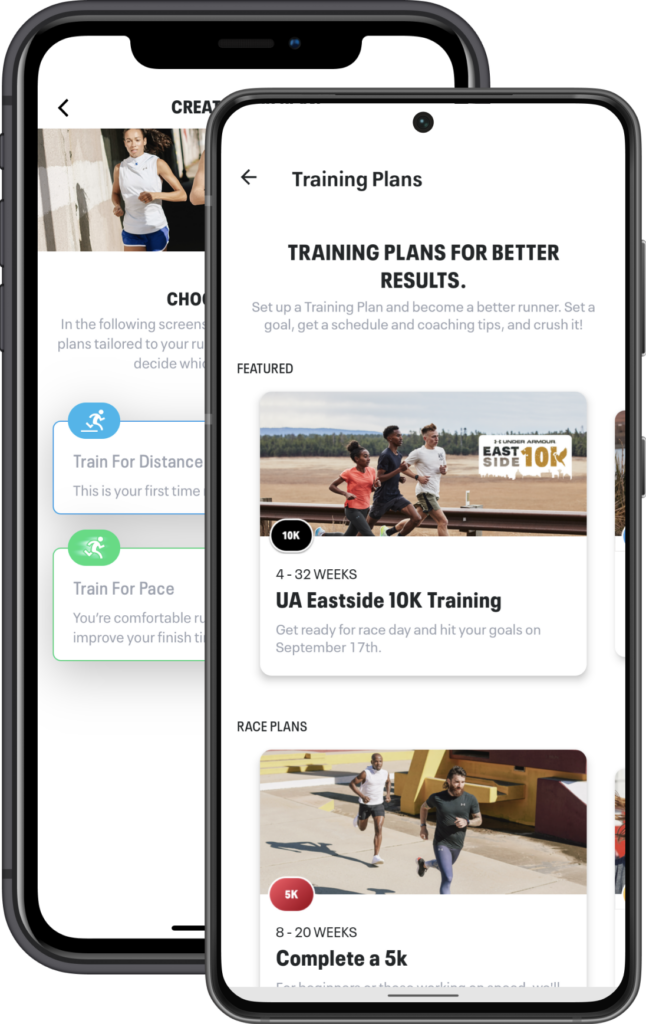
The strategy was ultimately more expensive than profitable. Under Armour sold MyFitnessPal in 2020, Endomondo was shut down, and the company divested MapMyFitness. What remains — MapMyRun and MapMyFitness (the consolidated platform) — is a more focused connected fitness offering that integrates with Under Armour’s HOVR-equipped smart shoes to automatically record run distance, pace, cadence, and stride length without requiring the user to manually start a workout session.
The UA Training Club app (formerly UA Training) provides users with structured workout programmes across strength, cardio, and sport-specific training. The app integrates training recommendations with product suggestions, creating a flywheel between digital engagement and commerce. Users who log consistent workouts on the platform are more likely to purchase new training gear and footwear, which generates a long-term revenue benefit from the digital investment.
In its retail stores, Under Armour has continued to explore technology-enhanced shopping experiences. Its “Fit Studio” concept uses interactive displays and 3D body scanning to help customers find the right size and fit — particularly important for compression garments where fit precision significantly affects performance. Retailers are also exploring
technology-enhanced retail experiences, including virtual try-on for footwear, which allows shoppers to preview how different styles look on their feet before making a purchase — reducing return rates and increasing purchase confidence.
8. Retail Presence and Distribution
Under Armour operates through a multi-channel distribution model that spans owned and operated retail stores, wholesale partnerships with leading department stores and sporting goods retailers, Factory House outlet stores, and a growing direct-to-consumer e-commerce operation.
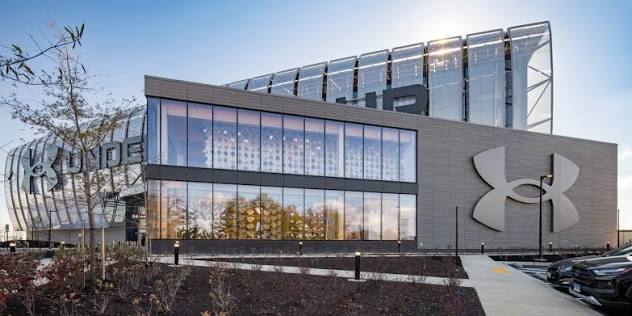
The brand operates more than 400 company-owned retail stores globally, including flagship locations in major urban markets that serve as immersive brand experience centres as much as transactional retail stores. These flagships incorporate interactive technology displays, sport-specific fitting areas, and product customisation services, providing the kind of brand experience that no wholesale partner or e-commerce platform can replicate.

Wholesale remains the largest single distribution channel by volume, with products available through major sporting goods retailers (Dick’s Sporting Goods, Academy Sports), department stores, and specialty sports retailers globally. Under Armour has been selectively rationalising its wholesale distribution — reducing presence in off-price channels that have historically diluted the brand’s premium positioning and incentivised discount shopping behaviour rather than full-price purchase commitment.
E-commerce on underarmour.com is the highest-margin channel in Under Armour’s distribution mix, and the brand has invested significantly in improving the digital commerce experience: personalised product recommendations powered by purchase and browsing data, streamlined mobile checkout, improved product photography and video content, and a more athlete-centric site architecture that organises products around sports and activities rather than generic categories.
The Factory House outlet network serves a distinct consumer segment that is value-driven and accepts a degree of seasonal or promotional product mix in exchange for lower prices. Under Armour is managing this channel more carefully under Kevin Plank’s leadership — ensuring that Factory House inventory is genuinely differentiated from full-price channel product rather than serving as a parallel markdown machine that trains consumers to expect discounts on core products.
Under Armour’s omnichannel approach ensures that customers who discover the brand through any channel — a retail store, a social media ad, an ambassador recommendation, or a search engine result — can seamlessly purchase and receive product through whichever channel suits them best. Buy online, pick up in store; order in store, ship to home; return in store regardless of purchase channel — these capabilities are table stakes for a premium sports brand in the current retail environment.
9. Customer Loyalty Programs: UA Rewards
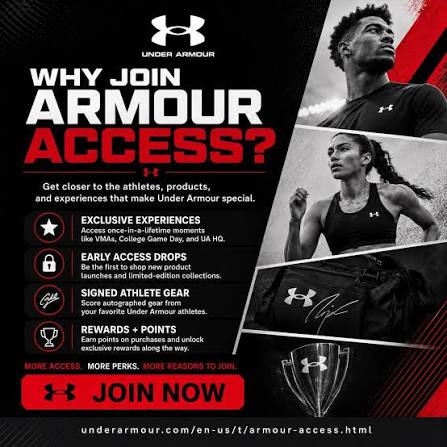
Under Armour’s loyalty programme, UA Rewards, is the brand’s primary vehicle for driving repeat purchase, increasing customer lifetime value, and building the emotional loyalty that converts a one-time buyer into a long-term brand advocate. The programme operates on a points-based structure where customers earn points for every dollar spent, which can be redeemed for product discounts, gift cards, and exclusive access to new releases.
Tiered levels within UA Rewards provide escalating benefits: higher-tier members receive early access to product launches, invitations to exclusive brand events, personalised service in flagship stores, and priority access to limited-edition collaborations and drops. This tiered architecture is a well-established mechanism for encouraging higher purchase frequency and total spend, because each tier offers tangible incremental value that motivates customers to reach and maintain higher levels.

The loyalty programme also serves as a data infrastructure for Under Armour’s marketing personalisation efforts. Purchase history, product preferences, sport affiliation, location, and engagement behaviour collected through the programme feed the email marketing, digital advertising retargeting, and product recommendation systems that make Under Armour’s DTC marketing more relevant and efficient. A loyalty member who has purchased running shoes receives different messaging than one who has purchased football cleats — and this personalisation improves both conversion rates and the customer’s experience of the brand.
Beyond transactional rewards, UA Rewards fosters a sense of community among its members through social media-connected challenges, fitness goal tracking, and exclusive content. Members who achieve fitness milestones — a first half marathon, a personal record, a training streak — are celebrated by the brand, creating emotional moments that deepen the relationship between customer and brand beyond the transactional.
10. UA Next: Youth Sports and Grassroots Strategy
One of the most strategically important — and often underreported — components of Under Armour’s marketing strategy is its investment in youth sports through the UA Next programme. UA Next is Under Armour’s elite youth sports platform, sponsoring all-star games, showcases, and scouting events across American football, basketball, baseball, and soccer that identify the next generation of elite athletes and provide them with their first exposure to the Under Armour brand.
The UA Next All-America Game — an annual showcase for the nation’s top high school football recruits — is broadcast nationally and generates significant exposure for the brand among the exact demographic that Under Armour most needs to convert into brand loyalists: 16–18-year-old male athletes who will soon be making their own apparel purchases and who will carry their brand preferences through collegiate and potentially professional athletic careers.


The strategic logic of youth sports investment is both long-term and deeply commercial. An athlete who first wears Under Armour at a UA Next showcase at age 16, receives it at their college programme at age 18, and purchases it independently at age 22 represents a lifetime customer relationship worth thousands of dollars in lifetime revenue. This funnel — from youth identification to collegiate reinforcement to adult purchase — is the most efficient brand-building machine in the sports apparel industry.
Under Armour also partners with high school and collegiate athletic programmes across America as an equipment supplier, providing teams with game-day gear in exchange for brand visibility on sidelines, in stadiums, and in broadcast coverage. These partnerships generate authentic, unforced brand impressions among athletes and fans that paid advertising cannot replicate.
11. Sustainability and Corporate Responsibility
Under Armour has articulated sustainability commitments across its supply chain, product development, and facility operations, aligned with the broader sportswear industry’s movement toward more responsible manufacturing practices. The company has published sustainability targets across three areas: people (workforce equity and safety), product (sustainable materials and design), and planet (carbon emissions and waste reduction).
On the product side, Under Armour has increased its use of recycled polyester in apparel and has committed to expanding the percentage of products that incorporate sustainable materials. The brand has also explored durability-as-sustainability: products designed to last longer and perform better over time generate less waste than fast-fashion equivalents with shorter functional lifespans. This durability argument aligns naturally with Under Armour’s performance positioning — athletes want gear that holds up through thousands of repetitions, which is also the most sustainable choice.
Under Armour’s “UA Give Back” programme channels contributions to community organisations focused on youth sports access, particularly in underserved communities where access to quality athletic equipment and facilities is a genuine barrier to sports participation. This philanthropic work connects directly to the brand’s “underdog” positioning — Under Armour believes in giving every athlete, regardless of background, the tools to compete on an equal footing.
Marketing Mix of Under Armour: The 4Ps
1. Product
Under Armour’s product portfolio spans three primary categories, each anchored by a distinct performance technology platform:
Apparel ($3.4 billion, FY2026) is the largest and most strategically important category. The core range includes compression base layers (HeatGear® for warm conditions, ColdGear® for cold conditions, AllSeasonGear® for transitional weather), training shorts and pants, team uniforms, sport-specific gear for football, baseball, soccer, hockey and running, and an expanding women’s collection. A highlight in the women’s category is the InfiniteElite sports bra, designed for high-impact sports with adjustable support and breathable construction.
Footwear ($1.1 billion, FY2026) is led by the HOVR™ running platform (including the Infinite Elite and Machina models), the SlipSpeed training shoe (convertible heel, Iso-Chill™ technology, BOA Fit System), the Project Rock training shoes (co-designed with Dwayne Johnson), and sport-specific cleats for American football, baseball, and soccer. Footwear has faced the most significant revenue declines in the restructuring period, reflecting the brand’s decision to reduce distribution in discount channels where it previously moved high volumes of lower-margin footwear.
Accessories ($411 million in FY2025; stable) include hats, bags, gloves, sports masks, socks, and the UA Armour Sport gloves. Accessories serve as entry-point products that introduce new consumers to the brand at lower price commitments, with the expectation that positive product experiences will drive apparel and footwear purchases in subsequent seasons.
| Product Category | Revenue (FY2026) | Key Lines |
| Apparel | $3.4 billion (-2% YoY) | HeatGear®, ColdGear®, AllSeasonGear®, team uniforms, women’s |
| Footwear | $1.1 billion (-11% YoY) | HOVR™ run series, SlipSpeed, Project Rock, sport cleats |
| Accessories | ~$400+ million (stable) | Bags, hats, gloves, socks, sports accessories |
2. Price
Under Armour operates a tiered pricing architecture that positions it firmly as a premium performance brand — priced above mid-market alternatives (Champion, Starter) but below super-premium or fashion-luxury sportswear (Stone Island Sport, Lululemon at its highest price points). Entry-level items (basic compression shorts, accessories) start at $20–40, making the brand accessible to athletes at early stages of purchase commitment, while flagship performance products (HOVR Elite running shoes, top-tier Project Rock training shoes) reach $180–$220.

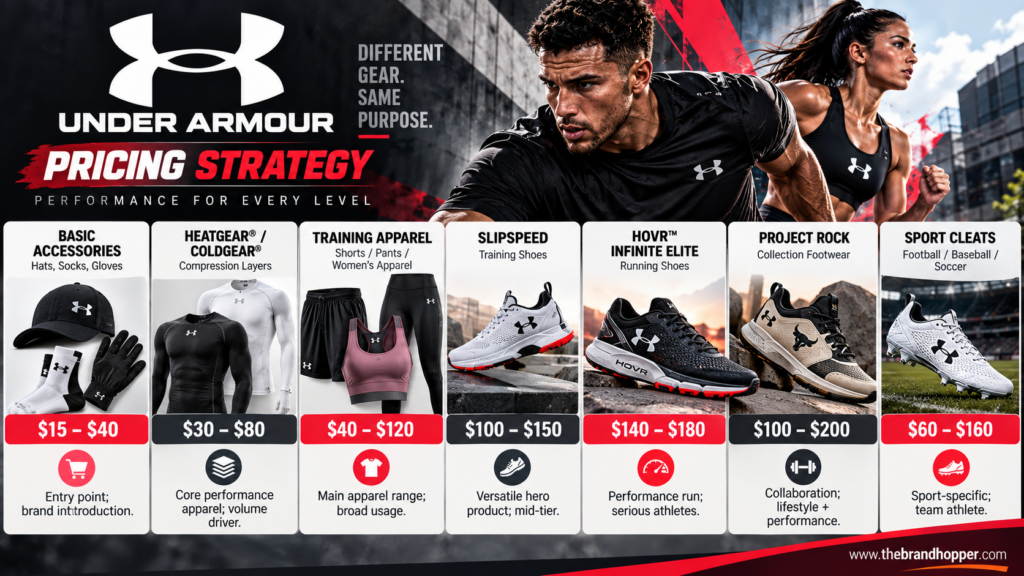
Under Kevin Plank’s strategic reset, the most significant pricing change has been behavioural rather than structural: the brand is selling fewer units through promotional channels and at promotional prices, and more units at full retail. In DTC specifically, the shift from a majority-discount environment to a majority-full-price environment has increased average order values and improved the brand’s gross margin, which reached 47.9 percent in FY2025 (up 180 basis points year-over-year). The combination of premium product investment and promotional discipline is the engine of Under Armour’s margin recovery story.
3. Place (Distribution)
Under Armour’s distribution strategy balances three channels: DTC (direct-to-consumer, including owned retail stores and e-commerce), wholesale (department stores and sporting goods retailers), and Factory House outlets.
In FY2025, DTC revenue was $2.1 billion and wholesale revenue was $3.0 billion, with wholesale remaining the larger channel. However, the quality of wholesale distribution is being actively managed: Under Armour has reduced its presence in off-price and discount department store channels that deliver lower average selling prices and damage brand perception among the premium consumer Under Armour wants to win.
International distribution is growing in strategic importance. With North America declining 8 percent in FY2026 and international growing 4 percent to $2.1 billion, the geographic mix of Under Armour’s revenue is shifting toward international markets. Europe (particularly the UK, Germany, and France), Asia-Pacific (South Korea, Japan, China, Australia), and Latin America are the primary growth markets, each requiring localised marketing, distribution partnerships, and ambassador strategies calibrated to local sports culture.
4. Promotion
Under Armour’s promotional strategy has been fundamentally reorganised under the current leadership. The brand now distinguishes between demand creation investment (advertising, ambassador marketing, events, digital content that builds brand equity and drives new customer acquisition) and trade promotion (discounts, buy-one-get-one offers, seasonal sales events that drive short-term volume at the cost of long-term brand equity).
Demand creation investment has been concentrated in three areas: the Protect This House and Be The Problem brand campaign platforms (executed in partnership with Zambezi, the brand’s lead global creative agency), Curry Brand storytelling and athlete roster content, and community programmes like UA Next and the UA All-America games that build grassroots equity. Trade promotion has been deliberately reduced, particularly in DTC digital channels where the inversion of the promotional mix has improved the customer’s perception of the brand as premium and full-price.
Sponsorship of major sporting events continues to be an important promotional vehicle, with Under Armour maintaining partnerships with NFL Combine activities, college athletic programmes, and international football (soccer) clubs. The brand’s partnership with Arsenal FC through the Mikel Arteta ambassadorship gives Under Armour authentic engagement with one of the world’s most globally followed football clubs.
STP Analysis of Under Armour
1. Segmentation
Under Armour segments its market across sport participation (athletes in specific sports versus general fitness versus lifestyle), demographics (age, gender, income, geography), and psychographics (effort-orientation, performance focus, authenticity preference).
The most important segmentation dimension for Under Armour’s current strategy is sport participation: the brand prioritises consumers who actually play the sports it sponsors (American football, soccer, baseball, hockey, running) over casual exercisers or lifestyle consumers who may buy athletic apparel without playing organised sport.
2. Targeting
Under Armour’s primary target is the serious team athlete aged 14–34 in North America, with an expanding secondary target in Europe (soccer) and South Korea/Asia-Pacific (K-pop-adjacent youth culture, soccer, and general fitness).
The UA Next programme specifically targets 14–18-year-old elite high school athletes, building brand relationships before career-defining purchase decisions are made. The Project Rock collaboration targets a secondary audience of fitness-enthusiast adults (25–40) who identify with Dwayne Johnson’s work-ethic brand personality regardless of their sport affiliation.
3. Positioning
Under Armour positions itself as the performance brand for the underdog athlete — the person who earns their place through effort rather than inheriting it through talent. In the competitive spectrum of sports apparel, Under Armour sits firmly at the performance end (competing directly with Nike and Adidas on product functionality) while differentiating on brand values (effort, grit, team) rather than on lifestyle aspiration (Nike’s “Just Do It” cultural breadth or Adidas’s fashion-forward collaborations).
The “Sports House” descriptor Plank uses internally is the positioning in action: Under Armour is a house dedicated entirely to sport, not to fashion or culture or streetwear. This is both a differentiating strength and a deliberate constraint.
Under Armour vs Competitors
| Brand | Revenue (Latest FY) | Key Strength | Positioning vs UA |
| Nike | ~$46B (FY2025) | Broadest cultural reach; Air / Jordan franchise; global distribution | Direct rival; far larger; lifestyle + performance |
| Adidas | ~€23.7B (FY2025) | European heritage; Yeezy legacy; Samba / Gazelle streetwear resurgence | Style-forward; Fashion + performance |
| Puma | ~€8.9B (FY2025) | Football / motorsport; Formula One; fashion-sport hybrid | European positioning; aspirational lifestyle |
| New Balance | ~$7.8B (est. FY2025) | Running heritage; retro-cool; strong US manufacturing story | Premium positioning; running & lifestyle crossover |
| Lululemon | ~$10.6B (FY2025) | Yoga / athleisure; premium DTC; community flywheel | Lifestyle premium; female-first; limited sport focus |
| Reebok | Part of ABG portfolio | CrossFit heritage; fitness studio audience | Niche; not a direct rival in core sports |
Frequently Asked Questions (FAQs)
Q1. What is Under Armour’s current marketing strategy?
A: Under Armour’s current marketing strategy centres on repositioning the brand as a “sports house” — a performance-first brand for serious athletes in football, soccer, baseball, hockey, and running. Under founder-CEO Kevin Plank, the strategy has three pillars: reducing the number of SKUs to concentrate storytelling on hero products; inverting the DTC promotional mix from discount-dominated to full-price-dominated to rebuild brand premium; and focusing ambassador and campaign investments on athletes who embody the “underdog” work ethic. The flagship campaign platforms are “Protect This House” (internal discipline and standards) and “Be The Problem” (external competitive disruption). Source: Under Armour FY2026 investor communications; Wwd.com; Media Group Online.
Q2. What happened to the Under Armour and Stephen Curry partnership?
A: Under Armour and Stephen Curry ended their partnership by mutual agreement in November 2025. Kevin Plank framed the split as a disciplined business decision: “For Under Armour, this moment is about discipline and focus on the core UA brand during a critical stage of our turnaround.” The Curry 13 — the final shoe produced under the Curry Brand partnership — was released in early 2026. Under Armour retains the right to sell existing Curry Brand inventory until October 2026, after which Curry Brand is free to partner elsewhere or operate independently. Source: SportsPro Media (November 2025); Sportico; Front Office Sports.
Q3. What is Under Armour’s revenue?
A: Under Armour’s revenue for fiscal year 2026 (April 2025 – March 2026) was $5.0 billion, a 4 percent decline year-over-year. Revenue for fiscal year 2025 (April 2024 – March 2025) was $5.16 billion, a 9 percent decline year-over-year. The declines reflect deliberate strategic choices — reducing off-price and wholesale distribution, cutting SKUs, and reducing promotional discounting — rather than a loss of consumer demand. Gross margins and adjusted operating income have both improved during the same period, suggesting the quality of revenue is rising even as volume has temporarily declined. Source: Under Armour FY2026 Full Year Results press release (May 2026).
Q4. Who are Under Armour’s current brand ambassadors?
A: Under Armour’s current ambassador roster includes Mikel Arteta (Arsenal FC manager, global ambassador), Diana Flores (world flag football champion, first flag football athlete in the UA family), Dwayne “The Rock” Johnson (Project Rock collection co-creator), Cale Makar (Colorado Avalanche, NHL), Freddie Freeman (Los Angeles Dodgers, MLB), K-pop group BOYNEXTDOOR (global ambassadors for Asian youth markets), Coach RAC (elite NFL skill-player development coach), Tinx (creator and lifestyle personality), Antonio Rüdiger (Real Madrid, soccer), Achraf Hakimi (Paris Saint-Germain, soccer), and Ibrahima Konaté (Liverpool FC, soccer), among others. Source: Under Armour Official Newsroom (about.underarmour.com).
Q5. What is Under Armour’s “Protect This House” campaign?
A: “Protect This House” is Under Armour’s signature brand campaign platform, originally created in 2003. The phrase encapsulates the brand’s core values of competitive intensity, defensive pride, and the imperative to defend one’s standards against opponents and doubt. The campaign was revived in 2023 with a new generation of athletes including Stephen Curry, WNBA star Kelsey Plum, and Aliyah Boston, and has been extended through the “Be The Problem” campaign launched in August 2025 with creative agency Zambezi. Together, the two campaigns define Under Armour’s current brand voice: internal discipline meeting external disruption. Source: Under Armour Official Newsroom; Ad Age.
Q6. What is Under Armour’s Project Rock?
A: Project Rock is Under Armour’s product collaboration line with actor, producer, and fitness icon Dwayne Johnson (“The Rock”). The partnership, which began in 2016, sees Johnson co-develop footwear, training apparel, and accessories with Under Armour’s design team, combining the brand’s performance engineering with aesthetic choices reflecting Johnson’s personal brand values of relentless effort and self-improvement. Project Rock products are typically released as limited drops, creating purchase urgency and media coverage beyond what standard product launches generate. The first Project Rock shoe in 2018 sold out in under 24 hours. Source: PR Newswire (2016 partnership announcement); FandomWire; Under Armour product pages.
Q7. What is UA Next?
A: UA Next is Under Armour’s elite youth sports programme, sponsoring all-star games, showcases, and identification events for elite high school athletes across American football, basketball, baseball, and soccer. The flagship UA Next All-America Game is an annual showcase for the nation’s top high school football recruits, broadcast nationally and generating significant brand exposure among the 16–18-year-old athlete demographic. UA Next is strategically important because it builds brand loyalty at the earliest stage of serious athletic identity formation — a young athlete who first wears Under Armour at a UA Next event carries that brand relationship through collegiate and professional careers. Source: Under Armour Official Newsroom (September 2025); underarmour.com.
Q8. What are Under Armour’s most innovative products?
A: Under Armour’s most noteworthy current product innovations include: the UA SlipSpeed (a convertible-heel training shoe that shifts from performance training to recovery slide; features Iso-Chill™ interior technology and BOA Fit System); the HOVR™ Infinite Elite (a running shoe with HOVR+ foam delivering approximately 62.6% energy return); HeatGear® and ColdGear® compression fabric platforms (the foundational technology that launched the company); and Project Rock footwear and apparel (co-developed with Dwayne Johnson for training and lifestyle use). The brand’s connected fitness products integrate with MapMyRun for automatic run tracking via HOVR smart shoes. Source: underarmour.com; Run Repeat product reviews; Under Armour product press releases.
Q9. How does Under Armour compare to Nike?
A: Nike and Under Armour are the two largest American sports apparel brands, but they differ significantly in scale, positioning, and strategy. Nike generated approximately $46 billion in revenue for its fiscal 2025, roughly nine times Under Armour’s $5 billion. Nike competes across performance sport, lifestyle fashion, streetwear, sneaker culture, and luxury collaborations, giving it far broader cultural reach. Under Armour, under Kevin Plank’s current leadership, is deliberately narrowing its focus to performance sport and the underdog athlete identity, accepting that it will not compete with Nike on lifestyle or cultural breadth. Under Armour differentiates through its engineering-first innovation story, its team-sport heritage, and its emotional resonance with effort-oriented athletes who find Nike’s cultural omnipresence less personal and authentic.
Q10. What is Under Armour’s gross margin and financial outlook?
A: Under Armour’s gross margin has been improving through the strategic reset period. Gross margin reached 47.9 percent in FY2025 (up 180 basis points from the prior year) and expanded to 54.1 percent in Q1 FY2026 (up 590 basis points, aided by tariff refunds and supply chain efficiency gains). The full FY2026 adjusted operating income was $107 million. Despite revenue declines ($5.16 billion in FY2025, $5.0 billion in FY2026), the improving margin profile indicates that the restructuring is delivering higher-quality revenue from fewer, better-priced products. Initial FY2027 guidance was provided with the May 2026 full-year results. Source: Under Armour FY2026 Full Year Results press release (May 2026); Investing.com Q1 FY2026 earnings call transcript.
Also Read: Coach New York Marketing Strategy: The $5.6B Playbook
Conclusion
Under Armour’s marketing strategy in its current form is a disciplined, long-term brand rebuilding programme that accepts short-term revenue pain in exchange for long-term brand equity gains. The $5.0 billion revenue number for FY2026 is down from the brand’s peak, but the gross margin trajectory, the promotional mix inversion, the SKU rationalisation, and the reconstituted athlete roster all suggest that the foundation being laid is sturdier than the one it replaced.
The Curry split — the most dramatic headline of the restructuring — is best understood as a strategic clarification rather than a failure. Under Armour is choosing to be the performance brand for every serious athlete rather than the brand of one basketball celebrity. The “Be The Problem” campaign and the “Protect This House” revival speak to a much wider athletic audience than any basketball-centric marketing could reach, and the roster now encompasses soccer (Arteta, Rüdiger, Torres, Hakimi, Konaté), flag football (Diana Flores), hockey (Makar), baseball (Freeman), and global youth culture (BOYNEXTDOOR).
For brands and marketers studying how to rebuild a premium sports brand after a period of over-distribution and discount dilution, Under Armour offers an honest, unfolding case study. The lessons are clear: premium pricing requires promotional discipline; brand equity requires consistent messaging over seasons, not just campaigns; and athlete partnerships should serve the brand’s values as much as the athlete’s reach. Under Armour is applying all three lessons simultaneously, and the early margin evidence suggests it is working. What remains to be seen is whether the brand can return to revenue growth while sustaining the quality standards that make that growth worth pursuing.
Also Read: The Art of Luxury: Chanel Marketing Strategies and Marketing Mix
Also Read: Gucci Marketing Strategies: How the Brand Stays Iconic
To read more content like this, subscribe to our newsletter
Go to the full page to view and submit the form.