


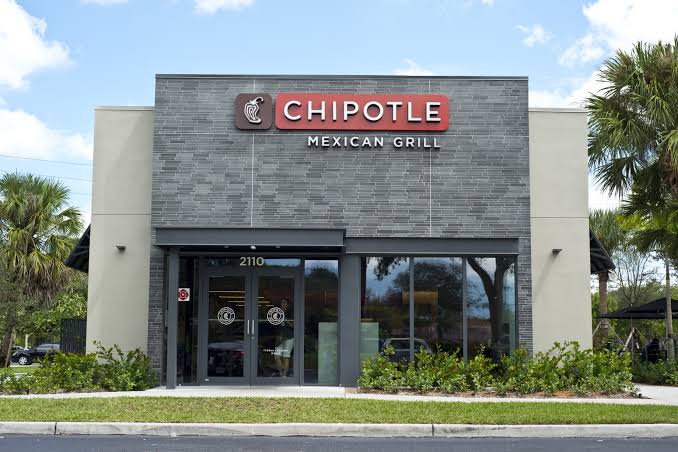
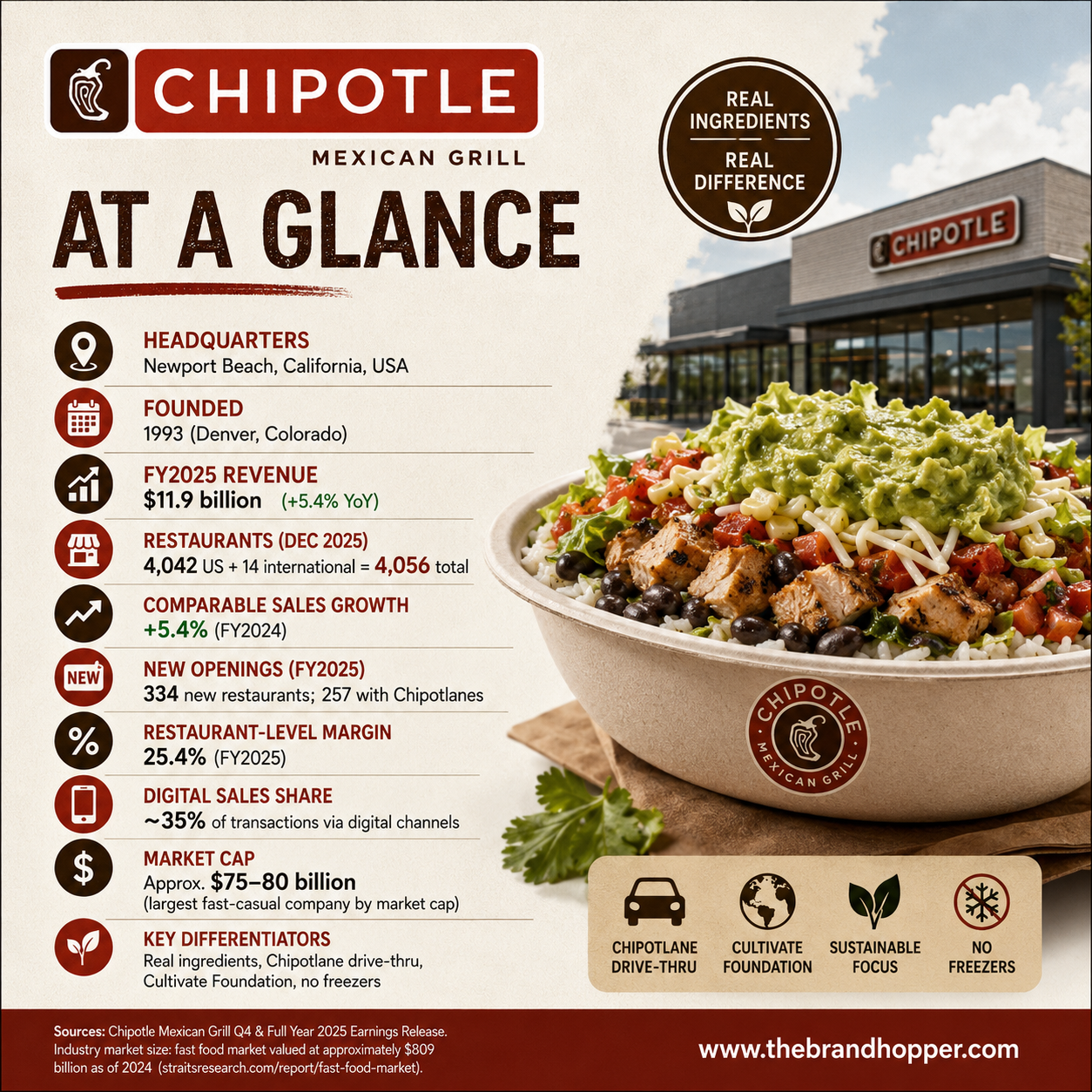
Chipotle Mexican Grill is the undisputed king of fast-casual Mexican dining — but that crown is harder to wear with every passing year. In FY2025, Chipotle delivered total revenues of $11.9 billion across 3,726 restaurants globally, with comparable sales up 5.4% and 334 net new restaurant openings. Its restaurant-level operating margin of 26.6% is the envy of the fast-casual industry.
Yet competitors are closing the gap — and from unexpected directions. CAVA Group grew revenue 33% in 2024. Raising Cane’s crossed $5 billion in annual sales. Shake Shack surpassed $1.25 billion. These are not marginal threats; they are fast-moving rivals competing for the same health-conscious, digital-savvy consumer that built Chipotle’s empire.
This article profiles Chipotle’s most significant competitors — from direct Mexican fast-casual rivals to broader fast-casual disruptors — with verified revenue data, current locations, and a clear-eyed view of what makes each one a genuine threat to Chipotle’s market position.
Chipotle at a Glance: The Market Leader

Market Context & Industry Overview
The fast-casual dining segment has grown from niche positioning to mainstream dominance. The US fast-casual sector — led by Chipotle — now commands premium pricing and loyalty from a demographic that increasingly rejects traditional fast food in favour of fresher, more customizable, and more ethically sourced options.
Chipotle holds approximately 10% market share within the US fast-casual dining segment. The Mexican restaurant subsector alone generates nearly $82.3 billion in annual US sales across more than 73,000 locations. However, the competitive pressure is no longer purely Mexican: fast-casual concepts in Mediterranean cuisine (CAVA), premium burgers (Shake Shack), and grilled chicken (Raising Cane’s) are all competing for the same dining occasion and the same wallet.
The post-pandemic acceleration of digital ordering, delivery, and drive-thru has permanently changed the competitive dynamics. Chains that built robust digital infrastructure — Chipotle included — gained a durable structural advantage. But newer entrants have also launched digitally-native from day one, reducing that moat. The result: a competitive landscape more intense, more diverse, and more global than at any point in Chipotle’s history.
Top 15 Competitors and Alternatives of Chipotle
Section A: Direct Fast-Casual Mexican Competitors
1. Qdoba Mexican Eats

Website: www.qdoba.com
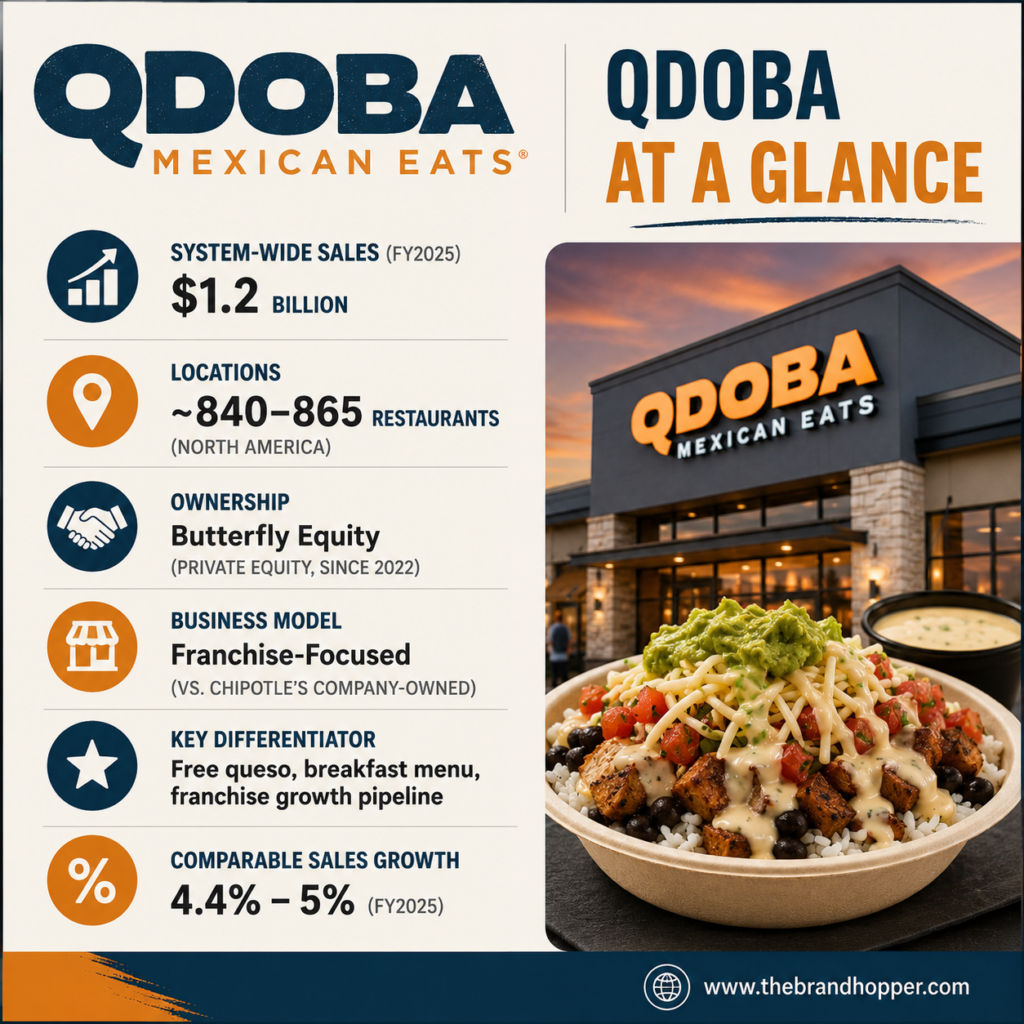
Qdoba is Chipotle’s most direct competitor — a like-for-like Mexican fast-casual chain that competes on format, menu, and occasion. Positioning itself as North America’s #1 franchisor of Mexican fast-casual dining, Qdoba has approximately 840-865 restaurants and reported $1.2 billion in system-wide sales in FY2025, with 7.7% comparable sales growth — performance that signals genuine competitive momentum against Chipotle.
Founded in Denver in 1995 and now owned by Butterfly Equity (since 2022), Qdoba’s franchise-first model enables rapid geographic expansion without the capital intensity of company-owned stores. With 500+ new franchise development commitments announced, Qdoba is aggressively targeting underserved markets that Chipotle has yet to fully penetrate.
Where Qdoba differentiates from Chipotle most visibly is in menu generosity: queso is always included at no extra charge (a point of competitive friction Chipotle faced backlash over when it charged $1.50+ for queso). Qdoba also offers breakfast menu items at select locations and more aggressive franchise promotions. Its franchise model — as opposed to Chipotle’s company-owned approach — means Qdoba can grow faster but with less operational consistency control.
2. Moe’s Southwest Grill
Website: www.moes.com
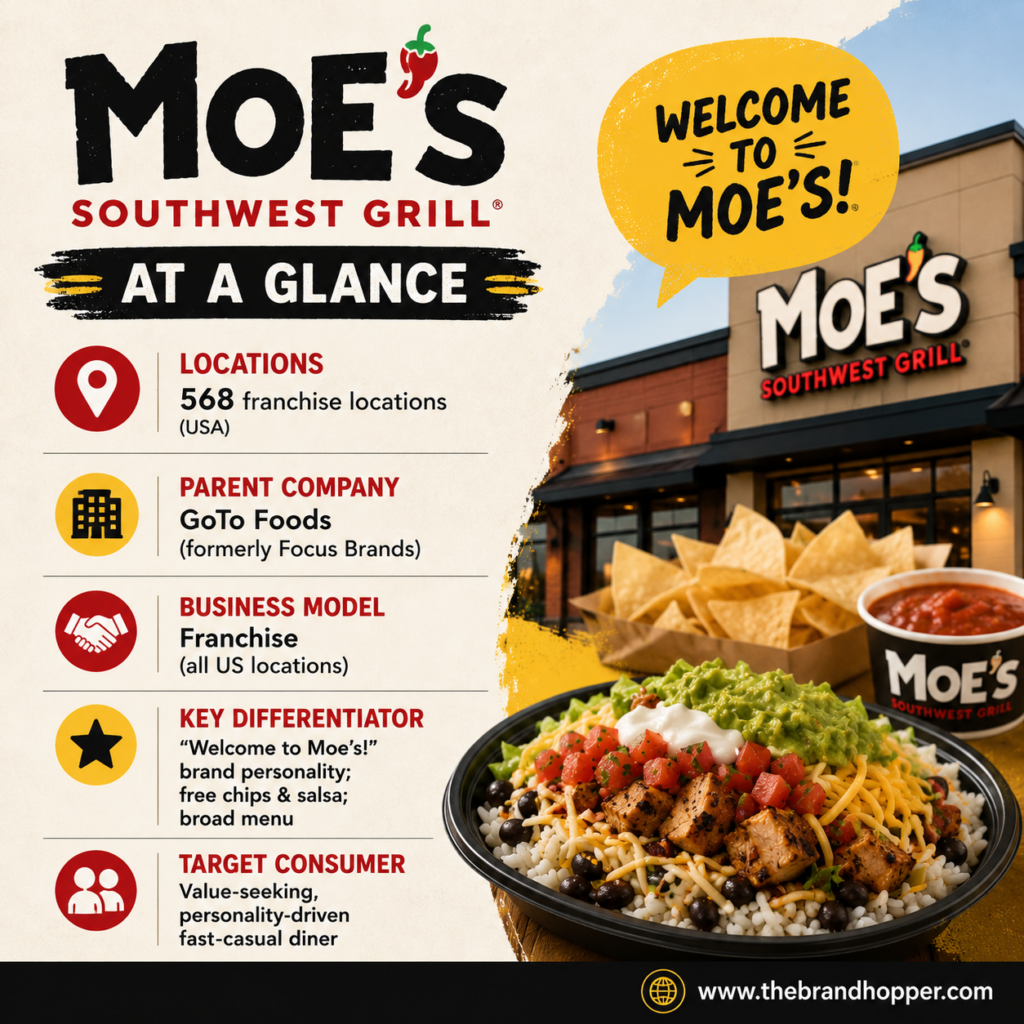
Moe’s Southwest Grill built its brand on a personality that Chipotle deliberately avoids: loud, music-driven, and unapologetically fun. The iconic “Welcome to Moe’s!” greeting — shouted by every employee when a customer walks in — has become one of the most recognized brand signatures in fast-casual dining. This culture-first positioning attracts a loyal customer base that values entertainment and personality alongside food quality.
Operating as part of the GoTo Foods portfolio (alongside Schlotzsky’s, Carvel, and Cinnabon), Moe’s benefits from operational synergies and shared best practices across multiple restaurant brands. With 568 franchise locations across the US and complimentary chips and salsa on every order, Moe’s targets consumers who find Chipotle’s minimalist approach too utilitarian. Its broader menu — including “stacks,” seasonal salsas, and bowls — offers more variety than Chipotle’s tightly focused format.
3. Baja Fresh Mexican Grill
Website: www.bajafresh.com
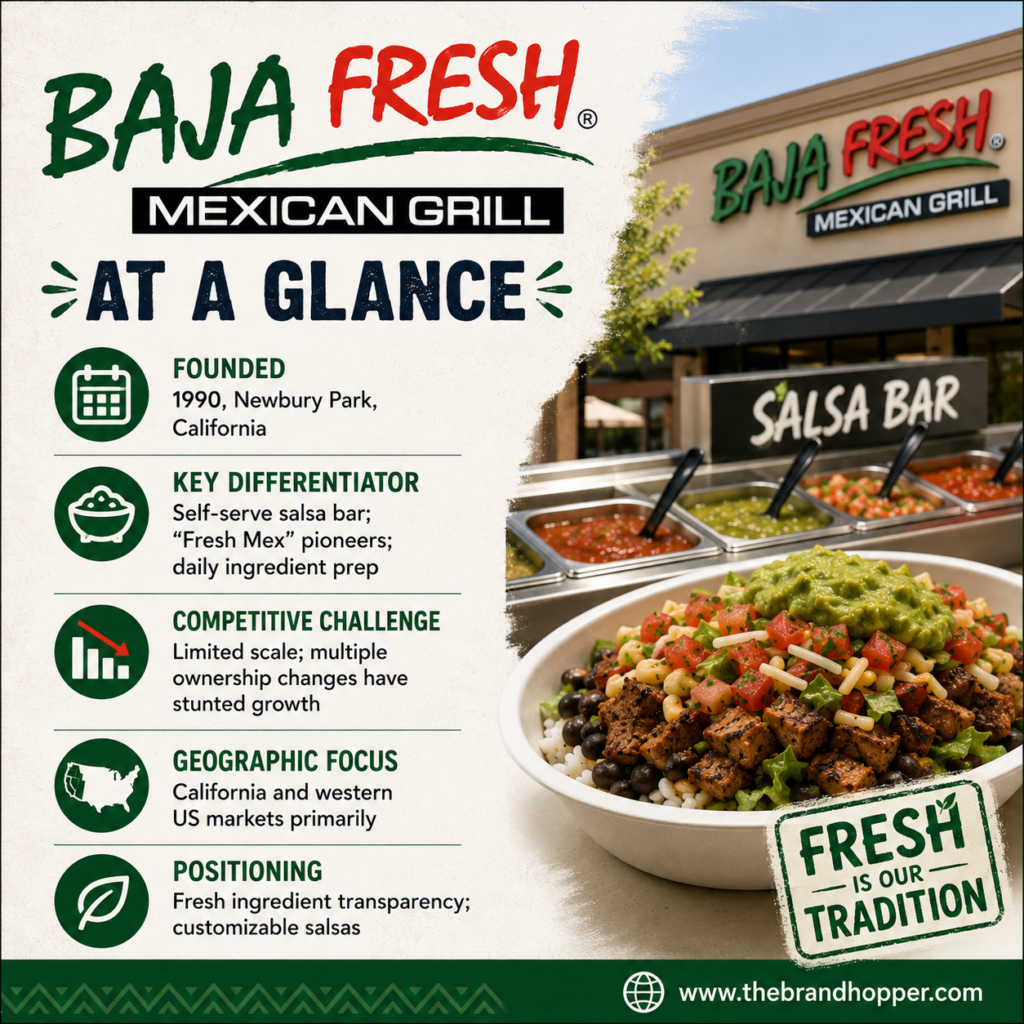
Baja Fresh is the original “Fresh Mex” pioneer — a predecessor to Chipotle’s philosophy in many ways. Founded in Newbury Park, California in 1990, it grew from 31 outlets in 1997 to 249 stores by 2002 before changing ownership multiple times. Today, Baja Fresh occupies a smaller regional footprint but maintains relevance through its self-serve salsa bars, fresh daily ingredient preparation, and no-microwave, no-can-opener, no-freezer kitchen philosophy — a positioning that predates Chipotle’s own “Food With Integrity” promise.
Baja Fresh’s competitive challenge is scale: it cannot match Chipotle’s digital infrastructure, supply chain leverage, or national marketing budget. However, in its California and western US stronghold markets, it retains loyal customers who value its freshness credentials and diverse salsa bar — an experience customization layer Chipotle does not offer.
4. Rubio’s Coastal Grill
Website: rubios.com
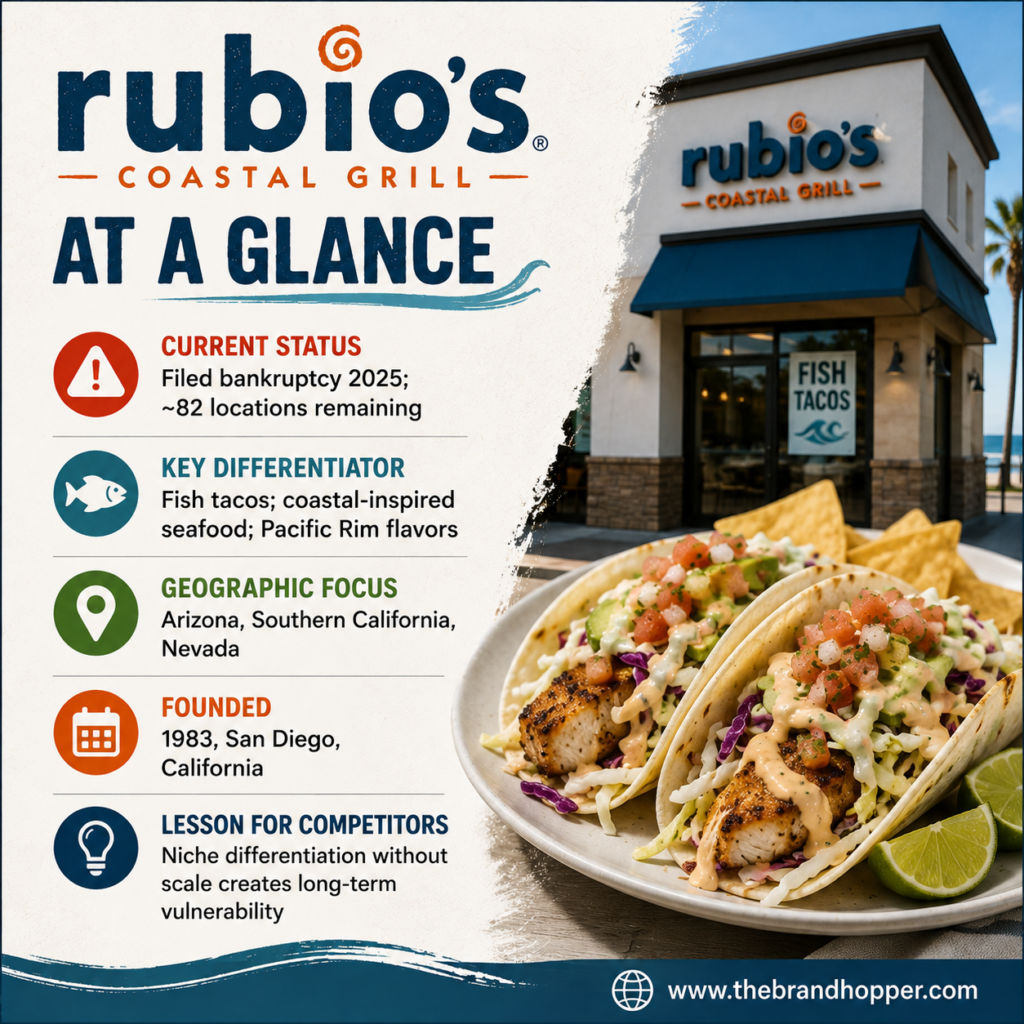
Rubio’s occupies a genuinely unique niche in the Mexican fast-casual space: it is the brand that popularized the fish taco in mainstream American dining. Founded by Ralph Rubio in 1983 after discovering fish tacos during a spring break trip to Baja California, the chain built its reputation around signature grilled mahi-mahi tacos and coastal-inspired seafood preparation — a protein differentiation that Chipotle does not offer.
However, Rubio’s trajectory highlights the precarious position of specialized regional chains competing against better-capitalized national brands. The chain filed for bankruptcy in 2025 and has reduced its footprint to approximately 82 locations across Arizona, Southern California, and Nevada — down from a peak of 196 restaurants. For Chipotle, Rubio’s challenges illustrate the competitive advantage of scale and diversification: niche specialization can be a moat, but it also creates vulnerability when consumer preferences shift or macroeconomic pressures mount.
5. Cafe Rio Mexican Grill
Website: www.caferio.com
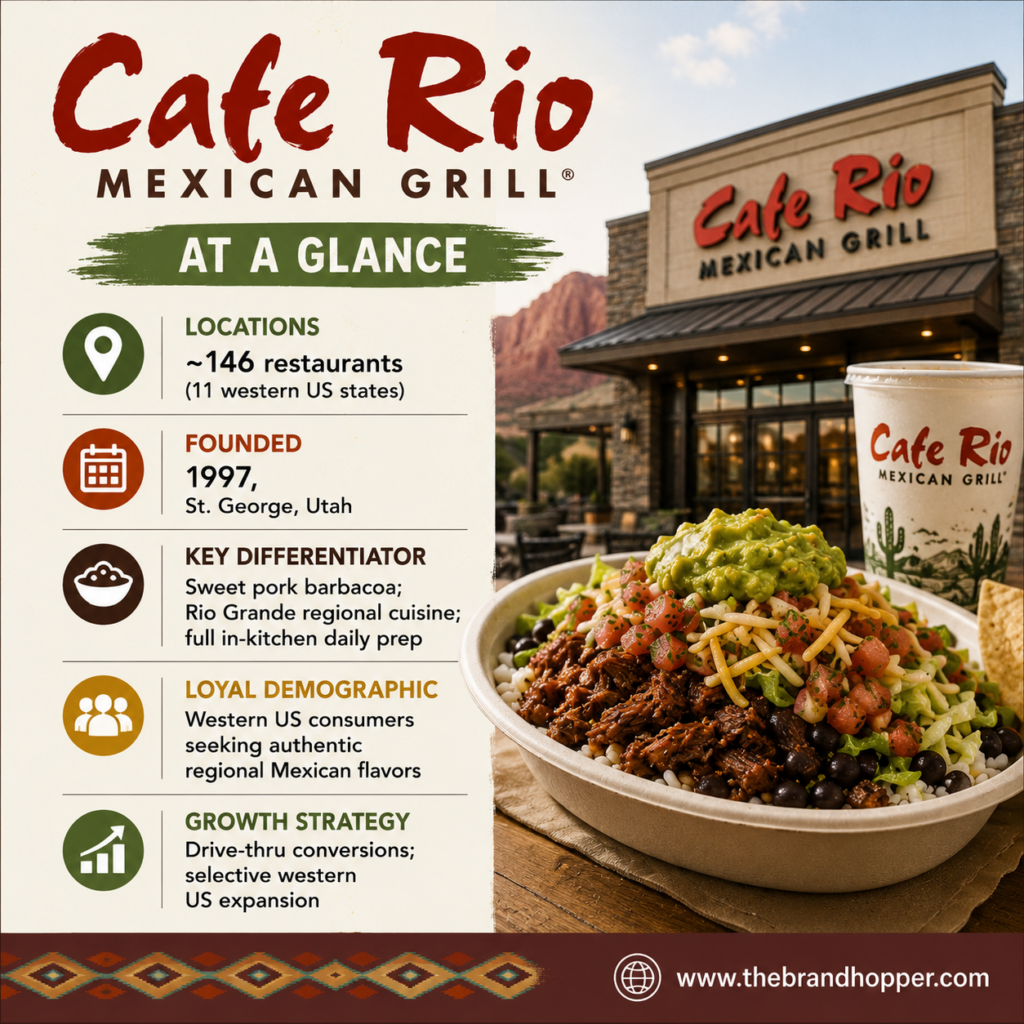
Cafe Rio differentiates itself through Rio Grande regional cuisine — drawing from the culinary traditions of Northern Mexico, Southern Texas, and New Mexico. Founded in St. George, Utah in 1997, the chain has become something of a cult brand in the western United States, particularly famous for its sweet pork barbacoa burritos prepared enchilada-style. This regional specificity creates a loyal following that tends to be fiercely protective of Cafe Rio versus Chipotle.
Operating 146 locations across 11 states — primarily western US — Cafe Rio’s competitive advantage is its authenticity: meals are cooked fresh daily in each restaurant’s open kitchen, a level of in-house preparation that even Chipotle’s “food with integrity” positioning partially delegates to central commissaries. Its growth strategy includes selective drive-thru conversions and geographic expansion into underserved western and southwestern markets.
Section B: Major Fast-Food Chain Competitors
6. Taco Bell
Website: www.tacobell.com
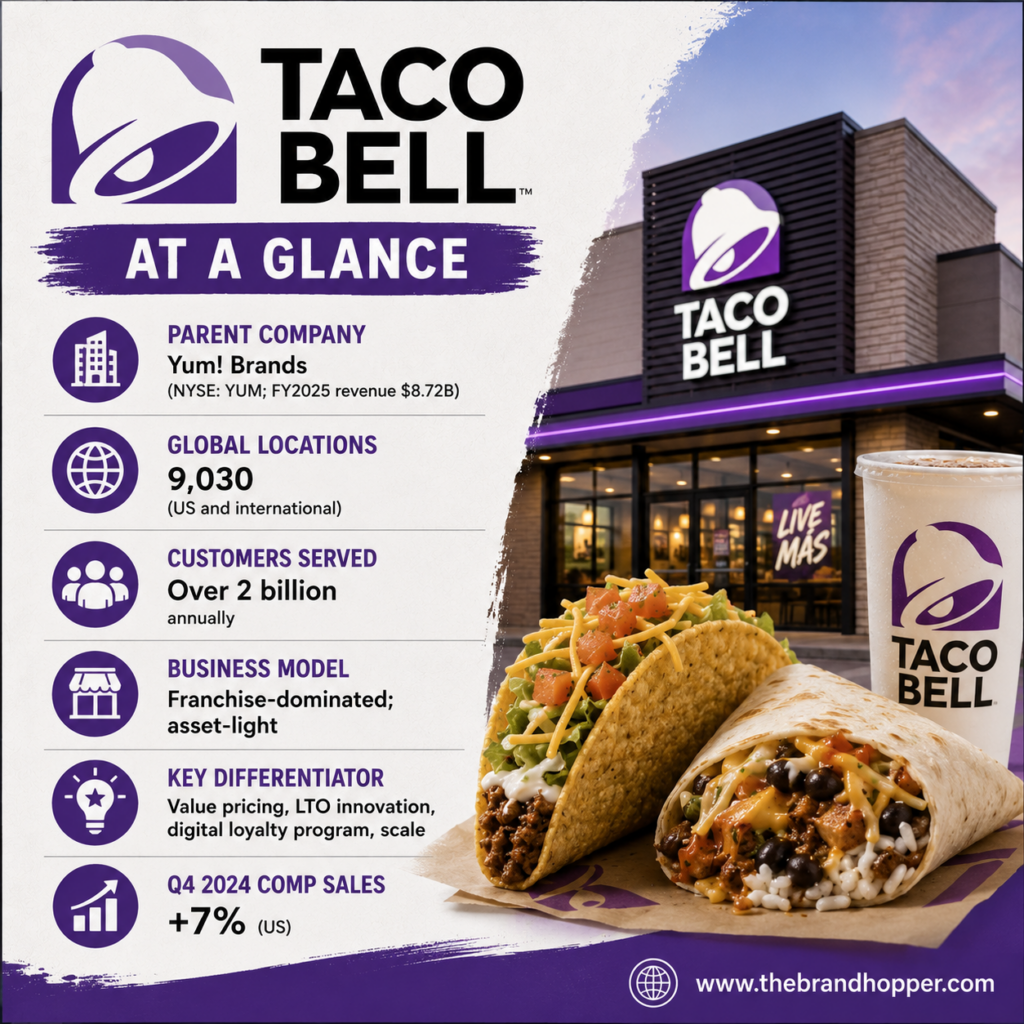
Taco Bell is the 800-pound gorilla of Mexican fast food and Chipotle’s most dangerous indirect competitor. A subsidiary of Yum! Brands (which reported total revenues of $8.72 billion in FY2025), Taco Bell operates more than 9,030 locations globally and serves over two billion customers annually — a scale that gives it unmatched marketing leverage, supply chain pricing power, and brand recognition.
Taco Bell competes with Chipotle not through product similarity but through value and convenience. Its ability to create buzz with limited-time offerings (the return of the Mexican Pizza generated more than 3 billion media impressions in 2022 alone), combined with aggressive value menu pricing, directly targets price-sensitive consumers who might otherwise trade up to Chipotle. In 2024, Taco Bell US delivered 7% same-store sales growth in Q4 and pushed digital sales through its loyalty program to over 50% of system sales at Yum! Brands overall.
Taco Bell’s “Live Mas” brand energy — irreverent, youth-oriented, culturally plugged-in — also competes directly for Gen Z mindshare with Chipotle’s more earnest “real ingredients” positioning. The two brands represent fundamentally different value propositions in the Mexican food space, but they compete for the same dining occasion in millions of markets every day.
7. Del Taco
Website: deltaco.com
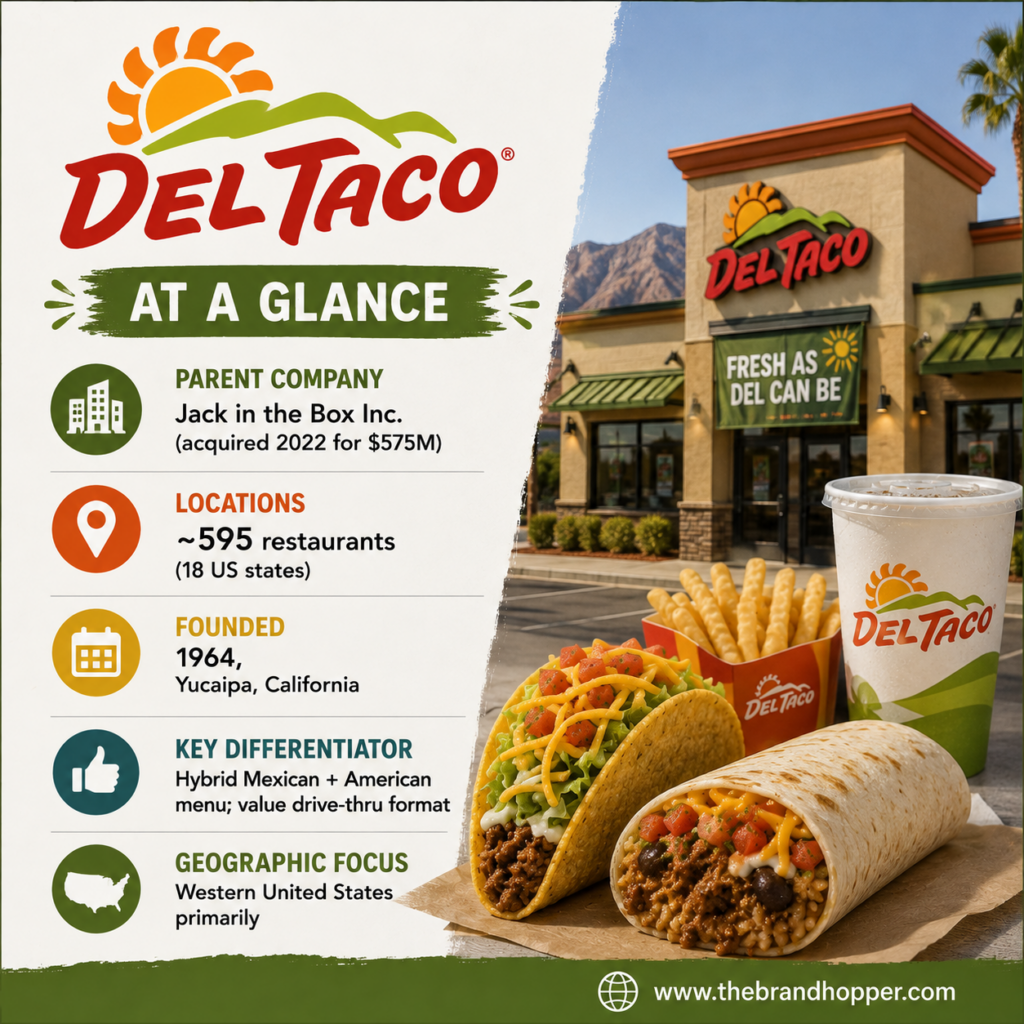
Del Taco occupies an unusual niche: a hybrid Mexican–American fast-food chain that offers both traditional Mexican fare and hamburgers, French fries, and breakfast items under one roof. Founded in 1964 and headquartered in Lake Forest, California, Del Taco operates approximately 595 locations across 18 states — primarily in the western US — making it primarily a regional competitor rather than a national one.
Following Jack in the Box’s acquisition of Del Taco in March 2022 for $575 million, the chain has undergone operational streamlining and brand refreshes. Its hybrid menu strategy — appealing to groups with mixed dietary preferences — differentiates it from pure-play Mexican competitors, while its drive-thru-centric format and value pricing make it a direct challenger to Taco Bell and an indirect one to Chipotle in fast casual adjacent markets.
Section C: Broader Fast-Casual Competitors
8. Panera Bread
Website: www.panerabread.com
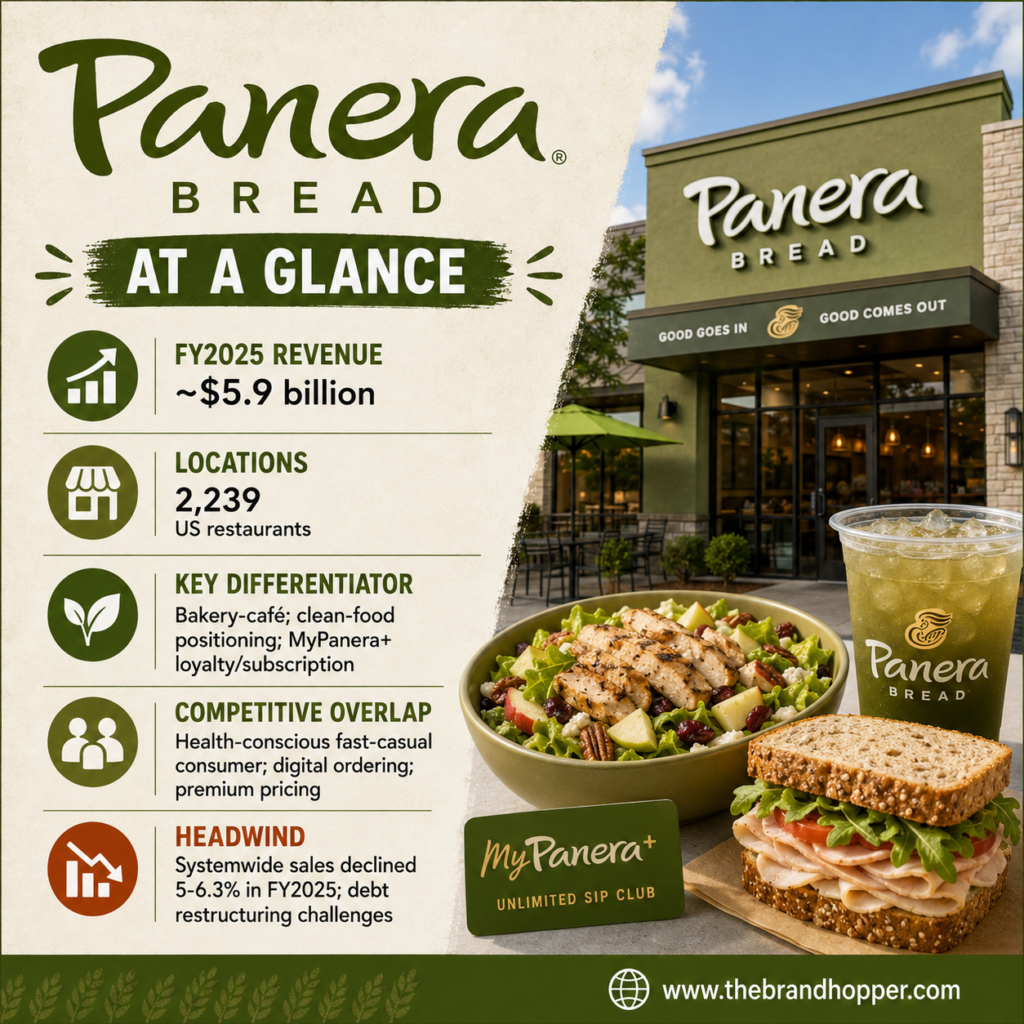
Panera Bread is the dominant bakery-café fast-casual brand in America, and despite serving zero Mexican food, it is one of Chipotle’s most important indirect competitors. With over 2,239 locations and FY2025 revenues of approximately $5.9 billion, Panera competes for the same health-conscious, premium fast-casual consumer that makes up Chipotle’s core customer base.
Panera’s “clean food” positioning — eliminating artificial colors, flavors, sweeteners, and preservatives from its menu — mirrors Chipotle’s own “Food With Integrity” sourcing story. The two chains do not compete for the same food; they compete for the same dining occasion and the same consumer identity: someone who wants to feel good about what they’re eating and is willing to pay $12–15 for the privilege.
Panera’s digital infrastructure — including its popular MyPanera+ subscription (unlimited coffee/tea for a monthly fee), mobile ordering, and delivery — demonstrates the operational sophistication fast-casual leaders must deploy to win in the modern market. The chain has encountered challenges with its debt load and declining systemwide sales (-6.3% in 2024), highlighting the risk of aggressive digital investment without proportionate traffic growth.
9. El Pollo Loco
Website: www.elpolloloco.com
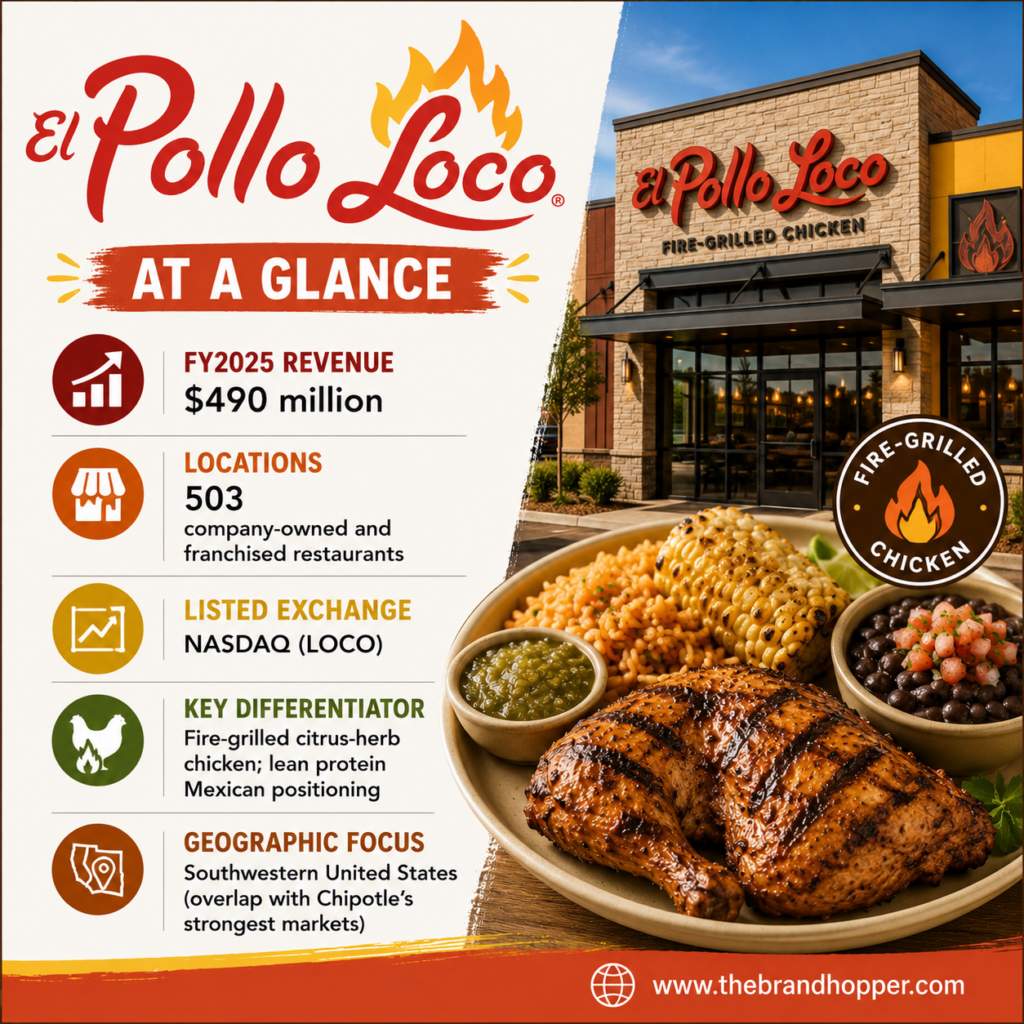
El Pollo Loco competes with Chipotle in the intersection of Mexican flavors and health-conscious protein choices — specifically fire-grilled chicken. Operating approximately 503 company-owned and franchised restaurants primarily in the Southwestern United States, El Pollo Loco reported FY2025 revenues of $490 million, a modest 0.93% increase year-over-year reflecting a mature, stable regional chain.
El Pollo Loco’s specialization in fire-grilled chicken — marinated using a citrus-herb recipe inspired by Mexican culinary tradition — differentiates it from both beef-heavy competitors and Chipotle’s protein-agnostic approach. Its pricing tends to be slightly below Chipotle, appealing to value-oriented consumers who still want the Mexican flavor profile and lean protein options of fire-grilled preparation.
As a publicly traded company on NASDAQ, El Pollo Loco possesses the financial resources and operational scale to compete through digital channels and loyalty programs. However, its regional concentration in the Southwest — the same geography where Chipotle has its deepest market penetration — creates concentrated competitive pressure rather than a buffer through geographic differentiation.
10. CAVA Group
Website: cava.com
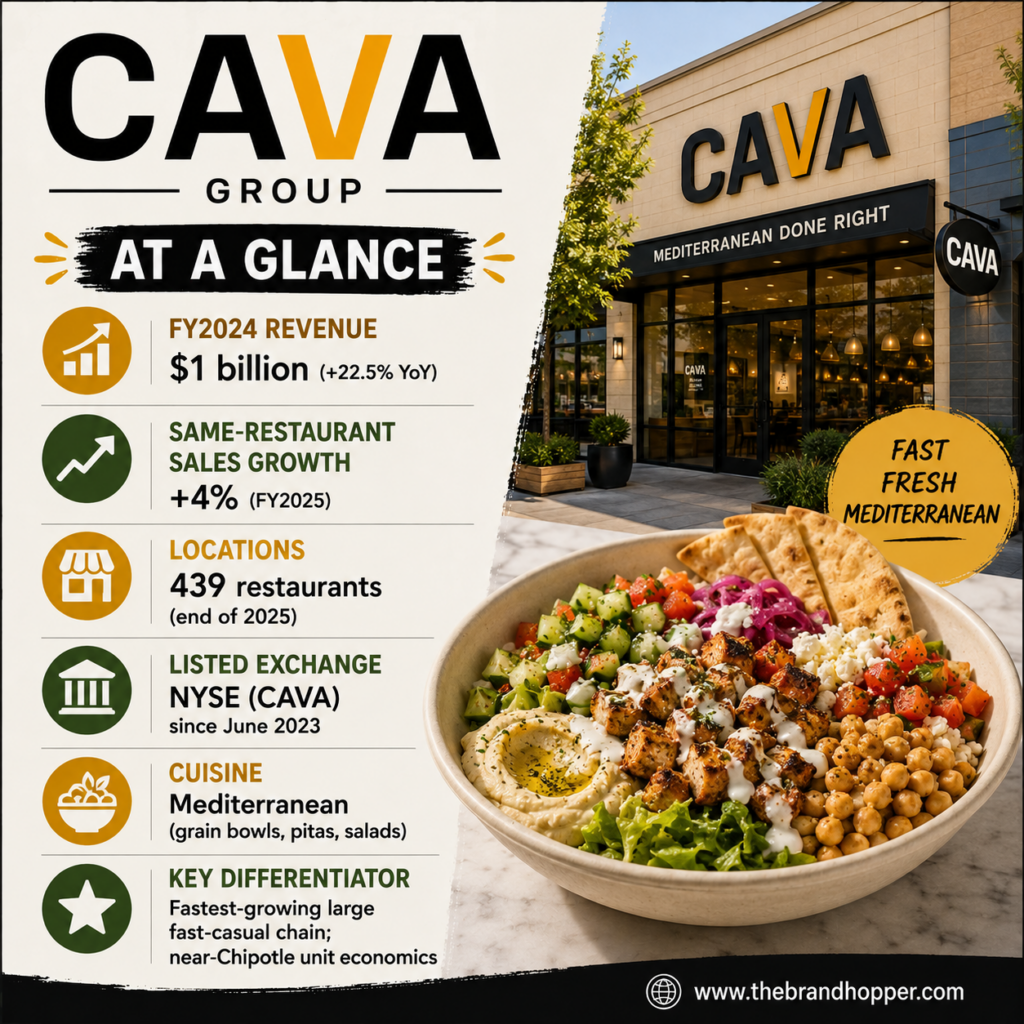
CAVA Group is the closest thing the fast-casual industry has seen to a new Chipotle. The Mediterranean fast-casual chain — serving customizable grain bowls, pitas, and salads with bold dips like harissa and tzatziki — went public in June 2023 at $22 per share and has been one of the restaurant sector’s highest-profile growth stories since. In FY2025, CAVA reported revenues of $1 billion, representing 22.5% revenue growth versus FY2024, with same-restaurant sales growth of 4%.
CAVA competes with Chipotle not for the same cuisine but for the same dining identity: the health-conscious, experience-seeking, digital-first consumer who wants customizable, high-quality food delivered with speed and transparency. CAVA’s Mediterranean bowl versus Chipotle’s burrito bowl is increasingly a direct comparison in the minds of consumers deciding where to spend $14-16 for a fast-casual lunch.
With 367 restaurants as of end-2024 and aggressive expansion planned across the US, CAVA is the #1 threat to Chipotle’s position that does not carry the word “Mexican” in its name. Its unit economics — AUVs approaching $2.8 million — already rival Chipotle’s own class-leading performance. Investors and analysts consistently compare the two companies, validating CAVA as a genuinely systemic competitor rather than a regional novelty.
11. Sweetgreen
Website: www.sweetgreen.com
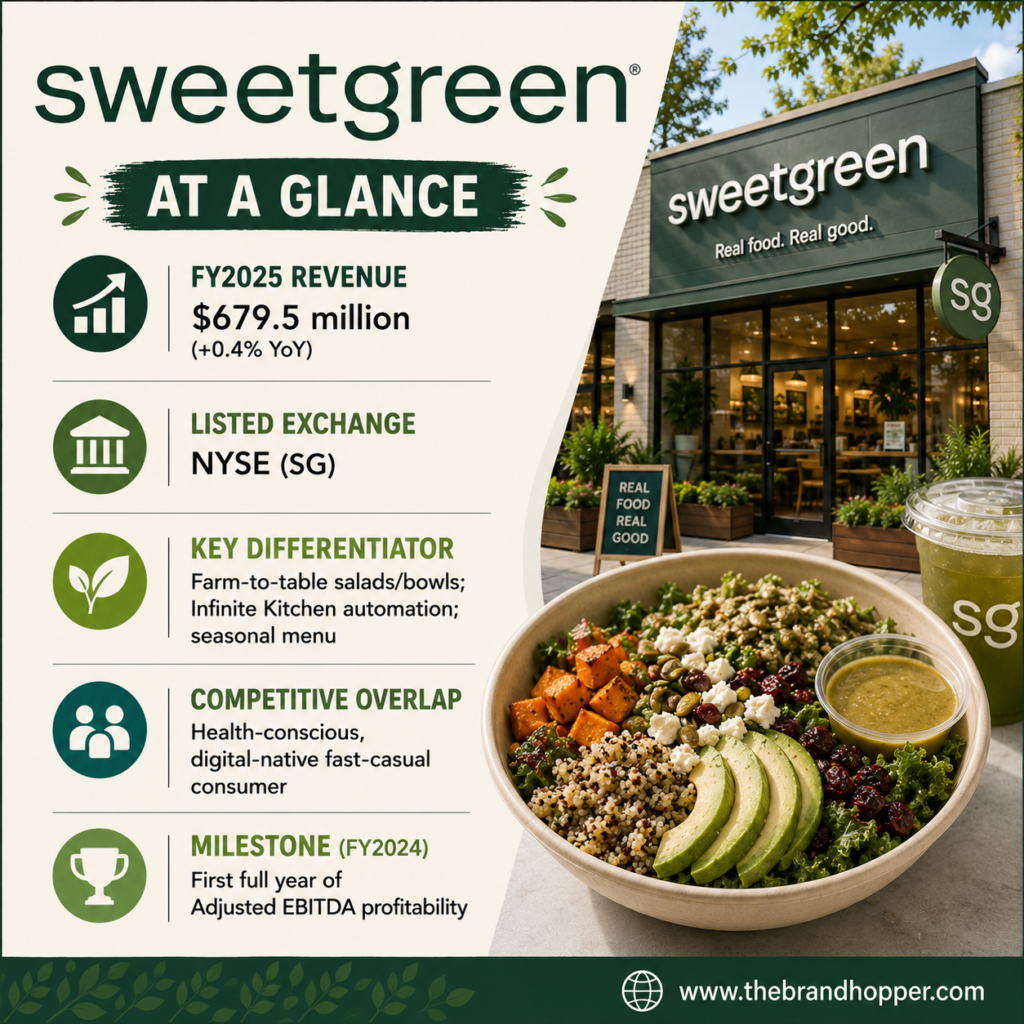
Sweetgreen is the fast-casual salad chain that turned $15 grain bowls into a mainstream proposition — and in doing so, built one of the most differentiated fast-casual brands in America. In FY2025, Sweetgreen reported revenues of $679.5 million, a 0.4% increase year-over-year — a milestone that validates its business model after years of investor skepticism.
Sweetgreen and Chipotle compete for an almost identical consumer: younger, health-conscious, sustainability-minded, and digitally engaged. Sweetgreen’s farm-to-table sourcing story, seasonal menu updates, and premium ingredient storytelling are aspirationally similar to Chipotle’s own messaging. The difference is cuisine (salads and warm bowls vs. burritos and tacos) and average check (Sweetgreen’s is slightly higher).
Sweetgreen’s Infinite Kitchen robotic assembly technology — rolling out across new restaurant formats — represents a genuine operational innovation that could lower labor costs and improve throughput, directly challenging Chipotle’s own automation investments (Autocado avocado-processing robot, Chippy tortilla chip fryer). The race for operational automation in fast-casual is one of the defining competitive dynamics of the next decade.
12. Shake Shack
Website: www.shakeshack.com
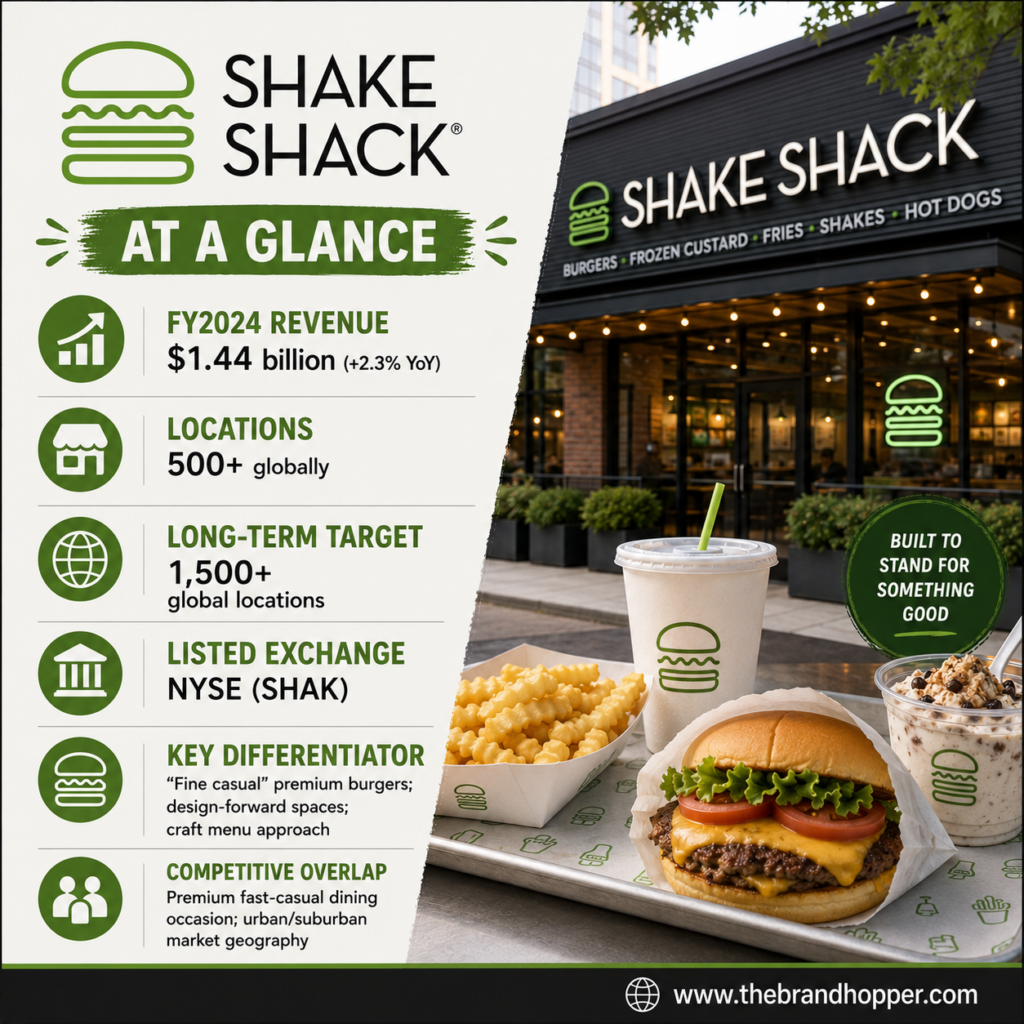
Shake Shack is the premium fast-casual burger brand that competes with Chipotle not through cuisine overlap but through the same premium fast-casual dining occasion. In FY2025, Shake Shack reported total revenues of $1.44 billion — a 2.3% increase over 2024 — driven by new unit openings and improvement in same-Shack sales performance across its 500+ locations globally.
Shake Shack’s “fine casual” positioning — thoughtfully sourced beef, craft beer pairings, design-forward restaurant environments — appeals to the same consumer willing to pay a premium for a “better” fast-food experience. When a family or group of friends is deciding between Chipotle and a Shake Shack nearby, those brands are competing for the same dining budget and dining occasion, even if they serve completely different food.
Shake Shack’s long-term target of 1,500+ global locations (vs. its current ~500) would bring it closer to Chipotle’s geographic coverage — intensifying the indirect competitive pressure on Chipotle in key urban and suburban markets where both chains cluster.
13. Wingstop
Website: www.wingstop.com
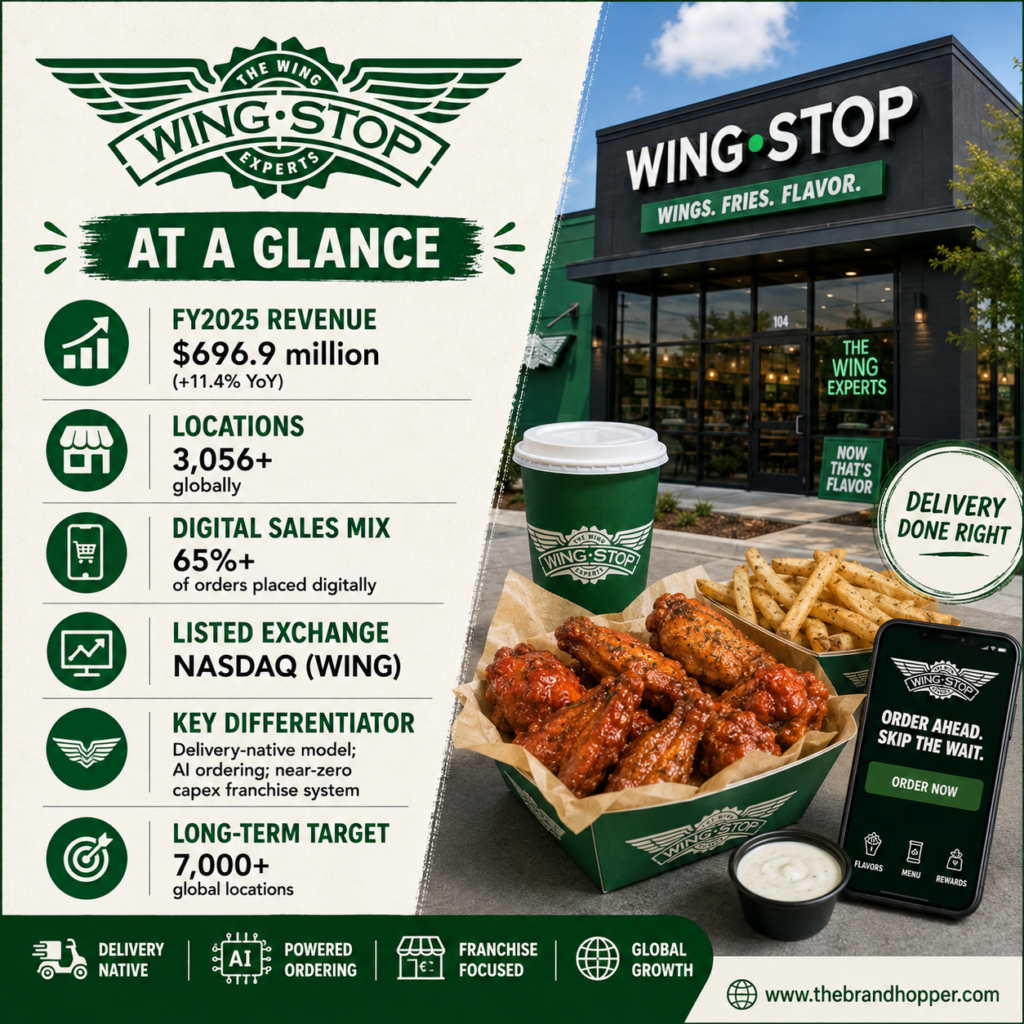
Wingstop is one of the fastest-growing restaurant brands in the US — and an increasingly significant competitor to Chipotle in delivery-driven fast-casual dining. In FY2025, Wingstop reported revenues of $696.9 million, a 11.4% increase versus 2024, with 3,056+ locations globally and domestic AUVs reaching $2.1 million after 493 net new restaurant openings.
Wingstop’s competitive relevance to Chipotle lies not in cuisine overlap but in delivery market dominance. As digital and delivery ordering has become a larger share of fast-casual revenue, Wingstop’s delivery-native model — where approximately 65%+ of orders are placed digitally — competes for the same digital-first ordering behavior that Chipotle depends on for its digital channel revenue (~35% of total sales).
Wingstop’s AI-powered digital ecosystem, its highly efficient franchise model (near-zero capital from Wingstop corporate), and its international expansion ambitions (targeting 7,000+ locations long-term) position it as a structural competitor to Chipotle’s share of the fast-casual delivery occasion.
14. Raising Cane’s Chicken Fingers
Website: www.raisingcanes.com
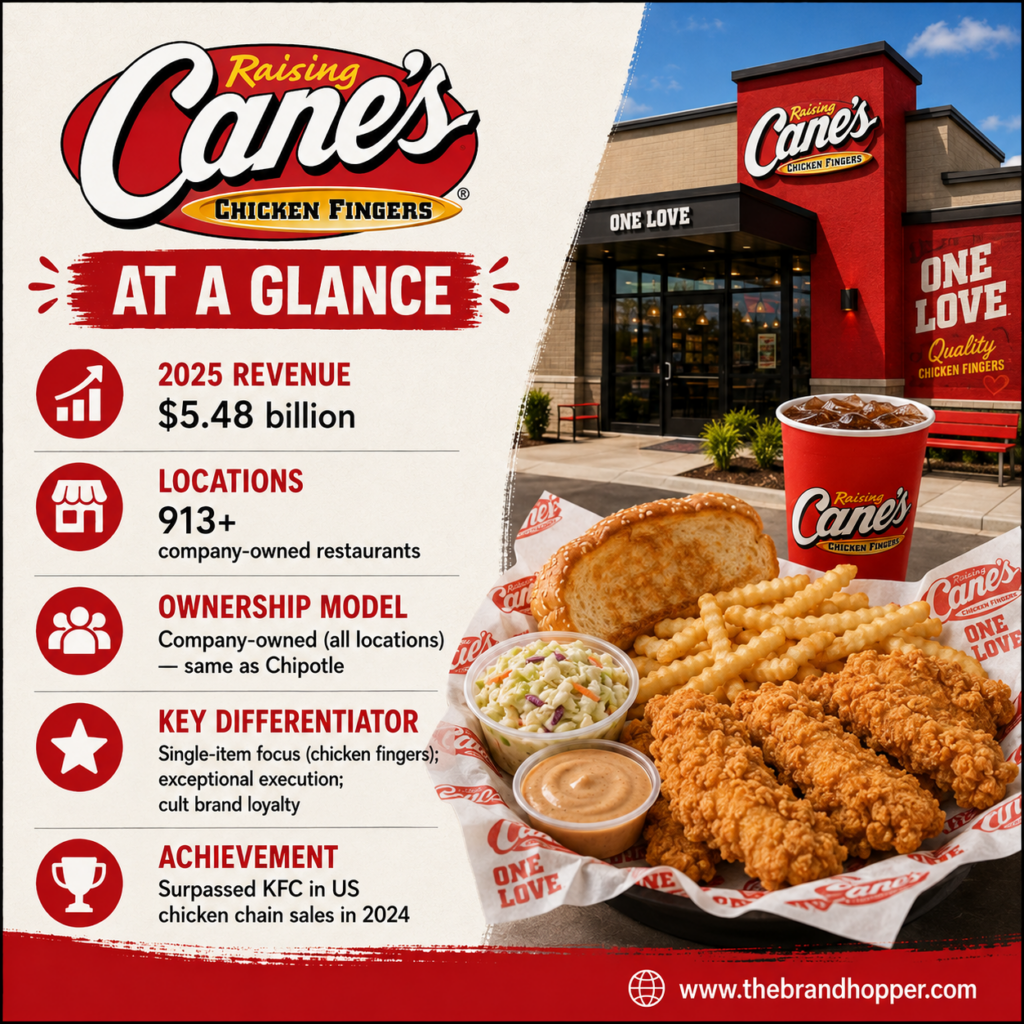
Raising Cane’s is the most dramatic fast-casual growth story of the past five years — a brand that built a $5+ billion business selling exactly one item (chicken fingers) with relentless quality and execution. In 2025, Raising Cane’s recorded $5.48 billion in revenue — a 34% increase — surpassing KFC in US chicken chain revenue for the first time and cementing itself as the third-largest chicken restaurant chain in America by annual sales.
Raising Cane’s operates 913 company-owned restaurants, having grown from 500 locations in 2020 — a 80%+ expansion in four years driven entirely by company-owned stores, mirroring Chipotle’s own company-owned model. This parallel growth strategy creates a direct comparison: both brands believe company ownership delivers better food quality and customer experience than franchising, and both are proving the model at scale.
The brand’s cult-like following — driven by consistently exceptional quality on a single menu item, genuine community engagement, and founder Todd Graves’ authentic personal brand — represents a competitive philosophy directly analogous to what made early Chipotle so powerful. As Raising Cane’s continues rapid expansion into new markets, it competes increasingly for the same dining occasions, the same lunchtime traffic, and the same crew labor pool as Chipotle.
15. Chick-fil-A
Website: www.chick-fil-a.com
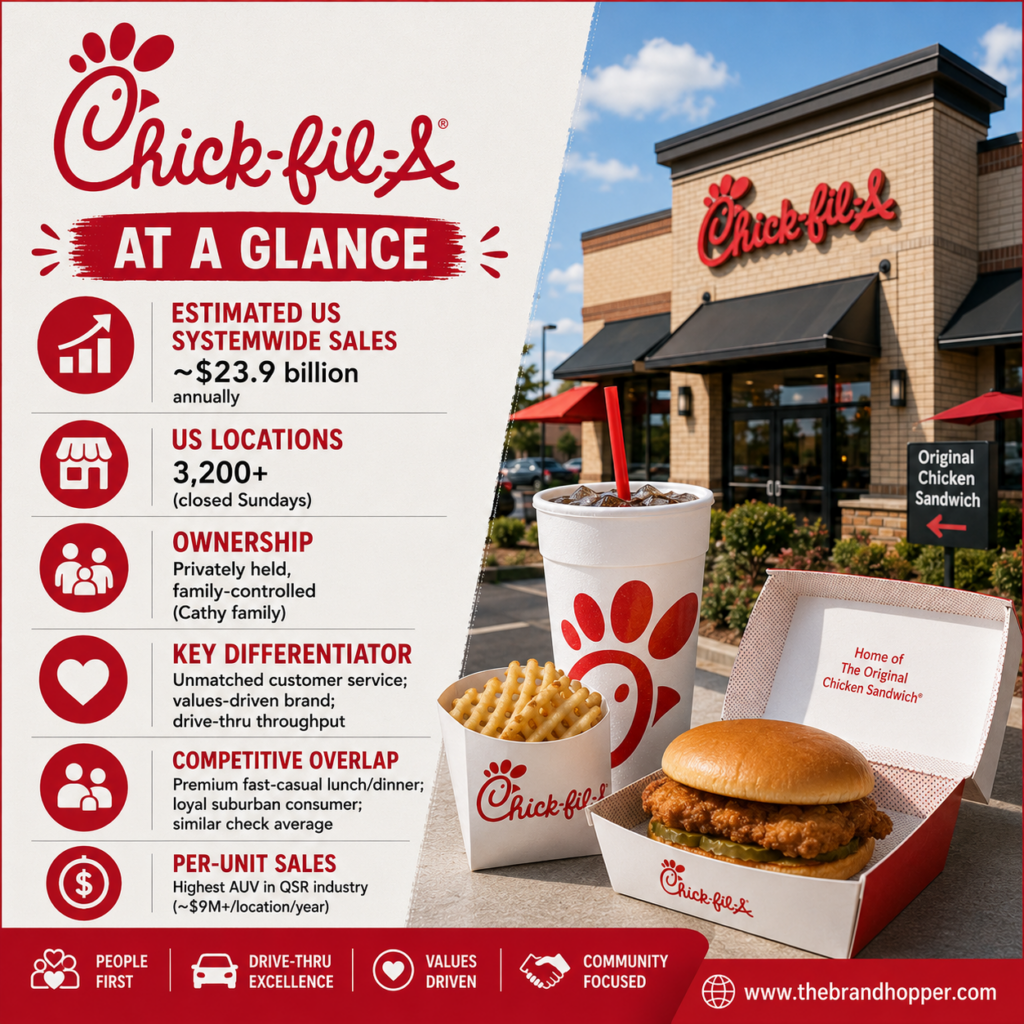
Chick-fil-A is the largest US chicken chain by systemwide sales and the fast-food chain that has most successfully replicated Chipotle’s model of building a brand premium through values, quality, and customer service — rather than through discounting. Chick-fil-A generates approximately $23.9 billion in US systemwide sales annually across its 3,200+ US locations — despite being closed on Sundays, a structural limitation that makes its per-unit and per-day sales figures the most impressive in the industry.
Chick-fil-A competes directly with Chipotle for the same high-value fast-casual lunch and dinner occasions in suburban and urban markets across the US. Both chains operate similarly priced menus ($12–16 average check), both emphasize quality sourcing, and both run highly successful loyalty programs. Chick-fil-A’s drive-thru throughput — its dual-lane systems process hundreds of cars per hour — represents an operational benchmark that Chipotle’s Chipotlane format is specifically designed to match.
As a privately held, family-controlled company with no debt-driven growth pressure, Chick-fil-A can invest patiently in brand building, employee training, and restaurant experience — the same long-game philosophy that underlies Chipotle’s company-owned model. The two brands represent the two most powerful values-driven fast-casual/QSR brands in America, competing intensely for the same premium consumer in thousands of overlapping markets.
Competitive Positioning & Differentiation Strategies
The competitive landscape surrounding Chipotle reveals several distinct strategic approaches that together form a comprehensive challenge to its market leadership.
1. Franchise vs. Company-Owned: The Scale Debate
Chipotle’s unwavering commitment to company-owned stores gives it superior operational control, brand consistency, and margin retention — but at the cost of slower expansion. Qdoba, Moe’s, and Wingstop use franchise models to achieve faster geographic footprints with minimal corporate capital. The franchise model trades consistency for speed; Chipotle’s model trades speed for consistency. Raising Cane’s is the only direct fast-casual competitor matching Chipotle’s company-owned scale approach — and both brands’ unit economics validate that decision.
2. Menu Differentiation: Niche vs. Breadth
Rubio’s (fish tacos), Cafe Rio (Rio Grande regional cuisine), El Pollo Loco (fire-grilled chicken), and CAVA (Mediterranean) all compete through menu differentiation that Chipotle cannot easily replicate without brand dilution. Chipotle’s focused menu — burritos, bowls, tacos, and quesadillas — is its greatest strength and its greatest constraint. Competitors exploit the gap between Chipotle’s high-volume model and more specialized consumer cravings.
3. Digital & Technology as the New Competitive Moat
The fast-casual arms race is now fought as much on app downloads as on restaurant counts. Chipotle’s digital channel (~35% of sales), Wingstop’s 65%+ digital mix, Sweetgreen’s Infinite Kitchen automation, and CAVA’s digital-native loyalty ecosystem all demonstrate how technology investment is reshaping competitive advantage. Brands that fail to build robust digital ordering, loyalty, and delivery infrastructure — as Panera’s challenges illustrate — find themselves structurally disadvantaged regardless of food quality.
4. The Health-Conscious Consumer: The Most Contested Battlefield
The single most valuable fast-casual consumer — health-conscious, ingredient-aware, sustainability-minded, and willing to pay $14-18 for lunch — is the prize that every competitor in this analysis is pursuing. Chipotle has historically owned this consumer. CAVA, Sweetgreen, and Shake Shack are mounting the most credible challenges to that ownership in the brand’s history. Whoever wins this demographic over the next five years will define the fast-casual hierarchy for the decade that follows.
Frequently Asked Questions (FAQs)
Q: Who is Chipotle’s biggest competitor?
A: Chipotle’s biggest direct competitor is Qdoba Mexican Eats — the closest format-for-format rival, with ~840 locations and $1.2 billion in systemwide sales in FY2024. However, Chipotle’s most financially significant indirect competitor is Taco Bell (8,200+ locations, Yum! Brands $7.5B revenue) in the Mexican dining space, and CAVA Group in the fast-casual health-conscious consumer space. By systemwide sales, Chick-fil-A (~$22B) and Raising Cane’s ($5.1B) represent the most formidable competitors in the broader fast-casual and QSR universe.
Q: How much revenue does Chipotle make?
A: Chipotle Mexican Grill reported total revenue of $11.93 billion in fiscal year 2025 (ended December 31, 2025), representing 5.4% growth year-over-year. Comparable restaurant sales declined 1.7%, driven by a 2.9% decrease in transactions, partially offset by a 1.2% increase in average check. Restaurant-level operating margin was 25.4%. As of the end of 2025, Chipotle had 4,056 restaurants, including 4,042 company-owned restaurants and 14 international partner-operated restaurants
Q: Is CAVA a threat to Chipotle?
A: Yes — CAVA is arguably Chipotle’s most strategically significant long-term threat. Though it serves Mediterranean food rather than Mexican, CAVA competes for the exact same consumer (health-conscious, premium fast-casual, digital-first) in the same format (customizable grain bowls vs. Chipotle’s burrito bowls). CAVA’s FY2024 revenue grew 33.1% to $954 million with 13.4% same-restaurant sales growth. Its unit economics (AUVs approaching $2.8M) are on a trajectory to rival Chipotle’s. As CAVA expands beyond 500 locations, the competitive overlap with Chipotle will intensify significantly.
Q: Why is Chipotle hard to compete with?
A: Chipotle is difficult to compete with for several structural reasons: (1) Supply chain scale — ordering more than any single produce or protein supplier in the US gives Chipotle extraordinary purchasing power; (2) Throughput efficiency — its assembly-line model processes 200+ customers per hour at peak; (3) Brand equity — built over 30+ years around ‘Food With Integrity’, creating genuine consumer trust; (4) Chipotlane infrastructure — its digital-pickup drive-thrus have structurally improved convenience without franchising; (5) Company-owned model — tight operational control produces consistency that franchise systems cannot easily match.
Q: How does Qdoba differ from Chipotle?
A: Qdoba and Chipotle are almost identical in format — both serve customizable Mexican burritos, bowls, and tacos through a fast-casual assembly line. The key differences are: (1) Queso: Qdoba includes queso at no extra charge; Chipotle charges extra. (2) Business model: Qdoba is primarily franchise-operated; Chipotle is entirely company-owned. (3) Scale: Chipotle has 3,726 locations; Qdoba has ~840. (4) Ownership: Butterfly Equity (private equity) owns Qdoba; Chipotle is publicly traded. (5) Menu breadth: Qdoba offers breakfast and more promotional items vs. Chipotle’s focused core menu.
Q: Does Chipotle have international competitors?
A: Outside the US, Chipotle faces different competitive landscapes. In the UK and Europe, Tortilla (a British fast-casual burrito chain) and local Mexican concepts compete alongside Chipotle’s small international presence (82 restaurants as of Dec 2024). In Canada, Chipotle competes with Mucho Burrito and local concepts. Taco Bell and McDonald’s are global competitors for the broader quick-service dining occasion in all markets. Chipotle has stated ambitions to grow its international footprint significantly, which will expose it to additional regional competitors in each new market.
Q: What is the fast-casual restaurant industry worth?
A: The overall fast-food market (which includes fast-casual as a premium segment) is valued at approximately $809 billion globally as of 2024. Within that, the US fast-casual segment — led by Chipotle — is one of the fastest-growing subsegments. The Mexican restaurant subsector alone generates nearly $82.3 billion in annual US sales across 73,000+ locations. Fast-casual has outpaced traditional fast-food in growth for over a decade, driven by consumer demand for fresher ingredients, more customization, and better dining experiences at accessible price points.
Q: Is Raising Cane’s bigger than Chipotle?
A: No — Chipotle is significantly larger. Chipotle had $11.3 billion in FY2024 revenue from 3,726 restaurants. Raising Cane’s had approximately $5.1 billion in 2024 revenue from 900+ locations. However, Raising Cane’s is growing faster in percentage terms (+34% revenue growth vs. Chipotle’s +14.6%) and its company-owned expansion model mirrors Chipotle’s. At its current trajectory, Raising Cane’s is on a path to become one of the top fast-casual brands by sales within the next 5-7 years — making it one of the most important competitive threats to Chipotle’s long-term position.
Q: Why did Rubio’s file for bankruptcy?
A: Rubio’s Coastal Grill filed for bankruptcy in 2025, reflecting the structural challenges facing specialized regional fast-casual chains in an increasingly competitive and cost-intensive market. Key factors included: rising labor and food costs reducing margins, increasing competition from better-capitalized national brands, the difficulty of maintaining brand differentiation (fish tacos) as a premium positioning across all market conditions, high debt from prior ownership transitions, and limited geographic diversification (primarily California, Arizona, Nevada). Rubio’s story illustrates that niche specialization can be a powerful differentiator but also creates vulnerability when economic headwinds intensify.
Q: How does Chipotle use technology to stay ahead of competitors?
A: Chipotle deploys technology across multiple competitive dimensions: (1) Chipotlane — digital pick-up-only drive-thru format generating higher digital order mix and throughput; 257 of 304 new locations opened in 2024 included Chipotlanes. (2) Autocado — a collaborative robot that cuts, cores, and peels avocados, reducing labor time on Chipotle’s most labor-intensive ingredient. (3) Chippy — an AI-powered tortilla chip frying robot reducing process variability. (4) Digital ordering — approximately 35% of Chipotle transactions are digital, enabling better demand forecasting and personalization. (5) Loyalty program — Chipotle Rewards has over 40 million enrolled members, providing first-party data for targeted marketing and offers.
Also Read: A Deep Dive into the Marketing Strategies of Chipotle
Also Read: Brand Elements and Brand Strategies of Chipotle
Also Read: Marketing Mix And STP Analysis of Chipotle