


The global eyewear industry is one of the most dynamic intersections of healthcare, technology, fashion, and retail in the world. At its apex stands EssilorLuxottica — controlling an extraordinary share of the eyewear supply chain, from lens manufacturing to branded frames and optical retail storefronts. Yet even with €26.5 billion in FY2024 revenue, the market is large enough and diverse enough that formidable competitors have built significant, growing businesses across every segment.
In this comprehensive guide, we profile the top competitors of EssilorLuxottica — analysing their financial performance, brand portfolios, competitive strengths, and strategic direction. Coverage spans frame manufacturers, lens technology companies, optical retailers, direct-to-consumer disruptors, and contact lens specialists.

Understanding EssilorLuxottica: The Market Leader
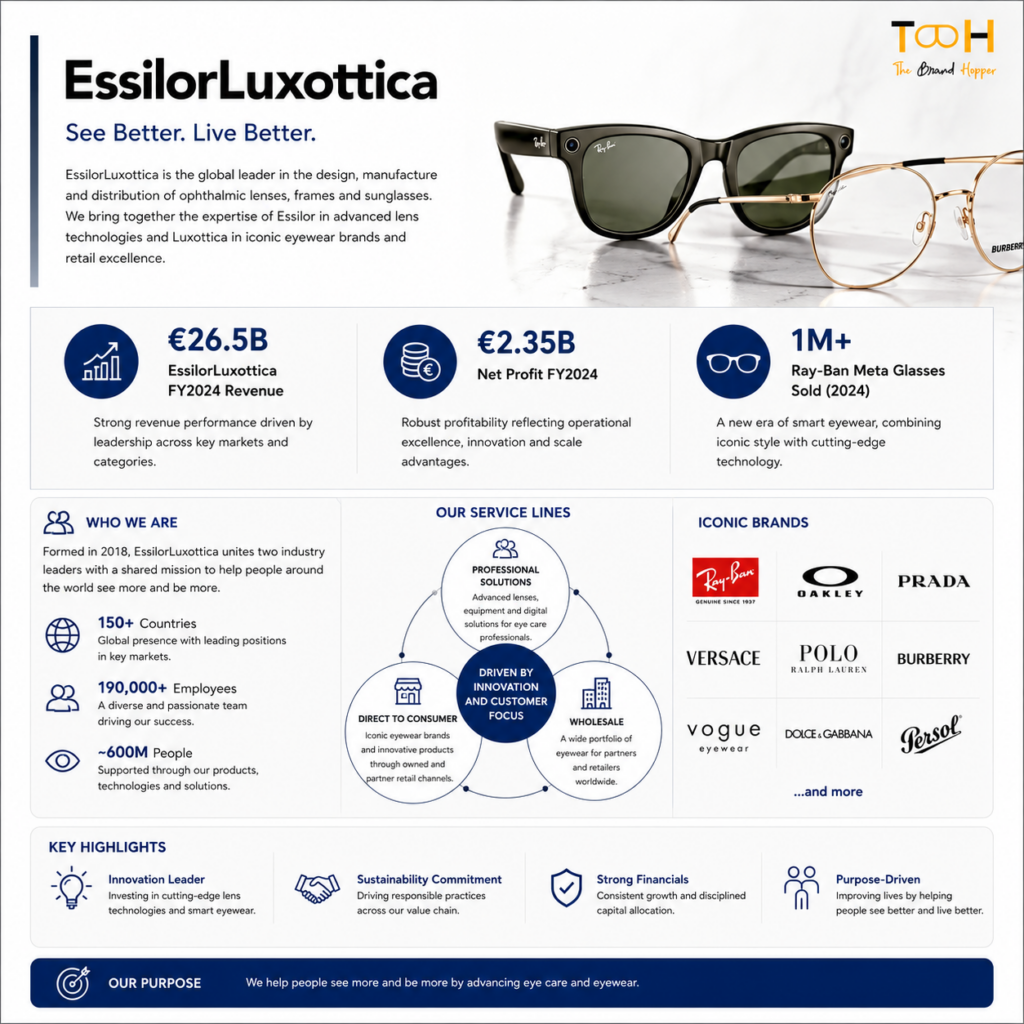
Before examining its competition, it is essential to understand how dominant EssilorLuxottica is. Born from the 2018 merger of French lens giant Essilor and Italian frame powerhouse Luxottica, the group brings together the world’s largest spectacle lens manufacturer with the world’s largest eyewear frame company. CEO and Chairman Francesco Milleri leads a strategy built on premiumisation, technology integration, and the convergence of eyewear with consumer electronics.
EssilorLuxottica’s brand portfolio is unmatched in breadth: Ray-Ban, Oakley, Persol, Oliver Peoples, Vogue Eyewear, Costa del Mar, Arnette, Alain Mikli, and — following a $1.5 billion acquisition — Supreme. It holds licensed manufacturing agreements with over 20 luxury fashion houses and operates retail chains including LensCrafters, Sunglass Hut, Target Optical, and Pearle Vision. The Ray-Ban Meta smart glasses partnership with Meta generated an estimated €365 million in revenue in 2024 from over one million pairs sold — with projections suggesting this single product line could reach €800 million annually and exceed €6 billion by 2030.
The group is targeting a revenue range of €27–28 billion by end of its 2022–2026 guidance period, reflecting mid-single-digit annual expansion.
For a complete guide to EssilorLuxottica’s owned brands, see:
A Deep-Dive into Iconic Brands Owned by Luxottica Group
The Global Eyewear Market: Setting the Competitive Stage
The global eyewear market is estimated at US$150–200 billion in current value, with compound annual growth rates of approximately 5.5–9.5% projected through the early 2030s. Key structural tailwinds include: rising global myopia rates (particularly in Asia), an ageing population requiring vision correction, the emergence of smart glasses as a new consumer technology category, growing demand for premium and personalised lenses, and e-commerce enabling mass-market disruption at the affordable price point.
This breadth of market — spanning prescription optics, fashion sunwear, contact lenses, ophthalmic surgery, online direct-to-consumer, and luxury retail — means that EssilorLuxottica’s competitors take many different forms. The 15 companies profiled below collectively represent the full competitive landscape.
Top Competitors of EssilorLuxottica
1. Safilo Group

Website: https://www.safilogroup.com/en
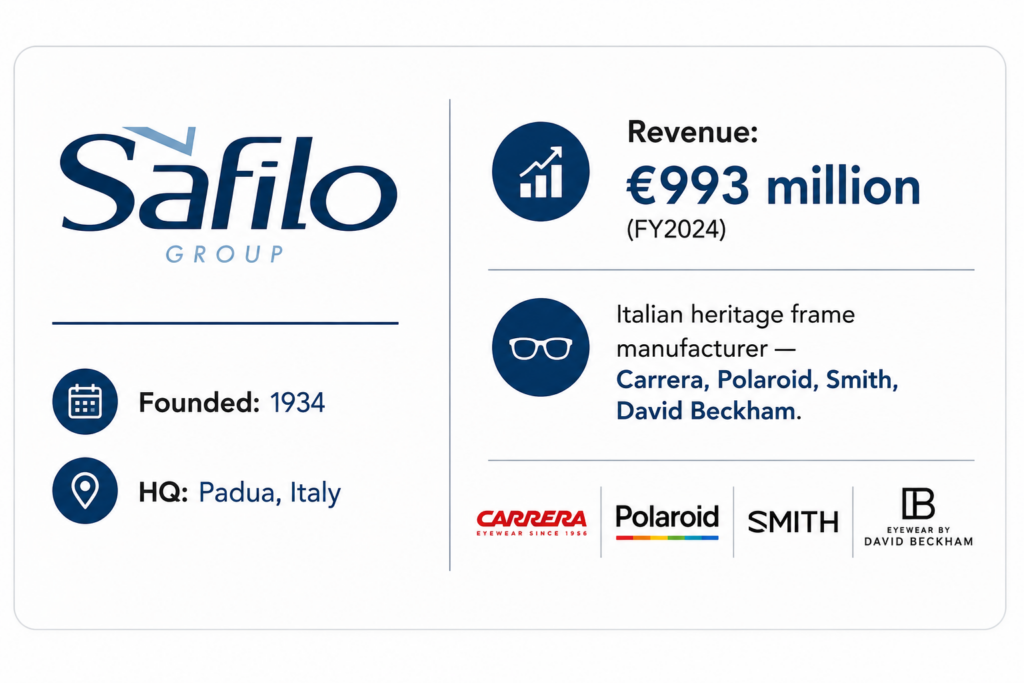
Safilo Group is one of the most storied independent eyewear companies in the world, tracing its origins to a small frame workshop in Padua in 1934. As a publicly listed Italian manufacturer, Safilo competes with EssilorLuxottica on frame design and manufacturing, and as a rival licensor of fashion brand eyewear.
For the full year 2024, Safilo reported net revenues of €993.2 million — a 2.3% decline at constant exchange rates, partly attributable to the expiration of the Jimmy Choo licence. Despite the top-line pressure, the gross industrial margin reached 59.7%, adjusted EBITDA margin came in at 9.4%, and adjusted net income more than doubled to €34.2 million, demonstrating improving underlying profitability. Net debt remained stable at €82.7 million.
Safilo’s owned brand portfolio includes Carrera (sporty, lifestyle-oriented designs with a motorsport heritage), Polaroid (affordable polarised lenses and value sunwear), and Smith (premium outdoor sports eyewear). Licensed brands include Tommy Hilfiger, Marc Jacobs, Carolina Herrera, and — following a major FY2024 deal — Eyewear by David Beckham, for which Safilo acquired a perpetual licence. Carrera and David Beckham both delivered double-digit growth through 2024.
On the innovation front, Safilo has invested significantly in sustainable materials, launching collections of biodegradable frames. Its “Safilo Create” incubator programme supports independent designers, and its digital sales platform for optical professionals continues to improve order management and service delivery.
2. Marchon Eyewear
Website: https://www.marchon.com
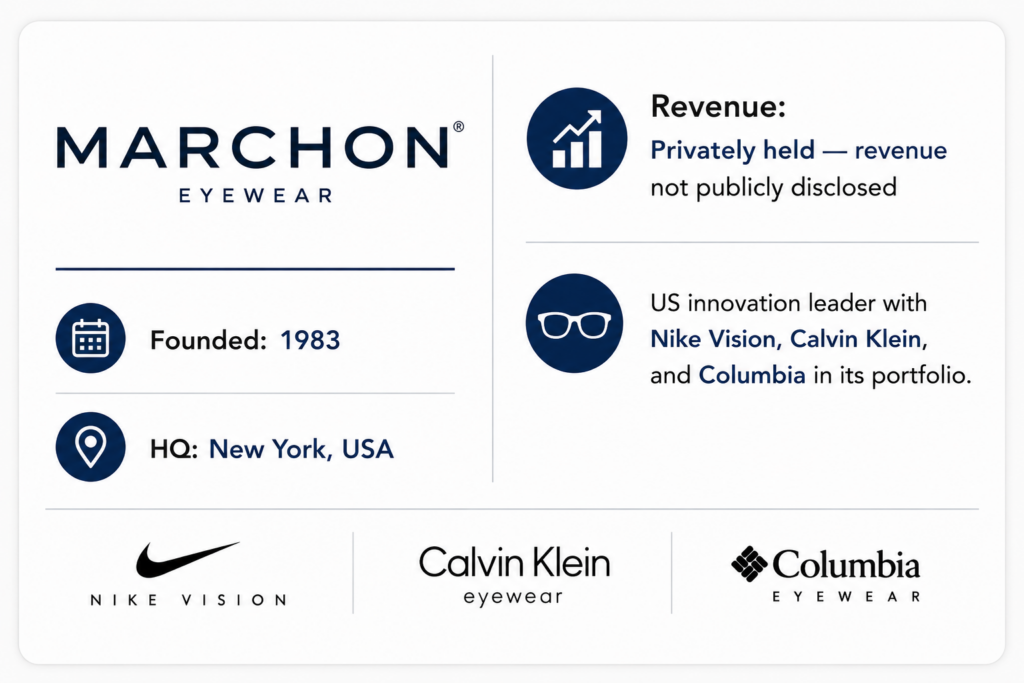
Founded in 1983 and headquartered in New York, Marchon Eyewear has built a global distribution network spanning more than 100 countries — a reach that rivals far older European incumbents. It operates as a subsidiary of Zyl AS, a Norwegian holding company.
Marchon’s competitive edge lies in its exceptional brand licensing portfolio. Nike Vision applies Nike’s performance engineering to eyewear — combining sport functionality with the world’s most recognised athletic brand. Calvin Klein delivers minimalist, fashion-forward frames. Columbia Sportswear caters to outdoor enthusiasts with durable, functional designs. Skagen and Flexon add Scandinavian design and flexible materials respectively.
On the materials side, Marchon’s proprietary “Marchon Xceed” frame material is both lighter and more durable than traditional acetate — a genuine product innovation that has resonated with optical professionals. Its investment in 3D printing technology for design prototyping has compressed its time-to-market. Marchon’s comprehensive optical lab network and swift delivery capabilities make it a preferred wholesale partner for eye care professionals across North America, Europe, and Asia.
3. De Rigo
Website: https://www.derigo.com/en
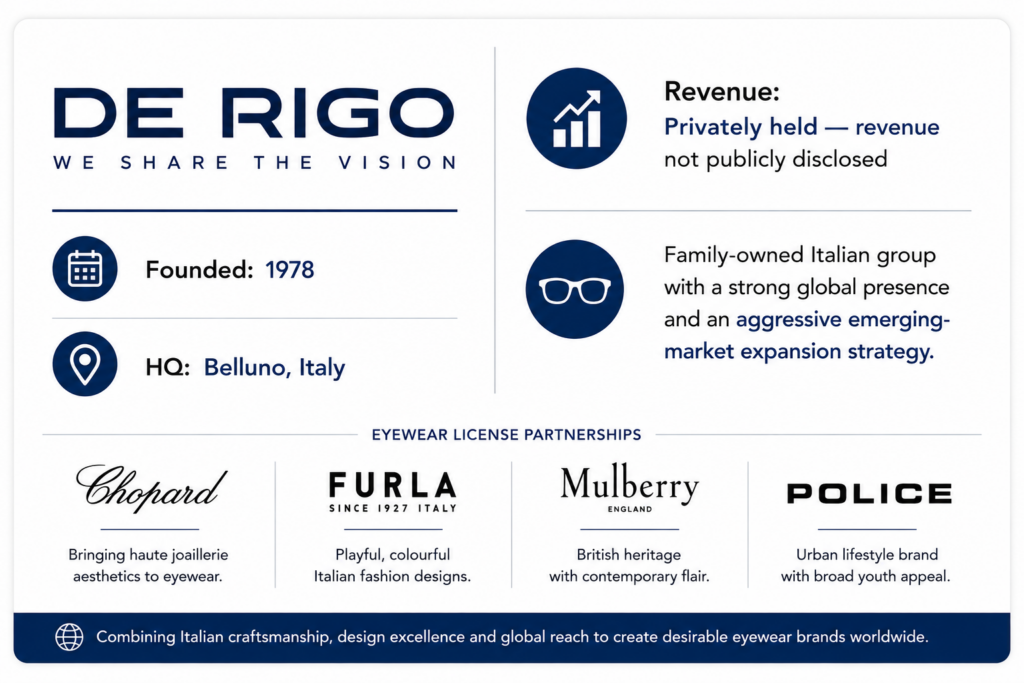
Founded in 1978 in Belluno — the heartland of Italian eyewear manufacturing — De Rigo is a remarkable example of a family business competing successfully against larger publicly listed rivals. The company has grown from a small artisanal workshop into a global distributor and manufacturer with reach across multiple continents.
De Rigo’s luxury licence portfolio features agreements with Chopard (bringing haute joaillerie aesthetics to eyewear), Furla (playful, colourful Italian fashion designs), Mulberry (British heritage with contemporary flair), and Police (urban lifestyle brand with broad youth appeal). These premium partnerships position De Rigo firmly at the upper tier of the licensed eyewear market.
A distinctive competitive characteristic of De Rigo is its deliberate focus on emerging markets. Rather than competing head-to-head in saturated European and North American channels, the company has aggressively developed its footprint in Asia and Latin America — regions where rising middle-class affluence is driving rapid premium consumer goods growth. De Rigo also operates the Optical Discount retail chain in Italy, providing a direct-to-consumer channel that complements its wholesale business.
4. Fielmann Group
Website: https://www.fielmann-group.com/en
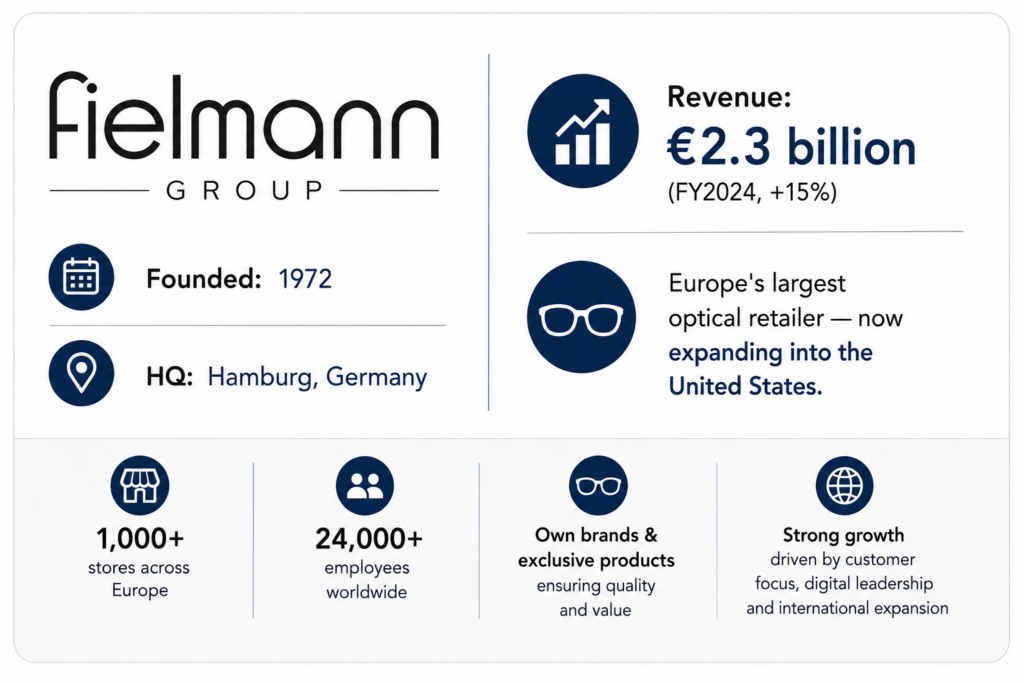
Fielmann Group is the dominant optical retailer in Europe and one of the most important competitors in the distribution layer of EssilorLuxottica’s value chain. Founded in 1972 in Hamburg by Günther Fielmann, the company built its empire on a simple but powerful consumer promise: high-quality prescription eyewear at affordable, transparent prices.
For the full year 2024, Fielmann delivered consolidated sales of €2.3 billion — a 15% increase driven by organic growth of 7% and the consolidation of US acquisitions contributing 8%. The adjusted EBITDA margin improved to approximately 21.7%. Double-digit growth was achieved in Austria (+10%), Spain (+10%), and Poland (+32%). The recommended dividend increased to €1.15 per share.
Fielmann’s customer proposition includes its “Satisfaction Guarantee” and transparent pricing — including free basic prescription eyewear under many European health schemes. Its e-commerce platform with virtual try-on technology and online vision testing extends its reach digitally. The group’s most strategically significant recent move is its US entry through targeted acquisitions of optical retail chains — bringing its proven European formula to the world’s largest eyewear market.
5. Warby Parker
Website: https://www.warbyparker.com/
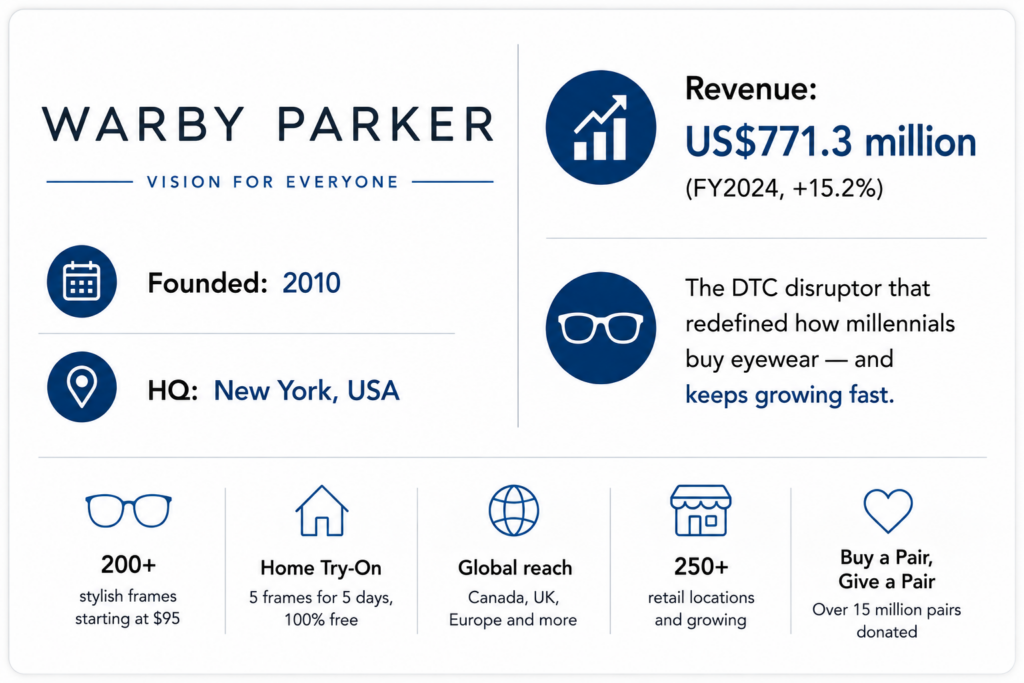
Founded in 2010, Warby Parker redefined the economics of eyewear retail. By designing its own frames, selling directly online and through owned stores, and cutting out licenced-brand markups, it brought fashionable prescription glasses to consumers at a fraction of traditional prices — and made the category feel culturally relevant again.
For the full year 2024, Warby Parker reported net revenue of US$771.3 million (+15.2%); active customers grew 7.8% to 2.51 million; average revenue per customer rose 6.8% to US$307; gross margin improved to 55.3%. The company opened 41 new stores during 2024, ending the year with 276 locations across the US and Canada. For 2025, the company projects US$878–893 million in revenue (14–16% growth), a credible target given its trajectory.
Warby Parker’s legendary “Home Try-On” programme — five frames sent home for free to try for five days — was a genuine retail innovation that has been widely copied. Its augmented reality virtual try-on app further reduces purchase friction. The “Buy a Pair, Give a Pair” programme has donated millions of pairs of glasses globally through non-profit partners, creating social purpose alignment that resonates strongly with younger consumers. Warby Parker is also expanding its eye care services, adding optometrists and vision tests to more stores.
6. Kering Eyewear
Website: https://www.keringeyewear.com
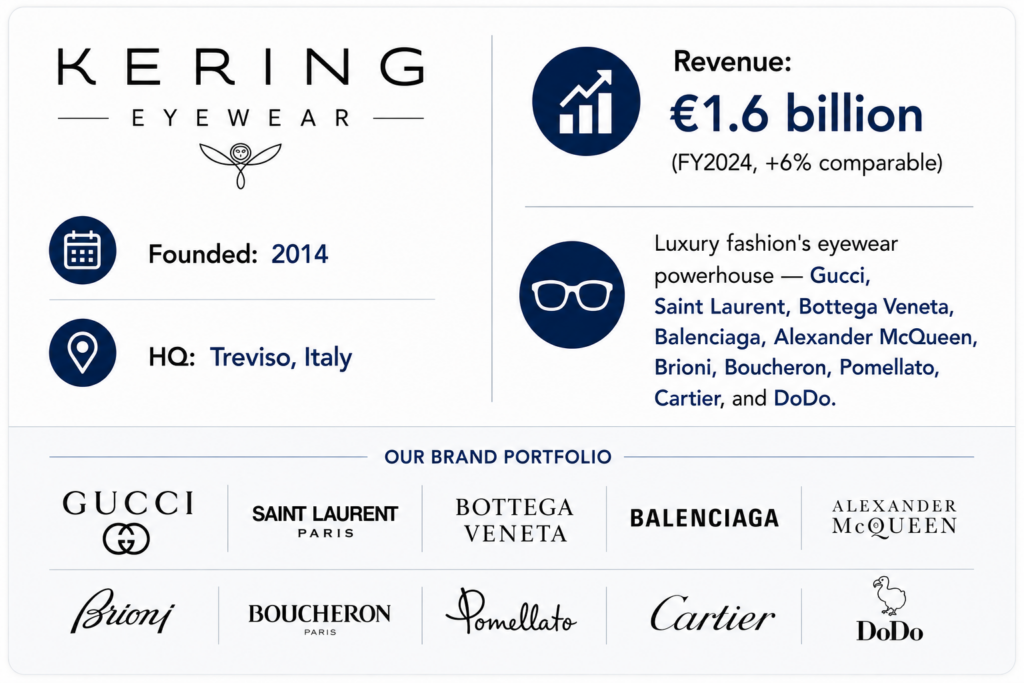
In 2014, Kering made the bold decision to terminate its eyewear licensing arrangements and build its own vertically integrated eyewear division. A decade later, Kering Eyewear has become a €1.6 billion business with recurring operating income of €277 million — validating the strategy decisively.
Kering Eyewear’s brand portfolio represents a concentration of some of the world’s most aspirational fashion names: Gucci, Saint Laurent, Bottega Veneta, Balenciaga, Alexander McQueen, Brioni, Boucheron, Pomellato, Cartier, and DoDo. The 2022 acquisition of Maui Jim added a premium performance sunglass brand with strong independent consumer loyalty. In all four quarters of 2024, Kering Eyewear grew on a comparable basis, even as the parent Kering Group saw revenue pressure across several of its fashion houses.
What differentiates Kering Eyewear is creative integration: collections are designed in direct collaboration with the fashion houses’ creative directors, resulting in eyewear that feels genuinely part of the runway narrative rather than a licensed afterthought. Sustainability is embedded through bio-based acetates, recycled metal components, and the group’s broader “Virtuous Circle” programme targeting renewable energy and waste reduction across production.
7. Hoya Corporation
Website: https://www.hoya.com
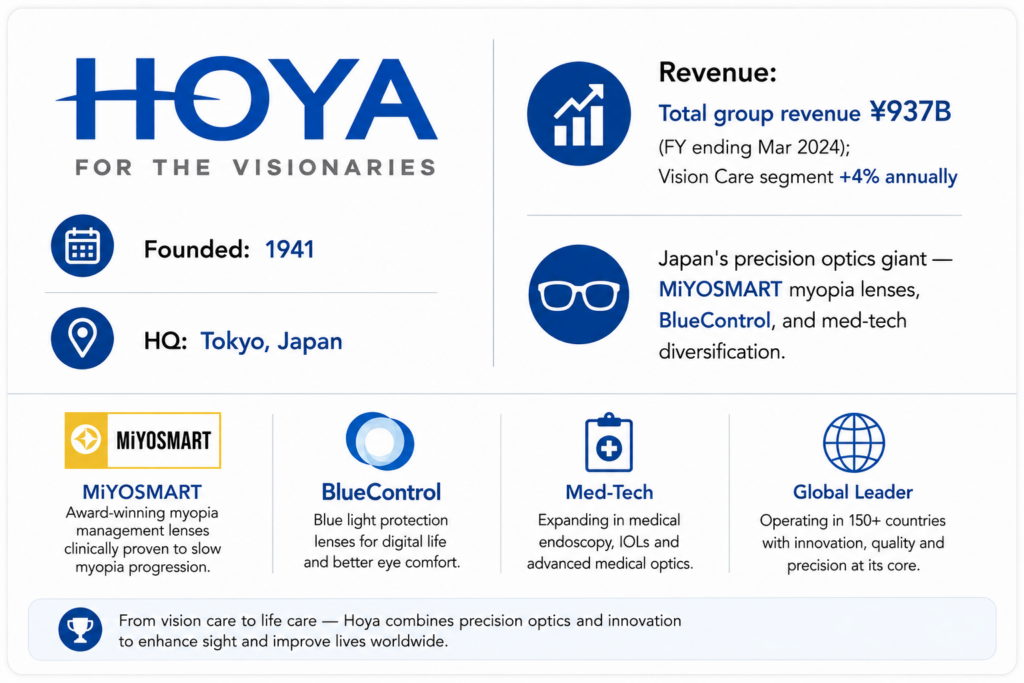
Hoya Corporation takes a fundamentally different competitive angle from frame-centric rivals. Founded in 1941 in Tokyo, Hoya has built its position through lens technology mastery — and its Vision Care segment is one of the most significant direct competitors to EssilorLuxottica’s Essilor lens division globally.
Hoya’s ophthalmic lens portfolio is led by MiYOSMART — a dual-focus myopia management lens developed in partnership with Hong Kong Polytechnic University, offering clinically validated efficacy in slowing myopia progression in children. This places Hoya at the forefront of one of the fastest-growing premium lens segments globally. The BlueControl coating filters harmful blue light from digital screens. ViewFit technology enables progressive lenses personalised to individual wearing habits. The Sync III lens specifically addresses the visual fatigue associated with extended near-work digital device use.
Hoya’s diversification into medical technology — including endoscopes, intraocular lenses (IOLs) for cataract surgery, and semiconductor photomasks — provides financial strength that pure-play eyewear companies cannot match. This enables sustained R&D investment in vision care far beyond what competitors can fund. Independent opticians globally treat Hoya and Essilor as their primary lens supplier alternatives, making Hoya’s competitive position structurally important.
8. Carl Zeiss Vision
Website: https://www.zeiss.com/
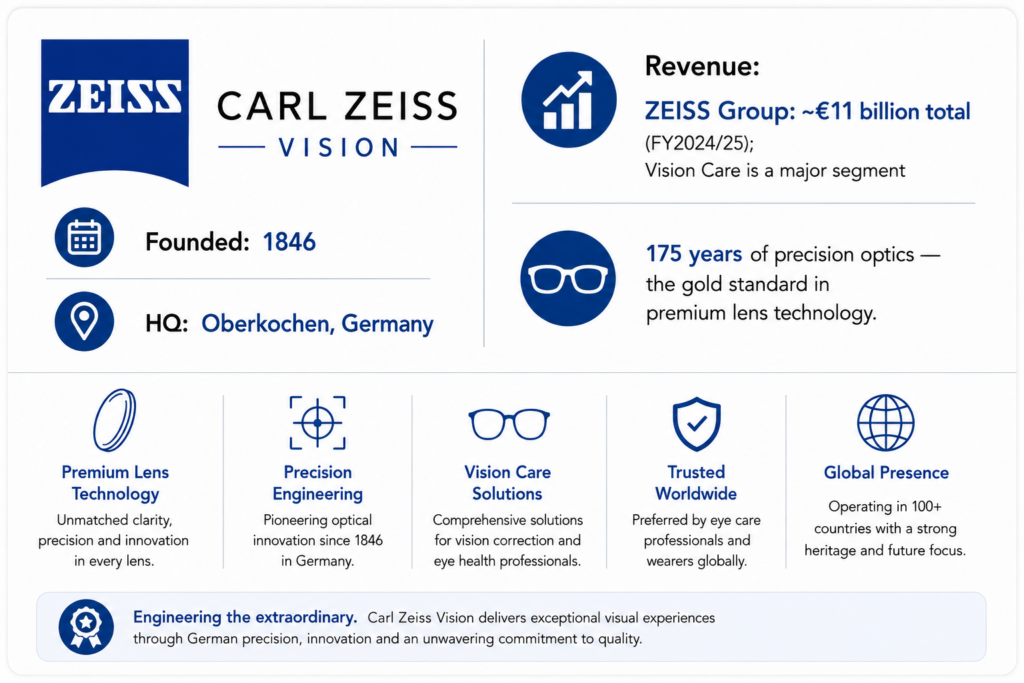
Few brand names carry more weight in optics than ZEISS. Founded in 1846 in Jena, Germany, the ZEISS Group reported revenues of approximately €11 billion in fiscal year 2024/25 — an 8% increase — with Carl Zeiss Vision representing a major segment competing directly with Essilor in premium ophthalmic lenses.
Carl Zeiss Vision’s product portfolio consistently sets the benchmark for optical performance. SmartLife lenses are designed for the visual challenges of the modern connected lifestyle. DriveSafe lenses reduce glare and improve clarity in low-light driving conditions. UVProtect technology delivers full UV protection in clear lenses. The ZEISS MyoCare portfolio, validated by clinical research through the ZEISS Myopia Advisory Board, addresses myopia management in children — one of the fastest-growing clinical lens categories.
ZEISS acquired Brighten Optix in early 2025 to expand its myopia management capabilities, while the ZEISS VISUCORE 500 and VISUFIT 1000 instrumentation embed ZEISS within the clinical workflow of eye care practices globally. Recognition is broad: ZEISS Progressive SmartLife Individual 3 and ZEISS MyoCare both won major industry awards in 2024. ZEISS also supplies certified camera optics to smartphone manufacturers, demonstrating how broadly its optical expertise translates across industries.
9. Rodenstock Group
Website: https://www.rodenstock.com
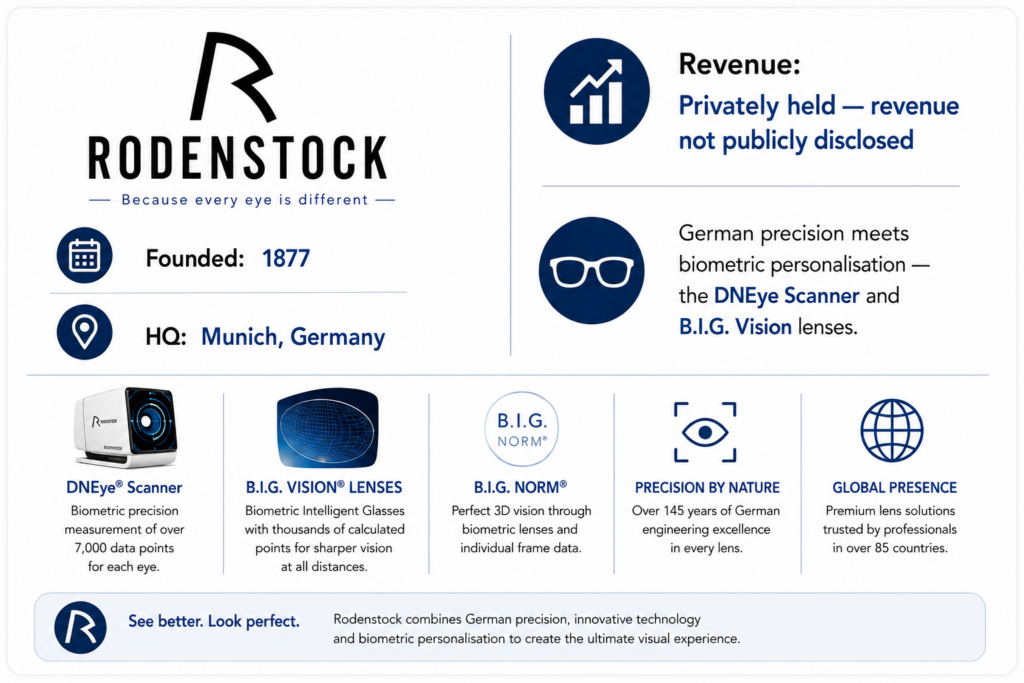
Founded in 1877 in Munich and with a manufacturing heritage spanning nearly 150 years, Rodenstock represents German precision engineering at its finest in the vision care industry. The company defines its positioning around “Biometric Intelligent Glasses” — a category it has essentially invented.
Rodenstock’s DNEye Scanner is the centrepiece of its competitive differentiation: a proprietary diagnostic device that captures more than 7,000 biometric measurements of the individual patient’s eye, including corneal topography and tear film analysis. This data feeds the production of B.I.G. Vision lenses — individually optimised for each wearer at a level of precision that delivers measurably superior peripheral clarity, reduced adaptation time, and better performance in challenging lighting compared to conventional progressive lenses.
The Impression FreeSign 3 progressive lens incorporates prescription, lifestyle data, and visual habits into a bespoke lens design. Rodenstock’s Indo Optical acquisition expanded its presence in Spain and Latin America. Its deep relationships with independent optical practices across Europe — where premium lens quality is a primary practice differentiator — make Rodenstock a formidable challenger to Essilor’s high-end lens portfolio.
10. Silhouette International
Website: https://www.silhouette-group.com
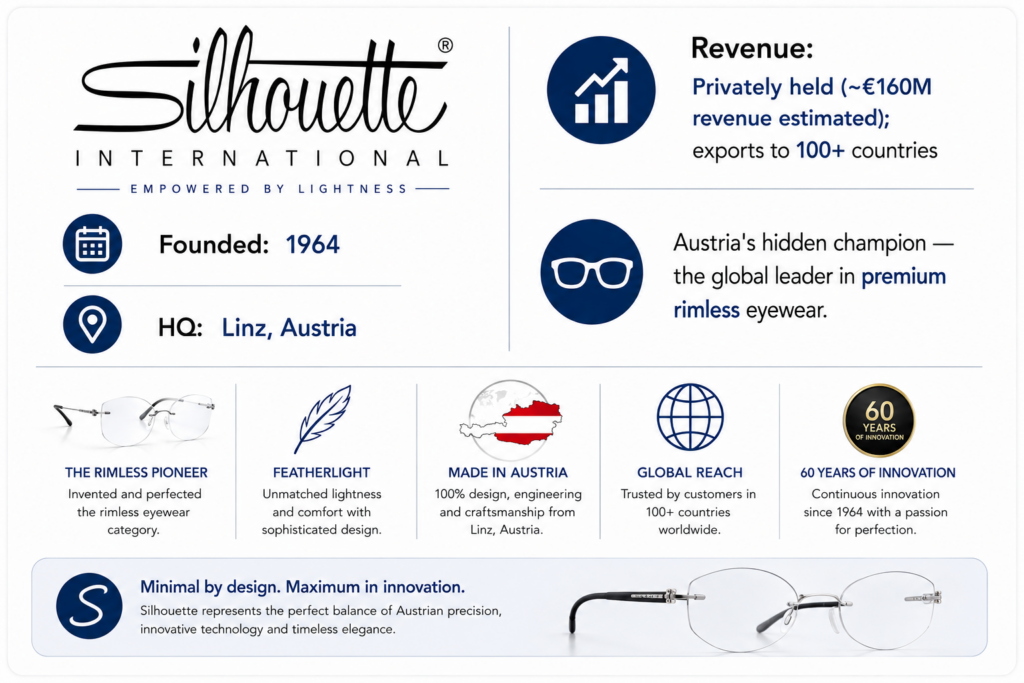
Silhouette International Schmied AG is one of the great hidden champions of the eyewear industry — a family-owned Austrian company that has carved out global market leadership in a highly specific and highly profitable niche: premium rimless eyewear. Founded in 1964 in Linz, the company exports approximately 95% of its production to more than 100 countries worldwide.
Silhouette’s flagship product lines — particularly the SPX and Titan Minimal Art collections — are renowned for their feather-light weight, precision craftsmanship, and minimalist design philosophy. Silhouette frames have been worn by multiple US Presidents and have accompanied astronauts aboard the International Space Station — testament to both the quality and the brand’s unique cultural cachet. The company also manufactures Adidas Sport Eyewear and operates the neubau eyewear brand for younger urban consumers.
Where EssilorLuxottica competes with enormous breadth, Silhouette competes with extraordinary depth in one high-margin segment. The company’s manufacturing remains entirely in Austria, its craftsmanship underpinned by individual frame construction requiring up to 50 individual manufacturing steps. This commitment to Austrian production is part of the brand identity and a quality signal that premium consumers value. Silhouette competes with EssilorLuxottica at the very top of the prescription eyewear price spectrum.
11. Specsavers
Website: https://www.specsavers.com
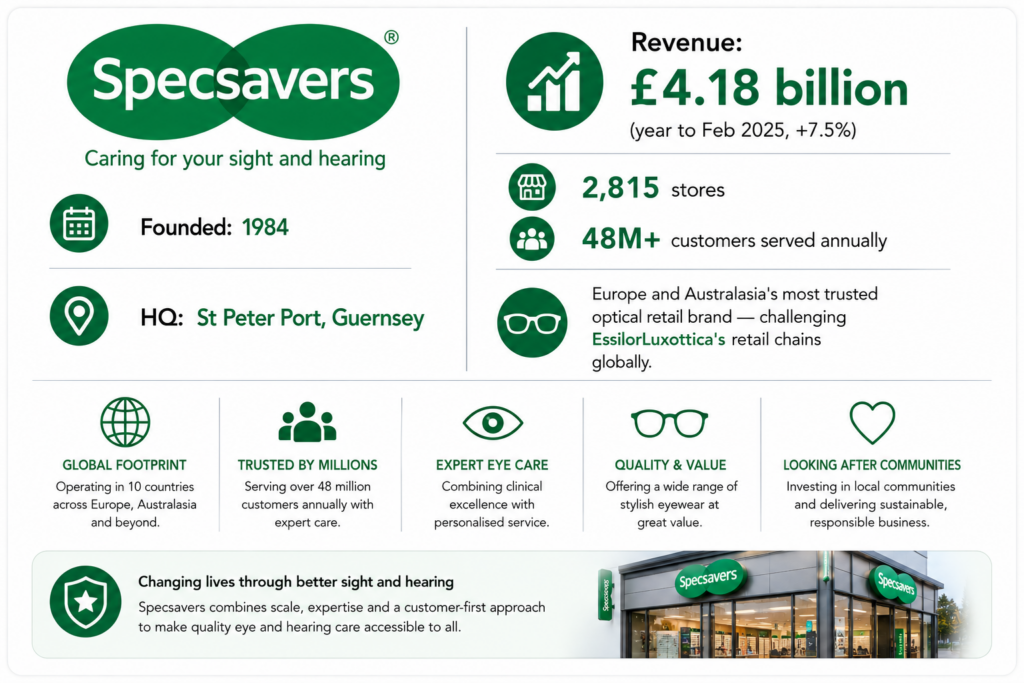
Founded in 1984 in Guernsey, UK, by husband-and-wife team Doug and Mary Perkins, Specsavers has grown into one of the world’s most formidable optical retail networks. The company reported group revenue of £4.18 billion for the year to February 2025 — a 7.5% increase — serving more than 48 million customers annually across 2,815 stores in 11 countries.
Specsavers operates on a franchise model, enabling rapid geographic expansion while maintaining consistent quality standards. The UK remains the largest market (£2.32 billion), with Australia its second largest (£863M). Canada has emerged as a standout growth market. The group is investing in digital transformation — including an upgraded virtual try-on tool and expanded online ordering capabilities — to compete against digital-native eyewear brands.
Specsavers directly competes with EssilorLuxottica’s retail chains (LensCrafters, Target Optical) in markets where both operate. Its combination of professional eye care services (optometry and, importantly, audiology) with fashionable, affordable eyewear and a powerful price-guarantee message has built unmatched consumer trust. Its own-brand frames and competitive lens pricing put direct pressure on EssilorLuxottica’s value-tier offerings. Specsavers is also expanding into ophthalmology services, deepening its clinical positioning.
12. Zenni Optical
Website: https://www.zennioptical.com
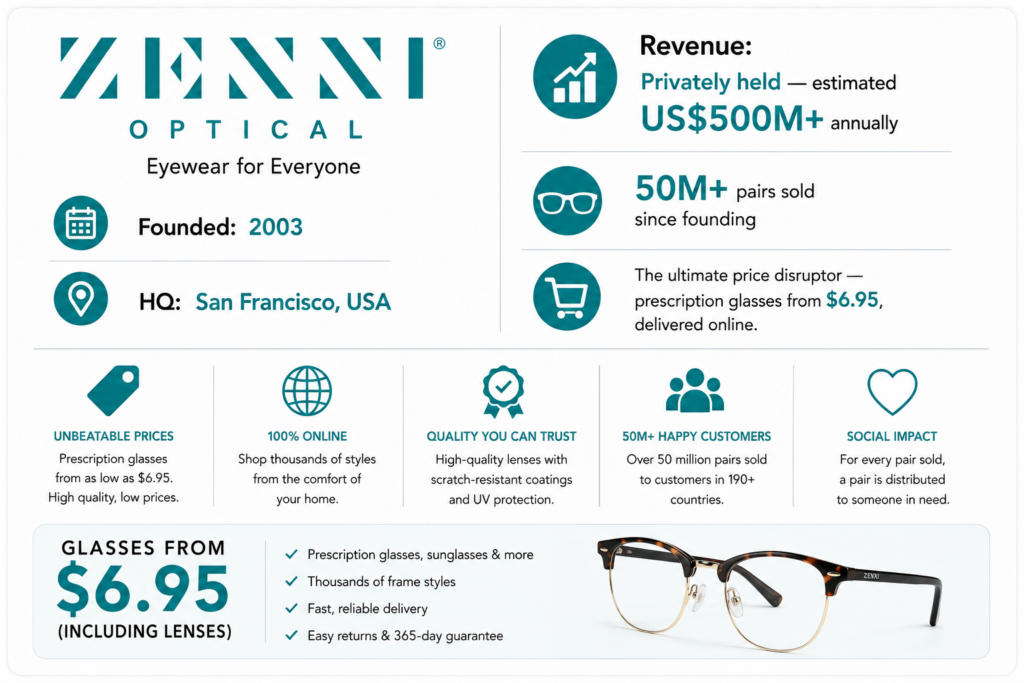
Zenni Optical represents the most radical price disruption in the eyewear industry. Founded in 2003 in San Francisco, the company sells prescription eyewear exclusively online, starting at $6.95 per pair, by manufacturing its own frames in China and shipping directly to consumers. Since founding, Zenni has sold more than 50 million pairs of glasses — a staggering volume that illustrates the enormous latent demand for affordable prescription eyewear when price barriers are removed.
Zenni’s business model is vertically integrated in a different direction from EssilorLuxottica: it controls its own supply chain to drive cost minimisation rather than premium brand value. Its digital-first approach includes a sophisticated virtual try-on tool powered by facial recognition technology, prescription verification systems, and a broad catalogue spanning standard single-vision lenses to progressives, tinted, photochromic, and blue-light-filtering options.
While Zenni is not a luxury competitor, it is a genuine strategic threat to EssilorLuxottica at the price-sensitive end of the prescription eyewear market — a segment that represents hundreds of millions of global consumers. As quality at affordable price points has improved dramatically, Zenni and similar online retailers have permanently changed consumer price expectations for prescription glasses, creating pressure on the entire industry including EssilorLuxottica’s value-positioned retail chains.
13. Alcon
Website: https://www.alcon.com
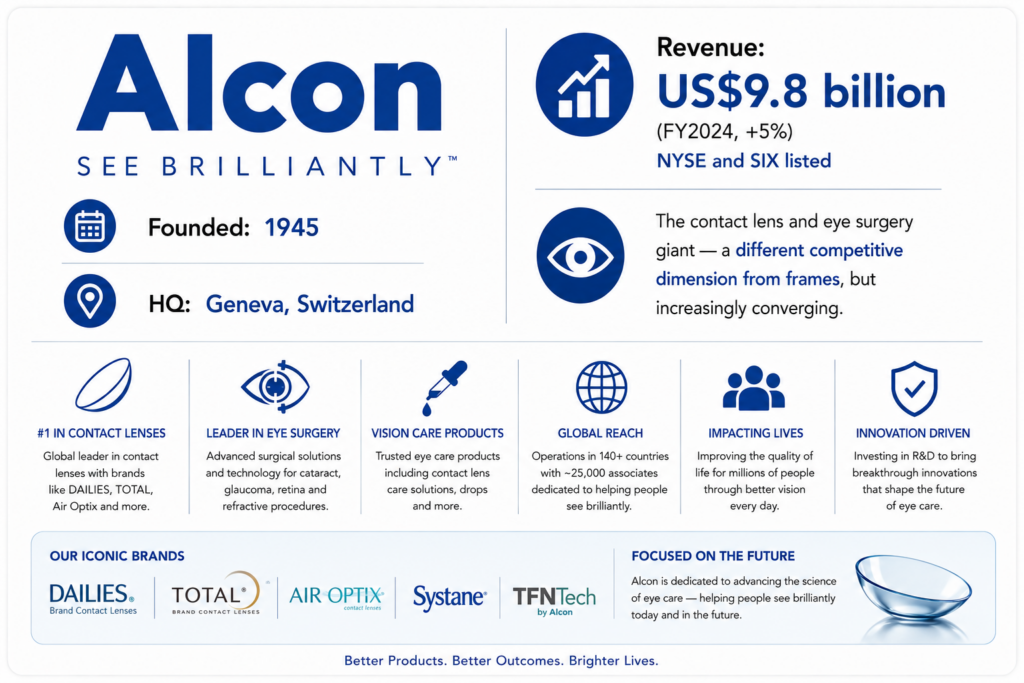
Alcon occupies a distinct competitive position relative to EssilorLuxottica: it competes primarily in contact lenses and ophthalmic surgical equipment rather than spectacle lenses and frames. However, as vision correction increasingly means a choice between spectacles and contact lenses, Alcon is a direct demand-side competitor — every patient who chooses to wear contact lenses is a patient who buys fewer spectacle lenses.
For the full year 2024, Alcon reported net sales of US$9.8 billion — a 5% increase (6% at constant currency) — with record free cash flow of US$1.6 billion. The Vision Care segment, which includes contact lenses and ocular health products, grew strongly, driven by Daily SiHy lenses and the Bausch + Lomb ULTRA and Total30 products. The Surgical segment — comprising cataract and refractive surgery products — also delivered growth, with strong performance from premium IOL implantables.
Alcon’s contact lens portfolio (Dailies Total1, PRECISION1, Air Optix) is the broadest and most clinically recognised in the market. Its research into next-generation lens materials — including biomimetic lenses that more closely replicate the eye’s natural tear film — signals continued premium differentiation. The company’s deep relationships with eye care practitioners, surgeons, and ophthalmology clinics also give it distribution advantages that parallel EssilorLuxottica’s professional channel presence.
14. Bausch + Lomb
Website: https://www.bausch.com/
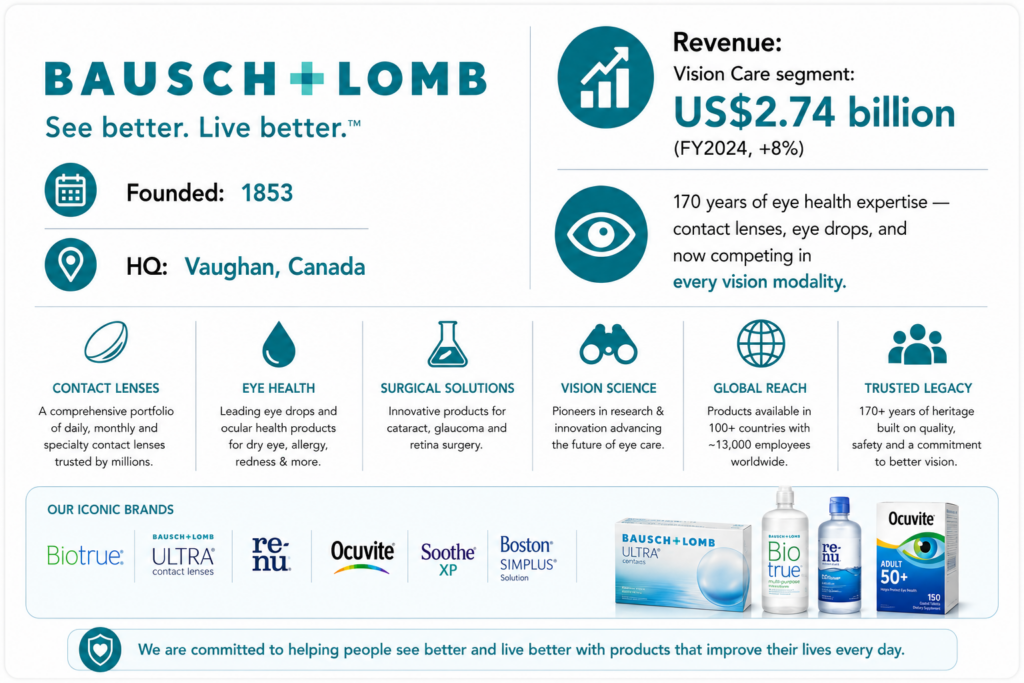
Bausch + Lomb, founded in 1853 in Rochester, New York, by John Jacob Bausch and Henry Lomb, is one of the oldest and most trusted names in eye health. The company was re-listed as an independent public company in 2022 following its separation from Bausch Health Companies, and now operates as a dedicated eye care business covering contact lenses, ocular health products, and ophthalmic pharmaceuticals.
For the full year 2024, Bausch + Lomb’s Vision Care segment generated US$2.74 billion in revenue — an 8% increase year-on-year (10% at constant currency). Growth was driven primarily by Daily SiHy contact lenses, the Bausch + Lomb ULTRA platform, and the consumer ocular health portfolio including LUMIFY (red-eye relief drops) and Biotrue ONEday lenses. Contact lens net sales grew double digits through 2024, reflecting both new product momentum and increasing market share in the premium daily replacement segment.
Like Alcon, Bausch + Lomb is a demand-side competitor to EssilorLuxottica: contact lens wearers are, broadly speaking, fewer spectacle lens wearers. Bausch + Lomb’s new biomimetic lens development programme — aiming to create lenses that more closely mimic the eye’s natural biology — could further shift vision correction preferences over the medium term. Its broad prescription eye drop and vitamin portfolio also gives it clinical presence in the practices and pharmacies through which EssilorLuxottica products are distributed.
15. National Vision (America’s Best)
Website: https://www.nationalvision.com/
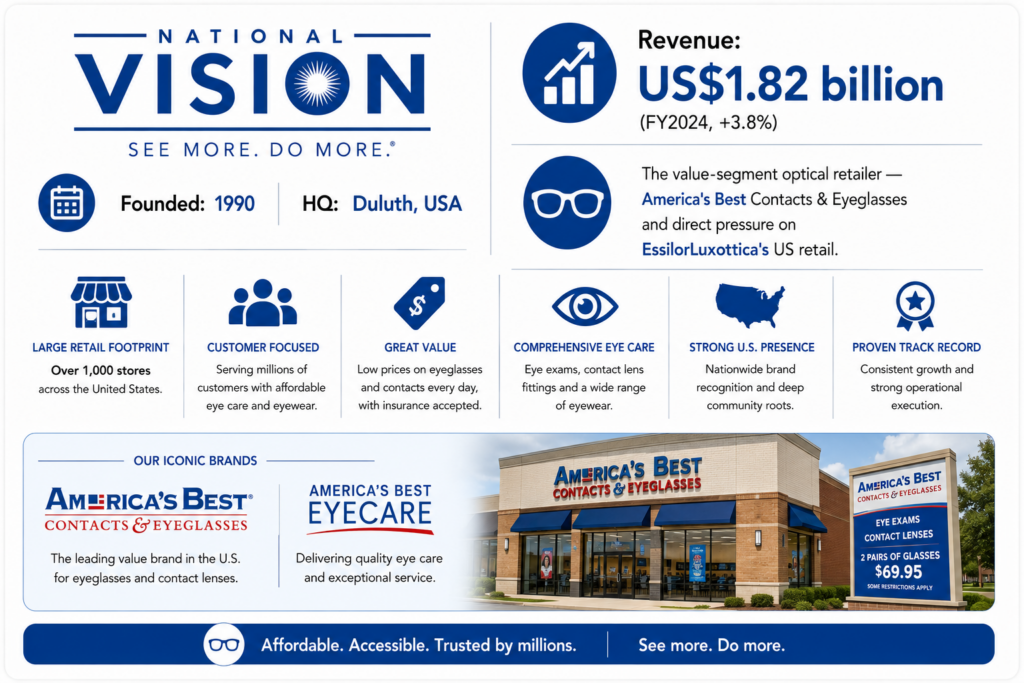
National Vision Holdings is one of the largest optical retail chains in the United States, operating primarily under the America’s Best Contacts & Eyeglasses brand — a value-positioned format that competes directly with EssilorLuxottica’s LensCrafters and Target Optical chains at the affordable end of the US optical market. The company also operated Eyeglass World stores, which it has been converting to America’s Best as part of its brand consolidation strategy.
For fiscal year 2024, National Vision reported net revenue from continuing operations of US$1.82 billion — a 3.8% increase over fiscal 2023 — with comparable store sales growth of 1.9%. The company improved adjusted operating income to $65.5 million despite ongoing transformation costs. Its model of low-cost prescription glasses and contact lenses with in-store vision exams caters to the broad US consumer base that cannot or will not pay premium prices — a segment EssilorLuxottica historically underserves.
America’s Best’s “two pairs for $79.95” pricing promise is one of the most recognised optical retail propositions in the US, driving significant foot traffic among value-seeking consumers. National Vision operates over 1,100 stores and is investing in digital capabilities, online appointment scheduling, and telehealth vision testing to modernise the customer experience. As the US optical retail market becomes more competitive, National Vision’s scale and value positioning make it a consistent competitive pressure point for EssilorLuxottica’s mid-market retail presence.
16. Charmant Group
Website: https://www.charmant.com
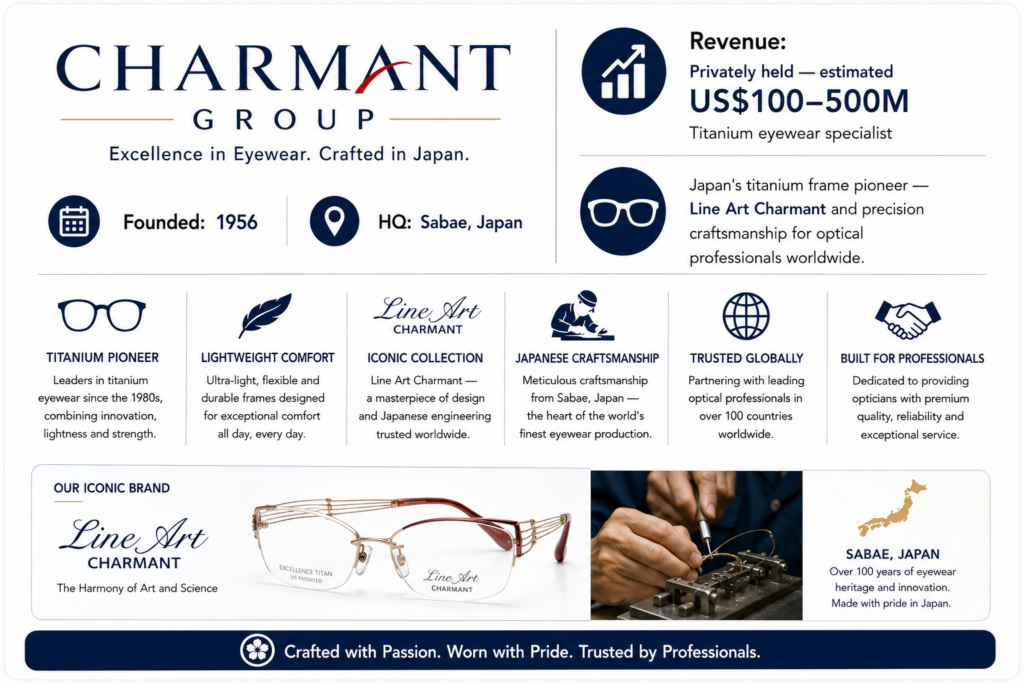
Charmant Group was founded in 1956 in Sabae, Japan — a city so dedicated to eyewear manufacturing that it is recognised as producing approximately 90% of Japan’s domestic glasses production. The company has built its reputation on mastery of titanium frame manufacturing, a discipline that requires both metallurgical expertise and exceptional precision craftsmanship.
Charmant’s flagship house brand, Line Art Charmant, is widely regarded among optical professionals as one of the finest titanium eyewear lines available — combining feather-light weight with extraordinary durability and hypoallergenic properties ideal for sensitive wearers. The Charmant Titanium Perfection and Charmant Japanese Made lines extend this heritage positioning. Licensed brands include Elle, Esprit, Head, Isaac Mizrahi New York, Eddie Bauer, and Aristar — expanding the company’s appeal across multiple style and price points.
Charmant distributes to optical professionals in over 100 countries through a dedicated sales network. Its “Motion Tech” temple technology, introduced in 2025 with the expanded Charmant Japanese Made range, provides a self-adjusting temple that adapts to different head sizes — solving a persistent fit challenge in eyewear. Charmant represents the specialist Japanese craftsmanship tradition in global eyewear and competes with EssilorLuxottica’s Luxottica division in the premium independent optical channel.
Competitive Landscape at a Glance
| # | Company | Primary Segment | FY2024 Revenue | HQ |
| 1 | Safilo Group | Frame Mfg + Licences | €993M (FY2024) | Italy |
| 2 | Marchon Eyewear | Licences + Distribution | Private | USA |
| 3 | De Rigo | Luxury Licences + Retail | Private | Italy |
| 4 | Fielmann Group | Optical Retail (Europe) | €2.3B (FY2024) | Germany |
| 5 | Warby Parker | DTC + Digital | US$771M (FY2024) | USA |
| 6 | Kering Eyewear | Luxury Frames | €1.6B (FY2024) | Italy |
| 7 | Hoya Corporation | Lens Technology | ¥937B group total | Japan |
| 8 | Carl Zeiss Vision | Precision Lenses | ~€11B group total | Germany |
| 9 | Rodenstock | Biometric Lenses | Private | Germany |
| 10 | Silhouette Intl. | Premium Rimless Frames | Private (~€160M est.) | Austria |
| 11 | Specsavers | Optical Retail (Global) | £4.18B (FY Feb 2025) | UK/Guernsey |
| 12 | Zenni Optical | DTC Online (Value) | Private (~US$500M est.) | USA |
| 13 | Alcon | Contact Lenses + Surgery | US$9.8B (FY2024) | Switzerland |
| 14 | Bausch + Lomb | Contact Lenses + Ocular Health | US$2.74B Vision Care (FY2024) | Canada |
| 15 | National Vision | Optical Retail (Value, US) | US$1.82B (FY2024) | USA |
| 16 | Charmant Group | Titanium Frame Mfg | Private | Japan |
Note: Group revenues shown where divisional figures are unavailable.
Key Competitive Trends Shaping the Industry
1. Smart Glasses — The Next Frontier
EssilorLuxottica’s partnership with Meta on Ray-Ban Meta smart glasses — over 1 million pairs sold in 2024, €365M revenue — has established a first-mover position in the consumer smart glasses category. Competitors are watching closely, but no rival has yet matched the scale of this technology-fashion hybrid success. The projected trajectory (€800M in a single year, €6B by 2030) would represent a structurally new revenue stream that most competitors cannot replicate without comparable technology partnerships.
2. Myopia Management
The global myopia epidemic is creating a fast-growing, high-margin clinical lens segment. Hoya MiYOSMART, Zeiss MyoCare, Essilor Stellest, and Rodenstock’s biometric personalisation all compete in this space with clinically validated products. The lifetime value of capturing a myopic child as a patient — decades of premium lens purchases — makes this one of the most strategically important battlegrounds in eyewear.
3. Value and Online DTC Disruption
Warby Parker ($771M, +15.2%), Zenni (50M+ pairs sold), and value retailers like National Vision ($1.82B) are collectively reshaping consumer price expectations. Online prescription eyewear has permanently reduced the willingness of a large segment of consumers to pay premium retail prices — creating structural pressure on EssilorLuxottica’s mid-market retail chains.
4. Contact Lenses vs. Spectacles
Alcon ($9.8B) and Bausch + Lomb ($2.74B Vision Care) represent demand-side competitive pressure. As daily disposable contact lens technology improves and becomes more affordable, each consumer who shifts to contacts represents fewer spectacle lens purchases. EssilorLuxottica’s own contact lens business partially offsets this, but the two largest contact lens players remain significant independent competitors.
5. Sustainability as Competitive Differentiation
Sustainability is no longer a “nice-to-have” in eyewear — it is a competitive requirement, particularly for premium and luxury brands. Safilo’s biodegradable frames, Kering Eyewear’s bio-based acetates, Warby Parker’s carbon-neutral operations, and Silhouette’s Austrian manufacturing transparency all represent different expressions of sustainability commitment. EssilorLuxottica has published its own sustainability commitments, but the field is competitive and consumers — particularly Gen Z — will increasingly make purchasing decisions on environmental grounds.
Frequently Asked Questions
Q: Who is the biggest competitor of EssilorLuxottica?
A. No single competitor matches EssilorLuxottica’s combined scale across lenses, frames, and retail. In lens technology, Hoya and Carl Zeiss Vision are the most significant rivals. In luxury eyewear, Kering Eyewear (€1.6B revenue) is the most formidable challenger. In optical retail, Specsavers (£4.18B revenue, 2,815 stores) leads globally outside the US; Fielmann (€2.3B) leads in Europe; National Vision ($1.82B) is the primary US value-segment retail competitor. In contact lenses, Alcon ($9.8B) and Bausch + Lomb are major alternatives to spectacle vision correction.
Q: Is Warby Parker bigger than EssilorLuxottica?
A. No. Warby Parker had FY2024 revenue of US$771.3 million — approximately 3% of EssilorLuxottica’s €26.5 billion. However, Warby Parker is growing much faster (15.2% in FY2024 vs. 6% for EssilorLuxottica) and has fundamentally changed consumer expectations around eyewear pricing and convenience, making it a more disruptive competitive force than its current revenue suggests.
Q: What brands does EssilorLuxottica own?
A. EssilorLuxottica owns Ray-Ban, Oakley, Persol, Oliver Peoples, Vogue Eyewear, Costa del Mar, Arnette, Alain Mikli, and Supreme (acquired in 2024). It also manufactures eyewear under licence for over 20 luxury fashion brands including Prada, Chanel, Versace, Bulgari, Ralph Lauren, and Michael Kors. See the internal link above for the full brand guide.
Q: How does Specsavers compete with EssilorLuxottica?
A. Specsavers operates its own optical retail chain across the UK, Ireland, Australia, New Zealand, and several other markets — directly competing with EssilorLuxottica’s retail chains (LensCrafters, Target Optical, Sunglass Hut) where both operate. With £4.18 billion in revenue and 2,815 stores serving 48 million+ customers annually, Specsavers is the leading optical retail brand across multiple of EssilorLuxottica’s key geographies.
Q: Does Alcon compete with EssilorLuxottica?
A. Alcon ($9.8B FY2024 revenue) competes with EssilorLuxottica as a demand-side alternative rather than a direct product substitute. Every patient who chooses contact lenses (Alcon’s core business) over spectacles purchases fewer frames and lenses from EssilorLuxottica. Additionally, Alcon’s ophthalmic surgical equipment — including premium intraocular lenses for cataract surgery — provides vision correction without either contact lenses or spectacles in some patient populations.
Q: Which company makes the best eyewear lenses?
A. The premium lens market is contested by Essilor (EssilorLuxottica), Hoya, Carl Zeiss Vision, and Rodenstock — all of whom offer excellent ophthalmic lenses with different technological strengths. Essilor is the largest and most ubiquitously distributed. Hoya excels in myopia management with MiYOSMART. Zeiss is recognised for optical precision and has strong clinical credibility. Rodenstock’s DNEye Scanner and B.I.G. Vision lenses represent the most individualised approach to lens manufacturing available.
Q: Is Kering Eyewear independent of EssilorLuxottica?
A. Yes, Kering Eyewear is fully owned by Kering, the French luxury group, and operates entirely independently of EssilorLuxottica. Indeed, it was created precisely because Kering chose to reclaim control of its brands’ eyewear manufacturing from EssilorLuxottica’s licensed framework. Kering Eyewear competes with EssilorLuxottica directly in the luxury and premium sunwear segment.
Q: What is Zenni’s competitive advantage over EssilorLuxottica?
A. Zenni competes on price — offering prescription glasses from as low as $6.95 online through a fully vertically integrated direct-to-consumer model. Its competitive advantage is radical affordability backed by a simplified online purchase journey and estimated revenue exceeding $500 million annually. Zenni targets a segment of the market that EssilorLuxottica’s premium positioning does not serve and permanently reshapes price expectations among budget-conscious consumers.
Conclusion
EssilorLuxottica’s €26.5 billion in revenue and vertically integrated control over large swaths of the global eyewear value chain represent a genuinely formidable competitive position. But the 15 (and more) competitors profiled in this article demonstrate that the eyewear industry is far from a winner-take-all market. Safilo and Marchon compete effectively in frame manufacturing and licensing. Fielmann and Specsavers dominate optical retail in Europe and Australasia. Warby Parker and Zenni have permanently disrupted price expectations in the DTC channel. Kering Eyewear has proven that luxury brand integration is a viable €1.6B+ business. Hoya, Zeiss, and Rodenstock hold the premium lens technology ground. Alcon and Bausch + Lomb address the vision correction market through contact lenses. And Silhouette and Charmant hold their ground in ultra-premium craftsmanship niches.
The coming decade promises intensified competition across every dimension: smart glasses technology, myopia management clinical protocols, AI-assisted prescription services, sustainable materials innovation, and expanding e-commerce distribution. For consumers, this competition is unambiguously positive — delivering more choice, better technology, and more transparent pricing than ever before in the industry’s history.
Also Read: A Deep-Dive into Iconic Brands Owned by Luxottica Group
To read more content like this, subscribe to our newsletter
Go to the full page to view and submit the form.