


Fiserv has long been one of the most powerful names in financial technology, serving banks, credit unions, merchants, and enterprises with solutions ranging from core banking software to payment processing and digital commerce. But the fintech landscape has never been more contested—and Fiserv’s competitors are more numerous, more diversified, and more technologically sophisticated than ever before.
Following its $22 billion merger with First Data in 2019, Fiserv vaulted to the top tier of financial technology providers, combining core banking scale with merchant acquiring, point-of-sale through Clover, and digital banking. The company now serves more than 10,000 financial institutions globally, processing over 100 billion digital banking transactions annually.
Yet the global payments and banking technology market has attracted a remarkable range of challengers—from incumbent giants like FIS and Global Payments to cloud-native disruptors like Stripe and Adyen, and from community banking specialists like Jack Henry to European payment powerhouses like Worldline. This comprehensive analysis profiles 16 of Fiserv’s most significant competitors with the latest verified financial data, giving you the clearest picture of who actually threatens Fiserv’s market position—and why.
Fiserv at a Glance

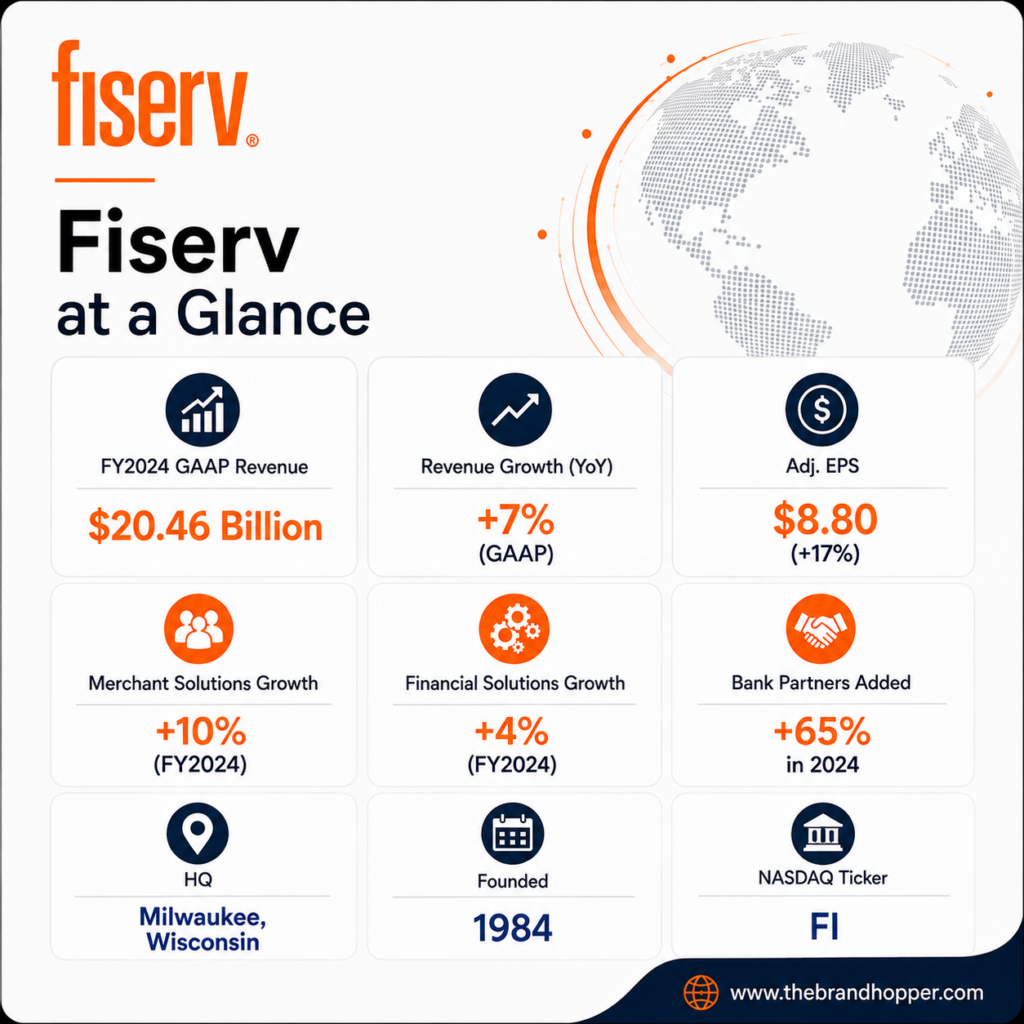
In FY2024, Fiserv crossed the $20 billion annual revenue milestone for the first time, reflecting sustained momentum across both its Merchant Solutions segment (powered by Clover, its cloud-based POS and business management platform) and its Financial Solutions segment (core banking, digital banking, and bill payment).
The company’s guidance for organic revenue growth of 10–12% and adjusted EPS of $10.10–$10.30 signals continued confidence in its competitive positioning.
The Fintech Competitive Landscape
The financial technology sector sits at a unique intersection of scale, trust, regulation, and innovation. Unlike most software markets, fintech incumbency is powerful—financial institutions change core banking vendors rarely, creating long contract cycles and high switching costs that benefit established players like Fiserv. At the same time, the rise of API-driven payments infrastructure (Stripe, Adyen), cloud-native banking platforms (Temenos, Q2), and consumer super-apps (PayPal, Block) is creating competitive pressure from entirely new directions.
The key battlegrounds where Fiserv faces competition are: (1) Core banking software for financial institutions, (2) Merchant acquiring and payment processing, (3) Digital banking platforms for banks and credit unions, (4) Real-time payments and financial crime compliance, and (5) Business banking and B2B payment solutions.

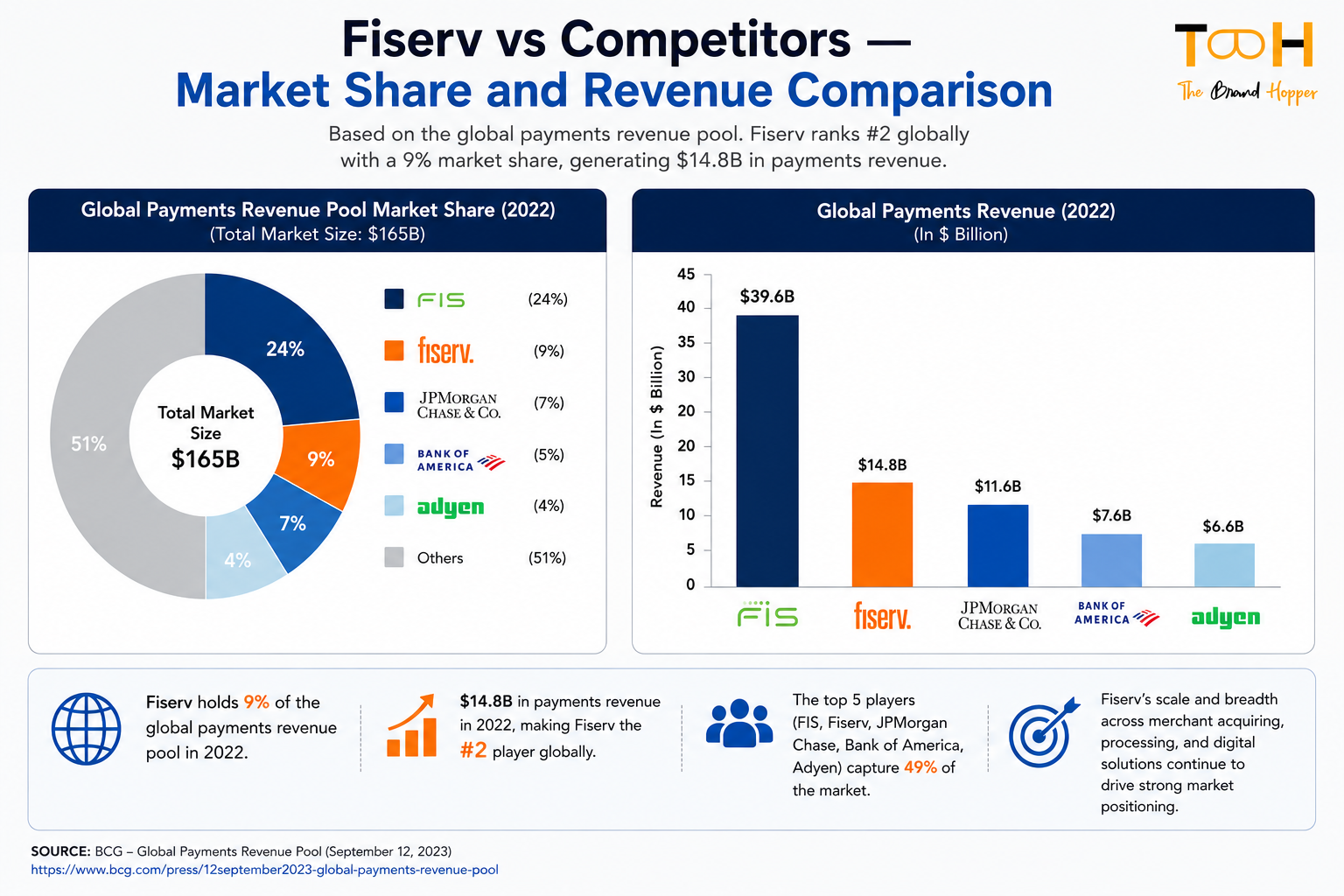
Fiserv’s Top 16 Competitors: In-Depth Analysis
Below we profile each competitor across their financial scale, core capabilities, overlap with Fiserv, and strategic differentiation.
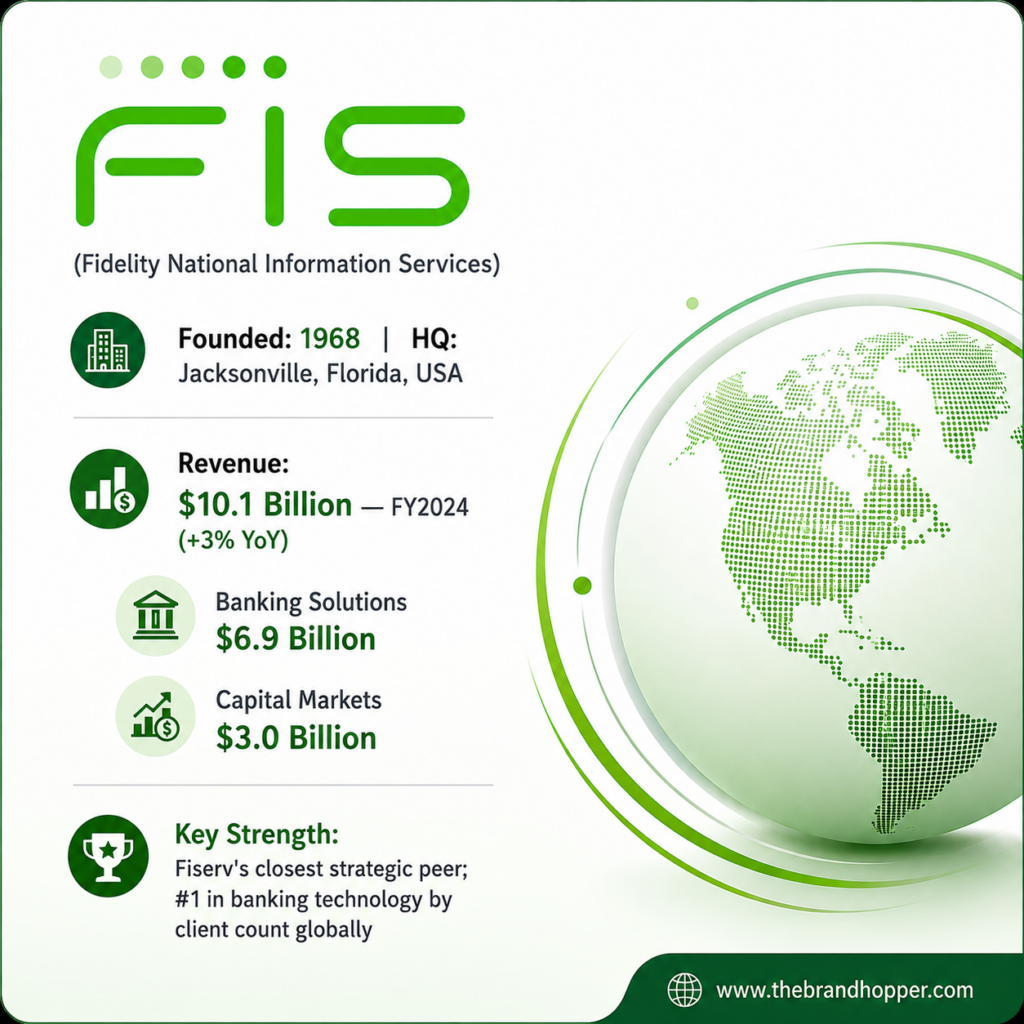
1. FIS (Fidelity National Information Services)
Official Website: fisglobal.com
FIS is arguably Fiserv’s most direct and equally-matched competitor, with a comparable heritage, service breadth, and market depth across core banking, payments, and capital markets. In FY2024, FIS reported total revenue of $10.1 billion, up 3% on a GAAP basis, with Banking Solutions generating $6.9 billion and Capital Markets $3.0 billion. Adjusted EBITDA margin expanded to 40.8%, reflecting the company’s efficiency improvement programme following its strategic divestiture of Worldpay (which it sold back to private equity in 2023 after its landmark $43 billion acquisition).
FIS’s Modern Banking Platform—built on cloud-native microservices architecture—has become a key battleground product against Fiserv’s core banking offerings. The platform’s flexibility and real-time capabilities have attracted institutions seeking to modernise without a full ‘rip and replace.’ FIS serves over 20,000 clients across 130+ countries, processing more than 75 billion transactions annually.
Where FIS most directly challenges Fiserv: in capital markets technology (where Fiserv has minimal presence), enterprise core banking for large global banks, and regulatory/compliance technology. Following the Worldpay divestiture, FIS has refocused on its core banking and capital markets strengths—making it a sharper, more focused competitor in Fiserv’s home territory.
2. Global Payments

Official Website: globalpayments.com
Global Payments has emerged as one of the most strategically differentiated players in the fintech space, building a powerful software-led payments business through vertical specialisation and deep ISV (independent software vendor) partnerships. In FY2024, GAAP revenues reached $10.11 billion (+4.7% YoY), with adjusted net revenues of $9.15 billion, growing 6%. The company processes over $140 billion in annual transaction volume and operates in more than 100 countries.
The company’s vertical-specific strategy—delivering sector-tailored payment and software solutions to healthcare, education, gaming, government, and hospitality—differentiates it from Fiserv’s more horizontally-focused offerings. Its PartnerCare programme and deep ISV ecosystem create powerful lock-in: once a vertical software vendor integrates Global Payments’ processing, its customer base tends to follow.
Global Payments competes most directly with Fiserv’s Merchant Solutions and Clover segments. Its 2024 results showed strong adjusted EPS growth of 10.8% to $11.55, signalling ongoing operational leverage even as it navigates the transition toward software-centric revenue. The company’s declared intent to monetise or divest its non-core assets suggests a sharper, more focused competitive posture in the near term.
3. Jack Henry & Associates

Official Website: jackhenry.com
Jack Henry & Associates has built one of the most defensible positions in financial technology by focusing exclusively on community and mid-tier banks and credit unions—the very institutions that form the core of Fiserv’s Financial Solutions client base. For fiscal year 2024 (ended June 30, 2024), Jack Henry reported revenue of $2.216 billion, up 6.6%, with adjusted revenue growth of 7.4% and adjusted operating income growth of 10.3%. Client retention rates exceed 95%, one of the highest in the industry.
Jack Henry’s Banno digital banking platform is its most strategically important growth product. Processing over 850 million transactions annually and growing mobile engagement by approximately 40% year-over-year, Banno provides community banks with digital experiences competitive with large national banks—directly addressing one of Fiserv’s key selling points. Its fintech integration ecosystem, now spanning 850+ fintech partners, allows clients to quickly adopt new technologies without leaving the Jack Henry platform.
Jack Henry’s differentiation is fundamentally about focus and trust: its entire business is built around community banks and credit unions. This singular focus creates deep product-market fit that a broadly diversified company like Fiserv finds difficult to match. Institutions served by Jack Henry rarely leave—and when they consider switching, Fiserv is typically the alternative they’re evaluating.
4. ACI Worldwide
Official Website: aciworldwide.com
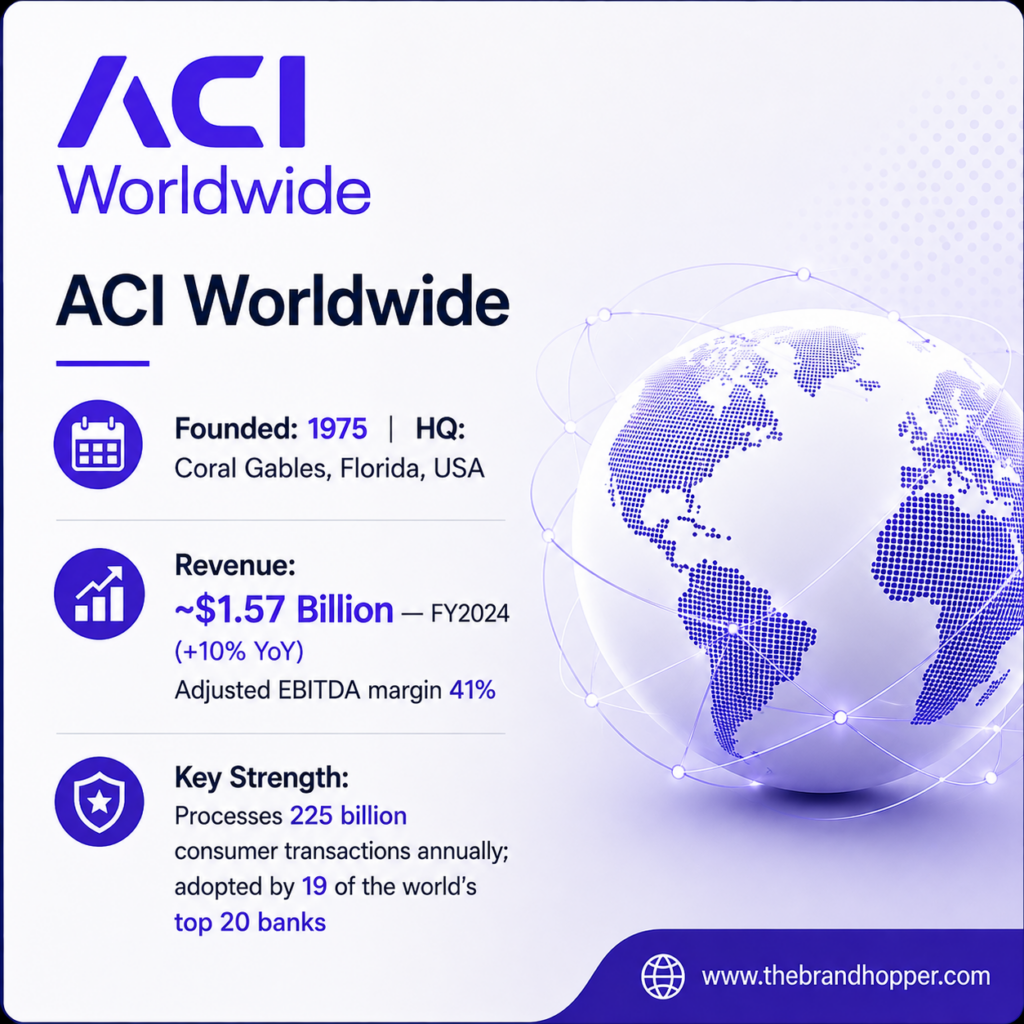
ACI Worldwide is a specialist in real-time payment solutions, fraud management, and enterprise payment infrastructure—areas where it competes head-to-head with Fiserv’s payment technology offerings. In FY2024, ACI grew revenue by 10%, expanded its adjusted EBITDA margin by 300+ basis points to 41%, and more than doubled its cash flow to over $350 million. The company processes approximately 225 billion consumer transactions annually for its global client base.
ACI’s Universal Payments platform is its flagship competitive weapon: adopted by 19 of the world’s top 20 banks, it provides end-to-end payment processing across multiple channels with industry-leading fraud detection capabilities. Its machine learning algorithms reduce false positives by up to 75% while maintaining high fraud detection rates—a critical capability as financial fraud grows more sophisticated.
ACI’s merchant payments business processes transactions worth over $14 trillion annually in the retail and billing sectors. For 2025, ACI expects to sustain revenue growth of 7–9%, maintaining its focused position as a real-time payments and fraud management specialist that challenges Fiserv’s payment processing capabilities without attempting to match its broad product breadth.
5. Block, Inc. (Square)

Official Website: block.xyz
Block (parent of Square and Cash App) represents a fundamentally different competitive model to Fiserv—one built from the consumer and small business up rather than from the financial institution down. In FY2024, Block reported gross revenue of approximately $22.1 billion (inflated by Bitcoin trading through Cash App) and gross profit of $8.89 billion, up 18% year-over-year. Adjusted EBITDA surged 69% to $3.03 billion, and adjusted free cash flow reached $2.07 billion—signalling a dramatically improved profitability profile.
Square’s merchant ecosystem—processing over $150 billion in annual payment volume for millions of merchants globally—directly competes with Fiserv’s Clover platform in the SMB merchant services market. Both offer integrated POS hardware, software, and payment processing, but Square’s brand strength, design-led hardware, and tight vertical software integrations (Square for Restaurants, Square for Retail, Square Appointments) have given it strong market penetration with digitally-native businesses.
Cash App’s financial services capabilities (banking, investing, Buy Now Pay Later via Afterpay integration, and Bitcoin) represent a growing threat in the consumer financial services space where Fiserv’s bank clients operate. With 57 million monthly active users transacting across Cash App, Block’s two-sided network of merchants and consumers creates competitive dynamics that differ fundamentally from Fiserv’s B2B model—but that increasingly encroach on the customer relationships Fiserv’s bank clients value most.
6. PayPal Holdings
Official Website: paypal.com
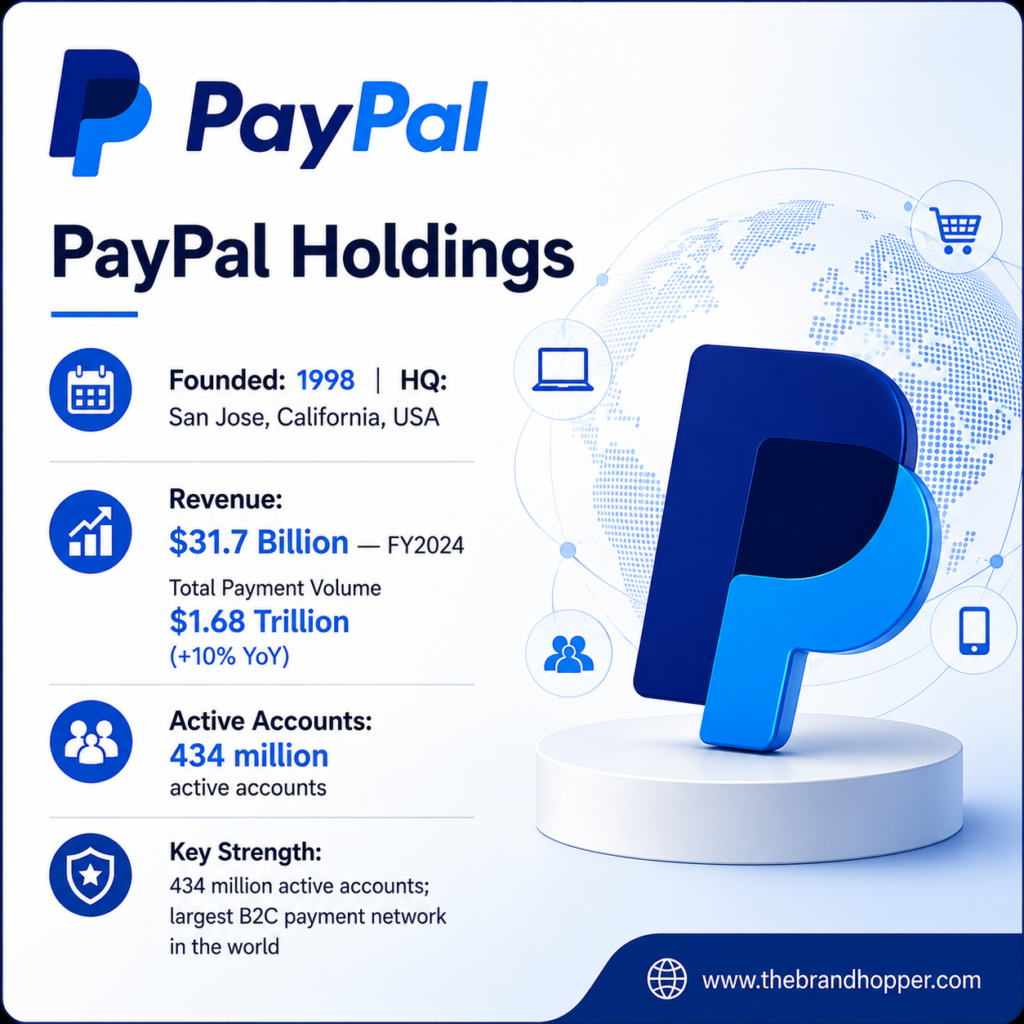
PayPal is the world’s largest independent payment platform by active users and transaction volume, making it one of the most formidable competitor ecosystems in fintech. In FY2024, PayPal generated $31.7 billion in revenue and processed $1.68 trillion in total payment volume (+10% YoY), across 26.3 billion transactions. Its network of 434 million active accounts creates a powerful two-sided marketplace that is difficult for any single competitor to replicate.
PayPal’s competitive overlap with Fiserv is primarily in the merchant payment acceptance, checkout optimisation, and B2B commerce spaces. Braintree (PayPal’s payment gateway for enterprise e-commerce) and Venmo’s business capabilities compete with Fiserv’s merchant acquiring services. PayPal’s ‘Pay Later’ solutions (BNPL) also compete with financing products offered through Fiserv’s bank clients.
PayPal’s key advantage over Fiserv in the consumer payments arena is trust and network effects: consumers who already have PayPal accounts will choose PayPal-enabled checkout at merchants, often bypassing Fiserv’s merchant processing relationships. PayPal’s investment in AI-driven personalisation, checkout optimisation, and fraud prevention has continued to strengthen its platform economics, with transaction loss rates consistently below industry averages.
7. Stripe
Official Website: stripe.com
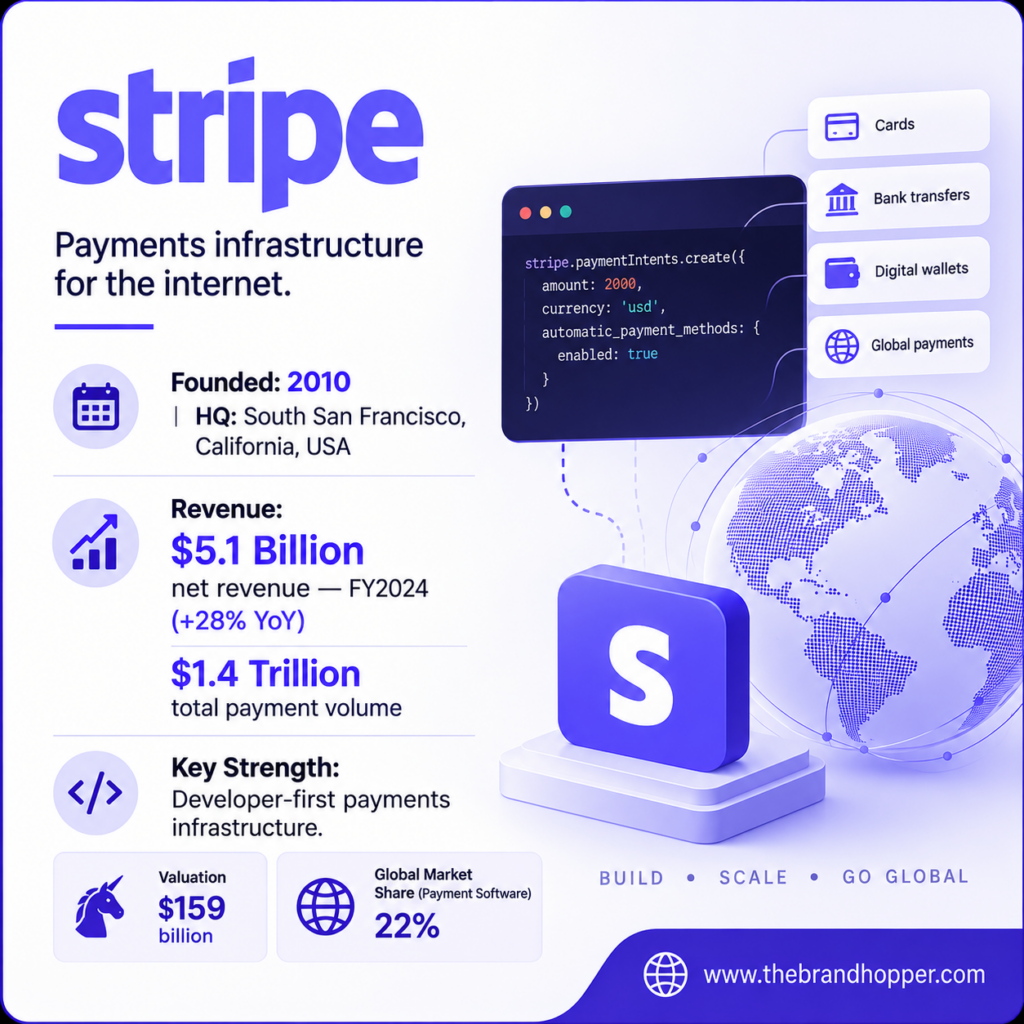
Stripe has achieved something remarkable for a private company: it has reshaped the global payments infrastructure market and now challenges Fiserv not from the banking side but from the technology side. In FY2024, Stripe generated $5.1 billion in net revenue, up 28% year-over-year, processing $1.4 trillion in total payment volume—a 38% increase—equivalent to roughly 1.3% of global GDP. The company achieved profitability in 2024 and its implied valuation reached $159 billion based on the February tender offer.
Stripe holds a 22.3% share of the global payment processing software market—second only in software reach to PayPal—with clients including Amazon, Google, Salesforce, Shopify, and thousands of high-growth technology companies. Its developer-first approach, comprehensive API documentation, and support for 135+ currencies and dozens of payment methods have made it the default payment infrastructure for digitally-native businesses.
Where Stripe most directly threatens Fiserv: in the SMB and mid-market payment processing space, Stripe’s ease of integration, transparent pricing, and rapid product iteration have attracted businesses that might otherwise have used Fiserv-powered payment processing. Stripe’s expansion into banking-as-a-service (Stripe Treasury), corporate cards (Stripe Corporate Card), and revenue and subscription management (Stripe Billing) is also pushing it toward financial services territory where Fiserv’s bank clients operate.
8. NCR Atleos & NCR Voyix (formerly NCR Corporation)

Official Website: ncratleos.com / ncrvoyix.com
NCR Corporation, which had over 135 years of history in financial technology, completed a landmark split in October 2023 into two separate publicly traded companies: NCR Atleos, focused on ATM and self-service banking networks, and NCR Voyix, focused on digital commerce for restaurants and retail. This structural transformation fundamentally changes how NCR competes with Fiserv—in more focused, targeted ways rather than as a broad generalist.
NCR Atleos operates the world’s largest ATM network with approximately 800,000 ATMs globally, competing directly with Fiserv’s branch and ATM channel management solutions. Its digital banking platform serves over 2,600 financial institutions reaching approximately 24 million retail banking users. In merchant services and digital banking, Atleos’ deep footprint in physical banking infrastructure gives it relationships that Fiserv’s digital-first offerings must work alongside or displace.
NCR Voyix focuses on cloud-based POS and restaurant/retail management systems—competing with Fiserv’s Clover platform in those verticals. Its acquisition of Cardtronics (completed pre-split) expanded its ATM network management capabilities significantly. Both entities retain strong client relationships from NCR’s legacy that Fiserv must actively compete against in their respective domains.
9. Oracle Financial Services
Official Website: oracle.com/financial-services
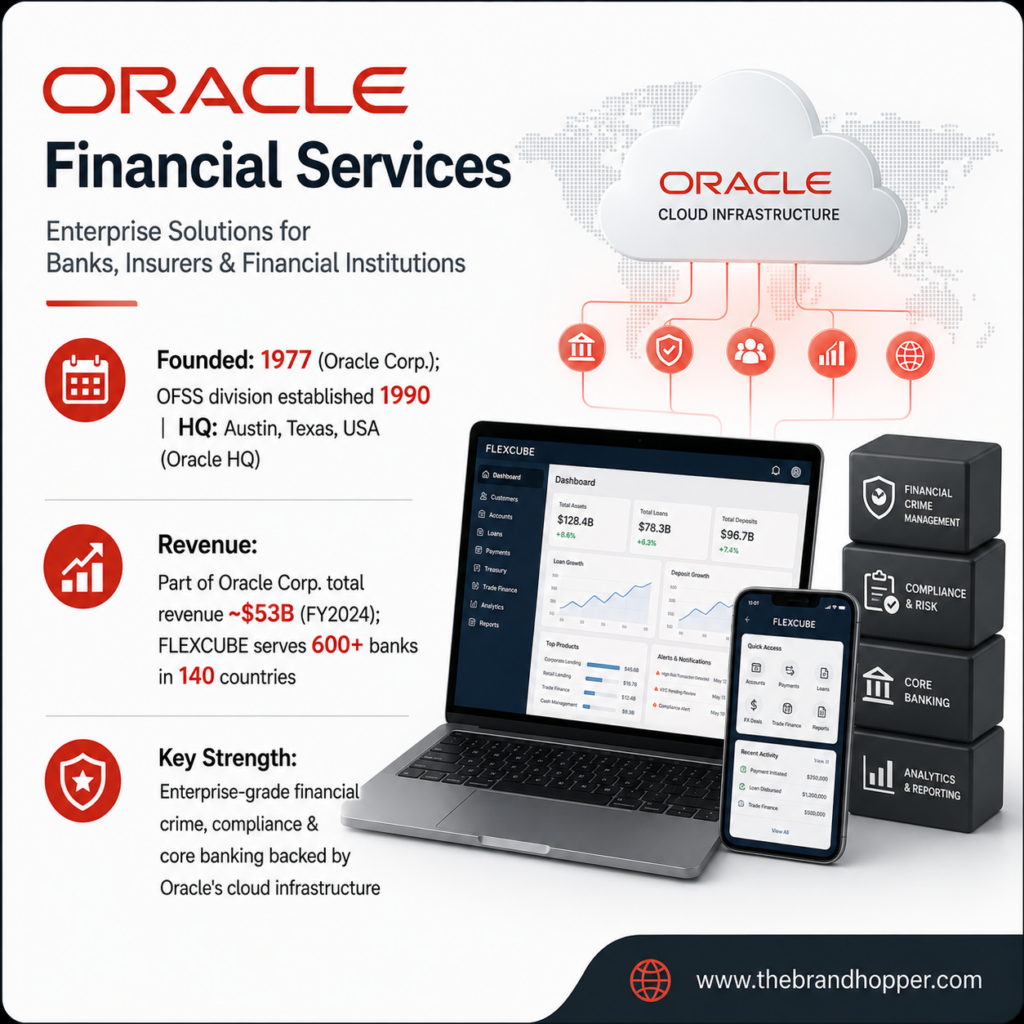
Oracle Financial Services leverages the full weight of Oracle’s enterprise technology ecosystem—its cloud infrastructure, database technology, and AI/ML platforms—to deliver core banking, financial crime compliance, and analytical solutions to financial institutions worldwide. Its FLEXCUBE core banking system is deployed at over 600 banks in 140 countries, processing millions of transactions daily, making it one of the most globally deployed core banking platforms competing with Fiserv’s offerings.
Oracle’s competitive advantage against Fiserv lies in the enterprise technology ecosystem: financial institutions that already run Oracle databases, ERP systems, or cloud infrastructure find Oracle Financial Services a natural fit. The company’s Oracle Financial Services Analytical Applications (OFSAA) suite—particularly its Financial Crime and Compliance Management module—is deployed at some of the world’s largest banks for AML, fraud detection, and regulatory reporting.
Oracle’s recent push toward Oracle Cloud Infrastructure (OCI) deployment of financial services workloads is intensifying competition with Fiserv in cloud-native banking. While Fiserv has the advantage of deeper payment processing integration, Oracle’s strength in multi-country deployments, capital markets analytics, and regulatory compliance gives it significant pull in the large enterprise banking segment.
10. Temenos AG
Official Website: temenos.com
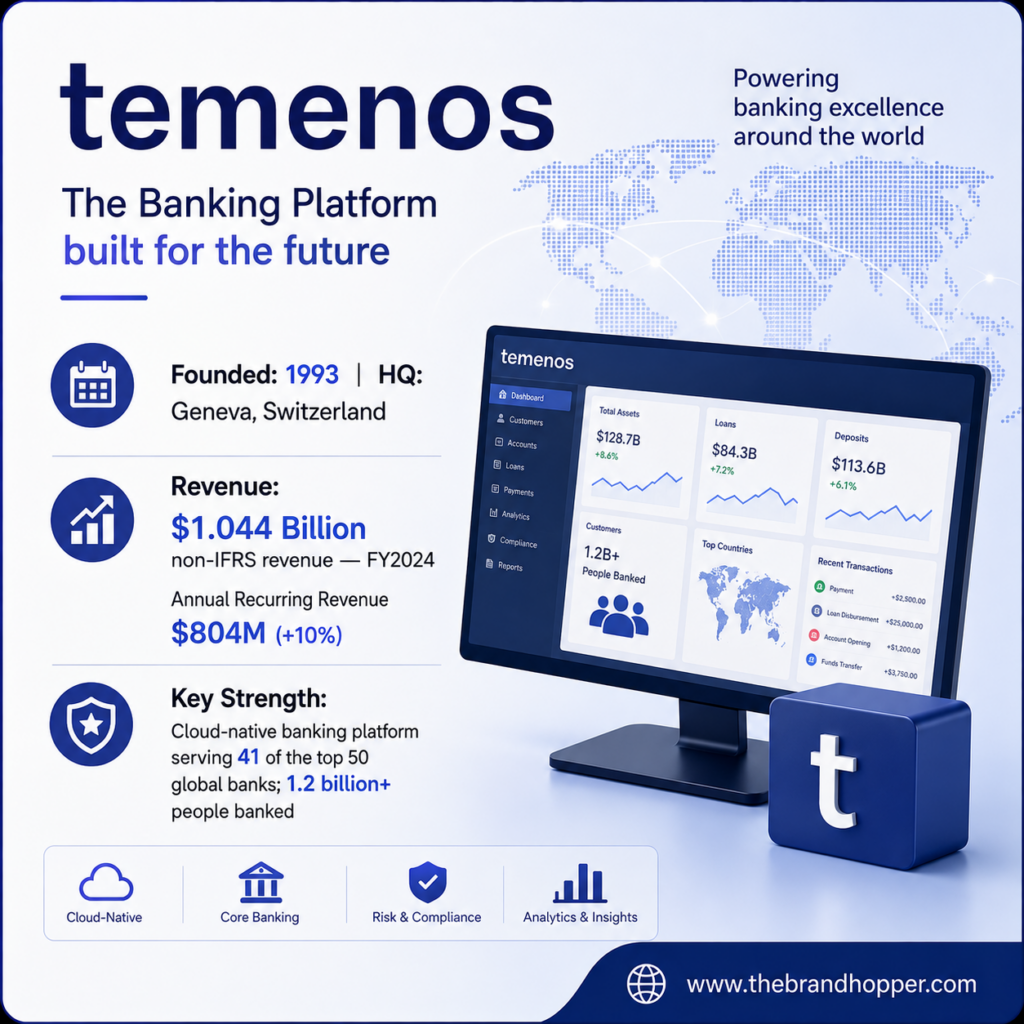
Temenos has established itself as the world’s leading banking software company by number of clients, with its cloud-native platform serving over 3,000 financial institutions including 41 of the top 50 banks and powering the accounts of more than 1.2 billion people globally. In FY2024, Temenos delivered non-IFRS revenue of $1.044 billion with EBIT of $355 million and EPS growth of 23%. Annual Recurring Revenue reached $804 million, up 10%, with free cash flow of $243 million, up 20%.
Temenos Banking Cloud—built on cloud-native microservices architecture from the ground up—represents the most technically differentiated core banking alternative to Fiserv’s financial institution platform offerings. Its composable banking model, where financial institutions can adopt individual banking capabilities as modular services rather than full system replacements, has been particularly attractive to banks seeking incremental modernisation.
Temenos’ strength in wealth management (Temenos WealthSuite) and Islamic banking capabilities have created complementary competitive advantages in segments where Fiserv has limited dedicated offerings. Its partnerships with Microsoft Azure and AWS expand deployment flexibility. After navigating a challenging period in 2023 linked to short-seller attention, Temenos has demonstrably stabilised its financial performance and is on a recovery trajectory.
11. Adyen N.V.
Official Website: adyen.com
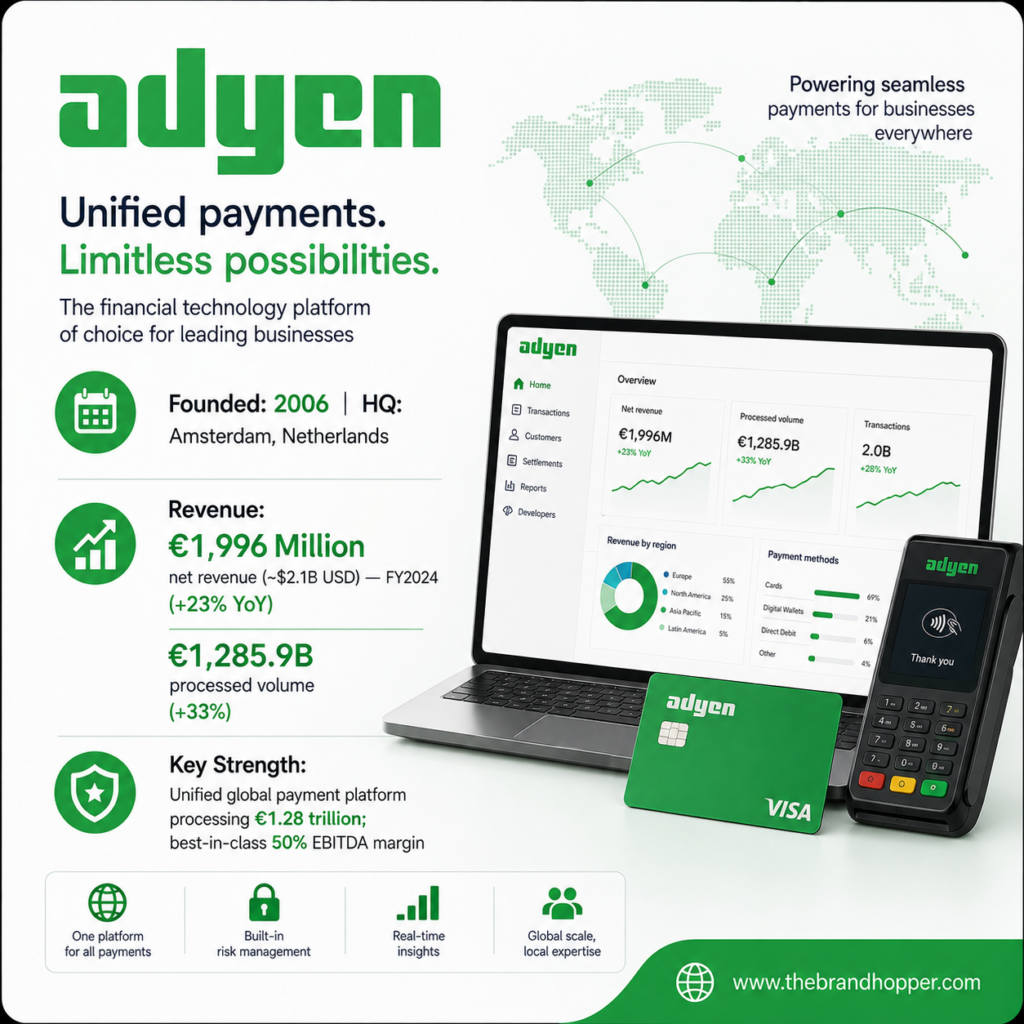
Adyen is one of the most impressive growth stories in global fintech, and increasingly one of Fiserv’s most formidable competitors in enterprise payment processing. In FY2024, Adyen surpassed €1 billion in revenue on a half-yearly basis for the first time, delivering annual net revenue of €1,996 million—up 23%—with a processed volume of €1,285.9 billion (+33%). Its EBITDA margin reached 50%—among the highest in the global fintech industry—with an 87% free cash flow conversion ratio.
Adyen’s unified commerce platform—which processes payments seamlessly across online, in-app, and in-person channels through a single integration—is its primary differentiator against both Fiserv and traditional payment processors. By eliminating the complexity of managing multiple payment providers across different channels, Adyen appeals strongly to global enterprise merchants. Its point-of-sale segment saw volumes soar to €232.7 billion, a 46% increase, as physical retail payment adoption accelerated.
Adyen’s enterprise client roster (Spotify, McDonald’s, eBay, H&M, Microsoft) represents the high end of the global merchant market that Fiserv’s merchant acquiring also targets. The key competitive tension: Adyen’s unified platform and transparent pricing model versus Fiserv’s deeper integration with financial institution relationships and broader US SMB reach through Clover. Adyen’s expansion into embedded finance and financial services for platforms also moves it into territory Fiserv considers its own.
12. Finastra
Official Website: finastra.com
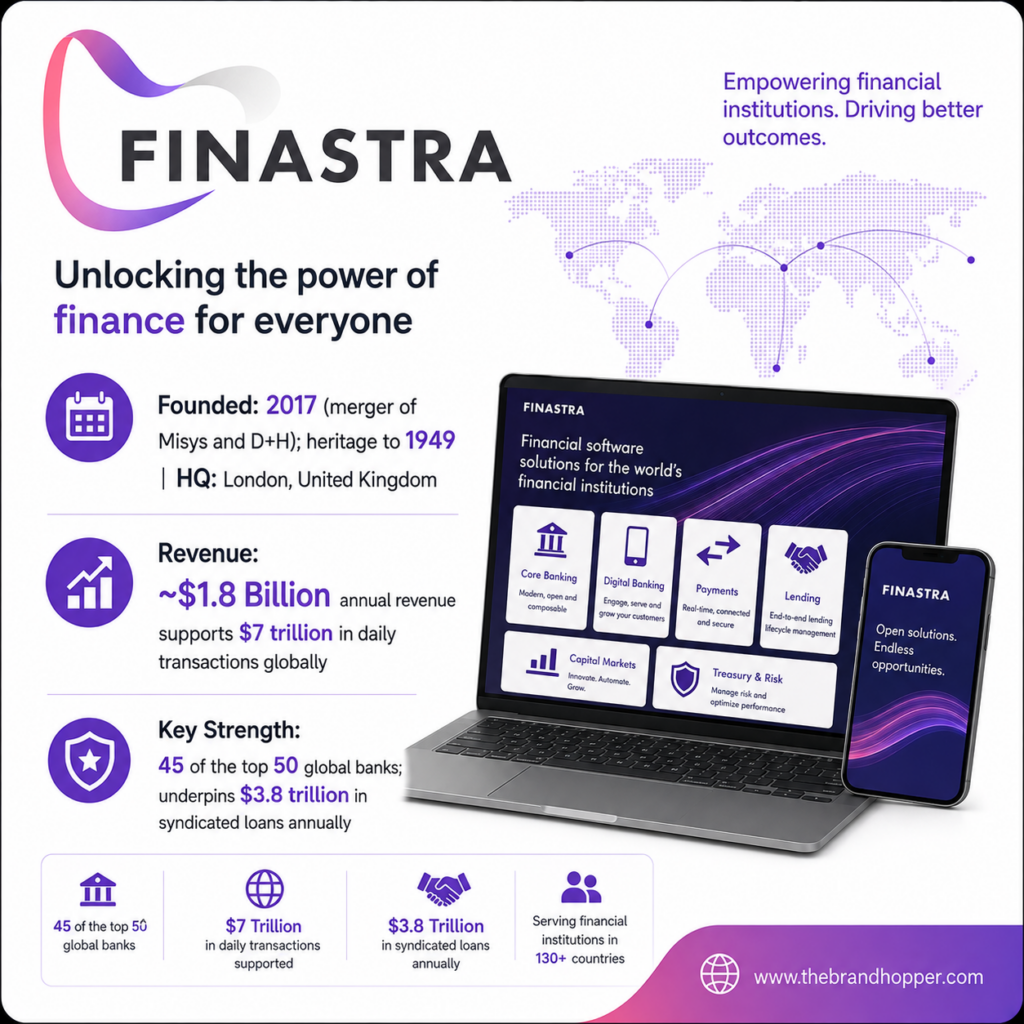
Finastra, formed from the 2017 merger of banking software giants Misys and D+H, is one of the world’s largest financial technology companies with approximately $1.8 billion in annual revenue. It supports more than 8,000 financial institutions globally—including 45 of the top 50 global banks—and its software underpins $7 trillion in daily transactions and $3.8 trillion in syndicated loans annually. These are extraordinary scale indicators that position Finastra as a genuine tier-1 competitor to Fiserv in the financial institution software market.
Finastra’s product portfolio spans universal banking (Fusion Essence core banking), lending (LaserPro, MortgageBot), treasury and capital markets, and transaction banking—overlapping significantly with Fiserv’s Financial Solutions segment. Its open-platform strategy, built around FusionFabric.cloud (an open API marketplace for fintech integration), mirrors Fiserv’s own ecosystem strategy but with a stronger emphasis on enabling third-party innovation.
Finastra’s private ownership (Thoma Bravo-backed) provides it with the financial flexibility to invest in long-cycle product development without quarterly earnings pressure. Its 2024 push into generative AI—with approximately 50 AI capabilities across ideation to production stages—positions it to compete on next-generation financial intelligence tools in the segments where Fiserv’s financial institution clients are most demanding.
13. Worldline S.A.
Official Website: worldline.com
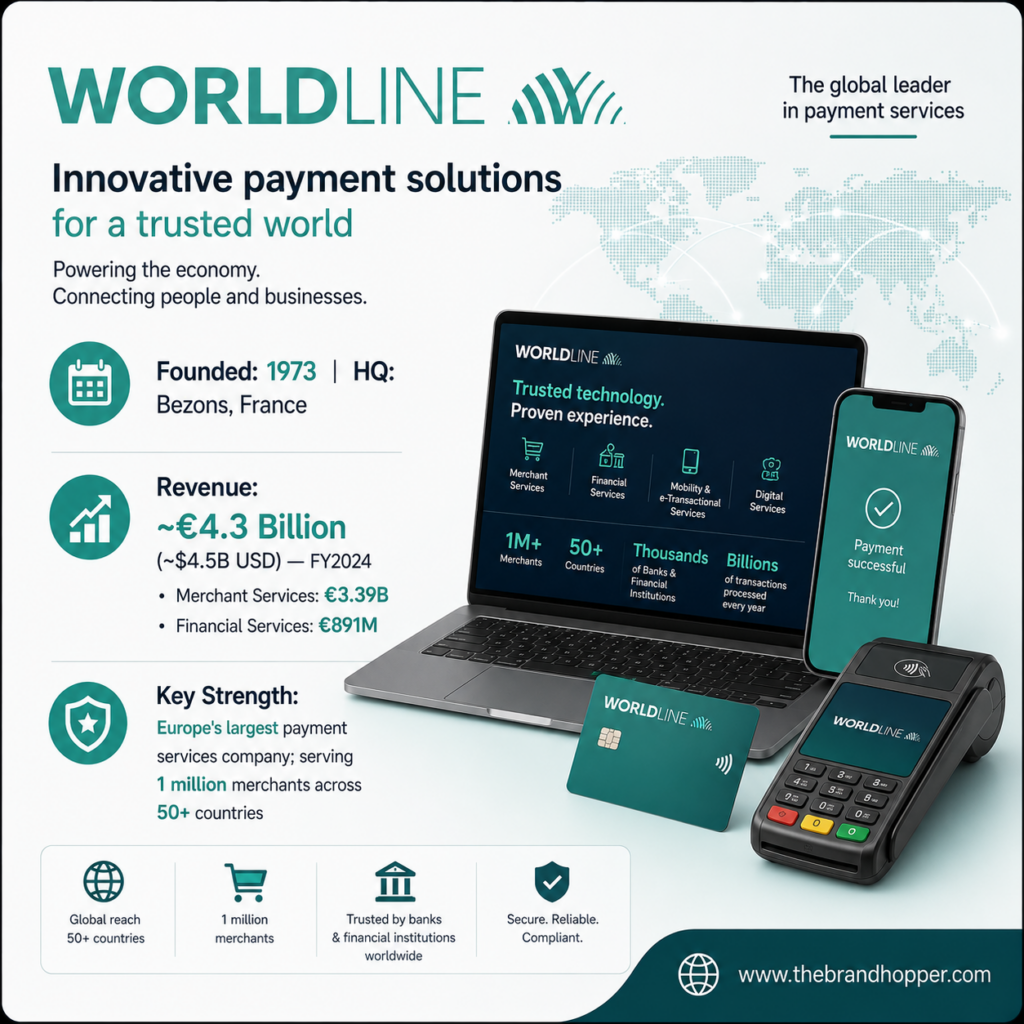
Worldline is the largest payment services company in Europe and one of the most geographically significant competitors to Fiserv in the global payment processing market. In FY2024, Worldline’s Merchant Services division generated €3.39 billion in revenue (+1.9% organic growth) and its Financial Services division contributed €891 million. Adjusted EBITDA was €815 million at a 24% margin—below historical levels due to softening macroeconomic conditions in key Central European markets.
Worldline’s European footprint—covering 50+ countries with deep relationships with European banks, retailers, and governments—gives it capabilities in the EU payment infrastructure that Fiserv cannot easily replicate. Its payment terminals business, national payment scheme connectivity, and digital banking infrastructure services for European banks serve segments that are distinctly relevant where Fiserv seeks to expand its international presence.
Worldline has faced strategic challenges in 2023-2024 including softer-than-expected organic growth and Asia-Pacific performance issues, leading to a strategic review and portfolio rationalisation. However, the company’s core European payment infrastructure position—particularly in France, Germany, Belgium, and Southern Europe—represents a significant competitive asset that positions it as a formidable partner or rival in any global payment processing context.
14. Q2 Holdings
Official Website: q2.com
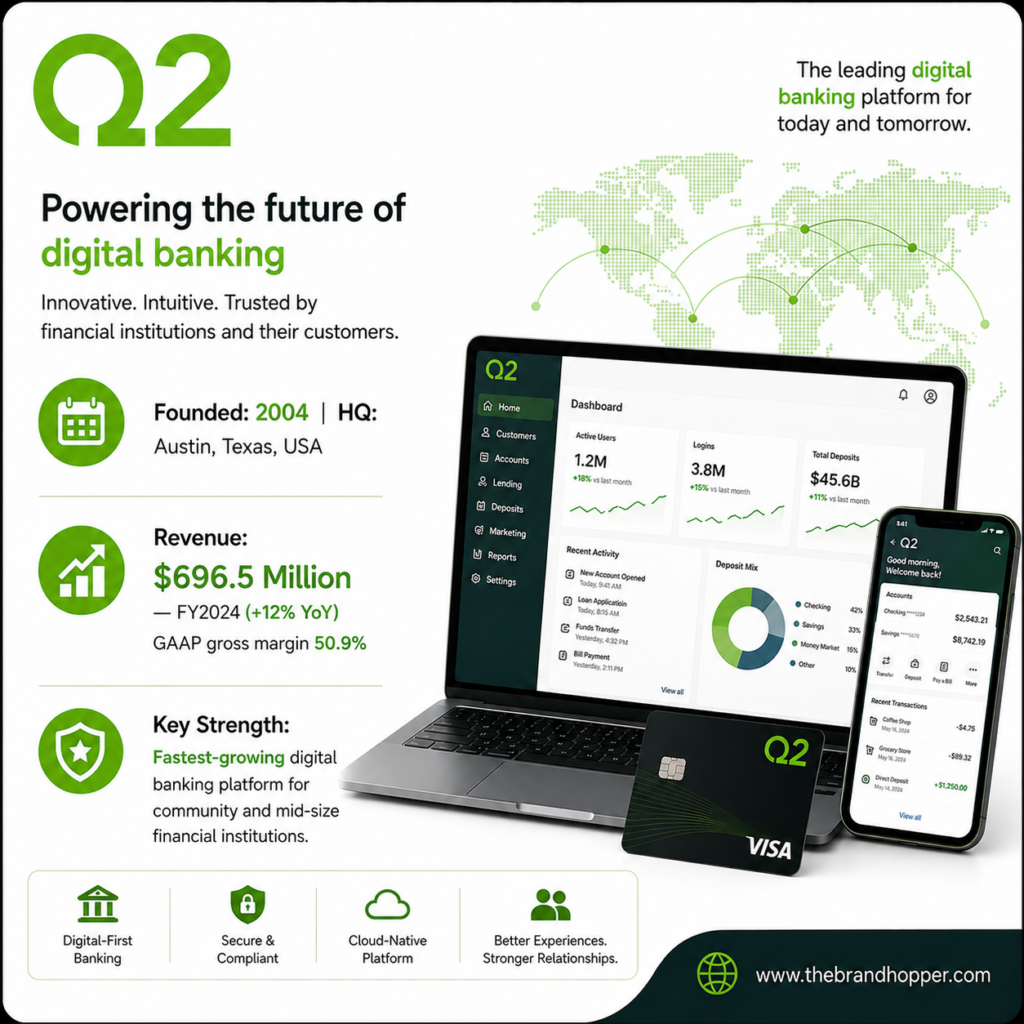
Q2 Holdings is a focused digital banking and lending technology provider serving financial institutions, fintechs, and alternative finance companies. In FY2024, Q2 generated $696.5 million in revenue—up 12% year-over-year and accelerating growth throughout the year—with a GAAP gross margin of 50.9%. This consistent double-digit growth in the digital banking segment directly reflects competitive pressure on Fiserv’s digital banking offerings for community and mid-size financial institutions.
Q2’s platform specialises in enabling banks and credit unions to deliver premium digital banking experiences to their account holders, offering account opening, digital lending, and financial wellness tools through a unified cloud platform. Its Helix banking-as-a-service product allows fintechs and brands to embed banking features, competing with Fiserv’s own BaaS capabilities.
Q2’s Q4 2024 revenue of $183 million—up 13% YoY—demonstrates accelerating momentum. As community banks and credit unions increasingly require modern digital banking capabilities to compete with megabanks and neobanks, Q2’s specialised focus on this segment positions it as a genuine alternative to Fiserv’s digital banking solutions, particularly for institutions seeking a best-of-breed digital platform rather than Fiserv’s broader suite.
15. SS&C Technologies
Official Website: ssctech.com
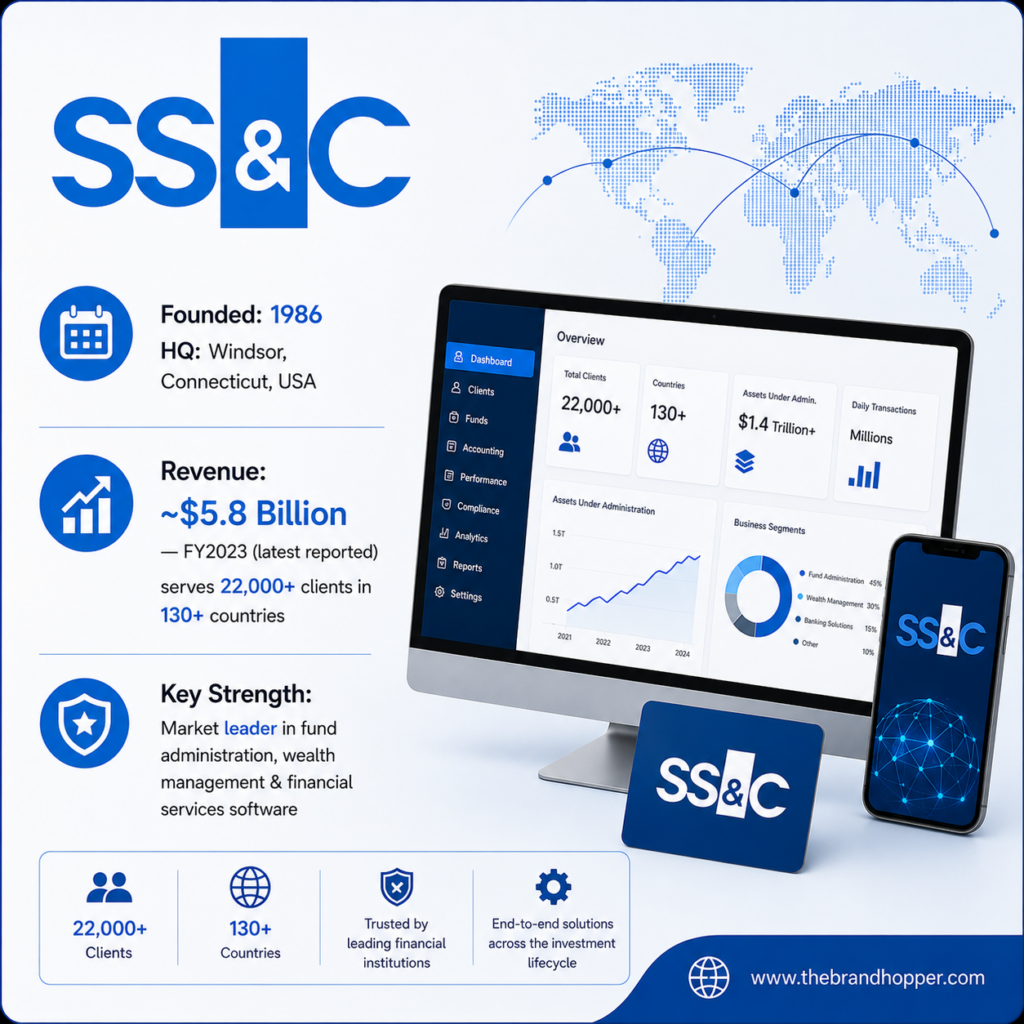
SS&C Technologies is one of the world’s largest and most diversified financial technology providers, with approximately $5.8 billion in annual revenue and over 22,000 clients across 130+ countries. While SS&C’s core strength lies in investment management software, fund administration, and wealth management technology—segments where Fiserv has limited presence—the company’s broader financial services technology platform increasingly encroaches on Fiserv’s customer relationships in banking and insurance technology.
SS&C’s product portfolio spans fund administration (where it is the world’s largest third-party fund administrator), wealth management platforms (Black Diamond, Advent Portfolio Exchange), insurance technology, and financial markets software. Its acquisitions of DST Systems (2018, $5.4 billion), Eze Software, and numerous other companies have created a technology conglomerate serving the full spectrum of financial services firms.
SS&C competes with Fiserv primarily in the wealth management, retirement services, and insurance technology adjacencies—segments where financial institutions increasingly seek integrated technology partners. As the boundaries between banking, investment management, and insurance blur through financial super-apps and integrated financial services platforms, SS&C’s breadth of coverage represents a growing competitive consideration for any Fiserv client evaluating their broader technology stack.
16. Bottomline Technologies
Official Website: bottomline.com
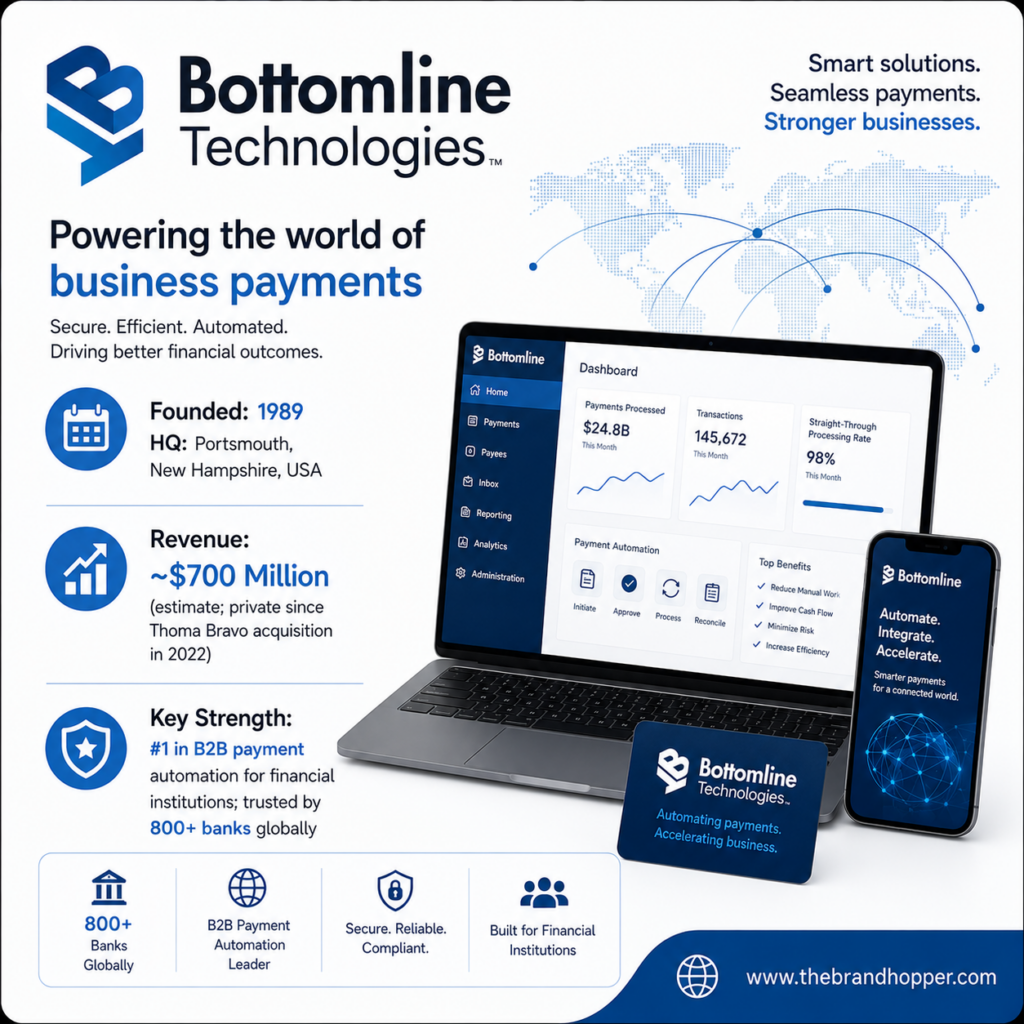
Bottomline Technologies, taken private by Thoma Bravo in 2022 for approximately $2.6 billion, is a specialist in business payments and financial operations software with approximately $700 million in estimated annual revenue. Its core products—Paymode-X (the largest business payment network in the US with over $400 billion in annual payment volume), digital banking for business, and financial messaging—compete directly with Fiserv’s financial institution and business banking technology.
Bottomline’s SWIFT messaging and financial crime solutions serve over 800 financial institutions globally, providing an alternative to Fiserv’s payment network and compliance offerings. Its PT-X (Payments, Transactions, and Exchange) platform for real-time payments and ISO 20022 messaging represents a focused threat in the payment modernisation space where Fiserv’s financial institution clients are actively investing.
Being private allows Bottomline to invest in long-cycle product development and strategic customer relationships without the quarterly revenue reporting constraints of public competitors. Its specialisation in B2B payment automation, digital banking for business customers, and bank-to-bank financial messaging gives it credibility in segments where Fiserv must compete against a purpose-built specialist rather than a generalist.
Fiserv vs. Competitors: At-a-Glance Comparison
The table below summarises key financial and operational metrics for Fiserv and its 16 major competitors, using the most recently available annual data.
| Company | HQ | Revenue (Latest) | Core Strength | Fiserv Overlap Zone |
| Fiserv | USA | $20.46B (FY2024) | Banking + Merchant Tech | (Reference) |
| FIS | USA | $10.1B (FY2024) | Core Banking, Capital Mkts | Banking Software |
| Global Payments | USA | $10.11B (FY2024) | Vertical Payment Software | Merchant Acquiring |
| Jack Henry | USA | $2.22B (FY2024) | Community Banking Tech | Digital Banking (FIs) |
| ACI Worldwide | USA | ~$1.57B (FY2024) | Real-Time Payments & Fraud | Payment Processing |
| Block (Square) | USA | $8.89B GP (FY2024) | SMB Payments & Consumer | Merchant Solutions (Clover) |
| PayPal | USA | $31.7B (FY2024) | Consumer Payment Network | Merchant & Consumer Pay |
| Stripe | USA | $5.1B (FY2024) | Dev-First Payment Infra | SMB & Enterprise Payments |
| NCR Atleos/Voyix | USA | ~$4.4B combined | ATMs & Digital Commerce | Branch + Merchant Tech |
| Oracle Fin. Services | USA | Part of $53B Oracle | Enterprise Core Banking | Large Bank Software |
| Temenos | Switzerland | $1.04B (FY2024) | Cloud Banking Platform | Core Banking (Global) |
| Adyen | Netherlands | €2.0B (FY2024) | Unified Commerce Payments | Enterprise Merchant |
| Finastra | UK | ~$1.8B | Universal Banking Software | Banking Technology |
| Worldline | France | ~€4.3B (FY2024) | European Payment Services | Merchant Acquiring (EU) |
| Q2 Holdings | USA | $696.5M (FY2024) | Digital Banking Platform | Community Bank Digital |
| SS&C Technologies | USA | ~$5.8B (FY2023) | Investment & Wealth Tech | Wealth/Insurance Adj. |
| Bottomline Tech. | USA | ~$700M (est.) | B2B Payment Automation | Business Banking Payments |
Key Competitive Dynamics Shaping the Fintech Landscape
1. Cloud-Native Architecture vs. Legacy Systems
The most fundamental competitive divide in financial technology today is between cloud-native platforms and legacy on-premise or hosted systems. New entrants like Stripe, Adyen, Q2 Holdings, and Temenos Banking Cloud were built cloud-native from inception—enabling faster product releases, elastic scalability, and lower total cost of ownership. Fiserv and FIS, as incumbents, have had to modernise existing platforms while maintaining backward compatibility for thousands of existing clients. This ‘innovate while maintaining’ challenge creates competitive openings for newer platforms in new contract opportunities.
2. The Embedded Finance Revolution
Embedded finance—the integration of financial services capabilities directly into non-financial platforms and apps—is reshaping who competes with Fiserv. Stripe’s Treasury product, Adyen’s financial services for platforms, Block’s Cash App financial ecosystem, and Q2’s Helix BaaS are all examples of embedded finance infrastructure that bypasses traditional bank technology relationships. As merchants, retailers, and SaaS companies increasingly want to offer financial services to their customers, the demand for financial technology moves upstream from the bank to the platform—directly challenging the B2B model that underpins Fiserv’s business.
3. Real-Time Payments and ISO 20022 Modernisation
The global shift to real-time payment infrastructure—FedNow in the United States, PIX in Brazil, UPI in India, and ISO 20022 adoption for SWIFT messaging—is driving a major investment cycle that all of Fiserv’s competitors are addressing. ACI Worldwide and Bottomline Technologies have particularly strong positions in real-time payment processing and financial messaging. Adyen and Stripe benefit from real-time capabilities as defaults. Fiserv’s Now Gateway and RTP capabilities compete in this space but face pressure from specialists with real-time DNA.
4. AI in Financial Services: Fraud, Personalisation, and Automation
Artificial intelligence is becoming the central competitive differentiator in financial technology. ACI’s ML-driven fraud prevention, PayPal’s AI-powered risk management, Finastra’s generative AI rollout, Oracle’s intelligent compliance analytics, and Stripe’s adaptive pricing algorithms all reflect the industry-wide race to deploy AI in commercially impactful ways. Fiserv’s AI investments—including real-time fraud scoring through its risk and compliance suite—position it competitively, but the pace of AI capability development across the competitive landscape means this battle is far from decided.
5. Community Banking as a Competitive Moat
The segment of community banks and credit unions—typically institutions with $1 billion to $50 billion in assets—remains one of the most contested battlegrounds in financial technology. Fiserv, Jack Henry, FIS, Q2 Holdings, and Finastra all compete actively for this customer base. Jack Henry’s focus and retention rates demonstrate that specialisation in this segment creates formidable loyalty. Fiserv’s breadth gives it cross-selling advantages but also the challenge of maintaining a focused value proposition that a community bank specialist like Jack Henry can more easily deliver.
What Makes Fiserv Competitive Against 16 Strong Rivals?
Despite the scale and quality of competition above, Fiserv retains structural advantages that make displacing it from established client relationships extremely difficult:
Scale and integration depth: With $20.46 billion in revenue and a client base spanning 10,000+ financial institutions, Fiserv’s integration into the core infrastructure of financial institutions creates switching costs that competitors rarely overcome without a compelling business case.
Clover as a growth engine: Fiserv’s Clover POS and business management platform has become a genuine competitive asset—a cloud-based, software-led merchant platform that grows through Fiserv’s bank distribution network in ways Stripe and Square cannot replicate without bank partnerships.
Distribution through bank partners: Fiserv’s strategy of distributing merchant services through its financial institution clients—adding 65% more bank partners in 2024 alone—creates a unique channel advantage. When a business bank account is opened at a Fiserv-powered bank, Clover merchant services is a natural next offering.
Breadth of solutions: No single competitor matches Fiserv’s breadth across core banking, digital banking, payment processing, merchant acquiring, bill payment, and lending technology—giving it genuine enterprise technology suite value.
Regulatory and compliance expertise: Deep entrenchment in the regulatory and compliance workflows of thousands of financial institutions creates data advantages and switching cost barriers that technology-first competitors rarely overcome.
Frequently Asked Questions (FAQs)
Q: Who is Fiserv’s biggest competitor?
A. FIS (Fidelity National Information Services) is consistently regarded as Fiserv’s most direct and comparable competitor. Both companies operate at similar scale in core banking software and payment technology for financial institutions. FIS serves 20,000+ clients across 130+ countries, generating $10.1 billion in FY2024 revenue, making it the nearest rival in terms of heritage, service breadth, and institutional client focus. Global Payments ($10.11B FY2024) is a close second in the merchant payments segment.
Q: How does Fiserv compare to Stripe and PayPal?
A. Fiserv, Stripe, and PayPal operate in adjacent but differently structured segments of fintech. Fiserv primarily serves financial institutions (banks, credit unions) with banking technology and also provides merchant services. Stripe primarily serves businesses with payment processing APIs and infrastructure, generating $5.1 billion in 2024 net revenue. PayPal serves consumers and merchants through its payment network ($31.7 billion FY2024 revenue). The three compete in merchant payments but target different customer profiles—Fiserv through bank distribution, Stripe through direct developer adoption, and PayPal through consumer trust and brand recognition.
Q: Why did NCR split into two companies, and how does this affect competition with Fiserv?
A. NCR Corporation split in October 2023 into NCR Atleos (ATM and self-service banking) and NCR Voyix (digital commerce for restaurants and retail). This split created two more focused competitors—Atleos targeting the branch/ATM banking infrastructure space where Fiserv also operates, and Voyix targeting the restaurant/retail POS space where Fiserv’s Clover competes. The split was intended to unlock value from two businesses with very different economics, but it also means Fiserv now faces two focused, independent competitors rather than one diversified one.
Q: What is Adyen, and why is it a significant Fiserv competitor?
A. Adyen is a Dutch payment technology company that provides a unified global payment platform processing across online, in-store, and mobile channels through a single integration. In FY2024, Adyen processed €1.28 trillion in payment volume and generated €1.996 billion in net revenue—with a 50% EBITDA margin that is exceptional by industry standards. Adyen is particularly significant as a Fiserv competitor because it targets the same large enterprise merchant segment with a more technically modern, unified-commerce approach, and is expanding into embedded finance for platforms.
Q: What is the difference between Fiserv and Jack Henry & Associates?
A. Fiserv is a broadly diversified financial technology conglomerate serving financial institutions, merchants, and enterprises with a wide range of solutions spanning core banking, payments, digital banking, and merchant services. Jack Henry & Associates is a specialist focused exclusively on community and mid-size banks and credit unions. Jack Henry’s singular focus delivers higher customer satisfaction and retention rates (95%+) in the community banking segment, while Fiserv’s breadth enables cross-selling across more product categories and client types. For a community bank choosing between them, Jack Henry’s focus is often a compelling differentiator; for a larger institution wanting a single enterprise technology partner, Fiserv’s breadth wins.
Q: Is Stripe a direct competitor to Fiserv?
A. Yes, though with important nuances. Stripe competes with Fiserv most directly in the payment processing and merchant services space—both enable businesses to accept payments. Stripe’s developer-first API approach attracts digitally-native businesses and enterprise technology companies, while Fiserv’s merchant services (Clover) are distributed primarily through bank partners and target a broader SMB base. Stripe’s expansion into banking-as-a-service (Stripe Treasury) and financial infrastructure for platforms also creates competitive overlap in areas Fiserv considers core territory.
Q: How is AI changing competition in the Fiserv market?
A. AI is transforming financial technology across fraud detection, credit decisioning, personalisation, and process automation. ACI Worldwide’s ML-driven fraud prevention (reducing false positives by 75%), PayPal’s AI risk management, Stripe’s adaptive payment optimisation, and Finastra’s generative AI rollout all demonstrate how AI is becoming a core competitive differentiator. Fiserv has integrated AI capabilities across its suite including real-time fraud scoring and AI-powered financial insights for bank clients. The competitive race in AI is particularly intense in fraud prevention, where real-time, accurate detection directly impacts both client satisfaction and financial outcomes.
Q: What segments of Fiserv’s business face the most competitive pressure?
A. Three segments face the most acute competitive pressure: (1) Digital banking for community and mid-size financial institutions, where Jack Henry, Q2 Holdings, and Temenos are strong alternatives; (2) Enterprise merchant payment processing, where Adyen, Stripe, and Global Payments offer compelling cloud-native alternatives; (3) Core banking modernisation, where Temenos, Finastra, and Oracle Financial Services compete for large-bank transformation projects. Fiserv’s most defensible segments are its SMB merchant services through Clover (distributed via bank partners) and its deeply integrated core banking platforms for existing clients.
Conclusion
Fiserv’s competitive landscape in financial technology is as complex as it is contested. The company faces pressure from all directions: from equally-scaled platform players like FIS and Global Payments, from vertically-specialised disruptors like Jack Henry and Q2 Holdings, from consumer and developer-facing innovators like PayPal, Stripe, and Block, from European payment giants like Adyen and Worldline, and from enterprise software powerhouses like Oracle and Finastra. Each competitor has found a wedge in Fiserv’s broad product market that it exploits with focus and specialisation.
Yet Fiserv’s FY2024 performance—crossing $20 billion in revenue with strong organic growth momentum—demonstrates that scale, integration depth, and distribution through its vast bank partner network create real competitive durability. The Clover ecosystem’s growth through bank distribution is a model that pure-play payment processors and software-first fintechs have not yet replicated at the same scale. In the battle for the future of financial technology, Fiserv’s incumbency advantage must be balanced against the agility and technical modernity of the challengers profiled above. The institutions and merchants choosing between them will increasingly determine the market’s direction.
Also read: Business Model of Visa – How Visa Makes Money
To read more content like this, subscribe to our newsletter
Go to the full page to view and submit the form.