


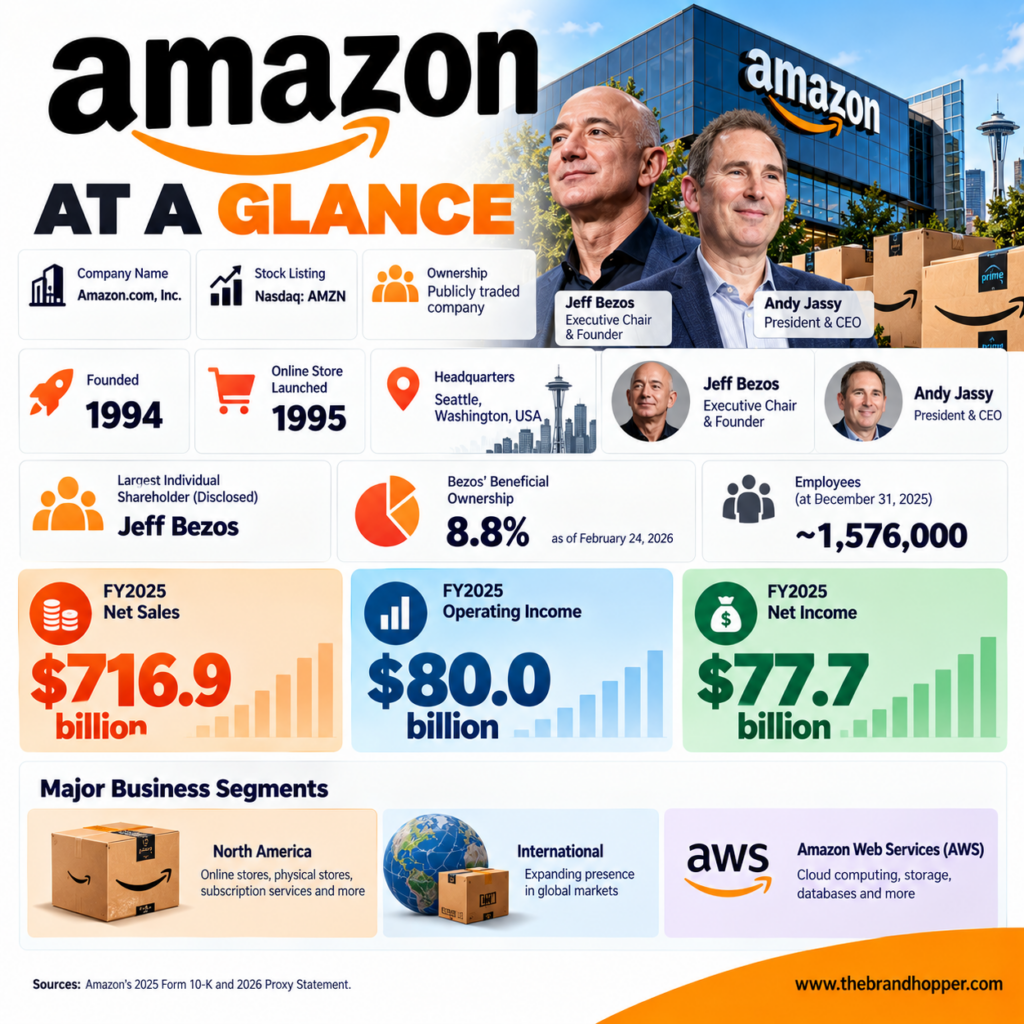
Amazon is one of the world’s largest e-commerce and cloud computing companies. At the end of 2025, it employed approximately 1.576 million full-time and part-time employees and generated $716.9 billion in annual net sales.
But who actually owns Amazon?
The short answer is that Amazon is owned by its shareholders. Amazon.com, Inc. is a publicly traded company listed on Nasdaq under the ticker symbol AMZN, and its founder, Jeff Bezos, remains its largest individual shareholder.
Amazon’s 2026 proxy statement reported that Bezos beneficially owned 950,434,581 shares, equivalent to 8.8% of the company, as of February 24, 2026. The same statement listed Vanguard and BlackRock among the largest institutional holders, although their disclosed ownership figures were based on older filings.
This guide explains who owns Amazon, how much of the company Jeff Bezos holds, who runs the business, what Amazon owns, and how its financial performance has evolved.
Quick Answer: Who Owns Amazon?
Amazon.com, Inc. is a publicly traded company owned by its shareholders, not by a parent company.
Jeff Bezos is the company’s founder and Executive Chair and was its largest individual shareholder in Amazon’s 2026 proxy statement, with 8.8% beneficial ownership.
Vanguard and BlackRock were also listed as holders of more than 5% in that statement, but the figures were based on filings from 2024 and should not be treated as verified current ownership percentages.
Andy Jassy has served as Amazon’s President and CEO since July 2021. Bezos remains influential through his shareholding and role as Executive Chair, but Amazon has one class of common stock with one vote per share.

Who Owns Amazon? The Major Shareholders
Amazon’s 2026 proxy statement reported beneficial ownership as of February 24, 2026. At that date, the company had 10,751,236,247 common shares outstanding.

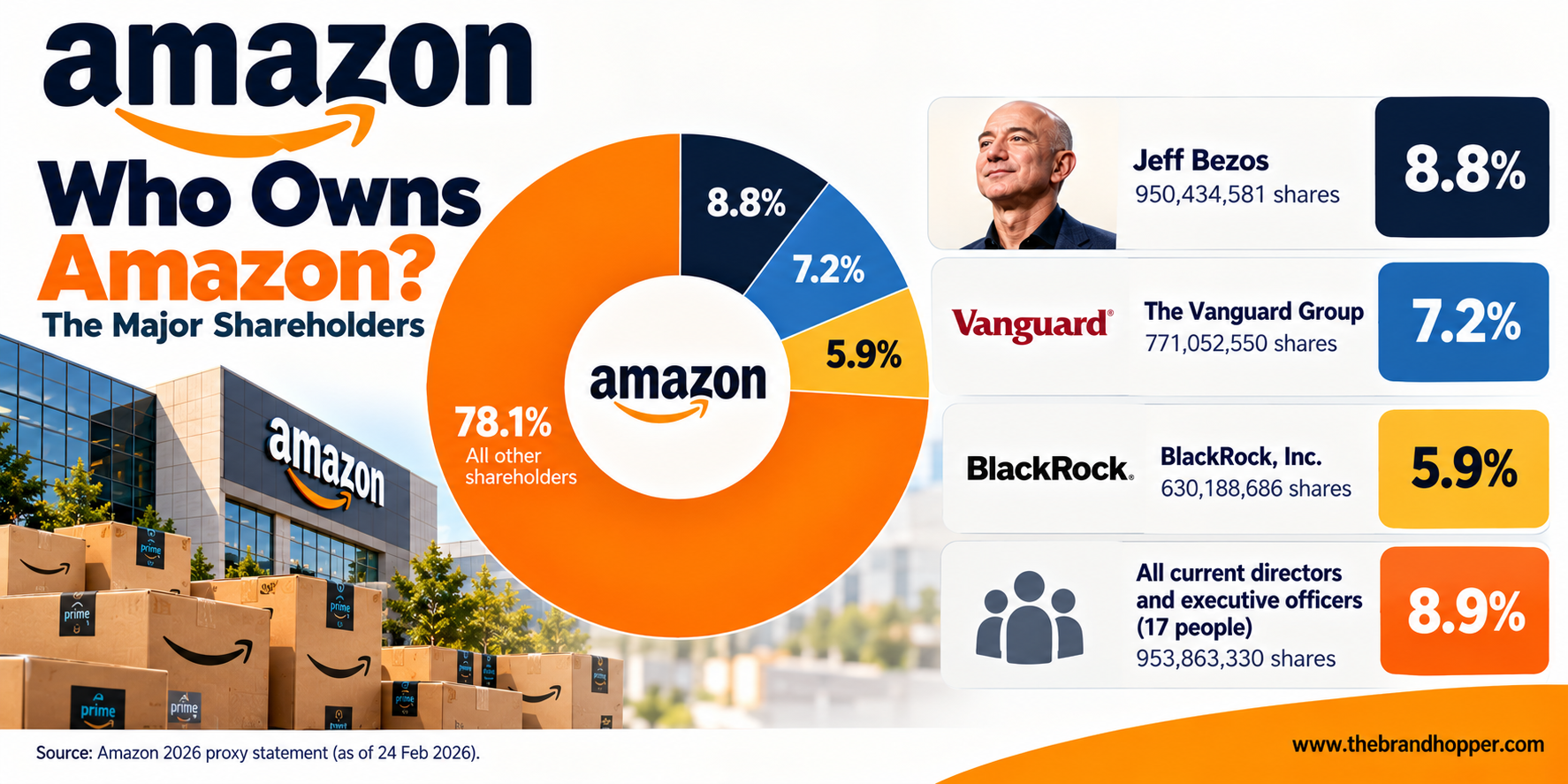
The figures in the table need to be interpreted carefully. Beneficial ownership can include shares over which a person or institution has voting or investment authority, and the reported figures may not represent the same kind of economic ownership in every case.
Vanguard and BlackRock manage investments on behalf of clients through funds, retirement accounts, and other investment products. Their holdings therefore should not be interpreted as personal ownership by the companies’ executives.
Amazon’s shareholder base also includes other institutional investors, pension funds, mutual funds, exchange-traded funds, hedge funds, and individual investors who hold shares directly or through brokerage accounts.
One Share, One Vote
Amazon has a single class of common stock, with one vote per share. Unlike companies with dual-class structures, Amazon does not give its founder a separate class of super-voting shares.
Bezos’ influence therefore comes from his shareholding, his position as Executive Chair, and his long history with the company. His stake is significant, but it does not give him unilateral voting control.
How Much of Amazon Does Jeff Bezos Own?
According to Amazon’s 2026 proxy statement, Jeff Bezos beneficially owned 950,434,581 shares, or 8.8% of Amazon, as of February 24, 2026.

That figure includes 68,232,131 shares over which Bezos has sole voting power but no investment power. These shares are associated with the voting arrangement established following his 2019 divorce from MacKenzie Scott.
The distinction matters because beneficial ownership is a legal and regulatory concept. It can include voting authority over shares that the reporting person does not economically own or control for investment purposes.
Amazon’s subsequent insider filings report additional share transactions by Bezos during 2026. As he sells or donates shares, the number of shares he holds and his percentage of Amazon can change.
Is Jeff Bezos Still in Charge of Amazon?
Jeff Bezos is no longer Amazon’s day-to-day CEO. He stepped down as Chief Executive Officer on July 5, 2021, and became Executive Chair, while Andy Jassy succeeded him as CEO.

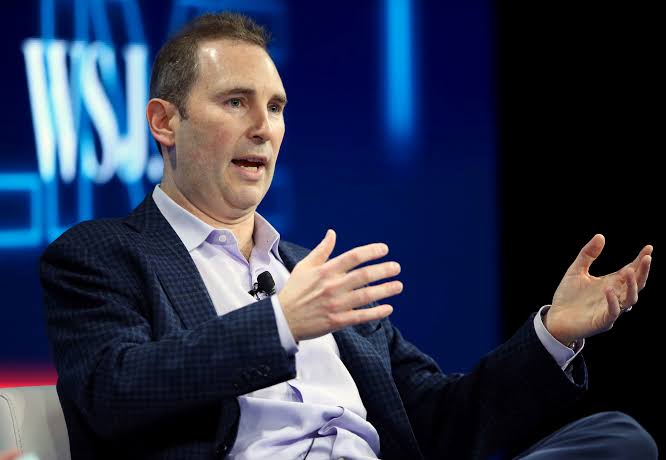
As Executive Chair, Bezos continues to serve on the Board and remains a prominent figure in Amazon’s long-term direction. Andy Jassy is responsible for running the company as President and CEO.
MacKenzie Scott’s Amazon Stake
MacKenzie Scott, formerly married to Jeff Bezos, received approximately 4% of Amazon in connection with their 2019 divorce settlement.
The agreement provided that Bezos would retain voting authority over the relevant shares, while Scott retained the economic ownership of the shares registered in her name. The arrangement meant that voting authority and economic ownership were not identical.
Scott has subsequently given away substantial wealth through philanthropy and has sold or donated Amazon shares over time. Her current holding should not be inferred from the original 2019 percentage.
Amazon’s 2026 proxy statement did not list Scott among shareholders known to beneficially own more than 5% of the company. That does not establish that she owns no Amazon shares; it means the proxy did not list her as a holder above that reporting threshold.
Who Runs Amazon? Leadership and Board
Amazon’s leadership combines its founder and Executive Chair with executives responsible for the company’s core operating businesses.
| Name | Role |
|---|---|
| Jeff Bezos | Founder and Executive Chair |
| Andy Jassy | President and Chief Executive Officer |
| Matt Garman | CEO, Amazon Web Services |
| Doug Herrington | CEO, Worldwide Amazon Stores |
| Brian Olsavsky | Senior Vice President and Chief Financial Officer |
| David Zapolsky | Senior Vice President, Chief Global Affairs and Legal Officer |
Amazon’s Board of Directors provides oversight of corporate governance, strategy, and management. Its directors include Bezos and Jassy, along with independent directors such as Keith Alexander, Edith Cooper, Jamie Gorelick, Daniel Huttenlocher, Andrew Ng, Indra Nooyi, Jonathan Rubinstein, Brad Smith, Patricia Stonesifer, and Wendell Weeks.
In September 2026, Amazon elected cybersecurity executive Kevin Mandia to its Board and appointed him to the Audit and Security Committees.
Amazon’s proxy statement reported that Andy Jassy beneficially owned 2,313,536 shares as of February 24, 2026, less than 1% of the company’s outstanding shares.
Amazon’s Financial Performance
Amazon’s scale helps explain why its ownership attracts so much interest. In FY2025, net sales rose 12% to $716.9 billion, while net income increased to $77.7 billion.
The company operates through three reportable segments: North America, International, and Amazon Web Services. It also reports revenue by product and service categories, including online stores, third-party seller services, advertising, subscriptions, physical stores, and other activities.
Amazon’s FY2025 Financial Results

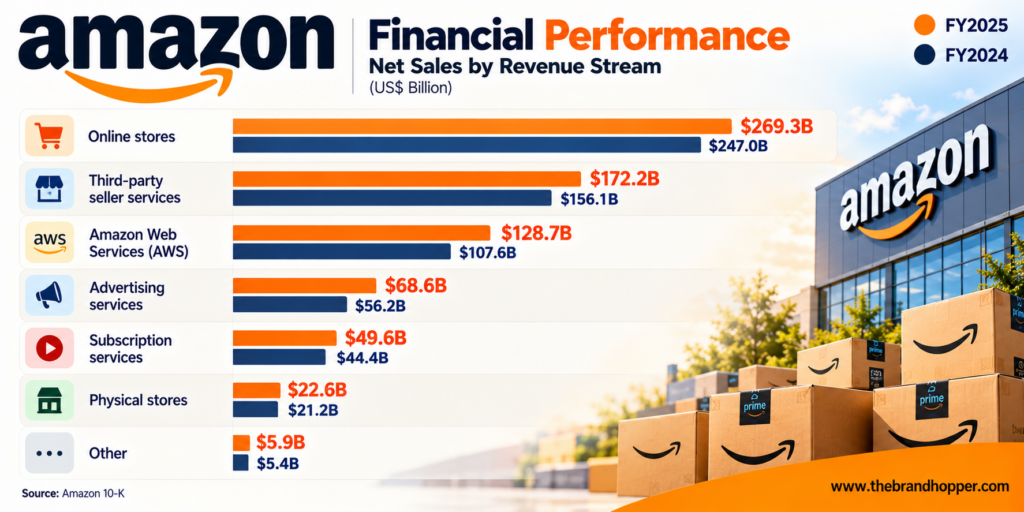
AWS is a major contributor to Amazon’s operating profitability. In FY2025, AWS generated $128.7 billion in sales and $45.6 billion in operating income, representing more than half of Amazon’s total operating income.
This makes AWS strategically important to Amazon’s overall results, even though the North America and International segments account for a larger share of consolidated sales combined.
Latest Reported Results: Q2 2026
For the quarter ended June 30, 2026, Amazon reported net sales of $200.6 billion, up 20% year over year. Operating income rose to $27.5 billion, while AWS sales increased 37% to $42.2 billion.
Amazon also reported net income of $62.6 billion for the quarter. This unusually high figure included $53.4 billion in non-operating income, primarily associated with valuation gains on investments in Anthropic.
These investment-related gains are not equivalent to revenue generated by Amazon’s normal retail, advertising, or cloud operations. When assessing Amazon’s underlying operating performance, net sales and operating income provide important context alongside reported net income.
What Does Amazon Own?
Amazon is the parent company of a broad group of businesses spanning e-commerce, cloud computing, entertainment, grocery retail, healthcare, devices, and satellite communications.

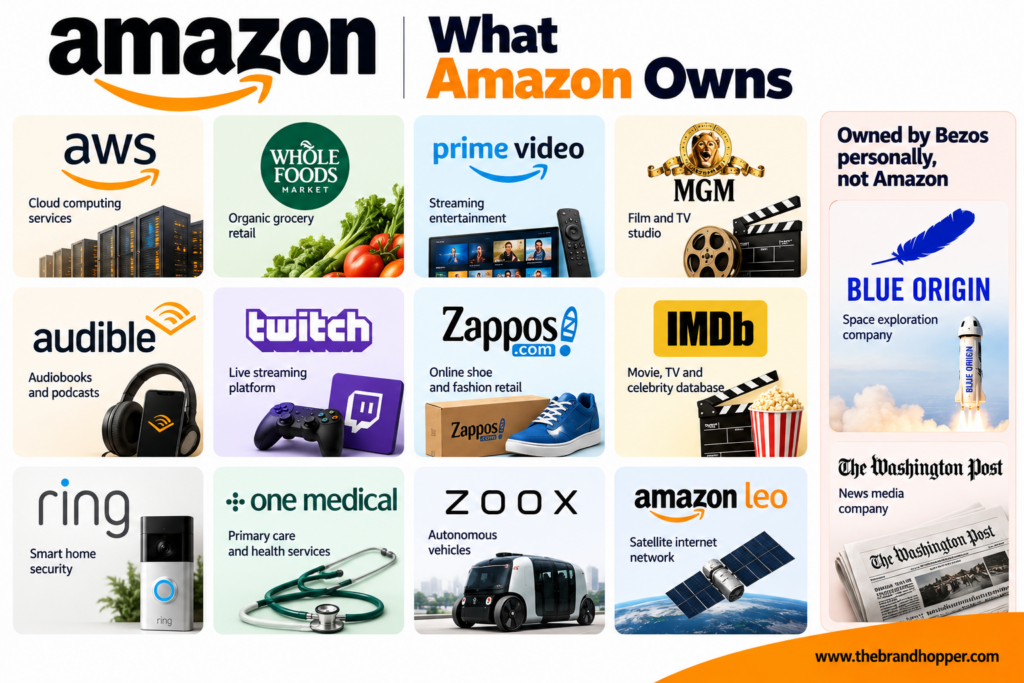
The company reports three operating segments—North America, International, and AWS—but its brands and services extend well beyond its online marketplace.
Amazon’s Major Businesses and Brands
- Amazon Web Services (AWS): Cloud computing, storage, databases, AI infrastructure, and related services.
- Whole Foods Market: Grocery retailer acquired by Amazon in 2017.
- Prime Video and MGM: Streaming entertainment and the MGM film and television studio, acquired in 2022.
- Audible: Audiobooks and spoken-word entertainment.
- Twitch: Live-streaming platform.
- Zappos: Online footwear and apparel retailer.
- IMDb: Film and television information database.
- Ring and Alexa-enabled devices: Smart-home products, cameras, Echo speakers, Kindle devices, and Fire TV.
- One Medical: Primary-care services and healthcare clinics.
- Zoox: Autonomous mobility and robotaxi business.
- Amazon Leo: Satellite broadband network previously known as Project Kuiper.
Amazon Leo was announced as the new name for Project Kuiper on November 13, 2025. The business is developing a low Earth orbit satellite network intended to provide broadband connectivity to homes, businesses, and other customers.
Amazon’s Major AI Investments
Amazon has significantly expanded its investments in artificial intelligence, including partnerships with Anthropic and OpenAI.
Anthropic, the company behind Claude, has received substantial investment from Amazon and has commercial arrangements with AWS. In Q2 2026, Amazon disclosed additional investments in Anthropic’s non-voting preferred stock, alongside large non-cash valuation gains.
Amazon’s Q2 2026 SEC filing reported upward valuation adjustments of approximately $50.5 billion in the quarter relating primarily to Anthropic preferred stock. These adjustments were recorded in non-operating income and contributed significantly to Amazon’s reported quarterly net income.
Amazon has also invested in OpenAI. During Q1 2026, Amazon invested $15 billion in OpenAI’s Series C preferred stock and agreed to purchase up to an additional $35 billion under a separate commitment.
By June 30, 2026, Amazon had invested $28.7 billion in OpenAI. Its SEC filing subsequently disclosed that the remaining $21.3 billion had also been invested after the end of the quarter, bringing the total under that commitment to $50 billion.
The arrangements include commercial agreements involving AWS computing services and AI infrastructure. These investments do not mean Amazon owns or controls either AI company outright.
What Amazon Does Not Own
Several businesses associated with Jeff Bezos personally are not owned by Amazon.com, Inc.
These include Blue Origin, the aerospace company founded by Bezos; The Washington Post, which he purchased personally; and Bezos Expeditions, his investment office.
Buying Amazon shares does not give an investor ownership of these separate businesses. Amazon’s ownership is distinct from Bezos’ personal investments and assets.
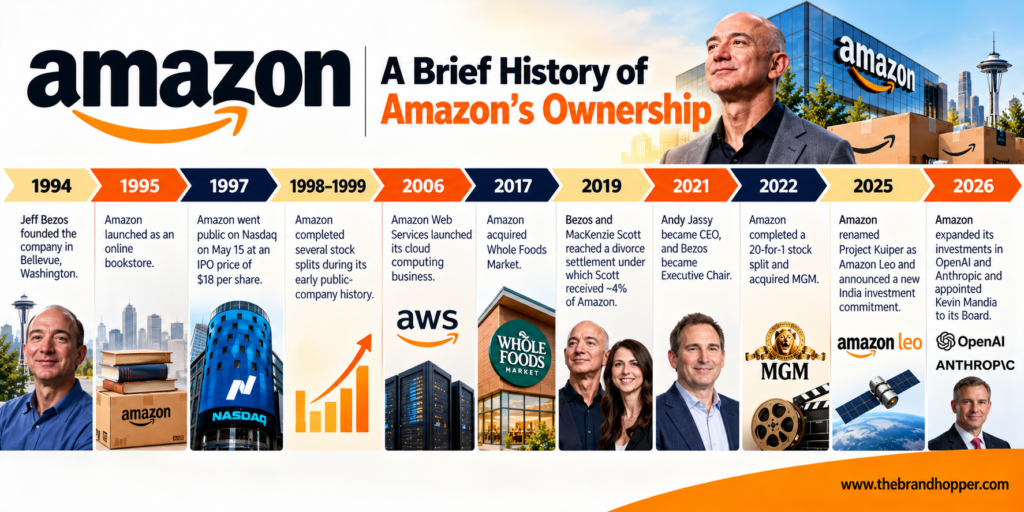
A Brief History of Amazon’s Ownership
How to Buy Amazon Shares
Investors can buy Amazon shares through a brokerage account that provides access to Nasdaq-listed securities. The shares trade under the ticker symbol AMZN.
Another option is to invest through mutual funds or exchange-traded funds that hold Amazon shares as part of a broader portfolio, such as certain funds tracking the Nasdaq-100 or S&P 500.
Amazon does not currently pay a regular dividend. Investors therefore generally rely on share-price appreciation and any indirect benefits from holding Amazon through a diversified investment fund, while also bearing the risk that the share price may decline.
This section is general information, not personalised investment or tax advice.
The Bottom Line
Amazon.com, Inc. is owned by its shareholders, with Jeff Bezos remaining its largest individual shareholder according to the company’s 2026 proxy statement. His reported 8.8% beneficial ownership as of February 24, 2026, includes shares over which he has voting authority but not investment power.
Vanguard and BlackRock were also listed as holders of more than 5% in the same proxy, although their reported figures rely on older ownership disclosures. Amazon’s shareholder structure is therefore broader than a simple ranking of the three names might suggest.
Andy Jassy leads Amazon as President and CEO, while Bezos serves as Executive Chair. The company’s financial performance is driven by its e-commerce operations, advertising, subscriptions, physical stores, and especially AWS, alongside its expanding investments in AI infrastructure and businesses.
Amazon’s ownership will continue to evolve as investors trade shares and insiders sell or donate holdings. For an accurate ownership snapshot, the best sources are Amazon’s latest proxy statement, SEC insider filings, and current shares-outstanding disclosures.
Frequently Asked Questions
Q: Who owns Amazon?
A: Amazon is owned by shareholders through Amazon.com, Inc., a publicly traded company listed on Nasdaq. Jeff Bezos is the largest individual shareholder disclosed in Amazon’s 2026 proxy statement.
Q: How much of Amazon does Jeff Bezos own?
A: Amazon’s 2026 proxy statement reported that Bezos beneficially owned 950,434,581 shares, or 8.8%, as of February 24, 2026. The figure includes shares over which he has voting power but no investment power, so it is not identical to his purely economic ownership stake.
Q: Who is the CEO of Amazon?
A: Andy Jassy has been Amazon’s President and CEO since July 5, 2021. Jeff Bezos is the company’s Executive Chair.
Q: Does Amazon have a parent company?
A: No. Amazon.com, Inc. is the top-level publicly traded parent company of the Amazon group and is not owned by another company.
Q: Does Jeff Bezos control Amazon?
A: Not outright. Amazon has one class of common stock, with one vote per share, and Bezos’ reported beneficial ownership was below 10% in the 2026 proxy statement. He remains influential because of his stake, his position as Executive Chair, and his history with the company.
Q: Does MacKenzie Scott still own Amazon shares?
A: Scott received approximately 4% of Amazon in the 2019 divorce settlement and has since sold or donated shares. Amazon’s 2026 proxy statement did not list her as a holder above the 5% reporting threshold, but that does not establish that she owns no shares.
Q: Does Amazon own Blue Origin and The Washington Post?
A: No. Blue Origin and The Washington Post are separate businesses associated with Jeff Bezos personally, not subsidiaries of Amazon.com, Inc.
Q: Does Amazon pay a dividend?
A: Amazon does not currently pay a regular dividend. The company generally reinvests capital into areas such as cloud computing, logistics, technology, AI infrastructure, and new business initiatives.
Q: What is Amazon’s annual revenue?
A: Amazon reported $716.9 billion in net sales for FY2025, up from $638.0 billion in FY2024. Its net income for FY2025 was $77.7 billion.
Q: What was Amazon’s latest reported quarterly result?
A: For Q2 2026, Amazon reported net sales of $200.6 billion and operating income of $27.5 billion. Net income was $62.6 billion, including substantial non-operating gains associated primarily with its Anthropic investments.
Also Read: Netflix vs Amazon Prime: Which Is Better? (2026 Guide)
To read more content like this, subscribe to our newsletter
Go to the full page to view and submit the form.