


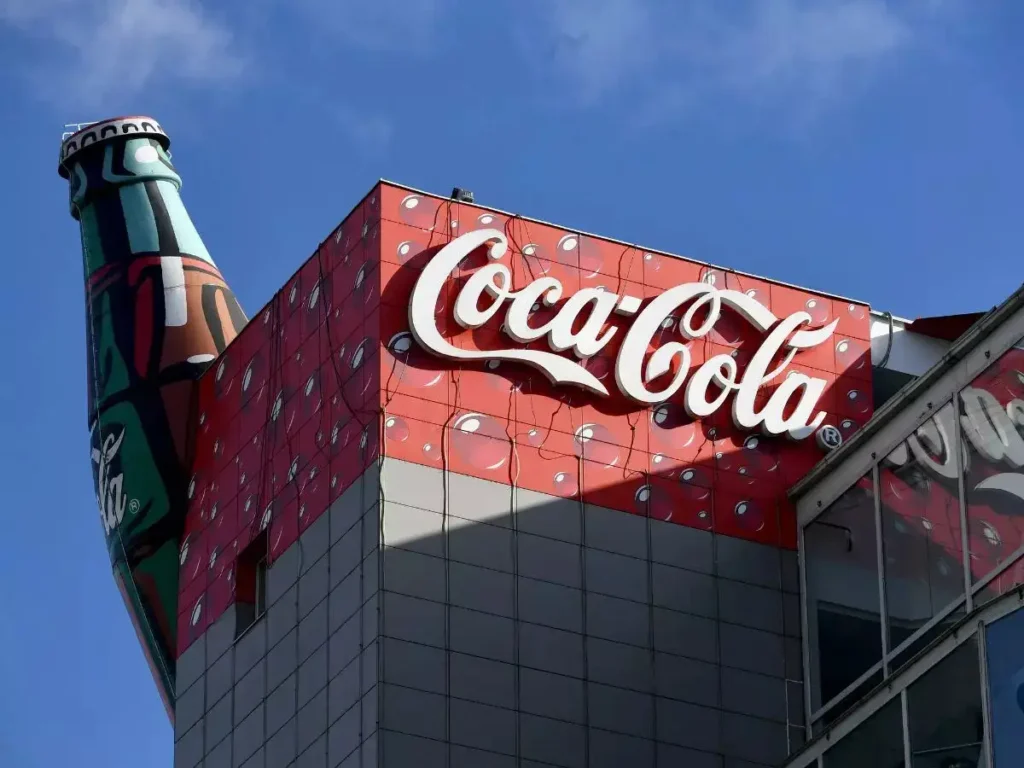
Coca-Cola is one of the most recognized brands on Earth, sold in more than 200 countries and consumed at a rate of well over a billion servings a day across its portfolio of sodas, juices, waters, and energy drinks.
Yet despite that global omnipresence, the company itself is a fairly conventional American public corporation — no founding family runs it, no dual-class shares protect an insider, and its most famous shareholder built his stake the old-fashioned way, by buying shares on the open market starting in 1988.
Here’s the complete, grounded picture of who owns Coca-Cola, how Warren Buffett became forever linked to the brand, how Coca-Cola’s unusual bottling structure works, and what the company’s latest financials reveal.
How Coca-Cola Began: A Pharmacist, a Notebook, and $2,300
Coca-Cola’s origin story starts far from the boardroom.
Atlanta pharmacist John Stith Pemberton invented the original formula in 1886, initially marketing it as a patent medicine touted for various health benefits, while his bookkeeper Frank Robinson coined the name “Coca-Cola” and hand-lettered the now-iconic script logo still used today.
Pemberton, however, was a poor businessman and sold off pieces of the formula to multiple parties before his death in 1888.
Atlanta entrepreneur Asa Griggs Candler spotted the opportunity, aggressively bought up the rights, and by 1891 had acquired full ownership of the formula for a total investment of about $2,300.

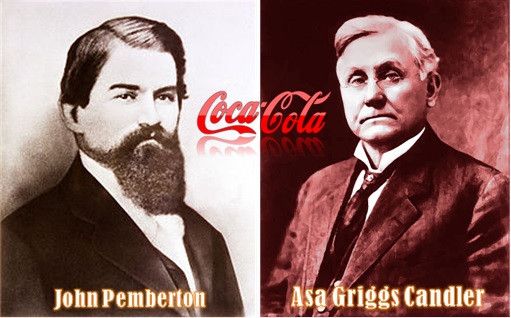
Candler incorporated The Coca-Cola Company on January 29, 1892, and turned it from a regional curiosity into a nationally distributed product by 1895, laying the commercial foundation for everything that followed.
The Woodruff Era: The Family That Built Coca-Cola Into a Global Icon
In 1919, an investor group led by banker Ernest Woodruff purchased Coca-Cola from the Candler family for $25 million and took the company public that same year.

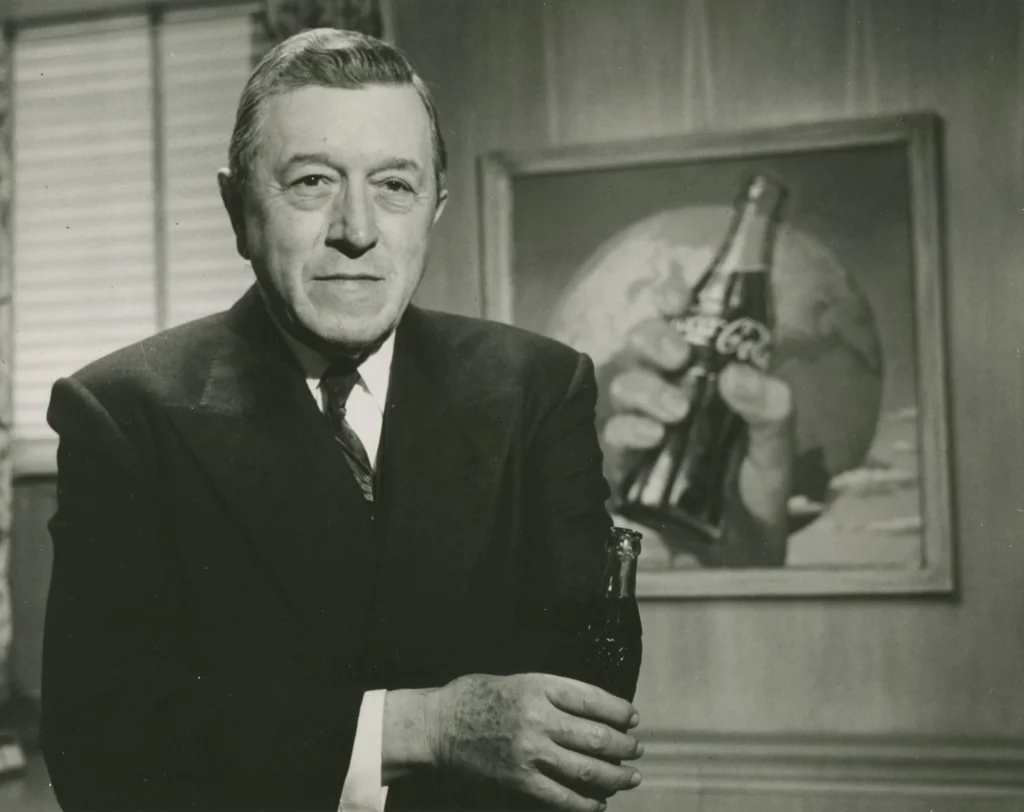
Ernest’s son, Robert W. Woodruff, became president of Coca-Cola in 1923 at just 33 years old and would go on to lead the company for an extraordinary 34 years, transforming it into a true global powerhouse.
Under Robert Woodruff’s leadership, Coca-Cola expanded its bottling network worldwide, embedded itself into American culture and military supply chains during World War II, and cemented the marketing playbook that made the brand synonymous with the product category itself.
Woodruff’s personal and philanthropic legacy also became deeply intertwined with Coca-Cola stock: the Robert W. Woodruff Foundation, established using his fortune, has historically held a large concentration of its endowment in Coca-Cola shares, illustrating just how much of the Woodruff family’s wealth and philanthropy remained tied to the company he built long after his death in 1985.
Warren Buffett and Berkshire Hathaway: Coca-Cola’s Most Famous Shareholder
No modern discussion of Coca-Cola ownership is complete without Warren Buffett.
Buffett first began buying Coca-Cola stock in 1988, following the 1987 stock market crash, betting on the durability of the brand’s competitive moat and consumer loyalty.
Berkshire Hathaway steadily built its position over the following years and has held a constant 400 million shares since August 1994 — Buffett has famously never sold a single share since, treating the stake as a permanent holding rather than a trade.

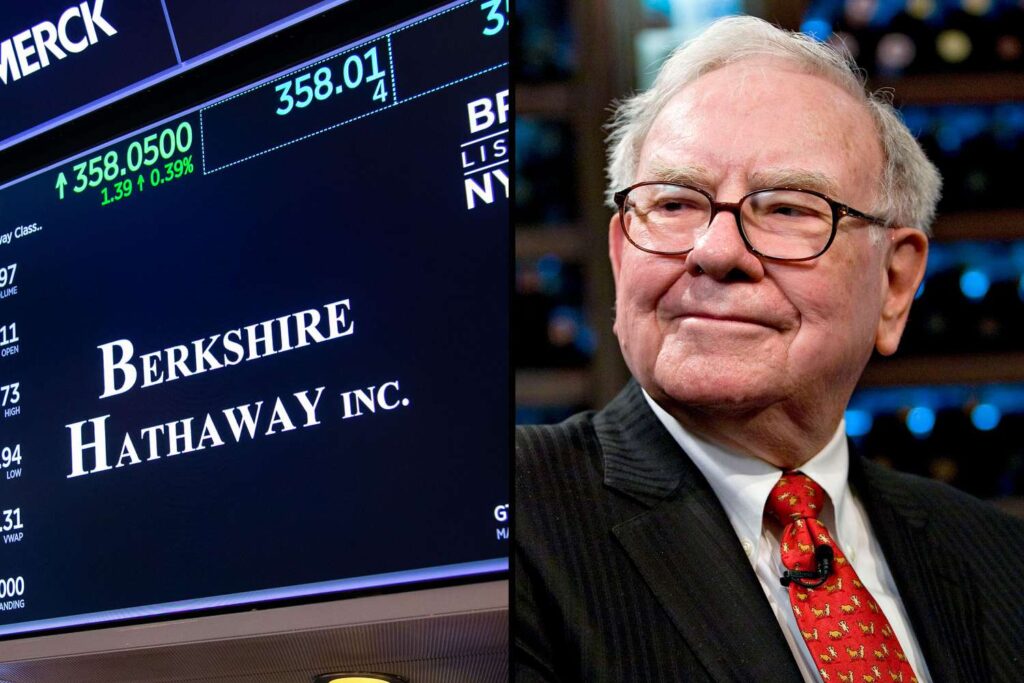
As of recent 2026 filings, that position equals approximately 9.3% of Coca-Cola’s total outstanding shares, making Berkshire comfortably the company’s single largest shareholder.
The relationship also generates enormous recurring cash for Berkshire: Coca-Cola’s dividend payouts have delivered Buffett’s company hundreds of millions of dollars annually, with cumulative dividend income from the position running into the billions of dollars over the decades.
Coca-Cola remains one of the “big five” holdings in Berkshire’s portfolio, alongside Apple, American Express, Alphabet, and Bank of America, and Buffett has repeatedly cited it as a textbook example of his long-term, buy-and-hold investment philosophy.
Institutional Ownership: Vanguard, BlackRock, and the Index Fund Effect
Beyond Berkshire Hathaway, Coca-Cola’s shareholder register looks similar to that of most other blue-chip S&P 500 companies, dominated by the same handful of giant passive index managers.
According to Coca-Cola’s 2026 proxy filing, The Vanguard Group holds roughly 370.7 million shares, equal to about 8.61% of shares outstanding, while BlackRock holds approximately 313.2 million shares, or about 7.28%.
Together, Berkshire, Vanguard, and BlackRock control roughly a quarter of the entire company, though none of the three exercises unilateral control given Coca-Cola’s single-class, one-share-one-vote structure.

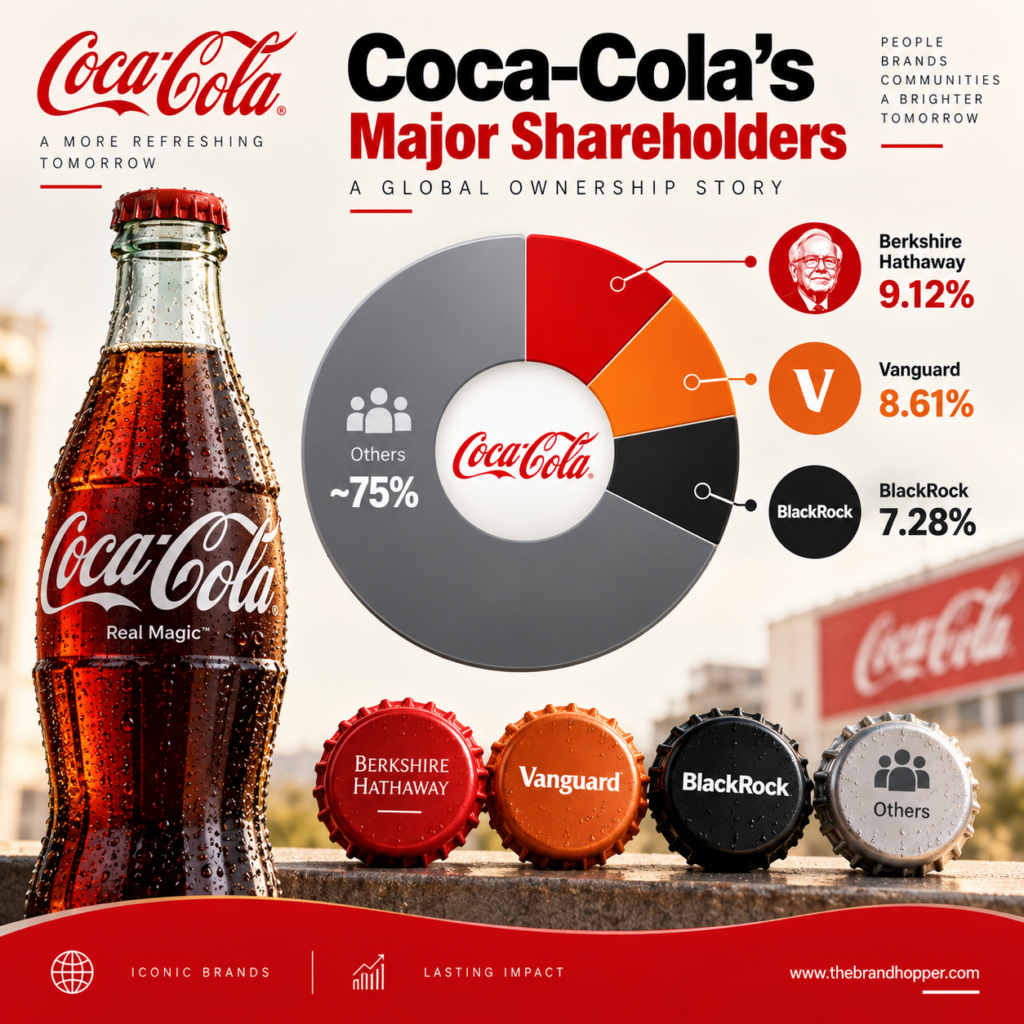
The remaining shares are spread across thousands of other mutual funds, pension funds, sovereign wealth funds, and millions of individual retail investors, many of whom hold Coca-Cola specifically for its status as a “Dividend King” — a company that has increased its dividend payout for more than 60 consecutive years.
Coca-Cola’s Unusual Business Model: It Doesn’t Bottle Its Own Drinks
One of the most misunderstood aspects of Coca-Cola’s ownership and structure is that the parent company generally does not own or operate the bottling plants that physically produce and distribute its drinks.
Instead, Coca-Cola runs an asset-light franchise model: it manufactures and sells concentrate and syrup to a global network of independently owned bottling partners, who then handle local production, distribution, and retail sales under license.

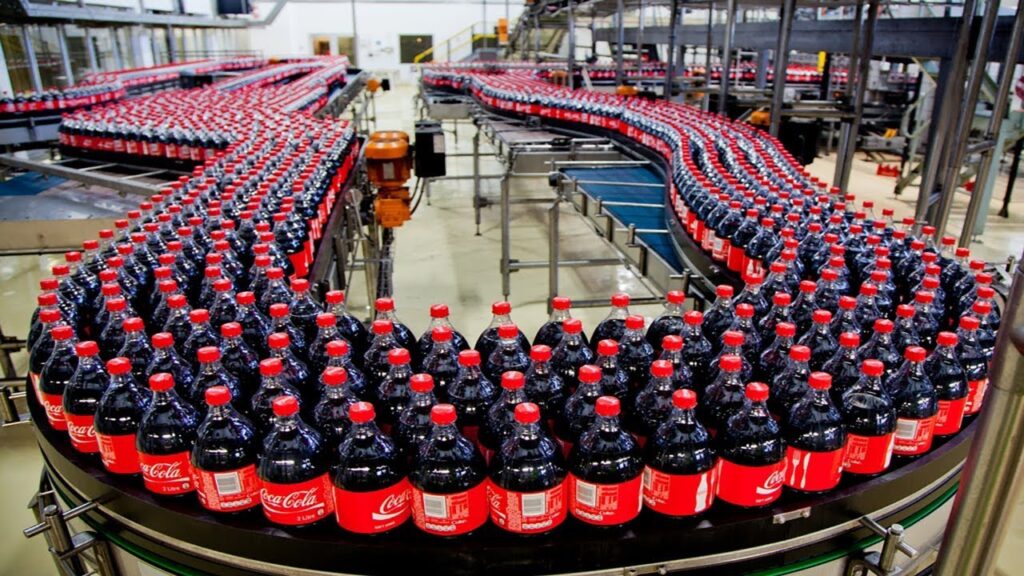
The largest of these partners include Coca-Cola Europacific Partners (covering much of Western Europe, Australia, and the Pacific), Coca-Cola Consolidated (the largest Coca-Cola bottler in the United States), and Coca-Cola HBC (covering much of Central and Eastern Europe and parts of Africa).
Former CEO James Quincey, who led Coca-Cola from 2017 until his transition to Executive Chairman in early 2026, played a significant role in refranchising the company’s remaining company-owned bottling operations during his tenure, further cementing this asset-light approach as core to Coca-Cola’s global strategy and helping the parent company focus capital on brand-building, innovation, and marketing rather than manufacturing infrastructure.
Coca-Cola’s Leadership Transition in 2026
Coca-Cola underwent a notable leadership change in 2026. James Quincey, who had served as CEO since 2017 and added the chairman title in 2019, stepped down as chief executive with Chief Operating Officer Henrique Braun succeeding him as CEO effective March 31, 2026, while Quincey transitioned into the role of Executive Chairman.
During his roughly nine years running the company, Quincey oversaw Coca-Cola’s transformation into what the company calls a “total beverage company,” expanding well beyond soda into waters, juices, teas, coffee, and energy drinks, and adding more than ten new billion-dollar brands to its portfolio along the way.
Braun’s promotion continues a pattern at Coca-Cola of grooming internal operating executives for the top job rather than bringing in outside leadership, reflecting the company’s preference for continuity in strategy and culture even as day-to-day leadership changes hands.
Coca-Cola’s FY2025 Financial Performance
Coca-Cola’s FY2025 results showed steady, if modest, top-line growth alongside a sharp rebound in profitability.
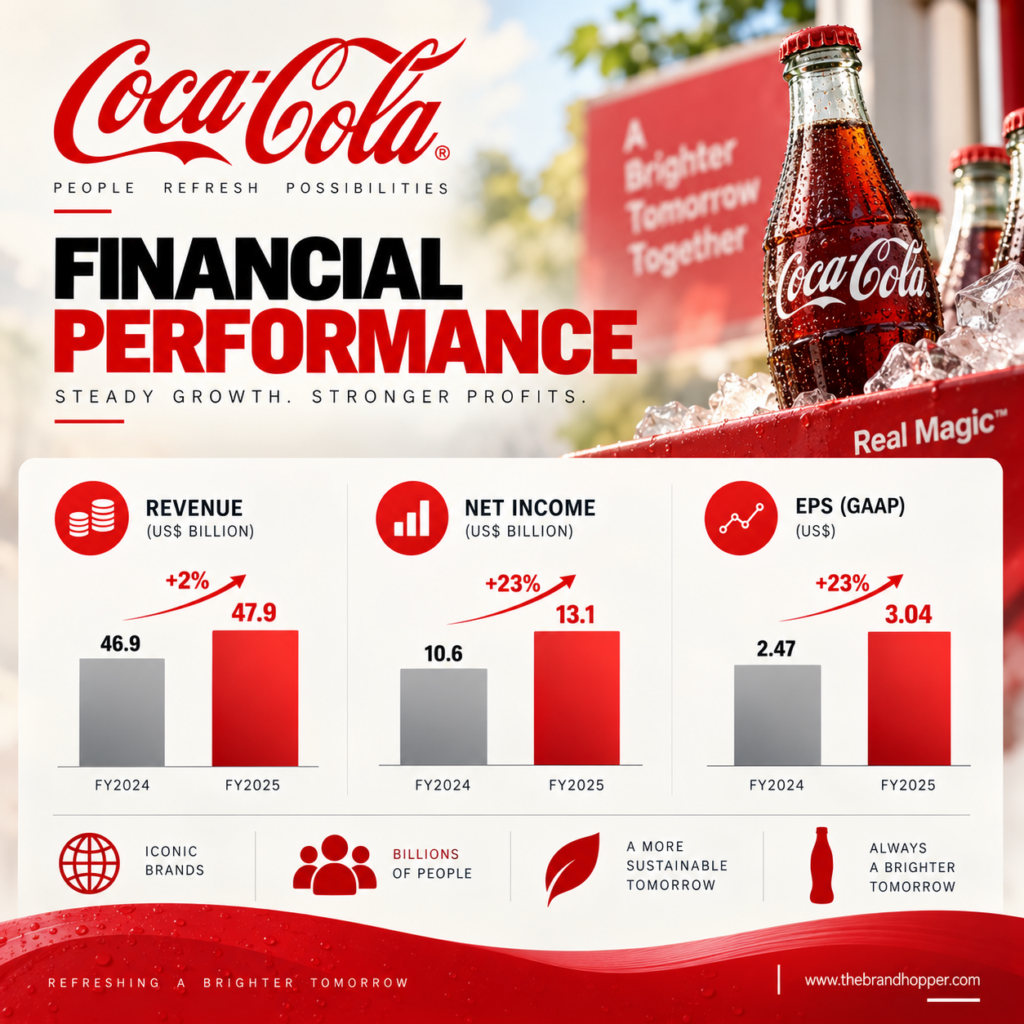
Full-year net revenues grew 2% to $47.9 billion, while organic revenue (a non-GAAP measure that strips out currency and structural effects) grew a stronger 5%, driven by 4 percentage points of price/mix improvement and a 1% increase in concentrate sales volume.
Global unit case volume was roughly flat for the full year, reflecting a mature, saturated core soda business even as newer categories picked up some of the slack.
Profitability improved substantially: full-year GAAP earnings per share grew 23% to $3.04, while comparable (non-GAAP) EPS grew a more modest 4% to $3.00, with the gap reflecting one-time items and prior-year comparison effects.
Full-year GAAP operating income grew an impressive 38%, while comparable currency-neutral operating income grew 13%. On the cash side, Coca-Cola generated $7.4 billion in cash flow from operations and $5.3 billion in free cash flow for the year, comfortably funding its dividend commitments.
Net income attributable to shareowners came in at approximately $13.1 billion for the full year, underscoring Coca-Cola’s continued status as one of the most consistently profitable large-cap consumer companies in the world.
Coca-Cola’s Market Value and Dividend Track Record
As of 2026, Coca-Cola’s market capitalization sits above $300 billion, reflecting its position as one of the most valuable consumer staples companies globally, even though its growth profile is far more modest than high-growth technology peers.
Much of the investment case for Coca-Cola rests not on rapid growth but on remarkable consistency: the company is a certified Dividend King, having raised its annual dividend for more than six decades in a row, a streak that spans multiple recessions, wars, and changes in consumer taste.
That reliability is precisely what has kept long-term holders like Berkshire Hathaway in the stock for over three decades without selling a single share, treating Coca-Cola less as a growth bet and more as a bond-like, cash-generating annuity wrapped in a globally beloved consumer brand.
Why Coca-Cola’s Ownership Structure Matters for Investors
Coca-Cola’s ownership profile tells a broader story about what kind of company it is. Unlike founder-led tech giants where a single individual’s dual-class shares concentrate legal control, Coca-Cola operates as a genuinely diffuse, professionally governed public company where no shareholder — not even Buffett — holds anywhere close to a controlling stake.
That structure, combined with the company’s franchise bottling model, means Coca-Cola’s own balance sheet stays relatively capital-light while its brand value and global distribution network remain the real sources of competitive advantage.
For investors, Coca-Cola represents a lower-volatility, income-focused holding rather than a high-growth or founder-driven bet, which is exactly why it has attracted a shareholder base dominated by index funds, pension funds, and famously patient long-term investors like Berkshire Hathaway.
Coca-Cola Ownership at a Glance (FY2025)
| Category | Detail |
| Founded | 1886 (formula); incorporated January 29, 1892 (Atlanta, Georgia) |
| Founders | John Stith Pemberton (formula); Asa Griggs Candler (company) |
| Largest shareholder | Berkshire Hathaway / Warren Buffett (400 million shares, ~9.3%) |
| Company structure | Publicly traded, single-class shares (one vote per share) |
| Stock listing | NYSE: KO |
| Top institutional shareholders | Vanguard (~8.61%), BlackRock (~7.28%) |
| CEO | Henrique Braun (since March 31, 2026) |
| Executive Chairman | James Quincey (CEO 2017-2026) |
| Headquarters | Atlanta, Georgia |
| FY2025 net revenue | $47.9 billion (+2% YoY) |
| FY2025 net income | ~$13.1 billion (attributable to shareowners) |
| Dividend track record | 60+ consecutive years of dividend increases (Dividend King) |
| 2026 market capitalization | $300+ billion |
Key Takeaways
Coca-Cola’s ownership story in 2026 is one of remarkable stability rather than drama: no founding family, no dual-class shares, and no single dominant owner, just a widely diversified shareholder base topped by Warren Buffett’s unchanged 400-million-share Berkshire Hathaway stake alongside index giants Vanguard and BlackRock.
The company’s unusual asset-light bottling model, in which independent partners like Coca-Cola Europacific Partners and Coca-Cola Consolidated handle most physical production, keeps Coca-Cola itself focused on brand and concentrate rather than manufacturing.
Financially, FY2025 delivered $47.9 billion in revenue, roughly $13.1 billion in net income, and continued dividend growth extending a streak of more than 60 consecutive years — even as a 2026 leadership transition brings new CEO Henrique Braun into the top operating role for the first time in nearly a decade.
Frequently Asked Questions
Q: Who owns the most shares of Coca-Cola?
A: Warren Buffett’s Berkshire Hathaway is Coca-Cola’s largest shareholder, holding 400 million shares — about 9.3% of the company — a position it has maintained unchanged since 1994.
Q: Does Warren Buffett control Coca-Cola?
A: No. Despite being the largest single shareholder, Buffett’s roughly 9.3% stake does not give Berkshire Hathaway control; Coca-Cola operates a single-class, one-share-one-vote structure with no controlling shareholder.
Q: Who founded Coca-Cola?
A: Pharmacist John Stith Pemberton invented the original formula in 1886. Atlanta businessman Asa Griggs Candler later acquired full rights to the formula and incorporated The Coca-Cola Company in 1892.
Q: Does Coca-Cola own its bottling plants?
A: Generally, no. Coca-Cola uses an asset-light franchise model, selling concentrate to independently owned bottling partners such as Coca-Cola Europacific Partners and Coca-Cola Consolidated, who handle production and distribution.
Q: Who are Coca-Cola’s other major shareholders?
A: Beyond Berkshire Hathaway, Coca-Cola’s largest institutional shareholders are The Vanguard Group (~8.61%) and BlackRock (~7.28%), according to the company’s 2026 proxy filing.
Q: Who is Coca-Cola’s CEO?
A: Henrique Braun became Coca-Cola’s CEO effective March 31, 2026, succeeding James Quincey, who transitioned to the role of Executive Chairman after leading the company since 2017.
Q: What was Coca-Cola’s revenue in FY2025?
A: Coca-Cola reported FY2025 net revenues of $47.9 billion, up 2% year-over-year, with net income attributable to shareowners of approximately $13.1 billion.
Q: Is Coca-Cola a Dividend King?
A: Yes. Coca-Cola has increased its annual dividend for more than 60 consecutive years, making it one of the relatively small group of companies known as Dividend Kings.
Also Read: Coca-Cola’s 2026 Global Visual Identity Refresh: Making Coca-Cola “More Coca-Cola”
To read more content like this, subscribe to our newsletter
Go to the full page to view and submit the form.