


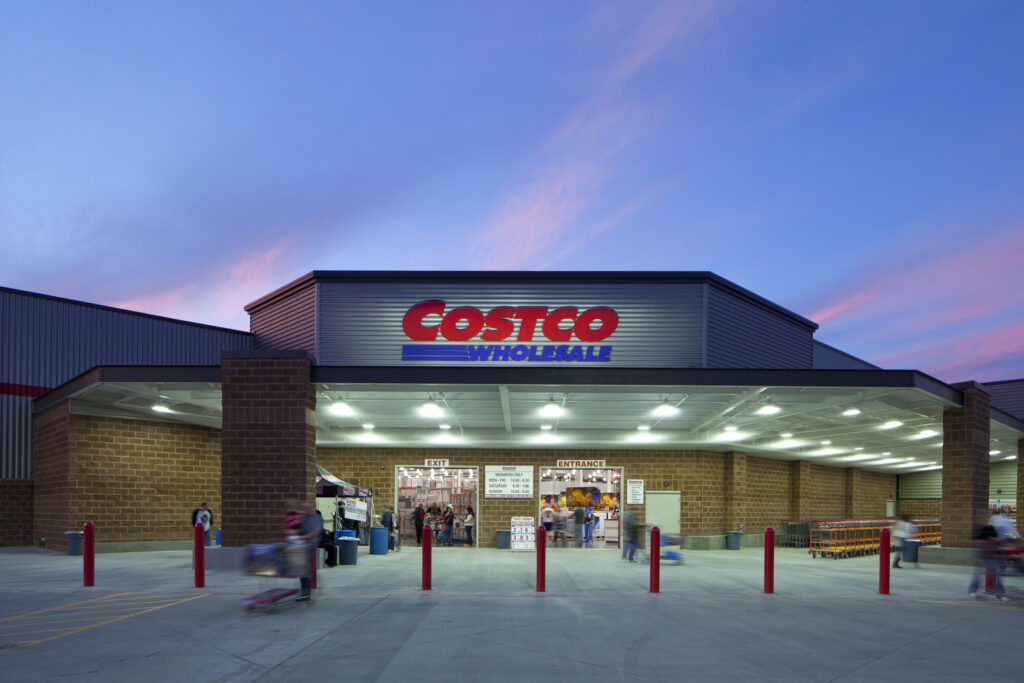
Costco is one of the most unusual success stories in American retail: a company that makes relatively little profit margin on the actual products it sells, instead building one of the most loyal customer bases in the world around a simple annual membership fee.
Unlike most public companies of its scale, there’s no complicated ownership drama here — no founding family battling for control, no activist investor fights, no dual-class shares.
Here’s the complete picture of who owns Costco, how two retail veterans built the company from a single Seattle warehouse, why its business model is genuinely different from other big-box retailers, and how Kirkland Signature quietly became one of the most powerful private-label brands on Earth.
How Costco Began: A Retail Apprentice’s Bet on the Warehouse Model
Costco’s origin traces directly back to a retail format pioneered by someone else entirely.
Sol Price invented the modern membership-warehouse concept when he founded Price Club in San Diego in 1976, originally designed to sell goods in bulk, warehouse-style, exclusively to small businesses before later expanding to non-business members as well.

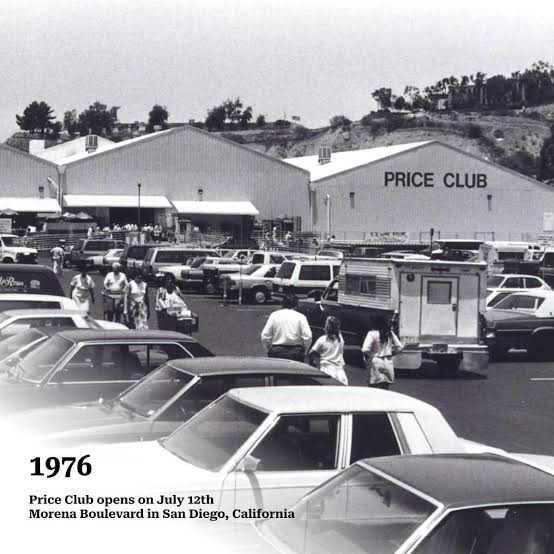
Jim Sinegal spent seventeen years working under Sol Price at Price Club, absorbing the operating philosophy and financial discipline that would define his own approach to retail for the rest of his career.
In 1983, Sinegal teamed up with fellow career retailer Jeffrey Brotman to open the very first Costco warehouse in Seattle, Washington, on September 15, 1983, applying the membership-warehouse lessons Sinegal had learned directly from the format’s inventor.
The two companies — Price Club and the newer Costco — operated as rivals for a decade before circumstances brought them together: in 1993, the Price Company was approached about a potential merger with Sam’s Club, Walmart’s own membership-warehouse chain, but instead chose to merge with Costco.
The resulting company, initially named PriceCostco, immediately became the largest operator of its kind in the country, overseeing roughly 206 warehouses and generating about $16 billion in annual sales at the time of the merger — a scale neither company could have reached as quickly on its own.
Who Owns Costco Today? A Textbook Widely Held Public Company
Costco has no controlling shareholder of any kind — no founding family stake, no activist investor with an outsized position, no dual-class share structure protecting insider control.
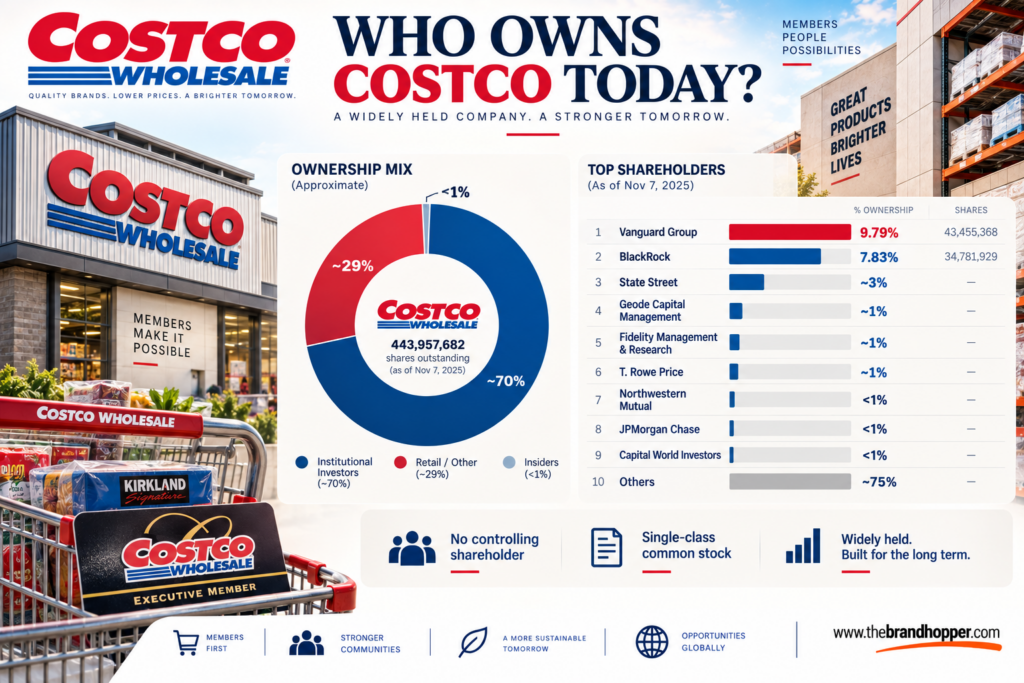
SEC filings confirm that institutional investors collectively own the large majority of the company, with Costco’s ownership split roughly 70% institutional, under 1% insiders (executives and directors), and the remainder held by individual retail investors.
The Vanguard Group is Costco’s largest single shareholder at approximately 9% of outstanding shares, reflecting its enormous index-fund holdings across the S&P 500.
BlackRock follows closely at around 7.88% (roughly 34.95 million shares), with State Street holding approximately 3%.
Together, these three passive asset-management giants alone account for close to a fifth of the entire company, a pattern common among mature, large-cap S&P 500 constituents but notable given how little drama or concentrated influence exists relative to Costco’s massive $400+ billion market value.
Neither Jim Sinegal nor Jeffrey Brotman’s families retain any meaningful controlling stake today, and Costco’s board and executive leadership operate with the kind of broad institutional accountability typical of a fully mature blue-chip public company.
The Membership Model: Costco’s Real Profit Engine
What genuinely sets Costco apart from ordinary retailers isn’t its product selection — it’s the business model underneath.
Rather than relying primarily on markups over the cost of goods sold, Costco intentionally keeps its retail margins razor-thin (often just 10-11% above cost, well below typical retail markups) and instead generates the bulk of its actual profit from membership fees paid annually by shoppers just for the right to walk through the door.

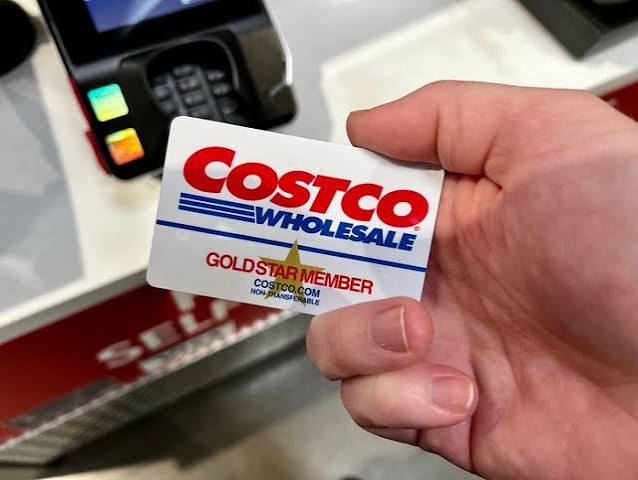
In FY2025, membership fee revenue totaled $5.323 billion, up 10.3% year-over-year, driven by both new member acquisition and periodic fee increases across Costco’s three membership tiers: the standard Gold Star Membership, the higher-tier Executive Membership (which includes an annual 2% cashback reward on qualifying purchases), and Business Membership for wholesale and commercial buyers.
This structure creates a powerful incentive alignment: Costco makes money by keeping members happy enough to renew year after year rather than by squeezing extra margin out of every transaction, which is precisely why the company has historically posted membership renewal rates in the 90%-plus range in markets like the U.S. and Canada — a remarkably sticky recurring-revenue engine hiding inside what looks, on the surface, like an ordinary big-box retailer.
Kirkland Signature: The Private-Label Brand Bigger Than Nike
If the membership fee is Costco’s profit engine, Kirkland Signature is increasingly its growth engine.
Launched in 1995, Costco’s private-label brand has grown from a modest cost-saving alternative into one of the most commercially significant consumer brands in the world, now spanning everything from apparel and electronics to packaged food, supplements, and household goods.
According to figures presented at Costco’s 2026 Annual Meeting of Shareholders, Kirkland Signature generated approximately $90 billion in total sales during 2025 — a figure that, if Kirkland were spun off as a standalone public company, would make it larger by revenue than Nike.
Private-label products overall (with Kirkland Signature as the dominant driver) now account for roughly 28% of Costco’s total merchandise sales, a proportion that has climbed steadily as Costco has deliberately expanded Kirkland’s footprint into higher-margin, higher-consideration categories once dominated entirely by national brands.
This strategy benefits Costco on multiple fronts simultaneously: private-label goods typically carry better margins than comparable national brands, they reinforce member loyalty by offering perceived quality at a lower price point, and they give Costco genuine negotiating leverage with national brand suppliers who know Kirkland Signature is a credible substitute sitting on the very same shelf.
Costco’s Leadership: A New CEO Continuing a Culture-First Playbook
Ron Vachris has served as Costco’s President and CEO since January 2024, succeeding longtime chief executive Craig Jelinek, who had led the company since 2012.

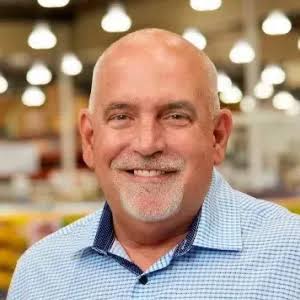
Vachris is a genuine Costco lifer, having joined the company decades earlier and risen through operational leadership roles before taking the top job, continuing a well-established pattern at Costco of promoting from within rather than seeking outside executive talent — a practice that mirrors founder Jim Sinegal’s own original leadership philosophy of prioritizing employee retention, internal promotion, and long-term culture over short-term cost-cutting.
Under Vachris, Costco has continued its steady physical expansion strategy, targeting more than 30 new warehouse openings annually, with the company’s global warehouse count reaching 921 locations as of the start of fiscal 2026, alongside continued investment in digital and e-commerce capabilities to complement its still-dominant physical warehouse footprint.
Costco’s FY2025 Financial Performance
Costco’s FY2025 results, covering the fiscal year ended August 31, 2025, demonstrated the continued strength of both sides of its business model.
Full-year net sales increased 8% to $269.9 billion, supported by a healthy 6% increase in comparable sales reflecting both higher shopping frequency among existing members and a modest rise in average ticket size.
Net income grew even faster than revenue, climbing 10% year-over-year to $8.099 billion, aided by that same $5.323 billion in membership fee revenue (up 10.3%) flowing almost directly to the bottom line given the minimal cost associated with collecting membership dues compared to the cost of moving physical merchandise.
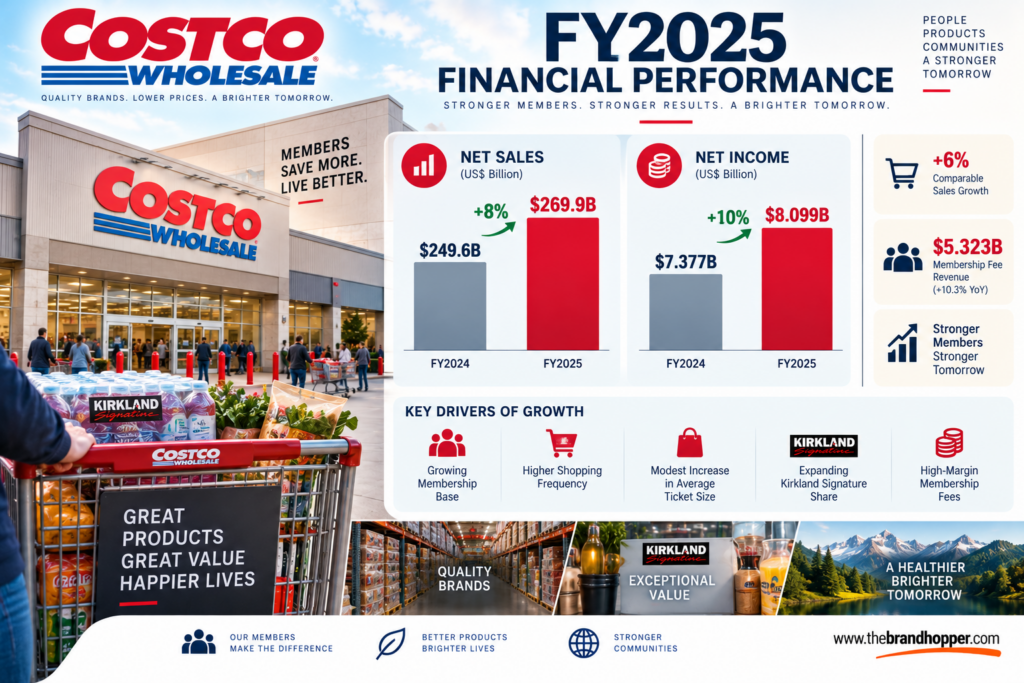
The consistency of this performance — steady, high-single-digit revenue growth paired with double-digit profit growth — has become something of a hallmark for Costco in recent years, reflecting the compounding benefits of rising membership counts, periodic fee increases, and Kirkland Signature’s expanding share of total sales.
Costco’s Market Value in 2026
As of 2026, Costco’s market capitalization sits in the range of roughly $406-414 billion, reflecting sustained investor enthusiasm for the company’s rare combination of durable recurring revenue (memberships), disciplined low-margin retail execution, and a rapidly scaling private-label business.
That valuation places Costco among the largest retailers in the world by market value, trading at a notably premium valuation multiple relative to traditional retail peers — a reflection of how differently investors treat Costco’s membership-fee-driven earnings compared to conventional thin-margin, markup-dependent retail businesses.
Why Costco’s Ownership Structure Matters for Investors
Costco’s genuinely dispersed, institutionally dominated ownership structure means the company answers to a broad base of index funds, pension funds, and asset managers rather than any founder, family, or activist investor pushing for short-term strategic shifts.
That stability has allowed Costco’s leadership to maintain a consistent, decades-old operating philosophy — low margins, high member loyalty, minimal advertising spend, and reinvestment in employee wages and benefits well above typical retail industry standards — without the kind of quarterly earnings pressure that has forced strategic pivots at other large-cap retailers.
For investors, Costco represents a genuinely differentiated retail bet: less a traditional merchandise business and more a recurring-membership company that happens to also sell groceries and electronics, a distinction increasingly reflected in how the market values the stock relative to peers like Walmart or Target.
Costco Ownership at a Glance
| Category | Detail |
|---|---|
| Founded | September 15, 1983 (Seattle, Washington) |
| Founders | Jim Sinegal and Jeffrey Brotman |
| Origin of model | Sol Price’s Price Club (founded 1976); merged with Costco in 1993 |
| Largest shareholder | The Vanguard Group (~9%) |
| Other major shareholders | BlackRock (~7.88%), State Street (~3%) |
| Company structure | Publicly traded; no controlling shareholder or family stake |
| Stock listing | NASDAQ: COST |
| CEO | Ron Vachris (since January 2024) |
| Headquarters | Issaquah, Washington |
| Global warehouse count | 921 (as of early fiscal 2026) |
| Private-label brand | Kirkland Signature (~$90 billion in 2025 sales; ~28% of total sales) |
| FY2025 net sales | $269.9 billion (+8% YoY) |
| FY2025 net income | $8.099 billion (+10% YoY) |
| FY2025 membership fee revenue | $5.323 billion (+10.3% YoY) |
| 2026 market capitalization | ~$406-414 billion |
Key Takeaways
Costco’s ownership story in 2026 is refreshingly uncomplicated: no founding family control, no activist battles, no dual-class shares — just a widely dispersed shareholder base led by index giants Vanguard (~9%) and BlackRock (~7.88%), nearly 43 years after Jim Sinegal and Jeffrey Brotman opened the first Costco warehouse using lessons Sinegal learned directly from Price Club inventor Sol Price.
What genuinely differentiates Costco isn’t who owns it but how it makes money: membership fees ($5.323 billion in FY2025) rather than retail markups drive the bulk of profitability, while private-label powerhouse Kirkland Signature — now generating roughly $90 billion in annual sales, more than Nike — has become an increasingly critical growth and margin engine.
Financially, FY2025 delivered $269.9 billion in net sales and $8.099 billion in net income, reinforcing Costco’s position as one of the most consistently performing large-cap retailers in the world under new CEO Ron Vachris.
Frequently Asked Questions
Q: Who owns the most shares of Costco?
A: The Vanguard Group is Costco’s largest shareholder at approximately 9% of outstanding shares, followed by BlackRock at roughly 7.88% and State Street at about 3%, with no single controlling owner.
Q: Who founded Costco?
A: Costco was founded by Jim Sinegal and Jeffrey Brotman, who opened the first Costco warehouse in Seattle on September 15, 1983. Sinegal had previously spent 17 years working under Sol Price, who invented the membership-warehouse model at Price Club.
Q: How does Costco make most of its profit?
A: Costco generates the majority of its actual profit from annual membership fees rather than retail markups. In FY2025, membership fee revenue totaled $5.323 billion, flowing almost directly to the bottom line.
Q: How big is Kirkland Signature?
A: Kirkland Signature, Costco’s private-label brand, generated approximately $90 billion in sales in 2025 — larger than Nike’s global revenue — and now accounts for roughly 28% of Costco’s total merchandise sales.
Q: What was Costco’s revenue in FY2025?
A: Costco reported FY2025 (fiscal year ended August 31, 2025) net sales of $269.9 billion, up 8% year-over-year, with net income of $8.099 billion, up 10%.
Q: Who is Costco’s CEO?
A: Ron Vachris has served as Costco’s President and CEO since January 2024, succeeding longtime CEO Craig Jelinek, and rose through the company’s internal ranks over decades.
Q: How many Costco warehouses are there?
A: Costco operated 921 warehouses globally as of the start of fiscal 2026, with the company targeting more than 30 new warehouse openings annually.
Q: Did Costco merge with another company?
A: Yes. In 1993, Costco merged with Price Club — the company that had originally invented the membership-warehouse retail format — forming PriceCostco, which later became simply Costco Wholesale Corporation.
Also Read: Target’s Top 20 Competitors in Retail: Complete Analysis
To read more content like this, susbcribe to our newsletter
Go to the full page to view and submit the form.