


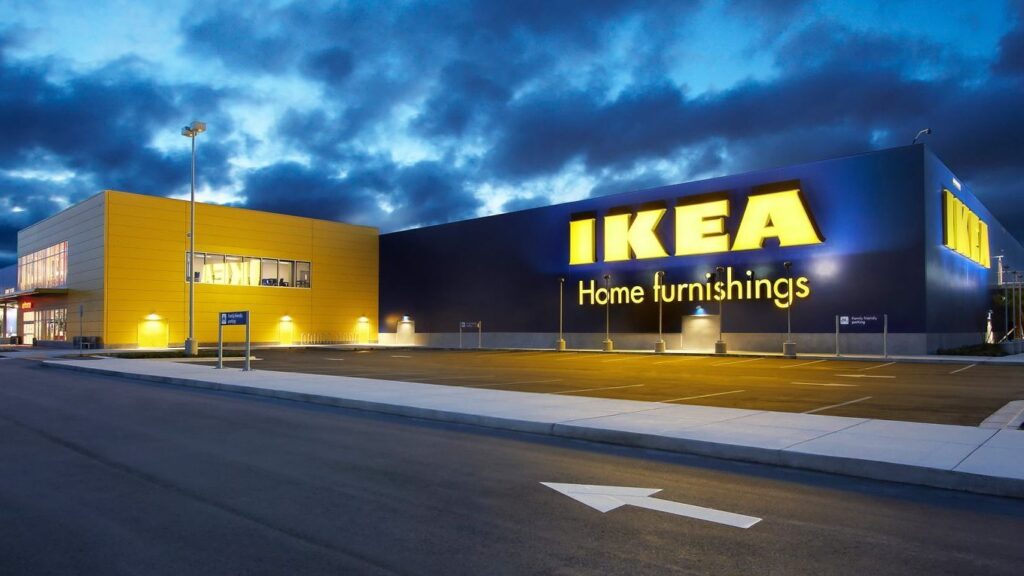
IKEA is one of the most recognizable retail brands on the planet, famous for flat-pack furniture, meatballs, and maze-like showrooms.
But its ownership structure is arguably stranger and more fascinating than anything on its shelves: a Swedish company legally headquartered through Dutch and Liechtenstein foundations, with no stock, no shareholders, and no single person who can claim to “own” it outright.
Here’s the complete story of how IKEA is actually structured, who controls it, and why founder Ingvar Kamprad built it this way in the first place.
How IKEA Began: A Teenager’s Mail-Order Business in Småland
IKEA’s story starts in 1943, when 17-year-old Ingvar Kamprad registered a small trading company in Sweden using money his father had given him as a reward for good grades.

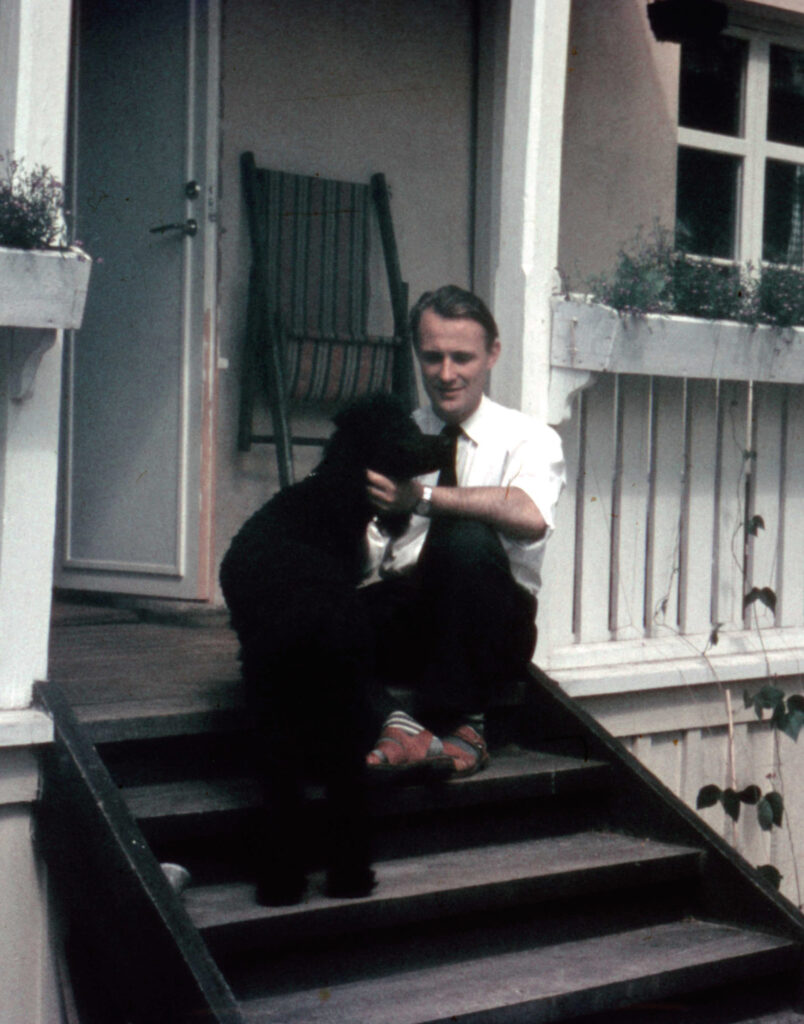
The name IKEA is an acronym built from Kamprad’s own initials plus the first letters of Elmtaryd, the family farm where he grew up, and Agunnaryd, the nearby Swedish village. Kamprad initially sold small household items like pens, wallets, and picture frames by mail order, reflecting the famously thrifty, resourceful culture of Småland, the stony, forested Swedish province where making the most of very little was a point of regional pride.
IKEA didn’t start selling furniture until 1948, and it took several more years before the company stumbled onto the innovation that would define it forever: flat-pack, self-assembly furniture, reportedly inspired by an employee removing the legs from a table so it would fit into a customer’s car without damage.
That single idea — sell furniture unassembled, in flat boxes, at dramatically lower shipping and storage cost — became the foundation of IKEA’s entire business model and its global expansion from the 1950s onward.
Why IKEA Isn’t Owned Like a Normal Company
Most large companies are owned by shareholders, founders, or private equity firms who can sell their stakes, collect dividends, or lose control in a takeover.
IKEA was deliberately built to avoid all three possibilities.
Starting in the 1970s and 1980s, Kamprad restructured IKEA’s ownership into a set of nonprofit foundations rather than a conventional shareholder-owned corporation, an arrangement that meant no individual or family could ever sell IKEA, extract its profits as personal dividends, or be forced to surrender control through a hostile acquisition.
On paper, this was framed as protecting IKEA’s long-term independence and its low-cost, “for the many people” mission from short-term shareholder pressure.
In practice, it also happened to be an extraordinarily effective tax and asset-protection strategy, and both explanations are widely accepted as true simultaneously.
The Two-Foundation Structure: Ingka and Inter IKEA
IKEA’s ownership actually splits across two separate, parallel structures, which often confuses people researching “who owns IKEA.”
The first is Ingka Group, the operating company that runs the large majority of the roughly 494 physical IKEA stores worldwide as of late 2025, along with IKEA’s online retail operations.
Ingka Group sits beneath Ingka Holding B.V., a Dutch company, which is wholly owned by the Stichting INGKA Foundation — a Dutch nonprofit foundation, or “stichting,” that Kamprad established in 1982 specifically to hold IKEA’s retail operations outside conventional ownership.
The second structure governs the IKEA brand itself: the name, the store concept, the product design system, and the franchise agreements that let Ingka Group and other franchisees operate stores under the IKEA name.
This brand and franchise system belongs to Inter IKEA Group, whose main operating subsidiary, Inter IKEA Systems B.V., acts as IKEA’s worldwide franchisor, collecting franchise fees from every IKEA store globally, including Ingka’s own stores.
Inter IKEA Group is owned by the Interogo Foundation, a separate foundation based in Liechtenstein and established in 1989.

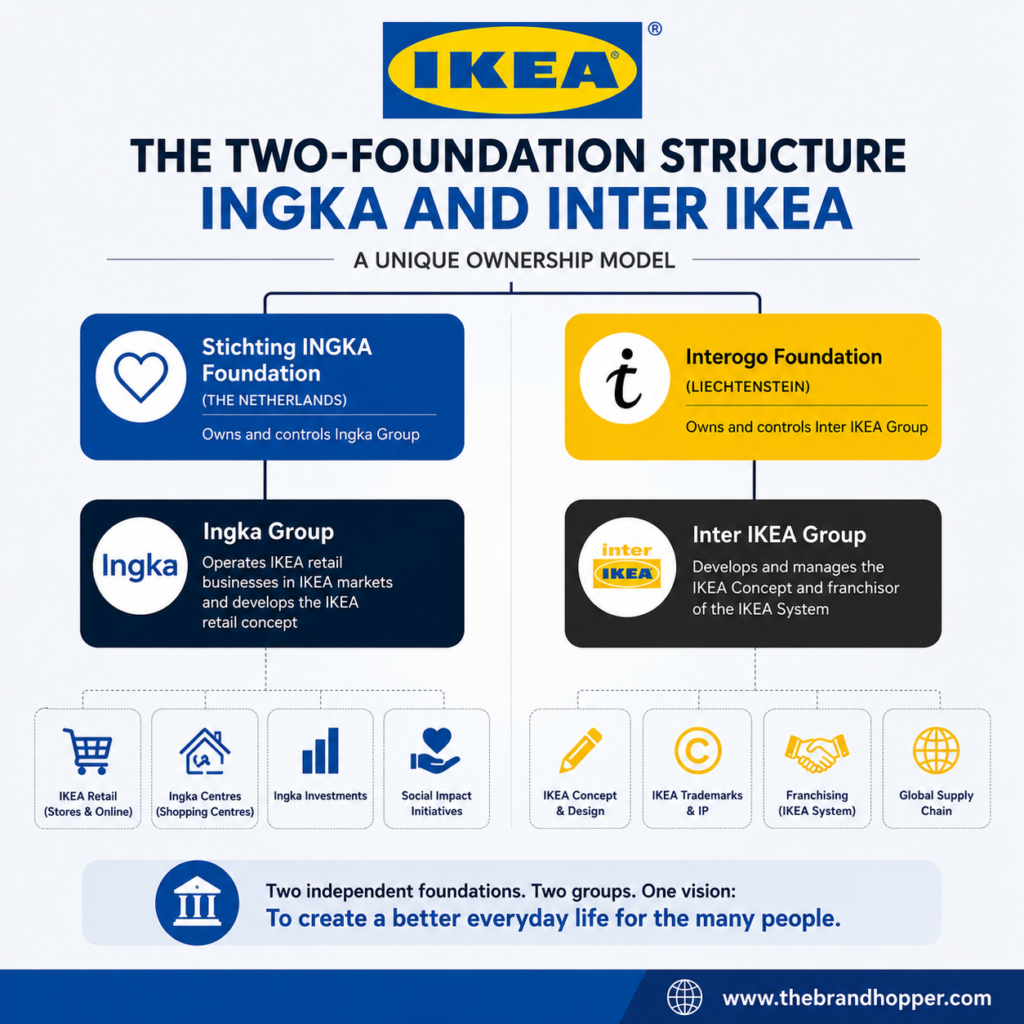
In short: one foundation owns the stores, a different foundation owns the brand and franchise rights the stores pay to use.
Why Kamprad Built It This Way
Kamprad’s own public explanation centered on protecting IKEA’s independence and its low-price mission for future generations, ensuring the company could never be broken up, sold off in pieces, or pressured by shareholders demanding higher prices to boost quarterly profits.
But the arrangement also had unmistakable financial advantages for Kamprad personally and for IKEA as a company.
Kamprad left Sweden in 1973 to escape the country’s high tax rates, and by placing IKEA’s ultimate ownership inside foundations registered in low-tax jurisdictions like Liechtenstein and the Netherlands, both Kamprad and IKEA avoided a substantial share of the taxes a conventionally structured, Sweden-based company and its billionaire founder would otherwise have owed.
Investigative reporting has estimated IKEA avoided roughly one billion euros in EU taxes between 2009 and 2014 alone through this structure, and the European Commission opened a formal investigation into IKEA’s use of Dutch subsidiaries to reduce its tax bill.
IKEA has consistently maintained that its structure complies fully with applicable tax laws in every jurisdiction where it operates.
What Happens to IKEA’s Profits?
Because Stichting INGKA Foundation has no shareholders and no beneficial owners in the conventional sense, Ingka Group’s profits legally can’t be distributed as dividends to any individual.
Instead, profits can only be reinvested back into the IKEA business itself or channeled toward the charitable work of the IKEA Foundation, a separate philanthropic entity funded by the Stichting INGKA Foundation that supports children’s rights, climate action, and humanitarian causes globally, including major partnerships with the UN Refugee Agency (UNHCR).
This structure has, at various points, made the IKEA Foundation one of the wealthiest charitable foundations in the world by assets, even though its actual annual charitable giving has historically been modest relative to that enormous asset base — a tension that outside observers have pointed to as evidence the foundation structure serves IKEA’s corporate and tax interests at least as much as it serves pure philanthropy.
The Kamprad Family Today
Ingvar Kamprad died in January 2018 at age 91 at his home in Småland, having stepped back from IKEA’s day-to-day operations years earlier.
In 2013, Kamprad transferred much of his remaining personal wealth and influence to his three sons — Peter, Jonas, and Mathias Kamprad — all of whom have held roles connected to IKEA’s foundations and governance structures, though none of them personally “owns” IKEA in any conventional sense, since the foundation structure was specifically designed to prevent that kind of individual inheritance of control.
The Kamprad family’s continued involvement is best understood as stewardship and governance influence over the foundations rather than equity ownership of the underlying business.
Who Runs IKEA Today?
Day-to-day leadership of Ingka Group, IKEA’s primary retail arm, transitioned in late 2025, when Juvencio Maeztu, previously deputy CEO, succeeded longtime CEO Jesper Brodin, who had led Ingka Group since 2017.

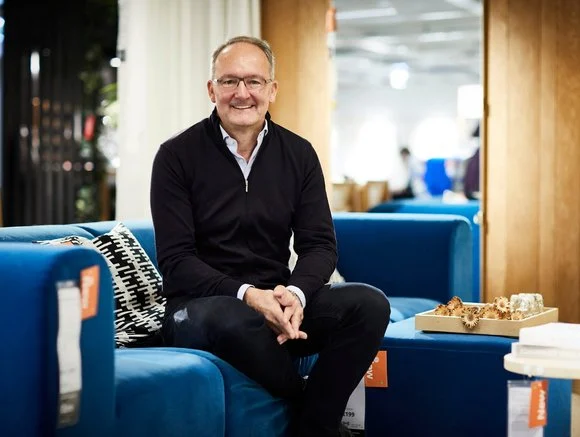
Brodin formally departed the CEO role by February 2026 and has continued in an advisory capacity connected to the IKEA Foundation.
This kind of internal, foundation-governed leadership succession — rather than a shareholder vote or activist-investor pressure campaign — is itself a direct product of IKEA’s unusual ownership structure, since there are no outside shareholders with the power to force a change in leadership.
IKEA’s Financial Reality in 2025
Despite a challenging global retail environment, IKEA remains a financial giant.
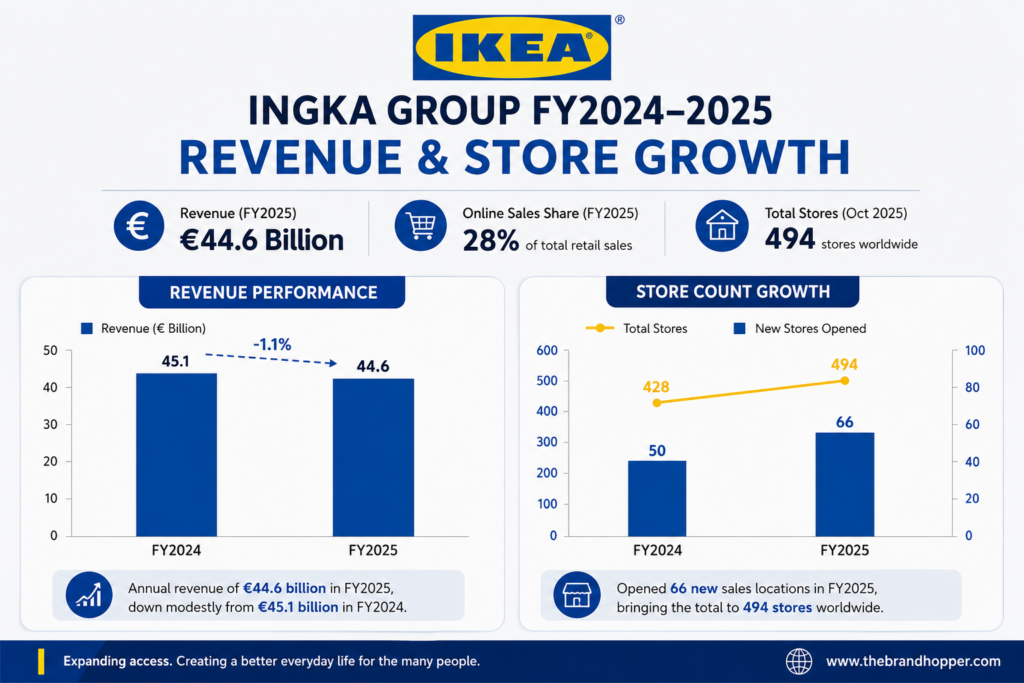
Ingka Group reported annual revenue of roughly €44.6 billion for fiscal year 2025, down modestly from €45.1 billion the year before, with online sales accounting for about 28% of total retail sales.
The company continued expanding its physical footprint even amid softer like-for-like growth, opening 66 new sales locations during the fiscal year and pushing its total global store count to 494 by October 2025.

IKEA has increasingly leaned into smaller-format city-center stores and expanded online fulfillment alongside its traditional big-box suburban model, reflecting a broader shift in how and where customers shop for furniture.
Is IKEA’s Structure Actually Legal?
Yes — IKEA’s foundation-based ownership structure is entirely legal in the jurisdictions where it’s registered, and versions of this “stichting” foundation model are used by other Dutch-registered organizations for similar independence and succession-planning reasons.
The controversy around IKEA has never centered on the legality of the structure itself, but rather on whether it was primarily designed for legitimate corporate-governance reasons or as an unusually effective, multi-decade tax minimization strategy dressed up in charitable language — a debate that remains unresolved and is likely to keep resurfacing every time IKEA’s finances draw fresh scrutiny from tax authorities or investigative journalists.
IKEA Ownership & History at a Glance
| Fact | Detail |
| Founded | 1943, by 17-year-old Ingvar Kamprad in Sweden |
| Furniture business began | 1948; flat-pack design pioneered soon after |
| Store operator | Ingka Group (runs most IKEA stores worldwide) |
| Store operator’s owner | Stichting INGKA Foundation (Netherlands, est. 1982) |
| Brand/franchise owner | Inter IKEA Group, via Inter IKEA Systems B.V. |
| Brand owner’s parent | Interogo Foundation (Liechtenstein, est. 1989) |
| Ownership type | Nonprofit foundations — no shareholders, no individual owner |
| Founder’s death | January 2018, age 91 |
| Kamprad’s heirs | Sons Peter, Jonas, and Mathias — governance roles, not ownership |
| Ingka Group CEO | Juvencio Maeztu (since late 2025) |
| Previous CEO | Jesper Brodin (2017–2025/26) |
| FY2025 revenue (Ingka) | ~€44.6 billion (down from €45.1B in FY2024) |
| Global store count (Oct 2025) | 494 stores |
| Online sales share (FY2025) | ~28% of total retail sales |
Key Takeaways
IKEA’s ownership is genuinely unlike almost any other major global retailer: no public stock, no shareholders, and no individual owner, only two interlocking nonprofit foundations — the Netherlands-based Stichting INGKA Foundation, which owns the stores through Ingka Group, and the Liechtenstein-based Interogo Foundation, which owns the IKEA brand itself through Inter IKEA Group.
Ingvar Kamprad built this structure deliberately, citing a desire to protect IKEA’s independence and low-cost mission forever, though the arrangement also delivered him and the company decades of significant tax advantages.
With Kamprad gone since 2018 and IKEA’s operational leadership now in the hands of professional executives like new Ingka Group CEO Juvencio Maeztu, the foundations — not any person or shareholder — remain the ultimate, permanent owners of the world’s largest furniture retailer.
Frequently Asked Questions
Q: Who owns IKEA?
A: IKEA has no shareholders or individual owner. Its stores are owned by Ingka Group, which is wholly owned by the Stichting INGKA Foundation (Netherlands), while the IKEA brand and franchise system are owned separately by Inter IKEA Group, controlled by the Interogo Foundation (Liechtenstein).
Q: Who founded IKEA?
A: IKEA was founded in 1943 by 17-year-old Ingvar Kamprad in Sweden, initially as a mail-order business selling small household goods before pivoting to furniture in 1948 and later pioneering flat-pack, self-assembly furniture.
Q: Why did Ingvar Kamprad give IKEA to a foundation instead of his family?
A: Kamprad restructured IKEA’s ownership into nonprofit foundations to protect the company from shareholder pressure, hostile takeovers, and breakup, while also significantly reducing the tax burden on both himself and the company for decades.
Q: Is the Kamprad family still involved with IKEA?
A: Yes, in a governance capacity. Ingvar Kamprad’s three sons — Peter, Jonas, and Mathias — have held roles connected to IKEA’s foundation structures, though none of them personally owns IKEA, since the foundation model was designed to prevent conventional inheritance of control.
Q: What’s the difference between Ingka Group and Inter IKEA Group?
A: Ingka Group operates the majority of physical IKEA stores worldwide and is owned by the Stichting INGKA Foundation. Inter IKEA Group owns the IKEA brand, concept, and franchise system, and is owned by the Interogo Foundation; Inter IKEA collects franchise fees from all IKEA stores, including Ingka’s own.
Q: Has IKEA’s ownership structure faced legal scrutiny?
A: Yes. The European Commission has investigated IKEA’s use of Dutch subsidiaries to reduce its tax bill, and reports have estimated IKEA avoided roughly one billion euros in EU taxes between 2009 and 2014, though IKEA maintains its structure fully complies with applicable laws.
Q: What happens to IKEA’s profits since there are no shareholders?
A: Because Ingka Group’s owner, the Stichting INGKA Foundation, has no shareholders, profits can only be reinvested into the business or directed toward the charitable work of the IKEA Foundation, which supports children’s rights, climate initiatives, and humanitarian partnerships including with the UN Refugee Agency.
Q: Who runs IKEA today?
A: Juvencio Maeztu became CEO of Ingka Group in late 2025, succeeding longtime CEO Jesper Brodin, who led the company since 2017 and has since moved into an advisory role connected to the IKEA Foundation.
Also Read: Marketing Strategies, Marketing Mix & STP Analysis of IKEA
To read more content like this, subscribe to our newsletter
Go to the full page to view and submit the form.