


L’Oréal is the undisputed giant of the global beauty industry, selling everything from drugstore mascara to five-figure luxury skincare across more than 150 countries.
Behind that scale sits a genuinely unusual ownership story: a French pharmacist’s hair-dye formula that grew into a business still substantially controlled by his own descendants more than a century later, alongside an improbable strategic alliance with a Swiss food and beverage conglomerate that has lasted over five decades.
Here’s the complete picture of who owns L’Oréal, how the Bettencourt family built and defended its stake, why Nestlé owns a fifth of a cosmetics company, and what sits inside L’Oréal’s sprawling brand empire.
How L’Oréal Began: A Chemist’s Hair Dye and a Company Built on Formula
L’Oréal’s origin traces to a single scientific breakthrough.
French chemist Eugène Schueller developed an innovative synthetic hair-dye formula in 1907, one that colored hair more naturally and safely than the harsh, often damaging dyes available at the time.

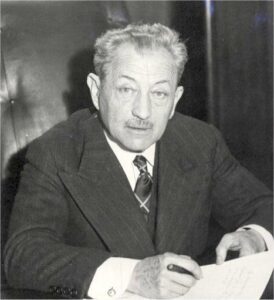
Schueller formally registered his company on July 31, 1909, under the name Société Française de Teintures Inoffensives pour Cheveux — the “French Company of Harmless Hair Dyes” — selling his formula to Parisian hairdressers before the business had even settled on the L’Oréal name it would eventually adopt.
By the 1920s, the company had already expanded beyond France’s borders, and Schueller proved to be as much a marketing innovator as a chemist, pioneering research-driven product development and aggressive advertising strategies that would become hallmarks of the L’Oréal approach for the century that followed.
The company later became famous for one of advertising’s most enduring taglines, “Because I’m worth it,” introduced in 1973, which helped position L’Oréal’s products as an accessible form of self-investment rather than simple vanity.
The Bettencourt Family: Three Generations of Ownership
Eugène Schueller’s daughter, Liliane Bettencourt, inherited his stake in L’Oréal and became one of the wealthiest women in the world, overseeing the family’s controlling interest for decades alongside her husband André Bettencourt, a French government minister.
Liliane Bettencourt’s later years were marked by a highly public legal and family controversy — the so-called “Bettencourt affair” — involving her relationship with photographer François-Marie Banier and a bitter dispute with her daughter, Françoise Bettencourt Meyers, over gifts Liliane had made to Banier, a saga that dominated French tabloids for years before mother and daughter eventually reconciled.
Following Liliane Bettencourt’s death in 2017 at age 94, her full stake passed to Françoise Bettencourt Meyers, who today stands as the wealthiest woman in the world according to various global wealth rankings, with her fortune overwhelmingly tied to the family’s L’Oréal shareholding.

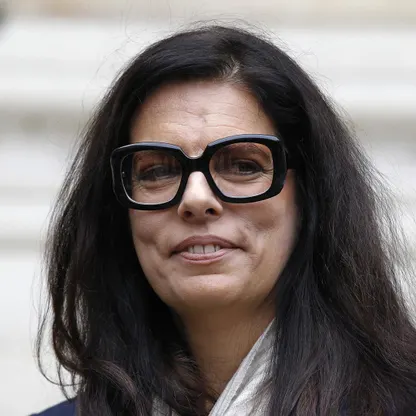
As of the end of 2025, Françoise Bettencourt Meyers and her immediate family — including her husband Jean-Pierre Meyers and sons Jean-Victor and Nicolas Meyers, holding shares both personally and through the family holding companies Téthys SAS and Financière l’Arcouest SAS — controlled 34.79% of L’Oréal’s total capital.
Why Nestlé Owns a Fifth of L’Oréal
Nestlé’s roughly 20.16% stake in L’Oréal is one of the more unusual cross-industry ownership arrangements in global business, and it dates back to a moment of real vulnerability for the Bettencourt family.
In the 1970s, amid political uncertainty in France and fears that a left-wing government might nationalize major French companies, Liliane Bettencourt arranged for a portion of the family’s L’Oréal holdings to be sold to Nestlé, giving the Swiss food giant a substantial minority stake in exchange for a degree of protective cover and capital diversification for the family.

That relationship has persisted for more than five decades, with Nestlé maintaining its roughly one-fifth ownership through a long-standing shareholders’ agreement with the Bettencourt Meyers family that has governed how each party can buy, sell, or vote its shares, helping preserve stability in L’Oréal’s ownership structure even as the beauty giant’s market value has grown into the hundreds of billions.
Nestlé’s L’Oréal stake has periodically been the subject of speculation about a potential sale, but the Swiss company has instead held onto the position as a long-term financial investment that has appreciated enormously in value over the decades.
L’Oréal’s Ownership and Voting Structure Today
Beyond the Bettencourt Meyers family and Nestlé, the remaining roughly 43% of L’Oréal’s shares trade freely on Euronext Paris, held by a broad mix of institutional investors, index funds, individual retail shareholders, and L’Oréal employees through company share ownership plans.
A distinctive feature of L’Oréal’s governance is France’s “loyalty share” system, under which shares held in registered form for more than two years are automatically granted double voting rights — a mechanism designed to reward long-term shareholders and reinforce stability against short-term activist pressure.
Because the Bettencourt Meyers family has held its shares in registered form for generations, this loyalty bonus lifts the family’s effective voting power to more than 38%, meaningfully higher than its raw 34.79% economic ownership stake, giving the family outsized practical control over major corporate decisions relative to the capital it actually holds.
L’Oréal’s Brand Portfolio: 37 Brands Across Four Divisions
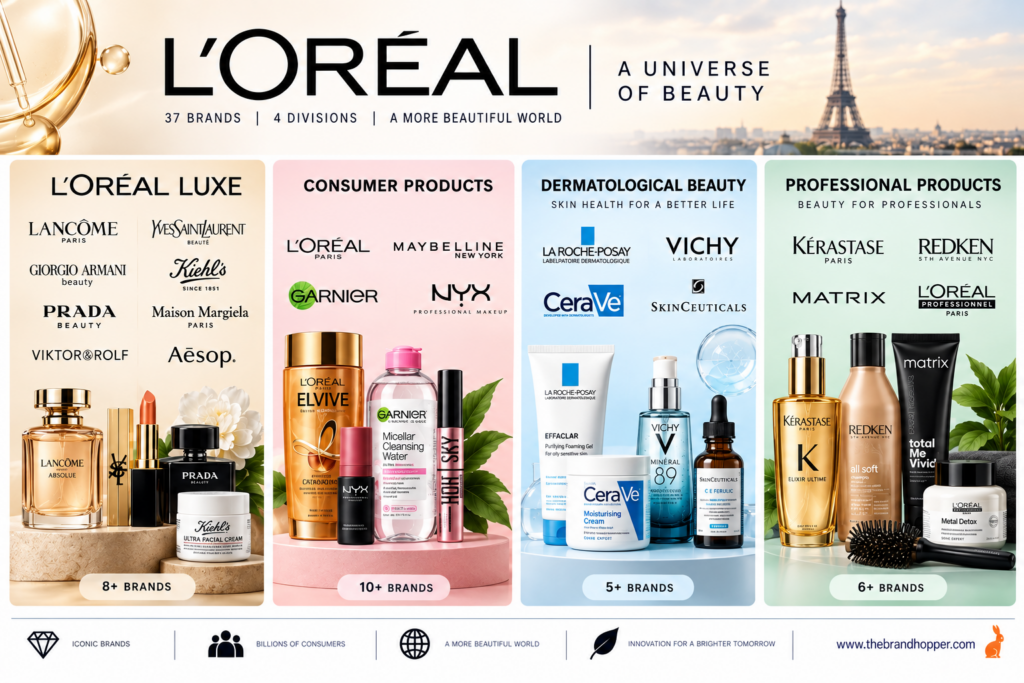
L’Oréal organizes its enormous brand portfolio — 37 international brands in total — across four distinct divisions: L’Oréal Luxe, Consumer Products, Dermatological Beauty, and Professional Products.
L’Oréal Luxe includes prestige names like Lancôme, Yves Saint Laurent Beauté, Giorgio Armani Beauty, Kiehl’s, Prada Beauty, Maison Margiela, Viktor&Rolf, and the recently acquired Aesop, and was the group’s single most profitable division in FY2025, generating approximately €3.49 billion in operating profit.
Consumer Products spans the mass-market brands most shoppers encounter directly, including L’Oréal Paris, Maybelline New York, Garnier, and NYX Professional Makeup.
Dermatological Beauty covers L’Oréal’s fast-growing skin-health brands, including La Roche-Posay, Vichy, CeraVe, and SkinCeuticals, a division that has benefited enormously from the broader “skinification” trend in global beauty.
Professional Products, the division that grew fastest in FY2025, serves hairdressers and salons directly through brands like Kérastase, Redken, and Matrix.
L’Oréal’s Acquisition Strategy Under CEO Nicolas Hieronimus
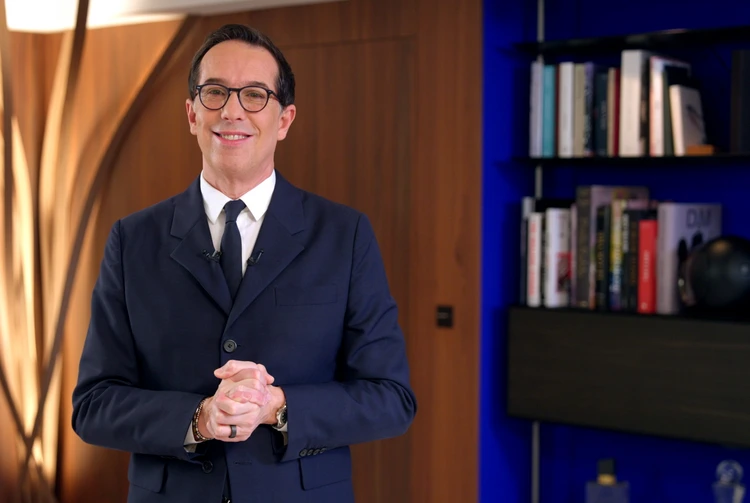
Nicolas Hieronimus became L’Oréal’s CEO in 2021, succeeding longtime chief executive Jean Paul Agon, who transitioned into the role of company chairman.
Under Hieronimus’s leadership, L’Oréal has pursued an aggressive brand acquisition strategy aimed at strengthening its position in premium and dermatological beauty, picking up brands including Youth to the People, Skin Better Science, Dr.G, ColorWow, and the Australian luxury brand Aesop for roughly $2.5 billion in 2023.

The most dramatic move of the Hieronimus era came with L’Oréal’s roughly €4 billion acquisition of Kering Beauté, the beauty division of luxury conglomerate Kering, in a deal that brought fragrance and cosmetics rights tied to brands including Gucci, Bottega Veneta, and Balenciaga into L’Oréal’s portfolio — the largest acquisition in the company’s history and a clear signal of L’Oréal’s ambition to dominate ultra-luxury beauty licensing alongside its existing prestige brands.
L’Oréal’s Financial Performance
L’Oréal’s FY2025 results reflected steady, disciplined growth in a beauty market that has cooled somewhat from its post-pandemic boom years.
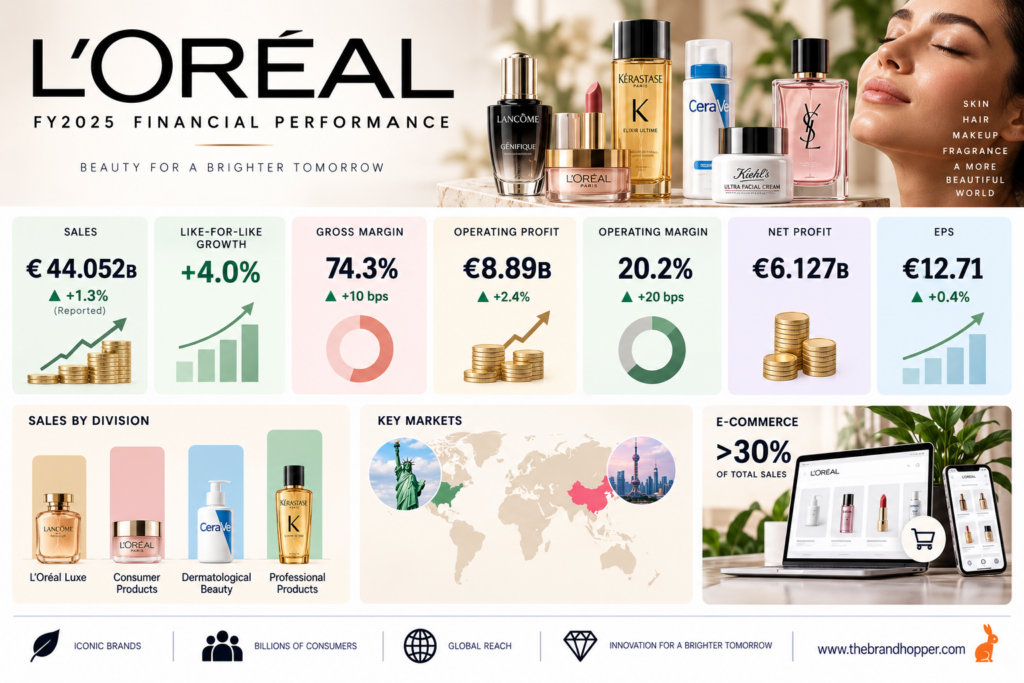
Full-year sales reached €44.052 billion, up 4.0% on a like-for-like basis (which strips out currency and portfolio effects) but a more modest 1.3% on a reported basis, reflecting unfavorable currency movements during the year.
Profitability held up well despite the softer top-line growth: gross margin improved 10 basis points to a robust 74.3%, operating profit grew 2.4% to €8.89 billion, and operating margin expanded 20 basis points to 20.2% of sales.
Net profit attributable to the group came in at €6.127 billion for the year, with earnings per share rising a modest 0.4% to €12.71. Growth was broad-based across all four divisions, led by Professional Products, while e-commerce continued its long-running rise, surpassing 30% of total group sales for the first time.
L’Oréal’s two largest individual markets, the United States and China, both staged a notable recovery in the second half of the year after a softer first half, providing an encouraging signal heading into 2026.
L’Oréal’s Market Value in 2026
As of 2026, L’Oréal holds market capitalization of approximately $226 billion, making it comfortably the world’s largest cosmetics and beauty company by market value, ahead of rivals including Estée Lauder and Unilever’s beauty-adjacent operations.
That valuation reflects investor confidence not just in L’Oréal’s current earnings power but in the durability of its ownership structure — a company where a committed, multi-generational family shareholder base and a stable long-term institutional partner in Nestlé have together provided decades of continuity that few large public companies can match, insulating L’Oréal’s strategic direction from the kind of short-term activist pressure that has reshaped other major consumer goods companies in recent years.
Why L’Oréal’s Ownership Structure Matters for Investors
L’Oréal’s ownership profile represents something increasingly rare among companies of its scale: genuine, multi-generational family control operating alongside public markets rather than instead of them.
The combination of the Bettencourt Meyers family’s loyalty-boosted voting power and Nestlé’s long-standing, stable minority position has allowed L’Oréal’s management to pursue patient, long-horizon strategies — including expensive, high-conviction acquisitions like the Kering Beauté deal — without the same degree of quarterly earnings pressure that purely index-fund-owned companies often face.
For investors, this means L’Oréal offers exposure to a genuinely defensive, family-anchored consumer staple with a demonstrated ability to compound brand value and profitability over multiple decades, even as beauty industry trends and individual product categories rise and fall around it.
L’Oréal Ownership at a Glance
| Category | Detail |
| Founded | July 31, 1909 (Paris, France) |
| Founder | Eugène Schueller (chemist, hair-dye formula) |
| Largest shareholder | Bettencourt Meyers family (~34.79% capital, ~38%+ voting power) |
| Second-largest shareholder | Nestlé (~20.16%, stake held since the 1970s) |
| Company structure | Publicly traded; double voting rights for long-held shares |
| Stock listing | Euronext Paris: OR |
| CEO | Nicolas Hieronimus (since 2021) |
| Chairman | Jean Paul Agon (former CEO) |
| Headquarters | Clichy, France |
| Brand portfolio | 37 international brands across 4 divisions |
| Largest recent acquisition | Kering Beauté (~€4 billion, 2025) |
| FY2025 sales | €44.052 billion (+4.0% like-for-like) |
| FY2025 net profit | €6.127 billion |
| 2026 market capitalization | ~$226 billion (world’s largest cosmetics company) |
Key Takeaways
L’Oréal’s ownership story in 2026 centers on a genuinely rare combination: a founding family, now three generations deep, that still controls the largest single stake at 34.79% (and over 38% of voting power thanks to loyalty shares), alongside Nestlé’s steady 20.16% position dating back to a 1970s protective deal, with the remaining shares trading freely among public investors.
Under CEO Nicolas Hieronimus, the company has aggressively expanded its already massive 37-brand portfolio through acquisitions like Aesop and the landmark €4 billion Kering Beauté deal, pushing further into ultra-luxury beauty licensing.
Financially, FY2025 delivered €44.05 billion in sales, €6.127 billion in net profit, and a market capitalization of roughly $226 billion, cementing L’Oréal’s position as the world’s largest beauty company by value even as growth moderated from the sector’s post-pandemic highs.
Frequently Asked Questions
Q: Who owns the most shares of L’Oréal?
A: The Bettencourt Meyers family, led by Françoise Bettencourt Meyers, is L’Oréal’s largest shareholder, controlling approximately 34.79% of capital and over 38% of voting power as of the end of 2025, thanks to France’s double-voting-rights system for long-held registered shares.
Q: Why does Nestlé own part of L’Oréal?
A: Nestlé acquired its roughly 20.16% stake in the 1970s, when the Bettencourt family sold a portion of their holdings to the Swiss company partly to protect against potential nationalization amid French political uncertainty at the time.
Q: Who founded L’Oréal?
A: L’Oréal was founded by French chemist Eugène Schueller, who developed an innovative hair-dye formula in 1907 and formally registered his company on July 31, 1909, in Paris.
Q: What brands does L’Oréal own?
A: L’Oréal owns 37 international brands across four divisions, including Lancôme, Yves Saint Laurent Beauté, Kiehl’s, and Aesop (Luxe); L’Oréal Paris, Maybelline, and Garnier (Consumer Products); La Roche-Posay, Vichy, and CeraVe (Dermatological Beauty); and Kérastase and Redken (Professional Products).
Q: Who is L’Oréal’s CEO?
A: Nicolas Hieronimus has been L’Oréal’s CEO since 2021, succeeding Jean Paul Agon, who remains involved with the company as chairman of the board.
Q: What was L’Oréal’s revenue in FY2025?
A: L’Oréal reported FY2025 sales of €44.052 billion, up 4.0% like-for-like, with net profit attributable to the group of €6.127 billion and an operating margin of 20.2%.
Q: What was L’Oréal’s biggest recent acquisition?
A: L’Oréal’s largest-ever acquisition was its roughly €4 billion purchase of Kering Beauté, the beauty division of luxury group Kering, bringing fragrance and cosmetics rights for brands including Gucci and Bottega Veneta into L’Oréal’s portfolio.
Q: Is L’Oréal still a family-controlled company?
A: Yes, in practice. While L’Oréal is publicly traded, the Bettencourt Meyers family’s roughly 34.79% stake and over 38% voting power give the family substantial continued influence over the company’s strategic direction, three generations after founder Eugène Schueller’s death.
Also Read: Decoding L’Oreal Winning Marketing Strategy
To read more content like this, subscribe to our newsletter
Go to the full page to view and submit the form.