


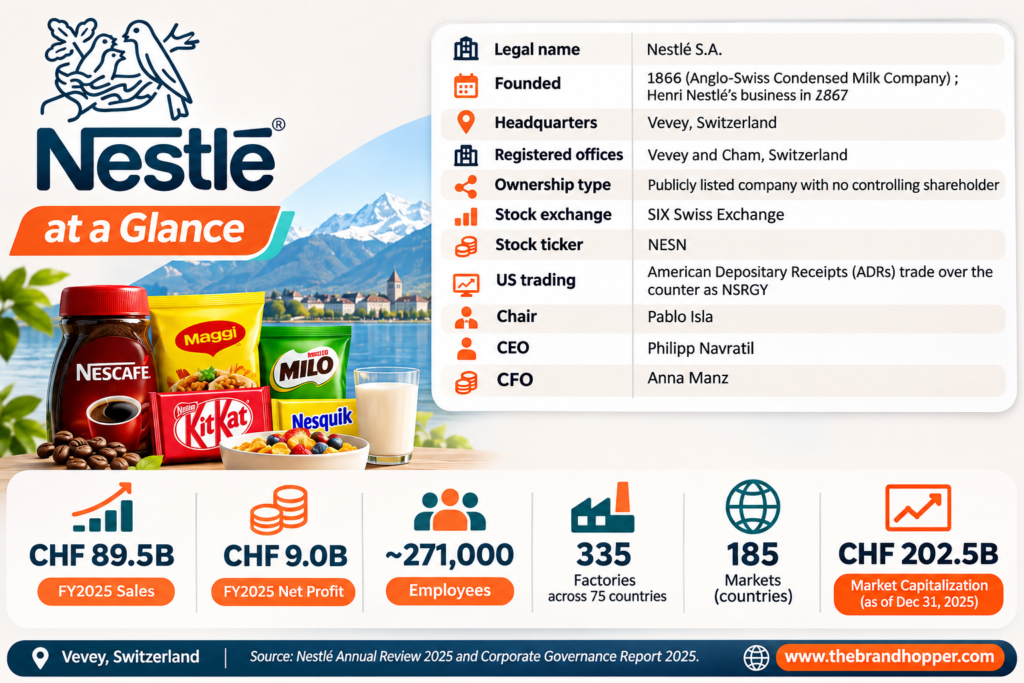
Nestlé is the company behind your morning Nescafé, the KitKat in your desk drawer, the Maggi noodles in your pantry, and the Purina food in your pet’s bowl. Headquartered in Switzerland, it sells products in 185 countries, operates 335 factories across 75 countries, and employs approximately 271,000 people.
Yet when people ask, “Who owns Nestlé?”, the answer may surprise them: there is no founding family, parent company, or individual billionaire controlling the business. Nestlé S.A. is a publicly traded company owned by its shareholders.
In this guide, we explain who owns Nestlé, who runs the company, how much revenue it generates, and which brands belong to its portfolio.
We also examine the major developments, including its planned waters joint venture, the sale of its mainstream vitamins business, the integration of Nestlé Health Science into Nutrition, and changes to its leadership and operating structure.

1. Who Owns Nestlé? The Shareholder Breakdown
Nestlé S.A. is a publicly traded company with a widely distributed shareholder base. Its ownership is divided among institutional investors, investment funds, private individuals, and other shareholders around the world.
As of December 31, 2025, Nestlé had 2,576,520,000 registered shares, each with a nominal value of CHF 0.10. This represented ordinary share capital of CHF 257.652 million.
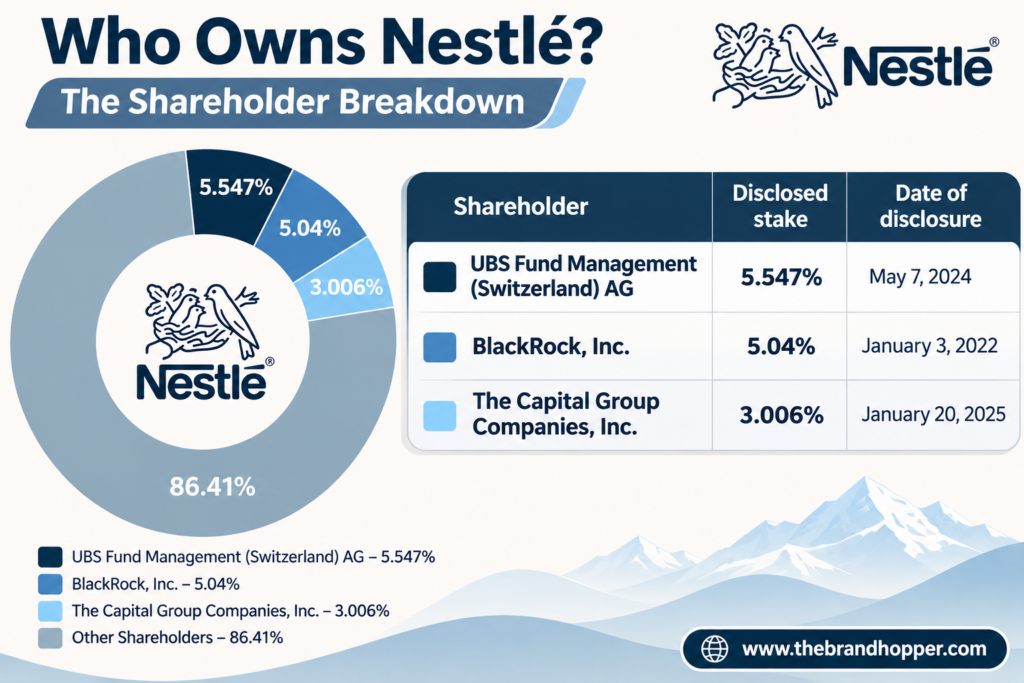
Nestlé does not have a controlling shareholder. Its three largest disclosed shareholders are asset management companies that invest on behalf of clients and funds.
1.1. Nestlé’s Largest Shareholders
According to Nestlé’s 2025 Corporate Governance Report, three investors held more than 3% of the company’s share capital at the end of 2025.
| Shareholder | Disclosed stake | Date of disclosure |
|---|---|---|
| UBS Fund Management (Switzerland) AG | 5.547% | May 7, 2024 |
| BlackRock, Inc. | 5.04% | January 3, 2022 |
| The Capital Group Companies, Inc. | 3.006% | January 20, 2025 |
It is important to understand that UBS, BlackRock, and Capital Group are asset managers. They generally hold shares on behalf of institutional clients, pension funds, investment funds, and other investors rather than exercising control over Nestlé as operating businesses.
1.2. The Nominee Holders You Might See Listed
Some ownership databases show banks and custodians such as Citibank, Northern Trust, and BNY Mellon among Nestlé’s largest registered holders.
These institutions may hold shares as nominees or custodians for underlying investors. Their appearance in the shareholder register does not necessarily mean they are the ultimate economic owners.
For example, Citibank N.A., London, which acts as the depositary for Nestlé’s American Depositary Receipts, was the registered holder of 167,052,768 shares, representing 6.48% of Nestlé’s shares at December 31, 2025.
Nortrust Nominees held 3.24%, while The Bank of New York Mellon held 3.11%. These positions should not be confused with beneficial ownership by the banks themselves.
1.3. The 5% Voting-Rights Registration Limit
Nestlé’s Articles of Association generally prevent a person or entity from being registered with voting rights for more than 5% of the company’s share capital.
The restriction also applies to certain nominee arrangements and related parties acting together. However, Nestlé’s Board can authorize exceptions for particular nominees to facilitate the trading and safekeeping of shares.
This is a restriction on registration with voting rights, not an absolute prohibition on acquiring more than 5% of Nestlé’s shares. It should therefore not be interpreted as a complete barrier to a potential takeover.
1.4. Institutions vs. Private Shareholders
Nestlé’s 2025 Corporate Governance Report provides a breakdown of its registered shares by investor type.
| Investor type | Share of registered shares |
|---|---|
| Institutional investors | 74% |
| Private shareholders | 26% |
These percentages relate to registered shares, which represented approximately 45.4% of Nestlé’s total share capital at December 31, 2025. They should not be interpreted as a complete breakdown of all beneficial owners across the company’s entire share capital.
Nestlé also has a substantial Swiss shareholder base, alongside institutional investors in the United States, the United Kingdom, Germany, and other markets.
Bottom line on ownership: Nestlé is owned by its shareholders, not by a family or a single corporate parent. Its largest disclosed institutional shareholders have significant investments, but none is identified as controlling the company.
2. Who Runs Nestlé? Leadership in 2026
Ownership and management are separate at Nestlé. Shareholders elect the Board of Directors, which oversees the company and appoints the Executive Board responsible for day-to-day operations.
Nestlé held its 159th Annual General Meeting on April 16, 2026, where shareholders approved the Board’s proposals and the company’s annual financial statements.
2.1. Philipp Navratil, CEO
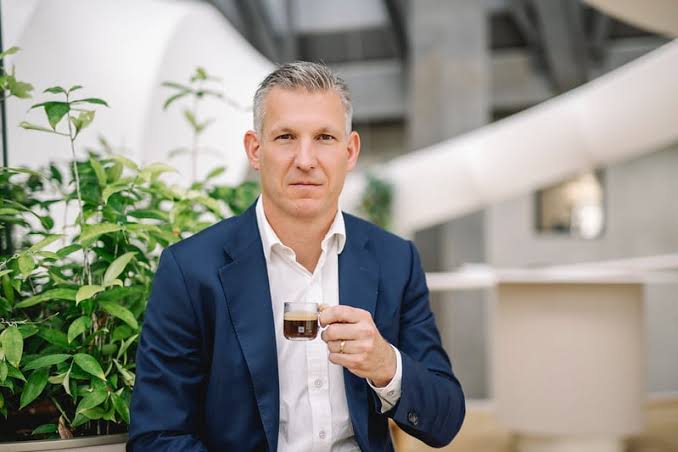
Philipp Navratil became Nestlé’s CEO on September 1, 2025. A long-time Nestlé executive, he previously led Nespresso and held several senior positions across the company’s international coffee and beverage businesses.

He replaced Laurent Freixe, who was dismissed by the Board following an investigation into an undisclosed romantic relationship with a direct subordinate, which Nestlé said breached its Code of Business Conduct.
Freixe had succeeded Mark Schneider in September 2024, meaning he served as CEO for approximately one year before Navratil took over.
Since becoming CEO, Navratil has emphasized stronger execution, greater investment in leading brands, a simpler operating structure, and a more focused portfolio.
In October 2025, Nestlé announced plans to reduce its global workforce by approximately 16,000 positions by the end of 2027. This includes around 12,000 white-collar roles and a further 4,000 positions through productivity initiatives in manufacturing and supply chain operations.
The white-collar reductions are intended to generate approximately CHF 1 billion in annual operational efficiency savings by the end of 2027.
2.2. Pablo Isla, Chair
Pablo Isla became Chair of Nestlé on October 1, 2025, succeeding Paul Bulcke, who stepped down earlier than originally planned.

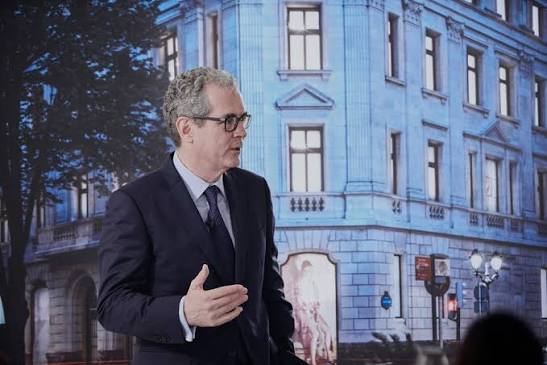
Isla previously served as Executive Chairman and CEO of Inditex, the Spanish retail group that owns Zara and several other fashion brands. He led Inditex from 2005 to 2022 and brings extensive experience in international retail, corporate governance, and global business management.
His appointment came as Nestlé entered a period of strategic restructuring under its new CEO.
2.3. Nestlé’s Executive Board
Nestlé’s Executive Board includes executives responsible for the company’s global functions, geographic zones, and major businesses.
Some of its key leaders include:
| Executive | Role |
|---|---|
| Philipp Navratil | Chief Executive Officer |
| Anna Manz | Chief Financial Officer |
| Stefan Palzer | Chief Technology Officer |
| Leanne Geale | Group General Counsel |
| Jeff Hamilton | CEO, Zone Americas |
| Remy Ejel | CEO, Zone Asia, Oceania and Africa |
| Guillaume Le Cunff | CEO, Zone Europe |
| Alfonso Gonzalez Loeschen | CEO, Nespresso |
Nestlé also has senior executives responsible for operations, human resources, strategic business units, marketing and sales, communications, and sustainability.
A major organizational change took effect on January 1, 2026, when the globally managed Nestlé Health Science business was integrated into the Nutrition business of the geographic zones. Anna Mohl, formerly CEO of Nestlé Health Science, left the Executive Board in February 2026.
3. How Big Is Nestlé? Financial Performance
Nestlé is one of the world’s largest and most diversified food and beverage companies. Its portfolio spans coffee, pet food, infant nutrition, confectionery, prepared foods, dairy products, and bottled water.
The company’s FY2025 financial performance reflected positive organic growth, but reported sales and profitability were affected by currency movements, input costs, and restructuring.
3.1. Nestlé FY2025 Financial Results
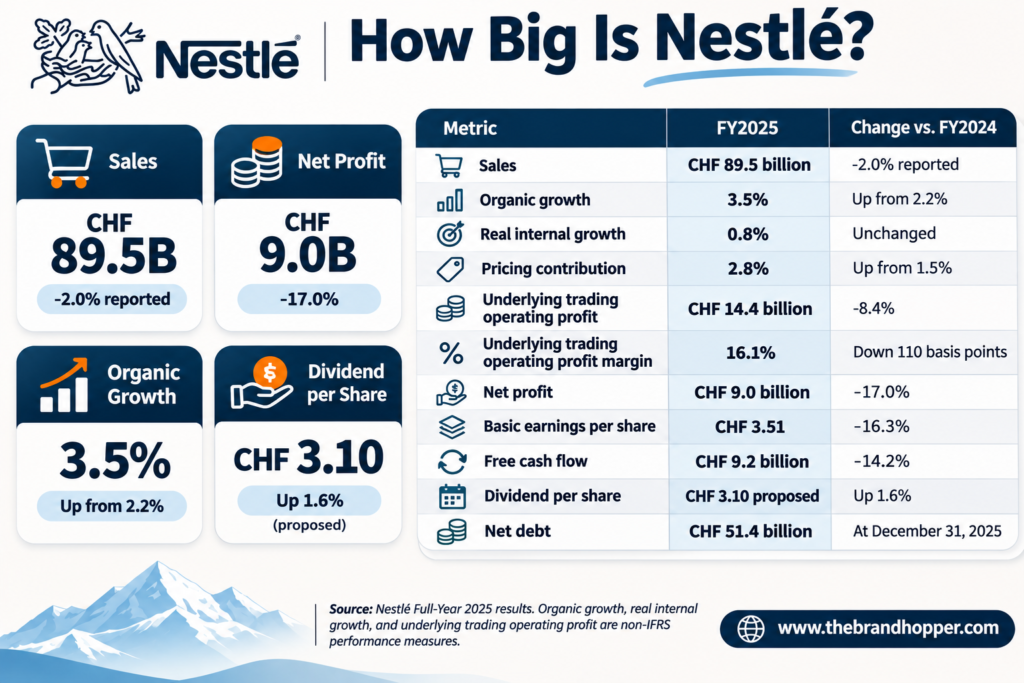
The 2% reported sales decline was largely driven by foreign exchange movements, which had a negative impact of 5.7%. Organic growth was 3.5%, supported by pricing of 2.8% and real internal growth of 0.8%.
Nestlé generated CHF 9.2 billion in free cash flow during 2025. Its proposed dividend of CHF 3.10 per share was approved at the April 2026 Annual General Meeting.
3.2. Nestlé’s 2025 Sales by Product Category
Nestlé updated its product-category reporting from January 1, 2026. Its four core product categories are Coffee, Petcare, Nutrition, and Food & Snacks, with Waters & Premium Beverages disclosed separately.
For comparability, Nestlé also republished its 2025 figures using the revised product categories.
| Product category | FY2025 sales |
|---|---|
| Coffee | CHF 24.6 billion |
| Petcare | CHF 18.4 billion |
| Nutrition | CHF 17.9 billion |
| Food & Snacks | CHF 25.1 billion |
| Waters & Premium Beverages | CHF 3.6 billion |
Figures are rounded and based on Nestlé’s revised product-category reporting.
3.3. 2026 Performance So Far
Nestlé’s nine-month 2026 results show that organic growth has improved despite currency-related pressure on reported sales.
For the first nine months of 2026, Nestlé reported sales of CHF 65.9 billion, virtually unchanged from the same period in 2025. Organic growth reached 3.7%, comprising real internal growth of 1.9% and pricing of 1.8%.
In the third quarter alone, sales reached CHF 22.8 billion, with organic growth of 4.0% and real internal growth of 2.8%. Growth was positive across all geographic zones and globally managed businesses.
| Metric | First nine months of 2026 |
|---|---|
| Reported sales | CHF 65.9 billion |
| Organic growth | 3.7% |
| Real internal growth | 1.9% |
| Pricing contribution | 1.8% |
| Reported sales growth | Approximately flat |
Nestlé’s first-half net profit fell 31.4% to CHF 3.5 billion. This was affected by restructuring costs and a non-cash write-down of approximately CHF 1.3 billion as businesses being divested were classified as assets held for sale.
For 2026, Nestlé maintained its guidance of 3% to 4% organic growth, an improved underlying trading operating profit margin compared with 2025, and free cash flow above CHF 9 billion.
3.4. Where the Money Comes From: 2026 Product Categories
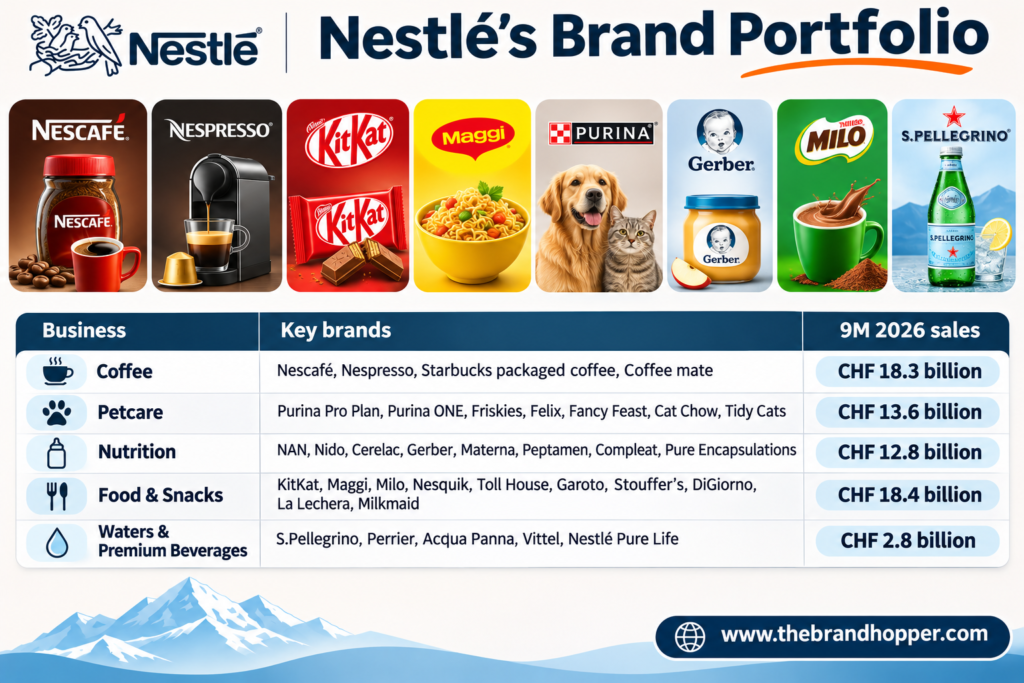
The following table shows Nestlé’s reported sales for the first nine months of 2026 under its updated product-category structure.
| Product category | 9M 2026 sales | Organic growth |
|---|---|---|
| Coffee | CHF 18.3 billion | 6.1% |
| Petcare | CHF 13.6 billion | 3.5% |
| Nutrition | CHF 12.8 billion | -0.7% |
| Food & Snacks | CHF 18.4 billion | 4.2% |
| Waters & Premium Beverages | CHF 2.8 billion | 7.5% |
Source: Nestlé Nine-Month Sales 2026. Figures are rounded.
Food & Snacks and Coffee were the largest product categories by sales during this period. Nutrition remained under pressure, partly due to the infant formula recall, while Petcare continued to deliver positive organic growth.
3.5. Geographic Sales Breakdown
Nestlé operates through three geographic zones and two globally managed businesses: Nespresso and Nestlé Waters & Premium Beverages.
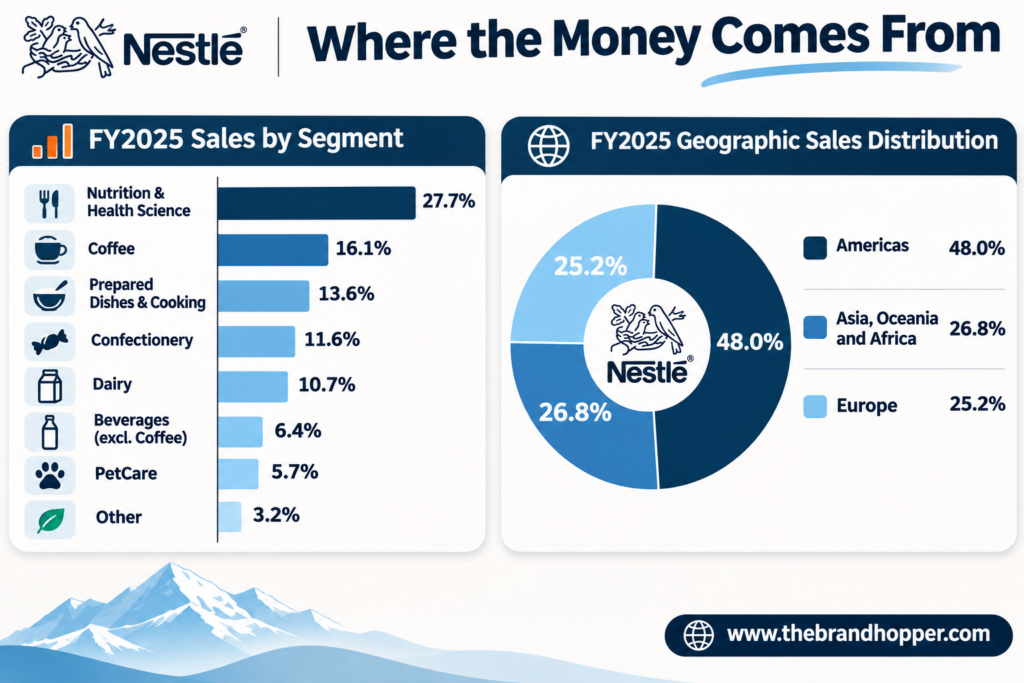
The Americas remains Nestlé’s largest geographic market, accounting for nearly half of group sales.
4. Nestlé’s Brand Portfolio: What Does Nestlé Own?
Nestlé has a portfolio of thousands of brands, ranging from global names to products with strong regional recognition. Its products cover coffee, petcare, nutrition, food, snacks, and premium beverages.
Following its 2026 organizational changes, Nestlé’s four core product categories are Coffee, Petcare, Nutrition, and Food & Snacks. Waters & Premium Beverages is reported separately while the planned joint venture is awaiting completion.
4.1. Coffee: One of Nestlé’s Biggest Businesses
Coffee is one of Nestlé’s most important global businesses, supported by major brands such as Nescafé, Nespresso, and Starbucks packaged coffee products.
Nescafé is one of the world’s best-known instant coffee brands, while Nespresso focuses on premium portioned coffee machines and capsules. Nestlé also manages Starbucks-branded packaged coffee products through its Global Coffee Alliance.
The Starbucks brand itself belongs to Starbucks Corporation, not Nestlé. Under the agreement completed in 2018, Nestlé received perpetual global rights to market Starbucks Consumer Packaged Goods and Foodservice products outside Starbucks coffee shops.
Nespresso generated approximately CHF 6.5 billion in sales in FY2025. In 2026, Nestlé also sold its Blue Bottle Coffee business to Centurium Capital.
4.2. Petcare: The Purina Powerhouse
Purina is one of the world’s leading pet food businesses and a major contributor to Nestlé’s financial performance.
Its portfolio includes Purina Pro Plan, Purina ONE, Friskies, Felix, Fancy Feast, Purina Cat Chow, and Tidy Cats. Purina Pro Plan Veterinary Diets and its supplements range also serve pets with specific nutritional and health requirements.
In FY2025, Nestlé’s Petcare category generated CHF 18.4 billion in sales and recorded an underlying trading operating profit margin of 21.7%, making it one of the company’s most profitable product categories.
4.3. Nutrition: From Infants to Healthy Ageing
Nestlé’s Nutrition business covers infant formula, baby food, fortified milk products, medical nutrition, and specialized nutritional products.
Its brands include NAN, Nido, Cerelac, Gerber, Materna, Peptamen, and Compleat. The portfolio also includes premium nutrition and supplement brands such as Pure Encapsulations and Garden of Life.
In 2026, Nestlé integrated the globally managed Nestlé Health Science business into the Nutrition business of its three geographic zones. This was an organizational change designed to simplify the company’s structure and strengthen its focus on nutrition.
Nestlé continues to invest in science-led nutrition and specialized products, while preparing to divest its mainstream vitamins, minerals, and supplements portfolio.
4.4. Food & Snacks: The Household Names
Nestlé’s Food & Snacks portfolio includes some of the world’s most recognizable food and confectionery brands.
KitKat is one of its flagship global chocolate brands and became the Official Chocolate Bar of Formula 1 in 2025. The company also owns regional brands such as Garoto in Brazil and Toll House baking products in the United States.
Its wider portfolio includes Maggi noodles and cooking products, Milo and Nesquik beverages, frozen food brands such as Stouffer’s and DiGiorno, and dairy products such as La Lechera and Milkmaid.
In 2026, Nestlé completed its acquisition of the remaining 51% stake in German smart-food company yfood Labs GmbH. The business generated approximately EUR 150 million in sales in 2025 and sells nutritionally complete ready-to-drink meals.
Did you know? KitKat bars sold in the United States are manufactured and marketed by The Hershey Company under a licence dating back to 1970. Nestlé sold its US chocolate brands, including Butterfinger and Baby Ruth, to Ferrero in 2018, but retained its Toll House baking products.
5. What Nestlé Is Selling and Restructuring in 2026
Under CEO Philipp Navratil, Nestlé is reshaping its portfolio around businesses where it believes it can achieve stronger growth and competitive advantage.
The company has announced several transactions and portfolio changes, although some remain subject to regulatory approval or completion.
5.1. Waters & Premium Beverages: Peranel Joint Venture
In July 2026, Nestlé and private equity firm Platinum Equity announced plans to establish Peranel, a 50:50 joint venture for Nestlé’s waters and premium beverages business.
The portfolio includes brands such as S.Pellegrino, Perrier, Acqua Panna, Nestlé Pure Life, and other regional water and hydration brands.
The transaction assigns Peranel an enterprise value of EUR 4.9 billion. Nestlé expects to receive approximately EUR 3.0 billion in cash proceeds, equivalent to CHF 2.8 billion, when the transaction closes.
The deal is subject to employee consultation and regulatory approvals, with completion expected in the first half of 2027. Until then, the transaction should be described as announced rather than completed.
5.2. Mainstream Vitamins and Supplements
In September 2026, Nestlé agreed to sell its mainstream Vitamins, Minerals and Supplements business to Yellow Wood Partners for USD 1.0 billion.
The transaction includes seven brands: Nature’s Bounty, Osteo Bi-Flex, Ester-C, Gard, Nuun, Puritan’s Pride, and Sisu, together with associated operations.
The business generated approximately USD 1.2 billion in sales during 2025. The transaction is subject to regulatory approvals and is expected to close in the first half of 2027.
Nestlé intends to retain its premium, science-led supplement brands, including Solgar and Pure Encapsulations.
5.3. Ice Cream Business
Nestlé has classified its remaining in-house ice cream businesses as assets held for sale and has been progressing a sale process involving Froneri.
Froneri is a joint venture between Nestlé and private equity firm PAI Partners, established in 2016. Many of Nestlé’s European ice cream operations and selected international businesses were already included in Froneri.
Nestlé’s remaining operations include markets and businesses that were not part of the original joint venture. The proposed transaction is part of its wider strategy to simplify the portfolio and focus on its core businesses.
5.4. Blue Bottle Coffee
Nestlé divested Blue Bottle Coffee to Centurium Capital during the first half of 2026.
Nestlé had acquired a majority stake in the specialty coffee company in 2017. The sale reflects its decision to focus its coffee investments on larger global platforms such as Nescafé, Nespresso, and Starbucks packaged coffee.
5.5. Russia Operations
In September 2026, Nestlé confirmed that it had taken note of a Russian presidential decree placing Nestlé Russia under temporary external administration.
The company said it was assessing the situation and its options, while taking steps to protect its rights and maintain business continuity for employees and other stakeholders.
The development creates uncertainty around Nestlé’s Russian operations. However, it should not be described as a completed sale or as a confirmed deconsolidation of the Russian business unless Nestlé publishes an explicit accounting or ownership update.
6. Nestlé’s Hidden Gem: A 20.2% Stake in L’Oréal
One of the lesser-known facts about Nestlé is that it is a major shareholder in L’Oréal, the world’s largest beauty company.
Nestlé owns 107,621,021 shares in L’Oréal, representing approximately 20.2% of the company’s share capital. The stake was worth approximately CHF 36.7 billion at the end of 2025.
The Bettencourt Meyers family is L’Oréal’s largest shareholder, while Nestlé is its second-largest shareholder.
Nestlé first invested in L’Oréal in 1974. The investment has since become one of the most valuable strategic shareholdings in the European corporate sector.
7. A Brief History of Nestlé

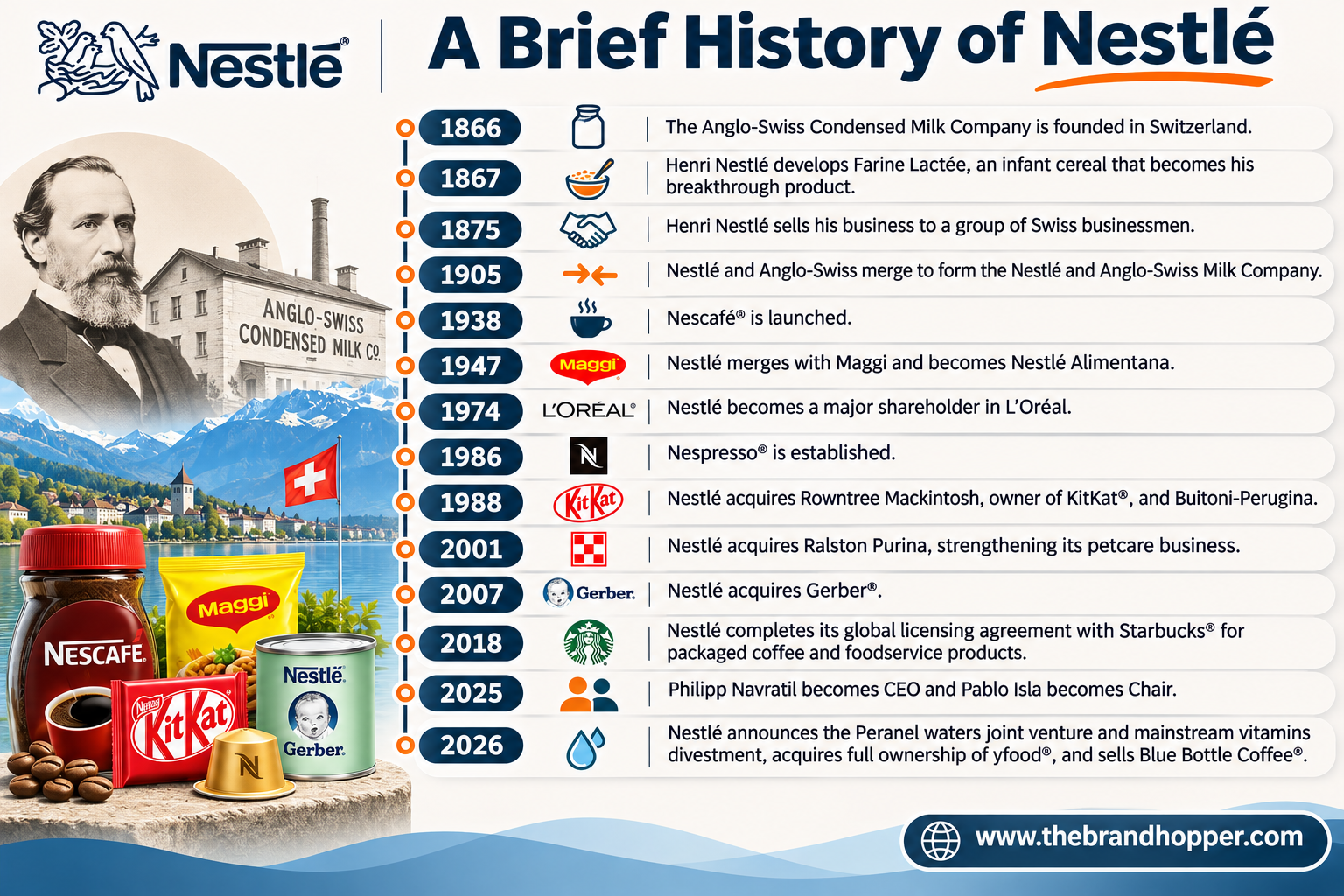
8. How to Invest in Nestlé
Because Nestlé is publicly traded, investors can purchase shares and become part-owners of the company.
Nestlé shares trade on the SIX Swiss Exchange under the ticker NESN. In the United States, investors can also access its American Depositary Receipts, which trade over the counter under the ticker NSRGY.
Nestlé is also included in various global, European, and dividend-focused investment funds and ETFs.
Indian investors can purchase shares of Nestlé India Limited through the NSE and BSE. However, Nestlé India is a separately listed subsidiary, so investing in it is not the same as directly purchasing shares of Nestlé S.A. in Switzerland.
As with any investment, investors should review current share prices, valuation, currency exposure, and financial performance before making a decision.
9. The Bottom Line
Nestlé is owned by its shareholders, not by a founding family, billionaire, or parent company. UBS Fund Management, BlackRock, and Capital Group are its largest disclosed shareholders, but none is identified as controlling the business.
The company is led by CEO Philipp Navratil and Chair Pablo Isla, who are overseeing a major strategic transformation. Nestlé is concentrating on Coffee, Petcare, Nutrition, and Food & Snacks while restructuring its waters, vitamins, and ice cream businesses.
Its portfolio continues to include globally recognized brands such as Nescafé, Nespresso, KitKat, Maggi, Purina, and Gerber. With operations in 185 countries and annual sales of CHF 89.5 billion in FY2025, Nestlé remains one of the most influential companies in the global food and beverage industry.
10. Frequently Asked Questions
Q: Who is the owner of Nestlé?
A: Nestlé has no single owner. Nestlé S.A. is a publicly traded Swiss company owned by its shareholders. Its largest disclosed shareholders include UBS Fund Management, BlackRock, and Capital Group.
Q: Is Nestlé owned by a family?
A: No. Nestlé is not a family-owned business. Henri Nestlé sold his business in 1875, and the company subsequently developed through mergers, public ownership, and international expansion.
Q: Who is the CEO of Nestlé?
A: Philipp Navratil has been CEO of Nestlé since September 1, 2025. He previously led Nespresso and held several senior positions within Nestlé’s global coffee business.
Q: Which country owns Nestlé?
A: Nestlé is a Swiss company headquartered in Vevey, Switzerland. It is not owned by the Swiss government or any other government; its shareholders are based around the world.
Q: What brands does Nestlé own?
A: Nestlé’s portfolio includes Nescafé, Nespresso, KitKat, Maggi, Milo, Nesquik, Purina, Friskies, Gerber, NAN, Coffee mate, S.Pellegrino, and Perrier, among many others.
Some products are sold under licensing or partnership agreements rather than being wholly owned brands. For example, Nestlé markets Starbucks-branded packaged coffee under a perpetual global licence.
Q: Does Nestlé own Starbucks?
A: No. Starbucks Corporation is a separate publicly traded US company. Nestlé acquired perpetual global rights to market Starbucks Consumer Packaged Goods and Foodservice products outside Starbucks coffee shops in 2018.
Q: Does Nestlé own L’Oréal?
A: No. Nestlé does not own L’Oréal outright. It holds approximately 20.2% of L’Oréal’s shares, making it the company’s second-largest shareholder after the Bettencourt Meyers family.
Q: How much does Nestlé make in a year?
A: Nestlé reported CHF 89.5 billion in sales and CHF 9.0 billion in net profit for FY2025. Its first nine months of 2026 generated CHF 65.9 billion in sales.
Q: Does Nestlé own Purina?
A: Yes. Purina is part of Nestlé’s Petcare business. Its portfolio includes Purina Pro Plan, Purina ONE, Friskies, Felix, Fancy Feast, and Tidy Cats.
Q: Does Nestlé own KitKat?
A: Yes. KitKat is part of Nestlé’s global confectionery portfolio. However, KitKat products in the United States are manufactured and marketed by The Hershey Company under licence.
Also Read: The Nestle Success Story and Key Factors Behind It
To read more content like this, subscribe to our newsletter
Go to the full page to view and submit the form.