



Nikon is one of the most famous names in photography, but the company behind NIKKOR lenses and Z-series mirrorless cameras is much larger than a camera manufacturer. Its businesses also include lithography systems used in semiconductor and flat-panel display production, microscopes, eye-care equipment, precision components and industrial metal 3D printers.
The question of who owns Nikon has become particularly interesting. EssilorLuxottica has become its largest disclosed shareholder, Nikon has reported a substantial annual loss, and a new CEO has started a five-year turnaround plan. In this guide, we explain who owns Nikon, who runs it, how its businesses are structured, how much it earns and what is happening to the company.

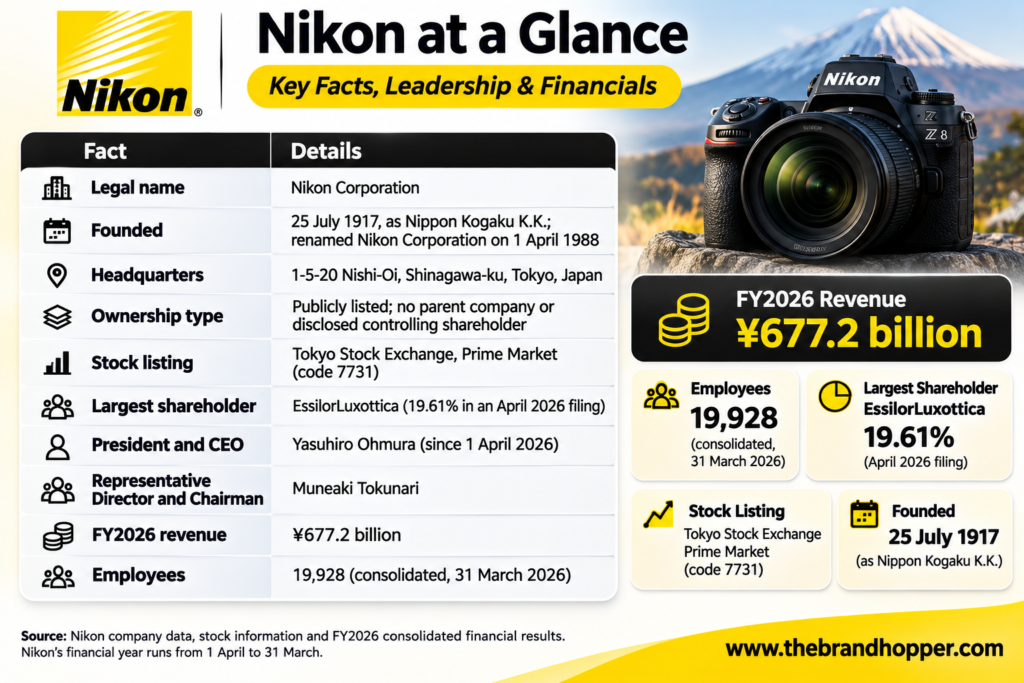
Who Owns Nikon? The Shareholder Breakdown
Nikon had 333,585,686 issued shares and 40,643 shareholders as of 31 March 2026. The following table lists the company’s largest shareholders at that date.
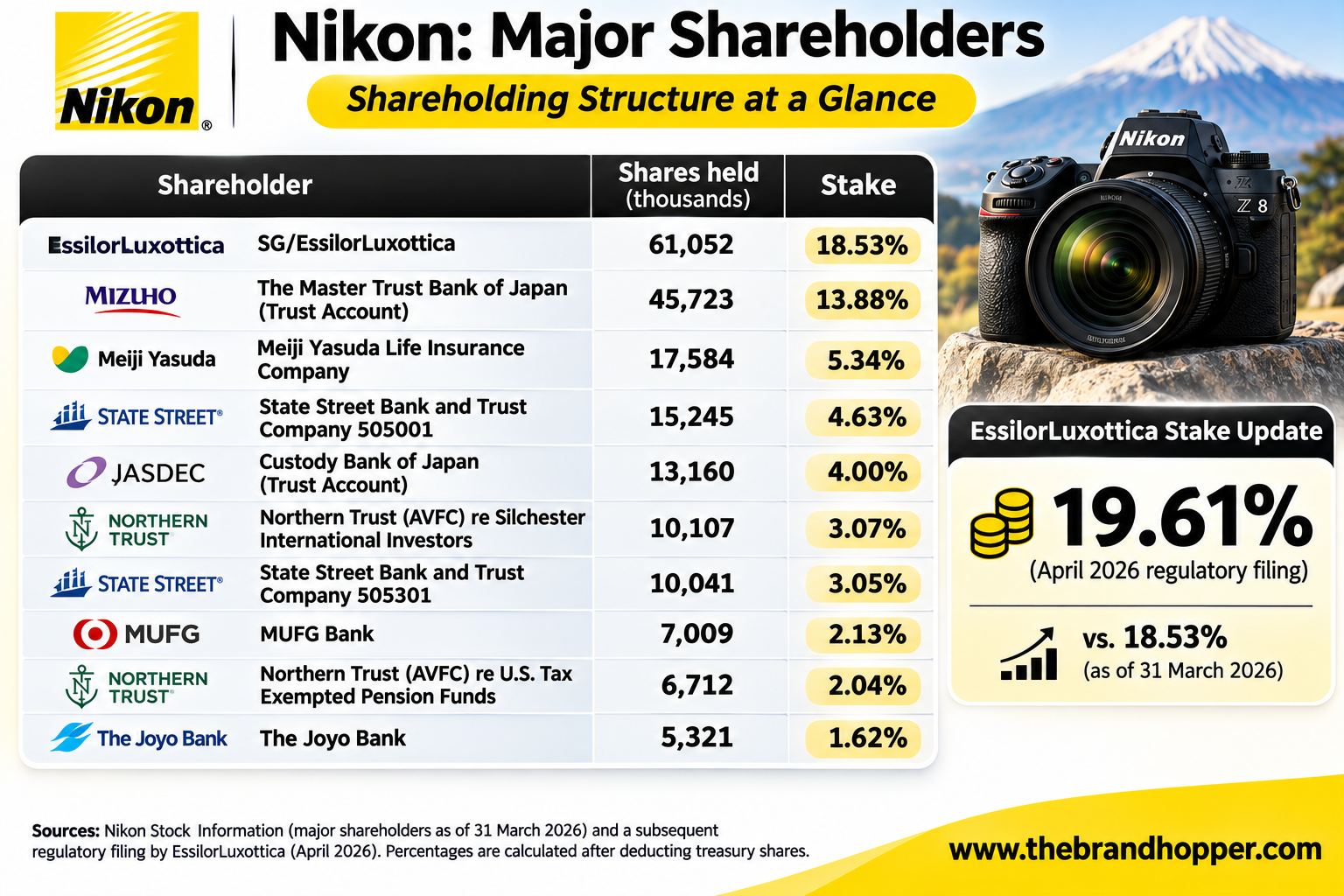
Two points help explain this table. First, The Master Trust Bank of Japan, Custody Bank of Japan, State Street and Northern Trust are institutional custodians or nominees. They hold shares on behalf of investment funds and other clients, so the names in the register do not necessarily identify the ultimate beneficial owners.
Second, Meiji Yasuda Life and MUFG Bank are long-standing Japanese financial institutions. Their presence reflects Nikon’s Japanese corporate and financial relationships, but their individual holdings do not give them control of the company.
EssilorLuxottica: Nikon’s biggest shareholder
The most important recent development in Nikon’s ownership is the rise of EssilorLuxottica, the international eyewear group behind Ray-Ban, Oakley and Essilor lenses. The two companies have also operated a 50:50 joint venture, Nikon-Essilor Co., Ltd., for Nikon-branded ophthalmic lenses since 2000.
EssilorLuxottica’s holding increased over time through share purchases. Nikon’s own shareholder register showed the group holding 18.53% at 31 March 2026, while a subsequent regulatory filing dated 14 April 2026 disclosed a holding of approximately 19.61%.
| Disclosure date | EssilorLuxottica stake in Nikon |
|---|---|
| 31 March 2026 | 18.53% in Nikon’s shareholder register |
| 14 April 2026 filing | 19.61% in a regulatory disclosure |
The two figures come from different disclosure dates and should not be treated as contradictory.
EssilorLuxottica’s investment has attracted attention because Nikon also operates in semiconductor lithography and other precision technologies. However, the reported shareholding alone does not establish that EssilorLuxottica controls Nikon or is seeking to acquire the company.
Is EssilorLuxottica buying Nikon? Speculation about a possible takeover has appeared in media coverage, but neither a takeover nor a change of control should be presented as an announced transaction. Based on the disclosed holding, EssilorLuxottica is Nikon’s largest shareholder, not its parent company.
The Mitsubishi connection
Nikon’s origins lie in the Mitsubishi group. The company was established in 1917 when three Japanese optical manufacturers were brought together to form Nippon Kogaku K.K., with backing from Koyata Iwasaki, then president of Mitsubishi.
Nikon retains historical links with the wider Mitsubishi business network, and Mitsubishi-affiliated financial institutions remain among its shareholders. However, those institutions hold minority stakes and do not collectively constitute a controlling parent company.
Bottom line on ownership: Nikon is owned by its shareholders. EssilorLuxottica is its largest disclosed shareholder, with a reported holding of just under 20%, but Nikon remains a separately listed company without a disclosed controlling shareholder.
Who Runs Nikon? Leadership and Governance
Nikon changed its leadership on 1 April 2026 as it began a new medium-term management plan. Yasuhiro Ohmura became Representative Director, President and CEO, having joined Nikon in 1992 and previously served as a senior executive and Chief Technology Officer.
Muneaki Tokunari became Representative Director and Chairman. Before joining Nikon’s leadership, Tokunari held senior roles at Mitsubishi Trust and Banking Corporation, now part of Mitsubishi UFJ Trust and Banking Corporation.


Toshikazu Umatate, Nikon’s former Chairman and CEO, moved to the position of Director following the April 2026 leadership change. Nikon’s board also includes independent external directors, with Takuya Nakata, Chairman of the Board of Yamaha Corporation, serving as Chairman of Nikon’s Board of Directors.
Nikon operates with an Audit and Supervisory Committee as part of its corporate governance structure. Its published governance information identifies independent external directors and committee members responsible for oversight.
Nikon’s Company Structure: Five Businesses
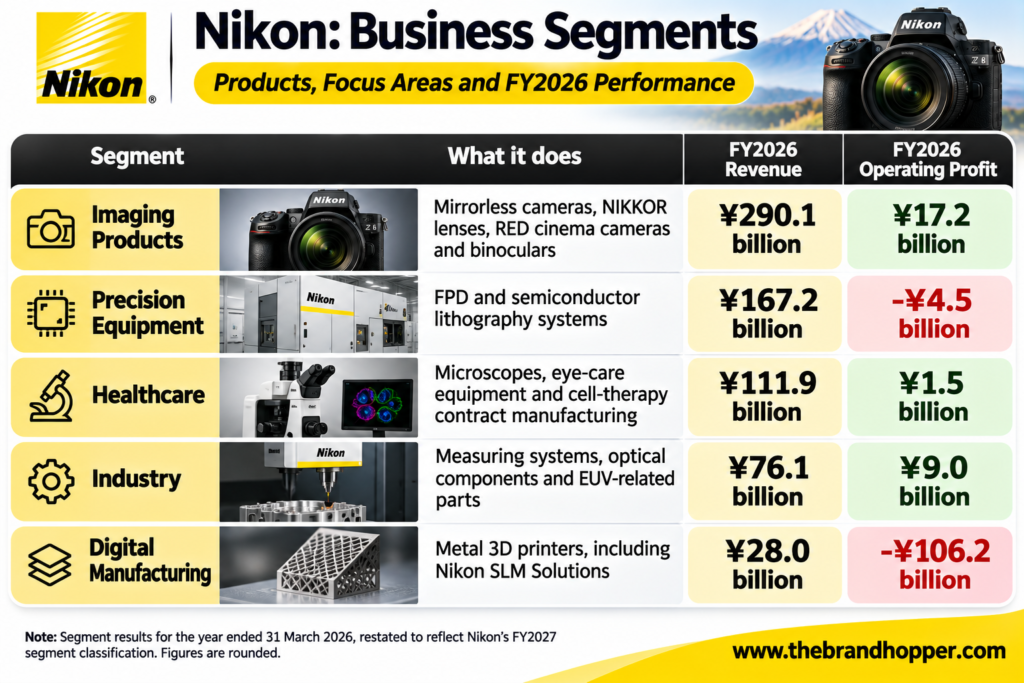
Nikon is organised into five reportable business segments: Imaging Products, Precision Equipment, Healthcare, Industry and Digital Manufacturing. From FY2027, the former Components Business was renamed the Industry Business, and Nikon Vision was transferred from Industry to Imaging Products.
The company has applied this reporting change retrospectively to FY2026, so the following figures use the revised segment classification.
Imaging Products
Imaging remains Nikon’s largest business and its best-known operation. It includes Z-series mirrorless cameras, NIKKOR lenses and RED Digital Cinema, the US cinema camera manufacturer acquired by Nikon in April 2024.
The Nikon ZR, introduced as Nikon’s first cinema camera under the Nikon brand, reflects the company’s effort to combine its imaging technology with RED’s cinema expertise. Nikon’s Imaging Products business recorded FY2026 revenue of ¥290.1 billion, although operating profit was affected by product mix, promotional expenses, tariffs and other costs.
Nikon also agreed to sell its UK-based robotic camera business, Mark Roberts Motion Control, as part of its portfolio adjustments. The transaction contributed one-time costs to the FY2026 results.
Precision Equipment
This business manufactures lithography systems that transfer circuit patterns onto semiconductor wafers and flat-panel display substrates. Its products serve the semiconductor and display manufacturing industries, where demand is influenced by technology investment cycles.
Precision Equipment had a difficult FY2026, reporting revenue of ¥167.2 billion and an operating loss of ¥4.5 billion. Nikon has since reported stronger first-half FY2027 performance, supported by higher sales of semiconductor lithography systems.
Nikon has also been developing digital lithography solutions for advanced semiconductor packaging. These systems are intended to address manufacturing requirements beyond conventional front-end wafer lithography.
Healthcare, Industry and Digital Manufacturing
Healthcare covers microscopes and life-science imaging, retinal imaging and eye-care equipment, as well as contract manufacturing for cell and gene therapies. The business generated FY2026 revenue of ¥111.9 billion and operating profit of ¥1.5 billion.
The Industry business supplies measuring systems, precision optical components and other industrial products, including components related to EUV lithography. It reported FY2026 revenue of ¥76.1 billion and operating profit of ¥9.0 billion.
Digital Manufacturing is built around Nikon SLM Solutions, the German metal 3D-printing company that became a wholly owned Nikon subsidiary in 2023. The business was the main source of Nikon’s FY2026 loss, after the company recorded substantial impairment charges against assets in the metal additive manufacturing operation.
How Much Does Nikon Make? Financial Performance
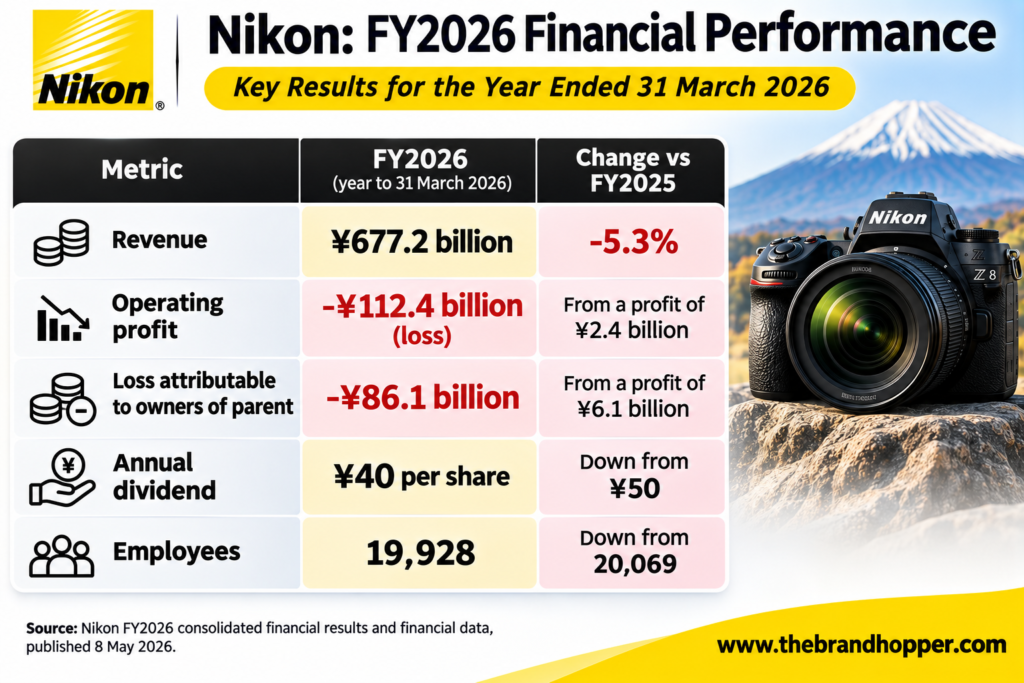
FY2026 was a particularly difficult year for Nikon. Revenue fell 5.3% to ¥677.2 billion, while the company recorded an operating loss of ¥112.4 billion and a net loss attributable to owners of the parent of ¥86.1 billion.
The main reason was the impairment of assets in Digital Manufacturing. Nikon recorded an impairment loss of approximately ¥90.6 billion in that business, alongside other one-time costs and weaker performance in parts of its operations.
The turnaround in 2026
Nikon’s first-half FY2027 results, published on 5 November 2026, showed a return to operating profitability. For the six months ended 30 September 2026, revenue increased 6.9% year on year to ¥334.6 billion, operating profit was ¥8.9 billion and profit attributable to owners of the parent was ¥10.6 billion.
Following its latest results, Nikon revised its FY2027 forecast. It now expects revenue of ¥722 billion, operating profit of ¥16.5 billion and profit attributable to owners of the parent of ¥16 billion for the year ending 31 March 2027.
The recovery is uneven across businesses. Imaging Products revenue declined to ¥129.3 billion in the first half, mainly because of weaker demand, particularly in China. Precision Equipment, Healthcare and Industry delivered stronger performance, while Digital Manufacturing continued to report an operating loss.
Nikon’s 2030 targets
Under its FY2026-2030 Medium-Term Management Plan, announced in May 2026, Nikon aims to reach revenue of ¥1 trillion, operating profit of ¥80 billion, company-wide return on invested capital of 7% and return on equity of 10% by FY2030.
The plan places greater emphasis on financial discipline and investment in businesses with the potential to create sustainable value. Imaging, Healthcare and Industry are expected to generate stable profits, while Precision Equipment and Digital Manufacturing are positioned as areas for pursuing additional corporate value.
A Brief History of Nikon
| Year | Milestone |
|---|---|
| 1917 | Nippon Kogaku K.K. founded in Tokyo with Mitsubishi backing |
| 1959 | Nikon F single-lens reflex camera launched |
| 1988 | Company renamed Nikon Corporation |
| 1999 | Nikon D1 professional digital SLR launched |
| 2000 | Nikon-Essilor joint venture for eyeglass lenses established |
| 2018 | Nikon enters the full-frame mirrorless market with the Z system |
| 2023 | SLM Solutions becomes a wholly owned subsidiary |
| 2024 | RED Digital Cinema acquired; Nikon’s headquarters moves to Nishi-Oi, Shinagawa |
| 2025 | EssilorLuxottica increases its stake and becomes Nikon’s largest shareholder |
| 2026 | Nikon reports a substantial annual loss; Yasuhiro Ohmura becomes CEO and the new medium-term plan begins |
How to Invest in Nikon
Nikon shares trade on the Prime Market of the Tokyo Stock Exchange under the code 7731. Investors outside Japan can access the shares through brokerage platforms that offer trading in Japanese-listed securities.
Indian residents considering overseas investment should check the applicable Reserve Bank of India Liberalised Remittance Scheme rules, annual limits, tax reporting requirements and the charges imposed by their broker. Availability and transaction costs vary by platform.
Nikon pays dividends to shareholders, but the amount can change from year to year. It paid an annual dividend of ¥40 per share for FY2026 and forecast a total annual dividend of ¥20 per share for FY2027, subject to the company’s stated outlook and applicable approvals.
As with any overseas investment, investors should review Nikon’s latest financial results, currency exposure and business risks before making a decision.
The Bottom Line
Nikon is owned by its shareholders, not by any single parent company. EssilorLuxottica is its largest disclosed shareholder, with a reported 19.61% stake in April 2026, followed by Japanese institutional investors and financial institutions.
Under CEO Yasuhiro Ohmura, the company is working to recover from its FY2026 loss and improve profitability across its five businesses. Its medium-term strategy focuses on imaging, precision equipment, healthcare, industrial technologies and metal 3D printing, with a target of reaching ¥1 trillion in revenue by FY2030.
Frequently Asked Questions
Q: Who is the owner of Nikon?
A: Nikon has no single owner. Nikon Corporation is a publicly traded Japanese company, and its largest disclosed shareholder is EssilorLuxottica, which reported a 19.61% stake in April 2026.
Q: Does EssilorLuxottica own Nikon?
A: No. EssilorLuxottica is Nikon’s largest shareholder, with a reported holding of just under 20%, but it is not Nikon’s parent company and does not have a disclosed controlling stake.
Q: Is Nikon part of Mitsubishi?
A: Nikon was founded in 1917 with backing from Mitsubishi’s Koyata Iwasaki. It retains historical links with the Mitsubishi business network, but Mitsubishi companies do not own a controlling stake in Nikon.
Q: Who is the CEO of Nikon?
A: Yasuhiro Ohmura has been Nikon’s Representative Director, President and CEO since 1 April 2026. He joined the company in 1992 and previously held senior technical and management roles.
Q: Is Nikon a Japanese company?
A: Yes. Nikon Corporation is headquartered in Shinagawa, Tokyo, Japan, and is listed on the Tokyo Stock Exchange.
Q: Does Nikon own RED?
A: Yes. Nikon acquired 100% of US cinema camera manufacturer RED.com, LLC in April 2024. RED is now part of the Nikon group.
Q: Is Nikon still making cameras?
A: Yes. Imaging Products remains Nikon’s largest business segment, generating FY2026 revenue of ¥290.1 billion from cameras, lenses, RED cinema products and related imaging operations.
Q: Why did Nikon post a loss?
A: Nikon’s FY2026 operating loss was mainly driven by impairment charges in its Digital Manufacturing business, including a substantial write-down of assets related to metal 3D printing. Weaker performance in other businesses and additional one-time costs also affected the results.
Nikon returned to operating profitability in the first half of FY2027, reporting operating profit of ¥8.9 billion for the six months ended 30 September 2026.
Also Read: Canon vs Nikon: Which Camera Brand Wins?
To read more content like this, subscribe to our newsletter
Go to the full page to view and submit the form.