


Few companies blur the line between “publicly owned” and “founder controlled” quite like Tesla.
On paper, it’s a widely held public corporation with thousands of institutional and retail shareholders and a board that answers to them.
In practice, one man’s name, reputation, and pay package dominate every conversation about who really runs the show. Here’s the complete, FY2025-grounded breakdown of who owns Tesla, how Elon Musk built his stake, what the board looks like, and why Tesla’s ownership story has become one of the most closely watched governance sagas in corporate America.
Who Really Founded Tesla? It Wasn’t Elon Musk
Contrary to popular belief, Elon Musk did not start Tesla.
The company was founded in July 2003 by engineers Martin Eberhard and Marc Tarpenning, who set out to build a company dedicated to proving that electric vehicles could be genuinely desirable, not just practical.


Musk entered the picture in 2004, leading a $7.5 million Series A funding round with a personal investment of $6.5 million and joining as chairman of the board; he would go on to contribute more than $30 million to the company in its early years.
Eberhard served as Tesla’s first CEO, but a mix of financial strain, cost overruns on the original Roadster, and boardroom disputes led to his departure in 2007.
After a brief interim period, Musk took over as CEO in October 2008 — technically Tesla’s fourth chief executive — and has run the company ever since, weathering the 2008 financial crisis with a personal loan to keep Tesla solvent just days before its first Roadster deliveries.
Elon Musk’s Stake: How It Grew to Roughly 20%
Musk’s ownership position has shifted dramatically over the years, largely through Tesla-granted stock option packages tied to ambitious performance milestones rather than simple open-market buying.

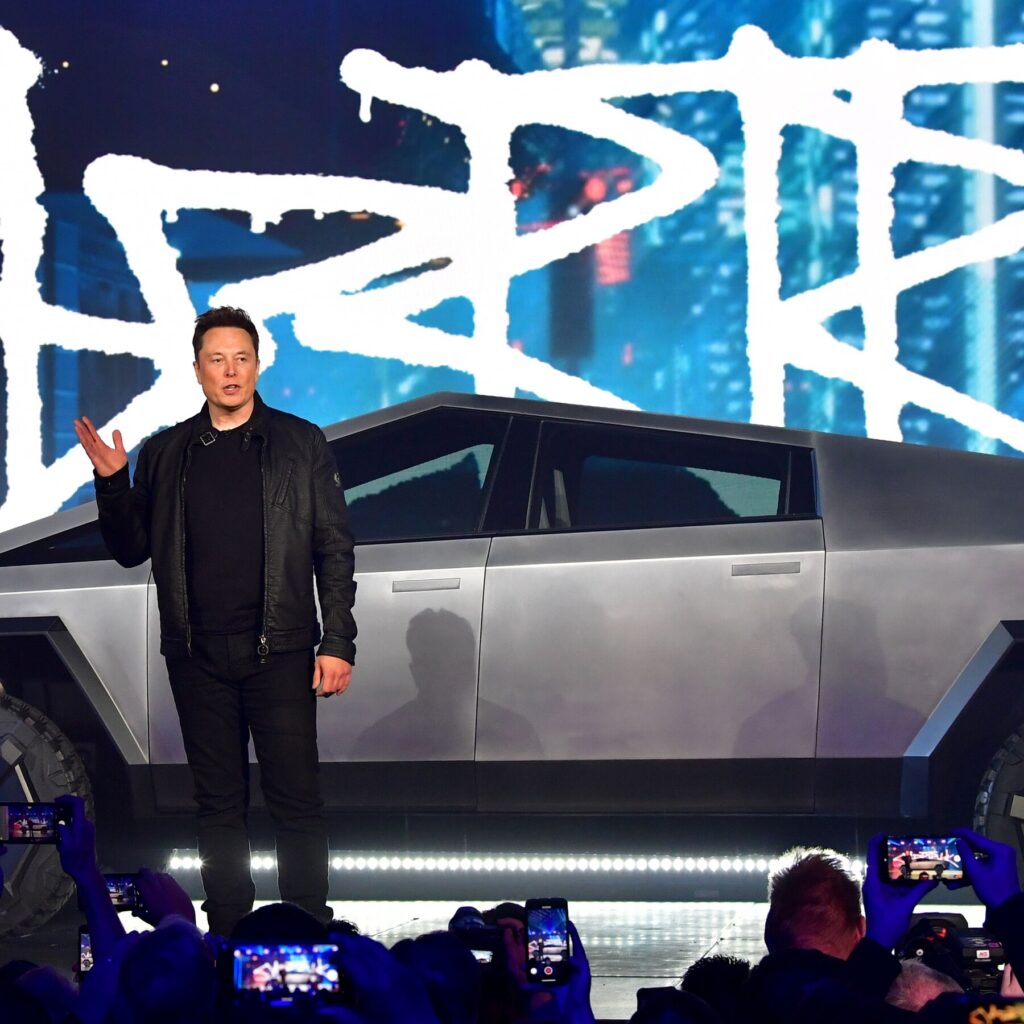
His current stake of approximately 19.9-20% of Tesla’s outstanding shares — worth roughly $200 billion at recent valuations — makes him comfortably the largest single shareholder, individual or institutional.
That stake grew substantially in June 2026, when Musk exercised 303.9 million stock options originating from his controversial 2018 compensation package, after the Delaware Supreme Court’s December 2025 ruling cleared the way for those options to be honored.
Because Tesla maintains a single-class share structure in which every share carries exactly one vote, Musk’s ~20% stake does not, by itself, hand him legal majority control of the company the way dual-class structures do for founders at companies like Meta or Alphabet.
Even so, his combination of large minority ownership, sole-CEO authority, and cult-of-personality public profile gives him practical influence that dwarfs what his voting percentage alone would suggest.
The $56 Billion Pay Package That Became a Legal Saga
No discussion of Tesla ownership is complete without the 2018 pay package, one of the largest and most contested executive compensation deals in corporate history.
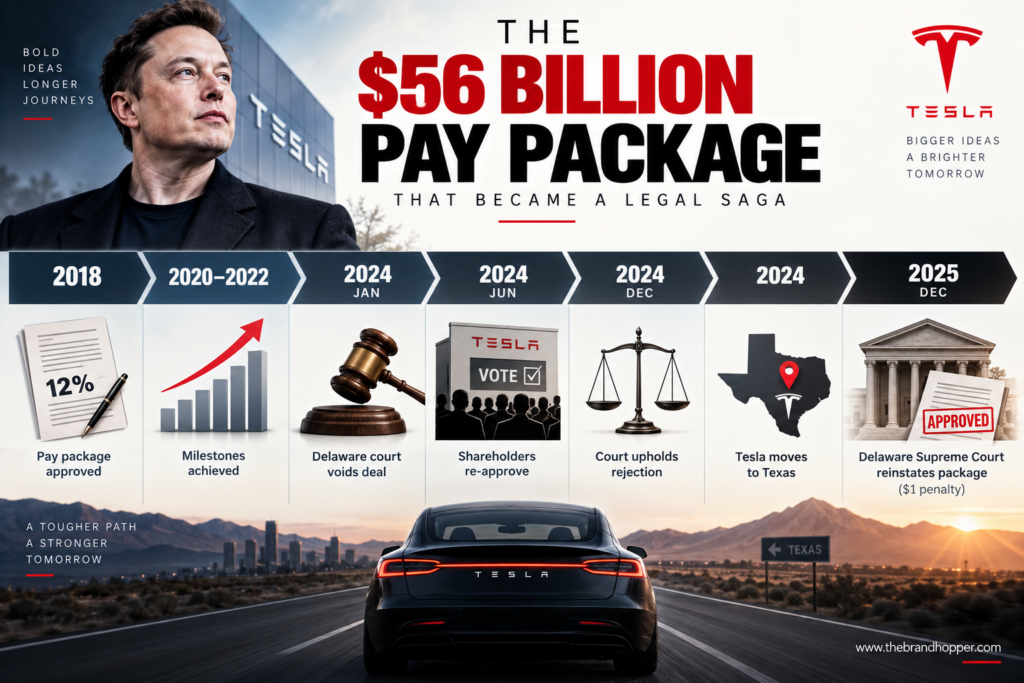
Under the original 2018 grant, Musk received stock options equal to roughly 12% of Tesla’s then-outstanding shares, structured to vest only if Tesla hit a staggering series of market capitalization and operational milestones, ultimately requiring the company’s valuation to grow twelvefold from about $50 billion to $600 billion.
Tesla shareholders initially approved the package, and by the time all tranches vested, it was worth an estimated $55-56 billion. A Tesla shareholder lawsuit challenged the package as improperly negotiated, and in January 2024, Delaware Chancery Court Judge Kathaleen McCormick sided with the plaintiff and voided the deal, ruling the approval process was tainted by Musk’s close ties to the board.
Tesla shareholders then re-approved the same package at the company’s June 2024 annual meeting in an attempt to cure the legal defect, but Judge McCormick upheld her original rejection in December 2024 regardless.
The saga finally resolved in Tesla’s favor on December 19, 2025, when the Delaware Supreme Court reversed the Chancery Court and reinstated the full pay package — though the justices still penalized Musk symbolically, ordering him to pay $1 plus attorneys’ fees given how flawed the original approval process had been.
Partly in response to the years-long fight, Tesla moved its corporate registration from Delaware to Texas in 2024, a jurisdiction widely seen as more management-friendly.

The New 2026 Pay Package: Up to $1 Trillion
Just as the 2018 saga concluded, Tesla shareholders approved an even larger successor package in 2026, potentially worth as much as $1 trillion in stock if Musk hits a new set of extraordinarily ambitious milestones spanning Tesla’s market capitalization, vehicle deliveries, robotaxi deployment, and profitability targets.
If fully achieved, the award could dilute existing shareholders by up to roughly 12% and would push Musk’s total ownership stake meaningfully higher than its current ~20% level.
Supporters framed the package as necessary to keep Musk focused on Tesla rather than his other ventures (SpaceX, xAI, Neuralink, and The Boring Company); critics, including several large pension funds and governance advisory firms, argued it represented an extreme transfer of shareholder value to a single executive with limited accountability.
Institutional Ownership: Vanguard, BlackRock, and State Street
Beyond Musk, Tesla’s shareholder base looks much like that of any other large-cap public company, dominated by the same handful of giant passive and active asset managers that appear atop most S&P 500 companies.
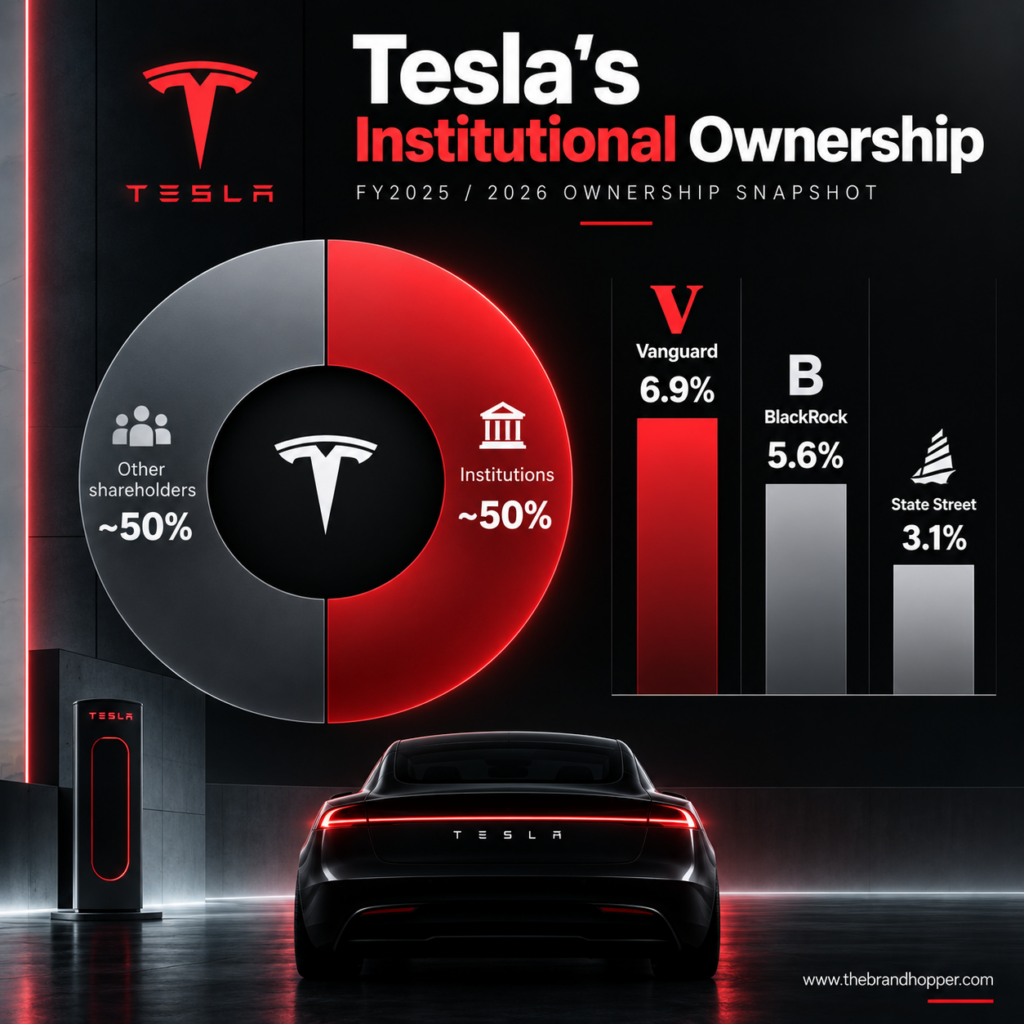
The Vanguard Group holds approximately 6.9% of Tesla shares, primarily through its index and actively managed funds, followed by BlackRock at roughly 5.6% and State Street Global Advisors at about 3.1%.
Collectively, institutional investors — including mutual funds, pension funds, hedge funds, and sovereign wealth vehicles — own roughly half of Tesla’s outstanding shares, with the remainder split between Musk, other insiders, and a very large base of individual retail investors who have made TSLA one of the most widely held retail stocks in the world.
Tesla’s Board of Directors and Governance
Tesla’s board is chaired by Robyn Denholm, an Australian former telecommunications executive who joined Tesla’s board in 2014 and was named chair in November 2018 as part of Musk’s settlement with the U.S. Securities and Exchange Commission over his infamous “funding secured” tweet about taking Tesla private.


That settlement required Musk to pay a $20 million personal fine, required Tesla to pay a separate $20 million corporate fine, and barred Musk from serving as board chairman for at least three years, prompting Denholm’s appointment as an independent counterweight.
Musk has remained CEO throughout, and the board itself came under fire in a related shareholder lawsuit alleging directors were overpaid by close to $1 billion in stock-based compensation over several years — a claim Tesla’s board agreed to partially unwind.
Despite the governance controversies, shareholders have repeatedly voted to keep the existing board and pay structures in place, reflecting how strongly many Tesla investors continue to back Musk’s leadership regardless of criticism from governance watchdogs.
Tesla’s FY2025 Financial Performance
Tesla’s FY2025 results reflected a company in transition. Full-year revenue came in at $94.83 billion, down roughly 3% (about $2.86 billion) from FY2024, driven primarily by softer vehicle deliveries and lower average selling prices as Tesla leaned on customer incentives amid intensifying EV competition.
Net income attributable to common stockholders fell more sharply, dropping to $3.79 billion — a decline of about $3.30 billion year-over-year — while GAAP earnings per share collapsed 47% to $1.08.
Vehicle deliveries for the full year totaled 1,636,129 units, down 8.6% from the prior year, as Tesla faced increased competition from Chinese EV makers, most notably BYD, which overtook Tesla in 2025 as the world’s largest EV seller by units with roughly 2.26 million deliveries.
Not every part of the business struggled, though: Tesla’s energy generation and storage segment, powered by growing Megapack and Powerwall deployments, posted strong growth and partially offset softness in the core automotive business, while the company continued expanding its Robotaxi service following its June 2025 launch.
Tesla’s Market Value in 2026
Despite the softer FY2025 operating results, Tesla’s market capitalization has remained enormous, reflecting investor confidence in the company’s longer-term bets on autonomous driving, robotics, and energy storage rather than near-term vehicle sales alone.
As of mid-2026, Tesla’s market cap stood at approximately $1.27 trillion, with shares trading around $400, making it one of the most valuable companies in the world by market capitalization even as its core automotive revenue softened.
That valuation gap — a shrinking core business paired with a still-massive market cap — is central to why Musk’s ownership stake, and the incentive packages tied to Tesla’s valuation milestones, carry such enormous dollar figures relative to the company’s current profitability.
Why Tesla’s Ownership Structure Matters for Investors
Tesla’s single-class share structure is, in theory, more shareholder-friendly than the dual-class structures used by companies like Meta, Alphabet, or Ford, since it denies any individual outsized voting power disconnected from economic ownership.
In practice, however, Musk’s combination of large minority ownership, singular public profile, and now a potential $1 trillion pay package means Tesla’s governance functions less like a conventional widely held public company and more like a founder-led enterprise, even though Musk isn’t technically a founder at all.
For investors, this means Tesla-specific risk is unusually concentrated in one individual’s decisions, statements, and attention — a dynamic that has repeatedly moved Tesla’s stock price on Musk’s tweets, side ventures, and political activities far more than on quarterly delivery numbers alone.
Tesla Ownership at a Glance (FY2025)
| Category | Detail |
| Founded | July 2003 (San Carlos, California) |
| Founders | Martin Eberhard and Marc Tarpenning |
| Largest individual shareholder | Elon Musk (~19.9-20% of outstanding shares) |
| Company structure | Publicly traded, single-class shares (one vote per share) |
| Stock listing | NASDAQ: TSLA |
| Top institutional shareholders | Vanguard (~6.9%), BlackRock (~5.6%), State Street (~3.1%) |
| CEO | Elon Musk (since October 2008) |
| Board chair | Robyn Denholm (since November 2018) |
| Headquarters | Austin, Texas |
| FY2025 revenue | $94.83 billion (-3% YoY) |
| FY2025 net income | $3.79 billion (attributable to common stockholders) |
| FY2025 vehicle deliveries | 1,636,129 units (-8.6% YoY) |
| 2026 market capitalization | ~$1.27 trillion |
Key Takeaways
Tesla’s ownership story in 2026 is really the story of how one non-founder became so central to a public company’s identity that shareholders have twice approved multi-billion-dollar (and now trillion-dollar-scale) pay packages just to keep him engaged.
Elon Musk’s roughly 20% stake, reinforced by the reinstated 2018 options and the newly approved 2026 package, sits atop a conventional institutional shareholder base led by Vanguard, BlackRock, and State Street, all operating under a single-class, one-vote-per-share structure that limits Musk’s legal control even as his practical influence remains unmatched.
Meanwhile, Tesla’s FY2025 fundamentals — $94.83 billion in revenue, $3.79 billion in net income, and 1.64 million vehicle deliveries, all down year-over-year amid rising Chinese EV competition — show a company whose soaring valuation increasingly rests on future bets in autonomous driving and energy storage rather than current-year car sales.
Frequently Asked Questions
Q: Who is the largest shareholder of Tesla?
A: Elon Musk is Tesla’s largest individual shareholder, owning approximately 19.9-20% of outstanding shares as of 2026, following his June 2026 exercise of 303.9 million stock options from his reinstated 2018 pay package.
Q: Does Elon Musk have majority control of Tesla?
A: No. Tesla uses a single-class, one-share-one-vote structure, so Musk’s roughly 20% stake does not give him legal majority voting control, unlike founders at dual-class companies such as Meta or Alphabet.
Q: Who founded Tesla?
A: Tesla was founded in July 2003 by engineers Martin Eberhard and Marc Tarpenning. Elon Musk joined in 2004 as chairman and lead investor and became CEO in October 2008, Tesla’s fourth chief executive.
Q: What happened to Elon Musk’s $56 billion Tesla pay package?
A: A Delaware Chancery Court voided the 2018 package in January 2024 after a shareholder lawsuit, but the Delaware Supreme Court reversed that decision in December 2025 and fully reinstated it, while still fining Musk symbolically.
Q: Who are Tesla’s other major shareholders?
A: Beyond Musk, Tesla’s largest institutional shareholders are The Vanguard Group (~6.9%), BlackRock (~5.6%), and State Street Global Advisors (~3.1%), with institutions collectively owning roughly half the company.
Q: Who chairs Tesla’s board of directors?
A: Robyn Denholm has chaired Tesla’s board since November 2018, when she replaced Musk as chairman as part of his settlement with the SEC over his “funding secured” tweet controversy.
Q: What was Tesla’s revenue in FY2025?
A: Tesla reported FY2025 revenue of $94.83 billion, down about 3% from FY2024, with net income attributable to common stockholders of $3.79 billion.
Q: Is Tesla still growing?
A: Core vehicle deliveries declined 8.6% in FY2025 to 1,636,129 units amid rising competition from BYD and other Chinese automakers, but Tesla’s energy storage business and Robotaxi service both continued to expand.
Also Read: Tesla vs BYD: Who Is Winning the EV Race? (2026)
To read more content like this, subscribe to our newsletter
Go to the full page to view and submit the form.