


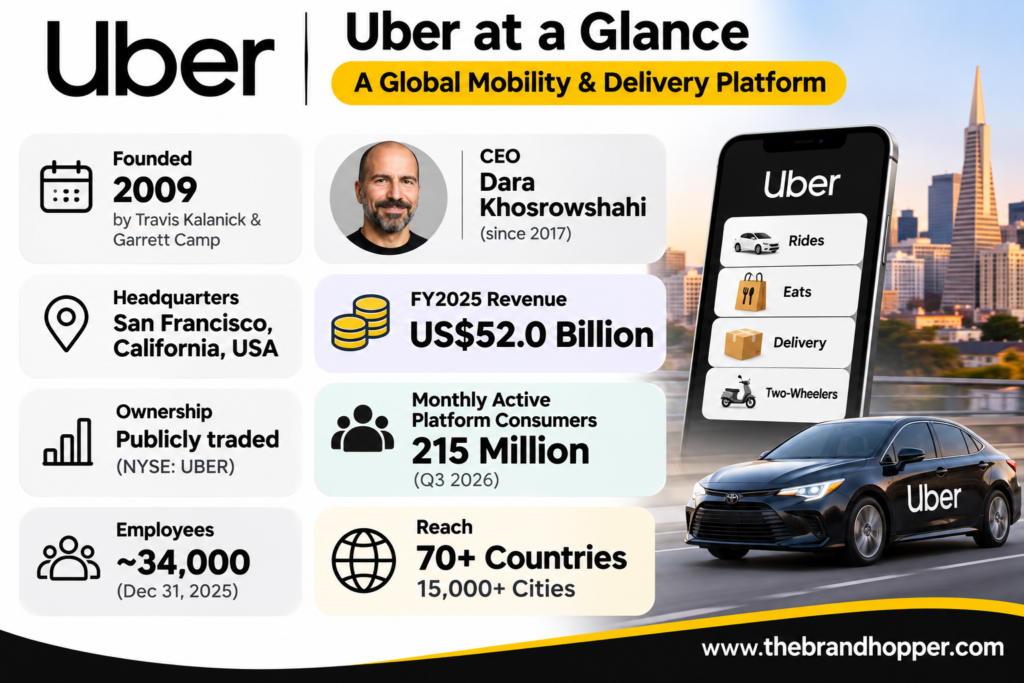
Uber is the world’s best-known ride-hailing app, but it is also one of the largest food-delivery and freight platforms in the world. In 2025, people completed more than 13.5 billion trips on Uber, and the company generated over US$52 billion in revenue. So who actually owns this giant, and who are the investors behind it?
The answer has changed considerably since Uber’s early days, when its founders and venture capital firms played a major role in its ownership. Today, Uber is a publicly traded company whose shares are held largely by institutional investors, including asset managers, pension funds, and investment funds.
In this guide, we explain who owns Uber, its largest disclosed shareholders, who runs it, how much money it makes, which companies Uber itself has invested in, and its biggest strategic move of 2026: the proposed takeover of Germany’s Delivery Hero.

Who Owns Uber? The Major Shareholders
Uber had 2,042,946,343 shares of common stock outstanding on March 2, 2026. Each share carries one vote, and the company does not have a dual-class share structure that gives its founders special super-voting rights.
In the United States, investors who beneficially own more than 5% of a public company generally have to disclose their holdings under SEC reporting rules. Uber’s 2026 proxy statement identified three institutional investors above this threshold.
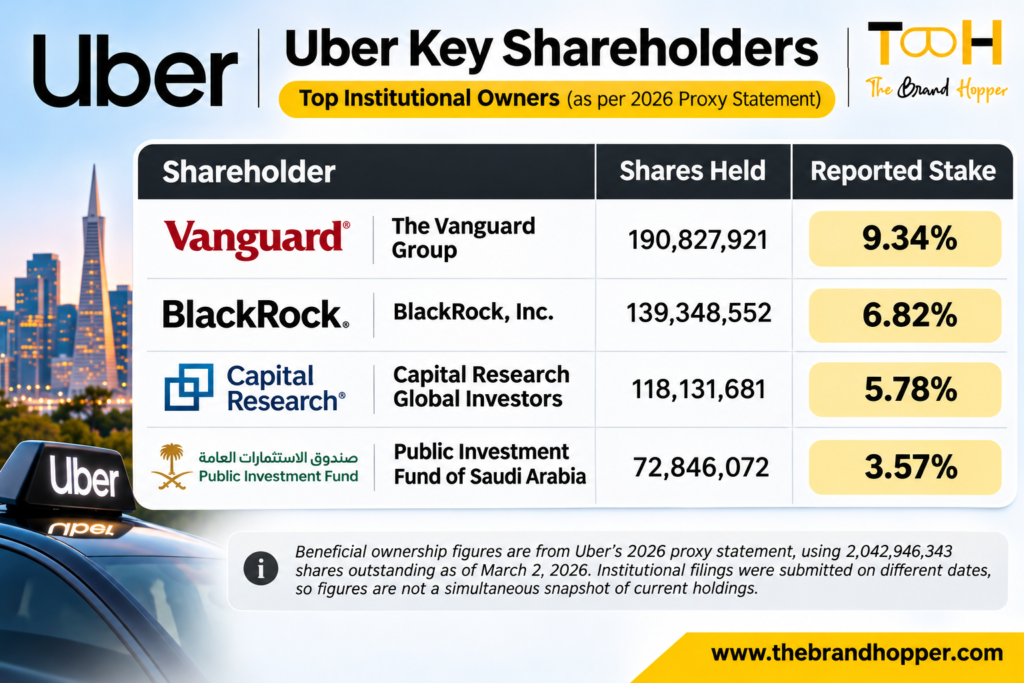
These figures need some context. Vanguard, BlackRock, and Capital Group are asset managers that hold Uber shares on behalf of investors through index funds, ETFs, mutual funds, and retirement accounts.
They do not directly run Uber, and their combined reported ownership does not give any one of them control of the company. A subsequent filing by Vanguard Capital Management reported a 7.53% beneficial ownership position as of March 31, 2026, illustrating why institutional ownership figures need to be read alongside their filing dates and reporting entities.
Saudi Arabia’s Public Investment Fund
Saudi Arabia’s sovereign wealth fund, the Public Investment Fund (PIF), became one of Uber’s major backers when it invested US$3.5 billion in the company in 2016. The investment was one of the largest private funding transactions in Uber’s history.
Uber’s 2026 proxy statement reported approximately 72.8 million shares, or 3.57%, as beneficially owned by board member Turqi Alnowaiser. He is the PIF’s Deputy Governor and Head of its International Investments Division, and represents the fund’s interests on Uber’s board.
What happened to the founders and early investors?
Uber was founded by Travis Kalanick and Garrett Camp. Kalanick served as CEO until 2017, when he resigned amid investor pressure following a series of controversies and management challenges.

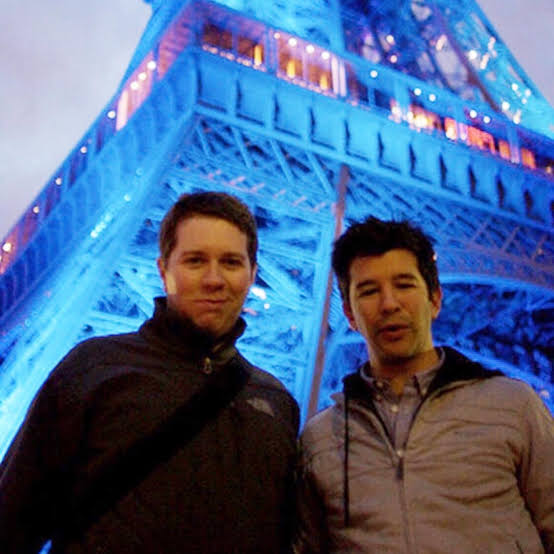
He subsequently sold a substantial portion of his Uber holdings after the company’s 2019 IPO and left its board at the end of 2019. Early backers such as Benchmark Capital and SoftBank, which became a major shareholder in 2018, have also reduced or exited their positions over time.
Neither founder nor the early venture capital firms appear among the three institutional investors above the 5% threshold identified in Uber’s 2026 proxy statement. This does not, by itself, establish that every founder or early investor has sold all their shares.
How much do Uber’s directors and executives own?
Uber’s 2026 proxy statement reported that its current directors and executive officers collectively beneficially owned approximately 3.81% of the company. However, almost all of this figure is attributable to the shares associated with PIF representative Turqi Alnowaiser.
CEO Dara Khosrowshahi beneficially owned approximately 2.38 million shares, including shares held directly, restricted stock units, and exercisable options. This represented less than 1% of Uber’s outstanding shares.
Bottom line on ownership: Uber is owned by its shareholders. Vanguard, BlackRock, and Capital Research Global Investors are its largest disclosed institutional holders, while Saudi Arabia’s PIF has a notable minority investment and board representation. No single shareholder has overall control of the company.
Who Runs Uber? Leadership and Board
Dara Khosrowshahi, the former CEO of Expedia, has led Uber since 2017. He took over after Kalanick’s departure, steered the company through its 2019 IPO, and helped transform it from a loss-making start-up into a business reporting sustained operating profitability.

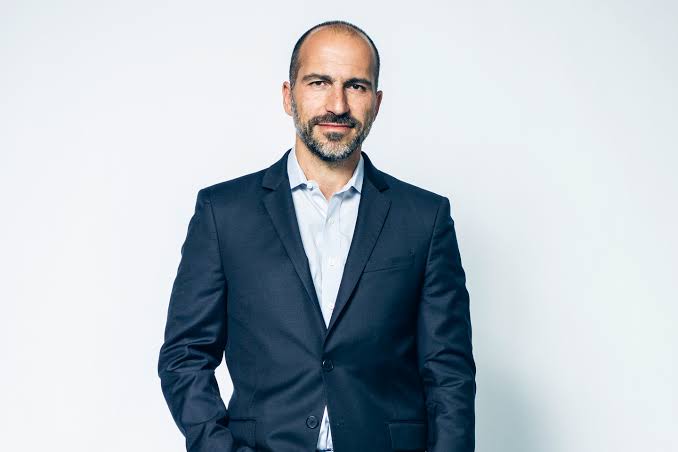
In February 2026, Uber appointed Balaji Krishnamurthy, a long-time company executive who had led strategic finance and investor relations, as Chief Financial Officer. He succeeded Prashanth Mahendra-Rajah, who served as CFO until February 2026.
In May 2026, Jill Hazelbaker became President and Chief Corporate Affairs Officer, taking on additional responsibilities following the departure of Chief People Officer Nikki Krishnamurthy. Other senior leaders include Andrew Macdonald, President and Chief Operating Officer.
Uber’s board is led by independent Chair Ronald Sugar, the former CEO of Northrop Grumman. Directors include Ursula Burns, Nikesh Arora, Revathi Advaithi, Robert Eckert, Amanda Ginsberg, John Thain, David Trujillo, Alexander Wynaendts, and the PIF’s Turqi Alnowaiser.
Uber’s directors are elected annually by shareholders. The board oversees the company’s strategy, executive leadership, corporate governance, and major business decisions.
How Big Is Uber? Financial Performance
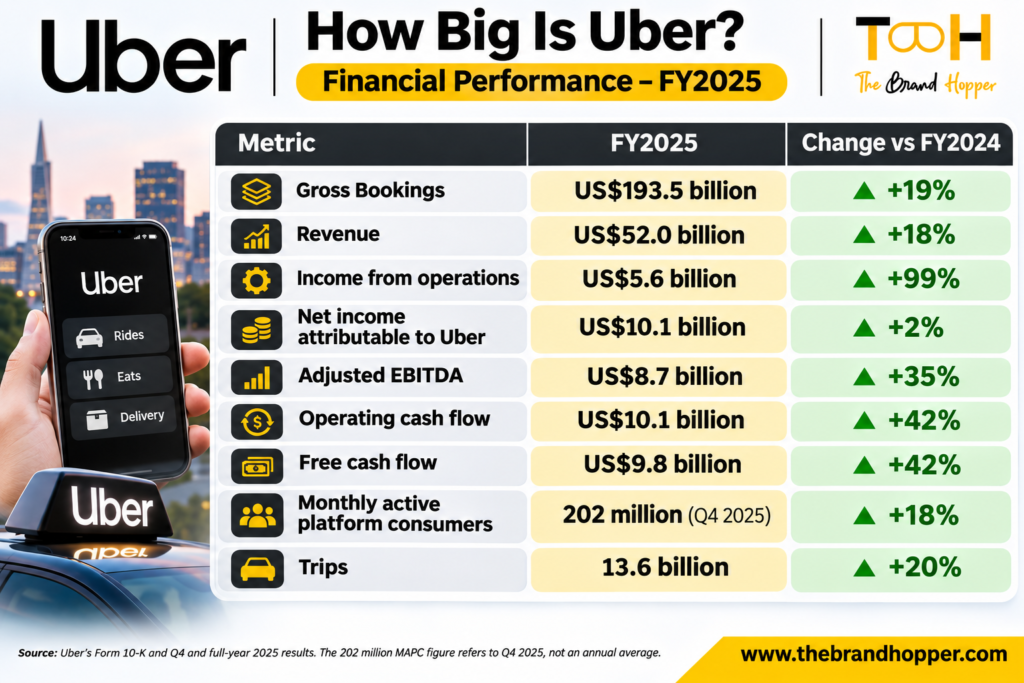
Uber has transformed from a famously loss-making start-up into a company generating substantial operating profits and cash flow. Its FY2025 net income was US$10.1 billion, although this figure included a US$5.0 billion benefit from the release of a tax valuation allowance.
The company’s underlying operating performance also improved considerably. Income from operations nearly doubled to US$5.6 billion, while Adjusted EBITDA increased 35% to US$8.7 billion.
The latest quarter
Growth continued in 2026. In the third quarter of 2026, Uber’s Gross Bookings increased 20% year over year to US$59.8 billion, while trips rose 16% to approximately 4.1 billion.
Monthly Active Platform Consumers reached 215 million, up 14% year over year. Revenue increased 10% to US$14.8 billion, although changes in Uber’s business model negatively affected reported revenue growth by approximately eight percentage points.
GAAP income from operations increased 30% to US$1.4 billion, while Adjusted EBITDA rose 31% to US$3.0 billion. Non-GAAP operating income increased 38% to US$2.3 billion.
Uber expects fourth-quarter 2026 Gross Bookings of US$63.25 billion to US$65.25 billion. Its outlook also includes non-GAAP EPS of US$0.95 to US$0.99.
Uber’s three businesses
| Segment | Q3 2026 Gross Bookings | Q3 2026 revenue |
|---|---|---|
| Mobility (rides) | US$29.5 billion (+18%) | US$7.5 billion |
| Delivery (Uber Eats, grocery and retail) | US$28.5 billion (+22%) | US$5.5 billion |
| Freight (Uber Freight) | US$1.8 billion (+35%) | US$1.8 billion |
Source: Uber Q3 2026 results release, November 4, 2026. Figures are rounded.
Uber as an Investor: Companies Uber Owns Stakes In
Uber is not just owned by investors; it is also a significant investor in other companies. Over the years, it has exchanged regional businesses for equity stakes and invested in autonomous-driving, delivery, and mobility companies.

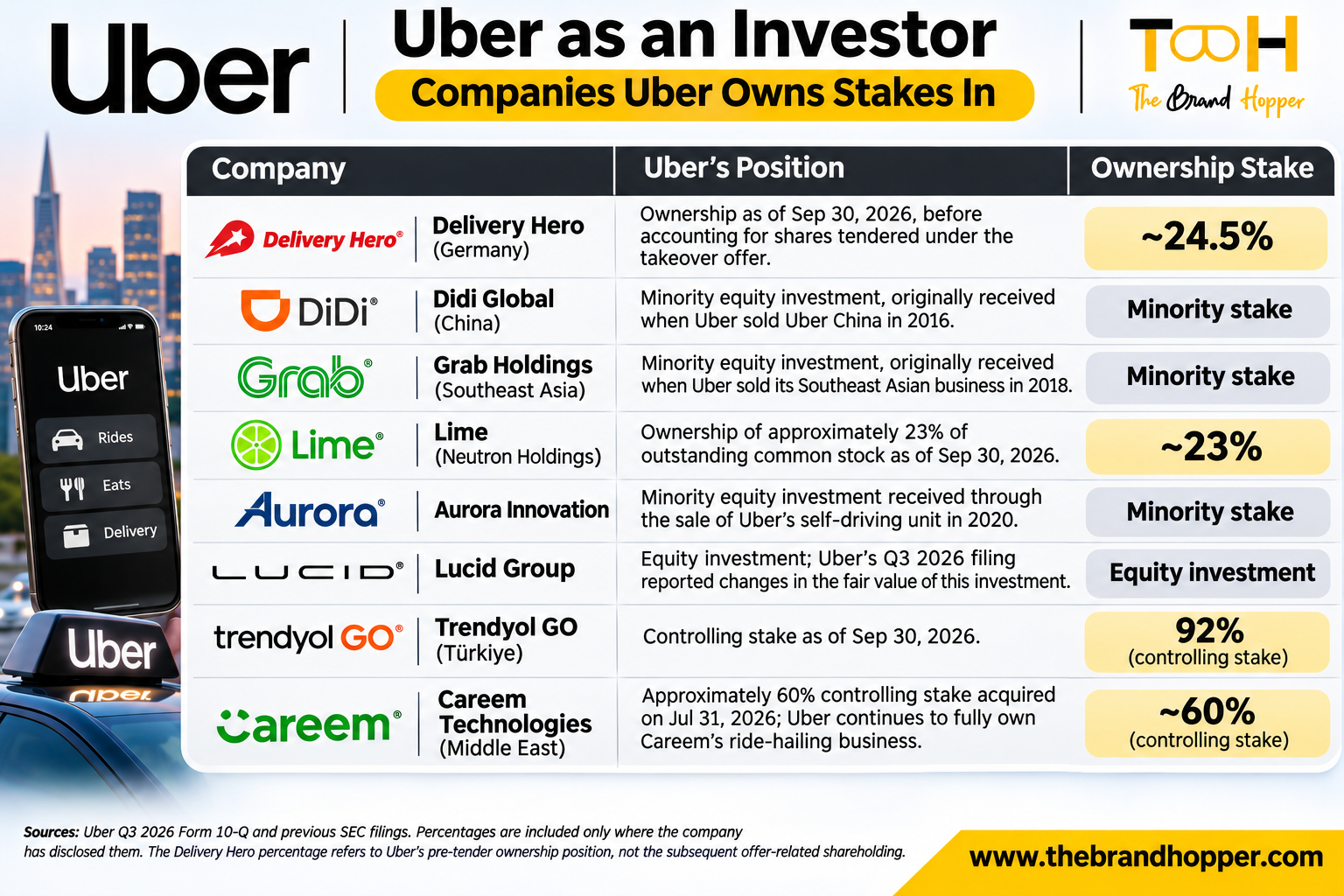
Uber’s investment strategy has evolved over time. Rather than competing directly in every market, it has sometimes sold local operations to established players in exchange for equity, retaining financial exposure to those businesses.
The company’s latest filings continue to identify Didi, Grab, and Aurora among its minority-owned investments. It also reported investments in Lucid and other companies, although not every holding has a publicly disclosed ownership percentage.
Uber’s Biggest Move of 2026: The Delivery Hero Takeover
On July 16, 2026, Uber announced an agreement to make a voluntary public takeover offer for Delivery Hero, the Berlin-based food-delivery company behind brands such as Talabat, Glovo, and PedidosYa.
Uber offered €41.50 in cash per share, implying a fully diluted equity value of approximately €13.0 billion, or US$14.8 billion. The offer was subject to a minimum acceptance threshold of 50% plus one share, as well as regulatory and other customary conditions.
Uber already owned approximately 24.99% of Delivery Hero after acquiring additional shares in the second quarter of 2026. Its ownership was reported at approximately 24.5% in Uber’s September 30, 2026 filing.
The first acceptance period for the takeover offer ran from August 27 to November 5, 2026. Following this period, 66.56% of Delivery Hero’s shares and voting rights were attributable to Uber’s bidder, taking the offer beyond the minimum acceptance threshold.
An additional acceptance period is running from November 11 to November 24, 2026. The transaction is still subject to regulatory clearances and other closing conditions, with settlement expected in the second half of 2027.
To address competition concerns in overlapping markets, investment firm SSW Partners has separately agreed to acquire Delivery Hero operations in 14 markets, conditional on completion of Uber’s takeover offer. Uber will not acquire control of the businesses transferred to SSW Partners.
The transaction is expected to expand Uber’s delivery reach and strengthen its position in international food delivery and quick commerce. Uber and Delivery Hero said the combined platform would span 99 countries, with pro forma Gross Merchandise Value of US$236 billion in 2025.
Other 2026 deals: Uber completed its acquisition of Getir’s food-delivery business in Türkiye on July 1, 2026, for approximately US$465 million in cash, alongside a minority interest in its grocery-delivery business.
Uber also acquired digital parking platform SpotHero in April 2026 for approximately US$617 million. In October 2026, it agreed to acquire ezCater, a US catering and workplace-meals platform, in an all-cash transaction valued at US$2.3 billion.
Separately, Uber agreed in March 2026 to acquire Berlin-based chauffeur service Blacklane for approximately US$550 million. That transaction remained subject to regulatory approvals and other closing conditions in the company’s latest filing.
A Brief History of Uber’s Ownership
| Year | Milestone |
|---|---|
| 2009 | Travis Kalanick and Garrett Camp found UberCab |
| 2010 | Service launches in San Francisco |
| 2016 | Saudi PIF invests US$3.5 billion; Uber sells Uber China to Didi for an equity stake |
| 2017 | Kalanick resigns as CEO; Dara Khosrowshahi takes over |
| 2018 | SoftBank becomes a major shareholder; Uber sells its Southeast Asian business to Grab |
| 2019 | IPO on the New York Stock Exchange at US$45 per share |
| 2020 | Uber sells its self-driving unit to Aurora and acquires Postmates |
| 2023 | Uber reports its first full year of operating profit |
| 2026 | Balaji Krishnamurthy becomes CFO; Uber completes the Getir and SpotHero acquisitions, launches the Delivery Hero takeover offer, and announces the ezCater and Blacklane deals |
How to Invest in Uber
Because Uber is publicly traded, investors can become part-owners by purchasing its shares. Uber stock trades on the New York Stock Exchange under the ticker UBER and is included in the S&P 500 index, meaning most S&P 500 index funds and ETFs hold it.
Indian investors can buy Uber shares through eligible international brokerage platforms, subject to applicable Liberalised Remittance Scheme (LRS), tax, and foreign-exchange rules. Investors should review the latest RBI and tax requirements before investing.
Uber does not currently pay a regular dividend but has an active share repurchase programme. As with any investment, investors should review the company’s financial performance, valuation, risks, and their own financial circumstances before making a decision.
The Bottom Line
Uber is owned by its shareholders, not by its founders or any parent company. Vanguard, BlackRock, and Capital Research Global Investors are its largest disclosed institutional investors, while Saudi Arabia’s PIF has a minority stake of approximately 3.6% and representation on the board.
Led by CEO Dara Khosrowshahi and chaired by Ronald Sugar, Uber has grown into a global mobility, delivery, and freight platform. With FY2025 revenue of US$52 billion, more than 200 million quarterly active platform consumers, and a takeover offer for Delivery Hero that has passed its initial acceptance threshold, the company is continuing to expand its international reach.
Frequently Asked Questions
Q: Who is the owner of Uber?
A: Uber has no single owner. Uber Technologies, Inc. is a publicly traded company owned by its shareholders.
Its largest disclosed institutional shareholders in the 2026 proxy statement were Vanguard (9.34%), BlackRock (6.82%), and Capital Research Global Investors (5.78%). These percentages are based on filings made on different dates.
Q: Does Travis Kalanick still own Uber?
A: Travis Kalanick co-founded Uber and served as its CEO until 2017. He subsequently sold a substantial portion of his shares after the company’s 2019 IPO and left its board at the end of 2019.
He is not listed among the major shareholders above the 5% reporting threshold in Uber’s 2026 proxy statement. This does not establish that he owns no remaining shares.
Q: Does Saudi Arabia own Uber?
A: No. Saudi Arabia’s Public Investment Fund is associated with approximately 3.57% of Uber’s shares through the beneficial ownership reported for its board representative, Turqi Alnowaiser.
The PIF also has a board representative, but it does not control Uber.
Q: Who is the CEO of Uber?
A: Dara Khosrowshahi has been Uber’s CEO since 2017. Balaji Krishnamurthy is the CFO, and Ronald Sugar is the independent Chair of the Board.
Q: Is Uber profitable?
A: Yes. In FY2025, Uber reported income from operations of US$5.6 billion and net income of US$10.1 billion on revenue of US$52.0 billion.
However, FY2025 net income included a US$5.0 billion tax valuation allowance benefit. Its operating income and cash flow provide additional measures of its underlying financial performance.
Q: Does Uber own Uber Eats?
A: Yes. Uber Eats is part of Uber’s Delivery segment, which generated US$28.5 billion in Gross Bookings in the third quarter of 2026.
The segment includes food delivery, grocery, and retail delivery services.
Q: Is Uber buying Delivery Hero?
A: Uber has launched a €41.50-per-share public takeover offer for Delivery Hero, implying an equity value of approximately US$14.8 billion. Following the first acceptance period, 66.56% of Delivery Hero’s shares and voting rights were attributable to Uber’s bidder.
The additional acceptance period runs until November 24, 2026. The transaction remains subject to regulatory approvals and other closing conditions, with settlement expected in the second half of 2027.
Q: Is Uber an American company?
A: Yes. Uber Technologies, Inc. is incorporated in Delaware and headquartered in San Francisco, California, USA.
Also Read: Uber vs Lyft: Which Ride-Hailing App Is Better?
To read more content like this, subscribe to our newsletter
Go to the full page to view and submit the form.