


Few companies touch daily life as broadly as Unilever, whose products — soap, shampoo, deodorant, mayonnaise, tea, and cleaning supplies — sit in an estimated 3.4 billion people’s homes worldwide every single day.
Yet despite that scale, Unilever isn’t a founder-controlled empire or a family dynasty; it’s a widely held, professionally managed public company built from a 1929 merger of two very different businesses, one selling soap and one selling margarine.
Here’s the complete, grounded picture of who owns Unilever, how its unusual Anglo-Dutch history shaped the company, what’s inside its enormous brand portfolio, and why 2025 marked one of the biggest strategic shake-ups in its nearly century-long history.
How Unilever Began: A Soap Baron and a Margarine Merger
Unilever’s origin story starts with two entirely separate businesses on two sides of the North Sea.
In Britain, brothers William Hesketh Lever and James Darcy Lever founded Lever Brothers in 1885, building a fortune by commercializing an innovative soap-making process using vegetable oils rather than animal fats, a product they marketed under the now-legendary Sunlight Soap brand.
William Lever, later ennobled as Viscount Leverhulme, became one of Britain’s most influential industrialists, even building an entire model village, Port Sunlight, to house his factory workers.

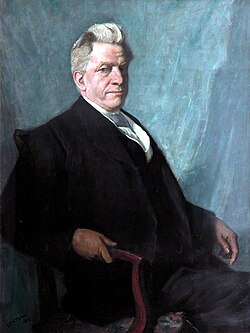
Meanwhile, in the Netherlands, four competing margarine producers — Antoon Jurgens United, Van den Bergh’s, Centra, and Schicht’s — consolidated in 1927 into Margarine Unie N.V., a Dutch conglomerate that had become one of Europe’s dominant margarine makers by exploiting overlapping vegetable-oil supply chains with the soap industry.
Recognizing that both businesses competed for the same raw materials and increasingly overlapping markets, the two companies merged their operations on September 2, 1929, forming Unilever — a name blending “Unie” and “Lever.”
By 1930, the newly combined company employed roughly 250,000 people and had become the largest company in Britain by market value, an extraordinary scale achieved almost overnight through consolidation rather than organic growth.
The Anglo-Dutch Dual Structure: A Century of Two Head Offices
For over 90 years, Unilever operated under one of the corporate world’s more unusual arrangements: two separate parent companies, Unilever NV in Rotterdam and Unilever PLC in London, functioning as a single unified business with one shared board of directors, equalized dividends, and identical economic rights for shareholders in either entity.

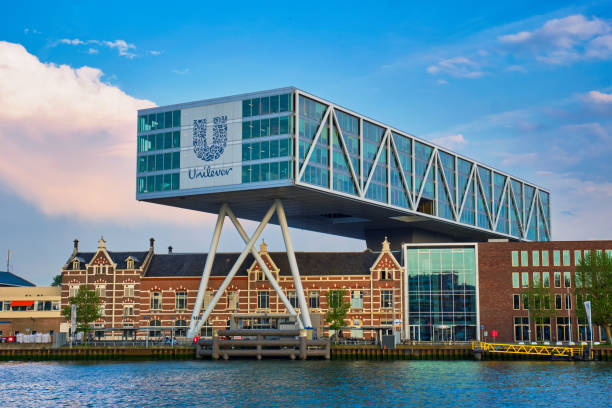
This dual structure was originally designed to preserve national pride and tax treatment in both the U.K. and the Netherlands following the 1929 merger, but it grew increasingly cumbersome over the decades, creating unnecessary complexity for cross-border transactions, share buybacks, and major corporate actions.
In 2020, Unilever finally simplified this arrangement, unifying under a single parent company, Unilever PLC, headquartered in London, while retaining listings across multiple exchanges to preserve access to Dutch and other European investors — a structural cleanup that made the modern, more conventionally governed Unilever possible.
Who Owns Unilever Today? A Diffuse Institutional Shareholder Base
Unilever has no controlling shareholder, founder, or family dynasty running the show today.
According to 2026 ownership data, the company is owned by roughly 11% institutional shareholders in aggregate reporting terms (with total institutional and fund ownership considerably higher when all fund types are counted), a negligible direct insider stake, and the remainder spread across a vast retail and indirect fund shareholder base.
BlackRock is Unilever’s single largest shareholder, holding approximately 8% of shares (around 174.6 million shares as of May 2026), followed by The Vanguard Group at roughly 5.88%.
Notably, the Leverhulme Trade Charities Trust — a charitable body with historical roots tracing back to William Lever’s original philanthropic vision — still holds about 1.91% of the company, a quiet but meaningful thread connecting the modern Unilever back to its 19th-century soap-making founder.
Other significant holders include UBS Asset Management (~1.73%) and State Street Corporation (~1.56%), with Wellington Management the largest non-index individual asset manager at roughly 1.83%.

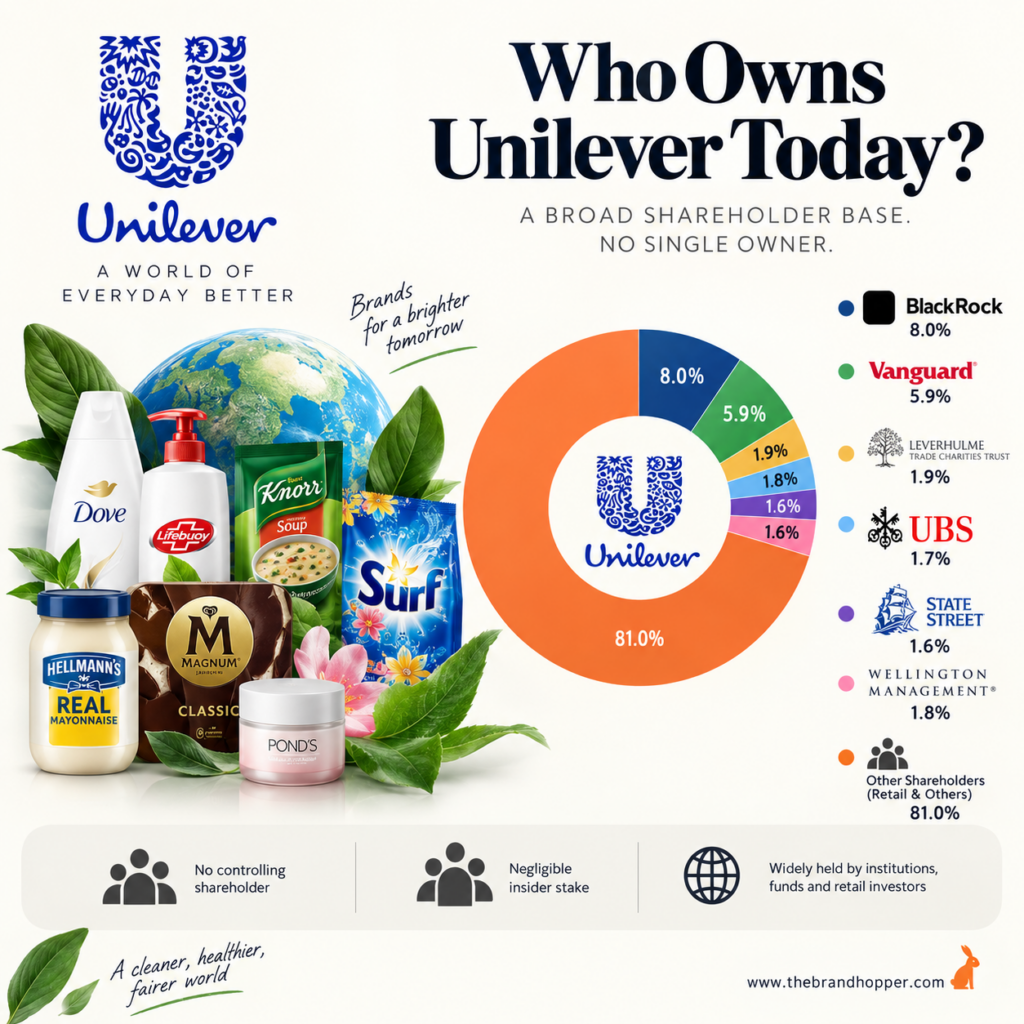
This structure makes Unilever a textbook example of a mature, professionally governed public company: no dual-class shares, no founder veto, and no family trust with anything close to majority control.
Unilever’s Enormous Brand Portfolio: From Dove to Domestos
Unilever’s real competitive moat isn’t any single product — it’s the sheer breadth of its brand portfolio, which historically spanned more than 400 individual brands sold across food, home care, and beauty and personal care categories before recent divestments trimmed the roster.
The company has increasingly focused on what it calls “Power Brands” — roughly 30 core brands that now account for about 78% of total turnover — including Dove (Unilever’s single largest brand, driving roughly 40% of Personal Care division revenue and growing around 9% in the first half of 2026), Vaseline, Hellmann’s, Knorr, Lifebuoy, Sunsilk, Comfort, Rexona, LUX, Axe/Lynx, and Domestos, among many others.
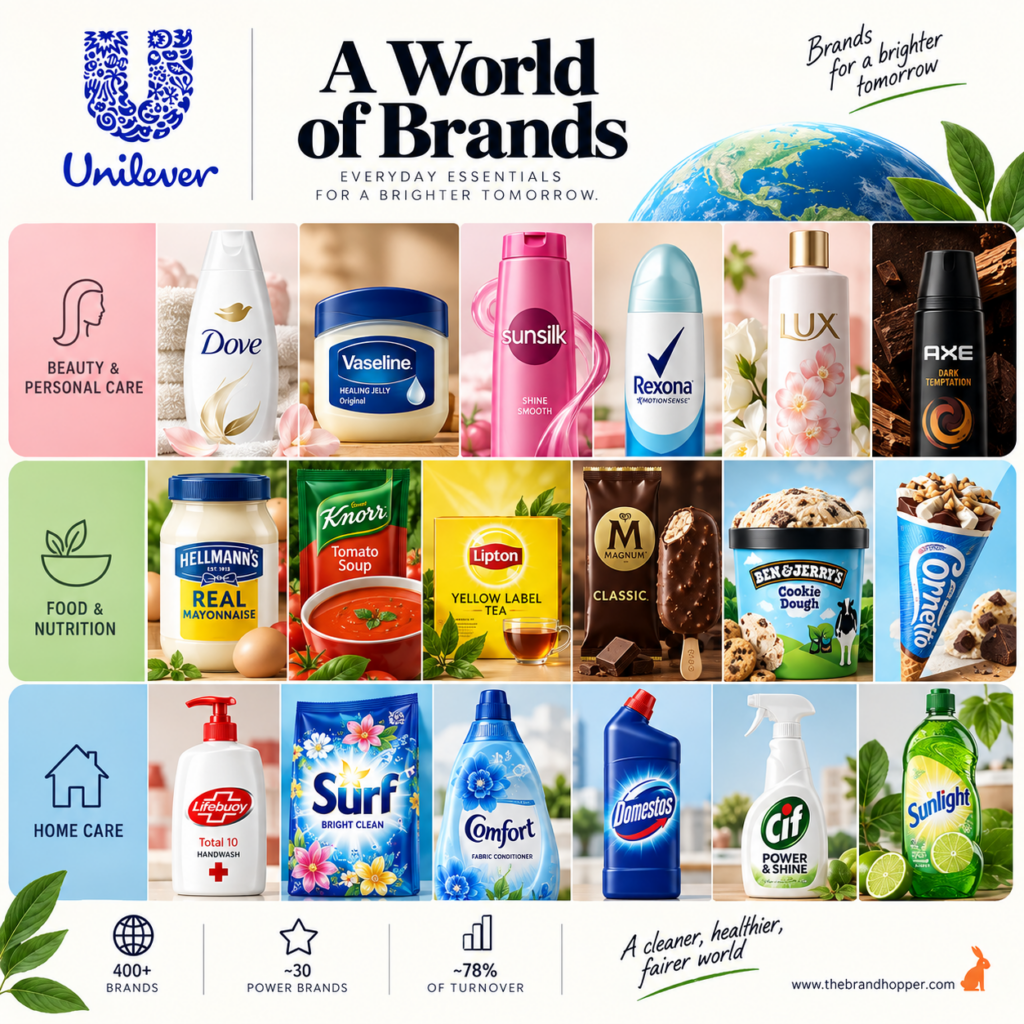
This “fewer, but better” strategy represents a deliberate shift away from decades of unrelated diversification toward a tighter portfolio of higher-growth, higher-margin brands with genuine global scalability, reflecting broader pressure across the consumer goods industry to simplify sprawling multi-category conglomerates into more focused, faster-growing businesses.
The Magnum Ice Cream Company Demerger: Unilever’s Biggest Shake-Up in Decades
The single biggest ownership and structural story in Unilever’s recent history is the complete demerger of its ice cream business, first announced in March 2024 and finally completed on December 8, 2025.
The spun-off entity, The Magnum Ice Cream Company (TMICC), took with it iconic ice cream brands including Magnum, Ben & Jerry’s, Wall’s, Cornetto, and Breyers, and began trading as an independent public company with a primary listing on Euronext Amsterdam and secondary listings in London and New York, led by newly appointed CEO Peter ter Kulve.

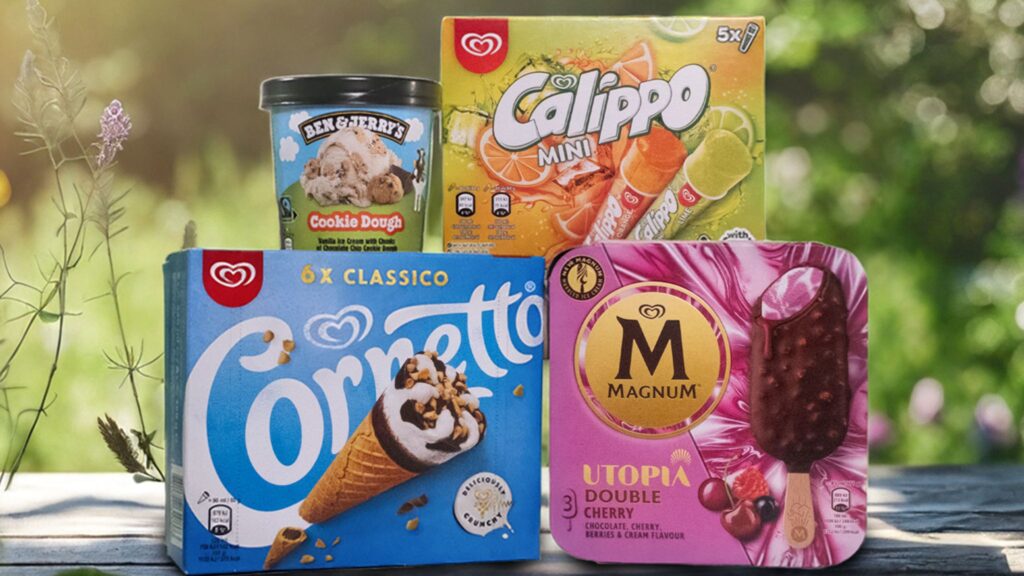
As part of the separation structure, Unilever retained a 19.9% minority stake in TMICC for up to five years, giving the parent company continued financial exposure to the ice cream business’s performance without operational responsibility for it.
The demerger, which came alongside roughly 7,500 job cuts across Unilever’s broader business, was explicitly framed by leadership as a move to create “a simpler Unilever” with a sharper strategic focus and a structurally higher margin profile, since the capital-intensive, highly seasonal, and lower-margin ice cream category had long been considered a drag on Unilever’s overall growth and profitability metrics relative to its personal care and beauty businesses.
Unilever’s Leadership: A New CEO Steering the Turnaround
Unilever’s current CEO, Fernando Fernandez, took over from predecessor Hein Schumacher earlier in this transformation period and has been the public face of the company’s aggressive refocusing strategy, explicitly stating the company needed to “leave behind” underperforming, capital-heavy categories like ice cream in favor of its higher-margin Power Brands.
Fernandez’s tenure has been defined by executing exactly the kind of structural simplification that activist investors and analysts had pushed Unilever toward for years: shedding the ice cream business, doubling down on Power Brand investment, and pursuing continued cost discipline across the group’s remaining Beauty & Wellbeing, Personal Care, Home Care, and Nutrition divisions.
Early results from this refocused strategy have been encouraging, with several Power Brands — including Dove, Vaseline, Sunsilk, Comfort, and Dirt Is Good — posting double-digit growth rates in subsequent quarters following the ice cream separation.
Unilever’s FY2025 Financial Performance
Unilever’s FY2025 results reflected a company in the midst of significant portfolio transformation.
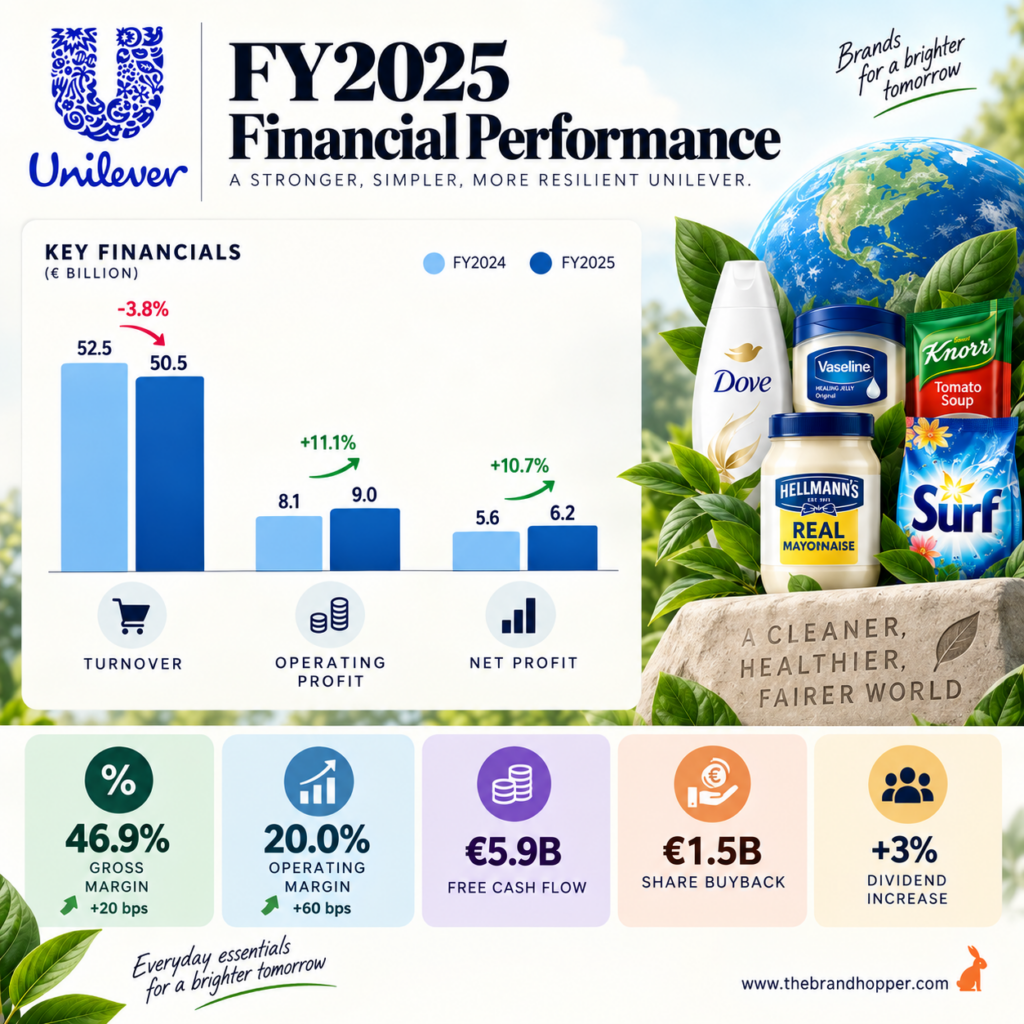
Full-year turnover came in at €50.5 billion, down 3.8% from the prior year, though that headline decline was driven primarily by adverse currency movements and the effects of net business disposals (including the ice cream demerger) rather than underlying weakness — underlying sales growth, which strips out those effects, was a solid 3.5%, made up of 1.5% volume growth and stronger pricing.
Profitability metrics improved meaningfully: gross margin expanded 20 basis points to a strong 46.9%, while underlying operating margin grew 60 basis points to 20.0%, reflecting the benefits of the company’s sharper focus on higher-margin Power Brands.
Full-year operating profit reached €9.0 billion, and net profit came in at €6.2 billion, with underlying earnings per share up 0.7% to €3.08 and diluted EPS rising a stronger 6.2% to €2.59. Unilever generated €5.9 billion in free cash flow for the year, comfortably supporting both a newly announced €1.5 billion share buyback program and a 3% increase in the company’s quarterly dividend, underscoring continued confidence in the business’s cash-generating capacity even amid major structural change.
Unilever’s Market Value in 2026
As of mid-2026, Unilever’s market capitalization stood at approximately $131 billion, reflecting investor confidence in the company’s sharpened Power Brand strategy following the ice cream separation, even as the smaller post-demerger revenue base initially reduced headline turnover figures.
Unilever’s shares trade across three major exchanges — the London Stock Exchange (primary listing), Euronext Amsterdam, and the New York Stock Exchange via American Depositary Receipts — a legacy of its Anglo-Dutch origins that continues to give the company access to a genuinely global institutional and retail investor base spanning Europe and North America.
Why Unilever’s Ownership Structure Matters for Investors
Unilever’s ownership profile illustrates a company deliberately reshaping itself under continuous institutional investor pressure rather than founder-driven vision.
With no controlling shareholder and a top-ten holder list dominated entirely by index funds and asset managers rather than any individual or family, decisions like the ice cream demerger reflect the kind of activist-adjacent portfolio discipline that widely held, professionally governed consumer goods companies increasingly face from their institutional base.
For investors, Unilever now represents a somewhat leaner, more margin-focused bet on global personal care and food brands, having deliberately shed a large, lower-margin category to concentrate capital and management attention on the roughly 30 Power Brands that already generate the vast majority of its profitable growth.
Unilever Ownership at a Glance (FY2025)
| Category | Detail |
| Founded | September 2, 1929 (merger of Lever Brothers and Margarine Unie) |
| Founding businesses | Lever Brothers (1885, UK); Margarine Unie (1927, Netherlands) |
| Largest shareholder | BlackRock (~8%, ~174.6 million shares) |
| Company structure | Publicly traded; unified single parent (Unilever PLC) since 2020 |
| Stock listings | London Stock Exchange (primary); Euronext Amsterdam; NYSE (ADR) |
| Top institutional shareholders | Vanguard (~5.88%), Leverhulme Trade Charities Trust (~1.91%) |
| CEO | Fernando Fernandez |
| Headquarters | London, United Kingdom |
| Major 2025 event | Ice cream business demerged as The Magnum Ice Cream Company (Dec 8, 2025) |
| Power Brands | ~30 brands (Dove, Vaseline, Hellmann’s, Knorr, Lifebuoy) = ~78% of turnover |
| FY2025 turnover | €50.5 billion (-3.8% reported; +3.5% underlying) |
| FY2025 net profit | €6.2 billion |
| 2026 market capitalization | ~$131 billion |
Key Takeaways
Unilever’s ownership story in 2026 centers on institutional stewardship rather than founder control: BlackRock (~8%) and Vanguard (~5.88%) lead a diffuse shareholder base with no dominant owner, while the historic Leverhulme Trade Charities Trust still holds a small stake tracing back to founder William Lever.
The company’s biggest recent event wasn’t a change in ownership but a change in shape — the December 2025 demerger of its entire ice cream business (Magnum, Ben & Jerry’s, Wall’s) into the independent Magnum Ice Cream Company, part of a broader “fewer, but better brands” strategy under new CEO Fernando Fernandez.
Financially, FY2025 delivered €50.5 billion in turnover, €6.2 billion in net profit, and a strengthening margin profile, positioning a leaner, more focused Unilever heading into its second century as one of the world’s most widely held consumer goods companies.
Frequently Asked Questions
Q: Who owns the most shares of Unilever?
A: BlackRock is Unilever’s largest shareholder, holding approximately 8% of shares (around 174.6 million shares as of May 2026), followed by The Vanguard Group at roughly 5.88%.
Q: Is Unilever still controlled by the Lever family?
A: No, not in a controlling sense. However, the Leverhulme Trade Charities Trust, a charitable body connected to founder William Lever, still holds a small stake of about 1.91% in the company today.
Q: Who founded Unilever?
A: Unilever was formed on September 2, 1929, through the merger of British soap maker Lever Brothers (founded 1885 by William and James Lever) and Dutch margarine producer Margarine Unie (formed 1927 from four merged companies).
Q: What brands does Unilever own?
A: Unilever owns dozens of brands across personal care, beauty, home care, and food, with around 30 “Power Brands” — including Dove, Vaseline, Hellmann’s, Knorr, Lifebuoy, Sunsilk, Comfort, and Axe — accounting for about 78% of total turnover.
Q: Did Unilever sell its ice cream business?
A: Yes. Unilever completed a full demerger of its ice cream division, including Magnum, Ben & Jerry’s, and Wall’s, into an independent public company called The Magnum Ice Cream Company on December 8, 2025, while retaining a 19.9% minority stake.
Q: Who is Unilever’s CEO?
A: Fernando Fernandez is Unilever’s CEO, having taken over from predecessor Hein Schumacher and led the company through the ice cream demerger and its broader “fewer, but better brands” strategy.
Q: What was Unilever’s revenue in FY2025?
A: Unilever reported FY2025 turnover of €50.5 billion, with operating profit of €9.0 billion and net profit of €6.2 billion, alongside underlying sales growth of 3.5%.
Q: Where is Unilever stock listed?
A: Unilever PLC shares trade on the London Stock Exchange (primary listing), Euronext Amsterdam, and as American Depositary Receipts on the New York Stock Exchange, reflecting its Anglo-Dutch corporate heritage.
Also Read: Complete List of HUL Brands: All Hindustan Unilever Brands Explained
To read more content like this, subscribe to our newsletter
Go to the full page to view and submit the form.