


WhatsApp is the world’s most widely used messaging app, a piece of daily-life infrastructure for more than 3 billion people who rely on it for everything from family group chats to small-business customer service.
But the app didn’t start inside a tech giant — it began as a scrappy, ad-free startup built by two engineers who explicitly rejected the idea of ever running ads, only to sell the company to the world’s biggest advertising-driven social media company a few years later.
Here’s the complete ownership story, acquisition history, and business reality behind WhatsApp today.
How WhatsApp Began: Two Yahoo Veterans and a Status Update
WhatsApp was founded in February 2009 by Jan Koum and Brian Acton, both of whom had previously worked together at Yahoo.

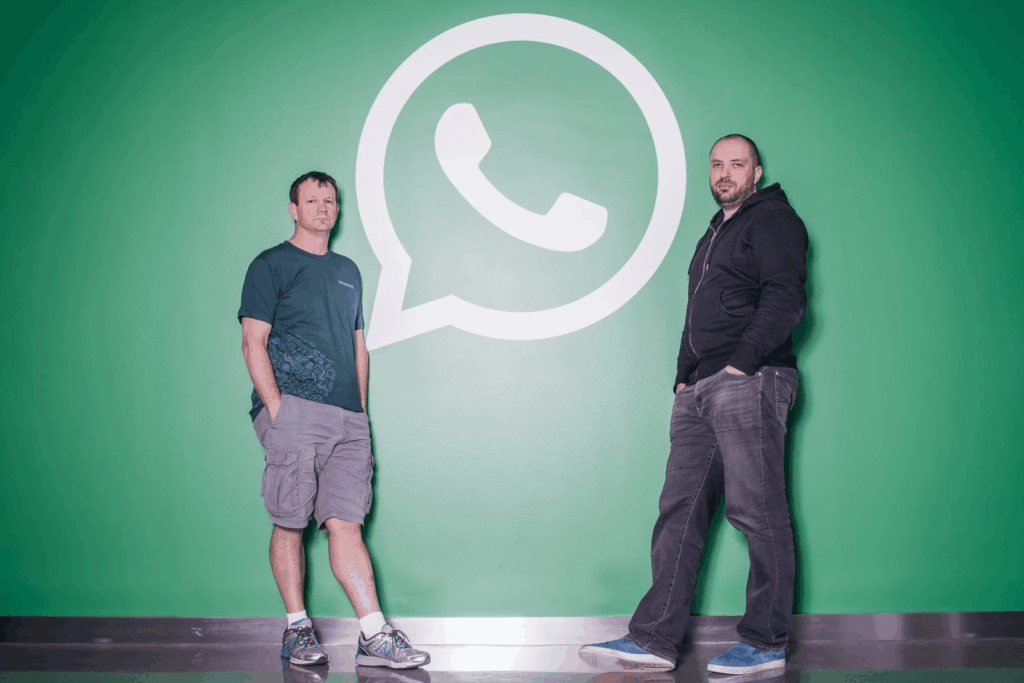
Koum came up with the initial concept after buying an iPhone and recognizing the emerging potential of mobile apps, reportedly workshopping the idea during a casual movie night with friends.
Acton, meanwhile, helped raise WhatsApp’s initial $250,000 in seed funding by convincing five former Yahoo colleagues to invest, before formally joining Koum as a co-founder later that year.
The app itself launched on May 3, 2009, and initially flopped — it wasn’t until Apple updated iOS to support push notifications a month later that WhatsApp’s status-update-turned-messaging functionality actually started gaining real traction.
In 2011, the company raised an $8 million Series A round from Sequoia Capital, the same venture firm that would later back WhatsApp all the way through to its eventual sale.
From Startup to a $19 Billion Acquisition
By early 2014, WhatsApp had grown into a messaging phenomenon, boasting more than 450 million monthly active users, 70% of whom were active on any given day, and adding over a million new registered users daily.
On February 19, 2014, Facebook announced a definitive agreement to acquire WhatsApp for a headline value of approximately $19 billion — structured as $4 billion in cash, roughly $12 billion in Facebook stock, and an additional $3 billion in restricted stock units for WhatsApp’s founders and employees vesting over four years.
As part of the deal, Jan Koum joined Facebook’s board of directors, and WhatsApp was allowed to continue operating with a degree of independence from the core Facebook product.
By the time the acquisition officially closed in October 2014, a rise in Facebook’s own share price had pushed the deal’s real value up to approximately $21.8 billion, making it, at the time, one of the largest technology acquisitions ever completed, dwarfing even Facebook’s earlier $1 billion purchase of Instagram.
Why the Founders Later Walked Away
The relationship between WhatsApp’s founders and their new corporate parent soured within a few years.
Both Koum and Acton had built WhatsApp around an explicitly anti-advertising, privacy-first philosophy — the company’s original offices reportedly had a note taped to the wall reading “No Ads! No Games! No Gimmicks!” — and that philosophy increasingly clashed with Facebook’s advertising-driven business model.
Brian Acton left the company in 2017, later telling reporters bluntly that he had “sold my users’ privacy” in agreeing to the acquisition, and publicly supported the #DeleteFacebook movement following the Cambridge Analytica scandal.
Jan Koum followed him out the door in 2018, reportedly worn down by sustained pressure from Facebook’s leadership to introduce advertising and loosen WhatsApp’s encryption and data-sharing practices.
The financial cost of walking away on principle was enormous: Acton alone is estimated to have forfeited roughly $850 million in unvested Facebook stock by leaving before his full vesting period completed.
Acton went on to co-found the Signal Foundation, backing the encrypted messaging app Signal as a direct, monetization-free alternative to the platform he’d help build and then left behind.
Who Owns WhatsApp Today? It’s All About Meta’s Ownership
WhatsApp itself has no separate ownership structure — it operates as a wholly owned subsidiary within Meta Platforms, Inc., alongside Facebook, Instagram, and Meta’s various AI and virtual-reality ventures.
Understanding who “owns” WhatsApp, therefore, really means understanding who controls Meta.
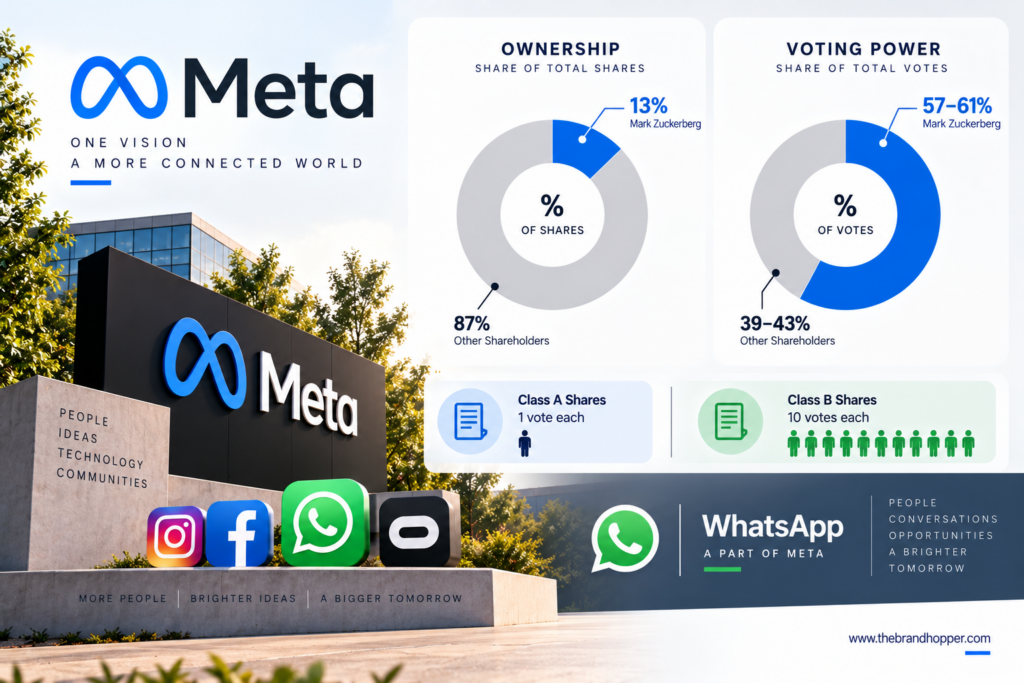
Meta is a publicly traded company (NASDAQ: META), but its ownership is far from evenly distributed among shareholders. The company operates a dual-class share structure: Class A shares, available to ordinary public investors, carry one vote each, while Class B shares, held overwhelmingly by CEO Mark Zuckerberg and a small circle of early insiders, carry ten votes each.
The practical effect is stark — Zuckerberg owns only around 13% of Meta’s total outstanding shares, yet commands somewhere between 57% and 61% of the company’s total voting power, giving him effective, unchallengeable control over Meta’s board and strategic direction, including decisions about WhatsApp, without needing majority economic ownership at all.
WhatsApp’s Leadership: A Surprising 2026 Handoff
Day-to-day leadership of WhatsApp has changed hands in a genuinely notable way in 2026.
Will Cathcart, who had led WhatsApp for more than seven years and became one of the most prominent public defenders of the platform’s end-to-end encryption commitments, stepped down from the role in mid-2026.
In an unusual move for a company of Meta’s scale, Zuckerberg announced that Kunal Shah — the founder of Indian fintech startup Cred — would take over as the new head of WhatsApp, while Cathcart transitioned into a different role at Meta focused on building new products from scratch.


The choice of an outside fintech founder to lead WhatsApp, rather than promoting an internal Meta executive, signals just how central payments and commerce features (already a major WhatsApp focus in markets like India and Brazil) have become to WhatsApp’s next phase of growth under Meta’s ownership.
WhatsApp’s Scale and Monetization in 2025-2026
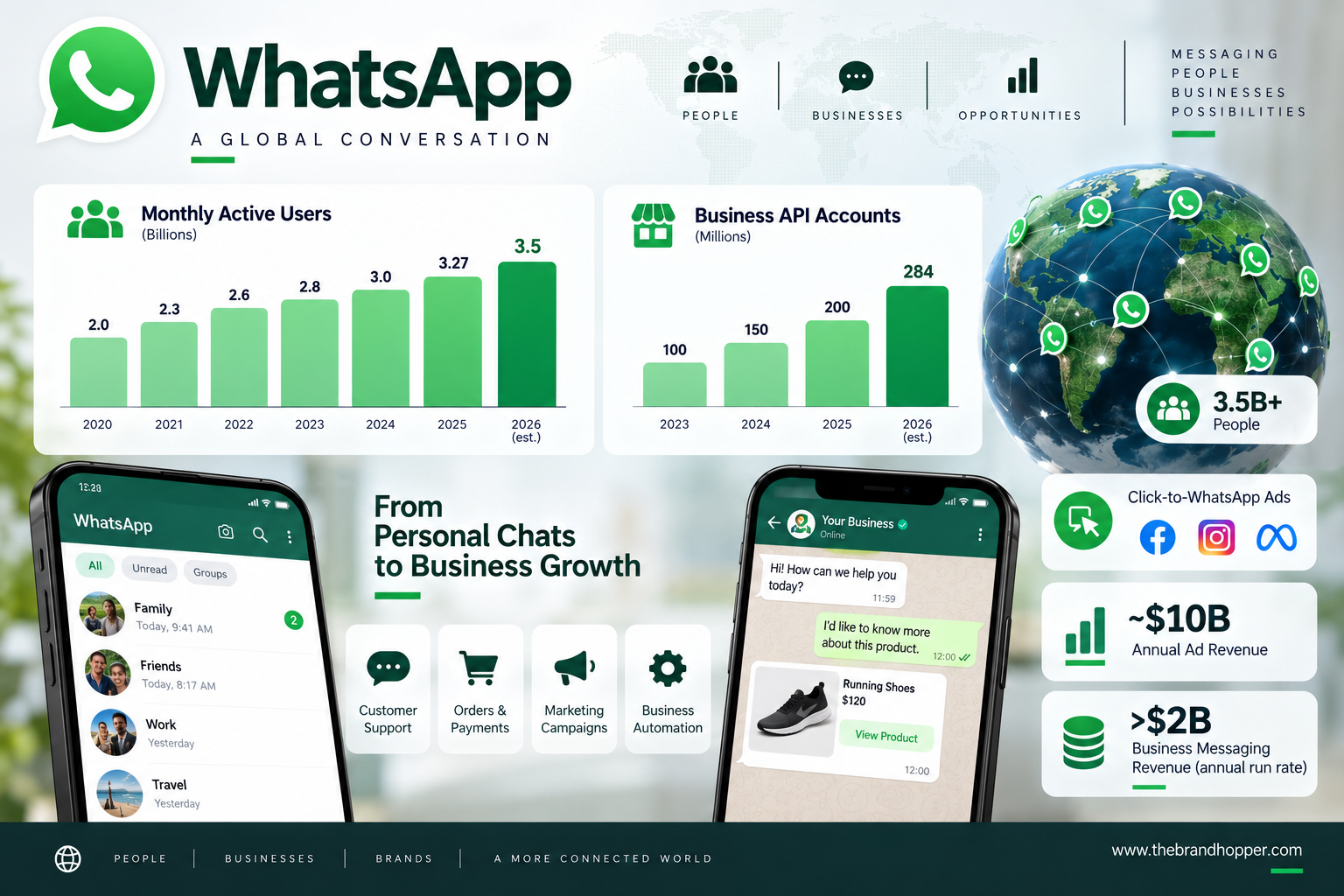
WhatsApp’s user base has grown enormously under Meta’s ownership, crossing 3.27 billion monthly active users and approaching an estimated 3.5 billion by late 2026, making it the first single messaging app in history to surpass the 3-billion-user mark.
Despite Koum and Acton’s original “no ads” philosophy, WhatsApp today generates substantial revenue for Meta, primarily through two channels: the WhatsApp Business API, used by an estimated 284 million active business accounts in 2026 (up 42% from roughly 200 million the year before) to route customer messages at scale, and click-to-WhatsApp ads, which let advertisers on Facebook and Instagram drive users directly into a WhatsApp conversation.
Click-to-WhatsApp ad revenue alone is estimated at roughly $10 billion annually for Meta, while WhatsApp Business messaging revenue crossed a $2 billion annual run rate and was projected to reach further heights through 2026, reflecting just how significant WhatsApp has become as a standalone revenue driver rather than simply a user-engagement tool for Meta’s broader advertising business.

WhatsApp vs Its Encrypted Rivals: Signal and Telegram
WhatsApp’s continued use of end-to-end encryption — a technical commitment it has maintained even under Meta’s ownership — puts it in an unusual competitive position relative to rivals like Signal (co-founded by former WhatsApp co-founder Brian Acton) and Telegram.
Signal, funded as a nonprofit through the Signal Foundation, offers similar encryption without any advertising or data-driven monetization model at all, appealing specifically to privacy-focused users who distrust WhatsApp’s corporate ownership by an advertising giant.
Telegram, meanwhile, offers broader public channel and community features but has faced more scrutiny over its default encryption practices. WhatsApp’s core advantage over both remains sheer network effects: with well over 3 billion users, it remains the default messaging choice in most of the world outside the US and China, regardless of any lingering skepticism about Meta’s data practices.
Is WhatsApp Data Shared with Facebook and Instagram?
This remains one of the most persistent points of public confusion and concern about WhatsApp’s ownership by Meta.
WhatsApp continues to advertise end-to-end encryption for message content, meaning Meta cannot read the actual text of WhatsApp conversations.
However, Meta has, at various points since the acquisition, updated WhatsApp’s terms of service to allow sharing of certain account metadata — such as phone numbers and usage information, though not message content — with Facebook and Instagram for purposes like ad targeting and business integrations, changes that directly triggered Brian Acton’s public break with the company and continue to generate periodic regulatory scrutiny in markets including the European Union.
WhatsApp’s Role Inside Meta’s “Family of Apps”
Within Meta’s own corporate reporting, WhatsApp is grouped alongside Facebook, Instagram, and Messenger under what the company calls its “Family of Apps” segment, distinct from Meta’s separate Reality Labs division that houses its virtual and augmented reality bets.
This structural grouping matters because it means WhatsApp’s financial performance isn’t broken out as a fully standalone line item in Meta’s public earnings reports, making precise WhatsApp-only profitability figures harder to pin down publicly compared to a company like Snap or Pinterest that reports as a single business.
What is clear is that WhatsApp’s role within that Family of Apps segment has shifted meaningfully since 2014, evolving from a pure user-engagement and retention tool into a genuine, multi-billion-dollar revenue contributor in its own right, particularly in high-growth markets like India, Brazil, and Indonesia where WhatsApp-based business messaging has become deeply embedded in everyday commerce.
WhatsApp Ownership & History at a Glance
| Fact | Detail |
| Founded | February 2009, by Jan Koum and Brian Acton |
| App launched | May 3, 2009 |
| Acquired by | Facebook (now Meta Platforms, Inc.), announced Feb 2014 |
| Acquisition value | ~$19 billion announced; ~$21.8 billion at closing (Oct 2014) |
| Current parent company | Meta Platforms, Inc. (NASDAQ: META) |
| Effective controller | Mark Zuckerberg — ~13% of shares, ~57-61% of voting power |
| Co-founder departures | Brian Acton (2017), Jan Koum (2018) |
| Acton’s post-WhatsApp venture | Co-founded the Signal Foundation (Signal app) |
| Current WhatsApp head | Kunal Shah (since mid-2026), founder of Cred |
| Previous WhatsApp head | Will Cathcart (7+ years) |
| Monthly active users (2026) | 3.27 billion+ (approaching 3.5 billion) |
| WhatsApp Business accounts (2026) | ~284 million (up 42% YoY) |
| Click-to-WhatsApp ad revenue (est.) | ~$10 billion/year for Meta |
Key Takeaways
WhatsApp’s ownership story is really two stories in one: the story of two idealistic, anti-advertising founders who built a messaging app and then walked away from nearly a billion dollars combined rather than compromise their privacy principles, and the story of Mark Zuckerberg’s near-total, dual-class-share-enabled control over Meta, the company that now owns WhatsApp outright.
Since the 2014 acquisition, WhatsApp has grown from 450 million to more than 3.27 billion users while quietly becoming a multi-billion-dollar revenue engine for Meta through business messaging and click-to-WhatsApp advertising — even as its 2026 leadership handoff to fintech founder Kunal Shah suggests Meta sees WhatsApp’s next chapter increasingly built around payments and commerce rather than pure messaging.
Frequently Asked Questions
Q: Who owns WhatsApp?
A: WhatsApp is owned by Meta Platforms, Inc., which acquired the company in October 2014 for approximately $21.8 billion. Meta itself is effectively controlled by CEO Mark Zuckerberg, who holds 57-61% of voting power through a dual-class share structure despite owning only about 13% of total shares.
Q: Who founded WhatsApp?
A: WhatsApp was founded in February 2009 by Jan Koum and Brian Acton, both former Yahoo employees, with the app officially launching on May 3, 2009.
Q: How much did Facebook pay for WhatsApp?
A: Facebook’s acquisition of WhatsApp was announced at a headline value of approximately $19 billion in February 2014, and the deal’s final value rose to roughly $21.8 billion by the time it closed in October 2014 due to a rise in Facebook’s stock price.
Q: Why did WhatsApp’s founders leave Facebook?
A: Brian Acton left in 2017 and Jan Koum left in 2018, both citing disputes with Facebook over plans to introduce advertising and weaken WhatsApp’s privacy and encryption commitments. Acton later said he had “sold my users’ privacy” by agreeing to the sale.
Q: Does Meta read WhatsApp messages?
A: No. WhatsApp messages remain protected by end-to-end encryption, meaning Meta cannot read message content. However, Meta does share certain account metadata between WhatsApp, Facebook, and Instagram for purposes like advertising and business integrations.
Q: Who runs WhatsApp today?
A: Kunal Shah, founder of Indian fintech startup Cred, became the new head of WhatsApp in mid-2026, succeeding Will Cathcart, who had led the platform for more than seven years before moving to a different role at Meta.
Q: How does WhatsApp make money?
A: WhatsApp generates revenue primarily through the WhatsApp Business API (used by 284 million business accounts in 2026) and click-to-WhatsApp advertising, which alone generates an estimated $10 billion annually for Meta.
Q: How many users does WhatsApp have?
A: WhatsApp surpassed 3.27 billion monthly active users in 2025-2026, making it the first single messaging app in history to cross the 3-billion-user threshold.
Also Read: How WhatsApp Makes Money? – Revenue Streams of WhatsApp
To read more content like this, subscribe to our newsletter
Go to the full page to view and submit the form.