


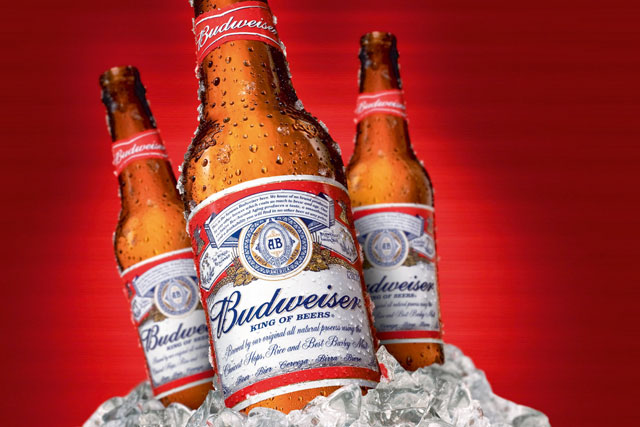
In 1998, a Philadelphia filmmaker and his childhood friends made a two-minute short film for a few hundred dollars, built around nothing more than the way old friends greet each other on the phone.
Two years later, a version of that same idea aired during Super Bowl XXXIV and became, by some measures, the second most-watched commercial ever made at the time — spawning a catchphrase repeated by everyone from schoolyard kids to a sitting U.S. president.
“Wassup?” ran as Budweiser’s flagship campaign from 1999 to 2002, but unlike most beer ads of its era, it never really went away: it came back for a 2008 political satire, a 2020 pandemic PSA with an A-list cast, and its DNA is still visible in Budweiser’s Super Bowl advertising as recently as February 2026.
This case study covers the full arc, from a home movie shot for almost nothing to a 27-year-old advertising franchise that’s still shaping how Budweiser shows up today.
| Quick Answer: What Was the Budweiser “Wassup?” Campaign?
• Debuted December 20, 1999 on Monday Night Football, then broke through nationally during Super Bowl XXXIV on January 30, 2000. • Built from “True,” a personal short film by Charles Stone III featuring his real childhood friends, licensed intact by DDB Chicago. • Drove a reported 15% sales lift and roughly 2.4 million added barrels of beer volume for Anheuser-Busch. • Revived twice since — a 2008 political short and a 2020 pandemic PSA — and its emotional, non-product-first approach still shapes Budweiser’s 2026 Super Bowl advertising. |
The Short Film That Started It All
The film that started it all was called “True,” a roughly two-minute short shot by then-music-video director Charles Stone III with several of his real-life childhood friends from the Philadelphia area: Fred Thomas, Paul Williams, Terry Williams, Jimmy “Puerto Rock” Perez, and Kevin Lofton.
The entire film is just a chain of phone calls between old friends, each one opening with an exaggerated, drawn-out “Wassuuup?!” — a real greeting the group actually used with each other, played up for comic effect.
It wasn’t made for a client or a brief; it was a personal project, shot cheaply, that happened to capture something genuinely funny and specific about how close friends talk to each other.
How an Ad Agency Found (Rather Than Invented) the Idea
Vinny Warren, then associate creative director at DDB Chicago, came across “True” while searching for ideas that could work during football playoff and Super Bowl programming for Budweiser.
He and art director Chuck Taylor brought the concept to August Busch IV, then vice president of Anheuser-Busch.
Busch IV’s team licensed the concept from Stone’s production company and brought Stone on to direct the Budweiser version himself, reshooting with most of the original cast — Scott Martin Brooks stepped into the role of “Dookie” after Kevin Lofton chose not to audition for the ad version.
It’s a rare case of an agency essentially finding a finished creative idea in the wild and licensing it intact, rather than developing a concept from scratch through the usual pitch process.
That decision ran against the grain of how most beer advertising got made at the time: the category leaned heavily on slapstick, talking animals, and overt product shots, while “Wassup?” offered none of that — no jokes about the beer itself, no punchline beyond the way the friends said hello.
Reshooting with the same non-actor friend group rather than casting professional actors preserved the specific, lived-in chemistry that made the original short work, a choice that added production complexity but was treated as non-negotiable by Stone.
Launch: December 1999 and Super Bowl XXXIV
The first Budweiser “Wassup?” spot aired during Monday Night Football on December 20, 1999, with little fanfare — the real moment came about six weeks later, on January 30, 2000, when a version of the ad ran during Super Bowl XXXIV.
It became, by some rankings, the second most-watched television commercial of all time at that point, and brand awareness and recall numbers moved almost immediately.
Anheuser-Busch has cited a roughly 15% sales lift tied to the campaign’s early run, and reporting by The New York Times credited the ad with helping the company add an estimated 2.4 million barrels of beer volume — a substantial swing for a single 60-second spot built around five friends and a phone.
The commercial’s demographic target was specifically 21-to-27-year-old male beer drinkers, a notoriously advertising-skeptical audience, and the campaign’s success in reaching that group with something that felt more like an inside joke than a sales pitch became its own case study in how to talk to younger consumers without talking down to them.
DDB Chicago followed the initial burst with a full media plan spanning sports programming, prime time, and late-night placements, ensuring the ad wasn’t a one-off Super Bowl moment but a sustained presence across the exact viewing windows where its target audience actually watched television.

How “Wassup?” Became a Genuine Cultural Phenomenon
“Wassup?” spread the way content spreads today, years before that infrastructure existed.
There was no YouTube, no Twitter, no algorithmic feed — the catchphrase moved through email forwards, early instant messenger chains, playground and office repetition, and unlicensed parody.
It got quoted in Scary Movie, became a stock punchline on late-night talk shows, and was even used by President Bill Clinton in a public address, an odd but telling marker of just how far a beer commercial’s language had traveled outside of advertising.
Budweiser leaned into the spread rather than fighting it, releasing an official run of spin-off spots — “Wassup Girlfriend?,” “Wassup Grandmas?,” “Wassup Wasabi?” — plus a Cartoon Network crossover called “Wassup Superfriends?” featuring Superman, Batman and Wonder Woman riffing on the same joke, one of the earliest brand-sanctioned internet-native format spinoffs of its kind.
The campaign also extended online with an interactive website that let visitors build and send their own customized “Wassup?” greeting using selectable characters and backgrounds — a genuinely early example of a brand inviting user participation in its own catchphrase rather than simply broadcasting it, years before user-generated content became a standard campaign component.
That combination of organic meme-like spread and brand-sanctioned participation is a big part of why marketing historians treat “Wassup?” as a precursor to viral marketing as a discipline, rather than simply a memorable ad from the era.

Awards and Industry Recognition
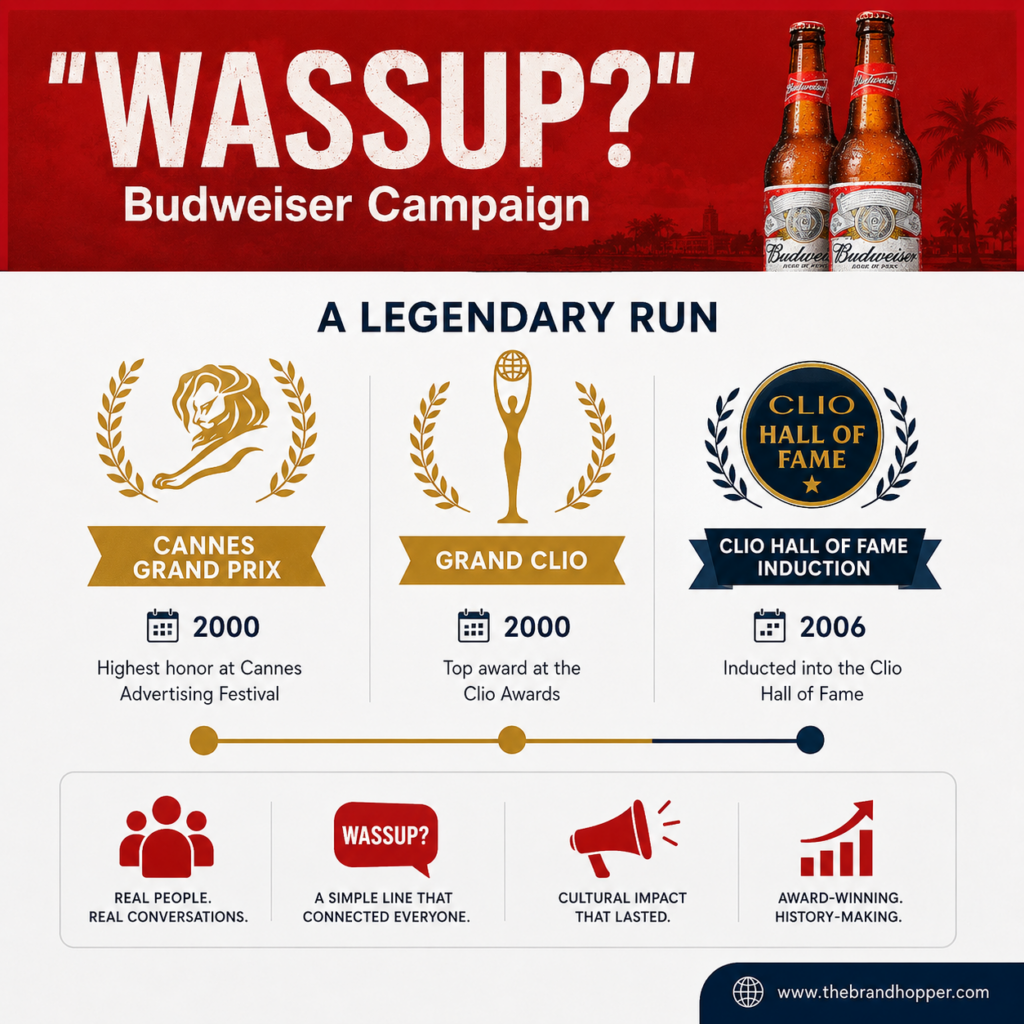
The campaign’s industry recognition matched its cultural reach: it won the Grand Prix at Cannes Lions and a Grand Clio, and was formally inducted into the Clio Hall of Fame in May 2006 — an honor reserved for ads judged to have lasting cultural and creative significance well beyond their original run.
For a campaign built on a single, low-production-value joke rather than a big visual set piece, that combination of business results (the sales and volume lift) and creative-industry validation (Cannes, Clio Hall of Fame) is part of why marketing courses and case studies still return to it decades later.
It’s also worth noting what the campaign didn’t rely on to win: no celebrity spokesperson (in its original 1999-2002 run), no elaborate visual effects, and no product-benefit messaging about taste, price, or refreshment — the entire creative and commercial case rested on five ordinary-looking friends greeting each other on the phone, which is precisely what made it feel so different from the beer-category advertising conventions of the late 1990s.

The 2008 Revival: A Political Statement, Not an Ad
Stone revived the concept in 2008 with the original cast, but repurposed the format for overt political commentary rather than beer advertising: the roughly two-minute short swapped the cheerful “Wassup?” greeting for a pointed conversation criticizing the presidency of George W. Bush and expressing support for Barack Obama’s campaign.
It wasn’t a Budweiser-commissioned ad — it was Stone and his real friends reusing a format the public already recognized to make a political statement — and it was nominated for the Favorite User-Generated Video award at the 35th People’s Choice Awards, itself a sign of how thoroughly the original format had become public cultural property rather than just an ad campaign.
The willingness of Stone and his friends to revisit the format on their own terms, nearly a decade after the original ran and entirely outside of any Budweiser contract, is itself a striking marker of the format’s staying power: very few commercial advertising formats are durable or recognizable enough that the original participants would voluntarily choose to reuse them for an unrelated purpose years later.

The 2020 Revival: “Checking In, That’s Whassup”
Twenty-one years after the original, Budweiser and agency VaynerMedia brought the format back for an entirely different reason: the COVID-19 lockdowns of spring 2020.
“Checking In, That’s Whassup” recreated the classic call-and-response structure with a cast that included NBA veterans Dwyane Wade and Chris Bosh, actress Gabrielle Union, two-time WNBA MVP Candace Parker, and DJ D-Nice, opening not with “watching the game, having a Bud” but with “in quarantine, having a Bud.”
The 90-second spot closed with “Buds support buds. Check in on yours,” alongside an on-screen number for the Salvation Army’s crisis line — repurposing a beer campaign’s most recognizable joke as a genuine public-health check-in prompt. The spot won a Bronze at the Clio Sports awards.
Notably, Budweiser sat out Super Bowl LV entirely in February 2021 for the first time in over three decades, redirecting that ad budget toward COVID-19 vaccine awareness instead — meaning the pandemic-era “Wassup” revival aired everywhere except the one stage it had originally been built for.

Where Budweiser’s Marketing Stands in 2026
Budweiser’s marketing hasn’t repeated the literal “Wassup?” script since, but the underlying instinct — warm, communal, unpretentious American nostalgia — is still the throughline of its biggest moments.
For Super Bowl LX in February 2026, Budweiser’s “American Icons” spot paired a Clydesdale foal with an injured bald eagle it shelters through a storm, scored to Lynyrd Skynyrd’s “Free Bird” and directed by Academy Award-nominated director Henry-Alex Rubin, timed to both Budweiser’s 150th anniversary and the United States’ upcoming 250th birthday.
It’s a very different execution from five guys on a phone call, but the strategic logic is the same one that made “Wassup?” work in 1999: skip the product-feature pitch entirely and sell an emotional, shareable moment instead.
Industry analysts have already flagged “American Icons” as a likely favorite of the 2026 Super Bowl ad slate specifically because it prioritizes goodwill and shareability over conventional beer-commercial tropes — the same bet Vinny Warren and August Busch IV made on an unproven short film back in 1999.
Parent company AB InBev reported full-year 2025 revenue of $59.3 billion, with its megabrands (Budweiser included) growing combined revenue 5.2% even against currency headwinds, and Anheuser-Busch remains the single largest advertiser at the Super Bowl by national airtime, splitting roughly two and a half minutes of ad time each year across Budweiser, Bud Light and Michelob Ultra — evidence that the brand-building playbook “Wassup?” helped pioneer is still central to how the company competes today, even as the specific creative executions have moved on entirely.

Lessons for Marketers
1. Find the idea, don’t always manufacture it. DDB Chicago’s biggest creative decision on “Wassup?” wasn’t inventing a new concept — it was recognizing a great one that already existed and moving fast to license it intact.
2. Authenticity is hard to fake and easy to spot when it’s real. The original cast were genuine lifelong friends, not actors reading a script for the first time, and that specific, unforced chemistry is widely credited as the reason the ad felt different from typical beer advertising.
3. A strong enough format can outlive its original context by decades. The same call-and-response structure has now been repurposed for political satire (2008) and public-health messaging (2020) without losing recognizability — evidence of just how deeply the format itself, not just the original ad, became cultural shorthand.
4. Sitting out a moment can be as strategic as showing up. Budweiser’s decision to skip Super Bowl LV in 2021 and redirect that spend to vaccine awareness shows the same brand that built its name on communal joy also knew when celebratory advertising would read as tone-deaf.
5. A legacy format can still inform new work without being literally repeated. Budweiser hasn’t remade “Wassup?” since 2020, but 2026’s “American Icons” spot pursues the identical goal — an emotional, non-product-forward moment built for maximum shareability — with an entirely new execution.
Frequently Asked Questions
Q: When did the Budweiser “Wassup?” campaign first air?
A: The first spot aired during Monday Night Football on December 20, 1999, with the campaign reaching mass audiences six weeks later during Super Bowl XXXIV on January 30, 2000.
Q: Who created the Budweiser “Wassup?” ad?
A: The concept originated as a short film called “True,” written and directed by Charles Stone III featuring his real-life childhood friends. DDB Chicago’s Vinny Warren discovered the film and brought the concept to Anheuser-Busch, which licensed it and hired Stone to direct the official ad version.
Q: Did the “Wassup?” campaign actually work commercially?
A: Yes. Anheuser-Busch cited a roughly 15% sales lift tied to the campaign’s early run, and The New York Times reported it helped the company add an estimated 2.4 million barrels of beer volume.
Q: Is the Budweiser “Wassup?” campaign still running today?
A: Not in its original form — the core campaign ran from 1999 to 2002 — but it has been revived twice since: as a 2008 political-commentary short and a 2020 pandemic-era “check in on your friends” PSA. Its emotional, non-product-forward approach still informs Budweiser’s advertising, including its 2026 Super Bowl LX spot.
Q: What awards did “Wassup?” win?
A: The campaign won the Cannes Lions Grand Prix and a Grand Clio, and was inducted into the Clio Hall of Fame in May 2006, an honor recognizing lasting cultural and creative significance.
Q: Who was in the 2020 “Wassup?” revival?
A: “Checking In, That’s Whassup,” created with VaynerMedia, featured NBA veterans Dwyane Wade and Chris Bosh, actress Gabrielle Union, WNBA MVP Candace Parker, and DJ D-Nice, encouraging people to check in on friends during COVID-19 lockdowns.
Q: Why did Budweiser skip the Super Bowl in 2021?
A: Budweiser sat out Super Bowl LV in February 2021 for the first time in over three decades, redirecting its advertising budget toward COVID-19 vaccine awareness instead of a traditional beer commercial.
Conclusion
Few ad campaigns get revived once, let alone twice, for reasons as different as a presidential election and a global pandemic — and fewer still are still shaping a brand’s Super Bowl strategy more than a quarter-century after their debut.
“Wassup?” worked because it captured something real (actual friends, an actual inside joke) at the exact moment mass media was becoming capable of spreading that authenticity at scale, years before social platforms made virality a marketing department’s explicit goal.
Budweiser’s newest Super Bowl spots look nothing like five guys on a phone call, but they’re chasing the same thing “Wassup?” proved was possible in 1999: an ad people want to share because it made them feel something, not because a brand told them to buy something.
Twenty-seven years on, that’s arguably the single most durable idea in Budweiser’s entire marketing history — more durable, in fact, than the specific joke that first proved it.
Related Case Studies
- A Case Study on Apple’s “Shot on iPhone” Brand Campaign
- Case Study Analysis: Nike’s “I Am Not A Role Model” Campaign
- Case Study Analysis: Coca-Cola’s “The Polar Bears” Campaign
- A Case Study on Cadbury’s Gorilla Brand Campaign
- Case Study Analysis: McDonalds “I’m Loving It” Campaign
To read more content like this, subscribe to our newsletter
Go to the full page to view and submit the form.