


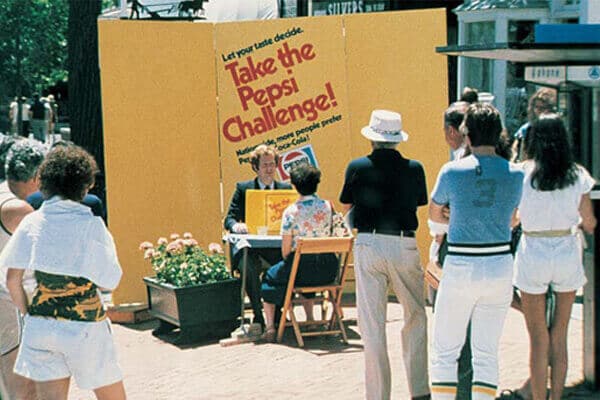
In 1975, PepsiCo did something that most challenger brands only imagine: it put its product next to the market leader’s, hid the labels and let strangers choose. The Pepsi Challenge, a blind taste test between Pepsi and Coca-Cola, began in Dallas and expanded nationally through public sampling events and television advertising.
The campaign became one of the most recognisable examples of comparative marketing. Although the original campaign ran from 1975 to 1983, Pepsi has revived the concept several times, including a 2015 social-led campaign and a 2025 Pepsi Zero Sugar versus Coke Zero Sugar tour. On February 8, 2026, the idea reached the Super Bowl LX audience in a commercial called “The Choice,” directed by Taika Waititi, in which a polar bear long associated with Coca-Cola chooses Pepsi.
This updated case study traces the story: the 1975 origin, how the campaign worked, the scientific criticism that has followed it for decades, the “New Coke” episode it helped influence, and where the Cola Wars stand in 2026. It also distinguishes documented campaign history and market data from company-reported promotional results and claims that cannot be independently verified.
1975: A Challenger Takes on Coke in Dallas
The Pepsi Challenge began in 1975 in Dallas, Texas, as a regional campaign in a market where Pepsi wanted to strengthen its position against Coca-Cola. Rather than competing only through conventional advertising, Pepsi used blind taste tests to challenge Coke’s reputation as the preferred cola.
The campaign followed consumer research suggesting that people could prefer Pepsi when they tasted the two drinks without seeing their labels. Pepsi’s advertising agency, BBDO, helped turn the tests into television commercials showing consumers sampling two unidentified colas and choosing Pepsi.
The strategy was strategic as much as creative: a challenger cannot easily outspend a market leader on familiarity, but it can attack the leader’s central claim. If a Coke drinker picked Pepsi with the labels removed, the campaign suggested that brand loyalty and taste preference were not necessarily the same thing.
The campaign initially focused on markets where Pepsi was performing less strongly, before expanding across the United States. By 1980, Pepsi Challenge advertising and taste tests were reportedly running in around 35% of the country, rising to approximately 75% of Pepsi’s markets the following year.

How the Challenge Worked: A Table, Two Cups and a Reveal
The format was simple and easy to repeat. A Pepsi representative set up a table at a grocery store parking lot, mall or other public location with two unmarked cups, one holding Pepsi and the other Coca-Cola.
Shoppers tasted both drinks, chose the one they preferred and were then told which brand they had selected. Pepsi used the results and footage of consumer reactions in its advertising.
The reveal was the key moment. The viewer did not just hear that Pepsi had won; they watched a Coke loyalist discover that they had selected its rival in a blind test.
The campaign’s original format was designed to make the comparison easy to understand and reproduce. Many older write-ups name specific malls, state fairs, stadiums, grocery chains and television appearances, but these details should not be repeated without reliable documentation.

What the Campaign Achieved: Separating Evidence From Folklore
How much the campaign moved sales is harder to establish than many summaries suggest. Pepsi’s advertising presented the results as evidence that consumers preferred its cola, while the campaign also changed the conversation around the category from who was bigger to which cola tasted better.
The campaign was credited with helping Pepsi narrow the competitive gap with Coca-Cola. Historical accounts also report that Pepsi overtook Coca-Cola in sales in grocery and other take-home markets in 1979, although this should not be interpreted as Pepsi becoming the overall market leader.
The commonly repeated figures that Pepsi’s share rose from 6% to 14% in promoted areas and that brand perception among young adults increased by 20% in a Harvard Business Review study could not be substantiated from reliable sources. They should therefore not be used as established campaign results.
The stronger evidence of the campaign’s impact is its influence on the category’s advertising and competitive strategy. It helped establish comparative taste testing as a memorable marketing device and became one of the pressures frequently discussed in accounts of Coca-Cola’s decision to reformulate its flagship drink.
The campaign was not Pepsi’s only advertising strategy, however. Pepsi continued to use lifestyle-led advertising alongside the taste-test campaign, and the original Pepsi Challenge advertising was phased out in 1983.
1985: The Pressure That Helped Produce New Coke
One of the most dramatic episodes in the Cola Wars came in 1985. Coca-Cola had been facing competitive pressure from Pepsi and had conducted extensive consumer research on a sweeter formula that performed well in blind taste tests.
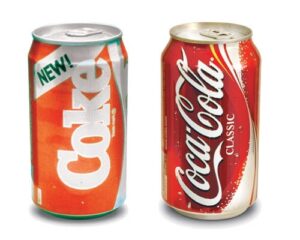
The company announced New Coke on April 23, 1985, replacing its original formula in the United States. The reformulated drink was designed partly in response to changing consumer preferences and the competitive pressure created by Pepsi’s taste-test advertising.
Consumer reaction was strong. Coca-Cola’s own historical account says its consumer hotline was receiving around 1,500 calls a day by June 1985, compared with approximately 400 calls a day before the formula change.
On July 11, 1985, Coca-Cola announced that the original formula would return as Coca-Cola Classic, just 79 days after New Coke’s launch. The company continued to sell New Coke for a period before eventually discontinuing it.
Accounts differ on how New Coke performed in internal testing, although historical accounts report that consumers generally preferred the sweeter formula in blind comparisons. Coca-Cola has also rejected the popular theory that the entire episode was a planned marketing stunt.
The lesson most often drawn is that a single-sip blind test measures something different from what people choose when they know the brand and drink a full can. Brand familiarity, emotional attachment and established habits can influence purchasing decisions beyond immediate taste preference.
The Pepsi Challenge had helped win a taste-test argument and contributed to the competitive pressure surrounding New Coke. It had not, however, made Pepsi the overall market leader.

Is a Blind Taste Test Fair? The Science and the Critics
The campaign’s methodology has been questioned for decades. In Blink (2005), Malcolm Gladwell discussed how a single sip can produce a different preference from drinking an entire can, arguing that the sweetness of Pepsi can make it more appealing in a short taste test.
The distinction is important because consumers do not normally purchase cola by taking one sip of two unlabelled samples. They buy a familiar product, consume it over time and make choices influenced by taste, brand associations, availability and habit.
There is also research showing that labels can influence taste preferences. A 1983 study titled “Pepsi versus Coke: Labels, Not Tastes, Prevail” found that participants’ judgments could be influenced by the labels attached to drinks, even when the contents were the same.
A 2008 study by Michael Koenigs and Daniel Tranel, titled “Prefrontal Cortex Damage Abolishes Brand-Cued Changes in Cola Preference,” found that healthy participants’ preferences shifted toward Coke when brand information was introduced, even though they preferred Pepsi in blind tests. Participants with damage involving the ventromedial prefrontal cortex did not show the same brand-cued shift.
Pepsi’s marketing language for this phenomenon in 2026 is the “Pepsi Paradox”: when labels and brand bias disappear, cola drinkers may prefer Pepsi. Critics reverse the logic: if brand information changes preferences, then the power of a cola brand extends well beyond its taste.
A fair summary is that the Pepsi Challenge was a persuasive marketing promotion rather than a controlled scientific study. Its results can illustrate the preferences of the people who participated, but they cannot establish a universal taste preference among all cola drinkers.
Revivals: 2015 and the 2025 Zero Sugar Tour
The Pepsi Challenge has been brought back in different forms over the years. In 2015, Pepsi relaunched the broader #PepsiChallenge as a global, social-led initiative involving celebrity ambassadors, interactive experiences and consumer challenges.
The 2015 campaign was broader than the original blind taste test. It included activities such as “Crash the Pepsi IPL” in India, which invited consumers to create advertisements for a chance to have their work aired during the Indian Premier League season.

In 2025, the campaign returned for its fiftieth anniversary with a more direct product comparison. Instead of focusing on the original colas, Pepsi put Pepsi Zero Sugar against Coca-Cola Zero Sugar, reflecting the growing importance of zero-sugar products in the category.
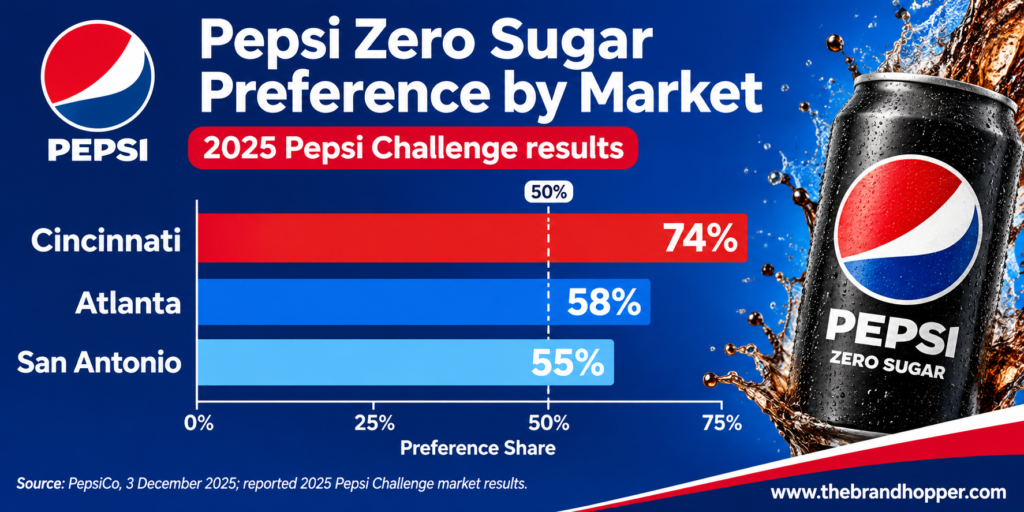
According to PepsiCo’s December 3, 2025 announcement, the tour invited more than one million consumers to participate and distributed over one million samples across 34 markets in 23 states plus Washington, D.C. Pepsi reported that Pepsi Zero Sugar won in all the markets where the company conducted the challenge.
The published market results included 58% preference for Pepsi Zero Sugar in Atlanta, 55% in San Antonio and 74% in Cincinnati. Pepsi said the overall preference exceeded 60% across the United States.
In its January 2026 Super Bowl announcement, Pepsi cited a separate overall figure: 66% of participants said Pepsi Zero Sugar tasted better than Coke Zero Sugar. These figures should be presented with their respective descriptions rather than treated as identical measurements.
The results are company-reported findings from a brand-run promotion, not an independent national taste survey. The company has not published enough methodological detail in its announcement to establish that the participants represent the wider U.S. cola-drinking population.
Pepsi also reported that Pepsi Zero Sugar’s sales grew 30.8% year to date in 2025 and that the brand reached more than one million additional households. The company said its growth was nearly twice that of the zero-sugar cola category.
For 2026, Pepsi announced an expanded tour with additional stops and a new flavour comparison. Pepsi Zero Sugar Wild Cherry was scheduled to appear at selected stops alongside Coca-Cola Cherry Zero Sugar.
The official Pepsi Challenge tour page lists 2026 events at locations and events including the NHL Stadium Series, the Ohio State Fair, the Days of 47 Rodeo and professional baseball games. This confirms that the revived campaign continued beyond the 2025 anniversary tour.
Pepsi’s marketing vice president, Gustavo Reyna, framed the logic in the company’s announcement: when stripped of brand bias, he said, people choose the better-tasting cola. That claim is the modern version of the 1975 pitch, and it carries the same limitations because a brand-run tasting tour can demonstrate the preferences of its participants but cannot settle what drives purchases in stores and restaurants.

Super Bowl LX: The Polar Bear Takes the Challenge
On January 29, 2026, PepsiCo unveiled its Super Bowl LX spot, “The Choice,” directed by Academy Award-winning filmmaker Taika Waititi. The 30-second commercial, produced using a combination of live action and CGI, follows a cola-loving polar bear who takes the Pepsi Challenge and chooses Pepsi Zero Sugar over Coke Zero Sugar.
Set to Queen’s “I Want to Break Free,” the commercial shows the polar bear reacting with surprise to its choice before going on a journey of self-discovery. Waititi also appears in the commercial as the bear’s psychiatrist.
The use of a polar bear was a deliberate reference to Coca-Cola’s advertising history. Coca-Cola first used polar bears in advertising in 1922, and the animal became a prominent brand character in the 1990s, making Pepsi’s use of the character a direct and playful provocation.
The commercial aired during Super Bowl LX on February 8, 2026. Pepsi supported it with a social giveaway on X offering a total of $100,000 in cash prizes, as well as complimentary Pepsi Challenge kits delivered through Gopuff in selected markets from February 6.
The brand also used social media, digital content and appearances by the polar bear around the San Francisco Bay Area during Super Bowl week. These activities extended the campaign beyond the television commercial and encouraged consumers to participate in the taste test themselves.
Reaction to the advertisement was mixed in an instructive way. Some commentators questioned whether using Coca-Cola’s polar bear was effectively giving additional attention to Coke, while others viewed the reference as a memorable way to dramatise Pepsi’s challenger positioning.
The campaign’s central idea remained consistent with the original Pepsi Challenge: remove the labels, let people taste both products and make the choice visible. No official Coca-Cola response to the advertisement was identified in the sources reviewed.

Cola Wars in 2026: Who Is Actually Winning?
To judge the Pepsi Challenge’s long-term effect, it helps to look at the market today. According to Beverage Digest data reported in 2026, Coca-Cola’s carbonated soft drink portfolio held the leading retail volume share in 36 of the 41 major U.S. metro markets tracked in 2025, excluding fountain sales.
At the individual brand level, Classic Coke held approximately 18.5% of U.S. carbonated soft drink volume in 2025, while Dr Pepper held 8.8%. Pepsi reclaimed the third position among U.S. soda brands, with a reported share of approximately 8.1%, after falling to fourth place in 2024.
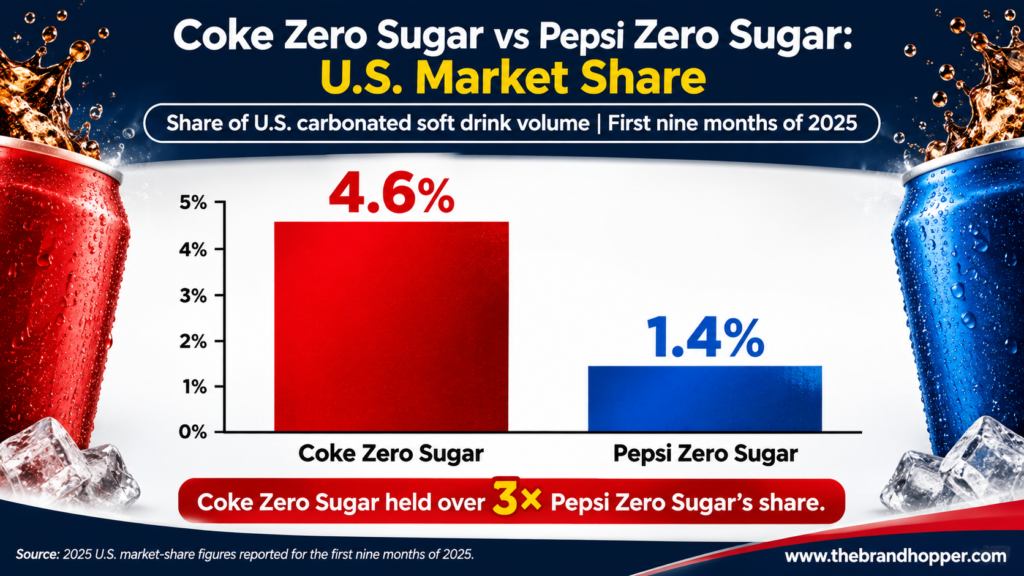
The zero-sugar segment tells a different story about growth and scale. Beverage Digest data shared with Marketing Dive showed that Coke Zero Sugar held 4.6% of the U.S. carbonated soft drink market during the first nine months of 2025, compared with 1.4% for Pepsi Zero Sugar.
Pepsi Zero Sugar was growing faster from that smaller base. Marketing Dive reported that its volume increased 18.1% during the period, compared with 4.8% for Coke Zero Sugar, while Pepsi separately reported 30.8% year-to-date sales growth for its product.
More recent Beverage Digest reporting also shows that the wider U.S. carbonated soft drink category remained under pressure in 2026. During the first nine months of 2026, retail volume was flat while dollar sales increased 3.8%, with the growth driven by pricing rather than higher category volume.
Beverage Digest reported that Coca-Cola outperformed the category during this period, while PepsiCo underperformed. This is broader company and portfolio context, not a direct update to the individual brand market-share figures for Coke and Pepsi.
Both can be true: Pepsi Zero Sugar can grow quickly from a smaller base while Coke Zero Sugar retains a substantially larger share. Fifty years after the first test, Pepsi has kept its taste argument alive, but Coca-Cola remains ahead in the U.S. soda market.
Lessons for Marketers
1. Attack the leader’s strongest claim: The Pepsi Challenge targeted Coke’s reputation for taste, which made it more effective than a generic comparison.
2. Let the customer be the evidence: A blind test and a visible reveal turned preference into a story that viewers could watch, making the message more engaging than a conventional product claim.
3. Test results are marketing, not science: Single-sip blind tests have limitations, so brands should disclose their methodology and avoid overstating what a promotion proves.
4. Know the difference between preference and choice: Pepsi has won taste tests, but Coke remains ahead in U.S. soda sales, showing that brand meaning, availability and habits influence behaviour alongside flavour.
5. A good mechanic can be reused: The blind taste-test format has returned in different forms, from the original campaign to the 2015 social initiative, the 2025 national tour and the 2026 Super Bowl advertisement.
6. Verify every number: Older write-ups repeat campaign statistics that cannot be sourced. Removing unsupported figures makes a case study more trustworthy rather than less.
Frequently Asked Questions
Q: When did the Pepsi Challenge start?
The Pepsi Challenge started in 1975 in Dallas, Texas, as a blind taste test between Pepsi and Coca-Cola. It began as a regional campaign and expanded across the United States.
Q: How did the original Pepsi Challenge work?
A Pepsi representative set up a table in a public place, often a grocery store parking lot, with two unmarked cups containing Pepsi and Coca-Cola. Consumers tasted both, chose their preferred drink and then learned which brand they had selected.
Q: Was the Pepsi Challenge a fair test?
It was a marketing promotion rather than a controlled scientific study. Critics, including Malcolm Gladwell in Blink, have argued that single-sip tests can produce different preferences from drinking a full can, while academic research has shown that brand labels can influence taste judgments.
Q: Did the Pepsi Challenge cause New Coke?
The Pepsi Challenge was one of the competitive pressures surrounding Coca-Cola’s decision to introduce New Coke, but it was not the only cause. Coca-Cola launched the reformulated drink on April 23, 1985, and brought back the original formula as Coca-Cola Classic on July 11, 1985.
Q: Is the Pepsi Challenge still running in 2026?
Yes. Pepsi revived the campaign in 2025 with Pepsi Zero Sugar versus Coke Zero Sugar and announced an expanded 2026 tour. The company also introduced Pepsi Zero Sugar Wild Cherry for selected comparisons with Coke Cherry Zero Sugar.
Q: What were the 2025 Pepsi Challenge results?
According to PepsiCo, Pepsi Zero Sugar won in all the markets where the company conducted its 2025 tour. Reported preference ranged from 55% in San Antonio to 74% in Cincinnati, while Pepsi said the overall preference exceeded 60%. These are company-reported promotional results.
Q: Who directed Pepsi’s Super Bowl LX ad?
Academy Award-winning filmmaker Taika Waititi directed “The Choice,” which features a polar bear choosing Pepsi Zero Sugar over Coke Zero Sugar in a blind taste test. The advertisement aired during Super Bowl LX on February 8, 2026.
Q: Is Pepsi bigger than Coke in the United States?
No. Coca-Cola remains ahead in the U.S. carbonated soft drink market. Beverage Digest data reported in 2026 showed Classic Coke leading individual soda brands by 2025 volume share, while Pepsi reclaimed the third position behind Coke and Dr Pepper.
Conclusion
The Pepsi Challenge remains one of the best examples of a challenger brand using the market leader’s own product as the stage. Its core idea, take the label away and let people choose, has lasted across multiple revivals because it is easy to understand, easy to repeat and creates a compelling story: a cola drinker surprised by their own taste preference.
The honest summary for 2026 is that the campaign won attention, helped intensify competitive pressure on Coca-Cola and kept Pepsi’s taste argument alive across five decades. However, it has not displaced Coca-Cola as the U.S. market leader.
Pepsi’s revival results are company-reported and should be read in that context. The wider market data shows that Pepsi Zero Sugar is growing from a smaller base, while Coke Zero Sugar retains a larger share and Coca-Cola continues to lead the overall market.
What the history shows is that a clever test can change the conversation without changing the leaderboard. Pepsi has been making that argument since 1975.
Also Read: Coca-Cola vs Pepsi: Which Brand Leads the Market?
To read more content like this, subscribe to our newsletter
Go to the full page to view and submit the form.