


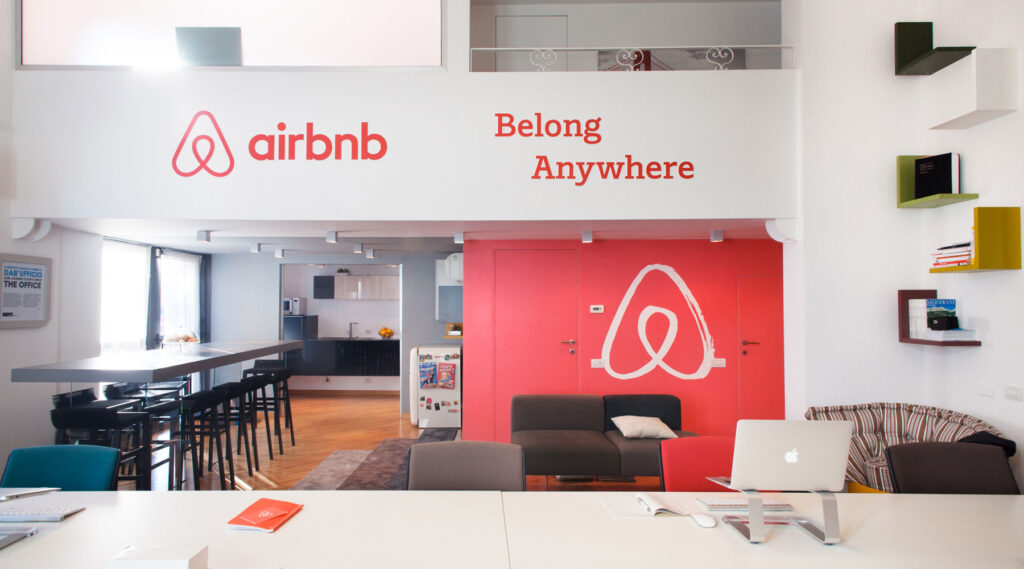
In July 2014, Airbnb unveiled a new logo it called a “universal symbol of belonging.” Within 48 hours, the internet had decided it looked like something else entirely, and more than 12,000 tweets were mocking it. That messy, very public launch is the real starting point for “Belong Anywhere” — not just the warm community-and-connection story Airbnb wanted to tell, but the story of a brand that has been repeatedly forced to defend, adapt and prove that idea, through a discrimination scandal, a Super Bowl ad about a travel ban, a pandemic, a full platform redesign, and now a global backlash over housing costs. This case study covers all of it, from the meme’d logo in 2014 to Airbnb’s 2025-2026 push into Services and Experiences.
| Quick Answer: What Is “Belong Anywhere”?
• Launched July 2014 by Airbnb and agency DesignStudio, built around a new “Bélo” logo and the mission that anyone can belong anywhere. • The Bélo logo drew over 12,000 mocking tweets within 48 hours of launch — and is still Airbnb’s logo today. • The mission survived a 2016 discrimination crisis (#AirbnbWhileBlack), a 2017 Super Bowl ad (#WeAccept), COVID-19, and a 2022 platform redesign. • 2025-2026: Airbnb has moved into Services and Experiences (launched May 2025) and is partnering around the 2026 Milan Winter Olympics. |
Origins: A Mission Launch That Became a Meme
Airbnb launched “Belong Anywhere” in July 2014 as a full repositioning, not just a new ad. Founders Brian Chesky and Joe Gebbia worked with London agency DesignStudio to move the company’s story away from “a website for renting spare rooms” toward a mission: a world where anyone could belong anywhere. The centerpiece was a new symbol, called the Bélo, merging a heart, a location pin, an “A,” and a person into one mark meant to represent belonging across people, places and Airbnb itself.

The Bélo Backlash: When “Belonging” Looked Like Something Else
The Bélo did not land the way Airbnb hoped. Design critics immediately flagged its resemblance to existing marks — German designer Erik Spiekermann publicly compared it to the logo of software firm Automation Anywhere, writing “someone didn’t do their homework” — while a much larger wave of social media users decided the symbol resembled body parts, turning it into a meme within hours and driving over 12,000 mocking tweets in two days. Airbnb’s response was to lean into transparency rather than quietly scrap the mark: it published a detailed design rationale and explainer video walking through the Bélo’s construction, and kept the symbol in place. It’s still Airbnb’s logo today, which is its own small case study in riding out a launch-week backlash rather than folding under it.
What Actually Made the Campaign Work
Once past the logo controversy, the campaign’s actual content leaned entirely on emotional, community-driven storytelling rather than product features: short documentary-style films about real hosts and guests, a #BelongAnywhere hashtag that pushed user-generated travel stories across Airbnb’s own channels, and out-of-home placements built around the same warm, inclusive visual language as the new mark. The strategy explicitly positioned Airbnb against hotel chains by selling connection to a place and its people, not just a bed to sleep in.

2016: The #AirbnbWhileBlack Crisis
That belonging narrative collided with a serious problem starting in 2015-2016: hosts discriminating against guests by race. A Harvard Business School study found that guests with distinctly African-American-sounding names were about 16% less likely to have their booking requests accepted than identical guests with white-sounding names, and throughout 2016 the hashtag #AirbnbWhileBlack spread firsthand accounts of the same pattern.
Airbnb’s response came in November 2016 with the “Community Commitment” — a mandatory non-discrimination agreement every user has to accept, covering race, religion, national origin, gender, sexual orientation and age, enforced by removal from the platform for violations.
2017: “#WeAccept” Turns a Crisis Response Into a Super Bowl Ad
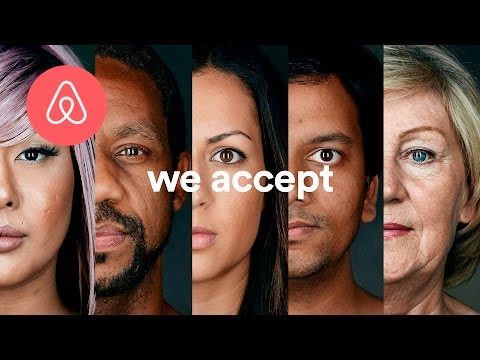
Three months later, in February 2017, Airbnb turned that same non-discrimination stance into a Super Bowl ad. “#WeAccept” ran during Super Bowl LI, days after the US federal government’s travel ban on seven Muslim-majority countries, closing on the line: “We believe no matter who you are, where you’re from, who you love or who you worship, we all belong. The world is more beautiful the more you accept.” It reused footage originally shot for the Community Commitment campaign, turning a defensive policy response into one of the more talked-about ads of that year’s Super Bowl.
2018: “Live There” — Belonging Gets Concrete
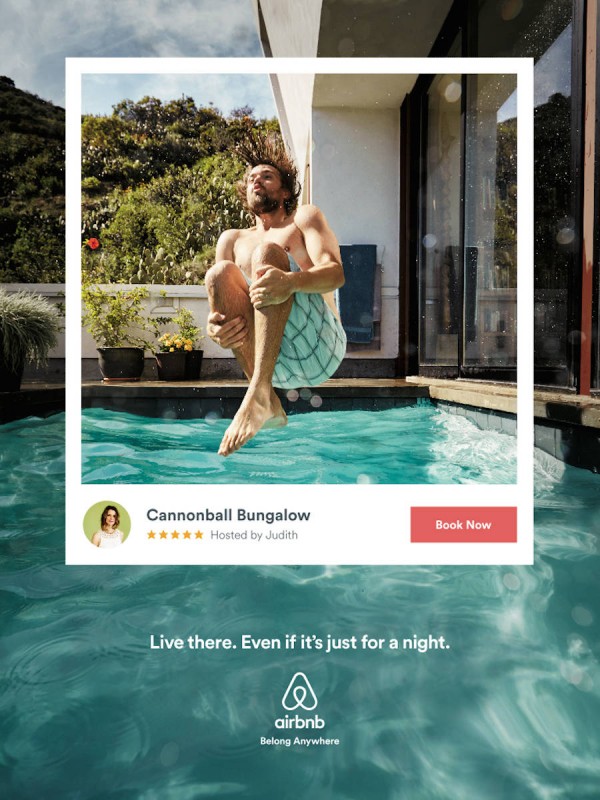
By 2018, Airbnb shifted its primary message from the abstract “belong anywhere” promise to something more concrete: “Live There.” The campaign encouraged travelers to skip tourist checklists and experience a destination the way a local resident would — grocery shopping at the neighborhood market, working from a local café — repositioning Airbnb stays as a lifestyle upgrade over hotels rather than just a cheaper alternative to them.

2020: Belonging Paused — COVID-19 and “Go Near”
COVID-19 stopped nearly all of this. Airbnb’s bookings collapsed in early 2020, the company laid off about 25% of its workforce that May, and paused most brand marketing. What advertising did run leaned into “Go Near” — short-distance, local travel — reflecting a world where “belong anywhere” had temporarily narrowed to “belong nearby.”
Airbnb went public in December 2020 in the middle of this disruption, one of the largest US IPOs of that year despite the state of the travel industry.
2022: Categories — The Biggest Change Since Airbnb Began
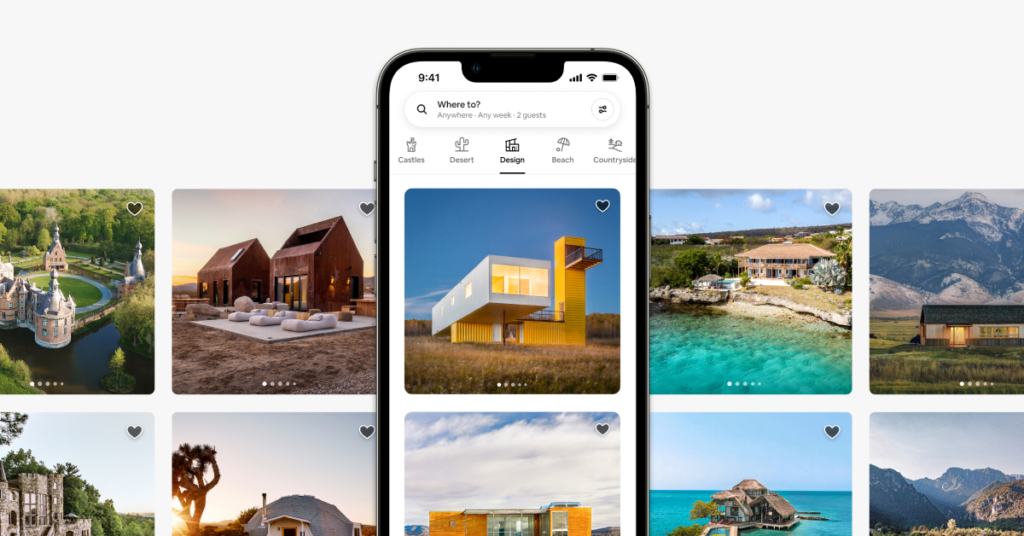
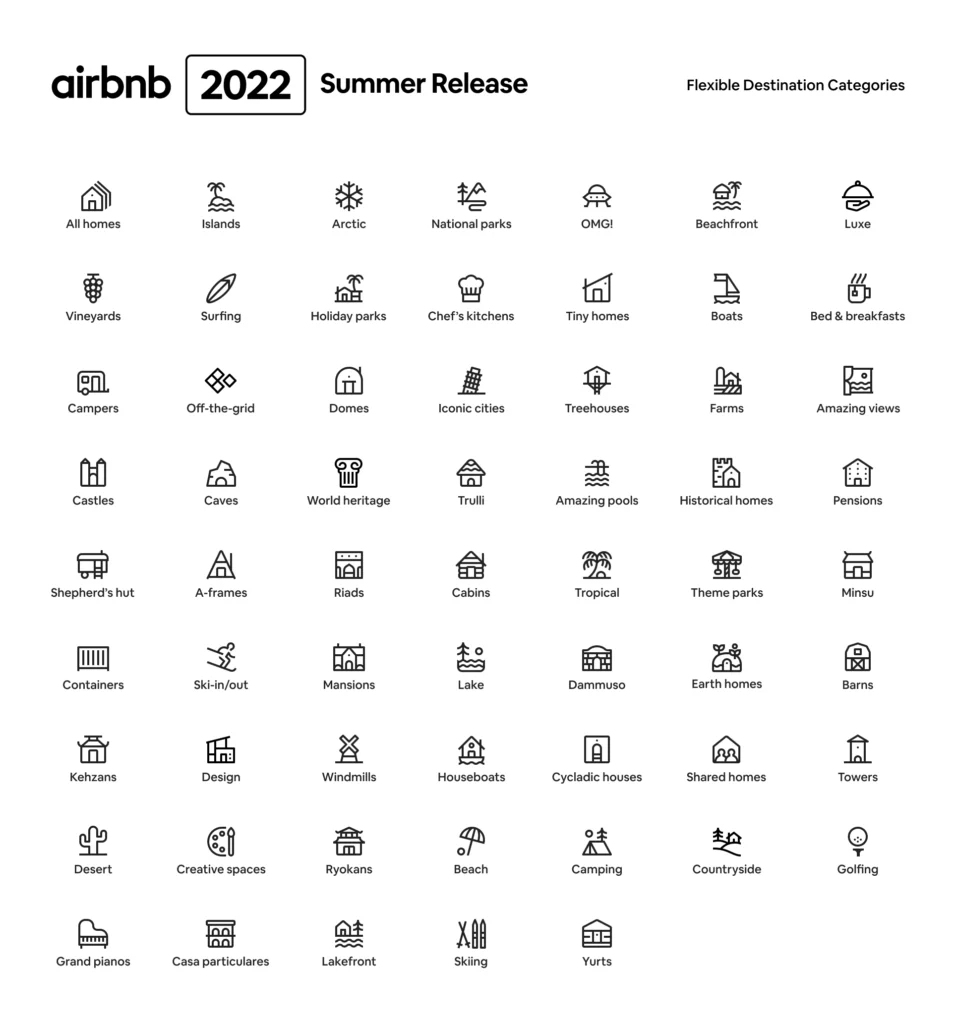
In May 2022, Airbnb shipped what Brian Chesky called the biggest change to the platform since the company’s earliest days: Airbnb Categories, a full search redesign organizing listings by type of stay (treehouses, tiny homes, islands, national parks) rather than destination alone, alongside AirCover, a standardized host-and-guest protection guarantee. It was less a marketing campaign than a product-led rebrand — the argument for “belonging” moved from ad copy into the browsing experience itself.


2023-2024: Airbnb Rooms and the Rise of “Icons”
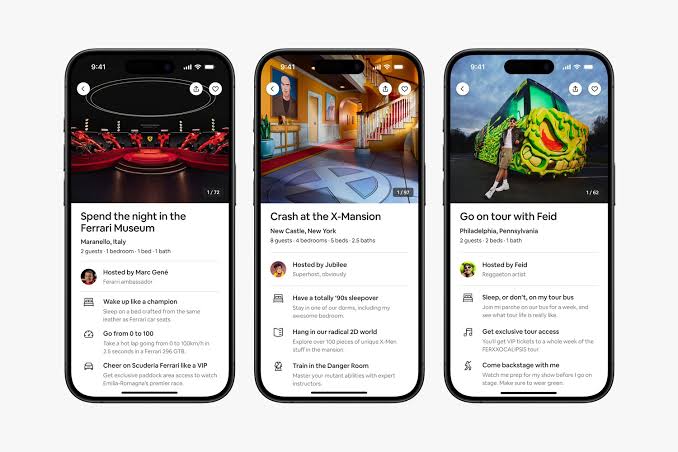
Airbnb kept iterating through 2023 and 2024. Airbnb Rooms, launched in 2023, went back to the company’s original single-room-in-a-shared-home format, positioned as a lower-cost, more human-scale alternative to the whole-home listings that had come to dominate the platform. Then in May 2024, Airbnb launched Icons: a small slate of surreal, mostly free or low-cost experiences hosted by cultural figures, including a night in Pixar’s Up house, Prince’s Purple Rain house, the Ferrari Museum, and meet-ups with Kevin Hart and Doja Cat. Airbnb issued about 4,000 invitations across 11 Icons experiences in the first year via a mixed lottery-and-judging selection process — a marketing-as-content play built for social sharing rather than direct revenue.

2025-2026: Services, Experiences, and the Milan Olympics
May 2025 brought Airbnb’s largest release since the 2022 redesign: a relaunch of Airbnb Experiences alongside an entirely new Airbnb Services product, offering on-demand chefs, personal training, spa treatments, massage, hair, makeup and catering bookable at a guest’s accommodation. Services launched in 260 cities and the Experiences relaunch (including “Originals,” experiences designed by Airbnb itself) rolled out across more than 600 cities, backed by up to $250 million in planned 2025 investment.
Airbnb has said it doesn’t expect meaningful revenue from either product this year, framing both as a multi-year bet on becoming more than an accommodation marketplace. Airbnb is also partnering to offer Services and Experiences around the 2026 Winter Olympics in Milan — arguably the clearest present-day descendant of the original “belong anywhere” idea: local, human experiences layered on top of a place to stay.

Data & Results
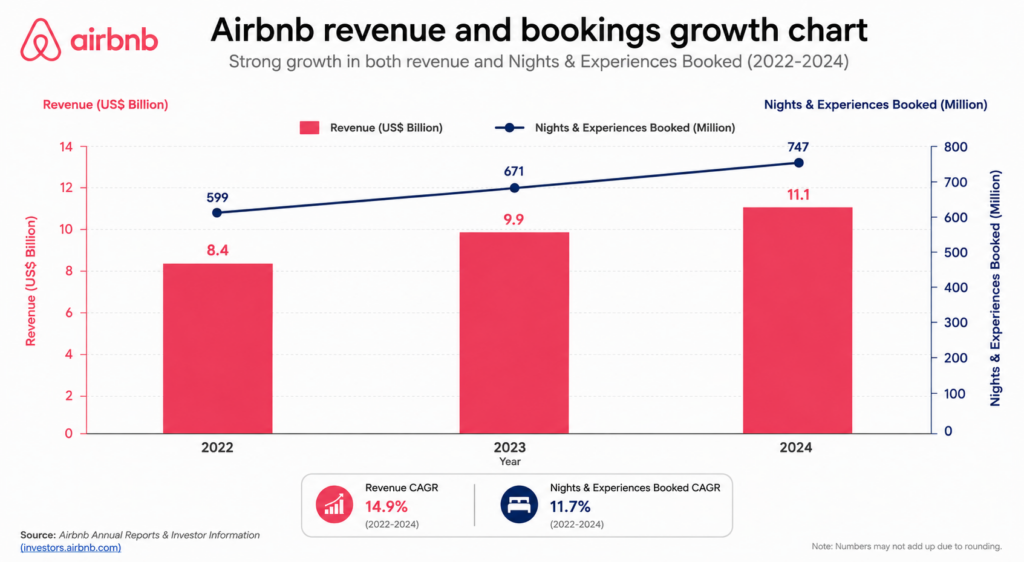
Airbnb reported full-year 2024 revenue of $11.1 billion, up 12% year-over-year, on nearly $82 billion in Gross Booking Value and more than 491 million Nights and Experiences Booked.
Adjusted EBITDA reached $4.0 billion in 2024 (a 36% margin), with $4.5 billion in free cash flow generated across the year.
Airbnb now operates across more than 220 countries and regions, and is investing up to $250 million in 2025 specifically to scale Services and Experiences beyond accommodation revenue.

The Other Side: Housing Backlash and Regulatory Crackdowns
The unresolved tension in “Belong Anywhere” is that the same short-term rentals that make travelers feel at home have made it harder for local residents to find one. New York City’s Local Law 18, fully enforced from late 2023, effectively banned most whole-unit short-term rentals under 30 days and approved only about 22% of registration applications as of January 2024 — and two years on, independent analysis has found city rents still near record highs despite the crackdown, suggesting the housing-cost story is more complicated than either side’s talking points.
Barcelona has gone further: in June 2024 the city announced it will not renew any short-term rental license after November 2028, aiming to return over 10,000 homes to the long-term market, a plan Spain’s Constitutional Court upheld in March 2025. Spanish national regulators fined Airbnb over unlicensed listings as recently as December 2025. None of this has reversed Airbnb’s growth, but it’s a direct, ongoing challenge to the emotional premise the 2014 campaign was built on.
Lessons for Marketers
1. A logo controversy doesn’t have to be a brand-ending event. Airbnb’s Bélo survived a genuine meme-storm by explaining itself transparently instead of retreating, and 12 years later it’s still the company’s mark.
2. Let the mission outlive any single campaign. “Belong Anywhere” has survived as Airbnb’s stated mission through at least four distinct marketing eras (Live There, Go Near, Categories, Icons) because the company treated it as a north star, not a slogan to protect word-for-word.
3. A defensive PR response can become an offensive marketing asset. The Community Commitment agreement, created to address a discrimination crisis, became the raw footage for one of Airbnb’s most-discussed Super Bowl ads within months.
4. Product design can carry a brand message further than advertising. The 2022 Categories redesign did more to reinforce “belonging” through browsing than any single ad campaign could have.
5. Don’t let the brand story outrun the real-world impact. Airbnb’s housing-market criticism shows what happens when a company’s marketing promise (belonging, community) moves faster than its policy response to the side effects of its own growth.
Frequently Asked Questions
Q. What was Airbnb’s “Belong Anywhere” campaign?
A. “Belong Anywhere” was Airbnb’s 2014 brand repositioning, built around a new logo (the Bélo) and a mission to make people feel at home anywhere in the world, shifting the company’s story from room-renting to global community and connection.
Q. Why was Airbnb’s Bélo logo controversial?
A. When Airbnb unveiled the Bélo symbol in July 2014, designers noted its similarity to existing marks and social media users widely joked that it resembled body parts, generating over 12,000 mocking tweets within 48 hours. Airbnb responded with a public design explainer rather than changing the logo, which is still in use today.
Q. Is “Belong Anywhere” still Airbnb’s mission?
A. Yes — Airbnb still describes its mission as creating a world where anyone can belong anywhere, even though its marketing has moved through several distinct campaigns since 2014, including Live There (2018), Go Near (2020), Categories (2022), Icons (2024) and the 2025 Services/Experiences relaunch.
Q. What was Airbnb’s #WeAccept Super Bowl ad?
A. “#WeAccept” aired during Super Bowl LI in February 2017, responding to the US travel ban on several Muslim-majority countries with a message of inclusion, built on footage from Airbnb’s 2016 Community Commitment anti-discrimination campaign.
Q. What is Airbnb doing in 2025-2026?
A. In May 2025, Airbnb launched Airbnb Services (on-demand chefs, spa treatments, personal training and more) in 260 cities and relaunched Airbnb Experiences in over 600 cities, backing both with up to $250 million in investment, and is partnering on Services and Experiences around the 2026 Milan Winter Olympics.
Q. Has Airbnb faced backlash over housing costs?
A. Yes. New York City’s Local Law 18 (2023-2024) effectively banned most short-term whole-unit rentals, and Barcelona will not renew any short-term rental licenses after November 2028 — a ban upheld by Spain’s Constitutional Court in March 2025 — as cities push back on short-term rentals’ effect on local housing supply.
Conclusion
“Belong Anywhere” is a rare case of a brand mission that survived its own launch-week disaster, a discrimination scandal, a pandemic, and a full product overhaul, and is still recognizably the same idea driving Airbnb’s biggest bets in 2025 and 2026. What’s changed isn’t the mission so much as Airbnb’s willingness to test it against reality — through a Super Bowl ad, a redesigned app, a slate of celebrity experiences, and now an entire Services business — while an increasingly organized regulatory backlash argues the company hasn’t yet squared “belonging” with its effect on the neighborhoods it operates in. Both things are true at once, which is exactly what makes this campaign worth studying past the nice logo story.