


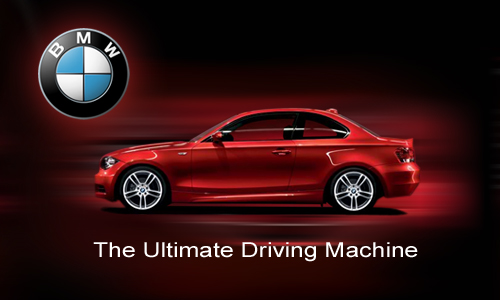
“The Ultimate Driving Machine” has been BMW’s advertising backbone for more than 50 years — one of the very few automotive taglines to outlast the agency that wrote it, three generations of every model in BMW’s lineup, and the entire combustion-engine era it was coined to describe. It has also, for one bruising three-year stretch, been quietly dropped by BMW’s own headquarters and then brought back after a customer backlash. This case study covers the full arc: the 1974 pitch that created the line, the decades that built it into the most recognized slogan in the car industry, the controversy that nearly ended it, and what it means for BMW now that the company is betting the same four words on an electric future.
| Quick Answer: What Is “The Ultimate Driving Machine”?
• Coined in 1974 by copywriter Martin Puris (Ammirati & Puris) after BMW exec Bob Lutz chose the agency over larger rivals. • Quietly replaced by “Joy” from 2009-2012; restored as BMW’s primary tagline by 2011 after a loyalist backlash. • BMW Group delivered 2.46M vehicles in 2025; BMW ranks 3rd among automotive brands in Interbrand 2025 ($46.8B). • 2025-2026: the tagline is being carried into BMW’s electric Neue Klasse era, starting with the iX3. |
Origins: A Struggling Importer and a Four-Week-Old Agency
In the early 1970s, BMW was a minor player in the US, overshadowed by Mercedes-Benz. Bob Lutz, then BMW’s head of sales and marketing, ran a review of three American agencies — Ted Bates, Benton & Bowles, and a two-person startup called Ammirati & Puris that had been operating out of a Manhattan hotel room for four weeks with no paying client. Ammirati & Puris won the account after presenting in Munich.
What set the pitch apart was process, not slogan-writing. Copywriter Martin Puris and his partner spent time not with BMW’s marketing department but with its engineers, trying to understand what the company actually valued before writing a word of copy. Puris later said that focus on engineering, not luxury or status, is what separated BMW from Mercedes and gave the agency its opening. The result, in 1974, was four words: “The Ultimate Driving Machine.”

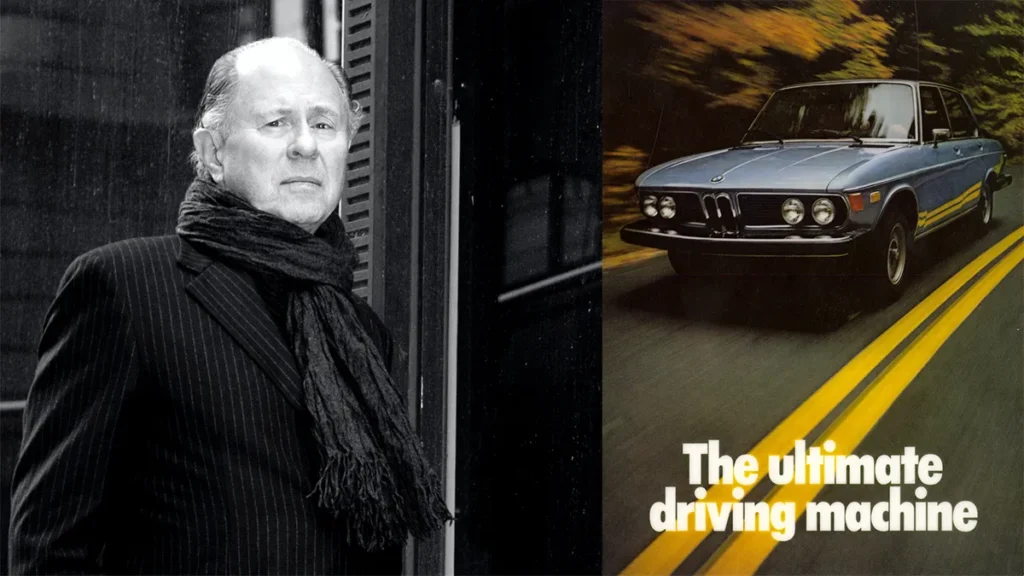
What Made the Line Work
The line did more than describe a car — it staked out ground none of BMW’s competitors were defending. Mercedes and other luxury marques sold comfort, status and prestige; BMW sold the act of driving itself. That gave the brand a distinct, defensible position with a specific buyer: an affluent, performance-oriented driver who saw a car as more than transport.
The tagline worked as well as it did because BMW’s product and its advertising said the same thing — precision engineering, sporty handling, driver-focused design — at every touchpoint.
Proof in the Product: Engineering Behind the Claim
A tagline this bold only survives if the product keeps proving it, and BMW built engineering choices specifically to make the claim defensible rather than just memorable: a near-perfect 50/50 front-rear weight distribution across most of the lineup, rear-wheel drive as the historical default even as competitors shifted to front-wheel platforms, and steering tuned for road feedback rather than isolation.
The M division, spun up in the 1970s and formalized through icons like the M3 and M5, exists specifically to give the tagline a halo range — cars whose track credentials make “ultimate” a claim journalists could independently test, not just a line copywriters wrote.
Even as BMW expanded into SUVs (the X line) and, later, EVs, the engineering brief stayed the same: whatever wears the badge has to out-handle its segment, or the tagline stops being credible.
Building the Message: The 1970s Through the 1990s
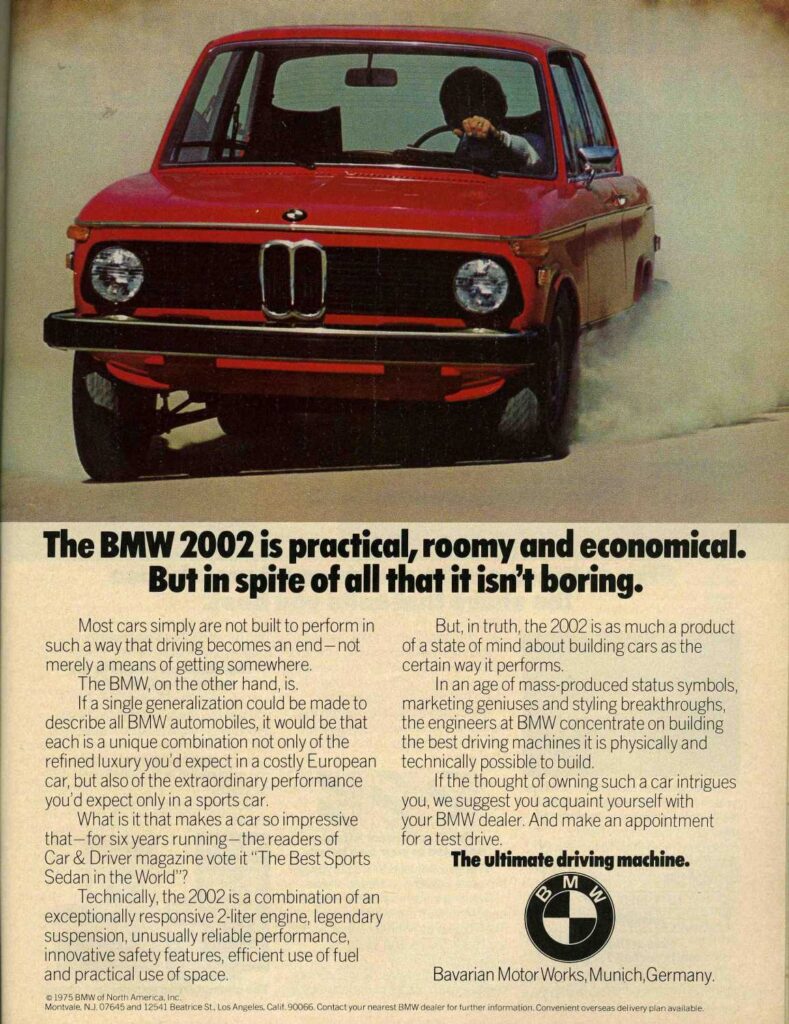
The commercial impact was immediate and sustained. BMW sold 15,007 cars in the US in 1974, rising to 19,419 in 1975 and 26,040 in 1976, and continued climbing through the 1980s and 1990s as print and TV ads leaned on the same imagery: BMWs on winding mountain roads and racetracks, framed around performance and precision rather than luxury lifestyle.

2001: BMW Films and “The Hire”
In 2001, BMW pushed the idea further than any car brand had tried, commissioning “BMW Films,” a series of short action films built around BMW vehicles rather than around obvious product shots. The best-known entry, “Beat the Devil,” starred Clive Owen opposite Gary Oldman and Danny Trejo, directed by Tony Scott, with a cameo appearance by James Brown and the Devil buying back his soul in a duel with a BMW Z8. The BMW Films series also included installments from directors John Frankenheimer, Ang Lee, Guy Ritchie and Alejandro González Iñárritu — a roster no car brand had assembled before or has matched since. It reframed automotive advertising as a content platform years before “branded content” was an industry term.

2009-2012: The “Joy” Interruption
Real Beauty-style purpose campaigns weren’t BMW’s risk; consistency was — and in 2009, BMW’s own Munich headquarters broke it. Corporate leadership pushed for fresh creative thinking and asked BMW of North America to drop “The Ultimate Driving Machine” altogether in favor of a softer, more inclusive message: “Joy.”
The stated goal was to broaden BMW’s buyer base — particularly toward women, a demographic where BMW under-indexed — and to soften a brand perception that internal research described as aggressive and arrogant. “Joy is BMW” launched alongside BMW’s sponsorship of the 2010 Winter Olympics and ran as the brand’s primary message even while some dealer and product advertising still quietly used the old tagline. The reaction from BMW loyalists was immediate and hostile: enthusiast forums revolted, and BMW’s marketing leadership faced public anger serious enough that the executive backing the change received death threats over what was, ultimately, an ad campaign.

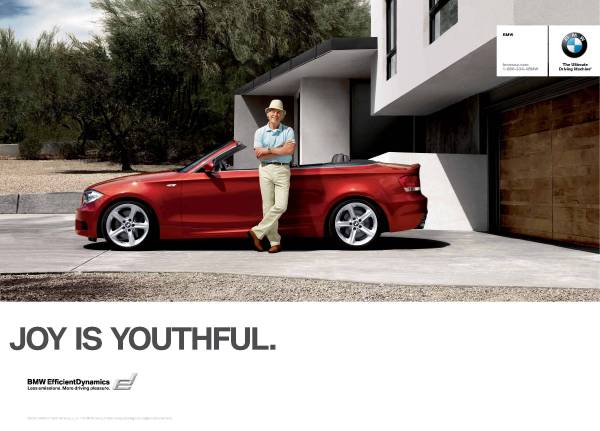
“Joy” never replaced “The Ultimate Driving Machine” in owners’ minds the way it was meant to, and BMW’s own marketing head, Dan Creed, pushed to bring the original line back into the spotlight. By 2011, the 5 Series ad “Refuel” closed on the restored tagline, and BMW of North America has not seriously moved away from it since. The episode is now a standing lesson in brand strategy: a 35-year-old tagline had become bigger than any single marketing department’s preference for it, and reversing course publicly cost BMW less credibility than staying the course would have.

The 2010s: Electrification Without Losing the Plot
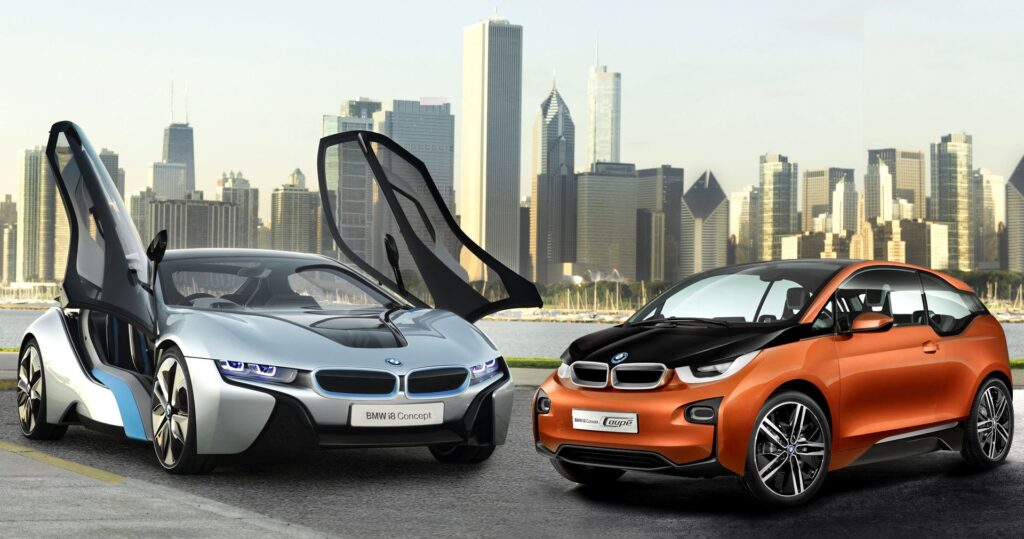
The 2010s saw BMW fold sustainability into the same promise rather than compete with it. The BMW i sub-brand launched the i3 city car and i8 hybrid sports car in 2013-2014, explicitly marketed as proof that “Ultimate Driving Machine” could include electrified drivetrains without losing driving character — carbon-fiber construction and sharp handling were used to keep the i3 and i8 inside the same performance identity as the 3 Series and M models, rather than positioning them as a separate, slower “green” line.

2024: The 50th Anniversary
2024 marked the tagline’s 50th anniversary, and BMW leaned into its own advertising history rather than just running a nostalgia ad. BMW of North America published “50 Stories for 50 Years,” a chapter-by-chapter retrospective covering the agency pitch, the Joy controversy, and the campaign’s global rollout, while Martin Puris donated the entire Ammirati & Puris agency archive to St. John’s University, creating a permanent public and academic archive of the campaigns (including BMW, Club Med and UPS work) that most defined 1970s-90s American advertising.
2025-2026: The Ultimate Driving Machine Goes Electric
2025-2026 is the tagline’s biggest test since “Joy”: BMW is applying it to a fully electric platform for the first time.
The BMW iX3, the first model built on BMW’s new “Neue Klasse” architecture, made its North American debut in September 2025 and is arriving in US showrooms in mid-2026 — explicitly framed by BMW’s own press materials as “signaling the future of The Ultimate Driving Machine.” A second Neue Klasse model, the electric i3 sedan, follows in 2026, with BMW planning to extend Neue Klasse technology across roughly 40 models by 2027.
The first fully electric M-branded Neue Klasse performance car is due in 2027, built on an 800-volt architecture with a 100+ kWh battery and four electric motors — BMW’s clearest statement yet that it intends “Ultimate Driving Machine” to survive the shift away from combustion engines entirely, not retire alongside them.

Global Adaptation: One Promise, Several Languages
The line has always traveled with local nuance rather than a literal translation. In Germany, BMW’s home-market equivalent is “Freude am Fahren” (“Joy of driving”) — the same word, “Freude,”/”Joy,” that caused so much friction when BMW tried exporting it to America as a replacement rather than a companion phrase. In China, the positioning is rendered closer to “the art of driving.”
The specific wording flexes by market; the underlying promise — that BMW is built around the experience of driving, not just the car itself — has not.
Competitor Response
BMW’s rivals answered with their own long-running lines rather than attacking “Ultimate Driving Machine” directly: Mercedes-Benz built its identity around “The Best or Nothing,” and Audi around “Vorsprung durch Technik” (“Progress through Technology”).
Neither has matched BMW’s line for longevity or unprompted recall, largely because neither brand kept its slogan as singularly consistent — BMW is the rare case where the same four words have anchored the brand’s advertising, dealership signage and product-development language for five decades.
Results: Does the Line Still Move Metal?
BMW Group delivered 2,463,715 vehicles worldwide in 2025, essentially flat year-over-year (+0.5%), with the BMW brand itself the global segment leader in premium/luxury autos despite a slight 1.4% dip in its own deliveries; electrified vehicles (BEV and PHEV) made up 26% of total sales, and BMW M GmbH posted an all-time delivery record of 213,457 performance cars (+3.3%).
In Interbrand’s 2025 Best Global Brands report, BMW ranks as the third most valuable automotive brand at $46.8 billion (14th overall) — behind Toyota ($74.2B) and Mercedes-Benz ($50.1B) — after a 10% year-over-year decline tied to EV competition and softer China demand.
BMW brand recall for “The Ultimate Driving Machine” remains unprompted in most industry brand-tracking studies, a rare feat for a tagline older than most of its target buyers.
The Real Challenge: What Does “Ultimate Driving” Mean in an EV?
The campaign’s most serious threat has never been a competitor’s slogan — it’s the credibility gap between “ultimate driving” and a product line that increasingly includes SUVs, plug-in hybrids and, from 2025 onward, fully electric Neue Klasse models built on principles BMW itself labels Electric, Digital and Circular rather than purely performance-driven.
Critics and even some BMW-focused outlets have openly asked what “Ultimate Driving Machine” is supposed to mean once the driving experience is mediated by battery weight, software-defined handling and, eventually, autonomous features — a question BMW has not fully answered yet, but one the Joy-era backlash already proved BMW cannot solve by quietly changing the words.
Lessons for Marketers
1. Consistency compounds. BMW’s 50-year refusal to swap taglines is the reason unprompted recall is still high; almost no other automotive slogan has survived three CEOs, the death of the agency that wrote it, and a full powertrain transition.
2. Know when a repositioning is a bridge too far. “Joy” wasn’t a bad idea in isolation — broadening appeal and softening brand perception are legitimate goals — but BMW underestimated how much equity was stored in the specific four words it was replacing.
3. Let the product prove the line, not the ad. “Ultimate Driving Machine” survived because 50/50 weight distribution, the M division and the i3/i8 were built to be evidence for the claim, not just a subject for it.
4. A tagline can flex locally without breaking globally. “Freude am Fahren” in Germany and a driving-art framing in China show the same promise adapting to language and culture without diluting the core idea.
5. Reversing a misstep publicly can cost less than defending it. BMW’s 2011 return to the original line, after “Joy,” was a bigger credibility win than staying the course would have been.
Frequently Asked Questions
Q. Who created BMW’s “The Ultimate Driving Machine” slogan?
A. Copywriter Martin Puris of the New York agency Ammirati & Puris created the line in 1974, after BMW’s then-marketing chief Bob Lutz selected the two-person startup agency over larger rivals Ted Bates and Benton & Bowles.
Q. When did BMW first use “The Ultimate Driving Machine”?
A. The tagline launched in 1974 for BMW of North America, as the company was trying to build a foothold in the US market against Mercedes-Benz.
Q. Did BMW ever stop using “The Ultimate Driving Machine”?
A. Yes. Between 2009 and 2012, BMW’s Munich headquarters pushed a replacement campaign called “Joy,” aimed at broadening the brand’s appeal. It provoked a strong backlash from BMW loyalists, and the original tagline was restored as the brand’s primary message by 2011.
Q. What was BMW’s “Joy” campaign?
A. “Joy” (2009-2012) was a BMW of North America campaign meant to soften the brand’s image and appeal more to women and mainstream buyers, tied in part to BMW’s 2010 Winter Olympics sponsorship. It’s remembered mainly for the backlash it caused among BMW enthusiasts, who saw it as abandoning “The Ultimate Driving Machine.”
Q. Is “The Ultimate Driving Machine” still BMW’s tagline in 2026?
A. Yes. BMW is carrying the tagline into its electric era, using it explicitly in the launch messaging for the iX3, the first model on its new Neue Klasse platform, which debuted in North America in September 2025.
Q. Is BMW the world’s most valuable automotive brand?
A. No — per Interbrand’s 2025 Best Global Brands report, BMW ranks third among automotive brands ($46.8B), behind Toyota ($74.2B) and Mercedes-Benz ($50.1B).
Q. What are BMW’s competitors’ equivalent taglines?
A. Mercedes-Benz uses “The Best or Nothing,” and Audi uses “Vorsprung durch Technik” (“Progress through Technology”). Neither has matched “The Ultimate Driving Machine” for longevity or consumer recall.
Conclusion
Fifty-two years after Martin Puris wrote four words for a struggling US importer, “The Ultimate Driving Machine” is still BMW’s advertising spine — durable enough to survive a corporate-mandated replacement, three CEOs, and now a genuine powertrain revolution. Its next real test isn’t a rival’s slogan; it’s whether an electric, software-defined Neue Klasse can still make good on a promise written for a straight-six engine and a winding road. BMW’s own marketing history says the brand has been here before, in its own smaller way, with “Joy” — and that betting on the original four words again is usually the safer trade.
Also Read: A Case Study on Intel’s Intel Inside Campaign
To read more content like this, subscribe to our newsletter
Go to the full page to view and submit the form.