


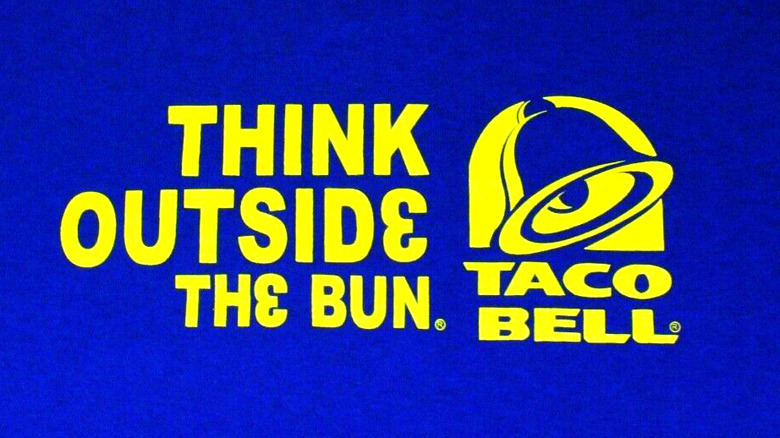
In the second quarter of 2000, Taco Bell posted the worst same-store sales decline in its history — a 6% drop — and fired the ad agency behind its most famous mascot in response. That failure is the real starting point for “Think Outside the Bun,” the campaign that replaced the Chihuahua and, in one form or another, is still shaping Taco Bell’s marketing 25 years later. This case study covers the full arc: why the previous campaign collapsed, how “Think Outside the Bun” rebuilt the brand from 2001 to 2012, and what replaced it — because the tagline itself was retired 14 years ago, and Taco Bell’s marketing today looks nothing like a 2004 TV spot.
| Quick Answer: What Was “Think Outside the Bun”?
• Launched September 2001 by agency Foote, Cone & Belding, replacing the commercially unsuccessful Chihuahua campaign. • Built the marketing story around genuinely unusual menu items — the Crunchwrap Supreme (2005) was the clearest proof point. • Retired in 2012 in favor of “Live Más,” which is still Taco Bell’s tagline today and drove the Doritos Locos Tacos launch (1B units in year one). • 2025-2026: an AI drive-thru misstep, and “Live Más LIVE,” an annual Peacock event unveiling each year’s menu news. |
Before the Bun: Why the Chihuahua Campaign Had to Go
Taco Bell’s Chihuahua campaign, built around the catchphrase “Yo quiero Taco Bell,” was a genuine pop-culture hit from 1997 to 2000 — and a commercial failure. The dog was popular enough to spawn merchandise and impressions from late-night hosts, but customers loved the mascot more than the menu: same-store sales kept sliding, and the campaign drew real backlash, including criticism of a 1998 ad dressing the dog as Che Guevara. When Taco Bell posted a 6% same-store sales drop in Q2 2000 — its steepest decline ever — the company ended the campaign that July, cut ties with agency TBWA, and replaced its president. (The dog had one more act: creators of the original ad concept sued and won a $42 million judgment against Taco Bell and TBWA in 2003 for stealing the idea.)

2001: The Birth of “Think Outside the Bun”
Taco Bell hired San Francisco agency Foote, Cone & Belding (FCB) to build the replacement. “Think Outside the Bun” debuted in September 2001, backed by a reported $200 million annual media budget, with a direct positioning goal: stop looking like a discount burger alternative and start looking like the one fast-food chain willing to make food that didn’t fit a bun at all. FCB and Taco Bell spent three more years refining the idea before making it the centerpiece of a full campaign relaunch in 2004, using that time to line up menu innovation that could actually back up the claim.

Strategy and Execution: Letting the Menu Prove the Slogan
The campaign ran across TV, print and (by the mid-2000s) early digital and social channels, but its real proof point was the menu. Taco Bell used “Think Outside the Bun” to justify products that were, literally, not sandwiches: the Crunchwrap Supreme, introduced as a limited-time item in summer 2005 and made permanent in January 2006, became one of the brand’s best-selling items ever and the clearest example of marketing and product development moving in lockstep. “Fourth Meal,” launched later in the campaign’s run, extended the same outside-the-box logic to daypart strategy — positioning late-night Taco Bell as a category Taco Bell had simply invented.

A Quick Correction: The Taco Liberty Bell Wasn’t This Campaign
A frequently misdated bit of Taco Bell lore belongs here for accuracy, not celebration: the infamous “Taco Liberty Bell” April Fools’ prank — full-page newspaper ads announcing Taco Bell had bought the Liberty Bell to help pay down the national debt — ran in 1996, five years before “Think Outside the Bun” existed and while the Chihuahua campaign was still airing.
Several marketing retrospectives misattribute it to the Think Outside the Bun era; it’s genuinely one of Taco Bell’s best pranks, just from an earlier chapter.
Impact on Brand Identity
The effect on brand identity was real and durable. Pre-2001, Taco Bell competed on price against burger chains; post-“Think Outside the Bun,” it competed on menu creativity and a self-aware, slightly rebellious tone that carried into social media once Taco Bell’s accounts became known for witty, unusually candid replies to customers and competitors alike in the late 2000s.
2012: The Shift to “Live Más”
“Think Outside the Bun” ran for roughly a decade before Taco Bell retired it in 2012 in favor of “Live Más” (“Live More”) — a broader lifestyle positioning rather than a menu-innovation pitch. The timing wasn’t a coincidence: 2012 was also the year Taco Bell launched Doritos Locos Tacos, developed with Frito-Lay, which went on to sell one billion units within its first year — reportedly the most successful product launch in the chain’s history — giving “Live Más” an immediate, enormous proof point right out of the gate.

The “Live Más” Era: Quesalupa, Scholarships, and Beyond
“Live Más” absorbed the same outside-the-box menu logic and kept running it: the Quesalupa, a chalupa stuffed with a molten cheese pocket, launched nationally in February 2016 after a 36-restaurant test run in Toledo, Ohio that the company called one of the most successful in its history.
Taco Bell also used the “Live Más” era to build out the Live Más Scholarship program, funding entrepreneurial and creative students, tying the brand’s “live more” message to a tangible off-menu benefit rather than just advertising language.
2025: The AI Drive-Thru Stumble
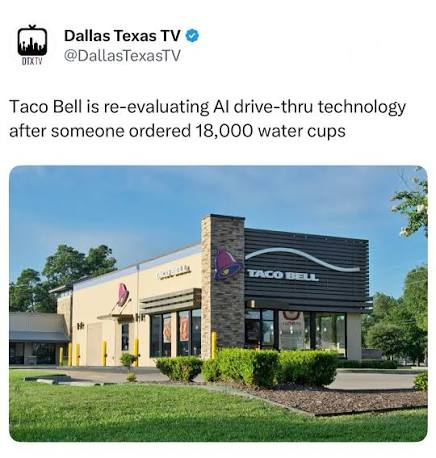
Not every recent experiment has landed. In 2025, Taco Bell rolled out voice-activated AI drive-thru ordering (built on Yum Brands’ Byte platform with Nvidia) to more than 500 US locations. The system went viral for the wrong reason that August, when a prank order for 18,000 cups of water was accepted and processed rather than flagged, and customers separately reported the AI repeatedly pushing add-on drinks mid-order.
Taco Bell paused expansion to review the technology and told franchises to treat voice AI as a supplementary tool paired with human staff during peak hours, not a standalone replacement — a rare recent misstep for a brand whose whole marketing identity is built on cleverness.

2026: “Live Más LIVE” and Today’s Taco Bell
As of 2026, “Live Más” remains Taco Bell’s primary tagline, and its highest-profile marketing event is now an annual streaming special rather than a TV commercial: “Live Más LIVE,” a Peacock variety show now in its third year, aired its 2026 edition on March 10 as “A Night at the Palladium,” hosted by musician Vince Staples and used to unveil more than 20 menu changes for the year, including Nacho Fries becoming a permanent menu item. It’s the clearest present-day descendant of “Think Outside the Bun”: still using a big cultural moment to launch menu news, just built for streaming audiences instead of Super Bowl-style TV spots.

Data & Results
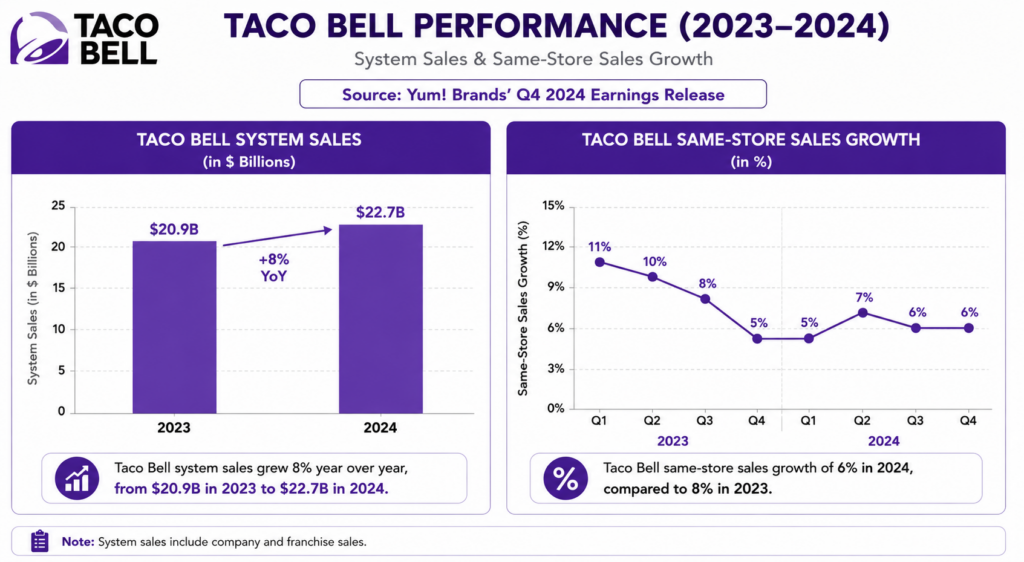
1. Taco Bell’s system sales reached $17.19 billion in 2024, up 8% excluding currency effects, making it the primary growth engine inside parent company Yum! Brands.
2. Same-store sales grew 4% for full-year 2024 (U.S. same-store sales up 6%), with a particularly strong fourth quarter in which Taco Bell Division same-store sales rose 14% year-over-year.
3. The Taco Bell Division operates 8,757 units globally, with 87% of locations in the United States.
- 4. Doritos Locos Tacos, launched alongside the shift to “Live Más” in 2012, sold one billion units within its first year on shelves.

Challenges and Criticisms
The campaign era wasn’t without real friction: some longtime customers worried the focus on novelty items diluted Taco Bell’s original value-menu identity, rising health-consciousness among consumers put pressure on Taco Bell to publish more nutrition information, and competitors (Wendy’s, Jack in the Box, and later Chipotle) all leaned into their own edgier, product-innovation-led advertising once Taco Bell proved it worked.
The 2025 AI drive-thru incident shows the same willingness to experiment can still misfire when the technology, not just the marketing idea, isn’t ready.
Lessons for Marketers
Know when a mascot has become bigger than the message. The Chihuahua was beloved and still a commercial failure, because affection for a character doesn’t automatically transfer to the product it’s selling.
Let the menu do the marketing’s job. “Think Outside the Bun” worked because Taco Bell built real products (the Crunchwrap Supreme, later the Quesalupa and Doritos Locos Tacos) that proved the tagline, rather than relying on the line alone.
A tagline doesn’t have to last forever to be worth writing about. “Think Outside the Bun” ran about a decade; its logic (menu innovation as the marketing story) outlived the specific four words by over a decade.
Match the format to a new generation’s attention, not just the message. Moving from Super Bowl-style TV spots to an annual Peacock variety special is a channel shift, but it’s carrying the exact same “here’s this year’s big menu news” structure Taco Bell has used since 2001.
Pilot new technology before scaling it publicly. The AI drive-thru rollout is a reminder that a viral failure in 2025 can undo weeks of quiet, successful testing.
Frequently Asked Questions
Q. What was Taco Bell’s “Think Outside the Bun” campaign?
A. “Think Outside the Bun” was Taco Bell’s brand repositioning campaign, created by agency Foote, Cone & Belding and launched in September 2001, built around the idea that Taco Bell’s menu wasn’t limited to sandwich-style food the way burger competitors’ menus were.
Q. Is “Think Outside the Bun” still Taco Bell’s slogan?
A. No. Taco Bell retired “Think Outside the Bun” in 2012 in favor of “Live Más,” which is still the brand’s primary tagline today.
Q. Why did Taco Bell replace the Chihuahua campaign?
A. The Chihuahua campaign (“Yo quiero Taco Bell,” 1997-2000) was popular with audiences but failed to grow sales; after Taco Bell posted its worst-ever same-store sales decline (6%) in Q2 2000, the company ended the campaign, fired agency TBWA, and replaced its president.
Q. What is Taco Bell’s current marketing campaign?
A. As of 2026, Taco Bell operates under “Live Más,” highlighted by “Live Más LIVE,” an annual Peacock streaming variety special now in its third year, used to reveal each year’s biggest menu changes.
Q. What happened with Taco Bell’s AI drive-thru?
A. In 2025, Taco Bell paused expansion of its voice-AI drive-thru ordering system after a viral prank order for 18,000 cups of water was processed without being flagged, prompting the company to pair AI with human staff rather than rely on it standalone.
Conclusion
“Think Outside the Bun” is a useful campaign to study precisely because it’s over — it ran a decade, did its job, and was deliberately retired in 2012 rather than run into the ground the way the Chihuahua campaign was. What makes it worth revisiting in 2026 is how directly its logic still shows up in Taco Bell’s marketing: menu news as the headline, built and re-proven through Doritos Locos Tacos, the Quesalupa, and now an annual Peacock event, with an AI drive-thru stumble along the way as a reminder that not every new idea survives contact with real customers.
Also Read: A Case Study of Doritos Locos Tacos Campaign: Taco Bell & Doritos Co-branding
Also Read: Best Taco Bell Commercials: A Look at the Most Memorable Ads
Also Read: Marketing Strategies and Marketing Mix of Taco Bell
To read more content like this, subscribe to our newsletter
Go to the full page to view and submit the form.