


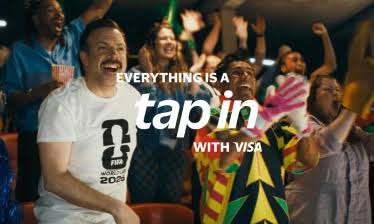
The verdict, up front: “Tap In” is the smartest single piece of wordplay any sponsor brought to the 2026 World Cup — a double-meaning so tidy it does the work of an entire creative brief. But the more delightful Jason Sudeikis gets, the more the football fades into the background, and that is a real risk for a brand whose only reason to be here is association. Our score: 7.5/10.
The setup: the oldest problem in sponsorship
There is a specific trap that catches long-tenured sponsors, and Visa has been sitting in it for the better part of two decades. Visa has been a FIFA World Cup partner since 2007. That longevity is an asset on a balance sheet and a liability in a creative meeting, because after eighteen years the logo on the perimeter board has become wallpaper. Fans don’t see it. They’ve been trained not to.
The strategic question facing Visa in 2026, then, wasn’t “how do we show up at the World Cup?” It was the far harder one: “how do we say pay with our card at the world’s biggest sporting event without being completely ignored?” Payments is a famously low-interest category. Nobody is emotionally invested in their tap-to-pay experience the way they are in their team. So Visa needed a creative idea that could smuggle a transactional message inside something people would actually want to watch.
“Tap In” is that idea, and the reason it works is almost entirely linguistic.
The campaign: what Visa actually made
The central conceit is a pun, and it’s a good one. “Tap in” means two things at once. In Visa’s world, it’s the colloquialism for contactless payment — you tap your card and you’re in. In football, a “tap-in” is the easiest goal in the game: the close-range finish, the ball rolled over the line from a yard out. One phrase, two meanings, both completely on-brand for the occasion. That single hinge is the whole campaign, and it’s more strategically efficient than most thirty-second scripts manage in a year.
The hero film builds a world around the pun. Jason Sudeikis — still carrying an enormous reservoir of football-adjacent goodwill from Ted Lasso, which makes him possibly the single most on-brief celebrity casting available for an American-hosted World Cup — anchors the spot. He watches Spanish prodigy Lamine Yamal score a tap-in goal, and something clicks. He realises that “tapping in” with his Visa card can transform his ordinary life. So it does: his TV script becomes a match ticket, his grouchy British cab driver becomes Norwegian superstar Erling Haaland, a kid’s street-hockey net becomes a soccer goal. The supporting cast is a genuine murderers’ row of the tournament’s most marketable names — Lamine Yamal, Erling Haaland, Christian Pulisic, the legendary goalkeeper Jorge Campos, and the iconic announcer Andrés Cantor, whose elongated “GOOOOL” is itself a piece of cultural shorthand.

The message Visa lands on is “the smallest touches can create the biggest moments,” which ladders neatly back to the product: a tap is a small touch; the experiences it unlocks are the big moments. The campaign runs across broadcast, digital, social, creator partnerships, and live fan activations — the now-standard omnichannel spread, with the creator element acknowledging where football conversation actually lives in 2026.
What works: three things Visa got genuinely right
1. The pun is a memory device that survives outside the ad. This is the campaign’s single greatest strength and it is rarer than it sounds. Most advertising is forgotten the instant it ends because it gives the viewer nothing portable to carry away. “Tap In” hands you a phrase you already half-know, now permanently linked to Visa and to football simultaneously. Every time a commentator says “and that’s a simple tap-in,” Visa gets a free brand impression for the rest of the tournament and arguably for years. That is the kind of earned, compounding association money can’t directly buy — it has to be designed in, and Visa designed it in.
2. The Sudeikis casting is low-risk and high-warmth. Celebrity casting usually carries danger: the star can overshadow the brand, age badly, or simply not fit. Sudeikis is about as safe as it gets for this specific brief. Ted Lasso made him synonymous with a warm, optimistic, distinctly American relationship to football — the exact emotional posture Visa wants for a tournament being introduced to a casual US audience. He’s funny without being abrasive, famous without being divisive, and football-coded without ever having kicked a ball professionally. He is, in effect, the perfect avatar for the bandwagon American fan the whole tournament is courting.
3. The benefit and the creative are genuinely fused. A lot of campaigns bolt a product message onto an unrelated piece of entertainment. “Tap In” doesn’t — the entire transformation device (small tap, big moment) is the product benefit (frictionless payment unlocks experiences). The line “the smallest touches create the biggest moments” works as both a piece of emotional copy and a literal description of contactless payment. That coherence from tagline to mechanic to product is the mark of a tightly built campaign, and it’s why the spot doesn’t feel like two ideas stapled together.
Where it’s exposed: the cracks worth naming
A teardown that only praises is just a press release with a byline. Here’s where “Tap In” is genuinely vulnerable.
1. The transformation device is borrowed, not invented. “Ordinary person’s mundane life becomes extraordinary” is one of the most heavily worn templates in all of advertising. Visa executes it with charm and a bottomless celebrity budget, but the underlying structure is familiar enough that a sharp viewer will feel the déjà vu. The pun is original; the film built around it is not. In a tournament where rivals are reaching for genuinely novel devices — Coca-Cola built a film around the VAR check, Lay’s reframed the bandwagon fan — Visa’s execution is the safest of the bunch, and safe is a choice with a cost.
2. The football can get upstaged by the comedy. Here’s the quiet tension at the heart of the campaign. The more entertaining the Sudeikis gags become, the less the World Cup actually matters to the viewer’s enjoyment. You could watch the whole spot, laugh at the cab-driver-becomes-Haaland bit, and walk away remembering “the funny Visa ad with the Ted Lasso guy” — with the tournament reduced to set dressing. For a sponsor whose entire value proposition is association with the event, that is not a small risk. The job isn’t to make a funny ad; it’s to make Visa feel inseparable from the World Cup. Comedy this good can actually work against that.
3. It’s a brand campaign in a moment that rewards utility. Visa’s deepest opportunity at a cashless, cross-border, three-country tournament is intensely practical: millions of travelling fans navigating unfamiliar payment systems across the US, Mexico, and Canada. “Tap In” gestures at frictionless payment but spends its energy on celebrity spectacle rather than on dramatising the genuinely useful thing Visa does for a fan in a foreign stadium. There was a more distinctive, more ownable campaign available in the practical reality of the event — and Visa chose the glossier path.
The annotated scorecard
| Dimension | Score | Why |
| Idea / wordplay | 9/10 | The double-meaning is the best strategic hook in the tournament |
| Casting | 8/10 | Sudeikis is near-perfect for the brief; the football roster is strong |
| Brand-to-benefit link | 8/10 | “Small touch, big moment” fuses message and mechanic cleanly |
| Originality of execution | 6/10 | The transformation device is a well-worn template |
| Football relevance | 6/10 | The comedy can crowd out the event the sponsorship is paying for |
| Overall | 7.5/10 | A brilliant hook in a competent but conventional execution |
What your brand should steal from this
Find the phrase that means two things at once. The single most transferable lesson here is the power of a genuine double-meaning — one sense in your category, one in your customer’s world. A real pun is the cheapest, most durable memory device in marketing, because it borrows recognition you don’t have to pay to build. Before you brief an expensive film, spend a day hunting for the linguistic hinge. If you find one as clean as “tap in,” half your work is done.
Cast for fit, not fame. Sudeikis works not because he’s famous but because his existing meaning (warm, optimistic, football-coded) matches the brief exactly. The lesson isn’t “hire a celebrity” — it’s “hire the meaning you need.” A smaller name with the right associations beats a bigger name with the wrong ones every time.
Don’t let the entertainment eat the brand. The cautionary lesson is the flip side: an ad can be too good in the wrong direction. If people remember the joke and forget you, you’ve bought attention you can’t bank. Pressure-test every funny idea against one question — does this make the brand more memorable, or just the ad?
The bottom line
“Tap In” is a smart campaign let down only by its own caution. The central pun is the best piece of strategic thinking any World Cup sponsor brought to 2026, and Sudeikis is the rare celebrity who actively strengthens the brief rather than overshadowing it. But Visa wrapped that brilliant hook in advertising’s most familiar template and let the comedy drift away from the football — and for an eighteen-year sponsor whose whole job is to feel inseparable from the event, drifting is the one thing it can’t afford to do. It’s a very good ad. It is not quite the great sponsorship the hook deserved.
Final verdict: 7.5/10 — the tournament’s best idea, in one of its most conventional executions.
FAQ
Q. What is Visa’s “Tap In” campaign?
“Tap In” is Visa’s FIFA World Cup 2026 campaign, built around the double meaning of the phrase — “tap in” is both the term for contactless payment and the name for the easiest goal in football. Starring Jason Sudeikis, it promotes frictionless Visa payments across the tournament.
Q. Who appears in the Visa “Tap In” ad?
Jason Sudeikis leads the campaign, supported by footballers Lamine Yamal, Erling Haaland, and Christian Pulisic, goalkeeping legend Jorge Campos, and famed announcer Andrés Cantor.
Q. How long has Visa sponsored the World Cup?
Visa has been an official FIFA partner since 2007, making the 2026 tournament part of a nearly two-decade sponsorship relationship.
Q. Why is the “Tap In” pun considered clever?
Because it links Visa’s product (contactless “tap” payment) and the event (a “tap-in” goal) in a single phrase, giving the brand a memory hook that’s reinforced every time a commentator describes an easy goal during the tournament.
Q. What can marketers learn from the campaign?
The biggest lesson is the value of a genuine double-meaning as a low-cost, durable memory device, plus the importance of casting talent for fit (Sudeikis’s football-coded warmth) rather than raw fame.
Also Read: Business Model of Visa – How Visa Makes Money
To read more content like this, subscribe to our newsletter
Go to the full page to view and submit the form.