


In the rapidly evolving landscape of artificial intelligence, few challenges are as fundamental as the problem of scale. As AI models grow larger, datasets expand to unprecedented volumes, and enterprises race to deploy machine learning across every business function, the underlying infrastructure must keep pace.
Anyscale occupies a critical position in this ecosystem as the company behind Ray, the open-source distributed computing framework that has become the backbone of AI infrastructure at some of the world’s most influential technology companies.
From training the largest language models at OpenAI to powering recommendation engines at Uber and Spotify, Ray and Anyscale have become synonymous with scalable AI computing.
Anyscale operates at the intersection of open-source community building and enterprise software commercialization, offering a fully managed compute platform that transforms the complexity of distributed computing into an accessible, developer-friendly experience.
The company’s mission is elegant in its simplicity: enable every developer and every team to succeed with AI without worrying about building and managing infrastructure.
This article provides a comprehensive analysis of Anyscale’s brand story, examining its origins, founding team, business model, competitive positioning, products, and growth trajectory.
Company Snapshot
| Company Name | Anyscale, Inc. |
| Founded | 2019 |
| Headquarters | San Francisco, California, USA |
| Industry | AI Infrastructure / Distributed Computing |
| Founders | Robert Nishihara, Ion Stoica, Philipp Moritz, Michael I. Jordan |
| Current CEO | Keerti Melkote (appointed July 2024) |
| Total Funding | $281 Million |
| Valuation | $1 Billion (Unicorn since December 2021) |
| Key Product | Anyscale Platform (built on Ray open-source framework) |
| Employees | ~637 (as of early 2026) |
| Notable Clients | OpenAI, Uber, Amazon, Microsoft, Shopify, Coinbase, Netflix |
Founding Story of Anyscale
The story of Anyscale begins not in a corporate boardroom but in the research labs of the University of California, Berkeley, specifically within the RISELab, the successor to the celebrated AMPLab that had previously given birth to Apache Spark and Databricks.
In the mid-2010s, a group of computer scientists at Berkeley were confronting a problem that would soon define the trajectory of the entire AI industry: how to efficiently scale machine learning workloads across distributed computing clusters.
Robert Nishihara and Philipp Moritz, both doctoral students at Berkeley, were deeply immersed in AI research and found themselves repeatedly frustrated by the limitations of existing distributed computing tools.
The frameworks available at the time were either too rigid for the dynamic, heterogeneous nature of AI workloads or required such deep expertise in distributed systems that most machine learning engineers could not use them effectively.
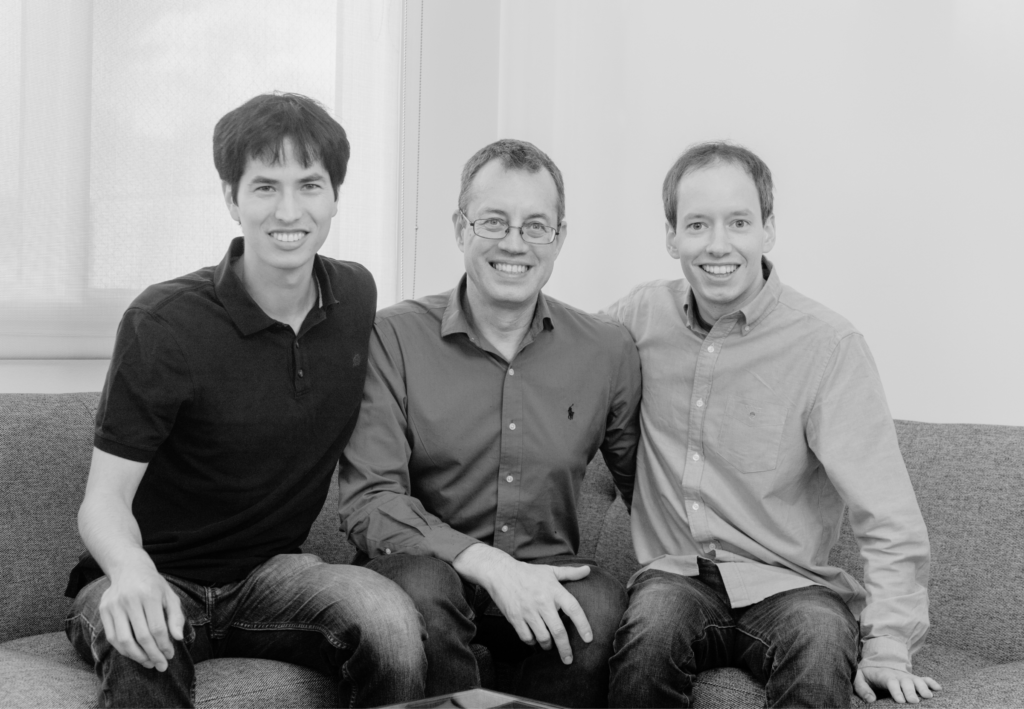
Together with their advisor Ion Stoica, a professor in the EECS Department at UC Berkeley who had already co-founded Databricks and Conviva, they began developing a new framework called Ray.

Ray was designed from the ground up to be different. Rather than forcing developers to conform to a fixed programming model, Ray offered a flexible, Python-native approach that allowed any application to be parallelized and distributed with minimal code changes.
A developer could write code that ran on a single laptop and then, with virtually no modifications, scale it across thousands of nodes in a data center. Ray was released as an open-source project and quickly attracted attention from the developer community.
The adoption curve was striking.
Companies like Amazon, Microsoft, Intel, and Ant Financial began integrating Ray into their production systems almost immediately. Recognizing the massive commercial potential, Nishihara, Moritz, and Stoica, along with Berkeley professor Michael I. Jordan (one of the most cited researchers in the history of machine learning), formally incorporated Anyscale in 2019.
The company launched with $20.6 million in Series A funding led by Andreessen Horowitz, marking the transition from an academic research project to a venture-backed enterprise startup.
Founders of Anyscale
Anyscale’s founding team brings together a rare combination of academic brilliance, deep technical expertise, and entrepreneurial experience. Each founder contributed a distinct dimension to the company’s identity and strategic direction.
| Founder | Education | Prior Experience | Role at Anyscale |
| Robert Nishihara | BA Mathematics, Harvard; PhD CS, UC Berkeley | Google, Jane Street, Microsoft Research, Facebook | Co-Founder (formerly CEO, now Product) |
| Ion Stoica | MS CS, Polytechnic Bucharest; PhD ECE, Carnegie Mellon | Co-Founder of Databricks & Conviva; Professor UC Berkeley | Co-Founder & Executive Chairman |
| Philipp Moritz | MASt Mathematics, Cambridge; PhD CS, UC Berkeley | Academic research in distributed systems | Co-Founder & CTO |
| Michael I. Jordan | BS Psychology, LSU; MS Mathematics, ASU; PhD Cognitive Science, UCSD | Professor UC Berkeley; pioneer in ML/statistics | Co-Founder & Advisor |
Robert Nishihara served as CEO from founding through July 2024, when he transitioned to focus on product strategy and customer growth.
Ion Stoica’s role as Executive Chairman brings extraordinary credibility, given his track record of co-founding Databricks, which has grown into one of the most valuable private technology companies in the world. In July 2024, the company appointed Keerti Melkote as CEO.
Melkote is an industry veteran who founded Aruba Networks in 2001, led it through an IPO in 2007, and oversaw its acquisition by Hewlett Packard Enterprise for $3 billion in 2015. His appointment was designed to bring enterprise scaling expertise as Anyscale enters its next phase of hypergrowth.
Business Model of Anyscale
Anyscale employs a classic open-core business model, a strategy that has proven highly effective in the enterprise infrastructure space.
The company maintains and advances Ray as a fully open-source project under the permissive Apache 2.0 license, ensuring that anyone can use, modify, and deploy Ray without restrictions.
This open-source foundation serves as a powerful distribution channel and community-building engine, attracting millions of downloads and thousands of contributors.
On top of this open-source base, Anyscale builds and sells its commercial platform: a fully managed, enterprise-grade compute environment that delivers significant additional value beyond what open-source Ray alone provides.

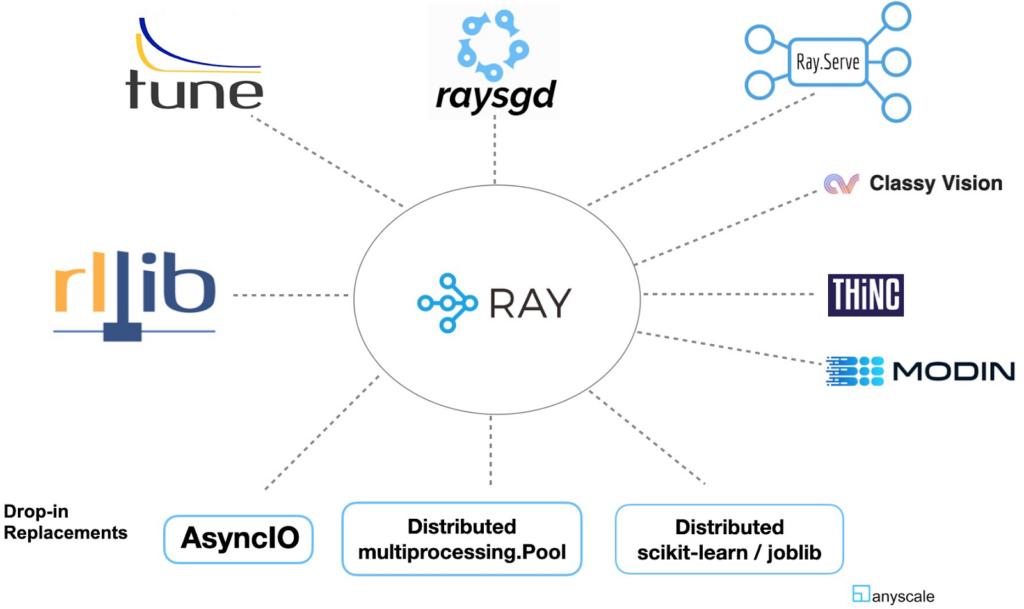
The commercial platform includes RayTurbo, an optimized runtime exclusive to Anyscale that delivers substantial performance improvements; enterprise governance and observability tools; managed infrastructure with automatic scaling; Kubernetes integration; and dedicated support and professional services.
This approach mirrors the strategy that made Databricks, co-founded by the same Ion Stoica, a $43 billion company.
The company positions itself as the essential middleware layer between raw cloud infrastructure (AWS, GCP, Azure) and AI application development teams.
Rather than replacing cloud providers, Anyscale sits on top of them, abstracting away the complexity of distributed computing and enabling enterprises to run AI workloads more efficiently, reliably, and cost-effectively across any cloud.
This cloud-agnostic positioning allows Anyscale to serve enterprises regardless of their cloud strategy.
Revenue Streams of Anyscale
Anyscale generates revenue through multiple complementary channels that collectively create a growing and diversified revenue base. By mid-2024, the company reported quadrupling its revenue year-over-year, a trajectory that underscores the accelerating enterprise demand for AI infrastructure.
| Revenue Stream | Description |
| Managed Platform Subscriptions | Enterprise customers pay for access to the Anyscale Platform, including RayTurbo, managed clusters, autoscaling, fault tolerance, and observability tools. Pricing is typically consumption-based, charged per compute-minute. |
| Anyscale Endpoints | API-based access to open-source LLMs (like Llama models), offered at highly competitive pricing of $1 per million tokens for state-of-the-art models. This service provides cost-efficient inference for developers building AI applications. |
| Private Endpoints | Self-hosted LLM deployment within customers’ own cloud accounts, managed by Anyscale infrastructure. Appeals to enterprises with strict data sovereignty and security requirements. |
| Enterprise Support & Services | Premium support tiers, professional services, and consulting engagements for organizations requiring hands-on guidance in deploying and optimizing Ray-based AI infrastructure. |
| Fine-Tuning Services | Tools and infrastructure for customizing open-source LLMs to enterprise-specific use cases, enabling clients to achieve optimal performance-to-cost ratios for their particular applications. |
Funding and Funding Rounds of Anyscale
Anyscale has raised a total of $281 million across four funding rounds since its inception, demonstrating consistent investor confidence in the company’s technology and market position.
The funding trajectory reflects both the company’s own maturation and the broader market’s growing recognition that AI infrastructure represents one of the largest commercial opportunities of the decade.
Funding Rounds of Anyscale
| Round | Date | Amount | Lead Investor(s) | Key Participants |
| Seed | Feb 2019 | ~$2.6M | Andreessen Horowitz | NEA, Ant Financial |
| Series A | Aug 2019 | $20.6M | Andreessen Horowitz | NEA, Intel Capital, Ant Financial, Amplify Partners, 11.2 Capital, The House Fund |
| Series B | Oct 2020 | $40M | NEA | Andreessen Horowitz, Foundation Capital, Intel Capital, Intel |
| Series C | Oct 2021 | $199M | Andreessen Horowitz, Addition | NEA, Foundation Capital, Intel Capital |
The Series C round in October 2021 was particularly significant, as it valued Anyscale at $1 billion and elevated the company to unicorn status. Andreessen Horowitz has participated in every round, reflecting the firm’s deep conviction in the Ray ecosystem. Board member Ben Horowitz has publicly described Ray as one of the fastest-growing open-source projects the firm has ever tracked, drawing a parallel to the transformative trajectory of Apache Spark before it.
Competitors of Anyscale
Anyscale operates in the highly competitive AI infrastructure market, where it faces competition from a diverse set of players spanning open-source projects, cloud-native services, and specialized AI platforms. Despite the crowded landscape, Anyscale occupies a distinct position as the only company offering a unified, general-purpose AI compute engine built on an open-source framework with massive existing adoption.
| Competitor | Category | Core Offering | Key Differentiator |
| Databricks | Unified Analytics Platform | Lakehouse, MLflow, Spark-based ML | Data + AI convergence |
| DataRobot | AutoML Platform | Automated ML model building | No-code ML accessibility |
| Lightning AI | AI Development Platform | PyTorch Lightning framework | Deep learning focused |
| Modal | Serverless Computing | Serverless GPU compute | Simplicity and speed |
| AWS SageMaker | Cloud ML Service | End-to-end ML on AWS | Deep AWS integration |
| Abacus.AI | AI Platform | Applied AI and LLM agents | Vertical AI solutions |
Competitive Advantage of Anyscale
Anyscale’s competitive moat is built on several reinforcing pillars that collectively make it difficult for competitors to replicate the company’s position in the market.
Open-Source Foundation with Massive Adoption: Ray has become the de facto standard for distributed AI computing, orchestrating more than one million clusters per month as of late 2024. This community-driven adoption creates a powerful network effect: the more developers use Ray, the richer the ecosystem of libraries, integrations, and knowledge becomes, and the more enterprises choose Anyscale for commercial support.
Academic Pedigree and Technical Depth: Born out of UC Berkeley’s RISELab, the same lab that produced Apache Spark, Anyscale’s technology carries significant academic credibility. The founding team includes some of the most cited and respected researchers in distributed systems and machine learning, a pedigree that attracts top engineering talent and builds trust with enterprise customers.
Cloud-Agnostic Flexibility: Unlike cloud-native competitors that lock customers into a single provider, Anyscale works across AWS, GCP, Azure, and on-premises Kubernetes environments. This flexibility is increasingly valuable as enterprises adopt multi-cloud strategies to avoid vendor lock-in.
RayTurbo Performance Edge: The proprietary RayTurbo engine delivers up to 4.5 times faster data processing and up to 60 percent cost savings compared to open-source Ray. These performance improvements are available exclusively on the Anyscale platform, creating a compelling commercial upsell from the free open-source tier.
Validation by Industry Leaders: OpenAI’s public endorsement of Ray as the framework it uses to train its largest models is perhaps the single most powerful proof point in the AI infrastructure market. Additional adoption by companies like Uber, Netflix, Airbnb, Pinterest, Spotify, Canva, and Coinbase creates an impressive roster of reference customers.
Products & Services of Anyscale
Anyscale’s product portfolio has evolved significantly since the company’s founding, expanding from a simple managed Ray service into a comprehensive, unified AI platform covering the entire AI development lifecycle.
Anyscale Platform
The core product is the Anyscale Platform, a fully managed compute environment for developing, deploying, and managing AI applications.
The platform provides developers with what co-founder Ion Stoica described as the illusion of an infinite laptop, where code written on a single machine can seamlessly scale to thousands of nodes without architectural changes.
Key capabilities include managed Ray clusters with automatic provisioning and scaling, integrated development tools such as VSCode and Jupyter notebooks, job queuing and scheduling with fault-tolerant execution, production-grade serving infrastructure with zero-downtime upgrades, and comprehensive monitoring and observability dashboards.
RayTurbo
RayTurbo is Anyscale’s proprietary optimized runtime, available exclusively on the commercial platform.
It represents the company’s most significant performance differentiator, delivering improvements across all four major AI workloads: data processing, distributed training, batch inference, and online serving.
RayTurbo achieves up to 4.5 times faster read-intensive data workloads, up to 4.5 times faster scale-up time for large model training, up to six times lower LLM batch inference costs compared to providers like AWS Bedrock and OpenAI, and up to 50 percent fewer nodes required for online model serving through features like replica compaction.
Anyscale Endpoints & Private Endpoints
Launched in September 2023, Anyscale Endpoints provides API-based access to popular open-source LLMs at market-leading prices, typically less than half the cost of comparable proprietary solutions and up to ten times cheaper for specific tasks.
Private Endpoints extends this to self-hosted deployments within customer cloud accounts for enterprises with strict data governance requirements.
Together, these services lower the barrier for developers to integrate advanced AI capabilities into their applications.
Anyscale Operator for Kubernetes
Announced at Ray Summit 2024 in partnership with Amazon EKS, Google GKE, Azure AKS, and OCI Kubernetes Engine, the Anyscale Operator allows enterprises to run RayTurbo natively within their existing Kubernetes clusters.
This product addresses the growing enterprise demand for Kubernetes-native AI infrastructure management, enabling organizations to unify their AI workloads with their broader container orchestration strategy.
Ray Open-Source Ecosystem
Underlying all commercial offerings is the Ray open-source project itself, which includes Ray Core for distributed task execution, Ray Data for unstructured data processing at scale (generally available since 2024), Ray Train for distributed model training, Ray Tune for hyperparameter optimization, and Ray Serve for scalable model serving.
In October 2025, Ray was welcomed into the PyTorch Foundation, further cementing its position as a cornerstone of the AI open-source ecosystem. Additional Anyscale-exclusive ML libraries include LLMForge for LLM fine-tuning, AnyBatch for LLM batch inference, and Ray LLM for LLM inference.
Conclusion
Anyscale stands at a uniquely advantageous inflection point in the history of technology. The company was founded on the prescient insight that AI workloads would demand fundamentally new approaches to distributed computing, and that insight has been validated spectacularly by the explosion of large language models, multimodal AI, and enterprise AI adoption since 2022. With Ray orchestrating over one million clusters monthly and being used by the most demanding AI workloads on the planet, Anyscale has established itself as critical infrastructure for the AI era.
The appointment of Keerti Melkote as CEO in 2024, following a year of quadrupled revenue and explosive adoption, signals the company’s transition from a technology-first startup to an enterprise-scale software business. Melkote’s experience in building Aruba Networks from a garage startup to a $5 billion revenue business is precisely the kind of scaling expertise Anyscale needs as it moves to capture a larger share of the rapidly expanding AI infrastructure market.
Looking ahead, Anyscale faces both enormous opportunity and significant challenges. The AI infrastructure market is attracting massive investment and intense competition from cloud hyperscalers, specialized startups, and open-source alternatives. However, Anyscale’s combination of a deeply entrenched open-source community, proprietary performance advantages through RayTurbo, cloud-agnostic flexibility, validation by the world’s leading AI companies, and a proven management team positions it as one of the most compelling companies in the AI infrastructure landscape. The company’s journey from a Berkeley research lab to a billion-dollar unicorn is not just a startup success story; it is a reflection of the transformative power of distributed computing in the age of artificial intelligence.
Also Read: Databricks Success Story- A Data Storage Giant Born Out Of UC Berkeley
To read more content like this, subscribe to our newsletter
Go to the full page to view and submit the form.