


Data is not just a by-product of doing business — it has become business itself. Every customer interaction, every transaction, every sensor reading and every AI-generated output is a data point. For the world’s largest enterprises, the challenge is not finding data; it is trusting it, governing it, and putting it to work in a way that is compliant, secure, and genuinely useful. That is the problem Collibra was built to solve.
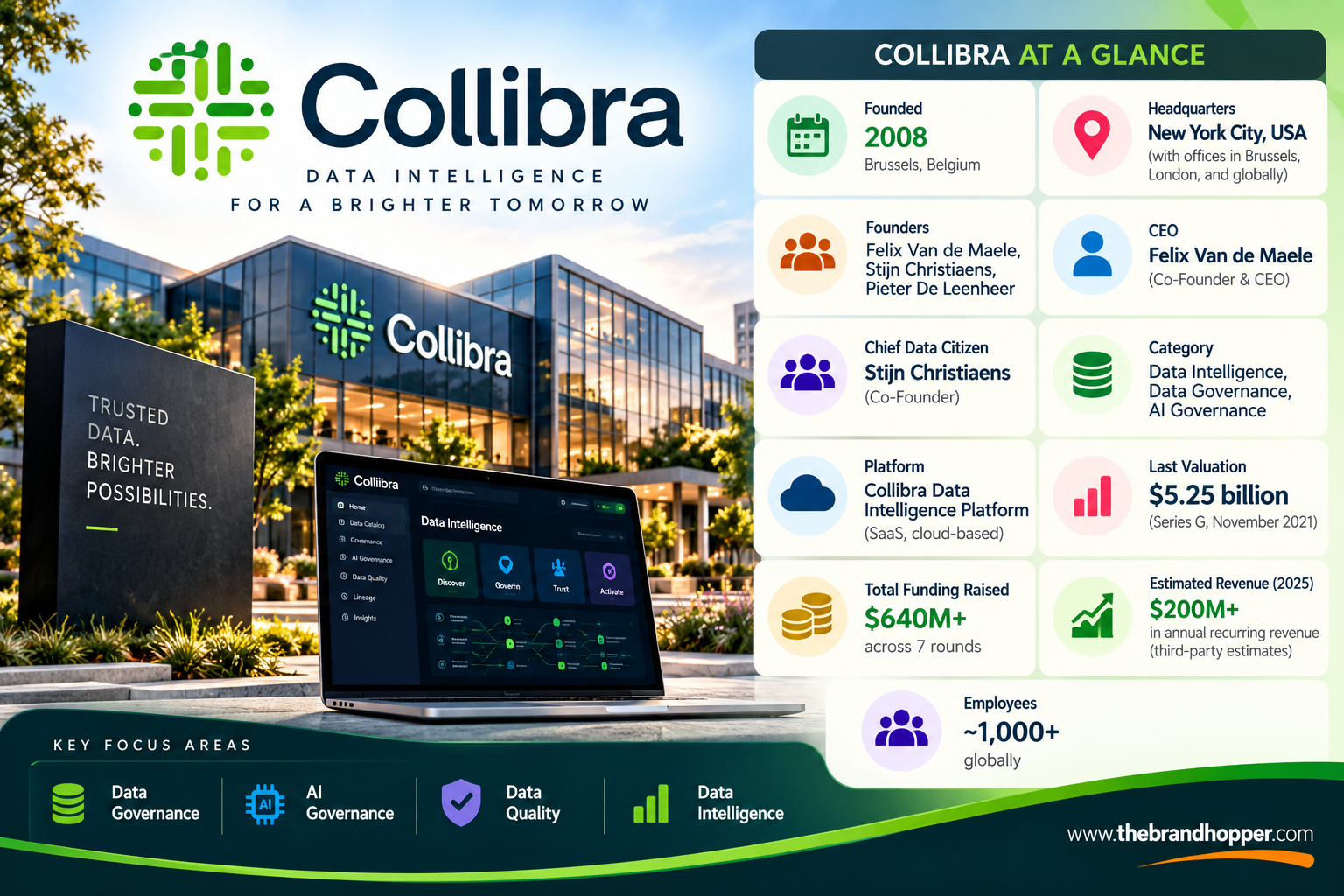
Founded in Brussels, Belgium in 2008 and now headquartered in New York City, Collibra is the world’s leading data intelligence company. Its platform enables enterprises to govern, manage, and extract value from their data at scale — providing a single, trusted view of an organisation’s entire data landscape, from raw ingestion to AI model output. Collibra’s customers include some of the world’s most data-intensive organisations: HSBC, Pfizer, Shell, Toyota Motor Europe, TELUS, and HEINEKEN, among hundreds of enterprises across every major industry.
The company has raised over $640 million in venture capital across seven funding rounds and carries a last-disclosed valuation of $5.25 billion — making it one of the most highly valued pure-play data governance companies in the world. Its investors include Sequoia Capital, ICONIQ Capital, CapitalG (Alphabet’s growth fund), Tiger Global Management, Index Ventures, Battery Ventures, and Dawn Capital.
What makes Collibra’s story particularly compelling today is the pivot it has executed — largely out of public view — from a data governance platform company to the defining platform for unified governance of both data and AI. As enterprises rush to deploy generative AI and machine learning models at scale, the questions of where that AI’s training data came from, how it was governed, and whether it is compliant with emerging AI regulation (the EU AI Act, the NIST AI Risk Management Framework, and others) have become urgent priorities for boards, legal teams, and chief data officers worldwide.
Collibra launched Collibra AI Governance to general availability in 2024 and has since accelerated its AI governance capabilities through two strategic acquisitions in 2025 alone: Raito (data access governance) and Deasy Labs (unstructured data governance). The company is no longer just a data governance vendor; it is positioning itself as the governance operating system for the AI era.

What is Collibra and What Do They Do?
Collibra is a data intelligence company that provides an enterprise-grade platform designed to help organisations find, understand, trust, and effectively use their data. In its simplest form, Collibra answers the questions that every data-driven organisation struggles with: Where does this data come from? Can I trust it? Who owns it? Am I allowed to use it? And now, in the age of artificial intelligence: Is the AI model built on this data compliant with our policies and regulations?
The Collibra platform is a cloud-native SaaS solution that sits at the intersection of people, processes, and data. It enables data producers and data consumers — from data engineers and data scientists to business analysts, compliance officers, and C-suite executives — to collaborate around a shared, governed understanding of an organisation’s data landscape.
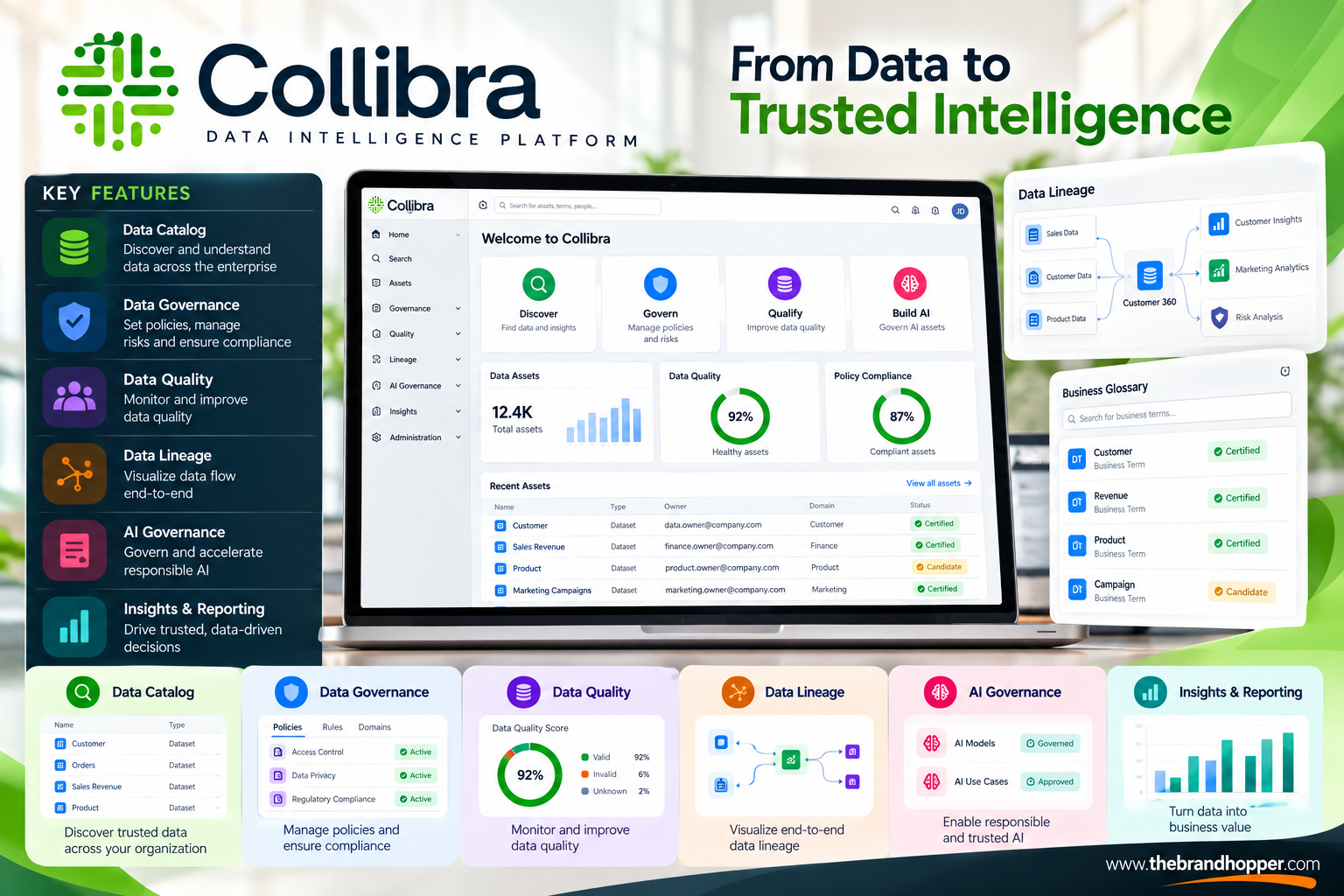
Collibra’s platform covers the following core functional areas:
1. Data Catalog
The Collibra Data Catalog is the foundation of the platform — a centralised, searchable repository of metadata about every data asset in an organisation’s environment. It pulls in metadata from databases, data warehouses, data lakes, APIs, files, and business applications, creating a unified inventory of all data assets. Business users can search for data they need, understand what it means, see who owns it, and assess its quality — all without needing to know where the data physically lives or how to query it.
2. Data Governance
Collibra’s data governance capabilities enable organisations to establish and enforce policies for how data is used, accessed, and maintained. This includes defining data ownership (who is responsible for each data asset), data quality standards (what does “good” look like for this data), data access policies (who is authorised to see what), and data classification (what sensitivity level applies to what data). Governance workflows allow data stewards to manage exceptions, review and approve data usage requests, and track policy compliance across the enterprise.
3. Data Quality and Observability
Data quality is worthless as a concept if it cannot be measured and enforced. Collibra’s data quality capabilities — significantly enhanced through the 2021 acquisition of OwlDQ — provide automated data profiling, rule-based quality scoring, anomaly detection, and quality monitoring across data pipelines. The 2025.02 platform release added enhanced rule precision and smarter data quality monitoring, continuing the company’s investment in this area.
4. Data Lineage
Data lineage answers the question: where did this data come from, and where does it go? Collibra’s lineage capabilities allow organisations to visualise the full journey of a data asset — from its origin in a source system, through all transformations and movements across pipelines and processes, to its final use in a report, dashboard, or AI model. This is critical for impact analysis (if this source system changes, what downstream processes are affected?), regulatory compliance (can I demonstrate to a regulator where this data came from?), and AI explainability (what training data was used to build this model?).
5. Data Privacy and Compliance
As data privacy regulations have proliferated — GDPR in Europe, CCPA in California, LGPD in Brazil, PDPA in Southeast Asia, and now sector-specific regulations including the EU AI Act — the burden on enterprises to demonstrate data compliance has grown dramatically. Collibra’s privacy and compliance capabilities help organisations map personal data across their systems, manage data subject requests (right to access, right to erasure), conduct privacy impact assessments, and demonstrate compliance to regulators. These capabilities are deeply integrated with the data catalog and governance workflow capabilities, ensuring that privacy is managed as an inherent property of data rather than a separate compliance exercise.
6. Collibra AI Governance (Launched GA 2024)
The most strategically significant product launch in Collibra’s recent history is Collibra AI Governance, which became generally available in 2024. As organisations race to deploy AI models and generative AI applications at enterprise scale, a new set of governance questions has emerged: What data was used to train this model? Has that data been approved for AI use? Does the model comply with the EU AI Act or other applicable regulation? Who is responsible for the model’s outputs? What happens when a model produces biased or inaccurate results?
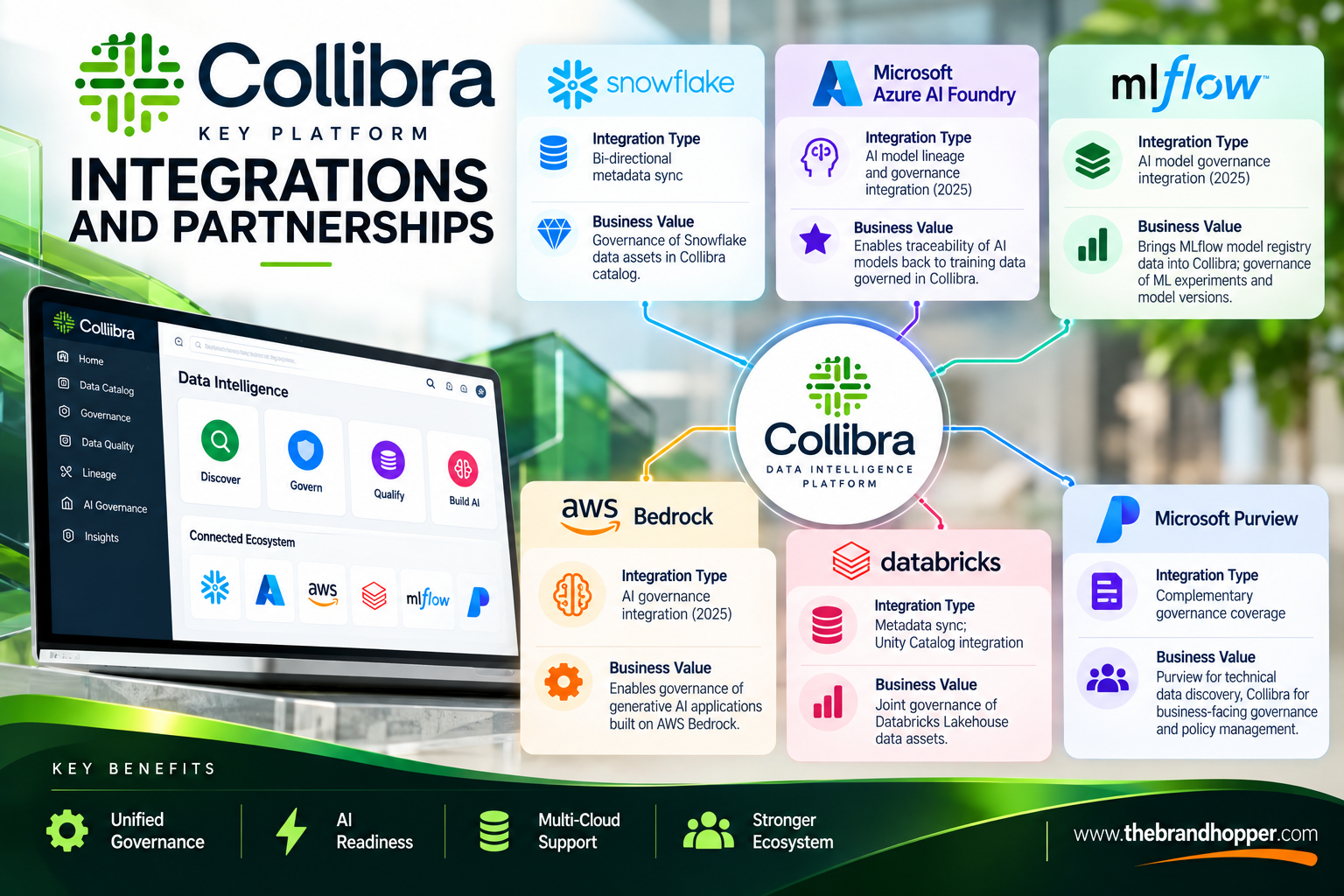
Collibra AI Governance addresses these questions by extending the company’s core data governance capabilities to cover AI models and their associated data assets. The product allows data, AI, and legal teams to collaborate on AI compliance, manage model inventories, document model lineage (from training data to production output), and demonstrate compliance with emerging AI regulation. Integrations announced in 2025 include Microsoft Azure AI Foundry and MLflow, enabling Collibra to connect directly with the tools where AI models are actually built and deployed.
7. Data Access Governance (via Raito, 2025)
In June 2025, Collibra acquired Raito, a startup specialising in data access governance. Raito’s technology enables organisations to manage, monitor, and control who has access to what data — across cloud data warehouses, data lakes, and analytics platforms. This acquisition fills a critical gap in Collibra’s platform: while the existing governance capabilities focused on what data exists and how it should be governed, Raito adds fine-grained control over who can actually access and use that data. The integration strengthens Collibra’s ability to offer unified governance across the data lifecycle, from discovery to access.
8. Unstructured Data Governance (via Deasy Labs, 2025)
In July 2025, Collibra acquired Deasy Labs — a New York City-based startup founded in 2023 by AI and metadata veterans from McKinsey & Company. Deasy Labs provides AI-powered tools for automated discovery and enrichment of unstructured data: documents, contracts, transcripts, emails, reports, and other file-based content that traditionally has been difficult to govern because it lacks the structured schema of database tables and data warehouse columns.
The acquisition makes Collibra the first and only platform capable of delivering unified governance across both structured and unstructured data. This is particularly relevant for AI use cases: many of the most valuable AI applications — contract analysis, customer service automation, regulatory document review — depend on unstructured data, and governing that data for AI use has previously required separate, ad hoc tooling. Deasy Labs brings that capability natively into the Collibra platform.
Founding History and Founders of Collibra
Collibra’s origin story begins in the academic corridors of the Vrije Universiteit Brussel (VUB) in Belgium, where three computer scientists — Felix Van de Maele, Stijn Christiaens, and Pieter De Leenheer — shared both a lab and a vision. All three studied at VUB’s STARLab research centre, a hub for research in semantic web technology, ontology engineering, and information management. It was here, working on research around how organisations could better understand and manage complex information systems, that the seeds of Collibra were planted.
Felix Van de Maele — Co-Founder & CEO


Felix Van de Maele is the co-founder and Chief Executive Officer of Collibra. He holds a master’s degree in Computer Science from the Vrije Universiteit Brussel. Before co-founding Collibra, Van de Maele gained experience as a Software Engineer at Business Architects International and as a Researcher at STARLab. Under his leadership as CEO, Collibra has grown from a Belgian research spin-off into a global enterprise software unicorn with a $5.25 billion valuation and customers across every major industry worldwide. Van de Maele has been the consistent driving force behind Collibra’s product vision and strategic direction, including the company’s pivot to AI governance in 2024 and its accelerated acquisition strategy in 2025.
Stijn Christiaens — Co-Founder & Chief Data Citizen

Stijn Christiaens is the co-founder of Collibra and serves as the company’s Chief Data Citizen — a title that reflects his role as both an internal champion for data-driven culture and an external thought leader on data governance, data intelligence, and the evolving role of data in modern enterprise. Like Van de Maele, Christiaens holds a master’s degree in Computer Science from the Vrije Universiteit Brussel and worked as a researcher at STARLab before co-founding Collibra. He is one of the most prominent voices in the data governance space, regularly speaking at industry conferences, contributing to policy discussions around data regulation, and authoring content that helps enterprises navigate the complexities of data management in the AI era.
Pieter De Leenheer — Co-Founder

Pieter De Leenheer is the third co-founder of Collibra. Also a graduate of the Vrije Universiteit Brussel with a master’s degree in Computer Science, De Leenheer’s background in software engineering and data management was instrumental in shaping the technical foundations of Collibra’s early platform. He departed the company in its early years, and Collibra’s subsequent growth has been led by Van de Maele and Christiaens.
The Founding Vision
Collibra was founded in 2008 with a specific insight: that as organisations generated more data, the problem was not data availability but data trustworthiness. Data was accumulating in silos. Different teams were using different versions of the same metric. Compliance with data regulations was becoming impossibly complex without automated tooling. And the gap between the people who produced data (IT, engineering) and the people who needed to use it (business, analytics) was widening.
The three founders set out to build a platform that would bridge this gap — providing a structured, collaborative environment in which data producers and data consumers could work together to make data understandable, trustworthy, and actionable. That original vision has remained remarkably consistent over nearly two decades, even as the technology landscape around it has changed dramatically. The rise of cloud computing, the explosion of big data, the emergence of the data lakehouse architecture, and now the generative AI revolution have all been challenges that Collibra has absorbed and responded to with platform evolution rather than strategic retreat.
Business Model of Collibra
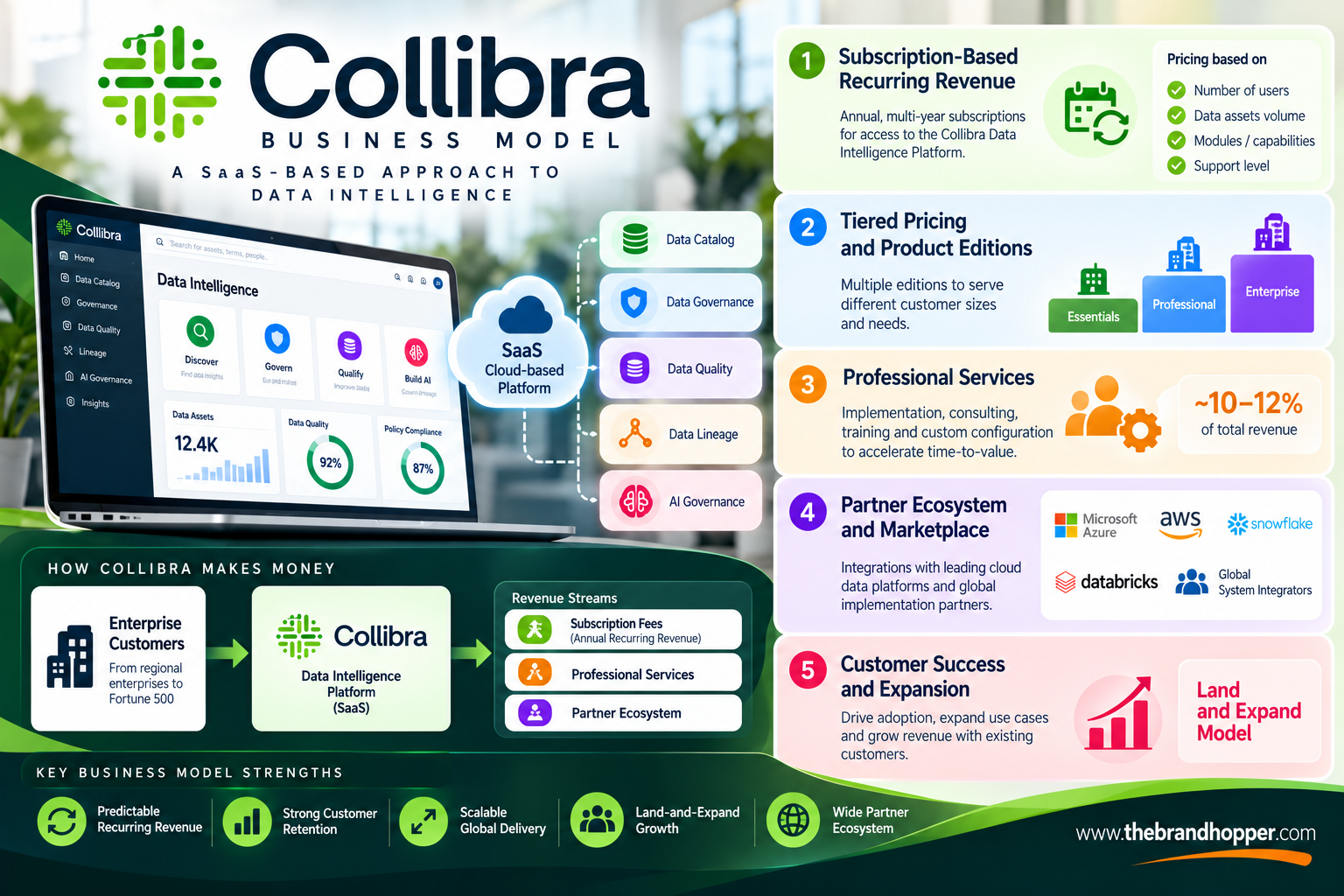
Collibra operates a Software-as-a-Service (SaaS) business model, providing its data intelligence platform through recurring subscription contracts with enterprise customers. This model provides Collibra with predictable, recurring revenue, strong customer retention economics (enterprises that integrate Collibra into their data operations tend to expand usage over time), and a scalable delivery model that can serve customers from regional enterprises to global Fortune 500 companies.
1. Subscription-Based Recurring Revenue
The core of Collibra’s business model is annual recurring revenue (ARR) generated through subscription contracts. Enterprise customers pay an annual subscription fee for access to the Collibra platform, which is delivered as a cloud-based SaaS solution. Subscriptions are typically multi-year commitments, reflecting the depth of integration that Collibra achieves within a customer’s data infrastructure — once an enterprise’s data catalog, governance workflows, and quality monitoring are built on Collibra, the switching costs are high and the incentive to renew is strong.
Subscription pricing is based on multiple dimensions, including the number of users, the volume of data assets being governed, the modules or capabilities being licensed, and the level of support and professional services required. Enterprise customers typically start with one or two use cases — a data catalog for a specific business unit, or data quality monitoring for a critical data pipeline — and expand to broader enterprise deployments over time. This land-and-expand model is common among successful enterprise SaaS companies and is particularly well-suited to Collibra’s platform, where the value of governance increases as more data assets and more users are brought onto the platform.
2. Tiered Pricing and Product Editions
Collibra offers its platform in multiple editions or tiers, each calibrated to the needs of different types of customers. Smaller organisations or specific departmental deployments may start with entry-level configurations focused on core data catalog and basic governance functionality. Larger enterprises can access the full suite of capabilities, including advanced data quality, lineage, privacy, AI governance, and the integrations with Raito and Deasy Labs that have been added through the 2025 acquisitions. Tiered pricing allows Collibra to serve a wide range of customer sizes and budgets while maintaining its focus on enterprise-grade deployments.
3. Professional Services
In addition to subscription revenue, Collibra generates revenue from professional services, including implementation consulting, training, and custom configuration engagements. Professional services are particularly important in the early stages of a customer relationship, as enterprise data governance implementations typically require significant scoping, planning, and technical integration work before the platform goes live. Collibra’s professional services team works alongside the customer’s data and IT teams to design governance frameworks, configure the platform, integrate it with existing data infrastructure, and train end users. Professional services revenue is typically a smaller portion of total revenue than subscription fees — historically around 10-12% — but it plays an important role in accelerating time-to-value for new customers and reducing churn risk.
4. Partner Ecosystem and Marketplace
Collibra has built a significant ecosystem of technology partners and implementation partners that extends the reach and capabilities of its platform. Technology partnerships — with companies including Snowflake, Microsoft Azure (including Azure AI Foundry), AWS (including Bedrock), Databricks, and others — enable Collibra to integrate natively with the cloud data platforms where enterprise data actually lives. These integrations are critical for product competitiveness and customer adoption, as enterprises increasingly operate multi-cloud, multi-platform data environments.
Implementation partners — including global systems integrators and boutique data consulting firms — help Collibra scale its professional services capacity without building an equivalent internal services organisation. Partner-delivered implementations generate a share of revenue for Collibra while allowing the company to focus its internal resources on product development and customer success.
5. Customer Success and Expansion
A key pillar of Collibra’s business model is a robust customer success function focused on ensuring that customers achieve measurable value from the platform and expand their usage over time. Customer success managers work with each enterprise customer to identify new use cases, new departments that could benefit from Collibra, and new capabilities (such as AI Governance or the newly integrated Raito and Deasy Labs capabilities) that could deepen the customer’s relationship with the platform. Net revenue retention — the rate at which existing customers grow their spending with Collibra — is a critical health metric for any enterprise SaaS business, and Collibra’s land-and-expand model is designed to deliver strong NRR.
Revenue Streams of Collibra
Collibra’s revenue streams can be broken down into three primary categories: subscription fees, professional services, and partnership-driven revenue. As a private company, Collibra does not publicly disclose its exact financial results. The figures below represent the best available verified data from official sources and reputable third-party estimates.
| Revenue Stream | Description | Estimated Contribution |
| Subscription Fees (ARR) | Annual recurring fees for platform access, user licences, and module subscriptions. The primary and fastest-growing revenue stream. | ~85-90% of total revenue |
| Professional Services | Implementation, configuration, training, and consulting engagements with enterprise customers. | ~10-12% of total revenue |
| Partner / Marketplace Revenue | Revenue from certified implementation partners, technology integration fees, and marketplace listings. | ~2-5% of total revenue (growing) |
Source: Collibra official communications; industry analyst estimates; Latka SaaS database (getlatka.com). Note: All percentage figures are estimates. Collibra does not publicly disclose a detailed revenue breakdown.
In terms of absolute revenue scale: Collibra has been one of the fastest-growing pure-play data governance companies globally. The company previously reported that its revenue approximately doubled between 2020 and 2022 as demand for cloud-based data governance accelerated, driven by the proliferation of cloud data platforms (Snowflake, Databricks, BigQuery) and the increasing enforcement of data privacy regulations. Third-party estimates for fiscal 2025 put Collibra’s annual recurring revenue above $200 million, though the exact figure has not been officially confirmed by the company.
Key factors driving Collibra’s revenue growth include: the rapid growth of enterprise cloud data environments that require centralised governance; increasing regulatory compliance pressure (GDPR, CCPA, EU AI Act); the shift from data governance as an IT compliance exercise to a strategic business capability; and the new revenue opportunities created by the AI governance market, which is expanding rapidly as enterprises seek to govern their AI models and the data used to build them.
Acquisitions by Collibra: Building a Complete Governance Platform
Collibra has made four strategic acquisitions since its founding, each designed to fill a specific capability gap in its platform and accelerate its competitive position.
| Acquisition | Year | What They Did | Strategic Rationale for Collibra |
| OwlDQ | 2021 | Automated data quality monitoring and anomaly detection platform | Added automated data quality capabilities to complement Collibra’s governance and catalog features. OwlDQ’s technology became the foundation for Collibra’s Data Quality product. |
| Raito | June 2025 | Data access governance — fine-grained control over who can access data across cloud data platforms | Extended Collibra’s governance capabilities to cover data access control. Enables “policy-to-access” governance: define a policy in Collibra, enforce it automatically via Raito. |
| Deasy Labs | July 2025 | AI-powered automated discovery and enrichment of unstructured data (documents, contracts, emails, transcripts) | Made Collibra the first and only platform to deliver unified governance across both structured and unstructured data — critical for AI use cases that depend on unstructured content. |
Key Platform Integrations and Partnerships of Collibra
Collibra’s platform is designed to work with the data infrastructure that enterprise customers already have, rather than requiring them to replace existing tools. Its integration ecosystem spans cloud data platforms, AI development environments, and enterprise data tools:
Valuation, Funding and Investors of Collibra
Valuation
Collibra’s last disclosed valuation is $5.25 billion, established at its Series G funding round in November 2021. This represented more than a doubling of the company’s previous valuation of $2.35 billion (set at the Series F round in April 2020) — itself more than triple the company’s valuation at the Series E round in 2019 ($1 billion+). The trajectory of Collibra’s valuation reflects the rapid investor appreciation for data governance platforms as cloud data infrastructure proliferated and data privacy regulation intensified.
As a private company, Collibra has not provided a public valuation update since the Series G round. The company has not filed for an IPO and has not announced any concrete plans to do so, though its scale ($200M+ estimated ARR, global enterprise customer base, strong investor roster) would make it a candidate for a public offering when market conditions are favourable.
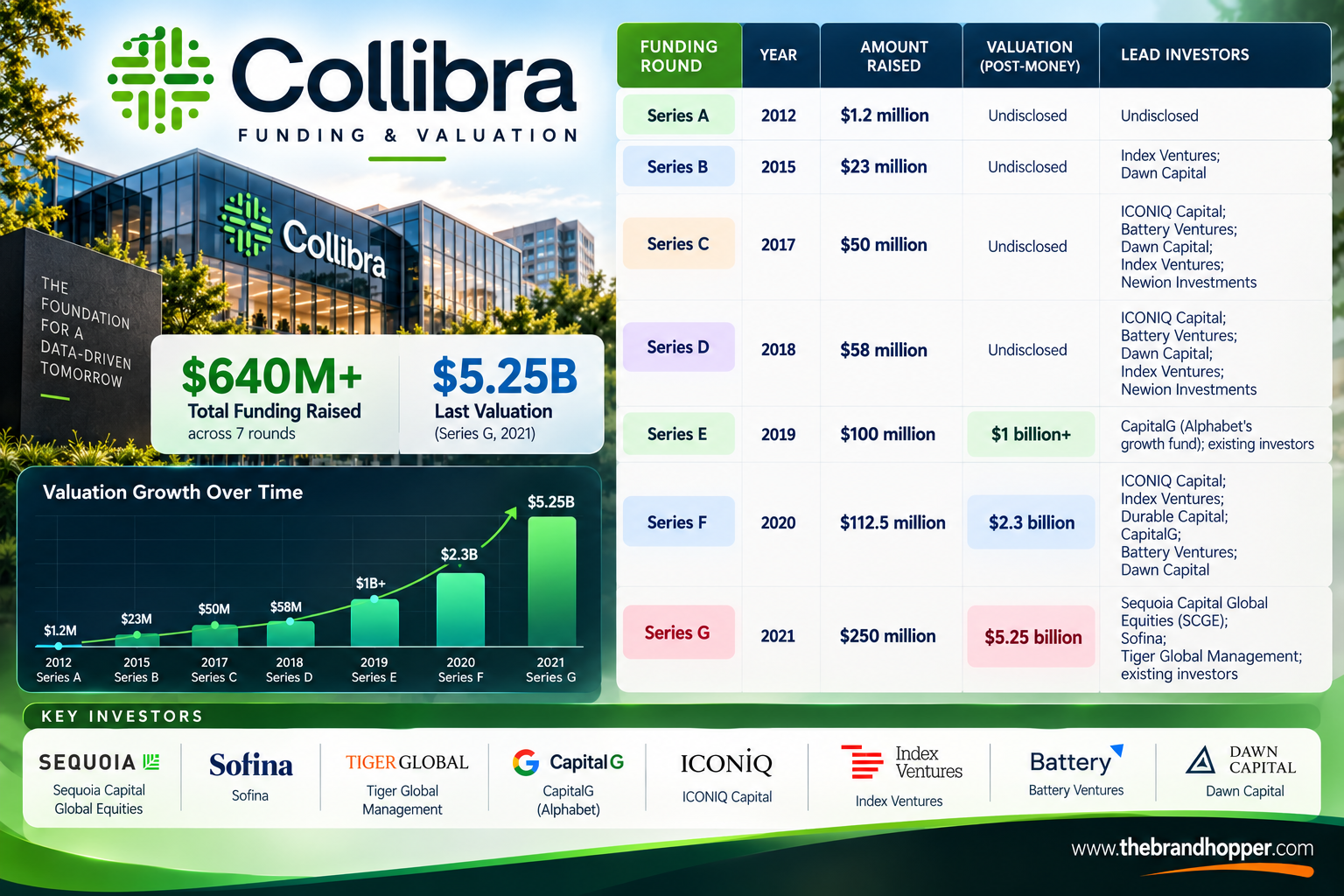
Total funding raised: $640M+ across all rounds.
Series B — 2015
In 2015, Collibra raised a $23 million Series B investment round led by Index Ventures, with participation from Dawn Capital. This round was a pivotal step in Collibra’s transition from a European research spin-off to an enterprise software company with global ambitions. The funding was used to accelerate product development and expand the company’s commercial operations in the United States.
Series C — 2017
In 2017, Collibra closed $50 million in Series C financing led by San Francisco-based ICONIQ Capital, with participation from Battery Ventures and returning investors Dawn Capital, Index Ventures, and Newion Investments. This round significantly accelerated Collibra’s growth, enabling the company to scale its sales and marketing organisation and deepen its product capabilities in data governance and data catalog technology.
Series D — 2018
In 2018, Collibra closed $58 million in Series D financing led by existing investors ICONIQ Capital and Battery Ventures, with participation from Dawn Capital, Index Ventures, and Newion Investments. The Series D was used to expand Collibra’s global operations, including its European offices, and to accelerate product development across the platform.
Series E — 2019 (Unicorn Status)
In 2019, Collibra raised a $100 million Series E round led by CapitalG, Alphabet’s growth equity investment fund. The round pushed Collibra’s post-money valuation above $1 billion for the first time, making it a unicorn and one of the most valuable enterprise data companies in the world at that time. The backing of CapitalG — the growth fund behind companies including Duolingo, Stripe, and UiPath — significantly raised Collibra’s profile in the global enterprise technology community.
Series F — 2020
In April 2020, Collibra raised $112.5 million in Series F funding at a post-money valuation of $2.3 billion. The round was co-led by ICONIQ Capital, Index Ventures, and Durable Capital Partners LP, with participation from CapitalG, Battery Ventures, and Dawn Capital. Notably, this round was completed in April 2020 — in the midst of the global pandemic — reflecting strong investor conviction in the importance of data governance as enterprises accelerated their digital transformation programmes.
Series G — 2021 (Valuation $5.25B)
In November 2021, Collibra raised $250 million in Series G funding in a round led by Sequoia Capital Global Equities (SCGE) and Sofina, with new investor Tiger Global Management also participating. Existing investors Battery Ventures, CapitalG, Dawn Capital, Durable Capital Partners LP, ICONIQ Capital, and Index Ventures also participated. The round valued Collibra at $5.25 billion — more than doubling the company’s valuation from its Series F and establishing it as one of the most valuable enterprise data companies in the world. Collibra used the Series G funding to accelerate its go-to-market motion, invest in R&D (particularly in AI and machine learning capabilities), and expand its global footprint.
Industry Recognition and Awards of Collibra
Collibra has been consistently recognised by leading technology industry analysts, research firms, and media organisations as a leader in the data governance and data intelligence market.
| Recognition | Organisation | Year(s) | Significance |
| Leader — Gartner Magic Quadrant for Data and Analytics Governance Platforms | Gartner | January 2025, January 2026 (2 consecutive years) | The most widely cited analyst ranking in the data governance market. Named a Leader for multiple consecutive years, placing Collibra in the top tier of vendors for both completeness of vision and ability to execute. |
| “Exemplary” — IDC MarketScape: Worldwide Data Intelligence Platform Software | IDC | 2024 | IDC’s highest rating category for enterprise software vendors. Recognises Collibra’s comprehensive platform capabilities and market execution. |
| Forbes Cloud 100 | Forbes / Bessemer Venture Partners | 2021, 2023 | Definitive annual ranking of the 100 most innovative private cloud companies in the world. Selected in both 2021 and 2023. |
| Leader — Bloor Research Data Governance Market Landscape | Bloor Research | 2024, 2025 | Independent UK-based research firm recognising Collibra as a market leader in data governance. |
| Leader — BARC Data Management & Analytics Survey | BARC Research | 2024, 2025 | Leading European BI and analytics research firm; Collibra consistently rated highest by enterprise users for data governance capabilities. |
| Leader — McKnight Consulting Group Rankings | McKnight Consulting Group | 2024 | Annual data management vendor rankings; Collibra rated as a leader. |
The Data Governance Market: Collibra’s Opportunity
Collibra operates in one of the fastest-growing segments of enterprise software. The global data governance market was estimated at approximately $4.35 billion in 2024 and is projected to grow to approximately $5.11 billion in 2025, representing a compound annual growth rate of approximately 17.7%. Multiple research firms project the market to exceed $16 billion by the early 2030s, driven by continued expansion of enterprise data volumes, proliferation of data privacy regulation, and the new governance requirements created by enterprise AI adoption.
The emergence of the EU AI Act — the world’s first comprehensive legal framework for AI, which became enforceable in stages beginning in 2024 — has significantly expanded the data governance market beyond its traditional scope. Enterprises deploying AI in the EU must now document the training data used in high-risk AI systems, conduct impact assessments, and demonstrate compliance to regulators. This creates new, mandatory governance requirements that directly benefit platforms like Collibra that can connect data governance (what data is used) with AI governance (how models are governed).
The competitive landscape for data governance includes both specialist vendors (Alation, Ataccama, Informatica, Talend, Erwin by Quest) and large platform vendors (Microsoft Purview, IBM Knowledge Catalog, SAP Data Intelligence) that have added data governance capabilities to broader platform offerings. Collibra’s consistent placement as a Gartner Magic Quadrant Leader reflects its position as the leading specialist platform in the market, competing on depth of governance capability, ease of use for business users, and the breadth of its integration ecosystem.
Frequently Asked Questions (FAQs)
Q1. What is Collibra?
A: Collibra is a data intelligence company that provides an enterprise SaaS platform for data governance, data catalog, data quality, data lineage, data privacy compliance, and AI governance. Founded in Brussels, Belgium in 2008 and headquartered in New York City, Collibra enables organisations to find, understand, trust, and effectively use their data — and, since 2024, to govern the AI models built on that data. Its customers include HSBC, Pfizer, Shell, Toyota Motor Europe, TELUS, and HEINEKEN, among hundreds of global enterprises. Source: collibra.com; Collibra official press releases.
Q2. Who founded Collibra?
A: Collibra was co-founded in 2008 by Felix Van de Maele, Stijn Christiaens, and Pieter De Leenheer — three computer scientists who met at the STARLab research centre at the Vrije Universiteit Brussel (VUB) in Belgium. Felix Van de Maele remains CEO and Stijn Christiaens serves as Chief Data Citizen. Pieter De Leenheer left the company in its early years. Source: Collibra official leadership page (collibra.com/company/leadership).
Q3. What is Collibra’s valuation?
A: Collibra’s last publicly disclosed valuation is $5.25 billion, established at its Series G funding round in November 2021. The Series G was led by Sequoia Capital Global Equities and Sofina, with Tiger Global Management as a new investor. As a private company, Collibra has not provided a public valuation update since the Series G round. Source: Collibra Series G press release (collibra.com/company/newsroom).
Q4. How much funding has Collibra raised?
A: Collibra has raised over $640 million in total across seven funding rounds, from Series A ($1.2M in 2012) through Series G ($250M in 2021). Its investor roster includes Sequoia Capital Global Equities, ICONIQ Capital, CapitalG (Alphabet’s growth fund), Tiger Global Management, Index Ventures, Battery Ventures, Dawn Capital, Sofina, and Durable Capital Partners LP. Source: Collibra official press releases; Crunchbase; PitchBook.
Q5. What is Collibra AI Governance?
A: Collibra AI Governance is a product launched to general availability in 2024 that helps data, AI, and legal teams govern AI models and the data used to train them. It enables organisations to maintain an inventory of AI models, document AI model lineage (from training data to production output), manage AI compliance with emerging regulation (including the EU AI Act), and collaborate across teams on AI risk management. In 2025, Collibra announced integrations with Microsoft Azure AI Foundry and MLflow, expanding the product’s reach to AI development environments. Source: Collibra AI Governance press release (collibra.com/company/newsroom); TechTarget.
Q6. What companies has Collibra acquired?
A: Collibra has made three notable acquisitions: OwlDQ (2021), a data quality and anomaly detection platform whose technology became the foundation for Collibra’s Data Quality product; Raito (June 2025), a data access governance specialist enabling fine-grained control over who can access data across cloud platforms; and Deasy Labs (July 2025), a Y Combinator-backed startup founded by McKinsey AI veterans, whose technology enables automated governance of unstructured data (documents, contracts, emails, and other files). The Deasy Labs acquisition made Collibra the first platform to offer unified governance across both structured and unstructured data. Source: Collibra official press releases (collibra.com); BigDATAwire.
Q7. Is Collibra publicly traded?
A: No. Collibra is a privately held company and has not conducted an initial public offering (IPO). The company has not announced any concrete IPO plans. It remains backed by private venture capital investors including Sequoia Capital, ICONIQ Capital, CapitalG, and others. Source: PitchBook; Forge Global IPO tracker.
Q8. Who are Collibra’s main competitors?
A: Collibra competes in the data governance and data intelligence market against a mix of specialist and platform vendors. Key competitors include Alation (data catalog and governance), Ataccama (data quality and governance), Informatica (broad data management suite including governance), Talend (data integration and governance), Erwin Data Intelligence by Quest, and platform vendors including Microsoft Purview, IBM Knowledge Catalog, and SAP Data Intelligence. Collibra is consistently placed as a Leader in the Gartner Magic Quadrant for Data and Analytics Governance Platforms, reflecting its position as the leading specialist platform in the market. Source: Gartner Magic Quadrant for Data and Analytics Governance Platforms (January 2025 and January 2026 editions).
Q9. What industries use Collibra?
A: Collibra serves enterprises across all major industries, with particularly strong presence in financial services (HSBC and other global banks, insurance companies), life sciences and pharmaceuticals (Pfizer and other major pharmaceutical companies), energy (Shell and other energy majors), telecommunications (TELUS), consumer goods and manufacturing (HEINEKEN, Toyota Motor Europe), retail, and the public sector. These industries share common characteristics: large, complex data environments; significant regulatory compliance requirements; and high business stakes for data accuracy and trustworthiness. Source: Collibra customer references (collibra.com/customers); Collibra press releases.
Q10. What is the data governance market size?
A: The global data governance market was estimated at approximately $4.35 billion in 2024 and is projected to reach approximately $5.11 billion in 2025, growing at a compound annual growth rate (CAGR) of approximately 17.7%. Multiple research firms project the market to exceed $16 billion by the early 2030s. Growth is driven by the proliferation of enterprise cloud data infrastructure, increasingly complex data privacy regulations (GDPR, CCPA, and others), and the new AI governance requirements created by the EU AI Act and similar regulation. Collibra is well-positioned to benefit from all three of these growth drivers. Source: IMARC Group; Coherent Market Insights; GlobeNewswire (October 2025).
Also Read: Trade Republic – History, Founders, Business & Revenue Model, Funding
Conclusion
Collibra’s journey from a three-person research spin-off in Brussels to a $5.25 billion enterprise software unicorn is one of the most compelling stories in European technology. Its founders identified a problem in 2008 — organisations cannot trust, manage, or use their data effectively without a dedicated governance platform — and have spent the subsequent years building the most comprehensive and widely recognised solution for that problem in the enterprise market.
What makes Collibra particularly interesting today is that the problem it was founded to solve has only become more complex, more regulated, and more strategically important. The explosion of cloud data platforms, the proliferation of data privacy regulation, and now the enterprise AI revolution have all expanded the scope and urgency of data governance — and Collibra has responded to each wave with meaningful product evolution. The launch of Collibra AI Governance in 2024 and the back-to-back acquisitions of Raito and Deasy Labs in 2025 represent the most ambitious chapter yet in the company’s product strategy: a clear bid to define the governance operating system for the AI era, not just the data era.
With over $640 million raised, a $5.25 billion valuation, a customer base that spans the world’s most data-intensive industries, and a two-year streak as a Gartner Magic Quadrant Leader, Collibra is exceptionally well-positioned for the next phase of enterprise data and AI governance. For any organisation seeking to understand how leading enterprises manage the trust, quality, and compliance of their data and AI systems, Collibra’s platform — and its story — is essential reading.
To read more content like this, subscribe to our newsletter
Go to the full page to view and submit the form.