


The global energy transition has placed nuclear power at a crossroads. After decades of public scepticism, cost overruns at conventional large-scale plants, and the lingering shadows of Chernobyl and Fukushima, a new generation of nuclear companies is working to rewrite the story entirely. Among the most credible and technically advanced of these is Kairos Power — a Alameda, California-based startup that is quietly engineering what could become the defining clean-energy technology of the twenty-first century.
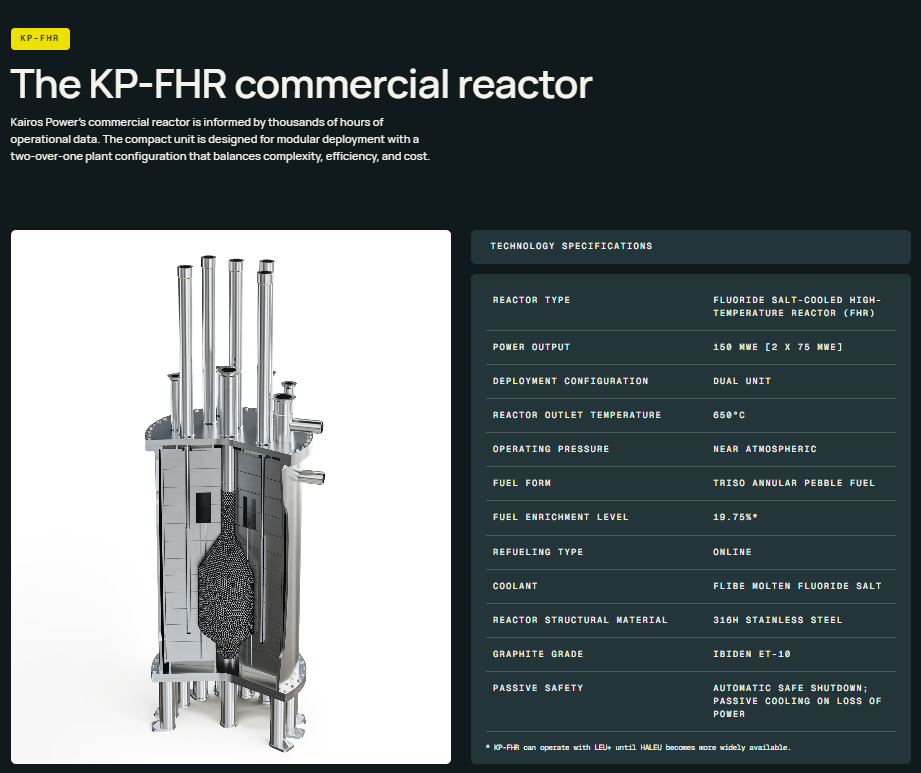
Founded in 2016 by academics turned entrepreneurs with deep roots at the University of California, Berkeley, Kairos Power has developed a fluoride salt-cooled high-temperature reactor (KP-FHR) that marries decades of government-funded research with the speed, capital discipline, and market instincts of a technology startup. The company’s reactor design uses TRISO pebble fuel — ceramic-coated fuel particles originally developed by Oak Ridge National Laboratory — submerged in low-pressure molten fluoride salt coolant. The result is a reactor that is intrinsically safe by the laws of physics, not merely by engineered redundancy.
Kairos Power entered public consciousness decisively in October 2024 when Google announced the world’s first corporate purchase agreement for small modular reactor (SMR) electricity — a landmark deal with Kairos to supply 500 megawatts of clean power from six to seven reactors, beginning as early as 2030. That single transaction elevated Kairos from a well-regarded but niche advanced-reactor developer into a central player in the emerging narrative around Big Tech’s nuclear ambitions. Microsoft, Amazon, and others have since followed Google into nuclear power agreements, but Kairos Power earned the distinction of pioneering the category.
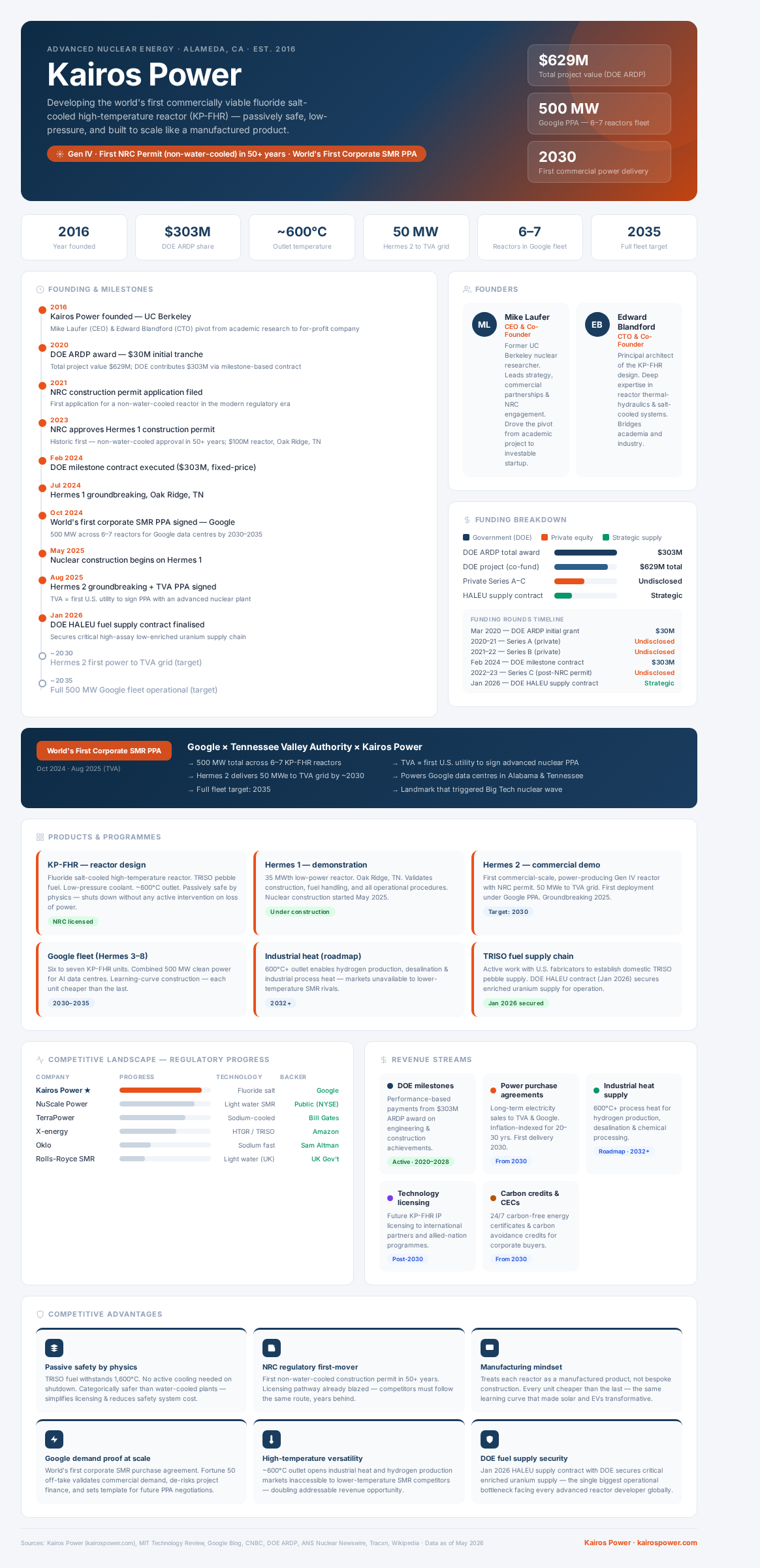
Today, with construction underway on the Hermes demonstration reactor in Oak Ridge, Tennessee, a power purchase agreement signed with the Tennessee Valley Authority (TVA) and Google; and over $600 million in combined government and private funding, Kairos Power stands at a genuinely pivotal moment. This brand story traces how the company arrived at this juncture — and where it is headed.
Founding Story of Kairos Power
The origin of Kairos Power is rooted in an unusual combination of scientific rigour, entrepreneurial ambition, and a deeply held conviction about climate change. The founding team, all associated with UC Berkeley’s Department of Nuclear Engineering, had spent years conducting federally funded research into advanced reactor concepts. By 2016, they had reached an inflection point: the technology was sufficiently mature that continued academic study felt insufficient. Climate change demanded deployment, not merely research.
The specific technology around which Kairos was built — the fluoride salt-cooled high-temperature reactor — had a rich intellectual lineage. The Molten Salt Reactor Experiment at Oak Ridge National Laboratory in the 1960s had demonstrated the core physics, but the programme was cancelled in 1969 in favour of solid-fuel reactor designs better suited to weapons-grade plutonium production. For more than four decades the technology sat dormant in the archive of great scientific ideas that history had set aside too soon.
The Berkeley team saw an opportunity to revive and modernise that legacy. By combining TRISO particle fuel — which can withstand temperatures exceeding 1,600°C without releasing fission products — with a low-pressure fluoride salt coolant, they designed a reactor that is passively safe: if power is lost or the reactor is damaged, it simply shuts down without requiring any active intervention, human or mechanical. This is a fundamentally different safety proposition from the water-cooled reactors that dominate today’s nuclear fleet, where active cooling must be maintained even after shutdown.
Kairos Power was incorporated in 2016 in Alameda, California. From the outset, the founders pursued a strategy of parallel development — simultaneously advancing the reactor design, engaging with the Nuclear Regulatory Commission (NRC) on a licensing pathway, and building the manufacturing and supply chain infrastructure needed for eventual commercial deployment. This disciplined, methodical approach proved prescient: when the NRC approved Kairos’s construction permit application for the Hermes demonstration reactor in 2023, it was the first time in more than 50 years that the regulator had approved a permit for a non-water-cooled reactor. The moment was historic.
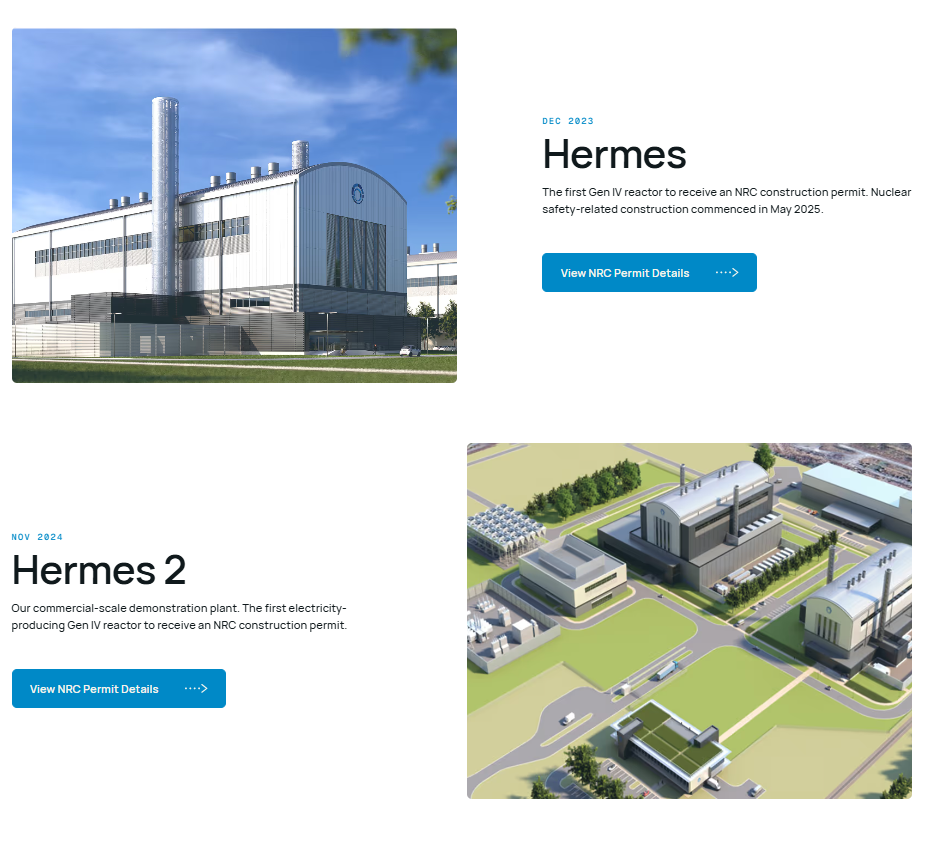
Groundbreaking on the Hermes 1 site in Oak Ridge took place in July 2024. Nuclear construction on the site began in May 2025. The Hermes programme — named after the messenger of the Greek gods, appropriate for a company carrying a message about nuclear energy’s future — is designed not merely as a proof of concept but as a systematic demonstration of the construction and operational processes that will be repeated at commercial scale.
Founders of Kairos Power
Kairos Power’s founding team brings together the technical depth of elite academic research and the commercial drive necessary to navigate the complex, capital-intensive world of advanced nuclear development. The three co-founders, all with ties to UC Berkeley, made the uncommon transition from grant-funded researchers to for-profit company builders — a leap that required not just technical confidence but genuine entrepreneurial conviction.
| Co-Founder | Role | Background & Contribution |
| Mike Laufer | CEO & Co-Founder | Kairos’s chief executive and primary external voice. Leads company strategy, commercial partnerships, and regulatory engagement. Former researcher at UC Berkeley’s Department of Nuclear Engineering; drove the pivot from academic project to investable startup. |
| Edward Blandford | CTO & Co-Founder | Chief Technology Officer and principal architect of the KP-FHR design. Deep expertise in reactor thermal-hydraulics and salt-cooled systems. Continued his faculty position at UNM while co-founding Kairos, bridging academia and industry. |
| Third Co-Founder (UC Berkeley) | Technical / Strategy | The founding trio collectively drew on decades of UC Berkeley nuclear engineering research, NRC engagement experience, and Department of Energy project management to accelerate the company’s early regulatory and technical milestones. |

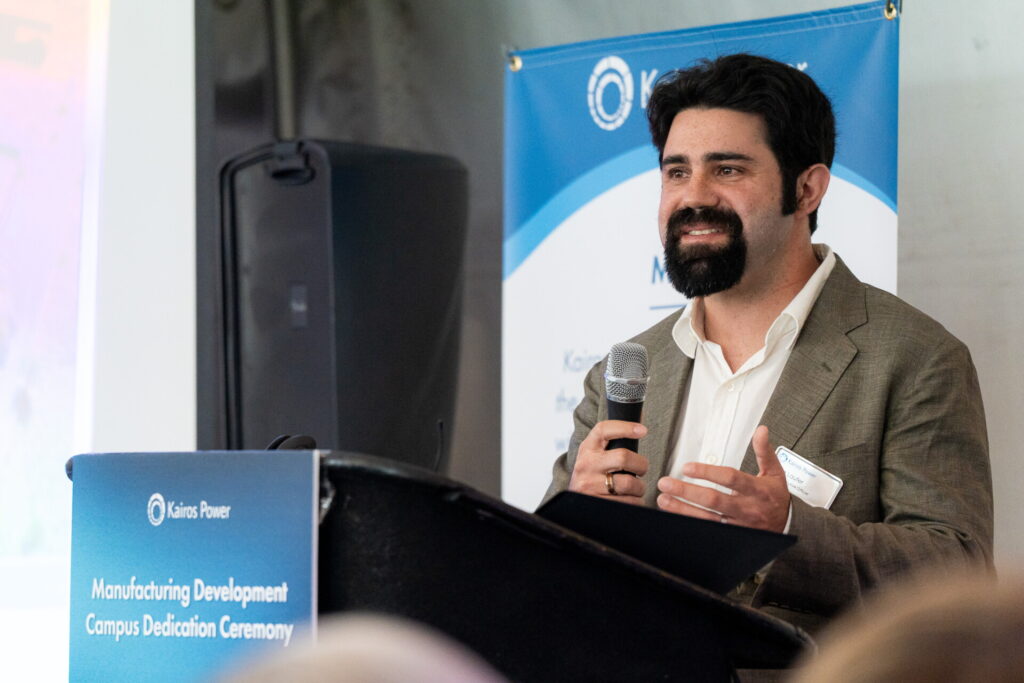

The founders’ decision to locate Kairos in Alameda, California — and to build a physical reactor in Oak Ridge, Tennessee, leveraging that city’s 80-year relationship with nuclear technology — reflects a deliberate blending of Silicon Valley startup culture with America’s deep nuclear heritage. Kairos has grown to employ hundreds of engineers, physicists, and operational staff across its California headquarters and Tennessee construction site, with additional offices supporting regulatory and business development functions.
Business Model of Kairos Power
Kairos Power operates as an integrated nuclear energy company — it designs, licenses, builds, owns, and operates its reactors, then sells the electricity they generate to utilities and large corporate customers under long-term power purchase agreements (PPAs). This vertically integrated model is fundamentally different from that of companies that merely design reactors and license the technology to utilities; Kairos retains control of the full value chain, which allows it to optimise for deployment speed and cost reduction at each successive unit.
The commercial logic of the business model rests on a learning curve that is endemic to manufactured goods but historically absent from nuclear power, which has been treated as bespoke construction rather than manufactured product. Each Hermes-series reactor that Kairos builds is intended to be materially cheaper and faster to construct than its predecessor, as the company accumulates construction experience, refines its supply chain, and amortises design and licensing costs across a growing fleet. This is the same economic dynamic that made solar panels, wind turbines, and lithium-ion batteries transformatively cheap — and Kairos’s founding thesis is that nuclear can follow the same trajectory if it is treated as an engineered, manufactured product.
| Business Layer | Activity | Value Created |
| Reactor Design & IP | Proprietary KP-FHR technology development; NRC licensing | Technology moat; regulatory first-mover advantage |
| Demonstration Programme | Hermes 1 & 2 construction in Oak Ridge, TN | De-risks commercial deployment; validates cost model |
| Power Generation & Sales | Long-term PPAs with utilities (TVA) and corporates (Google) | Predictable, inflation-indexed revenue for 20-30 years |
| Fleet Scaling | Repeat manufacturing & construction of KP-FHR units at scale | Learning-curve cost reduction; margin expansion over time |


The Google agreement exemplifies the commercial model in its most advanced form. Kairos will deploy six to seven reactors supplying a combined 500 MW of carbon-free electricity, with the first power delivered to the TVA grid by approximately 2030 and the full fleet operational by 2035. Google pays for the electricity under a PPA, providing Kairos with a creditworthy, long-duration revenue commitment that underpins the project finance structures needed to fund construction. This is the same model that made utility-scale solar and wind financeable, now applied to advanced nuclear.
Revenue Streams of Kairos Energy
As a pre-commercial company, Kairos Power’s current revenue is primarily composed of government milestone payments and the initial deployment of its Google-TVA power purchase agreement. However, its planned revenue architecture is multi-layered and designed to generate compounding returns as the reactor fleet scales.
| Revenue Stream | Description | Timeline |
| DOE Milestone Payments | Performance-based payments from the $303M DOE Advanced Reactor Demonstration Program award, triggered on achieving defined engineering and construction milestones. | 2020 – 2028 (active) |
| Power Purchase Agreements | Long-term electricity sales contracts with utilities (TVA) and corporate off-takers (Google). First power delivery from Hermes 2 targeted for 2030. | 2030 onwards |
| Technology Licensing | Potential future licensing of KP-FHR IP and operational know-how to international partners, utilities, and allied-nation government programmes. | Post-2030 |
| Industrial Heat Supply | High-temperature process heat from KP-FHR to industrial customers (hydrogen production, chemical processing) leveraging 600°C+ outlet temperatures. | 2032+ |
| Carbon Credit & Clean Energy Certificates | Revenue from selling carbon avoidance credits and 24/7 carbon-free energy certificates to corporate sustainability buyers. | 2030+ |
The highest-value long-term revenue stream is, unambiguously, the fleet of power purchase agreements. A single KP-FHR unit producing approximately 140 MWe under a 25-year PPA at competitive electricity rates represents hundreds of millions of dollars in contracted revenue. As the fleet scales towards the 500 MW committed under the Google agreement and beyond, the cumulative PPA backlog will constitute one of the most valuable long-duration revenue books in the clean-energy sector.
Funding Overview of Kairos Power
Kairos Power has assembled one of the most strategically composed funding portfolios in the advanced nuclear sector, combining federal government grants with private venture capital and strategic corporate investment. Total funding raised exceeds $600 million when government programme awards are included alongside private rounds — a figure that reflects both the capital intensity of nuclear development and the extraordinary confidence that sophisticated investors have placed in the company’s technology and team.
The anchor of the government funding is the Department of Energy’s Advanced Reactor Demonstration Program (ARDP), launched in 2020 as part of the Energy Act. Kairos was awarded a Risk Reduction project under ARDP — distinct from the two larger Demonstration projects awarded to TerraPower and X-energy — with a total project value of $629 million, of which the DOE contributes $303 million and Kairos Power matches the remainder from private sources. In February 2024, Kairos and the DOE executed a novel performance-based, fixed-price milestone contract, replacing the earlier cooperative agreement with a more commercially structured instrument that aligns payment with delivery.
On the private side, Kairos has raised multiple venture rounds, attracting investors drawn by the combination of deep technical differentiation, NRC regulatory progress, and the emerging corporate demand for clean, firm power. The company’s investor base includes climate-focused venture funds, strategic energy investors, and institutions with long-duration investment horizons suited to the nuclear development timeline.
Funding Rounds of Kairos Energy
| Round | Date | Amount | Investors / Notes |
| DOE ARDP Grant (Initial) | Mar 2020 | $30M (FY20 initial tranche) | U.S. Department of Energy — first-ever ARDP Risk Reduction award to a non-water-cooled reactor developer. |
| Series A | 2020–21 | Undisclosed | Climate-focused venture funds; strategic energy investors. Enabled hiring of core engineering team and NRC pre-application engagement. |
| Series B | 2021–22 | Undisclosed | Expanded private syndicate. Funded Hermes 1 NRC construction permit application and initial site preparation in Oak Ridge. |
| DOE ARDP Full Award | 2021 (formalised Feb 2024) | $303M (DOE share of $629M total project) | DOE — milestone-based fixed-price contract executed Feb 2024. Largest government commitment to any molten-salt reactor programme globally. |
| Series C / Growth | 2022–23 | Undisclosed | Followed NRC permit approval in 2023 — the first non-water-cooled reactor construction permit in over 50 years. Attracted new institutional investors. |
| DOE HALEU Supply Contract | Jan 2026 | Strategic (fuel supply) | DOE finalises HALEU (High-Assay Low-Enriched Uranium) supply agreement — critical de-risking of Kairos’s fuel supply chain for commercial operation. |
The structure of Kairos’s funding — blending DOE milestone payments with private equity — is a deliberate and sophisticated financial engineering strategy. The DOE funding provides non-dilutive capital tied to the demonstration programme, while private equity funds the company’s broader organisational build-out, commercial development, and the cost-sharing obligations under the federal contract. This structure minimises equity dilution at early stages while maximising the credibility that federal investment confers with private investors and corporate offtake partners.
Competitive Landscape of Kairos Energy
Kairos Power competes in the emerging advanced nuclear and small modular reactor (SMR) sector, a market that has attracted billions of dollars of investment and the attention of the world’s largest technology companies. The competitive set spans reactor developers using a range of coolants, fuel types, and power outputs — each making distinct technical and commercial bets about what the clean-energy grid of 2030–2050 will require.
| Company | Technology | Corporate Backer | Key Milestone | Output |
| Kairos Power | Fluoride salt / TRISO | NRC construction permit; Hermes 2 groundbreaking 2025 | ~140 MWe per unit; 500 MW fleet (Google PPA) | |
| TerraPower | Sodium-cooled (Natrium) | Bill Gates / ARDP Demo | Kemmerer, WY site preparation underway | 345 MW base / 500 MW peak |
| X-energy | HTGR / TRISO pebble | Amazon (AWS) | ARDP Demo recipient; DOE loan guarantee | 80 MWe (Xe-100 module) |
| NuScale Power | Light water SMR | Public (SMR on NYSE) | First NRC design certification Jan 2025 | 77 MWe per module |
| Oklo | Sodium fast reactor | Sam Altman / OpenAI-linked | NRC pre-application; first license declined, resubmitted | 15–50 MWe (microreactor) |
| Rolls-Royce SMR | Light water SMR (UK) | UK Government / HMG | UK Generic Design Assessment underway | 470 MWe per unit |
The competitive landscape is rich but not yet intensely rivalrous — the market opportunity for firm, clean power is vast enough that multiple technologies can succeed. However, speed to commercial operation, cost per megawatt-hour, and the ability to secure creditworthy offtake agreements will ultimately determine which developers emerge as the dominant platforms. On all three dimensions, Kairos Power is exceptionally well-positioned.
Competitive Advantage of Kairos Energy
1. Inherent Safety — Physics as the Safety System
The KP-FHR’s passive safety is not a marketing claim — it is a consequence of the reactor’s physics. TRISO fuel particles are ceramic-clad and can withstand temperatures far above any credible accident scenario. The low-pressure fluoride salt coolant does not flash to steam and has no zirconium cladding to oxidise. In every conceivable loss-of-coolant scenario, the reactor safely shuts itself down. This is a categorically different — and superior — safety profile compared to water-cooled reactors, and it dramatically simplifies the licensing case and reduces the cost of safety systems.
2. Regulatory First-Mover Advantage
Kairos was the first company in over 50 years to receive an NRC construction permit for a non-water-cooled reactor. That precedent is irreplaceable. The licensing pathway Kairos has pioneered — the application, the review process, the inspection programme — now exists as a template. Competitors pursuing similar technologies must follow a similar path, but Kairos has already invested the time and resources to blaze it. This head start translates into years of competitive lead time.
3. The Google-TVA PPA — Demand Proof at Scale
The world’s first corporate SMR purchase agreement, signed with Google in 2024 and operationalised through the TVA power purchase agreement in August 2025, is a landmark achievement. It demonstrates demand at commercial scale from the most creditworthy class of buyer — a Fortune 50 technology company. It provides Kairos with a revenue roadmap, a construction pipeline, and the reputational validation that will make subsequent PPAs significantly easier to negotiate. No other advanced reactor developer can claim an equivalent commercial milestone.
4. DOE Partnership & HALEU Supply Security
The combination of the ARDP award and the January 2026 HALEU supply contract with the DOE means that Kairos has both the construction funding and the fuel supply chain for its demonstration programme secured. For a fuel type — high-assay low-enriched uranium — that is currently produced in meaningful commercial quantities by only a handful of global suppliers, this supply-chain certainty is a significant operational advantage.
5. Manufacturing Mindset — The Learning Curve Thesis
Kairos Power is explicit about its intention to treat reactor construction as a manufacturing process, not a bespoke engineering project. Each successive Hermes-series unit is designed to be cheaper and faster to build than the last. This philosophy — borrowed from the solar, wind, and EV industries — has the potential to break the historical pattern of nuclear cost escalation and unlock the economic competitiveness that makes large-scale deployment viable.
Products & Services of Kairos Energy
Kairos Power’s product portfolio is anchored by its proprietary KP-FHR reactor technology and the demonstration programme that is proving its commercial viability. As the company scales, its product and service offerings will expand to encompass the full spectrum of clean-energy infrastructure.
| Product / Programme | Description | Status / Timeline |
| KP-FHR Reactor Design | Fluoride salt-cooled high-temperature reactor using TRISO pebble fuel. Designed for inherent passive safety, low-pressure operation, and high outlet temperature (~600°C). | Design complete; NRC licensed for Hermes series |
| Hermes 1 (Demonstration) | 35 MWth low-power demonstration reactor in Oak Ridge, TN. Purpose: validate KP-FHR construction processes, fuel handling, and operational procedures at scale. | Under construction; groundbreaking Jul 2024 |
| Hermes 2 (Commercial Demo) | First commercial-scale, power-producing KP-FHR. Delivers 50 MWe to TVA grid. First deployment under Google PPA. First Gen IV reactor ever to receive NRC construction permit. | Groundbreaking 2025; power delivery targeted 2030 |
| 500 MW Google Fleet (Hermes 3–8) | Six to seven KP-FHR units supplying 500 MW total to Google’s data centres via TVA grid. Full fleet operational target: 2035. | In planning / design; 2030–2035 |
| Electricity Sales (PPAs) | Long-term power purchase agreements with utilities and corporate customers for carbon-free, firm electricity. TVA is first utility signatory. | First PPA active; further agreements in negotiation |
| High-Temperature Industrial Heat | Future offering leveraging KP-FHR’s 600°C+ outlet temperature for hydrogen production, desalination, and industrial process heat applications. | Roadmap item; 2032+ |
| TRISO Fuel & Supply Chain Development | Kairos is actively working with U.S. fuel fabricators to establish domestic TRISO pebble fuel supply, reducing dependence on foreign supply chains. | Ongoing; DOE HALEU supply contract signed Jan 2026 |
The Hermes programme is simultaneously a product, a proof-of-concept, and a production process in itself. Every weld, every safety inspection, every fuel loading procedure that Kairos engineers execute on Hermes 1 and 2 is being documented, optimised, and prepared for replication. This is the company’s core intellectual output in 2024–2028 — not just a reactor, but a recipe for building reactors reliably, safely, and at decreasing cost.
The partnership with the Tennessee Valley Authority is also a product in its own right: TVA, as the first U.S. utility to sign a PPA with an advanced nuclear plant, becomes both a customer and a co-developer of the regulatory and operational frameworks that will govern advanced reactor integration into the U.S. grid. This collaboration has value that extends well beyond the 50 MW of Hermes 2 power.

Conclusion
Kairos Power is not simply another nuclear startup. It is the leading edge of a genuine technological renaissance in one of humanity’s most powerful and historically contentious energy sources. By combining the physics elegance of molten fluoride salt cooling, the proven safety of TRISO fuel, and the commercial discipline of a Silicon Valley technology company, Kairos has built a compelling and increasingly validated case that advanced nuclear power can be safe, affordable, and deployable at the scale and pace that the clean-energy transition demands.
The milestones it has achieved are remarkable for a company of its age. In less than a decade: the first NRC construction permit for a non-water-cooled reactor in over 50 years; the world’s first corporate SMR purchase agreement; the first advanced reactor power purchase agreement with a major U.S. utility; and a combined government-private funding base exceeding $600 million. Each of these achievements would be headline-worthy for any energy company, let alone one that began as a university research project.
The road ahead is still long. Nuclear construction is inherently complex, and the Hermes programme will inevitably encounter technical and scheduling challenges. The fuel supply chain for HALEU fuel, while improved by the January 2026 DOE contract, remains a systemic constraint for the sector. Regulatory approval processes, even for a company that has pioneered the pathway, are slow relative to the urgency of the climate crisis. And the economics of the first-of-a-kind units must prove out in practice, not merely in engineering models, before the investment community will fully price in the fleet-scaling upside.
Yet the trajectory is unmistakably upward. Google’s early-mover credibility has triggered a wave of Big Tech nuclear interest that is bringing capital, political support, and public attention to the sector in volumes not seen since the 1970s. Kairos is the company that started that wave — and it has every structural advantage to ride it to the clean-energy future its founders envisioned when they left their Berkeley labs nearly a decade ago. The next chapter of Kairos Power’s story will be written not in research papers but in megawatts of carbon-free electricity flowing into the American grid. And that chapter, by every indication, is going to be extraordinary.
Also Read: Clarity AI – Founders, Business Model, Funding & Competitors
To read more content like this, subscribe to our newsletter
Go to the full page to view and submit the form.