



In a world where artificial intelligence headlines are dominated by large language models and chatbots, LandingAI has quietly built a different kind of AI business — one rooted in computer vision, industrial inspection, and document intelligence.
Founded by Andrew Ng, one of the most recognized names in machine learning, LandingAI set out to solve a problem that most consumer-facing AI companies ignore: helping factories, hospitals, banks, and logistics firms turn messy visual and document data into reliable, structured insight.
LandingAI’s story is inseparable from the broader arc of Andrew Ng’s career. As the founding lead of Google Brain, former Chief Scientist at Baidu, co-founder of Coursera, and founder of DeepLearning.AI, Ng has spent over a decade evangelizing “AI for everyone.”

LandingAI represents his attempt to translate that mission into an enterprise software company — one built on the philosophy that small, high-quality datasets, not just massive ones, are often the key to solving real-world industrial AI problems. This idea, which Ng later branded “data-centric AI,” became the founding thesis of the company.
Today, LandingAI has evolved from a computer-vision inspection platform into a broader visual AI and agentic document extraction company, serving manufacturing, healthcare, financial services, and logistics clients. This article takes a detailed look at LandingAI’s origins, founders, business model, revenue streams, funding history, competitive landscape, and product portfolio — and where the company may be headed next.
Founding Story of LandingAI
LandingAI was founded in 2017 by Andrew Ng, shortly after he departed his role as Chief Scientist at Baidu, where he had built and led an AI organization of roughly 1,300 people. Before Baidu, Ng had already left an indelible mark on the AI industry: he founded and led Google Brain, Google’s deep learning research team, and taught the original Stanford “Machine Learning” course that trained a generation of engineers later popularized through Coursera, the massive open online course platform he co-founded in 2012.


By the mid-2010s, Ng had observed a recurring pattern across the AI industry. Internet-scale companies like Google, Baidu, and Facebook had abundant data and could train enormous models on millions or billions of examples. But most traditional industries — manufacturing plants, hospitals, insurance companies — did not have that luxury.
A factory inspecting circuit boards for defects might have only a few hundred labeled images of “good” and “bad” boards, and no way to generate more without slowing down production. Existing AI tools, tuned for big-data problems, performed poorly in this “small data” regime and were both fragile and hard to explain.
This gap set the direction for LandingAI. The company began as a computer vision startup focused on industrial visual inspection: helping manufacturers spot product defects, cracks, and inconsistencies on the production line, using significantly less training data than conventional deep learning approaches required.
Ng coined the term “data-centric AI” to describe his approach — a philosophy emphasizing that systematically improving the quality of a smaller dataset, rather than simply scaling model size or data volume, often produced more reliable, deployable AI systems. He evangelized this approach widely at industry events and through DeepLearning.AI, effectively using LandingAI as the commercial proving ground for the idea.
LandingAI’s early flagship product, LandingLens, embodied this vision: a low-code, end-to-end platform that let factory engineers — not just machine learning PhDs — label images, train custom vision models, and deploy them directly onto production-line cameras and edge devices. This “AI for non-AI-experts” framing echoed Ng’s long-standing mission of democratizing machine learning, first popularized through his Coursera courses and later through DeepLearning.AI’s short courses and specializations.
Over the following years, as generative AI and large language models reshaped the industry, LandingAI extended its scope from pure visual inspection into a broader category it now calls “visual AI” — encompassing not just defect detection but also agentic document extraction (ADE), a capability for converting unstructured business documents like invoices, forms, and scanned contracts into clean, structured, and auditable data. This pivot, formalized through a major product launch in 2025, positioned LandingAI at the intersection of computer vision and the fast-growing document AI market, while retaining its founding emphasis on accuracy, verifiability, and practical enterprise deployment.
Founders and Leadership of LandingAI
LandingAI is built around Andrew Ng’s vision, but its day-to-day leadership has been shaped by a small group of experienced technology executives who joined to scale the business commercially.
| Name | Role | Background |
| Andrew Ng | Founder & Executive Chairman | Founding lead of Google Brain; former Chief Scientist at Baidu; co-founder of Coursera; founder of DeepLearning.AI and AI Fund; former Director of the Stanford AI Lab |
| Dan Maloney | Chief Executive Officer | 25+ years in AI, SaaS, and enterprise software; former CEO of Perspica (acquired by Cisco) and Zepl (acquired by DataRobot); former Venture Partner at Sapphire Ventures; helped scale SAP’s ecosystem business past $500M in annual revenue |
Andrew Ng founded LandingAI in 2017 and continues to set its technical direction as Executive Chairman, particularly around the company’s Agentic Document Extraction roadmap. His reputation as an AI educator and researcher — built through Stanford, Google Brain, Baidu, and Coursera — has given LandingAI significant credibility and visibility that a typical enterprise software startup would struggle to achieve organically. Ng also runs AI Fund, a venture studio that builds and invests in AI startups, and DeepLearning.AI, an online AI education company; LandingAI operates as a distinct but philosophically related venture within this broader ecosystem of companies Ng has founded or backed.
Day-to-day operational leadership has increasingly shifted to Dan Maloney, who joined LandingAI initially as Chief Operating Officer before being named CEO. Maloney brings a track record of scaling enterprise software companies and navigating acquisitions, complementing Ng’s research-driven vision with commercial and go-to-market discipline. Under Maloney, LandingAI has sharpened its enterprise sales motion and broadened its addressable market from industrial inspection into document intelligence — a segment with a larger near-term commercial opportunity.
Business Model of LandingAI
LandingAI operates as a business-to-business (B2B) enterprise software company, selling AI infrastructure and applications to organizations rather than targeting individual consumers. Its business model rests on three pillars: a self-serve, credit-based API for developers and smaller teams; a subscription-based platform for building and deploying custom vision models; and custom enterprise contracts for large-scale deployments with dedicated support, security, and integration requirements.
The company’s go-to-market strategy blends product-led growth with enterprise sales. Developers and smaller businesses can sign up for LandingAI’s Agentic Document Extraction API directly, test it against sample documents, and pay only for what they use through a credit system. Larger organizations — manufacturers running vision AI across multiple factories, banks processing millions of documents, or healthcare systems automating patient intake — typically engage LandingAI’s enterprise sales team for custom pricing, on-premises or private-cloud deployment options, service-level agreements, and dedicated technical support.
This hybrid approach mirrors a broader trend among applied-AI startups: lowering the barrier to first use through self-serve tools while reserving high-margin, high-touch enterprise contracts for the customers who need scale, compliance, and reliability guarantees. LandingAI’s low-code interface — allowing subject-matter experts rather than machine learning engineers to label data and refine models — is central to its value proposition and pricing power, since it reduces the total cost of ownership for customers who would otherwise need to hire scarce and expensive ML talent.
Revenue Streams of LandingAI
LandingAI generates revenue through several interconnected channels, reflecting its dual identity as both a platform company and an applied-AI solutions provider.

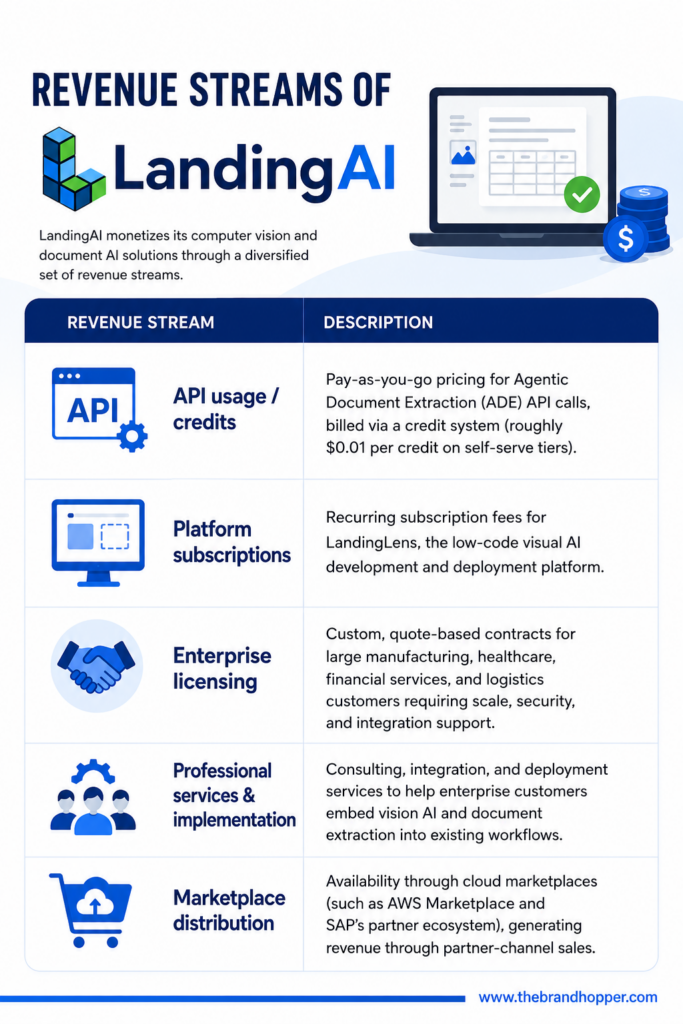
The company’s shift toward Agentic Document Extraction has meaningfully broadened its total addressable market. While industrial visual inspection is a valuable but comparatively niche market, document processing touches nearly every industry — finance, healthcare, insurance, logistics, government, and legal services all rely heavily on extracting structured data from unstructured paperwork. By positioning ADE as a horizontal capability usable across sectors, LandingAI has diversified its revenue base beyond manufacturing alone, while continuing to serve its original industrial inspection customer base through LandingLens.
Funding of LandingAI
LandingAI has raised external capital in stages typical of an enterprise AI startup: a period of quieter early development followed by a large, high-profile Series A once the product and customer base were established, and subsequent rounds to fund expansion into new product categories.
According to funding trackers including Crunchbase and Tracxn, LandingAI has raised approximately $57 million in disclosed funding across multiple rounds from more than a dozen investors, including Insight Partners and Lenovo Capital and Incubator Group, among others. The company’s most publicly documented and significant round to date was its $57 million Series A, announced in November 2021, which was widely covered by outlets including TechCrunch and CNBC given Andrew Ng’s profile in the AI community.
LandingAI subsequently raised additional capital, including a Series B round that saw participation from strategic investor Snowflake beginning in March 2024, with a further Series B round reported in September 2025. Exact dollar amounts for these later rounds have not been fully disclosed publicly, which is common for growth-stage enterprise software companies that prefer to keep valuation and round-size details private while still signaling investor confidence through strategic partnerships.
Funding Rounds of LandingAI
The table below summarizes LandingAI’s publicly reported funding history based on available data from Crunchbase, TechCrunch, CNBC, and Tracxn.
| Round | Date | Amount | Notable Investors |
| Seed / Early Funding | 2017–2020 | Undisclosed | Early backers supporting initial product development |
| Series A | November 2021 | $57 million | Insight Partners, McRock Capital, Intel Capital, Samsung Catalyst Fund, and others |
| Series B (initial close) | March 2024 | Undisclosed | Snowflake (strategic investor, first participation) |
| Series B (extension) | September 2025 | Undisclosed | Additional undisclosed investors |
It’s worth noting that publicly available totals (roughly $57 million disclosed) likely understate LandingAI’s actual cumulative funding, since amounts for the 2024 and 2025 rounds were not disclosed at the time of writing. As is common with venture-backed enterprise AI companies, LandingAI and its investors have chosen to highlight strategic partnerships — such as the relationship with Snowflake, a major cloud data platform — over specific valuation figures, which can also serve a go-to-market purpose by signaling product integration and enterprise credibility to prospective customers.
Competitors of LandingAI
LandingAI operates across two overlapping markets — visual/computer vision AI for industrial applications, and document data extraction — putting it in competition with a wide range of players, from cloud hyperscalers to specialized startups.
| Competitor | Primary Focus | How It Compares to LandingAI |
| Google Document AI | Cloud-native document processing | Broader language support (200+ languages) and pre-trained models for common documents, but steeper learning curve; less specialized for visual inspection |
| AWS Textract | Document text and data extraction | Deep integration with AWS ecosystem; strong OCR capabilities but less emphasis on low-code custom model training |
| Microsoft Azure Document Intelligence | Enterprise document processing | Strong enterprise and Microsoft ecosystem integration; competes directly with LandingAI’s ADE product |
| Scale AI | Data labeling and annotation for AI training | Broader focus on training data services across many AI modalities, rather than an end-to-end deployable vision platform |
| Snorkel AI | Programmatic data labeling | Focuses on weak supervision and labeling automation rather than visual inspection or document-specific extraction |
| Docsumo | Document data extraction | Direct competitor in intelligent document processing, targeting finance and lending use cases |
| Labelbox / SuperAnnotate / Encord | Data labeling and annotation platforms | Compete primarily on the data preparation layer rather than full model deployment and inspection workflows |
LandingAI differentiates itself from hyperscaler offerings (Google, AWS, Microsoft) by focusing narrowly on accuracy, visual grounding, and auditability for complex, high-stakes documents and industrial images, rather than offering broad, general-purpose AI infrastructure. Compared to data-labeling specialists like Scale AI and Snorkel AI, LandingAI positions itself further downstream — offering not just labeled data but a full pipeline from labeling through trained, deployed models.
Competitive Advantage of LandingAI
LandingAI’s competitive positioning rests on several interlocking strengths that have helped it carve out a defensible niche in a crowded applied-AI market.
First, founder credibility and brand recognition are significant assets. Andrew Ng’s reputation as a globally respected AI researcher and educator gives LandingAI outsized visibility and trust among enterprise buyers, a rare advantage for a company competing against much larger cloud providers.
Second, the company’s data-centric AI philosophy — improving model performance by systematically refining data quality rather than simply scaling data volume — has translated into a genuine technical advantage for customers with limited, imbalanced, or hard-to-label datasets, which is common in manufacturing and specialized document workflows.
Third, LandingAI’s low-code platform design lowers the skills barrier for deployment. Manufacturing quality engineers and operations staff, not machine learning specialists, can label data, train models, and monitor performance directly, reducing the total cost of AI adoption for customers without in-house AI teams.
Fourth, the emphasis on visual grounding and auditability in its Agentic Document Extraction product — showing exactly where in a document each extracted field came from — addresses a critical enterprise requirement around trust, compliance, and error-checking that purely text-based extraction tools often lack.
Finally, strategic partnerships, such as its relationship with Snowflake, extend LandingAI’s distribution reach into large enterprise data ecosystems, while marketplace listings on platforms like AWS Marketplace and integrations highlighted by SAP broaden its accessibility to enterprise buyers already standardized on those platforms.


Products & Services of LandingAI
LandingAI’s product portfolio has expanded from a single computer vision platform into a broader suite spanning visual inspection and document intelligence.
| Product | Description | Primary Use Cases |
| LandingLens | Low-code, end-to-end platform for labeling, training, and deploying custom computer vision models | Manufacturing defect detection, quality control, visual inspection on production lines |
| Agentic Document Extraction (ADE) | API platform that converts complex, unstructured business documents into structured, verifiable JSON data using visual grounding | Invoice processing, contract analysis, medical form intake, financial document automation |
| Document Pre-trained Transformer (DPT / DPT-2) | Underlying AI model powering ADE, combining vision, reasoning, and validation to interpret both document content and structure | Powers accuracy improvements across all ADE use cases, especially tables, forms, and mixed visual-text layouts |
| Edge deployment tools | Capabilities for deploying trained vision models directly onto factory-floor cameras and edge devices | Real-time inspection without dependence on constant cloud connectivity |
| Professional services | Implementation, integration, and customization support for enterprise deployments | Helping large customers embed LandingAI’s tools into existing manufacturing or document workflows |
The company’s 2025 upgrade to ADE, powered by its second-generation Document Pre-trained Transformer (DPT-2), was positioned as a significant leap in extraction accuracy for complex tables, mixed visual-text layouts, and multi-page documents, building on an initial ADE launch that the company said had already been used to process billions of pages. This progression illustrates LandingAI’s broader strategic arc: starting from a narrow, defensible niche in industrial computer vision, then expanding into the much larger document intelligence market while retaining a consistent focus on accuracy, explainability, and ease of deployment for non-specialist users.
LandingAI also maintains an active relationship with the broader Andrew Ng ecosystem, including DeepLearning.AI, which offers educational courses (such as “Document AI: From OCR to Agentic Doc Extraction”) that both build market awareness of LandingAI’s technology and help train the workforce that will eventually adopt it — a subtle but effective content-marketing and talent-pipeline strategy.
Conclusion
LandingAI’s journey from a 2017 computer vision startup to a broader visual AI and document intelligence company illustrates a distinctive path through the AI industry — one built less on chasing the largest possible models and more on solving practical, often overlooked problems in industries like manufacturing, healthcare, and financial services. Andrew Ng’s data-centric AI philosophy, first tested through LandingLens and industrial inspection, has since evolved into a horizontal, higher-growth opportunity in agentic document extraction, positioning the company for a larger addressable market than its industrial roots alone would have allowed.
With roughly $57 million in disclosed funding, backing from investors like Insight Partners and strategic partners like Snowflake, and a leadership team that pairs Ng’s technical vision with CEO Dan Maloney’s enterprise go-to-market experience, LandingAI has built a credible, if still modestly sized compared to hyperscaler rivals, position in a competitive landscape crowded with cloud giants like Google, AWS, and Microsoft, alongside specialized data-labeling and document-AI startups.
The company’s long-term success will likely hinge on how well it can continue differentiating on accuracy, auditability, and ease of deployment — the qualities that first distinguished LandingLens in industrial settings — as it scales Agentic Document Extraction into a much broader enterprise market. For a company founded on the idea that better data beats bigger data, LandingAI’s next chapter will test whether that philosophy can hold up against well-resourced hyperscaler competitors and a fast-moving document AI market. What is clear is that LandingAI remains one of the more closely watched applied-AI startups, not only for its technology but for what it represents: an attempt by one of AI’s most influential researchers to prove that practical, industry-specific AI adoption can be just as transformative as the large language models dominating today’s headlines.
Also Read: Marketers Adopted AI to Move Faster. They’re Still Late.
To read more content like this, subscribe to our newsletter
Go to the full page to view and submit the form.